
In This Article
Why an Indoor Invisible Dog Fence Might Beat Another Baby Gate
You’ve stepped over the baby gate for the hundredth time this week. You’ve stubbed a toe on it, knocked it over with a laundry basket, and watched your dog hop it like an Olympic hurdler the moment you left for work. Sound familiar? That frustration is exactly why the indoor invisible dog fence has quietly become one of the most searched pet-proofing tools in the US.
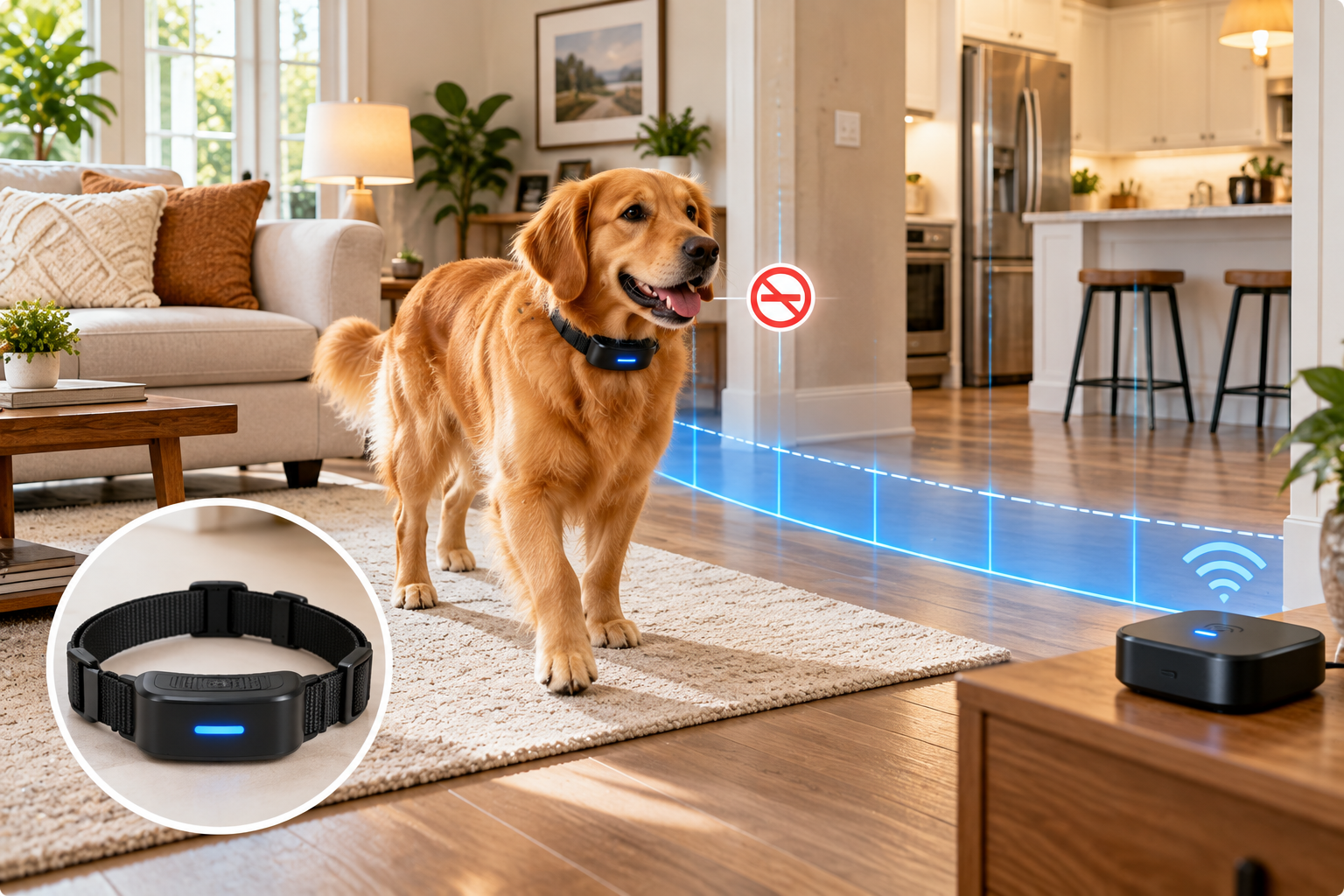
What is an indoor invisible dog fence? An indoor invisible dog fence is a wireless boundary system that keeps a dog away from specific spots inside your home, like the kitchen trash, the couch, a nursery doorway, or the stairs. A small transmitter creates an adjustable zone, and a receiver collar (or, in collar-free designs, a mat or motion-activated spray) signals the dog to back off.
Here’s the honest part most roundups skip: these devices are training aids, not walls. They work best when you pair them with reward-based training, and the veterinary behavior community has real concerns about aversive tools. The American Veterinary Society of Animal Behavior’s humane dog training position statement recommends reward-based methods for all dog training, which is why this guide includes collar-free options alongside static-collar systems, and why we spend serious time on how to train, not just what to buy.
In this guide, you’ll find seven real products available to US shoppers, from a budget-friendly indoor pet barrier to a newer rechargeable system with vibration. We compare specs, translate them into everyday performance, summarize what customer reviews actually report, and walk you through setup, troubleshooting, and long-term costs. By the end, you’ll know whether an indoor invisible dog fence fits your dog, your home, and your training philosophy, and which model to pick if it does.
Quick Comparison: The 7 Best Indoor Invisible Dog Fence Options at a Glance
| Product | Type | Boundary Range | Power | Best for |
|---|---|---|---|---|
| PetSafe Pawz Away 2.0 Indoor Wireless Pet Barrier | Collar (tone, vibration, static) | 2–12 ft diameter | Rechargeable collar + 3 AA puck | PetSafe Pawz Away 2.0: best overall for most dogs 10 lb+ |
| PetSafe Pawz Away Indoor Pet Barrier | Collar (tone, static) | 2–12 ft diameter | Battery collar + 3 AA transmitter | PetSafe Pawz Away Indoor: proven, expandable system |
| PetSafe Pawz Away Threshold Pet Barrier | Collar (tone, static) | Up to 3 ft | 4 AAA | PetSafe Pawz Away Threshold: doorways and stairs |
| Mimofpet B1 Indoor Pet Barrier | Collar (sound, static) | Up to 14 ft | Rechargeable | Mimofpet B1: budget pick with the widest zone |
| PetSafe Pawz Away Mini Pet Barrier | Collar (tone, static) | Up to 5 ft | Battery | PetSafe Pawz Away Mini: small spots, indoor/outdoor |
| PetSafe ScatMat Indoor Pet Training Mat | Mat (tone, static) | Mat surface only | Battery controller | PetSafe ScatMat: no collar, couches and counters |
| PetSafe SSSCAT Spray Pet Deterrent | Motion-activated spray | About 3 ft | 4 AAA + spray cans | PetSafe SSSCAT: collar-free, no static at all |
Looking at the table above, the real dividing line isn’t brand; it’s collar versus no collar. The PetSafe Pawz Away 2.0 and Mimofpet B1 give you the largest, most flexible zones, but your dog must wear a receiver collar. If static correction is a dealbreaker, the PetSafe SSSCAT and PetSafe ScatMat protect smaller spots without anything on your dog’s neck, though neither can block a wide room entrance as cleanly as the PetSafe Pawz Away Threshold.
💬 One click helps other shoppers make an informed choice too! 😊
Top 7 Indoor Invisible Dog Fence Picks: Expert Analysis
1. PetSafe Pawz Away 2.0 Indoor Wireless Pet Barrier — the most modern, gentlest-escalating option
The PetSafe Pawz Away 2.0 Indoor Wireless Pet Barrier is PetSafe’s newest take on the indoor invisible dog fence, and its headline upgrade is a warning sequence that starts softer than older designs.
Its “Variable Pulse” system delivers a tone first, then vibration, then progressive static that only ramps up if your dog stays in the zone. In practice, that vibration step matters: many dogs learn to turn around at the buzz, so you may rarely need meaningful static at all. The boundary adjusts from 2 to 12 feet in diameter, the base puck can be wall-mounted or set flat, and the rechargeable, waterproof collar charges in about two hours and can last up to three months per charge depending on use. The collar fits dogs 10 pounds and up with neck sizes of 8 to 22 inches.
Based on the spec sheet, this is the best fit for owners who want the full-size zone of a classic indoor wireless dog fence but prefer a gentler first warning. It also supports customized boundaries for up to two pets, which is handy if one dog is couch-approved and the other isn’t. Because it’s newer, large-scale customer review data is still limited, so we’re relying on specs and PetSafe’s documented design here rather than long-term reliability trends.
Pros:
- ✅ Tone and vibration warnings come before any static
- ✅ Rechargeable collar removes the coin-battery hassle
- ✅ Separate rules for two dogs in one home
Cons:
- ❌ Not suitable for dogs under 10 pounds
- ❌ Limited long-term review history so far
Expect it in the $100–$115 range (check the current price); it’s the best value if the vibration step means fewer corrections for your dog.
2. PetSafe Pawz Away Indoor Pet Barrier — the proven, endlessly expandable classic
The PetSafe Pawz Away Indoor Pet Barrier (model ZND-1200) is the system most other indoor pet barrier products get compared to, and its biggest strength is how far you can expand it.
The transmitter creates a zone adjustable from 2 to 12 feet across (about a 6-foot radius) and runs on three AA batteries, while the receiver collar uses two 3-volt lithium batteries. When your dog enters the zone, the collar beeps and then delivers progressive static that reaches its maximum in about three seconds, with an automatic 15-second shut-off so a confused dog can’t be corrected indefinitely. It’s rated for pets 5 pounds and up with neck sizes from 6 to 28 inches, and you can add unlimited barriers and collars.
Here’s what to weigh: this is a strong choice for multi-room problems (trash can, cat food station, couch) because each extra transmitter is just another “no-go bubble.” Reviews consistently report fast results with dogs already familiar with an e-collar beep, while common complaints mention a bulky collar on small pets, a so-so strap, and occasional collar failures. At the time of writing, the Amazon listing sits at a middling mid-3-star average across several thousand ratings, so set expectations accordingly.
Pros:
- ✅ Add unlimited barriers to protect multiple areas
- ✅ Built-in 15-second safety shut-off
- ✅ Works for both dogs and cats 5 lb+
Cons:
- ❌ Collar feels bulky on very small pets
- ❌ Coin batteries add ongoing cost
It typically sells in the $65–$90 range; solid value if you need several zones, less so for a single spot.
3. PetSafe Pawz Away Threshold Pet Barrier — the gate replacement for doorways and stairs
The PetSafe Pawz Away Threshold Pet Barrier (model PWF00-14406) is designed for one job a round-zone indoor invisible dog fence handles poorly: blocking a doorway or staircase without a gate.
Instead of a circle, the low-profile base sends a radio signal along three sides, and PetSafe notes the signal is strongest directly above the unit. It has four range levels up to about 3 feet, which is perfect for a hallway or stair landing. Power comes from four AAA batteries rated for up to nine months in Standard mode or about four months in Training mode. Standard mode reaches maximum stimulation in three seconds; Training mode gets there in two.
On paper, this is the most targeted option for renters and owners tired of tripping over gates. PetSafe’s own guidance says to keep it about 5 feet from metal and 8 feet from other barriers, and warns it can be a tripping hazard in a doorway. It’s designed for pets at least 6 months old, 5 pounds or more, and under 40 inches tall. Verified review volume is thinner than the flagship’s, so we weigh specs and PetSafe’s support documentation more heavily here.
Pros:
- ✅ Shaped signal suits doorways better than circles
- ✅ Long battery life in Standard mode
- ✅ Compatible with other Pawz Away barriers
Cons:
- ❌ Short maximum range limits wide openings
- ❌ Base unit can be a tripping hazard
Expect roughly $70–$100 (prices vary by seller); worth it if a gate is your main headache.
4. Mimofpet B1 Indoor Pet Barrier — the widest zone for the money
The Mimofpet B1 Indoor Pet Barrier is the budget-friendly challenger, and its standout spec is a boundary that stretches up to about 14 feet.
That range comes with six adjustable coverage levels, so you can shrink it for a trash can or widen it to guard a whole kitchen opening. The collar uses sound warnings plus adjustable static levels and is rechargeable, which means no coin batteries to buy. One important limitation: each transmitter creates only one barrier, so protecting three spots means three devices.
Based on comparing the specs, the Mimofpet B1 suits owners with open-plan homes who want one wide zone rather than several small bubbles. The kit includes the collar, transmitter, charger, test light, and contact points, so setup is complete out of the box. Customer feedback on Chewy is small in volume but mostly positive: owners report retiring baby gates and using it across multi-dog households. One reviewer noted their dog was frightened after crossing the boundary, a good reminder to start at the lowest level and train slowly.
Pros:
- ✅ Largest adjustable zone in this lineup
- ✅ Rechargeable collar keeps running costs low
- ✅ Complete kit with test light included
Cons:
- ❌ One device equals one barrier only
- ❌ Small review base compared with PetSafe
It usually lands around $40–$60 (check current pricing), making it the best value per foot of coverage.
5. PetSafe Pawz Away Mini Pet Barrier — compact protection that also works outside
The PetSafe Pawz Away Mini Pet Barrier (model PWF00-13665) is the small-footprint member of the family, and its unique trick is waterproofing for indoor-outdoor use.
The adjustable range reaches up to about 5 feet, and the Mini is one of only two Pawz Away devices (along with the Outdoor barrier) rated for outdoor use. That means you can guard a flower bed on the patio and then bring it inside to protect a plant stand. It uses the same tone-then-static logic as the rest of the Pawz Away line and pairs with compatible Pawz Away and YardMax collars.
Here’s the catch: reviews on Chewy repeatedly mention that the range feels too small for anything beyond a single object, and some owners recommend the full-size indoor transmitter if you need more coverage. So the PetSafe Pawz Away Mini makes the most sense as an add-on for a household that already uses Pawz Away, or for protecting one specific item like a houseplant, litter box, or dog-door flap.
Pros:
- ✅ Waterproof for patio and indoor use
- ✅ Small footprint hides easily near objects
- ✅ Shares collars with the Pawz Away system
Cons:
- ❌ Range is too short for room openings
- ❌ Reviews frequently cite limited coverage
As a full kit, expect roughly $70–$85; reasonable as a supplement, weaker as your only barrier.
6. PetSafe ScatMat Indoor Pet Training Mat — no collar, no guesswork about where the line is
The PetSafe ScatMat Indoor Pet Training Mat takes a completely different approach: instead of an invisible zone, the boundary is a translucent mat your dog can see.
It offers seven modes: tone only, three static-only levels, and three static-plus-tone levels. A safety timeout stops correction after 8 seconds on the mat, pauses for 4 seconds, and then resumes if your dog still hasn’t stepped off. It comes in five sizes, including a 30 x 16-inch medium and a long sofa-shaped option, and runs on a battery-operated controller.
What most buyers overlook is that a visible boundary is easier for a dog to understand. With a collar system, the “line” exists only in the air, while the mat gives your dog a clear, physical cue. That makes the PetSafe ScatMat a smart pick for couches, beds, and counters (with cats) and for households where nobody wants a dog wearing a collar 12 hours a day. Customer feedback summarized by retailers like Tractor Supply is broadly positive, with owners describing it as an effective deterrent for furniture and mattresses.
Pros:
- ✅ No collar required on your dog
- ✅ Tone-only mode for sensitive dogs
- ✅ Five sizes for furniture to floors
Cons:
- ❌ Protects only the surface it covers
- ❌ Visible mat isn’t truly “invisible”
Pricing climbs with size, from roughly $50 to $120+; excellent value for one high-traffic surface.
7. PetSafe SSSCAT Spray Pet Deterrent — the static-free option
The PetSafe SSSCAT Spray Pet Deterrent is the right answer if you want boundaries without any electrical correction at all.
An infrared motion sensor detects your dog within about 3 feet and releases a quick burst of odorless spray that startles rather than hurts. Each can delivers roughly 80 to 100 bursts, and the unit runs on four AAA batteries. Because it reacts to any animal in range, it works across multiple pets without buying extra collars.
Based on aggregated reviews, owners like it most for countertops, stair tops, and trash cans. Recurring complaints are that the sensor occasionally misses a pet, and that replacement cans add up over time (one reviewer estimated around $15 per can). It’s also worth knowing that it can’t distinguish between your dog and your toddler, so placement matters in busy homes. For many families, though, the PetSafe SSSCAT is the most comfortable middle ground between doing nothing and putting a static collar on a dog.
Pros:
- ✅ No collar and no static correction
- ✅ Works on every pet in range
- ✅ Odorless spray won’t stain surfaces
Cons:
- ❌ Refill cans create an ongoing expense
- ❌ Sensor occasionally misses fast or fluffy pets
Expect around $50–$70 for the unit (check current pricing); great value up front, but budget for refills.
Head-to-Head: How the Top 7 Compare on What Matters
| Product | Warning Before Correction | Minimum Pet Size | Ongoing Power Cost | Price Range | Best for |
|---|---|---|---|---|---|
| PetSafe Pawz Away 2.0 | Tone + vibration | 10 lb | Low (rechargeable) | $100–$115 | PetSafe Pawz Away 2.0: gentlest collar escalation |
| PetSafe Pawz Away Indoor | Tone | 5 lb | Medium (coin cells) | $65–$90 | PetSafe Pawz Away Indoor: multiple zones |
| PetSafe Pawz Away Threshold | Tone | 5 lb | Low (AAA, up to 9 months) | $70–$100 | PetSafe Pawz Away Threshold: doorways |
| Mimofpet B1 | Sound | Not clearly specified | Low (rechargeable) | $40–$60 | Mimofpet B1: open-plan spaces |
| PetSafe Pawz Away Mini | Tone | 5 lb | Medium | $70–$85 | PetSafe Pawz Away Mini: single objects |
| PetSafe ScatMat | Tone-only mode available | Any | Low | $50–$120+ | PetSafe ScatMat: furniture |
| PetSafe SSSCAT | None (spray is the cue) | Any | High (refill cans) | $50–$70 | PetSafe SSSCAT: static-free homes |
Reading across the “Warning Before Correction” column tells you a lot about training comfort: the PetSafe Pawz Away 2.0 is the only collar system here with a vibration step, which gives dogs one more chance to self-correct. Meanwhile, the PetSafe SSSCAT looks cheapest at checkout but carries the highest ongoing cost, while the Mimofpet B1 and PetSafe Pawz Away Threshold stay cheapest to run over a year.
✨ Don’t miss these smart pet-proofing picks!
🔍 Take your home training to the next level with this carefully curated lineup. Click a highlighted product name above to check current pricing and availability. These picks will help you get calmer, gate-free rooms the whole family will enjoy! 🐾
How to Set Up and Train With an Indoor Pet Barrier (Your First 30 Days)
Buying the device is the easy part. The first month of training is what decides whether your indoor pet barrier becomes a helpful cue or a source of stress for your dog.
Days 1–3: Setup and testing 🔧
- ✅ Place the transmitter away from large metal objects. PetSafe advises keeping barriers clear of appliances like refrigerators and washers, and notes that sofa and bed springs can shrink the range.
- ✅ Set the smallest range that covers the target, then walk the zone with the test light tool held to the collar’s contact points.
- ✅ Start the collar on its lowest setting, or tone-only/vibration-only if your model allows it.
Days 4–14: Teach the “turn away” ⚡
Put the collar on with your dog leashed, walk toward the zone, and the moment the warning sounds, cheerfully guide your dog back and reward with a high-value treat. You’re teaching “beep means turn around and get a cookie,” not “beep means pain.” Keep sessions to 5–10 minutes, two or three times a day.
Days 15–30: Gradual independence 🐕
Drop the leash but stay close. Reward voluntary turn-aways generously. Watch body language: tucked tail, lip licking, or avoiding a whole room (not just the zone) signals that you should lower the level or slow down.
Maintenance habits that matter 🔋
Check collar fit daily: two fingers should slide under the strap, and the contact points must touch skin. PetSafe’s threshold documentation advises not leaving the collar on longer than 12 hours to avoid skin irritation. Recharge or swap batteries on a schedule rather than waiting for failure, because a dead collar quietly un-teaches everything.
Real-World Scenarios: Matching the Right Indoor Wireless Dog Fence to Your Home
Specs only matter in context, so here are three common US household profiles and the indoor wireless dog fence (or alternative) that fits each.
🏙️ Profile 1: The apartment renter with a counter-surfing Lab
Budget: under $120. Use: daily, kitchen only. Home: open-plan one-bedroom, no drilling allowed. A Lab that counter-surfs needs a zone wide enough to cover the whole kitchen opening, and renters can’t install gates. The Mimofpet B1 fits best here: its 14-foot maximum range covers a galley kitchen entrance, the rechargeable collar keeps costs low, and nothing gets screwed into the wall. Pair it with a “go to your mat” cue so your dog has somewhere rewarding to be instead.
👶 Profile 2: The new parents guarding a nursery
Budget: flexible. Use: all day, one doorway. Home: two-story house with a curious Beagle. Here, the PetSafe Pawz Away Threshold Pet Barrier shines because its signal is shaped for doorways. Just mind the tripping hazard when you’re carrying a baby at 3 a.m.; placing it slightly inside the room, along the wall, reduces risk.
🐱 Profile 3: The multi-pet family who refuses static collars
Budget: around $150 total. Use: couch and trash can. Home: a dog, two cats, and a toddler. A PetSafe ScatMat on the sofa plus a PetSafe SSSCAT beside the trash can covers both problem spots without putting a collar on anyone. The trade-off is ongoing spray refills, but you avoid buying multiple collars and gain peace of mind about static.
🛒 Ready to pick your setup? Check today’s prices on your top match!
🔍 Click any highlighted product name in this guide to check current pricing and availability, and start building the calm, gate-free home your family deserves! ✨
Troubleshooting: Common Problems and Fixes
Even the best indoor invisible dog fence can misbehave. Here are the issues owners report most, with practical fixes.
❓ Problem 1: The zone feels smaller than advertised
Fix: Metal is usually the culprit. Move the transmitter off metal shelves, away from appliances, and out from under spring-based furniture. For the PetSafe Pawz Away Threshold, PetSafe specifically recommends 5 feet of clearance from metal.
❓ Problem 2: My dog ignores the warning and pushes through
Fix: First, check fit, because loose contact points mean no signal reaches the skin. Then revisit training rather than cranking the level up. Dogs who push through often never learned that turning back earns a reward.
❓ Problem 3: My dog now avoids the entire room
Fix: That’s over-generalized fear. Shrink the zone, drop to tone or vibration only, and rebuild positive associations with treats and play near (not inside) the boundary. If it persists, talk to a veterinarian or certified behavior consultant.
❓ Problem 4: Two barriers seem to interfere with each other
Fix: Space them apart. PetSafe’s threshold guide recommends about 8 feet between barriers. Use the A/B channel settings on Pawz Away transmitters to assign different zones to different pets.
❓ Problem 5: The spray deterrent fires inconsistently
Fix: Clean the PetSafe SSSCAT sensor window, replace weak batteries, and aim the sensor toward the approach path rather than straight into open space.
How to Choose an Indoor Invisible Dog Fence: 7 Steps
Use these seven numbered steps to choose an indoor invisible dog fence with confidence:
- Define the exact problem spot. A trash can, a doorway, and an open kitchen need very different zone shapes; a round bubble struggles with doorways.
- Measure the area. Compare your measurement to the range: about 3 feet (threshold), 5 feet (mini), 12 feet (Pawz Away), or 14 feet (Mimofpet B1).
- Weigh your dog. Several collars require 5 or 10 pounds minimum, and toy breeds may find full-size receivers heavy.
- Decide on collar versus collar-free. Groups like the MSPCA-Angell discourage electronic containment systems and stress careful monitoring if you use them, so consider mats or spray first for sensitive dogs.
- Check the warning sequence. Tone plus vibration before static gives your dog more chances to learn without correction.
- Count future zones. If you’ll protect several areas, choose an expandable system rather than one-barrier-per-device models.
- Price the batteries, not just the box. Rechargeable collars and long-life AAA bases save real money over two to three years.
The common thread: choose for your dog’s temperament first and your floor plan second. Specs are easy to compare; a dog’s stress response is not.
Indoor Wireless Dog Fence vs. Baby Gates, Crates, and Exercise Pens
Before you commit, it’s worth comparing an indoor wireless dog fence with the traditional tools it’s meant to replace.
| Option | Physical Barrier? | Blocks Determined Dogs? | Works for Furniture/Counters? | Best for |
|---|---|---|---|---|
| Indoor wireless dog fence | No | Partially (training-dependent) | Yes | Flexible zones without clutter |
| Baby gate | Yes | Mostly (jumpers excepted) | No | Doorways with reliable blocking |
| Crate | Yes | Yes | No | Short unsupervised periods |
| Exercise pen | Yes | Mostly | No | Puppies needing a safe play area |
The table makes one thing clear: physical barriers still win on certainty, while an indoor wireless dog fence wins on flexibility. A gate cannot stop a dog from jumping on the couch, but it will physically stop a dog who’s decided the reward beyond the zone is worth a correction. For high-stakes boundaries, like a pool door or a room with medications on low shelves, physical barriers remain the safer default.
Where wireless shines is everyday convenience: no stepping over gates, no rearranging furniture for a pen, and the ability to protect objects that a gate can’t, like countertops and trash cans. Many owners end up with a hybrid, keeping a gate on the stairs and using a wireless zone or PetSafe ScatMat for furniture.
Electronic Dog Barrier Indoor Options: Static, Vibration, Mat, or Spray?
An electronic dog barrier indoor setup can deliver its message in four very different ways, and the “how” matters more than most product pages admit.
Static collars (PetSafe Pawz Away Indoor, PetSafe Pawz Away Threshold, PetSafe Pawz Away Mini, Mimofpet B1) give the strongest, most consistent signal. On paper, that consistency speeds learning, but it also means a mistimed correction can create fear. Research on long-term electronic containment is still limited; one peer-reviewed study of cats in electronic containment systems noted that long-term welfare effects had not been directly studied in any species before that work, which tells you how thin the evidence base remains.
Vibration-first collars (the PetSafe Pawz Away 2.0) add a middle step. Many dogs respond to a buzz alone, so the static stage becomes a backup rather than the primary teacher.
Mats (the PetSafe ScatMat) make the boundary visible, which is a genuine cognitive advantage: the dog connects the sensation to a specific object.
Spray (the PetSafe SSSCAT) avoids electricity entirely and works on every animal in range, at the cost of refills and occasional missed detections.
Here’s what to weigh: the more sensitive or anxious your dog, the further down this list you should start. You can always move toward stronger tools later; undoing fear is much harder.
Invisible Dog Fence for Inside the House: Puppies, Small Dogs, and Seniors
An invisible dog fence for inside the house isn’t one-size-fits-all, and age and size change the right answer.
🐶 Puppies
Most collar systems are designed for pets at least six months old; the threshold barrier’s documentation states this explicitly. For young puppies, exercise pens, crates, and management are the right tools, paired with reward-based training. Save the collar decision for later, if at all.
🐕 Small and toy breeds
Minimum weights matter: 5 pounds for most Pawz Away gear and 10 pounds for the PetSafe Pawz Away 2.0. Reviews of the original PetSafe Pawz Away Indoor Pet Barrier frequently mention that the receiver feels bulky on small animals. For a Chihuahua or Yorkie, the PetSafe ScatMat or PetSafe SSSCAT is often the more comfortable choice.
🦮 Senior dogs
Older dogs may have reduced hearing, which weakens tone-based warnings. A vibration warning (as on the PetSafe Pawz Away 2.0) or a visible mat can communicate more clearly. Also consider whether a senior’s “trespassing” is really confusion or cognitive decline, which deserves a vet visit rather than a correction.
🏠 Multi-dog households
Expandable systems let you give each dog different rules. The PetSafe Pawz Away 2.0 supports custom boundaries for two pets, and classic Pawz Away transmitters offer A, B, and AB channel settings.
Long-Term Cost and Maintenance: What You’ll Really Spend
Sticker prices only tell half the story. Here’s an estimated two-year ownership picture (approximate, based on typical price ranges and published battery specs).
| Product | Up-Front Cost | Main Ongoing Cost | Estimated 2-Year Total | Best for |
|---|---|---|---|---|
| Mimofpet B1 | $40–$60 | Electricity only | Lowest | Mimofpet B1: tight budgets |
| PetSafe Pawz Away 2.0 | $100–$115 | AA batteries for the puck | Moderate | PetSafe Pawz Away 2.0: low-hassle ownership |
| PetSafe Pawz Away Indoor | $65–$90 | Coin-cell collar batteries + AAs | Moderate | PetSafe Pawz Away Indoor: multi-zone setups |
| PetSafe SSSCAT | $50–$70 | Spray refills | Highest with daily triggers | PetSafe SSSCAT: light-use spots |
The pattern is straightforward: rechargeable collars flatten long-term costs, while consumables (coin cells and spray cans) quietly add up. If your dog triggers the PetSafe SSSCAT often, its refill bill can overtake a collar system within months; if it fires only occasionally, it stays the cheapest static-free route.
Maintenance-wise, wipe collar contact points and the skin beneath weekly, inspect straps monthly for cracking, and keep spare batteries labeled by device. Expect collar straps to need replacement before electronics do. Finally, keep proof of purchase: several reviewers mention needing their Amazon invoice for warranty claims on failed collars.
Safety, Standards, and the Welfare Debate
Responsible ownership of an indoor invisible dog fence means understanding both the technical and ethical sides.
Device safety features. Look for automatic shut-off. Pawz Away collars stop correcting after 15 seconds in the zone, and the PetSafe ScatMat pauses after 8 seconds. These features exist because a frightened dog may freeze rather than retreat.
Radio and electronics compliance. Wireless pet barriers are low-power radio devices. In the US, consumer radio-frequency devices are generally subject to FCC equipment authorization rules, so buying from established brands and authorized sellers helps ensure you’re getting compliant hardware rather than an uncertified knockoff.
Placement hazards. PetSafe warns that the threshold transmitter can be a tripping hazard and shouldn’t be stepped on. In homes with kids or seniors, prioritize wall-side placement.
The welfare debate. This is where honesty matters most. Veterinary behavior organizations like AVSAB recommend reward-based training only, and several welfare groups question electronic containment. In the UK, the Kennel Club and allied welfare organizations publicly opposed exemptions for invisible electronic fencing, citing research suggesting electronic fencing was less effective than physical fencing. Electronic containment devices remain legal and widely sold in the US, but that context should shape how you use them: lowest effective level, tone or vibration first, and plenty of rewards.
Common Mistakes to Avoid When Buying an Indoor Invisible Dog Fence
Many disappointing reviews trace back to a handful of avoidable mistakes.
Mistake 1: Buying for range alone. A 14-foot zone sounds great until it accidentally covers your dog’s water bowl. Map your floor plan first.
Mistake 2: Skipping the test light. Without testing, you won’t know whether metal appliances shrank your zone, and your dog will learn inconsistent rules.
Mistake 3: Starting at a high level. Beginning strong to “get it over with” is the fastest way to create fear of a whole room. Start low and let rewards do the heavy lifting.
Mistake 4: Ignoring collar fit. Loose collars don’t work; overtight collars irritate. Rotate position and respect the 12-hour wear guidance.
Mistake 5: Using it to replace supervision. No indoor invisible dog fence can stop a highly motivated dog every time. For genuinely dangerous areas, keep a physical barrier.
Mistake 6: Forgetting about the other pets. Spray deterrents trigger for every animal; collar systems only affect the collared pet. Plan accordingly in multi-pet homes.
Mistake 7: Choosing a mismatched model for small dogs. Check weight minimums before you buy, especially for toy breeds and young puppies.
FAQ: Indoor Invisible Dog Fence Questions Shoppers Ask Most
❓ Does an indoor invisible dog fence work on stubborn dogs?
❓ What's the best indoor invisible dog fence for small dogs?
❓ Can I use an indoor pet barrier and keep my cat free to roam?
❓ How long do indoor wireless dog fence batteries last?
❓ Can I add more zones to an indoor invisible dog fence later?
Conclusion: Choosing the Right Indoor Invisible Dog Fence for Your Dog
An indoor invisible dog fence can genuinely make life easier: fewer gates, fewer raided trash cans, and fewer muddy paws on the couch. But the best results come from matching the tool to your dog, not the other way around.
If you want one recommendation for most dogs over 10 pounds, the PetSafe Pawz Away 2.0 Indoor Wireless Pet Barrier offers the gentlest warning sequence and the lowest-hassle ownership thanks to its rechargeable collar. On a tight budget with an open floor plan, the Mimofpet B1 Indoor Pet Barrier delivers the widest zone for the money. Need to block a doorway or staircase? The PetSafe Pawz Away Threshold Pet Barrier is purpose-built for it. Want several zones on one system? The classic PetSafe Pawz Away Indoor Pet Barrier still leads on expandability, while the PetSafe Pawz Away Mini Pet Barrier handles single objects indoors or out.
And if static correction doesn’t sit right with you, that’s a legitimate, science-backed position: the PetSafe ScatMat Indoor Pet Training Mat and PetSafe SSSCAT Spray Pet Deterrent protect furniture and counters without anything on your dog’s neck.
Whichever you choose, start at the lowest level, reward every good turn-away, and watch your dog’s body language. Train with kindness, and the boundary becomes a habit rather than a fear.
🐾 Ready to reclaim your couch and kitchen?
✨ Click any highlighted product name above to check current pricing and availability, and give your dog clear, kind boundaries starting today! 🏡
Recommended for You
- GPS Tracking Necklace for Child: 7 Smart, Safe Picks (2026 Guide)
- Perimeter Dog Collars: 7 Best Picks That Actually Work in 2026
- Best GPS Tracker for Equipment: 7 Proven Picks for 2026
Disclaimer: This post contains affiliate links. As an Amazon Associate, I earn from qualifying purchases made through these links, at no additional cost to you.
✨ Found this article helpful? Share it with someone who needs it! 💬🤗