
In This Article
Introduction: Why Perimeter Dog Collars Are Having a Moment
Your dog has one job in the backyard: stay in the backyard. Yet anyone who has chased a Beagle down the street at 6 a.m. knows how quickly “one job” turns into a neighborhood search party. That’s exactly the problem perimeter dog collars are built to solve — and in 2026, the category looks very different from the clunky buried-wire kits of a decade ago.
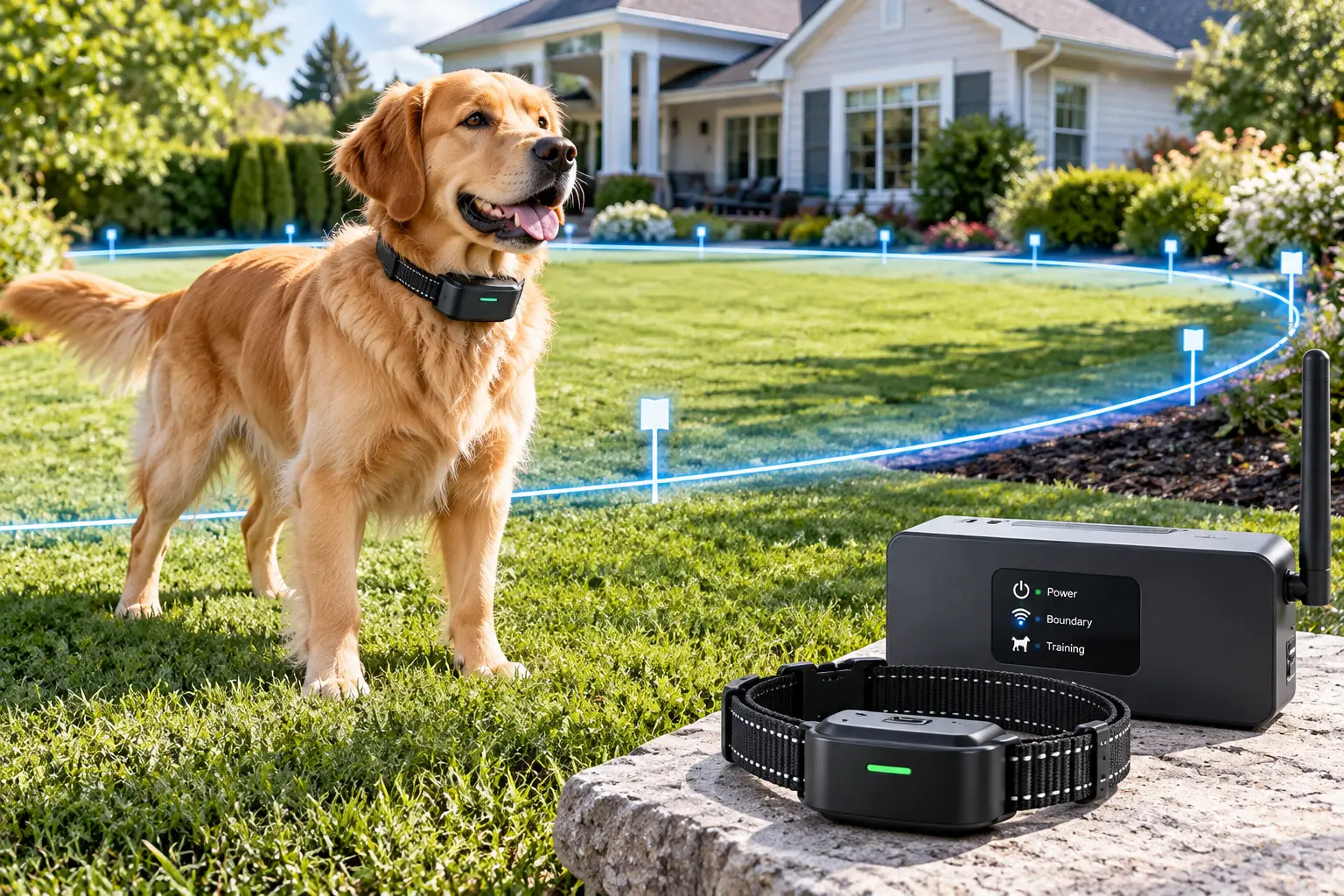
Today, perimeter dog collars fall into three distinct families. There are radio-based wireless systems that broadcast a circular boundary from an indoor transmitter, in-ground systems that read a signal from a wire you bury around your property, and GPS collars that draw a virtual boundary from satellites with no hardware in the yard at all. Each one solves the same problem with a different trade-off between accuracy, setup effort, flexibility, and long-term cost.
The concept itself isn’t new. The modern pet fence traces back to a 1970s patent for an underground wire paired with a signal-reading collar, and that basic design still powers most in-ground kits sold today. What has changed is the brains inside the collar: dual-frequency GPS chips, motion sensors that tell running from resting, and apps that let you redraw a boundary from your couch.
In this guide, you’ll find seven real products available to US shoppers, from a sub-$200 buried-wire starter kit to a roughly $1,000 GPS collar built for wooded acreage. Every pick comes with honest analysis based on published spec sheets and aggregated owner feedback — not invented test stories — plus practical setup, training, and cost-of-ownership advice the product listings won’t give you.
What Is a Perimeter Dog Collar?
A perimeter dog collar is a receiver collar that warns your dog — usually with a tone, then vibration or a mild static correction — when it approaches a boundary you’ve set. That boundary comes from a buried wire, a wireless radio transmitter, or GPS satellites, letting you contain a dog without building a physical fence.
Quick Comparison: The 7 Best Perimeter Dog Collars at a Glance
| Product | Technology | Coverage | Subscription | Price Range (approx.) | Best for |
|---|---|---|---|---|---|
| PetSafe Basic In-Ground Fence | Buried wire | 1/3 acre included, up to 5 acres | No | Under $200 | PetSafe Basic In-Ground Fence: tight budgets, small odd-shaped yards |
| PetSafe Stay & Play Compact Wireless Fence | Radio (circular) | Up to 3/4 acre | No | $250–$330 | PetSafe Stay & Play Compact Wireless Fence: renters, RV trips |
| SportDOG Rechargeable In-Ground Fence | Buried wire | 1 1/3 acres included, up to 100 acres | No | $300–$350 | SportDOG Rechargeable In-Ground Fence: big rural lots |
| Dogtra GPS Fence | Dual-band GPS | Custom shapes, up to 30 saved fences | No | Mid-hundreds | Dogtra GPS Fence: no-fee GPS containment |
| PetSafe Guardian GPS 2.0 | Dual-frequency GPS + motion AI | 1/2 acre minimum | Yes | $400–$650 | PetSafe Guardian GPS 2.0: small breeds needing GPS + tracking |
| Halo Collar 5 | Dual-frequency GPS + corrections | 30×30 ft minimum | Yes | $500–$600 | Halo Collar 5: small suburban yards, training help |
| SpotOn Nova Edition | Dual-band GPS, oversized antenna | 1/3 acre minimum | Optional | Around $1,000 | SpotOn Nova Edition: wooded acreage |
Reading across the table, the real dividing line isn’t price — it’s whether you’re willing to dig and whether you’re willing to pay monthly. The two buried-wire kits are the cheapest way to get a precise, any-shape boundary, but you’ll spend a weekend trenching. On the GPS side, the Dogtra GPS Fence and SpotOn Nova Edition keep containment working without a plan, while the Halo Collar 5 and PetSafe Guardian GPS 2.0 trade a monthly fee for live tracking and escape alerts.
💬 One click helps other shoppers make an informed choice too! Tap any highlighted product to check current pricing and availability. 😊
Top 7 Perimeter Dog Collars: Expert Analysis
The seven picks below run from entry-level to premium and cover all three technologies. Each section explains what the specs mean in your actual yard, who should buy it, and where it falls short.
1. PetSafe Basic In-Ground Fence — cheapest precise boundary you can buy
If you want a boundary that follows your exact property line for the least money, the PetSafe Basic In-Ground Fence is the classic starting point. The kit ships with 500 feet of boundary wire and 50 flags, enough for roughly a third of an acre, and the transmitter supports up to 5 acres with extra wire. In practice, that means a typical quarter-acre suburban lot is covered out of the box, with room to grow.
The receiver collar offers a tone-only mode plus four static levels, fits dogs from 8 lbs and 6–28 inch necks, and runs on a replaceable battery rather than a rechargeable cell. That last detail cuts both ways: you’ll buy batteries for years, but you never have a dead collar waiting on a charger.
Based on the specs, this is the right pick for budget-conscious owners with small or oddly shaped yards who don’t mind a weekend of trenching. Owner feedback commonly praises how well the system works once installed, while a recurring complaint is that the warning zone near the wire is fairly narrow, giving dogs little lead time before correction.
Pros:
- ✅ Lowest upfront cost of any precise boundary
- ✅ Follows any yard shape exactly
- ✅ Unlimited dogs with add-on collars
Cons:
- ❌ Installation means digging the full perimeter
- ❌ Narrow warning zone near the wire
💲 Typically under $200 — excellent value if you’ll stay put for years.
2. PetSafe Stay & Play Compact Wireless Fence — portable fence for renters and RVers
The PetSafe Stay & Play Compact Wireless Fence skips digging entirely: plug the transmitter in indoors and it projects a circular boundary of roughly 22 to 105 feet in every direction, up to about 3/4 acre. Setup takes one to two hours, which is mostly flag placement.
The rechargeable, waterproof collar charges in 2–3 hours and lasts about three weeks per charge, so you’ll top it up roughly once or twice a month. It offers a tone-only mode and five static levels and fits dogs from 5 lbs with 6–28 inch necks. One humane design choice matters: if your dog does cross the boundary, it won’t be corrected for coming back in.
The catch is geometry. A circle centered on your house rarely matches a rectangular lot, so you either give up part of the yard or let the circle spill into the street side. Reviews for radio systems like this commonly mention signal variation near metal siding, vehicles, or hills, so placement matters.
Pros:
- ✅ No digging, set up in an afternoon
- ✅ Packs up for camping or RV travel
- ✅ Rechargeable collar lasts about three weeks
Cons:
- ❌ Circular boundary wastes odd-shaped yards
- ❌ Signal can fluctuate near metal or slopes
💲 Generally $250–$330 — strong value for renters who can’t dig.
3. SportDOG Rechargeable In-Ground Fence — scales to 100 acres
For big properties, the SportDOG Rechargeable In-Ground Fence (model SDF-100C) is built on a simple promise: lots of wire, lots of reach. The box includes 1,000 feet of wire and 100 flags covering about 1 1/3 acres, and the transmitter can handle up to 100 acres with extra wire-and-flag kits.
The transmitter adds a wire-break alarm and built-in lightning protection — two features that matter more than they sound, because a silent break or a storm-fried transmitter is how buried-wire systems fail without you noticing. The collar offers tone, vibration, and static, fits dogs 10 lbs and up with 8–28 inch necks, and is rechargeable. It’s the newer, slimmer replacement for the older SDF-100A.
This is a farm-and-acreage tool. Owner reviews of the SportDOG line often mention that installation time is dominated by digging, and a common critique of the older model was its bulky collar, which the rechargeable version was designed to slim down.
Pros:
- ✅ Expands to 100 acres on one transmitter
- ✅ Wire-break alarm catches silent failures
- ✅ Tone, vibration, and static options
Cons:
- ❌ Not suited for dogs under 10 lbs
- ❌ Large installs take serious labor
💲 Usually $300–$350 — the best cost per acre on this list.
4. Dogtra GPS Fence — GPS containment with zero monthly fees
The Dogtra GPS Fence is for owners who want a wire-free boundary without signing up for another subscription. You draw circular or custom-shaped fences in the free app, and once the fence is loaded, the collar runs independently of your phone.
Its boundary design is layered: a warning zone, a main fence, and two backup fences behind it, plus a “return reminder” tone that guides the dog home. In practice, that layering is a safety net for GPS drift — if the dog pushes past the first line, there’s still structure behind it. You can save up to 30 fences, the collar carries an IPX9K waterproof rating, and up to three dogs can share a fence profile.
Aggregated feedback in the app store is consistent on two points: owners like the no-fee model and easy boundary edits, while battery life is the most common complaint. Dogtra has publicly acknowledged work on GPS stability under trees.
Pros:
- ✅ No subscription for core containment
- ✅ Layered backup boundaries reduce escapes
- ✅ Saves up to 30 fences for travel
Cons:
- ❌ Battery life is the top owner complaint
- ❌ Tree cover can affect GPS stability
💲 Typically priced in the mid-hundreds — check the current price; strong value over three-plus years.
5. PetSafe Guardian GPS 2.0 — smallest GPS collar with the longest battery
The PetSafe Guardian GPS 2.0 is PetSafe’s answer to Halo and SpotOn, and its standout spec is size: a collar built for dogs as light as 10 lbs with necks from 8 inches. Its AccuGuard system blends dual-frequency GPS with AI-driven motion detection, and it stores up to 50 custom fences.
Battery life is rated at up to 70 hours — roughly three days — which is meaningfully longer than most GPS rivals. Corrections include tone, vibration, and 10 static levels, giving finer control for sensitive dogs. The fine print matters, though: a subscription and cellular service are required, a 2.4 GHz Wi-Fi network is needed for setup, and PetSafe recommends properties of at least 1/2 acre without dense tree cover.
Verified long-term owner reviews of this second-generation model are still relatively limited, so weigh it on specs and PetSafe’s 1-year warranty rather than a large review history.
Pros:
- ✅ Compact collar suits smaller breeds
- ✅ Up to 70 hours of battery life
- ✅ Ten static levels for fine-tuning
Cons:
- ❌ Subscription required for the fence to work
- ❌ Needs half an acre and open sky
💲 Roughly $400–$650 depending on retailer and bundle — good value if you’ll use the tracking.
6. Halo Collar 5 — best for small yards and guided training
The Halo Collar 5 is the GPS collar that works in the tightest spaces: Halo supports fences as small as about 30 by 30 feet, far below the half-acre floors of most competitors. It pairs dual-frequency (L1 + L5) GPS with ground-station corrections, which Halo says delivers accuracy within roughly two feet.
That accuracy figure is the manufacturer’s claim, so treat it as best-case open-sky performance. Still, the practical benefit is real: a smaller workable fence means suburban owners with modest yards finally have a GPS option. Halo also automatically disables fence feedback when it detects the dog is indoors, and its membership includes training content from Cesar Millan’s program.
The trade-off is mandatory: without a Halo membership, the fence features don’t work, so your total cost keeps growing. Independent comparisons have praised Halo’s flexibility and app, while some testers reported less consistent boundary behavior than SpotOn in their trials.
Pros:
- ✅ Smallest supported fence size on this list
- ✅ Unlimited fences and live tracking
- ✅ Indoor detection prevents house corrections
Cons:
- ❌ Membership required for core features
- ❌ Mixed accuracy results in some tests
💲 Generally $500–$600 plus membership — best value for small lots that need GPS.
7. SpotOn Nova Edition — built for woods and big acreage
The SpotOn Nova Edition is the premium pick, designed around one obsession: keeping the boundary in the same place every time, even under trees. Its hardware uses a dual-band, dual-feed active antenna that SpotOn says is about five times larger than rival GPS fences.
Nova works on properties from 1/3 acre up to thousands of acres, lets you draw fences by walking the perimeter, and supports a fence-within-a-fence for off-limits zones like a pond. Battery life is around 33 hours with tracking, or 40-plus in extended mode. Core containment needs no subscription; cellular tracking is an optional add-on. It’s sized for dogs over 15 lbs with 10–26 inch necks.
Owner and reviewer feedback consistently highlights SpotOn’s walk-to-draw setup and boundary consistency, while the most common objection is simply price. Note that much of the comparative testing circulating online is published by SpotOn or Halo themselves, so read those claims critically.
Pros:
- ✅ Engineered for tree cover and terrain
- ✅ No subscription for containment
- ✅ Walk-to-draw fences are easy to create
Cons:
- ❌ Highest upfront price on this list
- ❌ Not for dogs under 15 lbs
💲 Around $1,000 — worth it for wooded acreage, overkill for small lots.
✨ Don’t miss these smart containment picks!
🔍 Ready to stop the backyard escapes? Click any highlighted product above to check current pricing and availability — the right collar can give your dog freedom and you peace of mind.
How to Set Up and Train With Perimeter Dog Collars: Your First 30 Days
Here’s the part no product listing tells you: the collar is maybe 30% of the result. The other 70% is training. A dog that has never been taught what the flags mean will experience a correction as a random, scary event — and a scared dog may bolt through the boundary instead of retreating from it.
🗓️ Week 1: Flags and tone only
- Set the collar to tone-only or vibration-only mode. Every pick on this list offers a no-static mode; use it first.
- Walk the boundary on a leash, twice a day for 10–15 minutes. When the tone sounds, guide your dog back toward the yard and reward heavily with treats and praise.
- Leave the flags up. They’re the visual cue your dog learns to associate with “turn around.” GPS owners should place temporary flags too.
🗓️ Week 2: Introduce the lowest effective correction
If your dog is responding reliably to tone, move to the lowest static or vibration level that earns a head-turn — not a yelp. Keep sessions on-leash and stay upbeat. Reward-based training matters here: the American Veterinary Society of Animal Behavior’s position statement on humane dog training recommends reward-based methods and warns that aversive tools can harm welfare and the human-dog bond. The practical takeaway: use tone and vibration as cues, keep static as a rarely needed backstop, and pair every boundary encounter with a reward for retreating.
🗓️ Weeks 3–4: Distractions, then supervised freedom
Add temptations — a neighbor walking past, a tossed ball near the line — while still on a long lead. Only after several days of clean responses should you try supervised off-leash time. Then remove flags gradually, every other one at a time.
⚠️ Common first-month mistakes
- Skipping the leash phase because “he’s smart”
- Starting at a mid-level static setting
- Charging the collar “sometimes” — GPS collars fail silently when dead
- Leaving the dog unsupervised in week one
Real-World Scenarios: Which Collar Fits Your Life?
Specs only make sense against a real situation. Here are three common US buyer profiles matched to the picks above.
🏡 Profile 1: The suburban family with a quarter-acre lot
You have a 0.25-acre lot in a subdivision, a 35-lb Labrador mix, and an HOA that frowns on chain-link. Budget: under $400 if possible. Your dog is outside a few hours a day, usually while someone’s home.
The smart picks narrow fast: most GPS collars won’t work reliably below a half acre, which rules out the PetSafe Guardian GPS 2.0, and the SpotOn Nova Edition needs at least a third of an acre plus a much bigger budget. Your real choice is between the PetSafe Basic In-Ground Fence (cheap, precise, but you dig) and the Halo Collar 5 (no digging, works in small yards, but a monthly fee). If you own and plan to stay, buried wire wins on cost. If you might move within three years, Halo’s portability earns its fee.
🌲 Profile 2: The rural owner with five wooded acres
You have a 70-lb German Shorthaired Pointer and a property that’s half forest. Budget is flexible, but you hate subscriptions.
Tree cover is the enemy of GPS accuracy, so your options are the SportDOG Rechargeable In-Ground Fence — about $300-plus in hardware and roughly 1,500+ feet of extra wire to cover the perimeter — or the SpotOn Nova Edition, designed specifically for forested terrain with no required plan. Wire is cheaper; SpotOn saves days of trenching through roots and lets you redraw boundaries as needs change.
🚐 Profile 3: The renter who travels
You rent a duplex, can’t dig, and spend summer weekends at campgrounds with a 20-lb terrier. The PetSafe Stay & Play Compact Wireless Fence fits neatly: it plugs into an RV outlet and packs into a bag. If you’d rather avoid the circular limitation, the Dogtra GPS Fence offers saved fences for multiple sites with no monthly cost.
Problem → Solution: Fixing the 5 Most Common Perimeter Collar Headaches
Even a great system will throw curveballs. Here’s how to handle the issues owners report most often.
1. “My dog gets corrected inside the house.” This is a GPS-collar classic: signal bounces indoors and the collar “thinks” the dog has wandered. The Halo Collar 5 automatically disables feedback indoors, and the SpotOn Nova Edition lets you draw a home zone. With other collars, simply remove the collar indoors.
2. “The boundary seems to move.” That’s GPS drift, worst under trees or near tall buildings. Pull your fence lines 10–15 feet inside any real danger like a road, and use layered systems such as the backup fences on the Dogtra GPS Fence.
3. “The wireless fence works one day, not the next.” Radio systems like the PetSafe Stay & Play Compact Wireless Fence are sensitive to metal siding, appliances, and parked cars. Move the transmitter higher and away from metal, then re-walk the boundary.
4. “My dog stopped responding.” Check the contact points first — long coats often need the longer prongs that most kits include. Then check the battery. Only then consider adjusting levels.
5. “The in-ground fence went silent.” A cut wire is the usual culprit. The wire-break alarm on the SportDOG Rechargeable In-Ground Fence flags it immediately; on simpler kits, an inexpensive wire-break locator can pinpoint the spot.
How to Choose Perimeter Dog Collars: 7 Steps
- Measure your usable yard first. Most GPS collars need a half acre or a third of an acre; below that, look at buried wire or the Halo Collar 5.
- Look up at your tree canopy. Dense trees degrade satellite signals. The official GPS.gov accuracy overview notes that real-world accuracy depends on factors like sky blockage and receiver quality — which is why antenna design matters so much in a GPS dog fence collar.
- Decide if you can dig. Renters and HOA residents usually can’t; homeowners with clear soil often should, because wire is the most precise boundary per dollar.
- Match the collar to your dog’s size. Minimums range from 5 lbs (PetSafe Stay & Play Compact Wireless Fence) to 15 lbs (SpotOn Nova Edition).
- Count the subscription. Over three to five years, a monthly plan can exceed the collar’s purchase price.
- Check correction options. Tone-only and vibration modes let you train humanely before ever using static.
- Think about charging habits. A 70-hour GPS collar fits a busy household better than one needing a nightly charge.
GPS vs. Wireless vs. In-Ground: Which Perimeter Technology Wins?
Each technology wins a different contest. Here’s how they compare where it counts.
| Factor | In-ground (wired) | Wireless (radio) | GPS collar |
|---|---|---|---|
| Boundary precision | Excellent, follows wire | Fair, circular only | Good to very good, varies with sky view |
| Installation | Dig full perimeter | 1–2 hours, no digging | Under an hour in an app |
| Portability | None | High (outlet needed) | Highest |
| Minimum yard | Any size | Small to 3/4 acre | About 1/3–1/2 acre for most |
| Ongoing cost | Batteries, repairs | Minimal | Charging; some need plans |
| Best for | SportDOG Rechargeable In-Ground Fence, PetSafe Basic In-Ground Fence | PetSafe Stay & Play Compact Wireless Fence | SpotOn Nova Edition, Halo Collar 5, Dogtra GPS Fence, PetSafe Guardian GPS 2.0 |
The pattern is clear: wire still wins on raw precision and cost, wireless radio wins on simplicity, and GPS wins on flexibility. If your boundary sits near a busy road, precision should outrank convenience — which tilts toward wire or a premium GPS collar with layered backup zones. If you move often or travel with your dog, a wireless dog fence collar or GPS system pays you back in portability.
Perimeter Dog Collars vs. Traditional Fencing
A perimeter collar isn’t automatically better than a physical fence — it’s different. Physical fences keep other animals and people out; collars only keep your dog in.
| Factor | Electronic perimeter collar | Traditional wood/vinyl fence |
|---|---|---|
| Typical upfront cost | Roughly $150–$1,000 | Often several thousand dollars for a full yard |
| Keeps wildlife and stray dogs out | No | Yes |
| HOA-friendly | Usually | Often restricted |
| Works when dog is highly motivated | Not guaranteed | Physical barrier |
| Moves with you | Wireless/GPS: yes | No |
The takeaway: an electric dog fence collar is a powerful, affordable tool for well-trained dogs in lower-risk settings, but it’s not a security barrier. For dogs with strong prey drive, reactive dogs, or properties beside highways, many owners combine a perimeter collar with a short physical fence along the most dangerous edge.
Long-Term Cost and Maintenance
Sticker price is only the beginning. Here’s a realistic five-year view based on published pricing structures.
| Product | Upfront (approx.) | Recurring costs | 5-year outlook |
|---|---|---|---|
| PetSafe Basic In-Ground Fence | Under $200 | Collar batteries, wire repairs | Lowest total cost |
| SportDOG Rechargeable In-Ground Fence | $300–$350 | Extra wire for big lots | Low per acre |
| PetSafe Stay & Play Compact Wireless Fence | $250–$330 | Near zero | Low |
| Dogtra GPS Fence | Mid-hundreds | None required | Low to moderate |
| SpotOn Nova Edition | Around $1,000 | Optional cellular plan | Moderate, front-loaded |
| Halo Collar 5 | $500–$600 | Required membership (low tier around $10/month) | Moderate to high |
| PetSafe Guardian GPS 2.0 | $400–$650 | Required plan, monthly or annual | Moderate to high |
The math explains the market. A required plan of roughly $10 a month adds about $600 over five years, which can make a cheaper-looking collar more expensive than the SpotOn Nova Edition over time. Meanwhile, rechargeable lithium batteries in every GPS collar degrade, so budget for a possible collar replacement around years three to five.
Maintenance checklist:
- 🔋 Charge GPS collars on a fixed schedule
- 🧼 Clean contact points and check the neck skin weekly
- 🔍 Walk wired boundaries each spring for breaks
- 📲 Install firmware updates — Dogtra, for example, has pushed updates aimed at GPS stability
Safety, Regulations, and Standards
In the US, there’s no single federal law banning or certifying perimeter dog collars, but several practical rules apply.
- Radio compliance: Wireless transmitters and GPS collars with cellular radios must meet FCC requirements; look for an FCC ID on the device or packaging.
- Electrical safety: Plug-in transmitters should be listed by a recognized lab such as UL or ETL. Use a surge protector, and prefer models with lightning protection.
- Waterproofing: IP67 or IPX9K ratings matter for dogs that swim or play in sprinklers.
- Leash and containment laws: Local ordinances often require your dog to be “under control.” An escaped dog is your liability regardless of the collar. Check your city or county code.
Health-wise, fit is the big one. Contact points pressing on the same spot for long hours can cause skin irritation, so limit daily wear time, rotate placement slightly, and remove the collar overnight. Never use a static setting on a puppy, a fearful dog, or a dog with a medical condition without talking to your veterinarian first.
Perimeter Dog Collars for Small Dogs and Seniors
Small dogs are where many GPS systems fall short. A collar sized for a 15-lb minimum simply won’t fit a Yorkie. The PetSafe Stay & Play Compact Wireless Fence starts at 5 lbs, the PetSafe Basic In-Ground Fence at 8 lbs, and the PetSafe Guardian GPS 2.0 at 10 lbs — the most small-dog-friendly GPS option here.
For senior dogs, think about hearing and sensitivity. Older dogs may not hear the warning tone, so vibration becomes the more reliable cue. Start at the lowest level, and watch for confusion: a senior dog with cognitive decline may not learn new boundaries reliably, and supervised time outdoors is the safer choice.
Common Mistakes to Avoid When Buying an Invisible Fence Collar for Dogs
- Buying for the yard you wish you had. A GPS collar with a half-acre minimum won’t magically work on a quarter-acre lot.
- Ignoring the subscription fine print. Check whether containment itself depends on the plan — on some models, it does.
- Trusting manufacturer comparisons blindly. Many head-to-head “tests” online are published by the brands themselves. Look for independent reviewers and patterns across owner reviews.
- Skipping training. No invisible fence collar for dogs works out of the box; budget two to four weeks.
- Putting the boundary right at the danger line. Always set the fence well inside roads and water.
FAQ: Perimeter Dog Collars
❓ Do perimeter dog collars work without Wi-Fi or cell service?
❓ Can I use one GPS dog fence collar for two dogs?
❓ Which perimeter dog collars work for dogs under 10 pounds?
❓ Is a wireless dog fence collar worth it over buried wire?
❓ How long does it take to train a dog on an electric dog fence collar?
Conclusion: Picking the Right Perimeter Collar for Your Dog
There’s no single “best” among perimeter dog collars — there’s the best fit for your yard, your dog, and your tolerance for digging or monthly fees. If budget and precision rule, the PetSafe Basic In-Ground Fence or the SportDOG Rechargeable In-Ground Fence still deliver unbeatable value per acre. If you rent or travel, the PetSafe Stay & Play Compact Wireless Fence is the easiest way to start.
On the GPS side, choose the Dogtra GPS Fence for no-fee containment, the Halo Collar 5 for small yards and guided training, the PetSafe Guardian GPS 2.0 for smaller breeds wanting long battery life, and the SpotOn Nova Edition when tree cover and acreage demand top-tier hardware.
Whichever you pick, remember the 30/70 rule: the collar is the tool, but consistent reward-based training is what actually keeps your dog home. Measure your yard, check the minimums, read the subscription terms, and invest those first few weeks in patient practice — your dog’s freedom depends on it.
🐕 Ready to give your dog safe freedom?
🔍 Click any highlighted product to check current pricing and availability, and find the perimeter collar that keeps your best friend happily at home — no backyard chases required!
Recommended for You
- Wireless Fence for 2 Dogs: 7 Best Heavy-Duty Containment Systems
- Best Shock Collar for Stubborn Dogs: 7 Smart Picks for 2026
- Long Range Dog Training Collar: 7 Best Picks Tested on Paper (2026)
Disclaimer: This post contains affiliate links. As an Amazon Associate, I earn from qualifying purchases made through these links, at no additional cost to you.
✨ Found this article helpful? Share it with someone who needs it! 💬🤗