
In This Article
Introduction: Big Training Tools, Tiny Necks
Shopping for electronic collars for small dogs is trickier than it looks. Most remote trainers on the market were designed around Labradors and hunting dogs, then shrunk down for the rest of us. Put the wrong one on a 9-pound Yorkie and you get a receiver that slides around, contact points that miss the skin, and a stimulation range that starts way too high for a sensitive little dog.
The good news? A handful of manufacturers now build receivers specifically for toy and small breeds. Some weigh around 2 ounces and are rated for dogs as small as 3 to 5 pounds. Others pair a compact collar with fine-grained dials offering 100 or more levels, so you can find the faintest cue your dog notices instead of jumping straight to something uncomfortable.
This guide compares seven real, widely sold models side by side. Rather than repeating product listings, we translate the spec sheets into everyday meaning and summarize what owners actually report in aggregated reviews. You’ll also get a getting-started plan, fixes for common problems, and an honest look at the welfare debate.
That last part matters. Veterinary behavior organizations recommend reward-based training as the first approach, and you should know that before you buy anything. So we’ll show you how to pick, fit, and use a collar as gently as possible — and when you might not need one at all.
What Are Electronic Collars for Small Dogs?
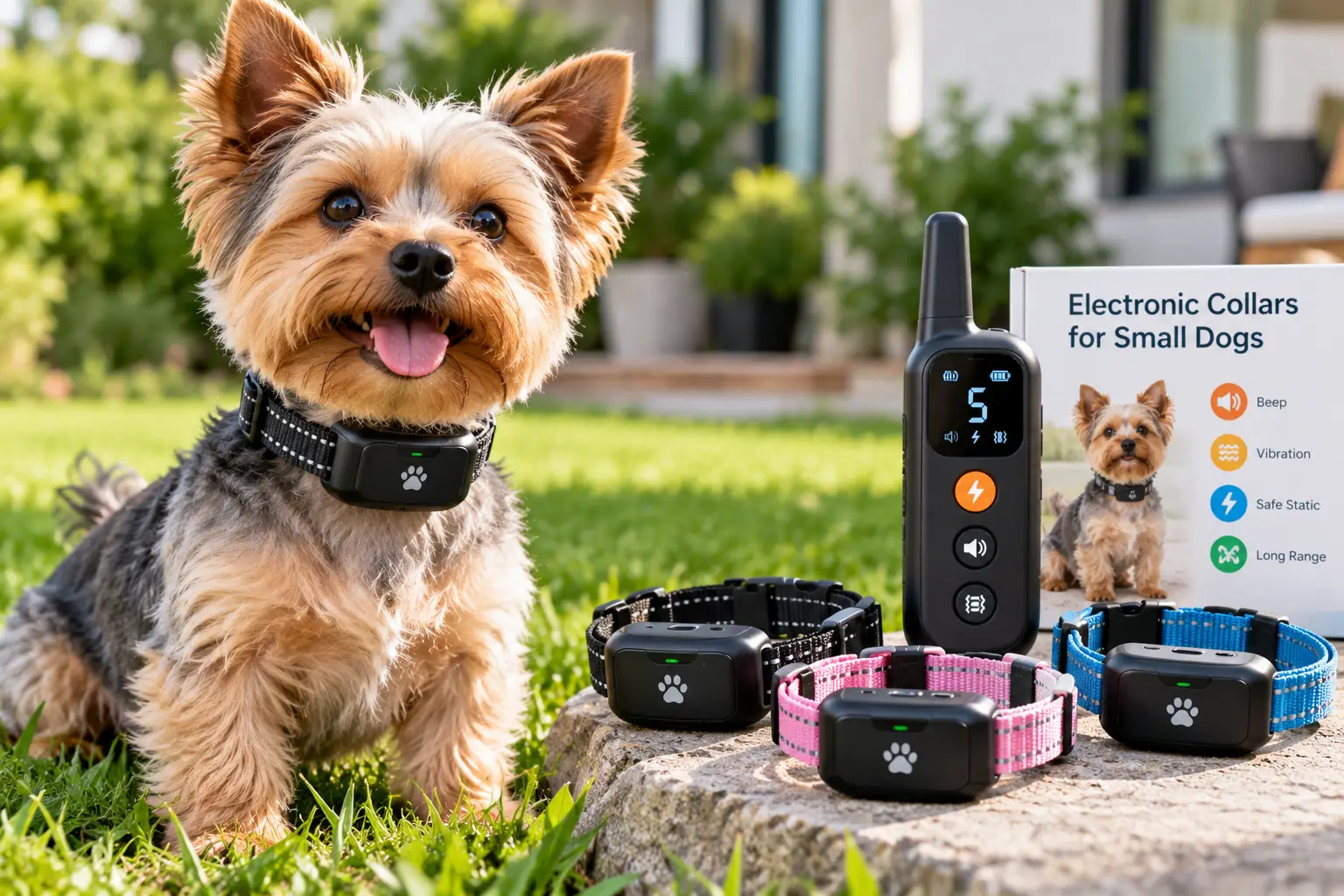
Electronic collars for small dogs are remote training systems with a lightweight collar receiver, typically 2 to 2.6 ounces, and a handheld transmitter. The remote sends a tone, a vibration, or a mild static stimulation to the collar. Small-dog versions use smaller receivers, lower power output, and finer level adjustments than standard models.
In practice, owners use them for three jobs: off-leash recall, interrupting unwanted behavior at a distance, and reinforcing commands the dog already knows. They are not meant to teach new behaviors from scratch. Think of the collar as a tap on the shoulder from across the park, not a replacement for actual training.
Where does the controversy come from? Older “shock collars” often had only a few crude power steps, so the first level could already be too strong. Modern units with 100-plus levels let you work at a barely perceptible setting. Even so, groups like the American Veterinary Society of Animal Behavior argue against aversive tools; you can read their reasoning in the humane dog training position statement shared by Purdue University’s Center for Animal Welfare Science.
Our take: if you choose to use one, the device design matters enormously. Low minimum output, a vibration or tone option, and a receiver that fits a tiny neck are not luxuries — they’re the whole point of buying a small-dog model.
Quick Comparison: 7 Small-Dog E-Collars at a Glance
| Product | Min. dog weight | Range | Static levels | Tone / Vibration | Price range | Best for |
|---|---|---|---|---|---|---|
| Educator ME-300 Micro | 3–5 lbs (varies by retailer) | 1/3 mile | 100 | Both | ~$200–$220 | Educator ME-300 Micro: toy breeds, timid dogs |
| Educator ET-300 Mini | 5 lbs | 1/2 mile | 100 | Both | ~$200–$220 | Educator ET-300 Mini: best all-rounder |
| Dogtra 200C | 10 lbs | 1/2 mile | 100 | Vibration only | ~$180–$200 | Dogtra 200C: simple one-hand control |
| Dogtra 280C | 10 lbs | 1/2 mile | 127 | Vibration only | ~$210–$230 | Dogtra 280C: precise level display |
| SportDOG FieldTrainer 425X | 8 lbs | 500 yards | 21 | Both | ~$150–$180 | SportDOG FieldTrainer 425X: swimmers, 3-dog homes |
| Garmin Delta XC | 8 lbs | 1/2 mile | 18 | Both | ~$150–$180 | Garmin Delta XC: easy multi-dog setup |
| PetSafe 100 Yard Lite Remote Trainer | 8 lbs | 100 yards | 15 | Both | Under $150 | PetSafe 100 Yard Lite Remote Trainer: budget, home and yard |
Prices are approximate ranges at the time of writing and change often — check the current price before you buy.
Reading across the table, the two Educator models are the only picks rated below 8 pounds, which makes them the default choice for Chihuahuas, Toy Poodles, and Pomeranians. If your dog is 10 pounds or more, the Dogtra 200C and Dogtra 280C compete on precision, while the SportDOG FieldTrainer 425X and Garmin Delta XC trade fine-grained levels for multi-dog flexibility. The PetSafe 100 Yard Lite Remote Trainer costs the least, but its short range limits it to the house and backyard.
💬 One click helps other shoppers make an informed choice too! 😊
Top 7 Electronic Collars for Small Dogs: Expert Analysis
Each pick below is a real model sold in the US, chosen for receiver size, minimum output, and how well it suits dogs under roughly 20 pounds.
1. Educator ME-300 Micro — smallest receiver for toy breeds
The Educator ME-300 Micro exists for one reason: dogs too small for everything else. E-Collar Technologies pairs its popular Mini remote with the RX-070 Micro receiver, which the company says is about 20% smaller, lighter, and lower in output than its standard Mini receiver.
On paper, that means a roughly 2-ounce receiver, 100 dial-adjustable levels with a “lock and set” feature, a tone, and a non-static “tapping” vibration. The lock-and-set feature matters more than it sounds: it stops an accidental thumb roll from jumping your 4-pound dog from level 6 to level 40. The receiver also rotates 90 degrees on the strap, which helps keep the contact points centered on a narrow neck.
Who is it for? Chihuahuas, Yorkies, Toy Poodles, and timid dogs of any size whose working level sits at the very bottom of the dial. The 1/3-mile range is plenty for parks and yards. E-Collar Technologies’ own comparison lists a 3-pound minimum, while several retailers state 5 pounds, so we’d treat 5 pounds as the conservative floor.
Aggregated ratings on the retail listings we checked hover around 4 out of 5 stars from a smaller review pool, positive overall but more mixed than its Mini sibling.
Pros:
- ✅ Lightest receiver among all seven picks
- ✅ Lower output suits sensitive, tiny dogs
- ✅ Tone and tapping vibration built in
Cons:
- ❌ Shorter range than the Mini Educator
- ❌ Premium price for a low-power unit
💲 Expect around $200–$220; strong value only if your dog truly needs the micro receiver.
2. Educator ET-300 Mini — best all-round small-dog system
The Educator ET-300 Mini is the model most small-dog trainers reach for first, and the specs explain why. It covers dogs from 5 pounds up with one 2.4-ounce receiver.
You get a 1/2-mile range, 100 levels with lock-and-set, momentary and continuous stimulation, an adjustable boost, tone, vibration, and a remote-activated tracking light. In practice, the boost lets you pre-set a slightly stronger level for emergencies — say, a dog darting toward a road — without spinning the dial in a panic. The floating, stopwatch-style remote weighs about 3.4 ounces and can be operated without looking.
This is the pick for owners who want one system that grows with them: a Jack Russell today, maybe a second dog later, since it expands to a two-dog setup. E-Collar Technologies backs it with a 2-year warranty and US assembly.
Reviews consistently land in the 4.4–4.5 star range on the major US retail listings we checked, across a large review base. Praise focuses on fine level control and build quality.
Pros:
- ✅ Rated for dogs as small as 5 pounds
- ✅ Boost and lock-and-set add real safety margin
- ✅ Tracking light helps at dusk walks
Cons:
- ❌ Receiver is bulkier than the Micro on toy breeds
- ❌ Feature-rich remote takes time to learn
💲 Typically around $200–$220; the best value-per-feature in this roundup.
3. Dogtra 200C — simplest one-handed control
The Dogtra 200C strips remote training down to the essentials, which is exactly what some owners want. Dogtra rates its compact receiver for dogs 10 pounds and up.
Its rheostat dial runs from 0 to 100 and sits right under your thumb, so adjusting intensity is one smooth motion rather than a series of button taps. You get nick (momentary) and constant stimulation plus a vibration pager, all rated IPX9K waterproof, with 2-hour rapid-charge batteries. One notable omission: the Dogtra 200C has no tone mode, so audio cues have to come from your voice or a clicker.
This suits owners of 10-to-25-pound dogs — Shih Tzus, Beagles, Miniature Schnauzers — who want obedience help without a menu-driven remote. The 1/2-mile range covers almost any suburban use, and a two-dog version, the 202C, exists if your household grows.
We found fewer independent review summaries for this model than for the Educators; the retailer and dealer feedback we could verify centers on its straightforward controls and compact size.
Pros:
- ✅ Intuitive front-facing dial for fast adjustments
- ✅ IPX9K waterproof transmitter and receiver
- ✅ Two-hour recharge for both units
Cons:
- ❌ No tone option for non-physical cues
- ❌ Not rated for dogs under 10 pounds
💲 Usually in the $180–$200 range; fair value for owners who prize simplicity.
4. Dogtra 280C — most precise level display
The Dogtra 280C is the step up for owners who want to see exactly where they are on the dial. It keeps the compact receiver but adds an LCD screen and more resolution.
The dial covers 0 to 127 levels, so each step is a smaller increment than on the Dogtra 200C. Why that matters: a small dog’s working level is often a narrow window, and finer steps help you stay inside it. The LCD shows the exact level and battery status, which removes guesswork when someone else in the family takes over training. It is IPX9K waterproof with a 1/2-mile range.
It fits stubborn-but-small breeds well — Dachshunds, Boston Terriers, Shibas — where you may need a slightly wider range. Note that Dogtra lists a 10-pound minimum while some retailers say 15 pounds; Dogtra’s own site now also promotes a successor, the 280X, so check which version a listing ships.
Owner feedback on dealer pages highlights battery life, ease of use, and the compact transmitter.
Pros:
- ✅ 127 levels for very fine adjustments
- ✅ LCD screen shows level and battery
- ✅ Two-dog version (282C) available
Cons:
- ❌ Minimum weight rating varies between sources
- ❌ No tone mode, like the 200C
💲 Around $210–$230; worth the premium if exact level tracking matters to you.
5. SportDOG FieldTrainer 425X — best for water-loving small dogs
The SportDOG FieldTrainer 425X is the smallest and lightest unit in SportDOG’s lineup, and it brings hunting-grade durability to dogs as small as 8 pounds.
Its DryTek design is waterproof and submersible to 25 feet, which means beach days and creek crossings are no problem. You get 21 levels of low-to-medium static, plus tone and vibration, with a 500-yard range. The rechargeable lithium-ion batteries charge in about 2 hours and are rated for 50 to 70 hours of use — realistically, a few weeks of daily sessions. Fit is listed for neck sizes 5 to 22 inches.
Who should pick it? Active small terriers, spaniel mixes, and households with up to three dogs, since the remote supports Add-A-Dog collars. One caution: don’t confuse it with the SportDOG FieldTrainer 425XS, an “S” version built with a higher, medium-to-high stimulation range for stubborn dogs. For a small dog, the plain 425X is the right one.
Aggregated reviews are strong: one large outdoor retailer shows an average around 4.7 out of 5 across more than 200 reviews, with battery life and ruggedness recurring as positives.
Pros:
- ✅ Submersible to 25 feet for swimmers
- ✅ Expands to three dogs on one remote
- ✅ Tone and vibration alongside static
Cons:
- ❌ Only 21 levels, so bigger steps between them
- ❌ Remote has an antenna and is bulkier
💲 Usually around $150–$180; excellent value for multi-dog or outdoor households.
6. Garmin Delta XC — easiest multi-dog setup
The Garmin Delta XC brings Garmin’s Tri-Tronics heritage to a slim 2.4-ounce dog device rated for dogs from 8 pounds.
The three-button handheld delivers 18 levels of momentary and continuous stimulation, plus tone and vibration, with a 1/2-mile range and IPX7 water resistance. Practically, the 18-level scale is simpler to learn but coarser: each step is a bigger jump than on a 100-level dial. A genuinely useful detail for small dogs is the included set of long and short contact points — short ones for smooth coats, long ones for fluffy breeds like Shih Tzus. It also trains up to three dogs from one handheld.
This is for owners who value clean ergonomics and brand support over maximum precision. If you want more levels, the Garmin Delta Sport XC steps up to 36 levels and a 3/4-mile range.
Review sentiment is mixed across retailers: one marketplace product page averages about 4.7 stars from a few dozen ratings, while another US retailer listing sits closer to 3.6. Availability also varies, so confirm the listing is current.
Pros:
- ✅ Long and short contact points included
- ✅ Trains up to three dogs
- ✅ Rechargeable handheld and collar
Cons:
- ❌ Coarse 18-level scale for sensitive dogs
- ❌ Stock can be spotty on some retailers
💲 Typically around $150–$180; good value if you’ll use the multi-dog feature.
7. PetSafe 100 Yard Lite Remote Trainer — best budget home trainer
The PetSafe 100 Yard Lite Remote Trainer is the most affordable entry point here, built for close-range training around the house and yard.
The “Lite” label means a smaller collar and gentler stimulation than PetSafe’s standard version. You get tone, vibration, and 15 static levels, a 100-yard range, and rechargeable batteries rated for up to 40 hours with a 2-hour USB charge. PetSafe lists it for dogs 8 pounds and up with neck sizes of 6 to 23 inches, and it is not intended for puppies under 6 months.
Where does it fit? Apartment and backyard owners working on jumping, counter-surfing, or door-dashing, who never plan to train at long distance. A hundred yards is roughly a football field, which is more than enough indoors.
Aggregated sentiment is noticeably more mixed than for the premium picks: one major pet retailer’s listing averaged under 3 stars when we checked, though other Lite versions score better elsewhere. Read recent reviews before buying.
Pros:
- ✅ Lowest price of the seven picks
- ✅ Gentler Lite output for timid dogs
- ✅ Simple digital remote for beginners
Cons:
- ❌ Short 100-yard range limits outdoor use
- ❌ Review feedback is more mixed
💲 Generally under $150, sometimes much less on promotion; solid value for close-range use only.
✨ Find the Right Fit for Your Little Dog!
🔍 Narrow it down by weight first, then by where you train. Click a highlighted model to check current pricing and availability — the right collar makes calm, confident walks something the whole family will enjoy!
Side-by-Side: Practical Features That Affect Daily Use
| Product | Waterproofing | Dogs per remote | Battery and charging | Standout extra | Best for |
|---|---|---|---|---|---|
| Educator ME-300 Micro | Waterproof | Up to 2 (ME-302 kit) | Rechargeable Li-polymer | Rotating micro receiver | Educator ME-300 Micro: dogs under 8 lbs |
| Educator ET-300 Mini | Waterproof, floating remote | Up to 2 | Rechargeable Li-polymer | Boost and tracking light | Educator ET-300 Mini: growing households |
| Dogtra 200C | IPX9K | Up to 2 (202C kit) | 2-hour rapid charge | Front thumb dial | Dogtra 200C: no-fuss owners |
| Dogtra 280C | IPX9K | Up to 2 (282C kit) | 2-hour rapid charge | LCD level display | Dogtra 280C: precision fans |
| SportDOG FieldTrainer 425X | Submersible to 25 ft | Up to 3 | 2-hour charge, 50–70 hrs use | DryTek sealing | SportDOG FieldTrainer 425X: swimmers |
| Garmin Delta XC | IPX7 | Up to 3 | Rechargeable Li-ion | Long and short contacts | Garmin Delta XC: fluffy coats |
| PetSafe 100 Yard Lite Remote Trainer | Waterproof remote and collar | 1 | Up to 40 hrs, 2-hour USB charge | Lowest entry price | PetSafe 100 Yard Lite Remote Trainer: indoor use |
The pattern here is clear: if you own two or three small dogs, the SportDOG FieldTrainer 425X and Garmin Delta XC let one remote handle everyone, which saves real money compared with buying separate kits. The Dogtra pair and the Educators win on stimulation resolution instead. Meanwhile, the PetSafe 100 Yard Lite Remote Trainer is the only single-dog-only option in our lineup, so think about future dogs before choosing it.
💬 One click helps other shoppers make an informed choice too! 😊
Getting Started: Your First 30 Days With a Small-Dog E-Collar 🗓️
The first month decides whether the collar becomes a calm communication tool or a source of anxiety. Here’s a practical plan that works with any of the seven models above.
Week 1: Let the collar be boring
Put the collar on — powered off — during meals, walks, and play for a few days. You want your dog to associate it with good things, not with corrections. Fit it high on the neck, just behind the ears, snug enough that you can slide one finger under the strap.
Week 2: Find the working level
Start at level 0 in a quiet room. Raise the level one step at a time, tapping briefly, until you see the smallest sign of awareness: an ear flick, a head turn, a pause. That is the working level. On a 100-level dial, small dogs often respond in the low single digits, so go slowly.
Weeks 3–4: Pair it with known cues
Use tone or vibration first, paired with a cue your dog already knows, like “come,” then reward generously with treats. Stimulation should only ever be a light tap at the working level, never a punishment after the fact.
Common mistakes in the first 30 days ⚠️
- ❌ Leaving the collar on for 10+ hours, which can irritate the skin
- ❌ Using the same level indoors and at a busy park
- ❌ Pressing the button after the behavior has already ended
- ❌ Skipping rewards because “the collar handles it”
Rotate the receiver’s position every couple of hours on long days and check the skin daily. Dealer guidance for Dogtra units, for example, advises against more than about 10 hours of wear per day.
Small Dog Training Collar With Remote: Real-World Scenarios
Specs only mean something once you match them to a real household. Here are three common profiles and the reasoning behind each pick.
🏙️ The apartment Chihuahua (4–6 lbs). Maria lives in a city apartment with a 5-pound Chihuahua who bolts through the door whenever it opens. Range barely matters; receiver weight and low output matter enormously. The Educator ME-300 Micro fits best, using tone or tapping vibration as the main cue. Budget: around $200–$220.
🏡 The suburban Beagle mix (18–22 lbs). A family with a fenced yard and weekend hikes wants reliable recall. The Educator ET-300 Mini or Dogtra 280C both fit, with the Dogtra 280C‘s LCD helping when kids and adults share training. Budget: around $200–$230.
🌊 Two lake-loving terriers (12 and 15 lbs). A retired couple spends summers at the lake with two Jack Russells. One remote for both dogs and real waterproofing beat maximum resolution here, so the SportDOG FieldTrainer 425X with an Add-A-Dog collar is the practical pick. Budget: around $150–$180, plus the extra collar.
Notice the common thread: each choice starts with weight and environment, then works backward to features. If you’re unsure, a small dog training collar with remote that offers tone and vibration gives you the most non-static options to try first.
How to Choose an E-Collar for Small Dogs
Choosing an e-collar for small dogs comes down to seven checks, in this order:
- Check the minimum weight rating. It’s the manufacturer’s statement of what output and receiver size are appropriate. Never put a 10-pound-rated unit on a 6-pound dog.
- Compare receiver size and weight. Around 2 to 2.4 ounces is the small-dog sweet spot. Heavier receivers rotate and lose skin contact.
- Prioritize low minimum output and fine steps. A 100- or 127-level dial lets you work at a whisper. Coarse scales (15–21 levels) jump faster.
- Insist on tone and vibration. Non-static cues are often enough for small, sensitive dogs. Note that both Dogtra picks lack a tone mode.
- Match range to real life. Apartments need 100 yards at most; trail hikers benefit from 1/3 to 1/2 mile.
- Look for safety locks and boost presets. These prevent accidental high-level presses when you’re flustered.
- Plan for more dogs. Expandable systems cost less than a second full kit later.
One extra tip: check contact-point options. Long-coated breeds like Maltese or Shih Tzus often need longer points, while smooth-coated Chihuahuas do better with short ones and less pressure.
Shock Collar for Small Dogs vs Vibration Collar vs Reward-Based Training
Shoppers often search for a shock collar for small dogs when what they really need is a reliable way to get attention at a distance. That opens up three realistic paths.
| Approach | How it cues the dog | Typical cost | Main trade-off | Best for |
|---|---|---|---|---|
| Static e-collar (e.g., Educator ET-300 Mini) | Tone, vibration, or low static | ~$150–$230 | Welfare concerns if misused | Distance recall with a trainer’s guidance |
| Vibration-only collar | Buzz or beep, no static | Often under $100 | Some dogs habituate and ignore it | Deaf dogs, very sensitive dogs |
| Reward-based training (long line, treats, clicker) | Food, play, praise | Under $50 in gear | Takes more time and consistency | Nearly every dog, first choice |
The evidence is worth knowing before you spend $200. A UK study published in PLOS ONE compared e-collar training with reward-based training and found reward-based methods worked comparably well, while some e-collar-trained dogs showed more stress-related behavior. A follow-up in Frontiers in Veterinary Science concluded there was no evidence that e-collar training is necessary, even for recall.
So where does a vibration collar for small dogs fit? It’s a middle path: no static, but still a remote cue. Many of the seven picks above double as a vibration collar for small dogs if you simply never use the static button, which gives you an upgrade path without buying twice. Our honest read: start with rewards and a long line, then add tone or vibration — and treat static as a last resort, ideally with a certified trainer.
Long-Term Cost and Maintenance 🔋
The sticker price is only part of the story. Over three to five years, three things shape what electronic collars for small dogs really cost you.
Batteries. Every pick here uses rechargeable lithium cells, and those lose capacity over time. PetSafe’s own guidance is to charge only when the battery is low, since constant topping-up can shorten its life. Dealer notes for the Dogtra 280C mention user-replaceable batteries, which can extend a unit’s lifespan instead of forcing a full replacement.
Add-on collars. If a second dog is in your future, the math matters. An Educator two-dog kit lists for roughly $130 more than the single version, and SportDOG Add-A-Dog receivers sell separately in a similar range. That’s still cheaper than buying a second complete system.
Warranty. E-Collar Technologies advertises a 2-year full warranty on its Educators, while PetSafe’s Lite trainers carry a 1-year limited warranty at some retailers. A longer warranty can quietly make a $200 collar cheaper per year than a $120 one.
A simple maintenance routine keeps any model working:
- ✅ Wipe the contact points and check your dog’s neck weekly
- ✅ Use the included test light after drops or swims
- ✅ Replace cracked or stiff straps before they slip
- ✅ Store the remote away from heat and full sun
Spread over four years, a $200 collar works out to about $50 a year — less than a single private training session in many US cities.
Safety, Regulations, and Standards
Remote trainers are legal to sell and use in the US, and we’re not aware of a federal ban as of this writing. Even so, the rules elsewhere — and the professional consensus — are worth understanding.
What the experts say
The American Veterinary Society of Animal Behavior recommends reward-based methods for all training, and its full position statement (PDF) lists electronic collars among aversive tools to avoid. It’s especially cautious about using them for fear or aggression, where aversives can make problems worse. If your small dog growls, snaps, or panics, see a veterinarian or certified behavior professional before buying any collar.
Legal and regulatory notes
- 🇺🇸 United States: no federal ban; check state or local rules, and read rescue adoption contracts, which sometimes prohibit e-collars.
- 🇬🇧 United Kingdom: Wales banned e-collars in 2010, and England’s ban took effect in 2024.
- 📡 FCC: the handheld transmitter is a radio device, so a legitimately marketed unit should carry an FCC ID on its label.
Understanding waterproof ratings
IPX7 means the device survives temporary submersion, roughly 1 meter for 30 minutes. IPX9K refers to resistance against high-pressure, high-temperature water jets. SportDOG’s DryTek rating goes further, to 25 feet of submersion.
Finally, follow each manufacturer’s age limit. PetSafe, for instance, says its Lite trainer isn’t intended for puppies under 6 months.
FAQ: Electronic Collars for Small Dogs
❓ Are electronic collars for small dogs safe for a 5-pound dog?
❓ Is the Educator ET-300 Mini worth the money for a small dog?
❓ Can an e-collar stop my small dog from barking?
❓ How long does a small dog e-collar battery last per charge?
❓ Do I need a professional trainer to start using an e-collar?
Conclusion: Pick for the Dog You Actually Have
The best electronic collars for small dogs share three traits: a light receiver, a gentle starting level, and non-static options you’ll use far more than static. Everything else is a question of fit.
For toy breeds under 8 pounds, the Educator ME-300 Micro is the most purpose-built choice, and the Educator ET-300 Mini is the best all-rounder for dogs from 5 pounds up. Owners of 10-pound-plus dogs who want simple, precise control should compare the Dogtra 200C and Dogtra 280C. Multi-dog and water-loving households will get the most from the SportDOG FieldTrainer 425X or Garmin Delta XC. And if you only train at home, the PetSafe 100 Yard Lite Remote Trainer keeps costs down.
Whatever you choose, remember what the research and veterinary behaviorists keep emphasizing: rewards do the teaching. The collar is, at best, a quiet cue across a distance. Start with treats and a long line, add tone or vibration, and keep stimulation at the lowest level your dog notices. Get a certified trainer involved early, especially if your dog is fearful.
Do that, and you’ll end up with a small dog who comes when called because it wants to — and that’s the real goal.
🐾 Ready to Train Smarter, Not Harder?
🔍 Compare the seven picks one more time, then click a highlighted model to check current pricing and availability. A well-fitted collar and a patient plan can give your little dog more freedom and you more peace of mind!
Recommended for You
- Small Dog Training Collar: 7 Best Gentle Picks for 2026
- Removable Dog Fence: 7 Best No-Dig Picks That Actually Work (2026)
- Best Temporary Dog Fence for Large Dogs: 7 Options Compared
Disclaimer: This post contains affiliate links. As an Amazon Associate, I earn from qualifying purchases made through these links, at no additional cost to you.
✨ Found this article helpful? Share it with someone who needs it! 💬🤗