
In This Article
Introduction: Small Dog, Big Recall Problem
Your 9-pound terrier can hear a cheese wrapper from three rooms away, yet somehow goes deaf the second a squirrel crosses the park. If that sounds familiar, you’ve probably wondered whether electric collars for small dogs could close the gap between “sit” at home and “come” off-leash.
Here’s the honest starting point: most e-collars on the market were designed for retrievers and shepherds, then shrunk as an afterthought. A small dog carries that hardware very differently. A receiver that feels like nothing on a 70-pound Lab can shift, rub, and press on a 10-pound neck. Stimulation tuned for a stubborn hunting dog can be far too much for a sensitive Yorkie. So the right choice of electric collars for small dogs comes down to three things: receiver size, how low the lowest levels really go, and how much control you have over every press of the button.
The debate is also real, and you deserve to hear it upfront. The American Veterinary Society of Animal Behavior recommends reward-based methods for all dog training and advises against aversive tools, including shock collars; you can read the AVSAB position statements in full. Many trainers, on the other hand, use low-level e-collar work as a communication tool layered on top of rewards.
This guide doesn’t pretend that tension away. Instead, it compares seven real models available to US shoppers, translates their spec sheets into practical terms, summarizes what owners actually report, and shows you how to use any of them as gently as possible, or decide not to use one at all.
What Is an Electric Collar for Small Dogs?
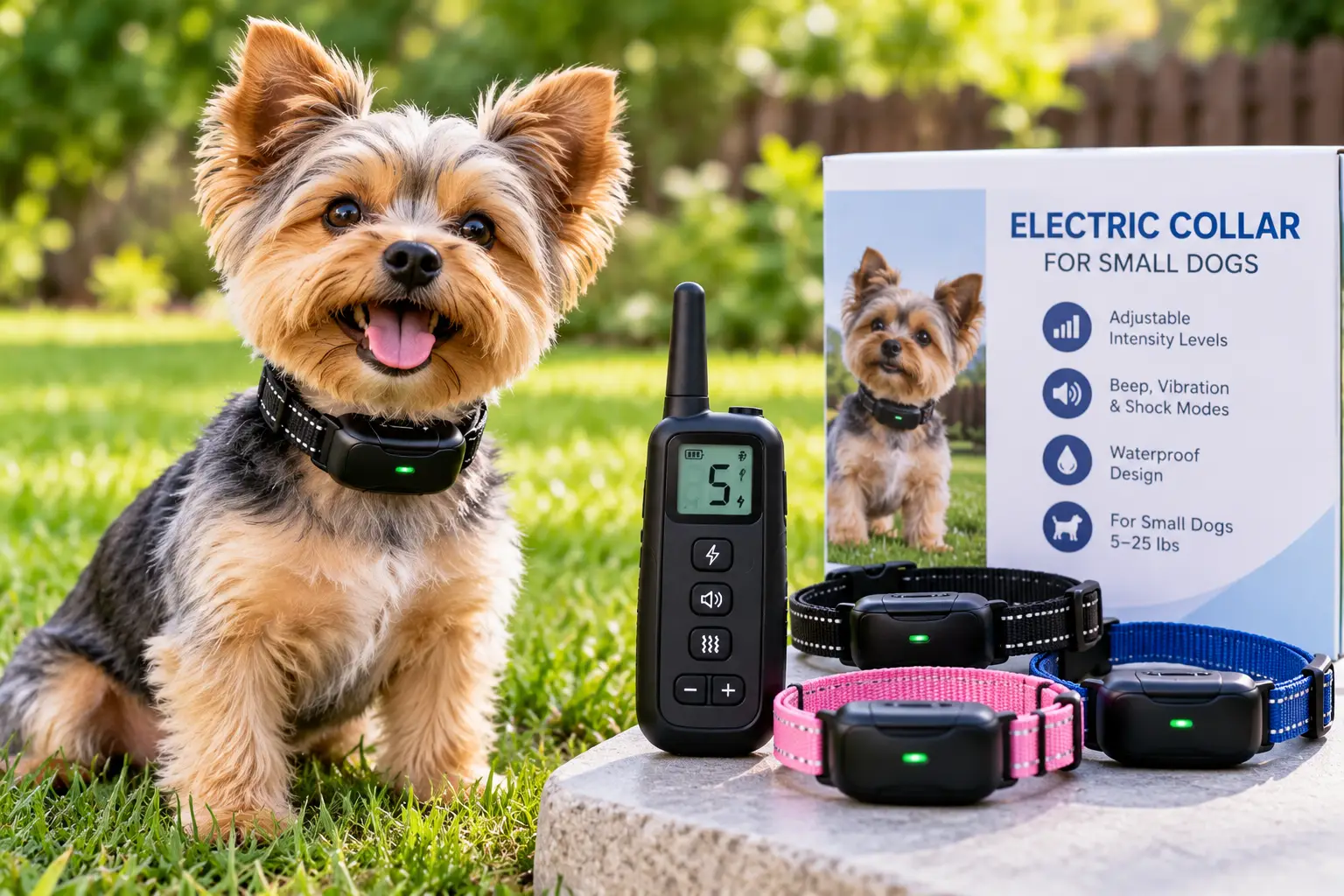
An electric collar for small dogs is a remote training system with a handheld transmitter and a compact, lightweight receiver worn on the neck. It delivers a tone, a vibration, or an adjustable static pulse through two contact points, with lower power ranges and smaller receivers built for dogs roughly 5 to 25 pounds.
You’ll also see it called an e-collar for small dogs, a remote training collar for small dogs, or, less flatteringly, a small dog shock collar. The terms describe the same category. What separates a good one from a bad one isn’t the name on the box but how fine the low end of the stimulation dial is, and whether you can train with tone and vibration alone.
Quick Comparison: 7 Electric Collars for Small Dogs at a Glance
| Model | Min. Dog Weight | Range | Static Levels | Non-Stim Modes | Price Range | Best For |
|---|---|---|---|---|---|---|
| Educator ME-300 Micro | 5 lbs | 1/3 mile | 100 + boost | Tone or vibration | Around $200-$220 | Educator ME-300 Micro: tiny, sensitive dogs |
| Educator ET-300 Mini | 5 lbs | 1/2 mile | 100 + boost | Tone or vibration | Around $200-$220 | Educator ET-300 Mini: small dogs with normal temperaments |
| Dogtra 200iQ | 10 lbs | 1/2 mile | 100 | Tone + vibration | Around $200 | Dogtra 200iQ: first-time e-collar users |
| Dogtra 280X | 10 lbs | 1/2 mile | 100 | Tone + vibration | $230-$250 | Dogtra 280X: night walks, multi-dog homes |
| PetSafe Remote Trainer Lite | 8 lbs | 100-600 yards | 15 | Tone + vibration | $140-$160 | PetSafe Remote Trainer Lite: in-home manners |
| SportDOG FieldTrainer 425X | 8 lbs | 500 yards | 21 | Tone + vibration | $155-$180 | SportDOG FieldTrainer 425X: outdoorsy small dogs |
| Bousnic Dog Training Collar (RS2) | 5 lbs | 3,300 ft | 99 | Beep + vibration | Under $70 | Bousnic Dog Training Collar (RS2): tight budgets, tone-first training |
Looking at the table, the two Educator models are the only premium picks officially rated down to 5 pounds, which makes them the safest starting point for Chihuahuas, Yorkies, and toy poodles. The Dogtra 200iQ and Dogtra 280X share the same 2.4-ounce receiver but start at 10 pounds, so they suit sturdier small breeds like Jack Russells, Frenchies, and miniature schnauzers. Meanwhile, the Bousnic Dog Training Collar (RS2) costs a fraction of the rest, yet its huge 1-99 static scale isn’t calibrated as finely for tiny necks, so it works best when you lean on beep and vibration.
💬 One click helps other shoppers make an informed choice too! 😊 Tap any highlighted model to check current pricing and availability.
Top 7 Electric Collars for Small Dogs: Expert Analysis
Every pick below is a real model sold in the US, with specs drawn from manufacturer and authorized-dealer listings. Ratings and review themes are aggregated from retailer pages at the time of writing, and they change, so always check the live listing.
1. Educator ME-300 Micro — smallest receiver for tiny, soft dogs
The Educator ME-300 Micro exists for one reason: dogs too small or too sensitive for a standard e-collar.
Its RX-070 receiver is about 20% smaller, lighter, and less stimulating than the Mini Educator’s, and its contact points sit roughly 20% closer together. In practice, that closer spacing matters on a 6-inch neck, where wider probes can straddle the windpipe instead of resting on muscle. You still get 100 “blunt” stimulation levels, an adjustable boost (1-60), and the “lock and set” feature that freezes your chosen level so a bumped dial can’t jump you to 40.
Based on comparing the specs, this is the most conservative premium option on the list. It suits Chihuahuas, Maltese, toy poodles, and any anxious dog where the goal is a whisper, not a correction. The 1/3-mile range sounds short, but very few small-dog owners train beyond a large park.
Aggregated ratings sit in the mid-4-star range across a few hundred reviews at the time of writing. Detailed written feedback is thinner than for the Mini, so weigh the spec sheet heavily.
Pros:
- ✅ Lowest-output Educator receiver, built for small necks
- ✅ Lock and set prevents accidental level jumps
- ✅ Waterproof remote and collar, expandable to two dogs
Cons:
- ❌ Shorter range than the similarly priced Mini
- ❌ Biothane strap must be trimmed to size
Price & value: Around $200-$220; worth the premium if your dog weighs under 10 pounds.
2. Educator ET-300 Mini — most adjustable all-rounder from 5 pounds
The Educator ET-300 Mini is the model professional trainers most often hand to small-dog clients with average temperaments.
Its 2.4-ounce receiver is rated for dogs 5 pounds and up, while the puck-shaped remote floats if dropped in a pond. Leerburg’s product notes say smaller dogs typically use boost settings of 1 to 20, which tells you the useful range for a terrier sits at the bottom of the dial. The built-in tracking light, solid or flashing, is a genuine help for evening potty breaks.
Here’s what to weigh: the Mini has more headroom than the Micro, so it fits a 15-pound beagle mix that ignores tone but would be overkill for a timid 5-pound Yorkie. Two sets of contact points (5/8 and 3/4 inch) let you match short or fluffy coats.
Review sentiment is mixed by channel. Trainer-run shops rate it highly, while at least one general retailer shows a mid-3-star average, so expect a learning curve with the unusual remote.
Pros:
- ✅ Fine 1-100 dial plus adjustable boost
- ✅ Night tracking light for evening walks
- ✅ Floating, waterproof remote survives dropped-in-the-creek moments
Cons:
- ❌ Puck-style remote takes time to learn
- ❌ More power than very tiny dogs need
Price & value: Around $200-$220; strong value for 10-25 pound dogs.
3. Dogtra 200iQ — simplest one-handed remote for beginners
The Dogtra 200iQ is Dogtra’s newer everyday collar, and it replaces the long-running iQ Plus and iQ Mini.
The receiver weighs 2.4 ounces and fits dogs 10 pounds and up with necks of at least 7 inches. You get 100 levels of momentary (nick) and continuous stimulation, Dogtra’s XPP vibration, an audible tone, and a flashing LED. The front-facing thumb dial is the standout: you can change levels without looking down, which keeps your eyes on the dog at the exact moment timing matters.
The spec sheet doesn’t say this, but the 10-pound floor is a real filter. A 7-pound Pomeranian should look at the Educator Micro instead. For a 12-pound Shih Tzu mix or a 20-pound Frenchie, though, the IPX9K waterproof rating and USB-C charging make daily life easy. Dogtra also notes the contacts can be removed for vibration-only training.
Ratings are still building for this newer model; one farm-and-ranch retailer shows a high-3-star average. Much of the online feedback still refers to its predecessor, the iQ Plus.
Pros:
- ✅ Thumb dial changes levels without looking
- ✅ IPX9K waterproofing and USB-C charging
- ✅ Expandable to a two-dog system
Cons:
- ❌ Not rated for dogs under 10 pounds
- ❌ Test light and belt clip sold separately
Price & value: Around $200; good value for first-time e-collar users.
4. Dogtra 280X — brightest light and screen for night walks
The Dogtra 280X takes the same compact receiver as the Dogtra 200iQ and pairs it with a more feature-dense remote.
You still get a 2.4-ounce receiver rated for dogs 10 pounds and up, 100 medium-output levels, nick, continuous, and XPP vibration. The upgrades are on the handheld: a 1-inch LCD screen showing your exact level, a central command button, boost and level lock, and an LED locate light on the collar. The 280X also expands to three dogs instead of two.
What most buyers overlook is the remote weight. At 5.2 ounces versus 3.7 ounces on the 200iQ, it’s chunkier in the hand. That’s a fair trade if you walk at dawn or dusk and want to see both your dog and your setting clearly. Households with two or three small dogs will value the expansion most.
It appears as an editor’s choice in several 2026 roundups, but verified retailer reviews for the current edition are still sparse. Treat praise for its predecessor, the 280C, as a rough guide only.
Pros:
- ✅ LCD screen shows the exact stimulation level
- ✅ Collar LED helps you spot your dog after dark
- ✅ Expandable to three dogs on one remote
Cons:
- ❌ Heavier remote than the 200iQ
- ❌ Still not rated below 10 pounds
Price & value: Roughly $230-$250; worth it mainly for multi-dog or low-light use.
5. PetSafe Remote Trainer Lite — gentlest budget option for in-home manners
The PetSafe Remote Trainer Lite is PetSafe’s softer version of its standard remote trainer, aimed at shy, timid, or small dogs.
The collar fits dogs 8 pounds and up with necks from 6 to 23 inches. You get tone, vibration, and 15 static levels, with a safety lock on the higher levels. PetSafe describes the Lite’s levels as slightly lower than the standard model. In the US it’s sold mainly in 100-yard and 300-yard versions, and the 300-yard model accepts an add-a-dog collar.
Based on comparing the specs, 15 levels is coarse next to a 100-step dial. Each click is a bigger jump, so finding a dog’s true “just noticeable” level is harder. On the other hand, a 100-yard range is all you need to stop counter surfing, doorway bolting, or lunging at the window.
We couldn’t verify a large, consistent pool of reviews specific to the Lite version, so lean on the spec sheet and the retailer’s return policy before committing.
Pros:
- ✅ Lower-output Lite tuning for sensitive dogs
- ✅ Two-hour charge, up to 40 hours of battery
- ✅ Safety lock guards the higher static levels
Cons:
- ❌ Only 15 levels, so steps are coarse
- ❌ Short range on the entry 100-yard version
Price & value: Around $140-$160; fair value for indoor and backyard use.
6. SportDOG FieldTrainer 425X — toughest waterproofing for outdoorsy small dogs
The SportDOG FieldTrainer 425X is SportDOG’s smallest, lightest e-collar, built for close-working dogs on trails and in fields.
It fits dogs 8 pounds and up with 5- to 22-inch necks. You get tone, vibration, and 21 static levels in low and medium ranges, adjustable on the collar itself. DryTek waterproofing allows submersion to 25 feet, and batteries charge in two hours and last 50 to 70 hours. Range is 500 yards, expandable to three dogs.
Here’s what to weigh: SportDOG markets this for hunting, yet the low/medium tuning suits a 15-pound terrier who swims, digs, and chases. The no-look remote is designed for operation by feel. Just don’t confuse it with the 425XS, which uses a higher static range for stubborn dogs and is the wrong pick for most small breeds.
At one large outdoor retailer, it averages around 4.7 out of 5 across roughly 200 reviews at the time of writing. That’s one of the most consistent rating pools on this list.
Pros:
- ✅ Submersible to 25 feet for water-loving dogs
- ✅ Long 50-70 hour battery life
- ✅ Expandable to three dogs
Cons:
- ❌ 21 levels feel coarser than 100-step dials
- ❌ Easy to confuse with the stronger 425XS
Price & value: Around $155-$180; excellent value for active outdoor small dogs.
7. Bousnic Dog Training Collar (RS2) — cheapest way to start tone-first training
The Bousnic Dog Training Collar (RS2) is a budget, dual-channel collar listed for dogs from 5 to 120 pounds.
It offers beep (8 levels), vibration (16 levels), and static (99 levels), plus a 3,300-foot range, an IP67 waterproof receiver, and a safety on/off switch on the remote. Two dogs can run off one remote. In practice, the generous beep and vibration scales are the real story here: they give a small dog meaningful non-static options.
Our honest analysis: one receiver for 5 to 120 pounds means the static scale is not calibrated for tiny necks, and there’s no lock-and-set. If you buy it, treat it as a tone and vibration collar first. A Chewy reviewer even cautioned against using it on a dog smaller than a standard Chihuahua.
The RS2 carries thousands of ratings averaging in the low-4-star range on large retail listings. Reviews consistently report that beep and vibration alone handle most corrections.
Pros:
- ✅ Lowest cost by a wide margin
- ✅ Separate, fine scales for beep and vibration
- ✅ Trains two dogs from one remote
Cons:
- ❌ Static scale not tuned for very small dogs
- ❌ No lock feature to prevent level slips
Price & value: Usually under $70; good value only if you mostly use tone and vibration.
✨ Ready to find the right fit for your little one?
🔍 Click any highlighted collar above to check current pricing, size options, and availability. The right match will help you get calmer walks and a reliable recall your whole family will enjoy!
Your First 30 Days With an E-Collar for Small Dogs
A collar is only as gentle as the routine around it. This four-week plan keeps the tool in the background and your rewards in front.
Week 1: Fit and wear, no buttons
Put the receiver on for short, happy stretches: meals, play, walks. Rotate its position every hour or two, and never leave it on overnight. The goal is a dog who sees the collar as “walk time,” not “trouble time.” Snug means you can slide one finger, not two, between the contacts and the skin.
Week 2: Teach tone and vibration as cues
Pair the tone with a treat, the same way you’d charge a clicker. After a few days, use tone right before “come” and reward generously at your feet. Many small dogs never need more than this. If yours does, test vibration next, again followed by a reward.
Week 3: Find the working level, if you need one
Start at level 1 in a quiet room and raise one step at a time. Stop at the first sign of awareness: an ear flick, a head turn, a pause. That’s your working level, and on a small dog it is often in the single digits. Then lock it with “lock and set” or level lock where available.
Week 4: Add distractions slowly
Move to the yard, then a quiet park, then a busier one. Keep using a long line so you can help the dog succeed without pressing anything. Common first-month mistakes include raising levels when the real issue was a loose fit, and using static for problems that need management, like barking at the window.
Real-World Scenarios: Matching Small Dogs to the Right Collar
Specs only matter once you put them in a real life. Here are three common profiles and the reasoning behind each match.
Scenario 1: The 6-pound apartment Chihuahua
Maria lives in a city apartment, walks twice a day, and mainly wants a reliable recall in the dog run. Her budget is about $200. The Educator ME-300 Micro fits best: it’s rated from 5 pounds, the closer contact points suit a tiny neck, and its 1/3-mile range far exceeds any dog run. She’ll likely train on tone alone.
Scenario 2: The 18-pound trail-loving Jack Russell
Dan hikes every weekend, and his terrier swims, digs, and chases chipmunks. He wants waterproofing and battery life above all. The SportDOG FieldTrainer 425X makes sense: 500 yards covers trail recall, the collar is submersible to 25 feet, and 50-70 hours per charge outlasts a long weekend. The Dogtra 200iQ is the runner-up if he prefers a finer 100-step dial.
Scenario 3: Two senior Shih Tzus in the suburbs
The Parkers want to stop door-dashing, train in a fenced backyard, and keep the budget near $150. The PetSafe Remote Trainer Lite in its 300-yard version works here: its Lite tuning favors sensitive dogs, and an add-a-dog collar covers the second pup. Frequency of use will be low, so battery life matters less than simplicity.
Problem → Solution: Fixing Common Small-Dog E-Collar Issues
Most “the collar doesn’t work” complaints come down to fit, timing, or the wrong tool for the job.
- The dog doesn’t react, even at higher levels. Check fit first. On fluffy coats like a Pomeranian’s, switch to longer contact points before touching the dial. Educator kits include both 5/8 and 3/4-inch points.
- Red marks or irritation on the neck. This usually signals pressure, not stimulation. Rotate the receiver regularly, cut wear time, wash the area, and pause until the skin heals. Ask your vet if it persists.
- The dog behaves only when wearing the collar. That’s collar-wise behavior. Put the receiver on at random times without using it, and keep rewards flowing so good behavior pays everywhere.
- Fear, freezing, or hiding. Stop using static right away. Go back to tone and treats, or drop the e-collar entirely and call a credentialed trainer or veterinary behaviorist.
- The remote triggers by accident in a pocket. Use the safety switch on the Bousnic Dog Training Collar (RS2), the lock features on the Educator and Dogtra models, or simply carry the remote on a lanyard.
How to Choose Electric Collars for Small Dogs
Use these seven steps in order; each one narrows the field fast.
- Weigh your dog and measure the neck. Minimum ratings are real limits. Under 10 pounds, stick to models rated from 5 pounds, like the two Educators.
- Check receiver weight. Around 2.4 ounces is the small-dog sweet spot. Heavier receivers slide and press on narrow necks.
- Look at the low end of the dial, not the top. A 100-step scale lets you find a barely noticeable level. Fifteen steps means bigger jumps between clicks.
- Insist on tone and vibration. These are the modes most small dogs end up using most, so they shouldn’t be an afterthought.
- Prefer a level lock. Lock and set, or level lock, stops accidental jumps when the remote bumps your keys.
- Match range to real life. A backyard needs 100 yards; a trail needs 500. Paying for a mile of range on a lap dog rarely adds value.
- Confirm contact point sizes. Long or double coats need longer points; short coats need shorter ones to avoid poking.
Common Mistakes to Avoid When Buying a Small Dog Shock Collar
The most expensive mistake isn’t overspending; it’s buying the wrong power range. Small-dog owners often grab a bestselling “5-120 pound” collar without realizing that one receiver can’t be equally precise for a Chihuahua and a Great Dane.
Another frequent error is shopping by headline range. A 3,300-foot claim looks impressive, but for a 9-pound dog that never leaves a fenced yard, a finer dial and smaller receiver matter far more.
Third, many buyers skip the variant check. The SportDOG FieldTrainer 425X and the higher-powered 425XS look nearly identical in listings. Likewise, Educator’s Micro and Mini share a remote shape, so read the receiver model before you click.
Finally, don’t buy an e-collar to fix a behavior rooted in fear or anxiety, like barking at visitors or snapping when handled. Those problems need behavior modification, ideally with a professional, and static stimulation can make them worse.
E-Collars vs. Reward-Based Training and Other Alternatives
A remote training collar for small dogs isn’t your only option, and for many dogs it isn’t the first one to try.
| Approach | Off-Leash Reach | Learning Curve | Welfare Concerns | Best For |
|---|---|---|---|---|
| Reward-based training + long line | Limited by line length | Moderate | Lowest | Every dog, as the foundation |
| Vibration collar for small dogs (no static) | Up to remote range | Low | Low to moderate | Sensitive dogs, deaf dogs |
| Low-level e-collar with tone first, e.g. Educator ME-300 Micro | Up to remote range | High | Contested by vet groups | Recall in open spaces, used with rewards |
| Bark-activated static collar | N/A | Low | Higher; works without owner timing | Generally not recommended |
The table shows the real trade-off: an e-collar extends your reach, but it also demands the most skill and draws the most criticism. The British Small Animal Veterinary Association recommends positive reinforcement and supports legislation banning electric shock collars, as its position on aversive training methods explains. In short, reward-based training is the foundation no matter which collar you choose, and a vibration-only setup is a reasonable middle step.
Features That Actually Matter (and Ones That Don’t)
Marketing pages love big numbers. For small dogs, most of them are noise.
What matters: receiver weight and size, minimum dog weight, the number of low-end levels, a working level lock, contact point options, and genuine tone and vibration modes. These features decide whether your dog feels a gentle tap or a jolt.
What matters a little: waterproofing (IPX9K or submersible ratings help swimmers), battery life, and a collar light for evening walks. The Dogtra 280X earns its higher price mostly here.
What rarely matters: half-mile-plus range, three-dog expansion for a one-dog home, and “humane” or “safe shock” labels. Those labels aren’t regulated standards, so judge a collar by its spec sheet, not its adjectives.
One overlooked detail: Educator describes its stimulation as “blunt” and Dogtra lists “medium output.” Neither term is standardized across brands, so you can’t compare level 10 on one collar with level 10 on another. Always find the working level fresh.
Long-Term Cost and Maintenance
The sticker price is only the first payment. Here’s how the true cost of ownership tends to break down.
| Model | Upfront Cost | Second-Dog Add-On | Rechargeable | Value Verdict |
|---|---|---|---|---|
| Educator ME-300 Micro | Around $200-$220 | Expandable to 2 dogs | Yes | Premium, built to last |
| Dogtra 200iQ | Around $200 | 2-dog bundles around $290 | Yes, USB-C | Strong mid-range value |
| PetSafe Remote Trainer Lite | $140-$160 | 300-yard version only | Yes | Fair for indoor use |
| Bousnic Dog Training Collar (RS2) | Under $70 | Built-in dual channel | Yes | Cheapest start, least precision |
The table makes one point clear: the cheapest collar is also the cheapest to expand, while the premium brands charge real money for a second receiver. Over three to five years, though, warranty support, replaceable batteries, and US-based customer service, which Dogtra highlights, can matter more than a $100 gap upfront. Budget a few dollars for replacement straps too, since nylon and biothane wear out with daily use.
Maintenance is simple: wipe contacts and the neck area weekly, charge before each outing, and inspect the strap monthly for cracks.
Safety, Regulations, and Standards
In the US, no federal standard specifically certifies dog training collars, so manufacturer rules are your main guardrails. Dogtra states its e-collars aren’t meant for dogs under 10 pounds or under six months of age, and PetSafe and SportDOG set similar minimum weights and age limits. Dogtra also warns never to attach a leash to the e-collar strap, because a pulled strap drives the contacts into the neck.
Local rules are shifting. San Francisco officials have reviewed draft legislation to ban the use and sale of e-collars, and several countries already restrict them; Wales, for example, has prohibited electronic collars for dogs and cats since 2010. Check your city and state before buying.
Practical safety habits matter most: use the lowest effective level, never leave the collar on unattended for hours, check the skin daily, and stop if your dog shows fear or stress. If you aren’t sure whether your dog is a good candidate, ask your veterinarian first.
FAQ About Electric Collars for Small Dogs
❓ Can you use an e-collar on a 5-pound dog?
❓ Is a vibration collar better than a shock collar for small dogs?
❓ What is the best electric collar for a Chihuahua?
❓ How many hours a day can a small dog wear an e-collar?
❓ Are cheap e-collars safe for small dogs?
Conclusion: The Right Electric Collar Is the Gentlest One That Works
Choosing among electric collars for small dogs is less about power and more about restraint. The best picks share a small, light receiver, a fine low end on the dial, real tone and vibration modes, and a lock that keeps you from overdoing it.
If your dog weighs under 10 pounds, the Educator ME-300 Micro is the clearest match. For a 10-25 pound dog with a typical temperament, the Educator ET-300 Mini and Dogtra 200iQ offer the best balance of precision and ease. Outdoor adventurers should look at the SportDOG FieldTrainer 425X, night walkers and multi-dog homes at the Dogtra 280X, and indoor-only households at the PetSafe Remote Trainer Lite. On a tight budget, the Bousnic Dog Training Collar (RS2) is a reasonable tone-and-vibration starter.
Whatever you choose, build on rewards. Veterinary behavior groups favor reward-based training, and even trainers who use e-collars treat them as a quiet cue, not a punishment. Start low, stay patient, and stop if your dog seems worried. A good recall should feel like a game your dog wants to win, not a test it fears failing.
✨ Don’t miss the right fit for your little one!
🔍 Take your small dog training to the next level with this carefully curated lineup. Click a highlighted collar to check current pricing and availability. These picks will help you get calmer walks and a reliable recall the whole family will enjoy!
Recommended for You
- Small Dog Training Collar: 7 Best Gentle Picks for 2026
- Removable Dog Fence: 7 Best No-Dig Picks That Actually Work (2026)
- Best Temporary Dog Fence for Large Dogs: 7 Options Compared
Disclaimer: This post contains affiliate links. As an Amazon Associate, I earn from qualifying purchases made through these links, at no additional cost to you.
✨ Found this article helpful? Share it with someone who needs it! 💬🤗