
In This Article
Indoor Cat Barrier Basics: Why Your Doorways Need a Rethink
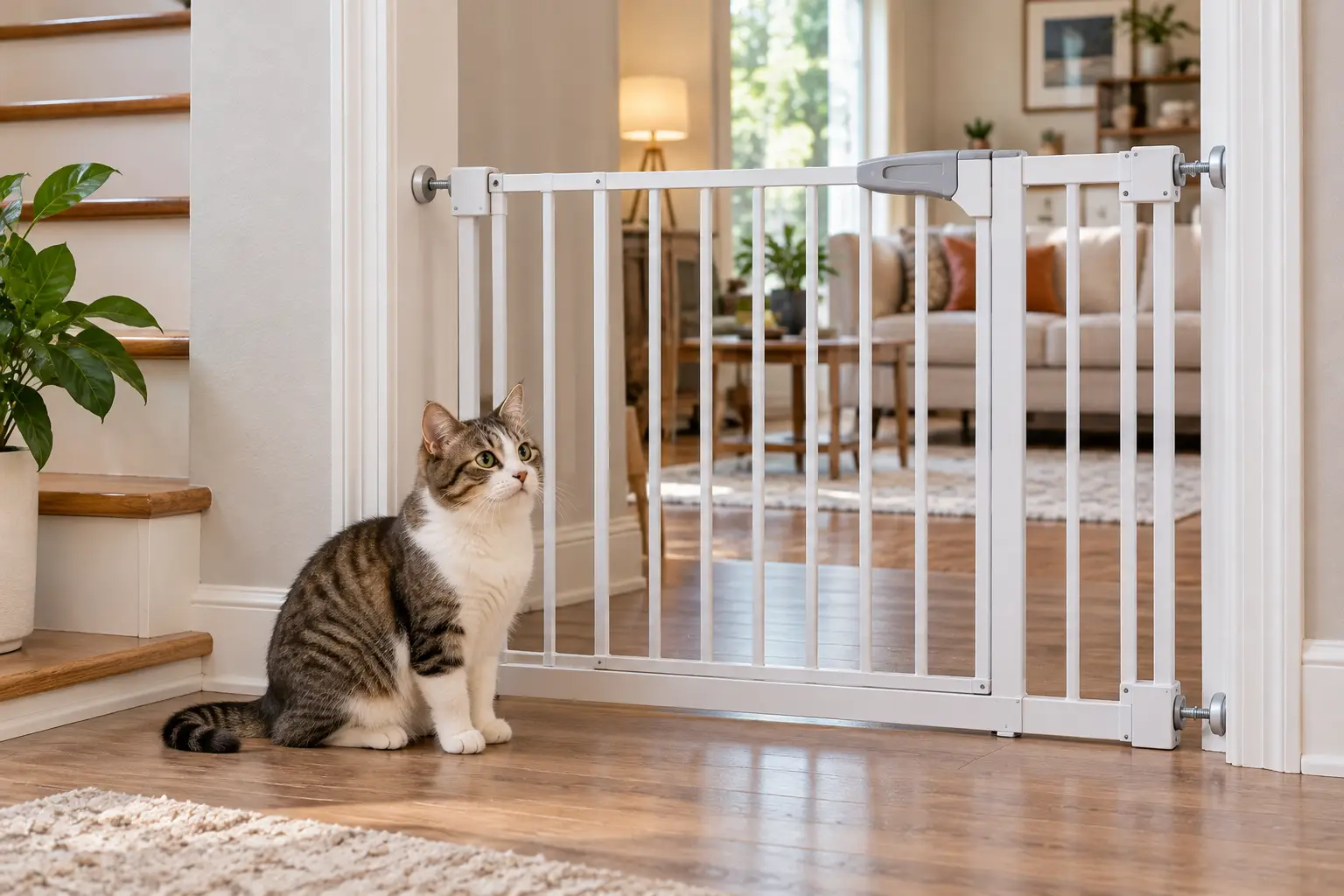
It’s 2 a.m. The bedroom door is shut, and your cat has strong opinions about that. Scratching, yowling, one pitiful paw sliding under the gap… sound familiar? An indoor cat barrier solves the problem nearly every cat owner eventually hits: you need to keep a cat out of (or inside) one part of the house without slamming a door on airflow, visibility, and your own sanity. Pick the wrong indoor cat barrier, though, and you’ve just bought a very expensive hurdle your cat clears for fun.
Here’s the catch most product listings skip. Cats are vertical animals. A 36-inch gate that stops a toddler or a Labrador is, for a healthy adult cat, often just a launchpad with a nice view. So the “right” barrier depends less on the brand name and more on three things: how high your cat can jump, how wide your opening is, and what you’re actually protecting — a nursery, a litter box from the dog, a home office, or an open front door.
There’s a welfare angle, too. Veterinary research on environmental enrichment for indoor cats stresses that indoor cats need predictable, low-stress spaces where stressors like dogs, other cats, and small children are kept to a minimum. In other words, a good barrier isn’t only about saying “no.” Used well, it carves out a quiet retreat for a senior cat, keeps the dog’s nose out of the food bowl, or separates two cats during a slow reintroduction.
Below, you’ll find seven real options available on amazon.com — from 75-inch floor-to-ceiling gates to a zippered mesh screen door and a counter-training mat. Each one is analyzed from spec sheets, retailer listings, and aggregated owner feedback. No invented test labs, no fake reviews — just the reasoning you need to buy once and buy right.
What Is an Indoor Cat Barrier?
An indoor cat barrier is any device that limits where a cat can go inside your home — most often an extra tall cat gate mounted in a doorway, but also mesh screen doors, stair netting, and deterrent mats. Unlike standard baby gates, effective cat barriers are designed around jumping, climbing, and squeezing through gaps.
That definition matters because the category is broader than most shoppers expect. Here’s how the main types break down in practice:
Extra tall gates (51 to 98 inches)
These are the heavy hitters. Their height removes the jump-over route entirely, and the best ones use narrow vertical bars (around 1.37 inches apart) so a slim cat can’t slip between them. They’re the closest thing to a door that you can see through.
Gates with built-in cat doors
These do the opposite job: they let the cat through while blocking a dog (or, sometimes, a crawling baby — though that use now raises regulatory red flags, covered in the safety section below). Think of them as a velvet rope for felines.
Mesh screen doors
Zippered, cat-resistant mesh panels stick to a door frame. They keep air and light flowing while sealing the doorway — ideal for patio doors, laundry rooms, and summer heat.
Deterrent mats
Training mats don’t block a doorway at all. Instead, they teach a cat that a specific surface — the kitchen counter, the sofa back, the spot in front of the Christmas tree — is off-limits. They’re the “invisible fence” of the indoor world.
Indoor Cat Barrier Quick Comparison
| Product | Type | Height / Size | Fits | Price Range | Best for |
|---|---|---|---|---|---|
| unipaws 75″ High Extra Tall Cat Gate | Floor-to-ceiling gate | 75″ body, rods to 98″ | 21″–34″ or 35″–38″ | ~$140–$180 | Best for escape artists |
| Gardner Pet 51″–87″ Extra Tall Cat Gate | Adjustable-height gate | 51″–87″ | 27.56″–37″ | ~$100–$200 | Best for growing problems |
| Lumizone 61″ Extra Tall Pet Gate | Tall pressure gate | 61″ | Many sizes | ~$65–$120 | Best for value seekers |
| Uforic 55″ Extra Tall Pet Gate with Cat Door | Tall gate + cat door | 55″ | 29.5″–48″ | ~$100–$130 | Best for dog-and-cat homes |
| Carlson 36″ Extra Tall Walk-Thru Gate with Pet Door | Standard gate + pet door | 36″ | Standard doorways | ~$40–$70 | Best for litter box guarding |
| NEWEEN Cat Screen Door | Zippered mesh screen | Fits 30″ x 80″ doors | Standard doors | Under $40 | Best for airflow lovers |
| PetSafe ScatMat Indoor Pet Training Mat | Static deterrent mat | Several sizes | Counters, sofas, floors | ~$40–$100 | Best for counter surfers |
Looking at the table, the split is clear: if your cat already jumps a standard gate, only the unipaws 75″ High Extra Tall Cat Gate, the Gardner Pet 51″–87″ Extra Tall Cat Gate, or the Lumizone 61″ Extra Tall Pet Gate truly solve the height problem. Meanwhile, the Carlson 36″ Extra Tall Walk-Thru Gate with Pet Door and the Uforic 55″ Extra Tall Pet Gate with Cat Door solve a completely different problem — keeping dogs out of cat territory. Prices are approximate at the time of writing, so check current pricing before you decide.
💬 One click helps other shoppers make an informed choice too! 😊
Top 7 Indoor Cat Barrier Picks for 2026: Expert Analysis
Every pick below is a real product listed on amazon.com. Product specs come from manufacturer and retailer listings; review sentiment is aggregated from public owner feedback and labeled honestly when it’s thin.
1. unipaws 75″ High Extra Tall Cat Gate — floor-to-ceiling block for escape artists
If your cat treats every gate as a personal challenge, this is the one that ends the game. The unipaws 75″ High Extra Tall Cat Gate pairs a 75-inch body with extendable rods that reach up to 98 inches, bracing against the top of the opening instead of relying on side pressure alone. In practice, that turns a doorway into something close to a wall with a door in it — there’s simply no top edge for your cat to hook its front paws over.
It ships in a 21″–34″ width version and a 35″–38″ version, so measure first; that narrow range is the trade-off for a rigid frame. The door auto-closes when pushed partway and stays open at 90 degrees, which matters more than it sounds. After all, the most common way cats “beat” a gate is a human leaving it ajar.
Based on the specs, this is the pick for determined jumpers, homes guarding an exterior door, and owners who need total separation — a quarantine room for a newly adopted cat, for instance. Owner feedback on retailer listings praises the close bar spacing and the lightweight swing door; one reviewer’s headline captures the main trade-off neatly: strong gate, weaker latch.
Pros:
- ✅ Rods reach up to 98 inches, sealing the jump route
- ✅ Auto-close plus stay-open at 90 degrees
- ✅ No drilling needed for rental-friendly installs
Cons:
- ❌ Narrow width ranges demand careful measuring
- ❌ Latch draws more complaints than the frame
Price range: roughly $140–$180 depending on width and color — strong value if nothing shorter has worked.
2. Gardner Pet 51″–87″ Extra Tall Cat Gate — widest height adjustment in the lineup
The Gardner Pet 51″–87″ Extra Tall Cat Gate earns its spot through flexibility: height adjusts from 51 to 87 inches, and width covers roughly 27.56 to 37 inches with included extensions. Why does adjustable height matter? Because you rarely know your cat’s true ceiling until you test it. You can start at a less intrusive 51 inches, then raise the gate if your cat proves it can clear that.
At full extension, the Gardner Pet behaves much like the unipaws — a near floor-to-frame barrier — but with more room to grow into different openings. Editorial roundups also highlight its closely set vertical bars, which shut down the “squeeze between the slats” trick that kittens and slim adults love.
On paper, this is ideal for hallway dividers in multi-cat homes and for owners who move often and need one gate to fit several houses. Honesty check: we couldn’t verify a large body of independent US owner reviews for this specific listing. Third-party roundups rate it highly, but treat those as a starting point — and scan recent Amazon reviews with install photos before buying.
Pros:
- ✅ Height range from 51 to 87 inches
- ✅ Close bar spacing stops slat squeezers
- ✅ Extension kit adapts to several door widths
Cons:
- ❌ Limited verifiable independent review data
- ❌ Full-height setups look imposing in open rooms
Price range: check the current price; tall adjustable gates in this class usually land between $100 and $200, so compare before you commit.
3. Lumizone 61″ Extra Tall Pet Gate — best balance of height and budget
The Lumizone 61″ Extra Tall Pet Gate stands just over 61 inches, uses a 1.37-inch bar gap, and offers auto-close with one-handed operation — all in a pressure-mounted frame that skips the drill. What really sets it apart is sizing: the listing comes in dozens of width and color combinations, so you’re more likely to find an exact fit rather than stacking awkward extensions.
Translated into daily life, 61 inches stops most average adult cats from a standing start. However, it won’t stop every athlete — especially if a couch, cat tree, or counter sits within leaping distance of the gate. Placement matters as much as height here.
Who’s it for? Renters, budget-conscious owners, and anyone whose cat is curious rather than relentless. If you’ve got a laid-back indoor cat who mostly wanders into the nursery out of habit, the Lumizone is probably all the barrier you need. Retail data shows it as a best seller on at least one major US retailer, and owner sentiment generally centers on solid value for the height — though specific long-term durability feedback is limited.
Pros:
- ✅ Over 61 inches tall at a mid-range price
- ✅ Narrow 1.37-inch gap blocks kittens
- ✅ Huge size selection for precise fitting
Cons:
- ❌ Athletic cats may clear it from nearby furniture
- ❌ Pressure mounts can loosen without periodic checks
Price range: roughly $65–$120 depending on size — excellent value per inch of height.
4. Uforic 55″ Extra Tall Pet Gate with Cat Door — dog-proof, cat-friendly zoning
Here’s a different philosophy. The Uforic 55″ Extra Tall Pet Gate with Cat Door doesn’t try to stop your cat at all — it stops your dog while letting the cat stroll through a built-in door. At 55 inches tall and 29.5″–48″ wide, with auto-close and no drilling, it’s built for one of the most common multi-pet headaches: the dog eating the cat’s food or raiding the litter box.
What this means in practice: you can set up a cat-only “safe room” with food, water, and a litter box, and your cat comes and goes freely while your dog stays out. Meanwhile, the 55-inch height discourages larger dogs from jumping over — a real risk with standard 36-inch gates.
One important limitation, though. Small dogs and puppies may fit through the cat door, so measure your dog’s shoulder width before trusting it. And because federal rules now bar pet openings on gates meant for young children, don’t treat this as a baby gate.
Review sentiment: the gate has gathered more than 100 ratings at a major US retailer, but we couldn’t verify detailed, consistent themes — check recent Amazon feedback for cat-door sizing comments.
Pros:
- ✅ Lets cats pass while blocking larger dogs
- ✅ 55-inch height deters jumping dogs
- ✅ Wide 29.5″–48″ fit for open layouts
Cons:
- ❌ Small dogs may squeeze through the cat door
- ❌ Not suitable as a child safety gate
Price range: around $100–$130 — fair value for a two-in-one zoning tool.
5. Carlson 36″ Extra Tall Walk-Thru Gate with Pet Door — budget litter-box guard for multi-pet homes
The Carlson 36″ Extra Tall Walk-Thru Gate with Pet Door is a classic for good reason: all-steel construction, a quick pressure-mount setup, and a small pet door measuring roughly 7.5″ wide by 7.75″ high. Owner feedback notes the little door swings both ways and can be latched shut with a spring-action lock, so you can switch between “cat pass-through” and “fully closed” in seconds.
Let’s be honest about what 36 inches means for cats: almost nothing. A healthy adult cat can usually hop it. In fact, one owner of several indoor cats described them as athletes who had defeated other gates before. So the Carlson isn’t really a cat-stopper — it’s a dog-stopper with a cat-sized loophole, and it’s very good at that job.
Based on the specs and owner reports, it’s the smartest low-cost way to guard a litter box or feeding station from a medium or large dog. It’s also handy for senior cats with arthritis who no longer jump much, giving them a quiet corner the dog can’t invade.
Pros:
- ✅ Lockable pet door adds flexible control
- ✅ Chew-proof steel holds up to dogs
- ✅ Budget-friendly entry into multi-pet zoning
Cons:
- ❌ Adult cats can easily jump 36 inches
- ❌ Small dogs may fit through the pet door
Price range: usually in the $40–$70 range — the best budget pick when the dog is the real problem.
6. NEWEEN Cat Screen Door — airflow without the escape route
Sometimes the barrier you need isn’t a gate at all. The NEWEEN Cat Screen Door fits door openings up to about 30″ x 80″, attaches with adhesive hook-and-loop strips (no tools), and uses a double zipper you can open from inside or outside. The mesh is thicker than standard window screen, designed to resist claws.
In practice, this is what you want when you’d like a door open for air conditioning, a breeze, or to hear what’s happening — but can’t risk your cat bolting. Patio doors, laundry rooms, and home offices are classic uses. It’s also a renter’s dream, since nothing gets drilled.
Review sentiment across this category of cat-resistant mesh doors (not only this brand) is notably consistent. Owners like that heavier mesh survives claws far better than regular screens, and several mention cats climbing it without damage. The most common complaint is the adhesive: some owners report strips peeling off, then fixing it with a stronger third-party hook-and-loop roll. Zippers can also feel fiddly at first.
Pros:
- ✅ Keeps doors open for airflow and light
- ✅ Tool-free install that’s renter friendly
- ✅ Thick mesh resists claws better than screens
Cons:
- ❌ Stock adhesive may fail with determined cats
- ❌ Zipper access feels clumsy with full hands
Price range: typically under $40 — check the current price; unbeatable value for warm-weather airflow.
7. PetSafe ScatMat Indoor Pet Training Mat — invisible barrier for counters and furniture
The PetSafe ScatMat Indoor Pet Training Mat sends a mild static pulse when a pet steps on it, with adjustable correction levels (three on many models, more tone/static modes on others). It includes a safety timeout: after 8 seconds of continuous contact, it pauses for 4 seconds before resuming. It runs on a single 9-volt battery and comes in multiple sizes, from a slim strip to sofa-length versions.
What does this mean in your home? The ScatMat works where gates can’t: kitchen counters, sofa backs, bookshelves, and the floor in front of a holiday tree. It teaches a boundary rather than physically enforcing one, so it pairs well with an approved alternative — a window perch or cat tree placed nearby.
A fair caution: it’s an aversive tool. Use the lowest effective setting, and note that at least one major retailer lists a minimum pet weight of over 8 pounds, which rules out small kittens. Owner feedback on retailer listings is largely positive, with many owners reporting their cats learned the boundary within a few encounters. One strip-size listing at a major US retailer shows a 4.5-star average across 87 ratings.
Pros:
- ✅ Protects counters and furniture gates can’t reach
- ✅ Adjustable correction with built-in safety timeout
- ✅ Rolls up for storage between uses
Cons:
- ❌ Not intended for small kittens
- ❌ Requires 9V batteries or optional adapter
Price range: roughly $40–$100 depending on size — great value for counter-surfing households.
✨ Don’t miss these smart picks for a calmer home!
🔍 Take your cat-proofing to the next level with this carefully curated lineup. Click a highlighted item to check current pricing and availability. These picks will help you get peaceful nights and protected rooms the whole family will enjoy!
Extra Tall Cat Gate Comparison: All 7 Side by Side
Now that you know each pick, here’s how the key decision points stack up when you line them up feature by feature.
| Product | Stops Jumping Cats? | Mounting | Auto-Close | Cat / Pet Door | Best for |
|---|---|---|---|---|---|
| unipaws 75″ High Extra Tall Cat Gate | Yes, near-total | Pressure + vertical rods | Yes | No | Best for exterior doors |
| Gardner Pet 51″–87″ Extra Tall Cat Gate | Yes, at full height | Pressure + adjustable height | Check listing | No | Best for hallway dividers |
| Lumizone 61″ Extra Tall Pet Gate | Most cats | Pressure | Yes | No | Best for renters on a budget |
| Uforic 55″ Extra Tall Pet Gate with Cat Door | No (by design) | Pressure | Yes | Yes | Best for cat safe rooms |
| Carlson 36″ Extra Tall Walk-Thru Gate with Pet Door | No | Pressure | No | Yes, lockable | Best for litter box guarding |
| NEWEEN Cat Screen Door | Yes, if well attached | Adhesive hook-and-loop | No (zipper) | No | Best for patio doors |
| PetSafe ScatMat Indoor Pet Training Mat | Teaches avoidance | None | N/A | N/A | Best for counters |
The table reveals something most buyers overlook: an extra tall cat gate isn’t automatically the best answer. If your goal is protecting a litter box from a dog, the Uforic or the budget Carlson outperforms a 75-inch gate because it lets your cat keep its freedom. On the other hand, if you’re guarding an exterior door, only the unipaws and the fully extended Gardner Pet offer the near-total coverage that peace of mind requires.
How to Install a Cat Gate for Doorway Use (First 30 Days)
A cat gate for doorway use is only as good as its installation. Most “my cat beat the gate” stories are really “the gate shifted an inch” stories. Here’s how to get it right from day one.
Before installation
- ✅ Measure the opening at the floor, middle, and top — old door frames are rarely square.
- ✅ Check what’s within 4–5 feet of the gate. A couch arm or shelf is a springboard.
- ✅ Decide which side the door should swing toward: away from stairs, always.
During installation
Tighten pressure mounts evenly on both sides, alternating a few turns at a time, until the frame is snug and doesn’t rattle. If your gate includes wall cups, use them — they spread pressure and stop the frame from creeping. For floor-to-ceiling models like the unipaws 75″ High Extra Tall Cat Gate, extend the vertical rods only after the side pressure is set, so the frame stays plumb.
The first 30 days
Week one is the testing phase, and your cat will test. Watch for scratching at the base, climbing attempts, or pacing. Re-tighten pressure mounts after the first week, then monthly; daily door swings slowly loosen them.
Common mistakes in the first month include leaving the auto-close door propped open “just for a minute,” placing food bowls right next to the gate (which encourages fixation), and skipping a positive alternative. Give your cat something good on its side — a window perch, a scratching post, a treat ritual — so the barrier feels like a boundary, not a punishment.
Real-World Scenarios: Matching the Right Barrier to Your Home
Specs only make sense in context. So here are three common household profiles, matched to the barrier that fits best — with the reasoning behind each pick.
Profile 1: The new parent in a two-bedroom apartment
You’ve got a crawling baby, one adult cat, and a $100 budget. The nursery needs to be cat-free at night. A 36-inch gate won’t cut it, and pet doors are a no-go around a crawler. The Lumizone 61″ Extra Tall Pet Gate hits the sweet spot: tall enough for most cats, narrow 1.37-inch gaps, and priced within budget. One caveat: if you rely on any gate for your child’s safety, choose one certified to the federal children’s gate standard — check the listing for that before buying.
Profile 2: The dog-and-cat household with a food thief
Your Lab eats the cat’s food daily and occasionally investigates the litter box (yes, really). You don’t need to stop the cat; you need to stop the dog. The Uforic 55″ Extra Tall Pet Gate with Cat Door turns a spare room into a cat sanctuary, while the Carlson 36″ Extra Tall Walk-Thru Gate with Pet Door handles the same job for under $70 if your dog isn’t a jumper.
Profile 3: The escape artist near the front door
Your cat dashes for the front door every time it opens, and you live near a busy road. This is where no compromise makes sense. A unipaws 75″ High Extra Tall Cat Gate installed in the entryway creates an airlock: close the gate, then open the front door. Meanwhile, a NEWEEN Cat Screen Door on the patio lets you enjoy summer air without the gamble.
Problem → Solution: When Your Cat Beats the Barrier
Cats are brilliant problem-solvers, and sooner or later, yours will probe for weaknesses. Here are the five most common failures and exactly how to fix them.
1. “My cat jumps right over it.” The gate is too short, or there’s a launchpad nearby. First, move furniture at least 5 feet away. If that fails, upgrade to a taller option such as the Gardner Pet 51″–87″ Extra Tall Cat Gate, which you can raise in stages.
2. “My kitten squeezes between the bars.” Kittens can slip through surprisingly narrow gaps. Look for bar spacing around 1.37 inches, like the Lumizone. For temporary fixes, clear acrylic panels or zip-tied mesh along the lower section close the gap.
3. “The gate keeps shifting or falling.” Pressure mounts loosen with use. Re-tighten monthly, add wall cups, and avoid installing on baseboards or hollow drywall without reinforcement.
4. “My screen door keeps peeling off.” This is the most common complaint about mesh screen doors. Clean the frame with rubbing alcohol before applying strips, let the adhesive cure for 24 hours, and consider industrial-strength hook-and-loop tape for heavy cats.
5. “My cat yowls at the gate all night.” This is often a sign of unmet needs, not a gate problem. Research summarized by the Indoor Pet Initiative at The Ohio State University highlights that indoor cats deprived of outlets for natural behaviors can develop stress-related problems. Add an evening play session, a puzzle feeder, and a comfortable perch on the cat’s side of the barrier.
How to Choose an Indoor Cat Barrier
Choosing the right indoor cat barrier comes down to seven quick decisions. Work through them in order, and you’ll narrow your options in minutes.
- Define the goal. Are you keeping the cat out, keeping the cat in, or keeping another pet away from the cat? This one question decides whether you need a tall gate, a screen door, or a gate with a cat door.
- Gauge your cat’s jumping ability. If your cat has ever cleared a baby gate or reached the top of the fridge in one leap, rule out anything under 60 inches.
- Measure the opening precisely. Measure top, middle, and bottom. Tall gates often have narrow width ranges, so a half-inch error can mean a return.
- Check bar spacing. Around 1.37 inches stops most cats and kittens. Wider gaps invite squeezing.
- Pick a mounting style. Pressure mounts suit renters and doorways; hardware mounts suit stair tops and high-traffic areas. Never use a pressure-mounted gate at the top of stairs.
- Prioritize auto-close. It protects against the single most common failure: human forgetfulness.
- Factor in kids. If a young child lives in the home, choose a gate certified for child use — and skip pet doors in that gate.
Ultimately, the best barrier is the one that matches your cat’s personality, not the one with the flashiest listing. A curious cat needs a reminder; a determined cat needs a wall.
Pet Gate for Cats vs. Baby Gate: Why the Difference Matters
On the shelf, a pet gate for cats and a standard baby gate look nearly identical. Functionally, they solve very different problems — and confusing the two is one of the costliest mistakes cat owners make.
Baby gates are engineered around a crawling or toddling child: typically about 29 to 37 inches tall, with strict rules on openings, latches, and push-out strength. That height is plenty for a 2-year-old. For a cat, it’s a minor inconvenience. Pet gates for cats, by contrast, often stand 51 to 75 inches tall or more, prioritizing jump prevention over the specific safety tests required of children’s products.
| Option | Stops Jumping Cats? | Airflow & Visibility | Child-Safe Certification? | Best for |
|---|---|---|---|---|
| Extra tall cat gate (51″–98″) | Yes | Good | Varies by model — check listing | Best for determined cats |
| Standard 36″ baby gate | Rarely | Good | Usually yes | Best for toddlers and dogs |
| Closed interior door | Yes | Poor | N/A | Best for quick fixes |
| Mesh screen door | Yes, if secured | Excellent | No | Best for airflow |
The table shows why many households end up combining tools. A tall pet gate for cats handles the jumper, but if a toddler shares the space, you also need a certified child gate somewhere along the line. Meanwhile, a closed door works but sacrifices airflow and visibility — exactly the trade-off a mesh screen avoids.
Safety, Regulations, and Standards
Here’s an update many shoppers haven’t heard about. In April 2026, the Consumer Product Safety Commission published a direct final rule updating the federal safety standard for gates and enclosures, incorporating the latest ASTM F1004 voluntary standard (ASTM F1004-25) into 16 CFR part 1239.
The headline change? Children’s gates and enclosures can no longer include features or openings that let pets pass through on their own. The CPSC’s reasoning is that pet openings can let a child escape, create head-entrapment hazards, and provide footholds for climbing. The updated standard took effect on July 19, 2026.
What does this mean for you? Gates with cat doors — like the Uforic 55″ Extra Tall Pet Gate with Cat Door and the Carlson 36″ Extra Tall Walk-Thru Gate with Pet Door — remain useful pet-management tools, but they shouldn’t double as child safety gates. If you have a baby or toddler, look for a gate that explicitly states certification to the current ASTM standard (JPMA certification is another helpful signal), and treat pet-door gates as a separate layer.
A few other safety principles apply to every indoor cat barrier:
- ✅ Never use pressure-mounted gates at the top of stairs — a push can dislodge them.
- ✅ Check for pinch points at hinges and latches, especially with curious paws.
- ✅ Watch for climbing footholds — horizontal bars are ladders to a cat.
- ✅ Inspect mesh regularly for tears that could snag claws.
Safety isn’t a one-time box to tick. Recheck mounts, latches, and mesh monthly, just as you would a smoke detector.
Features That Actually Matter (and Ones That Don’t)
Product listings love to pile on features. Some genuinely change daily life; others are marketing filler. Here’s the honest cut.
Features that matter
- ✅ Height above 60 inches — the single biggest predictor of whether an adult cat gets over.
- ✅ Bar spacing near 1.37 inches — stops slim cats and kittens from squeezing through.
- ✅ Auto-close with stay-open — protects against forgetful humans, while still letting you carry laundry through.
- ✅ Vertical bars only — horizontal elements become climbing rungs.
- ✅ Wide walk-through opening — a cramped door means you’ll prop it open, and the cat wins.
Features that matter less than you’d think
- ❌ “Heavy-duty” labels without specs — look for steel gauge or weight capacity instead.
- ❌ Extra decorative finishes — nice, but they don’t stop cats.
- ❌ Clear acrylic panels everywhere — great for visibility, but they can scratch and cloud over time.
The overlooked factor: threshold design
Many tall gates have a bottom bar you step over. That’s a tripping hazard for seniors and anyone carrying a laundry basket at night. Some newer designs use zero-threshold or rod-supported frames — worth prioritizing if mobility is a concern in your household.
The takeaway: spend your money on height, spacing, and closing mechanism. Everything else is secondary.
Cat Proof Barrier Options Beyond Gates
Not every problem is a doorway. A true cat proof barrier strategy often mixes several tools, each matched to a specific trouble spot.
Stair and railing netting
Open staircases and loft railings are a fall risk for kittens and a temptation for adventurous adults. Clear or white netting, attached along the balusters, closes gaps without blocking light. It’s especially useful in split-level homes where a gate can’t span the opening.
Mesh screen doors
As covered with the NEWEEN Cat Screen Door, zippered mesh is the go-to for patio doors, bedrooms in summer, and laundry rooms. It’s lightweight, renter friendly, and nearly invisible from a distance.
Training mats
The PetSafe ScatMat Indoor Pet Training Mat handles horizontal surfaces — counters, tables, and sofa backs — that gates simply can’t reach. It works best paired with a legal alternative nearby, such as a cat tree.
Environmental redirection
Sometimes the most effective cat proof barrier is a better option on the other side. Double-sided tape on a forbidden spot, plus a cozy perch three feet away, often works better than any physical block. Cats seek height, warmth, and a view; give them all three somewhere acceptable.
In short, think in layers: gates for doorways, mesh for airflow, mats for surfaces, and enrichment to remove the motivation in the first place.
Long-Term Cost and Maintenance
The sticker price is only part of the story. Over a few years, mounting hardware, batteries, replacement strips, and wear all add up — and some barriers age far better than others.
| Product | Upfront Range | Ongoing Costs | Main Wear Point | Value Verdict |
|---|---|---|---|---|
| unipaws 75″ High Extra Tall Cat Gate | ~$140–$180 | Minimal | Latch | Best for long-term peace of mind |
| Lumizone 61″ Extra Tall Pet Gate | ~$65–$120 | Minimal | Pressure mounts | Best for value per inch |
| Carlson 36″ Extra Tall Walk-Thru Gate with Pet Door | ~$40–$70 | Minimal | Wall cups | Best for low total cost |
| NEWEEN Cat Screen Door | Under $40 | Replacement adhesive strips | Adhesive, zipper | Best for cheap seasonal use |
| PetSafe ScatMat Indoor Pet Training Mat | ~$40–$100 | 9V batteries or adapter | Mat surface | Best for temporary training |
The pattern is telling: steel gates have high upfront costs but almost no ongoing expenses, so a unipaws or Lumizone spread over five years costs pennies a week. In contrast, the NEWEEN Cat Screen Door is cheap to buy but may need fresh adhesive strips each season, while the ScatMat carries a small, steady battery cost — though many owners only need it for a few weeks of training.
Maintenance itself is simple. Wipe steel gates monthly with a damp cloth, check pressure mounts, and lubricate hinges once or twice a year with a pet-safe silicone spray. For mesh doors, vacuum the screen to remove fur and inspect seams after heavy climbing.
Indoor Cat Barrier Advice for Kittens, Seniors, and Multi-Cat Homes
Your cat’s life stage changes what a good indoor cat barrier looks like. Here’s tailored advice for three common situations.
Kittens
Kittens can’t jump as high as adults, but they’re tiny escape artists. Gap width matters more than height here: look for spacing near 1.37 inches or add mesh to the lower section. Also, skip the PetSafe ScatMat until your kitten is larger, since at least one retailer lists a minimum pet weight above 8 pounds. Plan ahead, too — a kitten that’s contained by a 36-inch gate today may clear it in a few months.
Senior cats
Older cats often develop arthritis and jump far less. Ironically, that makes a modest gate like the Carlson 36″ Extra Tall Walk-Thru Gate with Pet Door surprisingly effective for creating a quiet senior suite away from rambunctious younger pets or a dog. Add a low-entry litter box and soft bedding inside the zone.
Multi-cat homes
When cats don’t get along, a barrier becomes a tool for gradual reintroduction. Separate them with a tall, see-through gate such as the Gardner Pet 51″–87″ Extra Tall Cat Gate, which lets them see and smell each other without contact. Feed them on opposite sides, moving bowls closer over days or weeks. Above all, make sure each cat has its own resources — food, water, litter, and resting spots — on its side.
Common Mistakes to Avoid When Buying an Indoor Cat Barrier
Even careful shoppers fall into a few predictable traps. Avoiding these will save you a return, a headache, or a lost cat.
Mistake 1: Buying a baby gate for a cat problem. Standard 36-inch gates stop children, not cats. Unless your cat is a senior or a kitten, you’ll likely need 60 inches or more.
Mistake 2: Measuring once, at one height. Door frames are rarely perfectly square. Measure at the top, middle, and bottom, then buy for the narrowest point.
Mistake 3: Ignoring the launchpad. A tall gate next to a bookshelf is a staircase. Clear the area around the barrier before blaming the gate.
Mistake 4: Forgetting the dog. In multi-pet homes, a cat door can let a small dog through too. Measure your smallest dog’s shoulders against the door opening.
Mistake 5: Using a pet-door gate for child safety. Under the updated federal standard, children’s gates can’t include pet openings. Keep those roles separate.
Mistake 6: Treating the barrier as the whole solution. A blocked cat with nothing to do will keep testing. Pair every barrier with enrichment: play, perches, and scratching options on the allowed side.
Mistake 7: Skipping maintenance. Pressure mounts loosen and adhesive fails over time. A two-minute monthly check prevents most failures.
Indoor Cat Barrier FAQ
❓ Will a 36-inch gate keep my cat out of a room?
❓ Are pressure-mounted cat gates safe for renters?
❓ What's the best indoor cat barrier for a home with a dog?
❓ Do cat screen doors hold up to large cats?
❓ Is the PetSafe ScatMat safe to use on cats?
Conclusion: Building the Right Indoor Cat Barrier for Your Home
Choosing an indoor cat barrier isn’t really about finding the “best” product — it’s about matching the right tool to the right problem. A cat that jumps needs height. A dog that raids the litter box needs a cat-door gate. A patio door in July needs mesh. And a cat that surfs the counters needs a lesson, not a wall.
If you only remember one thing, make it this: measure your cat’s ambition before you measure your doorway. For determined jumpers and escape-prone entryways, the unipaws 75″ High Extra Tall Cat Gate and the Gardner Pet 51″–87″ Extra Tall Cat Gate offer the most complete coverage. For budget-friendly height, the Lumizone 61″ Extra Tall Pet Gate is hard to beat. For multi-pet harmony, the Uforic 55″ Extra Tall Pet Gate with Cat Door and the Carlson 36″ Extra Tall Walk-Thru Gate with Pet Door let your cat keep its freedom while your dog stays out. And for airflow and surfaces, the NEWEEN Cat Screen Door and the PetSafe ScatMat Indoor Pet Training Mat fill the gaps no gate can reach.
Finally, remember that barriers work best alongside enrichment. Give your cat a great reason to stay on its side, check your mounts monthly, and keep child safety gates and pet-door gates in separate roles. Do that, and you’ll enjoy quieter nights, safer rooms, and a cat who’s content with the new map of home.
🐾 Ready to reclaim your rooms?
🔍 Explore these carefully selected barriers and find the one that fits your cat, your doorway, and your budget. Click a highlighted pick to check current pricing and availability — your calmer home starts today!
Recommended for You
- Dog Fence Designs: 7 Best Picks That Actually Work (2026)
- Halo Harness: 7 Best Picks for Blind Dogs (Honest 2026 Guide)
- Heavy Duty Dog Fence: 7 Best Escape-Proof Picks (2026 Guide)
Disclaimer: This post contains affiliate links. As an Amazon Associate, I earn from qualifying purchases made through these links, at no additional cost to you.
✨ Found this article helpful? Share it with someone who needs it! 💬🤗