
In This Article
Introduction: Taking Back the Couch (Without a Single Baby Gate)
If your dog treats the kitchen trash like a buffet, the sofa like a personal throne, or the front door like an escape hatch, you’re not alone. Most US households with dogs eventually hit the same wall: the pet gate that everyone trips over, the couch cushions that never stay clean, and the countertop that’s mysteriously licked at 2 a.m. That’s exactly where an inside electric fence for dogs comes in.
What Is an Inside Electric Fence for Dogs?
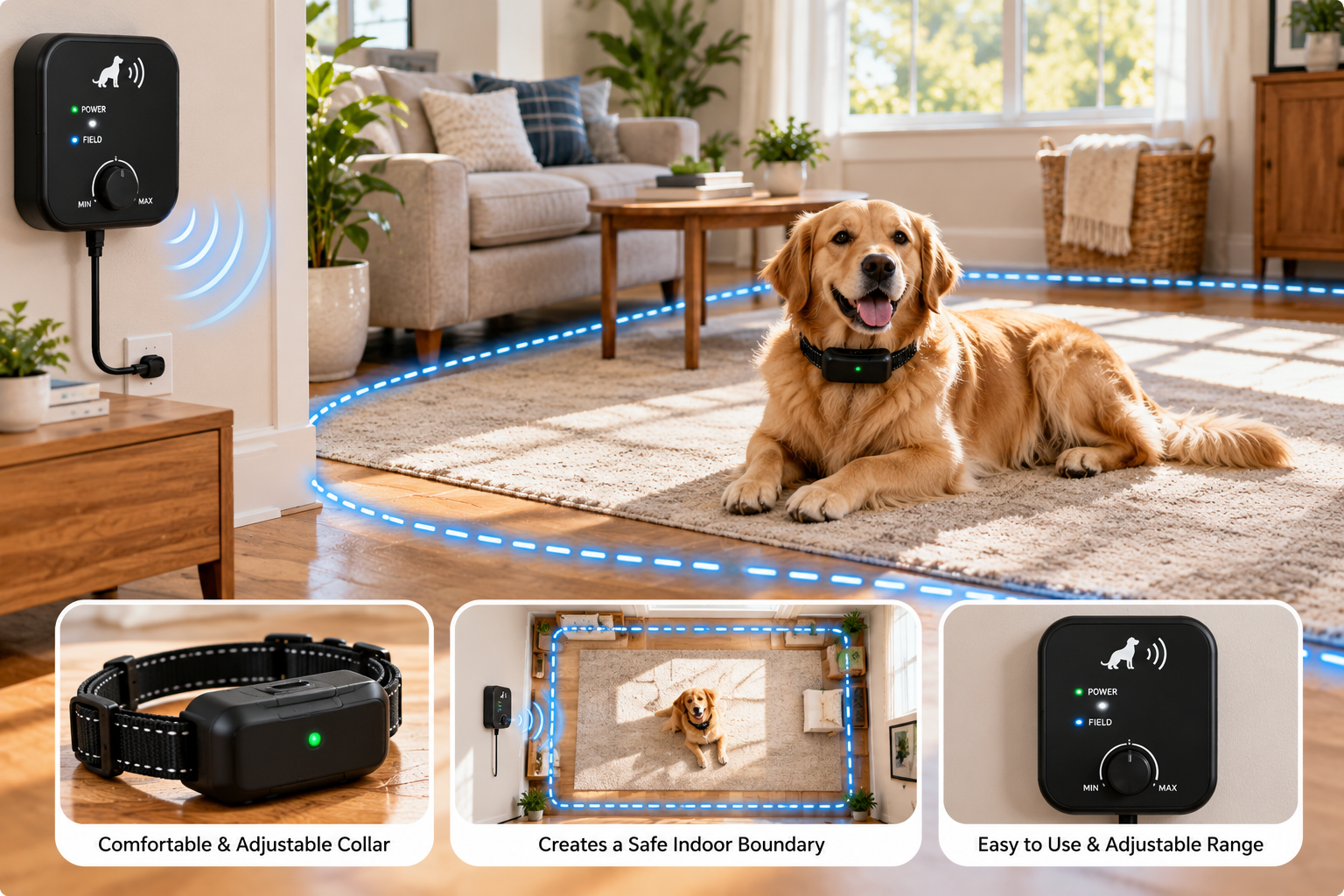
An inside electric fence for dogs is a wireless or touch-activated system that keeps a dog out of specific indoor areas. A small transmitter (or a pressure-sensitive mat) marks an off-limits zone; when the dog enters it, a receiver collar or the mat delivers a warning tone and, if needed, a brief static correction.
Unlike the outdoor containment fences that keep dogs in a yard, an indoor electric fence for dogs usually keeps them out of something: a couch, a nursery, a staircase, a cat’s litter box. That difference matters. You’re not building a perimeter; you’re drawing small “no-go bubbles” around the places that cause trouble.
It’s also worth knowing what you’re actually buying. These products sit in the same family as static training collars, which are a genuinely debated tool. The Wikipedia overview of shock collars is a fair starting point on how the technology works and why some countries restrict it. So this guide doesn’t just rank gadgets. It explains what each one does in real rooms, who it suits, and when a reward-based plan or a plain old gate is the smarter move.
Below, you’ll find seven real products available to US shoppers, honest analysis grounded in spec sheets and aggregated customer reviews, a setup plan for your first 30 days, and the mistakes that make these systems fail. Let’s get your house rules back on track. 🐾
Quick Comparison: The 7 Indoor Dog Boundary Picks at a Glance
| Product | Type | Boundary range | Power | Approx. price | Best for |
|---|---|---|---|---|---|
| PetSafe Pawz Away 2.0 Indoor Wireless Pet Barrier | Wireless zone + collar | 2–12 ft diameter | AA puck, rechargeable collar | Check current price | Pawz Away 2.0: newest tech, two-dog homes |
| PetSafe Pawz Away Indoor Pet Barrier | Wireless zone + collar | 2–12 ft diameter | 3 AA + 2 × 3V lithium | Around $65–$90 | Pawz Away Indoor: couches, trash cans, budget start |
| PetSafe Pawz Away Threshold Pet Barrier | Low-profile doorway unit | Up to 3 ft | 4 AAA | Around $70–$100 | Threshold Barrier: doorways and stairs |
| PetSafe Pawz Away Mini Pet Barrier | Small waterproof zone | Up to 5 ft diameter | Battery | Around $75 | Pawz Away Mini: tight spots, indoor/outdoor |
| PetSafe ScatMat Indoor Pet Training Mat | Touch-activated mat | Mat surface only | 9V battery | Around $55–$70 | ScatMat: collar-free homes, cats + dogs |
| PetSafe Pawz Away 2.0 Indoor Add-A-Barrier | Extra zone (no collar) | 2–12 ft diameter | 3 AA | Around $50 | Add-A-Barrier: expanding an existing system |
| PetSafe Stay & Play Compact Wireless Fence | Whole-yard wireless fence | 22–105 ft radius | Plug-in + rechargeable collar | A few hundred dollars | Stay & Play: yard containment, not room zones |
Reading across the table, the real decision isn’t brand (most of this category is PetSafe), it’s shape of the problem. A round “keep-away bubble” around furniture points you to the PetSafe Pawz Away Indoor Pet Barrier or the newer PetSafe Pawz Away 2.0 Indoor Wireless Pet Barrier, while a narrow doorway or staircase is exactly what the PetSafe Pawz Away Threshold Pet Barrier was shaped for. If you’d rather your dog wear no collar at all, the PetSafe ScatMat Indoor Pet Training Mat is the only true collar-free option here, and the PetSafe Stay & Play Compact Wireless Fence belongs on the list only if your real goal is the yard.
💬 One click helps other shoppers make an informed choice too! 😊
Top 7 Inside Electric Fence for Dogs Picks: Expert Analysis
1. PetSafe Pawz Away 2.0 Indoor Wireless Pet Barrier — smartest warning sequence in the lineup
The PetSafe Pawz Away 2.0 Indoor Wireless Pet Barrier (model PPD00-18375) is PetSafe’s newest take on the indoor wireless dog fence, and its biggest upgrade is how it warns your dog before anything stings.
The base “puck” creates an adjustable boundary from 2 to 12 feet in diameter, and it can sit flat or mount on a wall. When your dog enters the zone, the collar sounds a tone, then vibrates, then delivers progressive static that starts at the lowest level and steps up over a maximum of 15 seconds. In practice, that layered sequence gives a sensitive dog more chances to turn around on a sound or buzz alone, which is exactly what you want while training. The collar is rechargeable, so there are no coin cells to hunt down.
Based on comparing the specs, this is the model for two-dog homes where the rules differ: it supports customized boundaries for up to two pets, so one dog can keep couch privileges while the other learns. It also pairs with PetSafe’s YardMax and Classic in-ground fence collars, which is handy if you already own one.
Because this is a recent release, there isn’t yet a deep pool of verified long-term customer reviews to summarize, so treat durability as unproven for now.
Pros:
- ✅ Tone, then vibration, then progressive static warning
- ✅ Rechargeable collar removes coin-battery hassle
- ✅ Custom rules for up to two dogs
Cons:
- ❌ Limited long-term review data so far
- ❌ Static correction still raises welfare questions
Pricing varies by retailer, so check the current price; for most buyers the gentler warning sequence alone justifies choosing it over the original.
2. PetSafe Pawz Away Indoor Pet Barrier — proven budget workhorse for couches and trash cans
The PetSafe Pawz Away Indoor Pet Barrier (ZND-1200) is the original “keep-away bubble,” and it’s still the most common entry point into the indoor electric fence for dogs category.
The transmitter covers up to 12 feet across (a 6-foot radius) and runs on 3 AA batteries, while the receiver collar uses two 3-volt lithium cells and fits necks from 6 to 28 inches. The correction is progressive, ramping from low to maximum in about 3 seconds, and it shuts off after 15 seconds so a confused dog isn’t corrected indefinitely. What that means at home: one unit beside the sofa or trash can is enough for most single-problem dogs, and you can add unlimited extra barriers and collars later.
This model suits owners with one or two clearly defined trouble spots and a dog over 5 pounds. It’s less ideal for timid dogs, because the warning window is short.
Aggregated reviews are mixed-to-positive; one retailer listing shows an average around 3.7 out of 5 across roughly 50 reviews. A recurring complaint is that correction follows the beep almost immediately, and some small-pet owners say the collar doesn’t tighten as small as advertised.
Pros:
- ✅ Simple one-unit setup in minutes
- ✅ Expandable with unlimited barriers and collars
- ✅ 15-second automatic safety shut-off
Cons:
- ❌ Very short gap between beep and correction
- ❌ Collar may be bulky for small pets
Expect around $65–$90; solid value if you have one or two problem zones.
3. PetSafe Pawz Away Threshold Pet Barrier — the gate replacement for doorways and stairs
The PetSafe Pawz Away Threshold Pet Barrier (PWF00-14406) exists for one job: blocking a doorway or staircase without a gate you have to step over.
Instead of a round bubble, it projects an adjustable elliptical field up to about 3 feet, which suits narrow openings. It runs on 4 AAA batteries and is designed for pets over 5 pounds and under 40 inches tall. PetSafe’s setup guide says to keep the base at least 5 feet from metal and 8 feet from other barriers, which matters a lot in older homes with metal door frames or radiators nearby. The collar shuts off if your pet stays in range for 15 seconds.
This is the pick for households where a gate is a genuine hazard: grandparents visiting, toddlers, or anyone carrying laundry downstairs. PetSafe’s own manual also flags that the transmitter itself can be a tripping hazard in a doorway, so place it to the side, not on the walking line.
We couldn’t verify a large, consistent body of customer reviews for this specific model, so we’re not summarizing sentiment beyond the manufacturer’s documented limits.
Pros:
- ✅ Shaped for doorways rather than open rooms
- ✅ No gate to climb over or trip on
- ✅ Works with other Pawz Away collars
Cons:
- ❌ Short 3-foot range limits wide openings
- ❌ Sensitive to nearby metal and placement
Typically around $70–$100; worth it if a gate is a daily nuisance.
4. PetSafe Pawz Away Mini Pet Barrier — tiny waterproof zone for tight spots
The PetSafe Pawz Away Mini Pet Barrier (PWF00-13665) is the compact, waterproof sibling, built for small targets like a plant pot, cat food station, or garden bed.
Its adjustable range tops out at about 5 feet (roughly a 2.5-foot radius), and the collar fits necks from 6 to 28 inches. It’s one of only two Pawz Away barriers rated for outdoor use, so it can guard a houseplant indoors in winter and a flower bed in summer. Like the others, it beeps first, then corrects, and shuts off after 15 seconds.
On paper, this is for precise, small exclusions. If you need to keep a dog away from an entire sofa, the range is simply too small, and that’s the single biggest lesson from reviews.
On Chewy, customer reviews repeatedly complain about the very small range, and one owner suggested buying full-size transmitters instead for bigger zones.
Pros:
- ✅ Waterproof for indoor and outdoor spots
- ✅ Compact enough to hide near small targets
- ✅ Compatible with Pawz Away and YardMax collars
Cons:
- ❌ Range too small for furniture or rooms
- ❌ Often costs as much as the full-size unit
Around $75 at the time of writing; good value only for genuinely small zones.
5. PetSafe ScatMat Indoor Pet Training Mat — the only collar-free option
The PetSafe ScatMat Indoor Pet Training Mat skips the collar entirely: the boundary is the mat itself, and the correction only happens when a paw touches it.
The current version has an LCD controller with 7 modes: tone only, 3 levels of static only, or 3 levels of static plus tone. A safety timeout pauses stimulation for 4 seconds if a pet stays on the mat longer than 8 seconds. It comes in several sizes, including a 46 × 3-inch threshold strip, a 30 × 16-inch medium, a 50 × 12-inch curved mat, and a 48 × 20-inch large (model ZPD00-17031). Practically, “tone only” mode is a real advantage: many dogs respect the sound alone, so you may never need static.
This suits multi-pet homes, especially with cats, since every animal is covered without buying extra collars. A step counter also tells you whether your dog is still testing the mat.
Retail review summaries consistently report fast results; one Walmart listing averages 4.5 stars across about 87 ratings. A common complaint is that some mats stop working after a few months, and clever dogs may learn when it’s switched off.
Pros:
- ✅ No collar needed, covers every pet
- ✅ Tone-only mode for gentle training
- ✅ Clear vinyl blends into furniture
Cons:
- ❌ Durability complaints after months of use
- ❌ Only protects the exact mat surface
Around $55–$70 depending on size; excellent value for furniture and counters.
6. PetSafe Pawz Away 2.0 Indoor Add-A-Barrier — cheapest way to add more zones
The PetSafe Pawz Away 2.0 Indoor Add-A-Barrier (ZPD00-18378) isn’t a starter kit; it’s the expansion piece that turns one protected spot into a whole-house plan.
It creates another 2-to-12-foot boundary, runs on 3 AA batteries, and can sit flat or mount on a wall. PetSafe states it works with every generation of Pawz Away collars, which matters because it means owners of the original system can expand without replacing their collar. In real terms, that’s how you protect the sofa, the trash can, and the Christmas tree simultaneously.
Based on the compatibility notes, this is for people who already own a Pawz Away collar and have found a second or third problem area. Without a compatible collar, it does nothing on its own.
This is a new product, and we couldn’t find enough verified customer reviews yet to summarize sentiment honestly.
Pros:
- ✅ Lowest-cost way to add another zone
- ✅ Backward-compatible with older Pawz Away collars
- ✅ Wall-mount option keeps it out of reach
Cons:
- ❌ Requires a collar sold separately
- ❌ Batteries not included
PetSafe lists it around $50; strong value for expanding an existing setup.
7. PetSafe Stay & Play Compact Wireless Fence — the yard upgrade with an indoor transmitter
The PetSafe Stay & Play Compact Wireless Fence sits on this list for clarity: its transmitter plugs in inside your home, but it contains your dog in the yard, not out of rooms.
The transmitter creates a circular boundary adjustable from 22 to 105 feet in every direction, up to about three-quarters of an acre. The included rechargeable, waterproof collar fits dogs 5 pounds and up with neck sizes of 6 to 28 inches, and offers tone-only plus 5 static levels. Since it’s portable, you can bring it camping or in an RV, as long as there’s an outlet.
Here’s what to weigh: if someone searched for an inside electric fence for dogs but really wants to stop yard escapes, this is the relevant tool. It’s the wrong choice for couch training, because a 22-foot minimum radius would cover most of an apartment. PetSafe also notes that terrain and metal objects can affect range and that it isn’t for aggressive dogs.
Independent roundups note that very determined dogs can push through wireless boundaries, so supervision still matters.
Pros:
- ✅ No digging or wire burying required
- ✅ Rechargeable collar with tone-only mode
- ✅ Portable for travel and camping
Cons:
- ❌ Far too large for indoor room zones
- ❌ Circular boundary may not fit odd-shaped yards
Typically a few hundred dollars; good value only if your goal is the yard.
How to Set Up an Indoor Wireless Dog Fence: Your First 30 Days
The hardware takes minutes; the training takes weeks. Most failures in this category aren’t product defects, they’re skipped steps. Here’s a practical schedule that applies to any collar-based system, from the PetSafe Pawz Away Indoor Pet Barrier to the PetSafe Pawz Away 2.0 Indoor Wireless Pet Barrier.
Day 1: Install and test without your dog
- Place the transmitter where the problem actually happens, at least 5 feet from metal appliances and 8 feet from any other barrier.
- Start at the smallest range and walk the collar toward it with the test-light tool, held at your dog’s neck height.
- Test several angles. PetSafe’s own threshold barrier setup guide walks through this test-light method step by step, and it’s worth following exactly.
Days 2–7: Teach the warning, not the correction
If your model offers tone-only or vibration modes, use them first. Walk your dog on a leash toward the zone; the moment the tone sounds, guide them away and reward with a treat. You’re teaching “beep means turn around,” so the static rarely, if ever, fires. Keep sessions to 5–10 minutes.
Days 8–21: Short, supervised off-leash practice
Let your dog roam while you’re home and watching. Reward every voluntary turn-away. Check the neck daily for redness, since PetSafe advises against wearing the collar more than 12 hours at a time to avoid skin irritation.
Days 22–30: Fade and maintain
Most dogs now avoid the area on habit. Rotate collar position slightly each day, replace batteries on a schedule, and keep rewarding good choices. If your dog still panics or freezes near the zone, stop and consult a trainer.
✨ Don’t miss these smart indoor picks!
🔍 Take your dog’s house manners to the next level with this carefully curated lineup. Click a highlighted item to check current pricing and availability. These picks will help you get a calmer, cleaner home the whole family will enjoy!
Real-World Scenarios: Which Indoor Pet Barrier Fits Your Home?
Specs only mean something once they meet a real living room. Here are three common US household profiles, matched to the best tool and the reasoning behind each pick.
🏙️ The apartment couch guardian
Profile: a renter in a one-bedroom with a 35-pound mixed breed who naps on the sofa the moment everyone leaves. Budget: under $100. Use: daily, mostly while the owner is at work.
Best match: the PetSafe ScatMat Indoor Pet Training Mat in a sofa or large size. Why? It protects the exact cushion surface, needs no collar on a dog that’s often unsupervised, and the tone-only mode lets you start gently. A collar-based bubble would also catch the dog walking past the sofa to reach its water bowl in a small space, which creates confusion.
🏡 The two-dog house with different rules
Profile: a suburban family with a senior Lab allowed on the couch and a 9-month-old shepherd mix who raids the trash. Budget: flexible. Use: all day, with kids coming and going.
Best match: the PetSafe Pawz Away 2.0 Indoor Wireless Pet Barrier, later expanded with the PetSafe Pawz Away 2.0 Indoor Add-A-Barrier. Its custom boundaries for up to two pets mean the rules can differ by dog, and the add-on unit covers the trash can without buying a second collar.
🪜 The stair-safety household
Profile: a family with a toddler and grandparents who visit often, plus a beagle who bolts upstairs. Use: specific, mostly evenings and weekends.
Best match: the PetSafe Pawz Away Threshold Pet Barrier, placed beside, not on, the bottom step. Removing the gate removes a trip hazard for everyone on two legs, while the elliptical field fits the stairway opening. Still, keep a supervised period of several weeks before trusting it alone.
Problem → Solution: Fixing the Most Common Indoor Boundary Headaches
Even a well-chosen system will hit snags. These are the issues that come up again and again in owner feedback and manufacturer troubleshooting notes, with precise fixes.
1. “The boundary seems to move around.” Metal is the usual culprit. Refrigerators, radiators, and metal door frames distort the radio field. Move the transmitter at least 5 feet from metal, re-test with the collar at your dog’s neck height, and only then increase range.
2. “My dog gets corrected before it can react to the beep.” This is the most common complaint about the original PetSafe Pawz Away Indoor Pet Barrier. Reduce the range so the warning starts earlier relative to the target, or move to the PetSafe Pawz Away 2.0 Indoor Wireless Pet Barrier, whose tone-then-vibration sequence gives more reaction time.
3. “The Mini barrier barely covers anything.” That’s by design. The PetSafe Pawz Away Mini Pet Barrier tops out around 5 feet across. For furniture, swap to a full-size indoor transmitter and keep the Mini for plants or bowls.
4. “The ScatMat stopped working.” Check the 9V battery first, then the connector. If the mat itself fails within warranty, contact the manufacturer; reviews suggest wear-related failures appear after months of nightly use, so store it flat when not needed.
5. “My dog just waits until the collar comes off.” Dogs are smart. Put the collar on 15–20 minutes before you leave, so it doesn’t predict your departure, and keep rewarding the right choice even after training ends.
How to Choose an Inside Electric Fence for Dogs
Picking the right system comes down to six questions, asked in this order.
- What shape is the problem? A round object (sofa, trash can, tree) needs a bubble-style transmitter; a narrow opening (doorway, stairs) needs a threshold unit or a strip mat. Mismatching shape is the top reason for poor results.
- How big is the zone? Measure it. A 2–12 foot adjustable range covers most furniture, while a 5-foot mini unit only suits small targets.
- Collar or no collar? Collar systems protect an area even if your dog approaches from an angle; mats protect only their surface but cover every animal without extra gear.
- How sensitive is your dog? Timid or anxious dogs need a long warning window and a tone-only or vibration stage. If the product can’t start gently, skip it.
- How many pets, and do the rules differ? Look for Add-A-Pet support or per-pet boundaries before you buy, not after.
- Is an aversive tool right for your dog at all? The American Veterinary Society of Animal Behavior’s position statements on humane training recommend reward-based methods and caution against shock-based tools, including electronic fences. Read them before committing, and consider whether a gate or management plan solves the problem first.
Indoor Invisible Dog Fence vs. Pet Gates and Mats: An Honest Comparison
An indoor invisible dog fence isn’t automatically better than a $40 baby gate; it’s better in specific situations. The table below lays out the trade-offs.
| Factor | Collar-based indoor barrier | Static training mat | Traditional pet gate | Best for |
|---|---|---|---|---|
| Physical obstacle | None | Flat mat | Yes, must step over | Pawz Away Indoor: open walkways |
| Covers angled approaches | Yes | No, surface only | Yes | Pawz Away 2.0: multi-angle zones |
| Needs collar | Yes | No | No | ScatMat: collar-free homes |
| Works on jumpers | Yes | Yes, on furniture | Often not | Threshold Barrier: stairs |
| Aversive stimulus | Yes (static) | Yes (static or tone) | None | Gate: sensitive dogs |
The pattern is clear: a gate wins on welfare and simplicity, and it’s still the right answer for anxious dogs or short-term needs. Collar-based units like the PetSafe Pawz Away Indoor Pet Barrier shine when a gate would block human traffic, while the PetSafe ScatMat Indoor Pet Training Mat is the middle ground for furniture and counters where a gate can’t go at all.
Common Mistakes to Avoid When Buying an Indoor Electric Fence for Dogs
- Buying for the dog you wish you had. Products are rated for pets 5 pounds and up, and the threshold unit for pets under 40 inches tall. Check both before ordering.
- Skipping the training phase. The device is a reminder, not a teacher. Dogs that never learn “beep means turn around” get corrected repeatedly and can become fearful of the whole room.
- Using it on a dog with anxiety or aggression. PetSafe itself says its wireless fence isn’t for aggressive dogs, and an aversive can worsen fear-based behavior. Talk to your vet first.
- Over-sizing the zone. A 12-foot bubble in a small apartment can block water bowls or the path to the door. Start small and expand only if needed.
- Leaving the collar on 24/7. Pressure from contact points causes skin irritation; follow the manufacturer’s 12-hour limit and check the neck daily.
- Ignoring compatibility. The PetSafe Pawz Away 2.0 Indoor Add-A-Barrier works with Pawz Away collars, but older Pawz Away collars don’t work with the YardMax in-ground fence. Read compatibility notes before mixing systems.
Features That Actually Matter (and Ones That Don’t)
Matter a lot:
- Graduated warnings. Tone, then vibration, then the lowest effective static. The PetSafe Pawz Away 2.0 Indoor Wireless Pet Barrier does this best here, and the PetSafe ScatMat Indoor Pet Training Mat offers tone-only mode.
- Automatic shut-off. A 15-second collar cutoff or an 8-second mat timeout prevents a frozen, confused dog from being corrected nonstop. Treat it as non-negotiable.
- Adjustable range. Fine control from 2 feet up lets you start tiny and grow the zone as your dog learns.
- Expandability. Add-on barriers and collars turn one fix into a whole-house plan without starting over.
Matter less than marketing suggests:
- “Unlimited pets.” Useful, but every extra pet needs a collar, so the real cost scales.
- Waterproofing on indoor units. Nice for drool and spills, rarely decisive indoors.
- Number of static levels. More levels mostly add room to escalate. A good setup rarely gets past the lowest.
Long-Term Cost and Maintenance of an Indoor Pet Barrier
The sticker price is only the start. Batteries, extra collars, and replacements decide the true cost over two or three years.
| Setup | Upfront (approx.) | Ongoing costs | 2-zone, 1-dog total (approx.) | Best for |
|---|---|---|---|---|
| Pawz Away Indoor + extra barrier | $65–$90 + $50–$80 | AA batteries, 3V collar cells | $115–$170 | Tight budgets |
| Pawz Away 2.0 + Add-A-Barrier | Check price + ~$50 | AA batteries; collar recharging | Varies by retailer | Two-dog homes |
| Two ScatMat mats | $55–$70 each | 9V batteries; possible mat replacement | $110–$140 | Collar-free homes |
| Pressure-mounted pet gate | Usually under $60 | None | One gate per opening | Sensitive dogs |
The numbers show why the PetSafe Pawz Away 2.0 Indoor Add-A-Barrier matters: once you own a collar, each new zone costs roughly the price of one add-on unit. Mats look cheap per zone, but durability complaints mean you should budget for at least one replacement over a few years. For a single doorway, a gate is still the lowest total cost of ownership.
Safety, Regulations, and Standards for an Inside Electric Fence for Dogs
In the US, there’s no federal ban on static training devices, but the tools are increasingly scrutinized. Several veterinary bodies oppose them: the British Small Animal Veterinary Association’s position on aversive training methods lists electric containment fences among devices it recommends against, and Wales has banned electronic collars since 2010. In the US, Petco stopped selling shock collars in 2020, and San Francisco has considered local restrictions.
What does that mean for you? Practically:
- ⚡ Choose the gentlest setting that works, starting with tone or vibration.
- 🔋 Use only manufacturer batteries and chargers, and keep transmitters away from water unless rated waterproof.
- 🩺 Watch for stress signals such as cowering, lip licking, or avoiding the room entirely. Those mean stop.
- 🐶 Never use these on puppies under the manufacturer’s minimum age (PetSafe’s threshold manual cites at least 6 months).
Used carefully and briefly, a well-designed system can solve a stubborn problem. Used as a shortcut for training, it risks your dog’s trust.
FAQ: Inside Electric Fence for Dogs
❓ Does an inside electric fence for dogs also work on cats?
❓ Can I combine an indoor wireless dog fence with an outdoor in-ground fence?
❓ Is an indoor invisible dog fence okay for a very small dog?
❓ How often will I replace batteries on an indoor pet barrier?
❓ Can my dog wear the boundary collar overnight?
Conclusion: The Right Inside Electric Fence for Dogs Is the Gentlest One That Works
The best inside electric fence for dogs is the one matched to the shape of your problem, set to the mildest level that changes behavior, and paired with real reward-based training.
If you want the most modern collar system, the PetSafe Pawz Away 2.0 Indoor Wireless Pet Barrier offers the most forgiving warning sequence and two-dog customization. On a tighter budget, the PetSafe Pawz Away Indoor Pet Barrier remains a dependable starting point for a couch or trash can. Doorways and stairs belong to the PetSafe Pawz Away Threshold Pet Barrier, small spots to the PetSafe Pawz Away Mini Pet Barrier, and collar-free homes to the PetSafe ScatMat Indoor Pet Training Mat. Already own a Pawz Away collar? The PetSafe Pawz Away 2.0 Indoor Add-A-Barrier is the cheapest way to add zones. And if your real worry is the yard, the PetSafe Stay & Play Compact Wireless Fence is the relevant tool.
Finally, remember that leading veterinary behavior groups favor reward-based methods. Start with management and treats, use a static device only when it genuinely helps, and watch your dog’s body language. A calm dog who understands the rules beats a dog who’s simply afraid of the couch.
🎯 Ready to reclaim your home?
🛒 Click any highlighted product above to check current pricing and availability, and pick the indoor setup that fits your dog, your space, and your training style!
Recommended for You
- Indoor Invisible Dog Fence: 7 Best Picks That Actually Work (2026)
- Hunting Collars 2026: 7 Best Picks That Keep Your Dog Close
- How Does Fahlo Work? 7 Best Tracking Bracelets Explained (2026)
Disclaimer: This post contains affiliate links. As an Amazon Associate, I earn from qualifying purchases made through these links, at no additional cost to you.
✨ Found this article helpful? Share it with someone who needs it! 💬🤗