
In This Article
Introduction: Why an Inside Electric Fence for Dogs Deserves a Closer Look
You come home, and the trash can is on its side. Coffee grounds on the floor, a chewed-up yogurt cup under the couch, and one very proud dog wagging at the door. Sound familiar? Baby gates get knocked over, closed doors trap the cat, and you can’t exactly gate off a kitchen counter. That’s exactly the gap an inside electric fence for dogs is designed to fill.
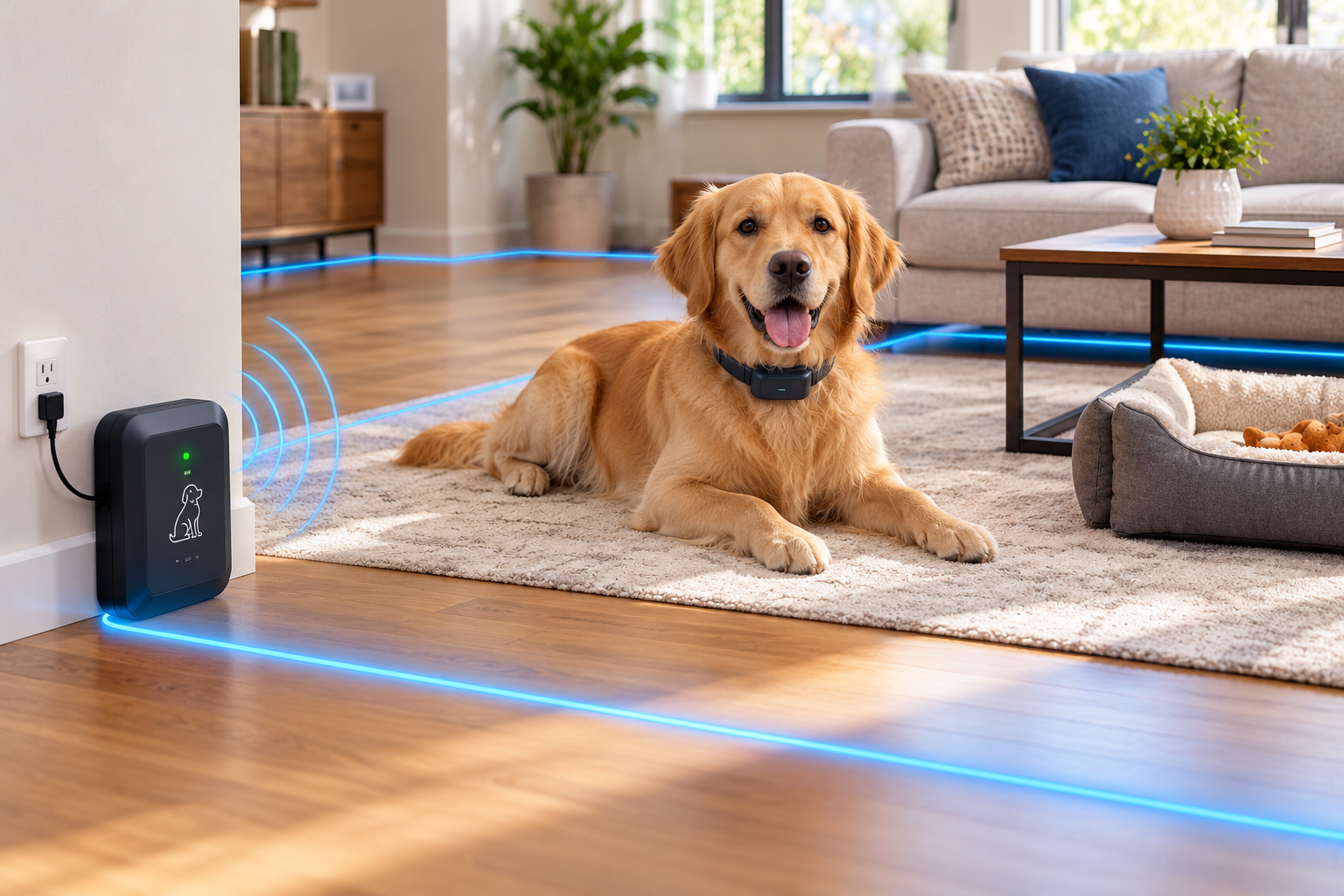
An inside electric fence for dogs (also called an indoor pet barrier or wireless indoor dog fence) creates a small, invisible “no-go” zone around one specific spot — a trash can, a couch, a doorway, the stairs. Instead of a wall of plastic, you get a compact transmitter and a collar that warns your dog with a tone (and, on many models, vibration or static) when they step into that zone.
But here’s what most product listings won’t tell you: these devices are training tools, not magic. They work best on clearly defined problems, with patient introduction, and on dogs that are old enough and calm enough for the method. They are also aversive-based tools, which means the veterinary behavior community has real reservations about them — something we’ll cover honestly later in this guide.
In this 2026 guide, we’ve compared seven real products available to US shoppers, from PetSafe’s newest rechargeable system to budget-friendly kits and a collar-free mat alternative. You’ll get side-by-side spec comparisons, the aggregated sentiment from real customer reviews, a step-by-step training plan, troubleshooting fixes, and a clear breakdown of long-term costs — so you can decide whether a barrier fits your home, and which one.
What Is an Inside Electric Fence for Dogs?
An inside electric fence for dogs is a wireless indoor barrier: a small transmitter broadcasts a short-range radio signal around a chosen spot, and a receiver collar on your dog reacts when they enter that zone — first with a warning tone, then (on most models) vibration or a mild static correction until the dog backs away.
That’s the 50-word answer. Here’s the longer version. Outdoor systems — the classic electronic pet fence — typically keep a dog inside a yard boundary using a buried wire or a large wireless circle. Indoor barriers flip that logic: they keep your dog out of a small area. The radius is tiny by comparison, usually somewhere between 1 and 6 feet, so the “fence” behaves more like a force field around a single object or doorway.
There are three main flavors you’ll see on amazon.com:
- Puck-style transmitters that create a circular zone (most Pawz Away models, My Pet Command, UltraCrab).
- Threshold transmitters that lie flat and project an elliptical zone across a doorway or stairway.
- Contact mats with no collar at all — the dog feels a static pulse only when paws touch the mat.
Each style solves a slightly different problem, which is why the “best” option depends entirely on where your trouble spot is.
Quick Comparison: Inside Electric Fence for Dogs at a Glance
| Product | Type | Boundary Range | Collar Power | Best for |
|---|---|---|---|---|
| PetSafe Pawz Away 2.0 | Puck transmitter | 2–12 ft diameter | Rechargeable (up to ~3 months) | PetSafe Pawz Away 2.0: multi-dog homes wanting tone + vibration |
| PetSafe Pawz Away Indoor Pet Barrier | Puck transmitter | 2–12 ft diameter | 2 × 3V lithium | PetSafe Pawz Away Indoor Pet Barrier: proven, expandable classic |
| PetSafe Pawz Away Mini Pet Barrier | Mini puck | Up to ~2.5 ft radius | 2 × 3V lithium | PetSafe Pawz Away Mini Pet Barrier: tight spots, indoor or out |
| PetSafe Pawz Away Threshold Pet Barrier | Flat threshold | Up to 3 ft (elliptical) | 2 × 3V lithium | PetSafe Pawz Away Threshold Pet Barrier: doorways and stairs |
| PetSafe ScatMat Indoor Pet Training Mat | Contact mat | Mat surface only | No collar (9V in mat) | PetSafe ScatMat Indoor Pet Training Mat: counters, sofas, collar-averse dogs |
| My Pet Command Indoor Pet Barrier | Puck transmitter | ~1–8 ft radius | Rechargeable (USB) | My Pet Command Indoor Pet Barrier: budget, two-frequency setups |
| UltraCrab Indoor Pet Barrier | Puck transmitter | 2–12 ft diameter | Rechargeable | UltraCrab Indoor Pet Barrier: lowest entry cost |
Reading the table, the big split is collar power. The PetSafe Pawz Away 2.0, My Pet Command Indoor Pet Barrier, and UltraCrab Indoor Pet Barrier use rechargeable collars, so you trade battery purchases for a charging routine. The original PetSafe Pawz Away Indoor Pet Barrier family uses coin cells, which is simpler day-to-day but adds ongoing cost — and the PetSafe ScatMat Indoor Pet Training Mat skips the collar entirely, which matters for dogs with sensitive necks or owners uneasy about collar-based correction.
💬 One click helps other shoppers make an informed choice too! 😊
Top 7 Inside Electric Fence for Dogs Picks: Expert Analysis
1. PetSafe Pawz Away 2.0 Indoor Wireless Pet Barrier — most refined collar experience
The PetSafe Pawz Away 2.0 (model PPD00-18375) is PetSafe’s newer take on its indoor barrier, and its headline upgrade is a gentler escalation ladder.
The boundary adjusts from 2 to 12 feet in diameter, and the collar responds with a warning tone, then vibration, then progressive static. That vibration step matters in practice: many dogs learn to turn around at the buzz, so the static stage gets triggered less often. The waterproof, rechargeable collar charges in about two hours and is rated to last up to three months depending on usage — no more hunting for 3V coin cells. You can also set customized boundaries for up to two pets, so one dog can be allowed on the couch while another is kept off it.
Based on comparing the specs, this is the pick for owners who want the least abrupt correction path and a multi-dog household with different rules. It’s also compatible with PetSafe’s YardMax and Classic In-Ground Fence collars, which is handy if you already own an outdoor system.
Because it’s a recent release, there isn’t yet a large body of aggregated customer reviews to summarize; we’d rather say that plainly than guess. Confirm current amazon.com availability before planning around it.
Pros:
- ✅ Tone, vibration, then static gives a softer learning curve
- ✅ Rechargeable collar removes recurring coin-cell costs
- ✅ Separate boundaries for two pets in one system
Cons:
- ❌ Too new for a meaningful review track record
- ❌ Likely priced above the original Pawz Away kit
Price & value: Expect a premium over the original kit (PetSafe lists its 2.0 add-on barrier alone at around $50) — check the current price; worth it mainly if vibration and recharging matter to you.
2. PetSafe Pawz Away Indoor Pet Barrier — the proven, expandable classic
The PetSafe Pawz Away Indoor Pet Barrier (model ZND-1200) is the long-running default in this category, and its biggest strength is the ecosystem around it.
The transmitter covers up to 12 feet across (a 6-foot radius) on 3 AA batteries, while the collar runs on two 3-volt lithium batteries. It’s rated for dogs and cats 5 pounds and up, with neck sizes from roughly 6 to 28 inches. Practically, that range covers everything from a Jack Russell to a Labrador. An automatic 15-second shutoff stops correction if a dog freezes inside the zone — an important welfare safeguard if your dog panics rather than retreats. You can add as many barriers and collars as you like.
Here’s what to weigh: this is the safest “known quantity” for a first-time buyer, but it rewards dogs that already understand collar tones. Reviews consistently report fast results for dogs previously trained on an e-collar or outdoor fence, while first-timers need more structured introduction.
Aggregated review sentiment is genuinely mixed. One retailer shows an average around 3.7 out of 5 across roughly 50 reviews, with recurring complaints about strap quality, collar bulk on small pets, and the cost of add-on barriers.
Pros:
- ✅ Wide 2–12 ft adjustable range for large objects
- ✅ Unlimited add-on barriers and collars
- ✅ 15-second safety shutoff built in
Cons:
- ❌ Strap quality draws repeated complaints
- ❌ Coin-cell collar batteries add ongoing cost
Price & value: Typically around $75–$90 for the kit at the time of writing; solid value if you plan to expand room by room.
3. PetSafe Pawz Away Mini Pet Barrier — compact precision for tight spots
The PetSafe Pawz Away Mini Pet Barrier (model PWF00-13665) shrinks the zone so you can protect one small spot without blocking a whole hallway.
Its adjustable range tops out around a 2.5-foot radius, it runs on 3 AAA batteries, and it’s waterproof — so it works both indoors and outside in a flower bed. On paper, the smaller zone is the feature, not a limitation: a 12-foot circle around a trash can in a narrow kitchen can accidentally block the path to the water bowl. The Mini lets you protect the bin without making the whole kitchen off-limits.
This is the one to pick when your problem is a single, compact object — a plant stand, a litter box, a shoe rack — in a room your dog otherwise needs to move through. It also pairs with the same Pawz Away collars, so it’s an inexpensive way to add a second, smaller zone to an existing setup.
We couldn’t verify a separate, substantial body of Mini-specific reviews, so we won’t characterize them; most aggregated feedback we found discusses the Pawz Away family as a whole.
Pros:
- ✅ Small zone avoids blocking walkways
- ✅ Waterproof for indoor or garden use
- ✅ Shares collars with other Pawz Away units
Cons:
- ❌ Range too small for couches or wide doorways
- ❌ Limited model-specific review data
Price & value: Usually in the same general bracket as the standard indoor barrier — check the current price; best value as a second zone.
4. PetSafe Pawz Away Threshold Pet Barrier — built for doorways and stairs
The PetSafe Pawz Away Threshold Pet Barrier (model PWF00-14406) replaces the pet gate you keep stubbing your toe on.
Instead of a circle, the flat transmitter projects an elliptical zone up to 3 feet, so it covers the width of a doorway or the base of a staircase without spilling into the room. It runs on 4 AAA batteries and is for indoor use only. PetSafe’s manual rates it for pets at least 6 months old and over 5 pounds, and the listing notes pets under 40 inches tall. Practically, that shape is the whole point: a round zone placed in a doorway would also block the hallway on either side.
PetSafe’s setup guidance is unusually specific — keep the base unit about five feet from metal and eight feet from other barriers, and don’t step on it. The manual itself flags it as a possible tripping hazard, so it’s a poor fit for a dark stairwell used by older family members.
Detailed aggregated review data for this model was limited in our research, so we’re relying on documented specs rather than review sentiment.
Pros:
- ✅ Elliptical zone fits doorways precisely
- ✅ No gate to climb over or open
- ✅ Detailed manufacturer setup and testing guide
Cons:
- ❌ Can be a tripping hazard in walkways
- ❌ Indoor only; sensitive to nearby metal
Price & value: Roughly $70–$100 depending on seller; good value if the doorway is your only problem.
5. PetSafe ScatMat Indoor Pet Training Mat — collar-free deterrence
The PetSafe ScatMat Indoor Pet Training Mat is the outlier on this list: no collar, no radio signal — just a clear vinyl mat that pulses when paws land on it.
It comes in several sizes — Strip (46 × 3 in), Medium (30 × 16 in), Curved (50 × 12 in), Sofa (60 × 12 in), and Large (48 × 20 in) — and runs on a 9-volt battery. Current listings describe 7 correction modes, including a tone-only option via an LCD controller. A safety timeout pauses correction after 8 seconds on the mat. In practice, the mat targets one behavior very precisely: a dog that jumps onto the sofa or counter edge meets the deterrent, and a dog walking past doesn’t.
That’s the key advantage for many owners: every dog in the house, plus the cat, gets the same rule without buying extra collars. It’s also the logical choice for dogs with neck sensitivities or owners who’d rather avoid a collar-based correction.
Reviews are notably positive. Walmart shows about 4.5 out of 5 across 87 ratings, and Tractor Supply’s 286 reviews skew heavily toward five stars, with buyers describing it as an effective deterrent for off-limits spots.
Pros:
- ✅ No collar required for any pet
- ✅ Precise: only triggers on contact
- ✅ Multiple sizes, including a doorway strip
Cons:
- ❌ Visible mat clutters furniture and counters
- ❌ Only protects the exact surface covered
Price & value: Generally in the $55–$70 range; excellent value for multi-pet homes.
6. My Pet Command Indoor Pet Barrier — budget-friendly with dual frequencies
The My Pet Command Indoor Pet Barrier (MPC150) is a budget alternative with one genuinely clever feature: two separate frequencies.
The transmitter creates a circular zone with an adjustable radius of roughly 1 to 8 feet, powered by 3 AA batteries that the brand says need replacing about every six weeks if left on constantly. The IP54-rated collar is rechargeable via USB and fits necks from about 6 to 20 inches. You can set “A” and “B” frequencies, which lets you keep one dog out of a zone while another is allowed in. The kit even includes plastic no-shock prongs, so you can run it tone-only.
Based on comparing specs, this suits a single small-to-medium dog in a household that’s testing the concept before committing to a pricier system. The 20-inch neck limit rules out many giant breeds, though.
Independent review roundups tend to position it as an entry-level, one-dog option, and one comparison noted weaker user feedback than competing models — so expect more variability in build consistency than with PetSafe.
Pros:
- ✅ A/B frequencies for different rules per dog
- ✅ Rechargeable collar with included no-shock prongs
- ✅ Flexible 1–8 ft radius adjustment
Cons:
- ❌ Transmitter drains AA batteries fairly quickly
- ❌ Collar fit tops out around 20 inches
Price & value: Typically below the PetSafe kits — check current pricing; good value for trial runs.
7. UltraCrab Indoor Pet Barrier — lowest-cost entry point
The UltraCrab Indoor Pet Barrier is the cheapest way into the category, and it borrows the classic puck format almost one-for-one.
Its transmitter includes a “Turbo” switch that expands the boundary from 2 up to 12 feet in diameter, and the collar uses a built-in rechargeable battery rated for about 1,000 charge cycles. When a dog enters the zone, it hears beeps, then receives progressive static. Practically, the rechargeable collar is the selling point at this price: you’re not buying coin cells every couple of months.
Here’s what to weigh: this makes sense for owners who want to experiment cheaply or need a second, low-stakes zone. It’s harder to recommend as a “set it and forget it” system because quality control appears less consistent.
Aggregated buyer feedback reflects that split: some owners report the collar holding a charge for over a week and recharging in about an hour, while others report the nylon strap failing quickly, forcing a replacement strap.
Pros:
- ✅ Lowest entry cost in this roundup
- ✅ Rechargeable collar rated for ~1,000 cycles
- ✅ Wide 2–12 ft range with Turbo switch
Cons:
- ❌ Reports of weak, failing nylon straps
- ❌ Less established support than PetSafe
Price & value: Generally the least expensive kit here — check the current price; best for testing the concept.
✨ Don’t let one trouble spot run your household!
🔍 Ready to reclaim your counters, couch, and trash can? Click any highlighted product above to check current pricing and availability on Amazon — and pick the barrier that matches your exact problem spot, not just the biggest spec sheet.
Detailed Spec & Value Comparison of All 7 Barriers
| Product | Correction Type | Power (Transmitter / Collar) | Min. Pet Size | Typical Price Range | Best for |
|---|---|---|---|---|---|
| PetSafe Pawz Away 2.0 | Tone, vibration, static | 3 AA / rechargeable | Check listing | Premium tier | PetSafe Pawz Away 2.0: gentler escalation |
| PetSafe Pawz Away Indoor Pet Barrier | Tone, static | 3 AA / 2 × 3V | 5 lb | ~$75–$90 | PetSafe Pawz Away Indoor Pet Barrier: expansion |
| PetSafe Pawz Away Mini Pet Barrier | Tone, static | 3 AAA / 2 × 3V | 5 lb | Mid tier | PetSafe Pawz Away Mini Pet Barrier: small objects |
| PetSafe Pawz Away Threshold Pet Barrier | Tone, static | 4 AAA / 2 × 3V | 5 lb, 6 mo+ | ~$70–$100 | PetSafe Pawz Away Threshold Pet Barrier: doorways |
| PetSafe ScatMat Indoor Pet Training Mat | Tone-only or static | 9V / none | All sizes | ~$55–$70 | PetSafe ScatMat Indoor Pet Training Mat: furniture |
| My Pet Command Indoor Pet Barrier | Tone, static | 3 AA / rechargeable | Neck 6–20 in | Budget tier | My Pet Command Indoor Pet Barrier: A/B zones |
| UltraCrab Indoor Pet Barrier | Beep, static | Batteries / rechargeable | Check listing | Lowest tier | UltraCrab Indoor Pet Barrier: cheap trial |
The pattern here is clear: you pay PetSafe’s premium for a larger ecosystem, better documentation, and more consistent reviews, while the My Pet Command Indoor Pet Barrier and UltraCrab Indoor Pet Barrier win on entry price and rechargeable collars. If you only have one problem area and a single dog, the budget kits are reasonable experiments. If you expect to add zones over time, the Pawz Away family’s cross-compatibility saves money and frustration in the long run.
How to Set Up and Train Your Dog on an Indoor Pet Barrier
Here’s the thing most buyers skip: the first week determines whether your inside electric fence for dogs becomes a calm boundary or a source of anxiety. Plug-and-pray rarely works.
Week 1: Set up and test before the collar goes on
- Place the transmitter near the protected object, following the manual’s spacing rules (for the Threshold model, about five feet from metal and eight feet from other barriers).
- Set the smallest effective range. Start small and expand only if needed — a zone that’s too big blocks walkways and confuses dogs.
- Walk-test the boundary at your dog’s actual neck height using the included test light. Test multiple angles, because furniture and appliances can distort the field.
- Mark the edge visually with small flags or tape at first. Dogs learn faster when they can see where the warning starts.
Days 3–10: Teach the warning, not the correction
- Start in tone-only mode if your device allows it (the PetSafe ScatMat Indoor Pet Training Mat, My Pet Command Indoor Pet Barrier with plastic prongs, and the PetSafe Pawz Away 2.0 vibration stage all help here).
- On leash, let your dog approach the zone. The moment the tone sounds, cheerfully call them back and reward heavily for retreating.
- Keep sessions to 5–10 minutes, two or three times a day.
Common first-30-day mistakes
- ❌ Leaving the collar on 24/7 — PetSafe advises against wear longer than 12 hours to avoid skin irritation.
- ❌ Using the highest level “to make it stick.”
- ❌ Placing the zone around the dog’s bed, crate, or water bowl path.
The goal is a dog that hears the tone and simply chooses another direction — no drama required.
Real-World Scenarios: Matching the Right Barrier to Your Home
Specs only make sense in context. Here are three common households and how we’d reason through each one.
Scenario 1: The apartment trash raider
Profile: A 2-year-old beagle mix, one-bedroom apartment, owner out 9 hours a day, modest budget.
The problem is one object in a small kitchen. A 12-foot circle would swallow the whole room, so the PetSafe Pawz Away Mini Pet Barrier is the logical pick — its small radius protects the bin without blocking the water bowl. If the budget is very tight, the UltraCrab Indoor Pet Barrier set to its smallest range is a cheaper trial, with the caveat of less consistent build quality.
Scenario 2: Two dogs, two sets of rules
Profile: A senior Lab allowed on the couch and a 1-year-old shepherd who isn’t; suburban home; mid-range budget.
This is exactly what the PetSafe Pawz Away 2.0 is designed for, thanks to its customizable boundaries for two pets. The budget alternative is the My Pet Command Indoor Pet Barrier with separate A/B frequencies — though check that the shepherd’s neck fits within its roughly 20-inch limit.
Scenario 3: Stairs, a toddler, and a cat
Profile: Family home, curious terrier, toddler, and a cat who needs to reach the upstairs litter box.
A traditional gate blocks the cat, too. The PetSafe Pawz Away Threshold Pet Barrier at the base of the stairs only affects collar-wearing pets, so the cat roams freely. Keep it out of the toddler’s main walking path, since the manual itself flags the transmitter as a tripping hazard.
Troubleshooting: Common Problems and Practical Fixes
Even a well-chosen indoor pet barrier for dogs will throw you a curveball or two. Here are the issues that come up most often in owner reviews and manufacturer support guides — and what to do about each.
Problem 1: The collar doesn’t activate where you expect. Fix: Metal is the usual culprit. Refrigerators, stoves, and metal furniture warp the radio field. Move the transmitter at least five feet from large metal objects, then re-test with the test light at your dog’s neck height.
Problem 2: Your dog ignores the tone and walks through. Fix: This is almost always a fit or training issue. Check that both contact points touch the skin (you should fit one finger under the strap, not two). Then go back to leash-based tone training — the dog may never have learned what the tone means.
Problem 3: Your dog now avoids the entire kitchen. Fix: The zone is too large, or corrections came before the dog understood the warning. Shrink the range, switch to tone-only, and rebuild positive associations with treats in the “safe” part of the room. If fear persists, stop using the device and talk to your veterinarian.
Problem 4: Batteries die constantly. Fix: Transmitters left on 24/7 drain fast — My Pet Command estimates roughly six weeks of AA life in continuous use. Turn barriers off when you’re home to supervise, or consider rechargeable AAs.
Problem 5: Redness or irritation under the collar. Fix: Remove the collar overnight, rotate its position daily, and clean the contact points. Any open sores mean a vet visit before resuming.
How to Choose an Inside Electric Fence for Dogs
- Define the exact problem spot. A doorway calls for a threshold unit; a single object calls for a mini or puck; furniture surfaces suit a mat.
- Measure the space you need protected. Choose a range that covers the target without swallowing walkways, food, water, or beds.
- Check your dog’s size and age. Several PetSafe models specify a 5-pound minimum, and the Threshold manual cites 6 months as a minimum age.
- Look for a gentle escalation path. Tone-only or vibration modes let many dogs learn without ever reaching static.
- Confirm safety shutoffs. A 15-second auto-stop (Pawz Away) or 8-second timeout (ScatMat) prevents prolonged correction if a dog freezes.
- Decide on power. Rechargeable collars mean no coin cells; disposable batteries mean no charging routine.
- Plan for expansion. If you’ll want more zones later, stick with one ecosystem so collars and barriers stay compatible.
Before you commit, it’s also worth reading the American Veterinary Society of Animal Behavior’s guidance on reward-based training, which recommends reward-based methods for all dog training and advises against aversive tools. Even if you choose a barrier, that perspective should shape how you use it: tone first, rewards always, correction as a rare backstop rather than the main teacher.
Inside Electric Fence vs. Baby Gates, Crates, and Deterrent Sprays
| Option | Blocks Other Pets? | Visible Clutter | Upfront Cost | Training Needed | Best for |
|---|---|---|---|---|---|
| Inside electric fence (e.g., PetSafe Pawz Away Indoor Pet Barrier) | Only collar-wearers | Minimal | Moderate | High | PetSafe Pawz Away Indoor Pet Barrier: multi-pet homes, open layouts |
| Contact mat (e.g., PetSafe ScatMat Indoor Pet Training Mat) | All pets | Moderate | Low–moderate | Low–moderate | PetSafe ScatMat Indoor Pet Training Mat: counters and sofas |
| Baby/pet gate | Everyone, including people | High | Low | Low | Physically containing puppies and determined climbers |
| Crate | N/A (contains dog) | High | Low–moderate | Moderate | Unsupervised time for young dogs |
| Bitter/deterrent spray | No | None | Very low | Low | Chewing on specific objects |
The biggest advantage of a barrier over a gate is selectivity: the cat, the kids, and you walk through freely while only the collar-wearing dog gets the warning. The trade-off is training effort and the welfare questions that come with an aversive tool. For pure chewing problems, sprays and management are often enough; for a dog who must be physically stopped while you’re out, a crate or gate remains more reliable than any signal-based system.
When a physical barrier still wins
Electronic boundaries can fail when a dog is highly excited — chasing a squirrel at the window, greeting a guest — because arousal overrides the warning. If the protected area holds something genuinely dangerous (medications, a pool door, a stairwell for a fragile senior dog), use a physical barrier as your primary layer and treat the electronic one as backup.
Features That Actually Matter (and Ones That Don’t)
Marketing copy loves to stack features. Here’s how to cut through it.
Features that genuinely matter
- Adjustable range with fine steps. Precision is everything indoors. Being able to shrink a zone by a foot is the difference between “protects the trash” and “blocks the kitchen.”
- Warning stage before correction. A clear tone (and ideally vibration, as on the PetSafe Pawz Away 2.0) gives your dog a chance to make the right choice.
- Safety shutoff. Non-negotiable. A dog that panics and freezes in the zone should never receive continuous correction.
- Collar fit range. A collar that doesn’t fit your dog’s neck properly won’t work reliably — and can rub.
- Ecosystem compatibility. PetSafe’s cross-compatible collars let you add zones without starting over.
Features that matter less than you’d think
- Maximum range bragging rights. A 12-foot diameter sounds impressive, but most indoor problems need 2–6 feet.
- “Unlimited pets.” Every Pawz Away model supports this, and it only matters if you actually buy more collars.
- Waterproofing indoors. Nice for drool and spills, but rarely decisive unless you’ll also use it outside, like the PetSafe Pawz Away Mini Pet Barrier.
Focus your budget on fit, escalation, and precision — those determine whether the device works humanely.
Common Mistakes to Avoid When Buying an Indoor Pet Barrier for Dogs
Most returns and bad reviews trace back to a handful of avoidable errors at the purchase stage.
Buying for the wrong problem. A dog that’s anxious when left alone and destroys a door frame isn’t really a “boundary” problem — it may be separation-related distress, and a correction device can make that worse. Address the root cause with your vet or a qualified trainer first.
Ignoring neck and weight limits. The My Pet Command Indoor Pet Barrier collar tops out around 20 inches, while Pawz Away collars cover larger necks. On the other end, toy breeds under 5 pounds fall below several manufacturers’ minimums.
Choosing a circle for a doorway. A round zone placed in a doorway also blocks the hallway on both sides. That’s what the PetSafe Pawz Away Threshold Pet Barrier is designed to solve.
Forgetting about other pets. If the cat must reach that area, a collar-based system works better than a mat. If you want every animal kept off the counter, a mat works better than buying three collars.
Assuming budget kits match premium ones. Aggregated reviews of cheaper kits like the UltraCrab Indoor Pet Barrier show more strap and durability complaints. That’s fine for a trial, less fine for a long-term solution.
Mixing brands. A barrier from one brand generally won’t talk to another brand’s collar. Commit to one ecosystem if you’ll ever expand.
Long-Term Cost and Maintenance
The sticker price is only part of the story. Batteries, extra collars, and add-on barriers can double what you spend over a couple of years.
| Cost Factor | Coin-cell collars (PetSafe Pawz Away Indoor Pet Barrier) | Rechargeable collars (PetSafe Pawz Away 2.0, UltraCrab Indoor Pet Barrier) | Mat (PetSafe ScatMat Indoor Pet Training Mat) | Best for |
|---|---|---|---|---|
| Ongoing collar power | Replacement 3V lithium cells | Electricity only | None | PetSafe ScatMat Indoor Pet Training Mat: lowest running cost |
| Transmitter power | AA/AAA batteries | AA batteries | 9V battery | Rechargeable AAs cut costs on all |
| Expansion cost | Add-on barriers + collars | Add-on barriers + collars | Extra mats per area | PetSafe Pawz Away Indoor Pet Barrier: big ecosystem |
| Replacement risk | Straps, collars | Straps, battery aging | Mat wear | Inspect monthly |
Based on these factors, rechargeable systems usually win on running costs if you use them daily for months, while coin-cell systems are simpler for occasional use. Mats have almost no running cost but scale poorly if you need many protected areas, since each one needs its own mat.
A simple maintenance schedule
- Weekly: Check collar fit and skin under the contact points; wipe contacts clean.
- Monthly: Re-test the boundary with the test light, especially after moving furniture.
- Every 2–3 months: Replace or recharge batteries before they fail (a dead collar teaches nothing).
- Yearly: Replace worn straps; check that your dog still needs the barrier at all — many don’t after consistent training.
Safety, Welfare, and Standards
An honest guide to any inside electric fence for dogs has to address welfare head-on.
The professional welfare debate
Static-correction devices are classified as aversive tools. The American Veterinary Society of Animal Behavior recommends reward-based methods for all dog training and advises against aversive methods, and several countries restrict electronic training collars. Manufacturers, meanwhile, market static correction as safe and point to safety shutoffs. Both perspectives exist, and you deserve to know about both. Our practical reading: if you use a barrier, prioritize tone or vibration, keep static at the lowest effective level, never use it on fearful or reactive dogs, and stop immediately if your dog shows lasting anxiety.
Battery safety at home
Most collars in this category use 3-volt lithium coin cells, which are dangerous if swallowed by children or pets. Store spares in a locked drawer, dispose of used cells promptly, and if you experience a safety incident with any consumer product, you can report it through the federal SaferProducts.gov database run by the Consumer Product Safety Commission.
Radio and electrical considerations
These barriers use low-power radio signals; low-power radio devices sold in the US are generally subject to FCC rules, so look for FCC identification on the product or packaging. Keep transmitters away from large metal objects for accurate boundaries, and don’t place a threshold transmitter where someone could slip on it.
Age and health limits
Follow manufacturer minimums (several PetSafe models specify 5 pounds and up, and the Threshold manual cites 6 months). Avoid collar-based correction for dogs with heart conditions, seizure disorders, or neck injuries unless your veterinarian approves.
Wireless Indoor Dog Fence Tips for Puppies, Seniors, and Small Breeds
Not every dog should use a barrier the same way — and some shouldn’t use one at all.
Puppies
Young puppies are still learning basic cues, and a correction during this sensitive period can create lasting fear. Respect manufacturer age minimums (the Threshold model cites 6 months), and in the meantime rely on gates, crates, and management. When your puppy is old enough, start with tone-only modes or a PetSafe ScatMat Indoor Pet Training Mat set to tone.
Senior dogs
Older dogs may have reduced hearing, which makes tone warnings less effective — and they may have health conditions that make static correction inappropriate. Vibration (as on the PetSafe Pawz Away 2.0) can help hard-of-hearing dogs, but talk to your vet first. Also watch for confusion; a senior dog that suddenly “forgets” a boundary may need a medical check, not a stronger correction.
Small and toy breeds
Several kits specify a 5-pound minimum, and owners in aggregated reviews note that some collars feel bulky on small animals. For a 6-pound Chihuahua, a collar-free mat may be the kinder, more practical option. If you do use a collar, check fit carefully and limit wear time.
Large and giant breeds
Confirm neck size. The My Pet Command Indoor Pet Barrier collar tops out around 20 inches, while Pawz Away collars fit larger necks — a deciding factor for a Great Dane or mastiff.
Frequently Asked Questions
❓ Does an inside electric fence for dogs work through walls?
❓ Can I use an indoor pet barrier for dogs and cats together?
❓ Is a wireless indoor dog fence worth it for renters?
❓ How long does it take a dog to learn an indoor boundary?
❓ Can I leave the collar on my dog all day?
Conclusion: Picking the Right Inside Electric Fence for Dogs
An inside electric fence for dogs can genuinely restore peace to a household — but only when the tool matches the problem and the training is patient. Here’s the short version of everything above.
If you want the most refined, multi-dog-friendly system and don’t mind paying more, the PetSafe Pawz Away 2.0 stands out for its tone-vibration-static ladder and rechargeable collar. For a proven, expandable classic with years of reviews behind it, the PetSafe Pawz Away Indoor Pet Barrier remains the safe bet. Tight spaces call for the PetSafe Pawz Away Mini Pet Barrier, and doorways or stairs are what the PetSafe Pawz Away Threshold Pet Barrier was built for.
Prefer no collar at all? The PetSafe ScatMat Indoor Pet Training Mat has the most consistently positive reviews in this roundup and works on every pet in the house. On a tight budget, the My Pet Command Indoor Pet Barrier and UltraCrab Indoor Pet Barrier let you test the idea for less — just expect more variability in build quality.
Whatever you choose, keep the warning stage front and center, reward your dog every time they turn away, follow the manufacturer’s safety limits, and don’t hesitate to step back if your dog seems stressed. The best barrier is the one your dog barely notices after a few weeks — because they’ve learned the rule, not because they fear the collar.
🐾 Ready to take back your kitchen counter?
✨ Click any highlighted product to check current pricing and availability on Amazon, and choose the barrier that fits your dog, your space, and your training style. A calmer, cleaner home is closer than you think!
Recommended for You
- Indoor Invisible Dog Fence: 7 Best Picks That Actually Work (2026)
- Hunting Collars 2026: 7 Best Picks That Keep Your Dog Close
- How Does Fahlo Work? 7 Best Tracking Bracelets Explained (2026)
Disclaimer: This post contains affiliate links. As an Amazon Associate, I earn from qualifying purchases made through these links, at no additional cost to you.
✨ Found this article helpful? Share it with someone who needs it! 💬🤗