
In This Article
Introduction: Why Little Dogs Need Their Own Training Gear
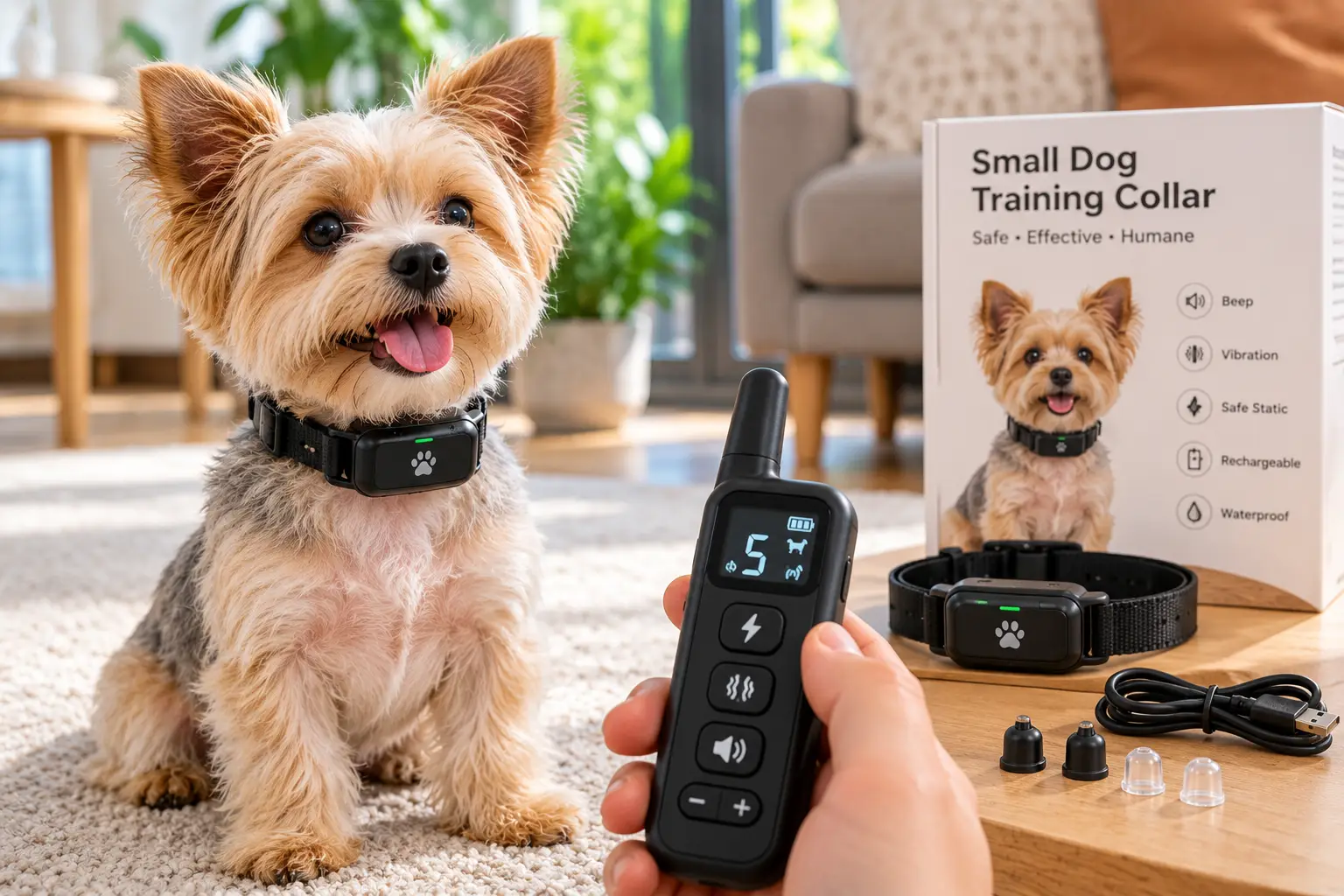
Picture a 7-pound Yorkie wearing a receiver built for a German Shorthaired Pointer. The box hangs crooked, the contact points barely touch skin, and the lowest setting may still feel like a lot. That’s the quiet problem behind most bad experiences with a small dog training collar: the gear was never designed for the dog wearing it.
Small dogs aren’t just big dogs in miniature. Their necks are narrower, their coats often fluffier, and many are more sound- and touch-sensitive than larger breeds. A good small dog training collar shrinks the receiver, lowers the output ceiling, and adds more steps at the gentle end of the dial — plus tone and vibration, so you can often skip static stimulation altogether.
In this 2026 guide, we compared manufacturer spec sheets, retailer listings, and whatever owner feedback we could actually verify for seven real systems sold on amazon.com. The range runs from about $140 for a simple indoor trainer to around $270 for a premium fob-style remote with a finger button. Along the way, you’ll find a 30-day starter plan, three household scenarios, troubleshooting fixes, and an honest look at the science.
And here’s the honest framing every buyer deserves: the American Veterinary Society of Animal Behavior’s humane training position statement recommends reward-based methods for all dog training. If you choose a collar, this guide shows you how to keep it gentle, keep treats in your pocket, and keep your dog’s trust front and center. 🐾
What Is a Small Dog Training Collar?
A small dog training collar is a remote system — a handheld transmitter and a compact neck-worn receiver — that sends a tone, a vibration, or a low-level static pulse to cue a dog at a distance, with receiver size and output scaled for dogs roughly 5 to 20 pounds.
The broader category is often called an e-collar, and Wikipedia’s overview of electronic training collars still lists it under the older “shock collar” name. Modern small-dog systems differ from that image in three practical ways:
- ✅ Smaller, lighter receivers that sit flat on a narrow neck instead of rotating.
- ✅ Low-to-medium power output, so even a mid-dial setting stays mild.
- ✅ More, finer levels — often 100 — because a small dog’s working level tends to sit near the bottom.
Many models also run in non-stimulating modes. A vibration training collar for small dogs, or a tone-only cue paired with treats, is often all a sensitive pup ever needs.
Quick Comparison: 7 Small-Dog Training Collars at a Glance
| Model | Min. Weight | Range | Levels | Modes | Price Range | Best For |
|---|---|---|---|---|---|---|
| Educator ME-300 Micro Educator | 5 lbs | 1/3 mile | 100 + boost | Stim, tone or vibration | Around $200–$220 | Toy breeds |
| Educator FE-560 FOB Educator | 5 lbs | 300 yards | 100, adjustable ramp | Stim, vibration | Around $200–$270 | Pocket-size convenience |
| Educator PG-300 Pager Only | Small dogs | 1/2 mile | 100 vibration | Vibration only | Around $210 | No-static training |
| Dogtra 200iQ | 10 lbs | 1/2 mile | 100 | Stim, tone, vibration | Around $200 | Beginners |
| Dogtra CUE | 10 lbs | 400 yards | Adjustable + boost | Stim, vibration | Around $180–$190 | Walks on the go |
| SportDOG FieldTrainer 425X | 8 lbs | 500 yards | 21 | Stim, tone, vibration | Around $150–$190 | Multi-dog homes |
| PetSafe Lite Remote Trainer | 8 lbs | 100 yards | 15 | Stim, tone, vibration | Around $140 | Indoor manners |
The weight column does most of the sorting: only the three Educator systems are built for dogs starting at 5 pounds, so they’re your shortlist for Chihuahuas, Yorkies, and toy Poodles. Above 10 pounds, the Dogtra 200iQ and Dogtra CUE open up, while the SportDOG FieldTrainer 425X and PetSafe Lite Remote Trainer win on price at the cost of coarser adjustment. If you never want static at all, the Educator PG-300 Pager Only stands alone.
💬 One click helps other shoppers make an informed choice too! 😊
Top 7 Small Dog Training Collar Picks: Expert Analysis
Each pick below is a real, currently listed model. We translate the spec sheet into what it means on a 5-to-20-pound dog, say plainly who should skip it, and summarize owner feedback only where we could actually verify some.
1. Educator ME-300 Micro Educator — best for toy breeds under 10 pounds
When your dog fits in a purse, the Educator ME-300 Micro Educator is the most carefully scaled option here. It pairs E-Collar Technologies’ proven Mini Educator remote with the RX-070 Micro receiver, which the company says is 20% smaller than its standard receiver.
That smaller housing is the real feature. A receiver that fits sits flat, keeps steady contact, and removes the temptation to raise the level when the actual issue is a loose fit. On top of that, you get 100 levels of what Educator calls “blunt” stimulation, a separate boost (1–60), tone or vibration, “lock and set” to save your level, and a night-tracking light.
Based on comparing the specs, this is the pick for Chihuahuas, Yorkies, Maltese, and nervous rescues. The 1/3-mile range is shorter than some rivals, but it’s plenty for parks and trails where a small dog should stay close anyway.
We couldn’t verify a stable Amazon star average at the time of writing. Comments we found on retailer and trainer pages mostly highlight how gentle the low end feels; some Educator users suggest shifting the receiver’s position during longer outings to avoid neck irritation.
Pros:
- ✅ Rated for dogs as small as 5 pounds
- ✅ Compact receiver that suits narrow necks
- ✅ Very fine control at the gentle end
Cons:
- ❌ Shorter range than half-mile systems
- ❌ Remote menus take practice to master
💰 Usually around $200–$220 — worth the premium if your dog is under 10 pounds.
2. Educator FE-560 FOB Educator — the pocket-size remote
The Educator FE-560 FOB Educator is built for owners who hate carrying gear. E-Collar Technologies calls its key-fob remote the smallest handheld it has made, paired with its smallest receiver yet.
The standout spec is adjustable ramping: you can set stimulation to rise gradually over 0, 1, 2, or 5 seconds instead of arriving all at once. In practice, that gives you a softer, more predictable cue for a sensitive dog. You also get 100 levels, a user-set maximum limit, vibration, a 300-yard range, rating for dogs 5 pounds and up, and two-dog compatibility. An optional wireless finger button lets you cue without reaching for the fob.
Here’s what to weigh: 300 yards is short by e-collar standards, but most small-dog training happens within a backyard or a block. This one suits city walkers, apartment owners, and anyone juggling a leash, poop bags, and a coffee.
Owner data is thin. Chewy listings we checked showed only two ratings at the time of research, so we can’t summarize meaningful sentiment yet.
Pros:
- ✅ Smallest remote and receiver in Educator’s lineup
- ✅ Adjustable ramping for gentler delivery
- ✅ Optional hands-free finger button
Cons:
- ❌ 300-yard range only
- ❌ Very few verified reviews so far
💰 Around $200–$220, or roughly $270 with the finger button — a convenience premium that pays off on daily walks.
3. Educator PG-300 Pager Only — best for owners who want zero static
If you’ve decided static stimulation isn’t for your household, the Educator PG-300 Pager Only gives you remote cueing without it.
E-Collar Technologies describes it as a vibration-only trainer with 100 levels of vibration. That range matters: a soft buzz works as an attention cue, while a stronger one cuts through distractions like squirrels or doorbells. Retail listings describe a half-mile range, which is more than most small dogs will ever need.
Our honest take: this is the most humane-leaning remote here, and a good match for dogs already trained with treats who need a “check in with me” signal at a distance. It also suits deaf dogs, who can learn a vibration as a recall cue. What it won’t do is stop a determined chaser on day one — vibration works only after you’ve paired it with rewards.
We couldn’t verify enough owner reviews to summarize sentiment, and we couldn’t confirm a minimum weight rating, so check the listing before buying for a very tiny dog.
Pros:
- ✅ No static stimulation at all
- ✅ 100 vibration levels for fine tuning
- ✅ Useful for deaf or noise-sensitive dogs
Cons:
- ❌ Needs solid reward-based groundwork first
- ❌ Minimum weight not clearly published
💰 Usually around $210 — fair value for a quality vibration-only system.
4. Dogtra 200iQ — easiest for first-time users
The Dogtra 200iQ is designed so you barely have to think about the remote. Dogtra built it around one-handed control and a front-facing dial.
That matters when you’re holding a leash in the other hand. You get 100 medium-output levels, nick and continuous stimulation, XPP vibration, an audible tone, IPX9K waterproofing, a half-mile range, a locate light, and two-dog expansion. It’s rated for dogs 10 pounds and up.
Based on the specs, this fits owners of 10–25-pound dogs — Shih Tzus, Westies, Pugs, Mini Schnauzers — who want a system that works on day one. Owners of dogs under 10 pounds should stay with the Educator models.
One Walmart listing we checked showed roughly 4.1 out of 5 across a few hundred ratings at the time of research; Amazon figures may differ, so check the listing directly.
Pros:
- ✅ Genuinely no-look, one-handed operation
- ✅ Fully waterproof with a locate light
- ✅ Tone, vibration, and 100 levels
Cons:
- ❌ Not rated for dogs under 10 pounds
- ❌ Fewer customization options than Educator
💰 Around $200 — excellent value for beginners who prize simplicity.
5. Dogtra CUE — best grab-and-go remote
The Dogtra CUE is Dogtra’s minimalist option, with a “Clip n’ Go” transmitter that has a built-in carabiner for your belt loop or bag.
Practically, that means the remote is always on you, not in a drawer. You get nick, continuous, and pager vibration, a customizable boost, a safety level lock, a 400-yard range, USB-C charging, and an IPX9K waterproof collar (the remote is water resistant). It expands to three dogs and remembers separate levels for each — a real plus in a mixed household.
Here’s what to weigh: the CUE has no audible tone, so if you plan to use a tone as a marker, choose the Dogtra 200iQ. Dogtra also notes that on slim necks, rotating the collar so the receiver sits vertically can improve fit — useful advice for Italian Greyhounds and Whippet mixes.
We couldn’t verify a current Amazon review average for the CUE, so we won’t quote one.
Pros:
- ✅ Clip-on remote that’s always within reach
- ✅ Separate saved levels for up to three dogs
- ✅ Safety level lock and USB-C charging
Cons:
- ❌ No audible tone mode
- ❌ Remote is water resistant, not waterproof
💰 Often around $180–$190 — strong value, especially for multi-dog homes.
6. SportDOG FieldTrainer 425X — longest battery life
The SportDOG FieldTrainer 425X is SportDOG’s smallest, lightest e-collar, and it’s the endurance champion of this list.
Its lithium-ion batteries charge in 2 hours and last 50–70 hours, so a weekly charge often covers you. It fits dogs 8 pounds and up with necks from 5 to 22 inches, reaches 500 yards, is submersible to 25 feet, and expands to three dogs. You get tone, vibration, and 21 static levels.
What most buyers overlook: 21 levels means bigger jumps between steps than a 100-level dial. That’s fine for a confident terrier, less so for a timid dog. Also be sure to buy the 425X, not the 425XS — SportDOG says the “S” version has a higher stimulation range intended for stubborn dogs.
We couldn’t verify an Amazon review average; retailer descriptions emphasize its no-look remote and close-range use.
Pros:
- ✅ 50–70 hours per charge
- ✅ Fits necks as small as 5 inches
- ✅ Expands to three dogs
Cons:
- ❌ Coarser 21-level adjustment
- ❌ Easy to confuse with the stronger 425XS
💰 Often $150–$190 — great per-dog value.
7. PetSafe Lite Remote Trainer — best budget pick for indoor manners
The PetSafe Lite Remote Trainer is the most affordable credible option here, designed by PetSafe for shy, sensitive, and small dogs.
PetSafe says the Lite version uses a smaller collar and slightly lower stimulation than its standard trainer. You get tone, vibration, and 15 static levels, with a safety lock on levels 8–15. It fits dogs 8 pounds and up with necks of 6–23 inches, charges in 2 hours, and lasts up to 40 hours. The 100-yard version suits homes and yards; 300- and 600-yard versions also exist.
Our honest take: this is a household manners tool — door dashing, counter surfing, backyard recall — not a trail collar. PetSafe also says it’s not for puppies under 6 months, which is sound advice for every collar here.
Retailer listings we checked had very few reviews, so we can’t responsibly summarize owner sentiment.
Pros:
- ✅ Lowest price in this lineup
- ✅ Safety lock on higher levels
- ✅ Gentle output tuned for timid dogs
Cons:
- ❌ Only 15 adjustment levels
- ❌ 100-yard model is short-range
💰 Around $140 for the 100-yard model — solid value for indoor training.
Spec Deep-Dive: The Details That Separate Them
| Model | Waterproofing | Battery | Multi-Dog | Safety Feature | Best For |
|---|---|---|---|---|---|
| Educator ME-300 Micro Educator | Waterproof | Rechargeable | Up to 2 | Lock and set | Dogs 5–12 lbs |
| Educator FE-560 FOB Educator | Waterproof | Quick-charge Li-polymer | Up to 2 | User-set max limit | City walks |
| Educator PG-300 Pager Only | Waterproof | Rechargeable | — | No static at all | Sensitive dogs |
| Dogtra 200iQ | IPX9K | Li-poly rechargeable | Up to 2 | Locate light | Beginners |
| Dogtra CUE | IPX9K collar | 2-hr charge, USB-C | Up to 3 | Level lock | Multi-dog walks |
| SportDOG FieldTrainer 425X | Submersible to 25 ft | 50–70 hrs | Up to 3 | — | Long battery life |
| PetSafe Lite Remote Trainer | Waterproof | Up to 40 hrs | Not on 100-yd | Lock on levels 8–15 | Indoor manners |
The deep-dive shows that safety features vary more than stimulation specs: the Educator FE-560 FOB Educator lets you cap the maximum level, while the Dogtra CUE and PetSafe Lite Remote Trainer lock out higher settings. For multi-dog homes, the Dogtra CUE and SportDOG FieldTrainer 425X are the only three-dog systems. And if battery anxiety bugs you, nothing here outlasts the SportDOG FieldTrainer 425X.
✨ Don’t miss these carefully chosen picks!
🔍 Take your small-dog training to the next level with this curated lineup. Click a highlighted model to check current pricing and availability — the right fit can turn frantic walks into calm, happy outings the whole family will enjoy! 🐶
How to Start With a Training Collar for Small Dogs: Your First 30 Days
The first month decides whether a training collar for small dogs becomes a calm, clear signal or a source of stress. This week-by-week plan keeps everything at the gentlest end.
Week 1: Make the Collar Boring 🐕
Put the collar on during good moments — meals, play, walks — without using it. Your dog should learn that the receiver predicts nothing unusual. Check fit every day: one finger, not two, should slide between the contact points and skin. Take it off afterward.
Week 2: Find the Working Level
In a quiet room, start at zero and raise the level one step at a time. Stop at the first sign your dog notices — an ear twitch, a glance, a pause in sniffing. That’s the working level. On a 100-level dial, small dogs often land in the low single digits. Write the number down, because coat moisture and excitement change it.
If you’re using vibration or tone only, do the same thing: find the lowest setting your dog notices.
Week 3: Pair the Cue With Rewards
Clip on a long line. Say your recall word, give the cue at the same moment, and reward the instant your dog turns toward you. The cue means “check in”; the treat says “great choice.” Keep sessions to 5–10 minutes, two or three times a day.
Week 4: Add Gentle Distraction
Move to the yard or a quiet park corner, still on the long line. If your dog stops responding, make the setting easier first — more distance from distractions, better treats — before you touch the level.
⚠️ Mistakes we see in month one: leaving the collar on all day, skipping rewards, cueing while frustrated, and jumping several levels at once. Short sessions and big rewards beat everything else.
Which Remote Training Collar for Small Dogs Fits Your Home? 3 Scenarios
Specs only matter in real life. Here’s how we’d match a remote training collar for small dogs to three typical US households.
Scenario 1: The High-Rise Maltese 🏙️
Priya lives in a Seattle apartment with a 6-pound Maltese who barrels into the hallway whenever the door opens. Training happens indoors and on short sidewalk walks, several times a day. Budget: around $220.
Our pick: the Educator FE-560 FOB Educator. Her dog is under the 8- and 10-pound minimums of most rivals, the 300-yard range is more than enough for a hallway, and the fob fits in a pocket next to her keys. If she wanted static removed entirely, the Educator PG-300 Pager Only would be the alternative.
Scenario 2: The Busy Three-Dog Household 🏡
The Garcias in Texas have a 12-pound Mini Schnauzer, a 15-pound Corgi mix, and a 22-pound Beagle. They want backyard recall and less fence barking. Budget: under $200 to start.
Our pick: the Dogtra CUE. It expands to three dogs and remembers each dog’s level, so nobody gets the Beagle’s setting by mistake. The clip-on remote stays on a belt loop during yard time.
Scenario 3: The Senior Owner and a Deaf Dachshund 🧓
Tom, a retiree in Florida, has a 14-pound Dachshund who lost her hearing. He wants a gentle way to call her in from the yard. Budget: flexible.
Our pick: the Educator PG-300 Pager Only. A vibration cue, taught with treats, can replace a spoken recall for a deaf dog — and it removes static from the equation completely. The Dogtra 200iQ is the backup if Tom prefers a larger, simpler remote.
Problem → Solution: Fixing 5 Common Small-Dog Collar Headaches
Most problems with small-dog collars come from fit or timing, not from the dial. Here’s how to fix the five we hear about most.
1. “My dog doesn’t notice the cue.”
🔧 Solution: Check contact before intensity. Fluffy breeds like Pomeranians and Shih Tzus often need longer contact points; the SportDOG FieldTrainer 425X, for example, ships with standard and long points. Swap points and refit before raising anything.
2. “The receiver slides around the neck.”
🔧 Solution: Tighten one notch and place it high on the neck. On slim necks, Dogtra suggests rotating the collar so the receiver sits vertically. If it still slides, the receiver may simply be too big — the Educator ME-300 Micro Educator was built for this.
3. “My dog acts nervous when the collar goes on.”
🔧 Solution: Stop all stimulation. Return to Week 1 and pair the collar with meals and play. Fear is a signal to slow down — and a good moment to bring in a certified, reward-based trainer.
4. “I see redness under the contact points.”
🔧 Solution: Remove the collar right away. Shorten wear time, shift the receiver’s position during longer outings, and wash the skin and points. If redness lasts or looks like a sore, call your vet.
5. “It works at home but not at the park.”
🔧 Solution: That’s a training gap, not a gear failure. Build distraction slowly, use higher-value treats, and raise the level one step at most.
How to Choose a Small Dog Training Collar
To choose a small dog training collar, match the rated weight to your dog first, then check receiver size, level count, non-stimulating modes, safety locks, range, and multi-dog needs — in that order.
- Start with the minimum weight rating. Under 8 pounds, only the Educator systems in this guide qualify. Never “round up” your dog.
- Check receiver size and fit. A smaller receiver keeps steady contact on a narrow neck, so you can use lower levels.
- Count the levels. Around 100 levels means smaller jumps; 15–21 levels means bigger steps between settings.
- Insist on tone or vibration. You’ll want a non-stimulating cue for most training, and some dogs never need more.
- Look for a safety lock or maximum cap. Lock features stop accidental jumps when the remote is bumped in a pocket.
- Size the range to your life. Apartments and yards need 100–300 yards; trails justify a half mile.
- Plan for more dogs. If a second dog may join the family, buy an expandable system now.
Common Mistakes to Avoid When Buying a Small Dog Training Collar
Most buyer regret comes from a few predictable choices.
- ❌ Buying for range instead of fit. A one-mile collar is pointless if the receiver flops on a 9-pound dog.
- ❌ Picking the cheapest unbranded unit. Ultra-cheap listings often claim to fit “8–120 lb” dogs with one receiver. A single output curve can’t be equally right for a Pug and a Mastiff.
- ❌ Ignoring the “S” or “stubborn” versions. Models like the SportDOG 425XS carry a higher stimulation range than small dogs need.
- ❌ Skipping non-stim modes. A collar without tone or vibration forces you to use static for everything.
- ❌ Forgetting the contact points. Long-coated breeds may need longer points; check what’s in the box.
- ❌ Buying without a plan. A collar doesn’t teach anything by itself — the rewards do.
Small Dog Shock Collar vs. Vibration Collar vs. Reward-Only Training
The phrase “small dog shock collar” still dominates searches, but it lumps very different tools together. Here’s how the three main approaches compare for little dogs.
| Approach | What It Uses | Main Advantage | Main Risk | Best For |
|---|---|---|---|---|
| Static e-collar (e.g., Educator ME-300 Micro Educator) | Low-level stim + tone/vibration | Clear cue at a distance | Fear or stress if misused | Recall in open areas, with expert guidance |
| Vibration-only (e.g., Educator PG-300 Pager Only) | Vibration levels only | No static at all | Ignored if not paired with rewards | Sensitive or deaf dogs |
| Reward-only (leash, long line, treats, clicker) | Food, praise, play | Strongest welfare evidence | Slower in high-distraction settings | Every dog, as the foundation |
The table makes the trade-off visible: static adds reach, vibration adds a remote cue without static, and reward-based training underpins both. Research backs that foundation — a 2020 study in Frontiers in Veterinary Science found reward-based training at least as effective as e-collar training for recall. For most small-dog owners, that points toward a vibration or tone cue built on treats, with static as a last resort, if at all.
Vibration Training Collar for Small Dogs: When It’s All You Need
A vibration training collar for small dogs works like a tap on the shoulder. It doesn’t punish anything; it simply means “look at me,” and your treat pouch does the teaching.
Vibration tends to work best when:
- ✅ Your dog already knows basic cues and needs a distance signal.
- ✅ Your dog is deaf or hard of hearing.
- ✅ Your dog is sensitive, anxious, or a recent rescue.
- ✅ You want household manners, like coming away from the front door.
It works less well with a highly aroused dog mid-chase who’s never been taught what the buzz means. The fix isn’t more power — it’s more practice in easy settings first.
The Educator PG-300 Pager Only is the dedicated vibration choice here, but every model in this guide offers vibration. Many owners find they buy a static-capable collar and end up using vibration 90% of the time.
Features That Actually Matter (and Ones That Don’t) in a Small Dog E Collar
Marketing pages list dozens of features. For a small dog e collar, only a handful change your daily experience.
Features that matter 👍
- Fine level control — more steps at the low end, like the 100-level dials on the Educator and Dogtra 200iQ systems.
- Safety locks and caps — the max-limit setting on the Educator FE-560 FOB Educator is a quiet lifesaver.
- Real waterproofing — an IPX9K rating or a stated submersion depth beats vague “water resistant” claims.
- Battery life you’ll respect — the SportDOG FieldTrainer 425X‘s 50–70 hours means fewer dead-collar mornings.
Features that matter less 🤷
- Mile-plus range — rarely relevant for dogs who should stay close.
- Huge level counts beyond 100 — past that, extra steps are hard to feel.
- Bright colors and bundles — nice, not functional.
Long-Term Cost and Maintenance
The purchase price is only part of the cost. Plan for spare contact points (a few dollars a set), an eventual replacement strap, and possibly a replacement battery after a few years of charging. Add-on collars for a second dog often run well over $100, so a three-dog-ready system like the Dogtra CUE can save money over time. Clean contact points weekly with a damp cloth, and charge fully before storage.
Safety, Science, and Standards for Small-Dog Collars
Safety starts with honesty about the evidence. Veterinary behavior groups, including AVSAB, recommend reward-based training and advise against aversive methods. Purdue University’s Center for Animal Welfare Science summarizes the AVSAB position as a key resource for owners and breeders. If you do use a collar, these rules matter:
- ⚠️ Age: PetSafe states its Lite trainer isn’t for puppies under 6 months; that’s a sensible minimum for any collar.
- ⚠️ Wear time: Remove the collar after training to reduce the risk of skin irritation or pressure sores.
- ⚠️ Behavior problems: Fear, aggression, or reactivity need a veterinarian or certified behavior professional, not a remote.
- ⚠️ Retail and legal context: E-collars are legal across the US, but Petco stopped selling them in 2020, and England and Wales have banned them. Check local rules if you travel.
- ⚠️ Radio compliance: US-sold transmitters should carry an FCC ID label; avoid unlabeled imports.
FAQ: Small Dog Training Collar Questions Shoppers Ask
❓ Can a 5-pound dog safely wear a small dog training collar?
❓ How many hours a day can my small dog wear a training collar?
❓ Is a training collar cheaper than hiring a dog trainer?
❓ Will a vibration collar work on a stubborn small dog?
❓ What neck sizes do small dog collars fit?
Conclusion: The Best E Collar for Small Dogs Is the One That Fits
The right small dog training collar isn’t the most powerful one — it’s the one scaled to your dog’s body and your training style. For dogs under 10 pounds, the Educator ME-300 Micro Educator is the most precise choice, while the Educator FE-560 FOB Educator wins on pocket-size convenience. If you’d rather skip static entirely, the Educator PG-300 Pager Only gives you a remote cue without it.
For dogs 10 pounds and up, the Dogtra 200iQ is the easiest system to learn, and the Dogtra CUE shines in busy multi-dog homes. Budget-minded owners get real value from the SportDOG FieldTrainer 425X, with its 50–70-hour battery, and the PetSafe Lite Remote Trainer for simple indoor manners.
Whichever you choose, the same rules apply: fit it carefully, find the lowest working level, pair every cue with a reward, and take it off after training. The collar delivers the signal; your treats, patience, and consistency do the teaching. Get those right, and your little dog gets something better than obedience — more freedom, with you. 🐕❤️
🚀 Ready to find your perfect fit?
🐾 Click any highlighted model above to check current pricing and availability on Amazon. A well-matched collar — and a pocket full of treats — can make every walk calmer and happier for your whole family!
Recommended for You
- Best Temporary Dog Fence for Large Dogs: 7 Options Compared
- PetSafe Wireless Fence User Guide: 7 Easy Setup Wins (2026)
- Petootsy Dog Collar Reviews: 7 Proven Picks Worth Buying (2026)
Disclaimer: This post contains affiliate links. As an Amazon Associate, I earn from qualifying purchases made through these links, at no additional cost to you.
✨ Found this article helpful? Share it with someone who needs it! 💬🤗