
In This Article
Introduction: Why Correction Collars for Small Dogs Deserve a Closer Look
Your 9-pound terrier just spotted a squirrel, and suddenly you’re the one being walked. If you’ve been researching correction collars for small dogs, you’re probably tired of the zigzagging, the lunging at the mail carrier, or the recall that only works when it’s convenient for your dog. Fair enough. But here’s the catch: small dogs aren’t scaled-down Labradors, and the collar that works on a 70-pound shepherd can genuinely hurt a 7-pound Yorkie.
So let’s be upfront about the landscape. The American Veterinary Society of Animal Behavior’s Humane Dog Training Position Statement concludes that reward-based methods work for all canine training and that aversive tools aren’t necessary. Plenty of professional trainers still use prong collars and e-collars, and they’ll argue the opposite. You deserve to hear both sides, and you deserve tools sized for a neck about as wide as a soda can.
This guide does three things. First, it compares seven real products you can find on amazon.com, from low-level remote trainers built for tiny dogs to a head halter and a martingale that manage pulling with far less force. Second, it translates spec sheets into plain English, so you know what “100 stimulation levels” or “2.25 mm links” actually mean on a dog that weighs less than your laptop bag. Third, it hands you a 30-day starter plan, a problem-solving guide, and a decision framework, so you don’t spend $200 on the wrong tool.
One note on method: no product here was personally tested by the author. Every verdict comes from manufacturer specifications, retailer listings, and the recurring themes in genuine customer reviews. Where something couldn’t be verified, you’ll see it flagged rather than glossed over.
What Are Correction Collars for Small Dogs?
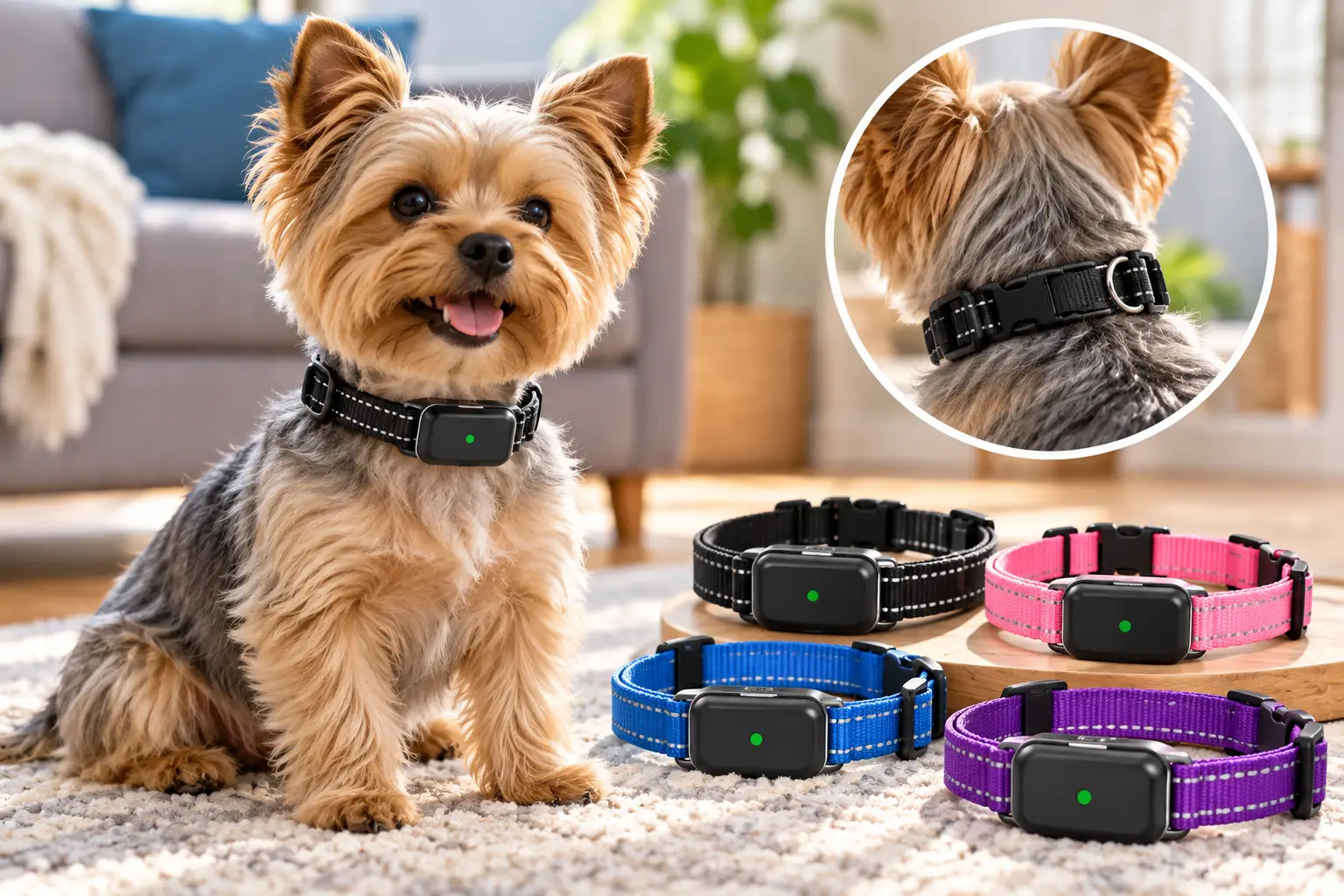
Correction collars for small dogs are training collars that interrupt an unwanted behavior, such as pulling, lunging, or ignoring a recall, by applying a sound, vibration, static stimulation, or pressure that the dog learns to avoid. The category includes electronic remote trainers, prong collars, martingale (limited-slip) collars, and, more loosely, head halters.
Why does size change everything? Because a toy breed’s windpipe is narrow and, in many small breeds, prone to weakening over time. Pressure that a big dog shrugs off can trigger coughing in a Pomeranian. On top of that, a receiver box that’s unnoticeable on a retriever can be a real fraction of a Chihuahua’s body weight.
Here’s how the main types break down:
- ⚡ Electronic collars (e-collars): a remote sends tone, vibration, or static stimulation to a receiver on the collar. The best small-dog models let you dial intensity in very fine steps.
- 🔗 Prong collars: interlocking links that tighten and press evenly around the neck when the leash goes taut. Metal and plastic versions exist.
- 🔄 Martingale collars: a fabric loop that tightens only to a fixed point, mainly to stop a dog from backing out.
- 🐕 Head halters: a nose loop that turns the head toward you when the dog pulls, taking pressure off the throat entirely.
Each one asks something different of you as a handler, which is exactly why the comparison below matters.
Quick Comparison: Correction Collars for Small Dogs at a Glance
If you only have two minutes, this table gives you the shape of the market. Prices are approximate ranges at the time of writing, so check the current price before you buy.
| Product | Type | Size guidance | How it corrects | Price range | Best for |
|---|---|---|---|---|---|
| Educator ME-300 Micro Educator | E-collar, micro receiver | Dogs 5 lb+ (manufacturer) | Tone, vibration, 100-level blunt stimulation | Around $200 | Educator ME-300 Micro Educator: toy breeds needing reliable recall |
| Educator ET-300 Mini Educator | E-collar | Dogs 5 lb+ | Tone, vibration, 100 levels, ½-mile range | $200–$230 | Educator ET-300 Mini Educator: active small dogs off leash |
| PetSafe Lite Remote Trainer (100-yard) | E-collar | Dogs 8 lb+, 6–23″ necks | Tone, vibration, 15 static levels | $100–$140 | PetSafe Lite Remote Trainer: budget in-home training |
| Herm Sprenger Ultra-Plus 2.25 mm | Metal prong | Necks up to about 13–14″ | Even pressure when leash tightens | $30–$50 | Herm Sprenger Ultra-Plus: experienced handlers, sturdy breeds |
| Starmark Pro-Training Collar (Small) | Plastic prong | Necks up to 15″ | Pressure when leash tightens | Under $20 | Starmark Pro-Training Collar: lighter prong alternative |
| PetSafe Gentle Leader Headcollar | Head halter | Petite: under 5 lb; Small: up to 25 lb | Turns the head toward you | $15–$25 | PetSafe Gentle Leader: pullers with sensitive throats |
| Blueberry Pet Martingale Collar (Small) | Martingale | Small: 12–16″ necks | Limited slip, no full choke | $15–$20 | Blueberry Pet Martingale: escape-prone dogs |
Looking at the table, the split is obvious: the three electronic models cost five to ten times more than the mechanical tools, but they’re the only ones that work off leash. If your problem is purely leash pulling, the PetSafe Gentle Leader or the Blueberry Pet Martingale solves it for under $25 without touching the windpipe the way a prong does. If recall is the issue, the Educator ME-300 Micro Educator is the most purpose-built choice for very small dogs.
💬 One click helps other shoppers make an informed choice too! 😊
Top 7 Correction Collars for Small Dogs: Expert Analysis
The seven picks below span entry-level, mid-range, and premium options, plus two gentler alternatives that many trainers reach for first. Each one is judged on what it means for a small dog in real life, not on how long its feature list is.
1. Educator ME-300 Micro Educator — smallest receiver for toy breeds
The Educator ME-300 Micro Educator exists for one reason: to put a professional-grade remote trainer on a dog that weighs less than a bag of flour.
It pairs Educator’s popular ET-300 Mini transmitter with the RX-070 micro receiver, which the manufacturer describes as roughly 20% smaller, 20% lighter, and 20% lower in stimulation than the standard Mini receiver. In practice, that cut matters twice. A lighter box means less weight bouncing on a narrow neck, and a lower ceiling means a fumbled thumb can’t deliver as strong a jolt. You still get tone, vibration, 100 dial levels, a 1/3-mile range, and the brand’s “blunt” stimulation, which Educator describes as more of a tap than a sharp pulse.
Based on the specs, this is the most purpose-built e-collar for small dogs in this lineup. It suits Chihuahuas, Maltese, and toy poodles whose owners want off-leash reliability, ideally with a trainer who teaches the collar as a low-level cue rather than a punishment. One heads-up: Educator’s own product page rates it for dogs 5 lb and up, while at least one dealer chart lists 3 lb. Go with the manufacturer’s 5-pound floor.
On major US retailers, the ME-300 carries far fewer reviews than its bigger sibling; the feedback that exists praises the compact receiver, while fitting very thin necks is the recurring question.
Pros:
- ✅ Smaller, lighter receiver designed for tiny necks
- ✅ Lower stimulation ceiling adds a safety margin
- ✅ Tone and vibration let you skip static entirely
Cons:
- ❌ Premium price for a niche, single-purpose tool
- ❌ Thinner review history than the ET-300
💲 Expect to pay around $200; worth it if your dog is under 10 lb and recall is a safety issue.
2. Educator ET-300 Mini Educator — trainer favorite with half-mile range
The Educator ET-300 Mini Educator is the collar many professional trainers default to, and its spec sheet explains why.
Its 100 stimulation levels let you find your dog’s “working level,” the lowest setting the dog barely notices, often signaled by an ear flick or head turn. That fine graduation is the whole idea behind modern low-level e-collar training: a 5-step jump on a cheap collar can feel like a shove, while a 1-step change on a 100-level dial is a whisper. Add tone and vibration modes, a ½-mile range, waterproofing, a rechargeable battery, a night-tracking light, and expansion to a second dog.
This is the better choice for small dogs in the 10- to 25-pound range who hike, swim, or run beaches off leash, think beagles, Shelties, and Jack Russells. For dogs under about 8 lb, the receiver is bulkier than ideal; the Educator ME-300 Micro Educator fits better there.
Review sentiment is consistently positive about the ergonomic remote and build quality; the most common caveat is choosing contact points that match your dog’s coat length so the signal registers at low levels.
Pros:
- ✅ Very fine 100-level dial for gentle, precise cues
- ✅ Half-mile range covers trails and open fields
- ✅ Expandable to a two-dog system later
Cons:
- ❌ Receiver is chunky on dogs under eight pounds
- ❌ Costs more than most mass-market remote trainers
💲 Typically $200 to $230; strong value if you’ll use it for years of off-leash time.
3. PetSafe Lite Remote Trainer (100-yard) — gentlest budget e-collar for sensitive dogs
The PetSafe Lite Remote Trainer (model PDT00-16126 in the US) targets shy or sensitive dogs at roughly half the price of an Educator.
It offers tone, vibration, and 15 adjustable static levels, plus a safety lock on the higher settings so you can’t hit them by accident. In daily use, that lock is the feature that matters most: small dogs are easily over-corrected, and a guard against a pocket-press is real protection. The 100-yard range sounds limited, but it’s plenty for kitchens, backyards, and doorways, which is where most small-dog problems (counter surfing, door dashing, lunging at the window) actually happen. Collar and remote are rechargeable and waterproof, and the strap fits 6- to 23-inch necks for dogs 8 lb and up.
Based on the specs, this suits budget-minded owners working on in-home manners, not off-leash hiking. Fifteen levels means coarser steps than the Educator ET-300 Mini Educator, so start at tone or vibration and climb carefully.
Review data tied to this exact model number is limited, so weigh early feedback cautiously; what’s verifiable is the spec sheet and PetSafe’s positioning of the Lite line for gentle stimulation.
Pros:
- ✅ Safety lock blocks accidental high-level presses
- ✅ Rechargeable and waterproof at a mid-range price
- ✅ Vibration mode suits sensitive, easily startled dogs
Cons:
- ❌ 100-yard range rules out off-leash trail work
- ❌ Not rated for dogs under eight pounds
💲 Usually $100 to $140; good value for indoor and backyard training.
4. Herm Sprenger Ultra-Plus 2.25 mm — best-made prong for experienced handlers
If you’ve decided on a prong collar for small dogs, the Herm Sprenger Ultra-Plus is the benchmark the cheap copies imitate.
The German manufacturer, in business since 1872, uses a patented center plate that keeps the links aligned so pressure spreads evenly instead of jabbing at one spot. The 2.25 mm gauge is its smallest; Herm Sprenger USA lists it for dogs up to about 40 lb, and the common configuration fits necks around 13 to 14 inches with a 16-inch chain. Links are removable, which is critical: a prong only works safely when it sits snug and high, just behind the ears. Too loose, and it slides down onto the throat, exactly where a small dog is most vulnerable. A nickel-free Curogan finish is available for dogs that react to standard metal.
Here’s the honest analysis: veterinary behavior organizations classify prong collars as aversive tools, and dogs with any airway issue shouldn’t wear one. If you do use it, it belongs on a sturdy 15- to 30-pound dog, fitted and taught by someone experienced.
Customer reviews consistently praise the smooth links and build quality versus knockoffs; reviewers also stress that sizing makes or breaks the experience.
Pros:
- ✅ Center plate spreads pressure more evenly than knockoffs
- ✅ Removable links allow a precise, snug fit
- ✅ Durable German build lasts for years
Cons:
- ❌ Aversive tool; unsuitable for dogs with airway issues
- ❌ Easy to misuse without hands-on guidance
💲 Around $30 to $50; fair for the quality, but only if it’s the right tool for your dog.
5. Starmark Pro-Training Collar (Small) — lightweight plastic prong alternative
The Starmark Pro-Training Collar takes the prong concept and rebuilds it in high-strength polymer, which changes the experience more than you’d expect.
The small size fits necks up to 15 inches at a 3/4-inch width, and its “watch band” links snap together for sizing, with add-a-link packs extending it by about 3.5 inches. Plastic prongs are lighter and blunter than steel, which means less weight on a small neck and fewer problems for dogs sensitive to metal. From a few feet away it looks like an ordinary flat collar, a small detail that helps if neighbors’ stares bother you. It was developed by Starmark’s training academy and ships with a small backup safety collar.
On paper, this is a middle ground for owners who want prong-style feedback without metal. It still works by pressure, though, so the same rules apply as with the Herm Sprenger Ultra-Plus: fit high, never jerk, and skip it entirely for any dog with a cough or diagnosed tracheal weakness.
Reviews consistently report that owners prefer it to metal prongs for weight and comfort. The recurring complaints are coarse sizing (removing one link can make it too tight), a small latch that’s fiddly for big hands, and minor skin irritation on some thin-coated dogs.
Pros:
- ✅ Much lighter than a steel prong collar
- ✅ Metal-free, useful for dogs with sensitivities
- ✅ Looks like a regular flat collar
Cons:
- ❌ Link steps are coarse for in-between neck sizes
- ❌ Small latch can be fiddly to operate
💲 Usually under $20; inexpensive, but buy it only if pressure-based training fits your plan.
6. PetSafe Gentle Leader Headcollar (Petite/Small) — no-pull steering without throat pressure
The PetSafe Gentle Leader fixes pulling by steering the head instead of squeezing the neck, which makes it the most trachea-friendly tool in this roundup.
Designed by a veterinary behaviorist, it uses a soft nose loop and a neck strap that sits high behind the ears. When your dog pulls, the leash gently turns the muzzle back toward you, and where the head goes, the body follows. The Petite size covers dogs under 5 lb (nose loop 3.5–8 inches, neck strap 6–8.5 inches); Small covers dogs up to 25 lb. Your dog can still eat, drink, pant, and take treats while wearing it.
Here’s what to weigh: it’s the best first pick for a small dog whose main problem is leash pulling, especially a breed prone to airway trouble. However, PetSafe advises against using it for jogging or running, and it won’t fit flat-faced breeds like pugs. You also must never yank the leash, since sudden force on the head is the real risk with any halter.
Retailer reviews repeatedly describe it as highly effective for pullers; the most common caveat is an adjustment period while dogs get used to the nose loop.
Pros:
- ✅ Takes pressure off the throat and windpipe
- ✅ Petite size made for dogs under five pounds
- ✅ Inexpensive and easy to resize
Cons:
- ❌ Many dogs paw at the nose loop at first
- ❌ Not suitable for short-snouted breeds
💲 Around $15 to $25; outstanding value for leash pulling alone.
7. Blueberry Pet Martingale Collar (Small) — limited-slip control on a small budget
The Blueberry Pet Martingale is the simplest tool here, and for escape artists it’s often all you need.
A martingale tightens only to a set point when the leash pulls, then stops; it can’t keep cinching the way a slip chain does. The classic version has no buckle and slips over the head. The Small size fits 12- to 16-inch necks at 5/8 inch wide, and some Blueberry lines offer an X-Small for roughly 7.5- to 10-inch necks. In practice, that limited slip stops a dog from backing out of the collar at the curb, a common and genuinely dangerous small-dog trick.
Based on the design, this suits Italian greyhounds, whippets, and any slim-headed small dog that slips standard collars. It’s a gentle cue tool, not a heavy correction, and the brand notes it shouldn’t be worn without a leash. Like any neck collar, avoid it for dogs with tracheal issues.
Reviews consistently praise the comfort and build; the main complaint is the lack of a clasp, which means sliding it over the head each time.
Pros:
- ✅ Prevents backing out without a full choke
- ✅ Soft nylon that’s comfortable on short coats
- ✅ Personalized embroidered versions add ID info
Cons:
- ❌ No buckle on the classic slip-over design
- ❌ Not meant to be worn unsupervised off leash
💲 About $15 to $20; excellent value for slip-prone dogs.
Top 7 Compared Side by Side
This second table compares the seven picks on what owners actually decide on: the level of aversiveness, the learning curve, and the dog each one suits.
| Product | Off-leash use | Aversiveness | Learning curve | Review sentiment | Best for |
|---|---|---|---|---|---|
| Educator ME-300 Micro Educator | Yes, 1/3 mile | Low to moderate (tone/vibration available) | Moderate to high | Positive, limited volume | Educator ME-300: dogs under 10 lb |
| Educator ET-300 Mini Educator | Yes, ½ mile | Low to moderate | Moderate to high | Strongly positive | Educator ET-300: active 10–25 lb dogs |
| PetSafe Lite Remote Trainer | Limited, 100 yd | Low to moderate | Moderate | Limited model-specific data | PetSafe Lite: indoor manners |
| Herm Sprenger Ultra-Plus | No | Moderate to high | High | Positive on build | Herm Sprenger Ultra-Plus: sturdy pullers, pro guidance |
| Starmark Pro-Training Collar | No | Moderate | Moderate | Mostly positive | Starmark Pro-Training: metal-free prong users |
| PetSafe Gentle Leader | No | Low | Low to moderate | Strongly positive | PetSafe Gentle Leader: pullers, airway-prone breeds |
| Blueberry Pet Martingale | No | Low | Low | Positive | Blueberry Pet Martingale: escape artists |
Read across the rows and a pattern emerges: the tools with the lowest learning curve are also the least aversive, which is good news for first-time owners. The Educator ET-300 Mini Educator and Educator ME-300 Micro Educator reward patient handlers with off-leash freedom, while the Herm Sprenger Ultra-Plus demands the most skill for the narrowest benefit on a small dog.
✨ Ready to find the right fit for your small dog?
🔍 Take your small dog’s leash manners to the next level with this carefully curated lineup. Click a highlighted item to check current pricing and availability. These picks will help you get calmer walks and safer outings the whole family will enjoy!
Getting Started: Your First 30 Days With a Small Dog Training Collar
The first month decides whether a small dog training collar becomes a helpful cue or a source of fear. Here’s a practical schedule that works for any tool on this list.
Days 1–5: Make the collar boring 🦴
Put the collar on for short periods with no corrections at all. Pair it with meals, treats, and play. If your dog only ever feels the collar before something unpleasant, it learns to dread the collar itself, and that’s the start of collar-wise behavior, where the dog behaves only while wearing it.
Days 6–12: Find the lowest effective signal ⚡
For an e-collar, start at level 0 and raise one level at a time in a quiet room until you see a tiny reaction: an ear flick, a head turn, a pause. That’s your working level, and on a small dog it’s often surprisingly low. Try tone and vibration first; many sensitive dogs never need static. For a head halter, martingale, or prong, practice loose-leash walking in the hallway before you hit the sidewalk.
Days 13–30: Pair, then fade 🔄
Use the signal only alongside a cue your dog already knows, such as “come” or “with me,” and reward generously the instant they respond. Gradually add distractions: the yard, then a quiet street, then the park.
Daily care habits ✅
- Check skin under contact points or prongs every day for redness.
- Shift an e-collar receiver’s position every couple of hours, and don’t leave it on all day; most manufacturers’ manuals warn about pressure sores from prolonged wear.
- Remove any correction collar before crate time or unsupervised play, since tags and links can snag.
The most common mistake in the first 30 days? Moving too fast. If your dog flinches, hides, or yelps, drop back a stage.
Real-World Scenarios: Matching the Collar to the Dog
Spec sheets are abstract, so here are four realistic owner profiles and the reasoning behind each match.
🏙️ Profile 1: The apartment door-dasher
A 6-lb Chihuahua bolts into the hallway every time the door opens. Budget: flexible. The owner works from home and can train daily. Best match: the Educator ME-300 Micro Educator, used at tone or vibration to interrupt the dash, paired with a rewarded “place” cue. Why not a prong or martingale? The problem happens off leash, so a leash tool can’t reach it.
🥾 Profile 2: The weekend trail beagle
A 22-lb beagle mix follows its nose and ignores recall on hikes. Budget: around $200 to $250. Best match: the Educator ET-300 Mini Educator for its ½-mile range and fine 100-level dial. A long line during the first month adds a safety net while the recall builds.
🫁 Profile 3: The senior Yorkie with a honking cough
A 10-year-old, 7-lb Yorkie pulls toward every dog and coughs on walks. Best match: no neck pressure at all. A well-fitted harness is the first step, and a vet visit should come before any training tool. If pulling persists, the PetSafe Gentle Leader in Petite or Small can be considered after the vet weighs in.
🐕 Profile 4: The strong-willed corgi
A 26-lb corgi drags its owner across parking lots. Budget: under $50. Best match: start with the PetSafe Gentle Leader. If a trainer recommends prong-style feedback, the Starmark Pro-Training Collar or the Herm Sprenger Ultra-Plus are the better-built options, fitted in person.
Problem → Solution: Fixing 5 Common Small-Dog Collar Headaches
Even the right collar can misfire. Here are five frequent problems and what to do about each.
- The collar slides down to the throat. Prongs and martingales are usually too loose. Remove a link or tighten the adjustment so it sits high behind the ears; you should fit about two fingers underneath, not a fist.
- Your dog ignores the e-collar. Nine times out of ten, it’s contact, not level. Swap to longer contact points for fluffy coats or snug the strap before raising stimulation.
- Your dog coughs on walks. Stop using any neck-based tool immediately and see your vet. Switch to a harness or head halter in the meantime.
- Your dog seems scared of the collar. That signals over-correction or poor timing. Return to days 1–5, use tone or vibration only, and consider a certified trainer.
- Red marks appear on the neck. Check fit, rotate e-collar contact points, and shorten wear time. Persistent sores need a vet’s eye.
Notice that most fixes involve fit and timing, not a stronger collar. That’s the single biggest lesson in this whole guide.
How to Choose Correction Collars for Small Dogs
Choosing well comes down to seven questions, asked in this order.
- Is your dog’s airway healthy? Coughing, wheezing, or a “goose honk” sound on walks rules out neck-pressure tools until a vet clears your dog.
- What’s the exact weight and neck size? Weigh your dog and measure the neck high behind the ears with a soft tape. Sizes for prongs and martingales follow neck inches, while e-collars list minimum weights.
- What behavior are you fixing? Leash pulling needs a leash tool; off-leash recall or door dashing needs a remote. Buying the wrong category is the most expensive mistake.
- What’s the least aversive tool that can work? Try a head halter or martingale before a prong, and tone or vibration before static.
- How finely can you adjust it? More stimulation levels, smaller link increments, and safety locks all mean gentler fine-tuning on a small body.
- How heavy is the hardware relative to your dog? A receiver that’s fine on 25 lb may be clumsy on 6 lb; micro receivers exist for a reason.
- Who will teach you to use it? Budget for a lesson or two with a certified trainer, especially for prongs and e-collars.
Work through these honestly and the shortlist usually writes itself.
Common Mistakes to Avoid When Buying a Prong Collar or E-Collar for Small Dogs
Most bad outcomes trace back to a handful of buying errors, not to the dogs themselves.
❌ Trusting “5–120 lb” labels
Generic remote collars often claim to fit any dog from five to 120 pounds. A single receiver and stimulation range can’t be ideal for both ends of that spectrum. Small dogs need low starting levels, fine increments, and a lighter receiver, which is why purpose-built models cost more.
❌ Sizing by weight instead of neck
A 12-lb dachshund and a 12-lb pug have very different necks. For any prong collar for small dogs or martingale, the neck measurement wins.
❌ Buying for fear or aggression
If your dog lunges because it’s frightened, a correction can deepen the fear. Veterinary behaviorists recommend treating fear and aggression with behavior modification, not added discomfort. Talk to your vet first.
❌ Leaving it on all day
Correction collars are training equipment, not everyday wear. Long wear times cause pressure sores under e-collar contact points and snag risks with prongs.
❌ Skipping the instructions
It sounds obvious, yet many problems come from misplaced contact points or reversed prong orientation. Spend ten minutes with the manual before day one.
Correction Collars vs. Harnesses, Head Halters, and Choke Chains
How do these tools stack up against more traditional options? The table below summarizes the trade-offs.
| Tool | Neck pressure | Off-leash use | Escape-proof | Best for |
|---|---|---|---|---|
| Choke (slip) chain | High, unlimited | No | Moderate | Generally not recommended for small dogs |
| Flat collar | Moderate when pulling | No | Low | ID tags, calm walkers |
| Front-clip harness | None | No | Moderate | Pullers, airway-prone breeds |
| PetSafe Gentle Leader | Minimal | No | Moderate | PetSafe Gentle Leader: strong pullers |
| Blueberry Pet Martingale | Limited | No | High | Blueberry Pet Martingale: slim-headed dogs |
| Educator ET-300 Mini Educator | None from the leash | Yes | Not applicable | Educator ET-300: recall training |
The takeaway: an e-collar isn’t really a leash tool at all, which is why it’s the only option here that addresses off-leash problems. For pulling, a harness or the PetSafe Gentle Leader removes nearly all throat pressure, while a choke chain applies pressure with no limit, the worst combination for a toy breed.
It’s also worth knowing that electronic collars are debated well beyond training circles. The Wikipedia overview of shock collars summarizes the welfare concerns, notes that some countries restrict them, and records that Petco became the first major US retailer to stop selling them. An e-collar for small dogs used at tone or vibration is a very different tool from one cranked to a high static setting, but you should go in with eyes open.
Safety, Regulations, and Standards
Safety starts with anatomy. According to the American College of Veterinary Surgeons’ guide to tracheal collapse, small breeds such as Yorkshire terriers, Pomeranians, poodles, and Chihuahuas are the most commonly affected, and signs include coughing when someone pulls on the collar. That’s why every neck-based tool in this guide carries an airway warning.
🇺🇸 The US regulatory picture
- No federal ban: remote training collars are legal to buy and use in the US. Restrictions mostly come from retailers, local animal-welfare rules, and some training organizations’ policies.
- FCC authorization: e-collar remotes are radio transmitters. Reputable units carry FCC authorization; ultra-cheap imports with no FCC ID are a red flag for quality as well as compliance.
- Abroad: several countries restrict or ban shock collars, so check local rules before traveling with one.
🔋 Device safety
Rechargeable receivers use lithium batteries. Charge with the supplied adapter, don’t charge a damaged unit, and replace cracked housings, since water inside a receiver can cause malfunctions.
🩺 Health checks
See your vet before starting any correction collar if your dog is a senior, overweight, coughs, or has a neck or spine issue. Overweight dogs with weakened tracheas tend to show more pronounced symptoms, so weight management and a harness can matter more than any collar.
Features That Actually Matter (and Ones That Don’t)
Marketing copy for training collars is loud. Here’s how to separate what helps a small dog from what just looks good on a box.
✅ Features that matter
- A low starting point and fine steps. On a 100-level dial like the Educator ET-300 Mini Educator, one click is a tiny change. On a 10-level collar, one click can double the intensity your dog feels.
- Tone and vibration modes. Many small dogs respond to these alone, which means you may never need static at all.
- A safety lock or boost limit. The PetSafe Lite Remote Trainer locks higher levels so a pocket-press can’t surprise your dog.
- Receiver size and weight. Smaller receivers, like the micro version in the Educator ME-300 Micro Educator, sit better on necks under 10 inches.
- Contact-point options. Short points for smooth coats, longer ones for fluffy breeds; poor contact leads owners to crank levels unnecessarily.
- Precise sizing increments. Removable links or wide adjustment ranges keep prongs and martingales high on the neck where they belong.
🚫 Features that don’t matter much
- Huge range numbers. A 3,300-foot range is irrelevant for an apartment Pomeranian. Buy for where you actually train.
- “99 shock levels” headlines. More levels only help if the lowest ones are genuinely low and the steps are even.
- Flashlights and multi-dog bundles you won’t use. Nice extras, but they add bulk and cost.
- Automatic bark-triggered static. Automatic corrections can fire at the wrong moment and without you there to judge context, which is a poor fit for a sensitive small dog.
The pattern is simple: pay for control and fit, not for spectacle. A $200 collar with fine control is safer than a $40 one with big numbers on the box.
Long-Term Cost and Maintenance
The sticker price is only part of what you’ll spend. Here’s what ownership looks like over two to three years.
| Product | Upfront range | Ongoing costs | Typical lifespan factors | Value verdict |
|---|---|---|---|---|
| Educator ME-300 Micro Educator | Around $200 | Replacement contact points, eventual battery service | Waterproof build; charging habits matter | Educator ME-300: high value for tiny dogs |
| Educator ET-300 Mini Educator | $200–$230 | Same as above; optional second receiver | Built for heavy professional use | Educator ET-300: best long-term value for e-collars |
| PetSafe Lite Remote Trainer | $100–$140 | Replacement contact points | Fine for home use; light outdoor duty | PetSafe Lite: solid budget value |
| Herm Sprenger Ultra-Plus | $30–$50 | Spare links | Steel lasts for years when cleaned | Herm Sprenger Ultra-Plus: durable, niche |
| Starmark Pro-Training Collar | Under $20 | Add-a-link packs | Plastic wears faster than steel | Starmark Pro-Training: cheap to replace |
| PetSafe Gentle Leader | $15–$25 | Replacement when outgrown or chewed | Nylon wears with daily use | PetSafe Gentle Leader: best value overall |
| Blueberry Pet Martingale | $15–$20 | Occasional replacement | Wash gently to extend life | Blueberry Pet Martingale: lowest total cost |
Over several years, the mechanical tools stay cheap, but the e-collars don’t really cost more per year than you’d expect: a well-cared-for Educator ET-300 Mini Educator can serve one dog for much of its life. The cost many owners forget is professional coaching; private lessons vary widely by city, so ask local certified trainers for their rates before you buy.
🧽 Simple maintenance routine
- E-collars: wipe contact points and the strap weekly, charge fully before outings, and check that contact points are snug.
- Prongs: rinse off salt and mud, dry thoroughly, and inspect links for wear or loose fit.
- Nylon collars and halters: hand-wash or wash on gentle cycles, air-dry, and replace when stitching frays.
A five-minute weekly check catches nearly every problem before it reaches your dog’s skin.
FAQ: Correction Collars for Small Dogs
❓ Can puppies wear correction collars for small dogs?
❓ Is a vibration-only collar enough for a small dog?
❓ What's the best correction collar for a Chihuahua?
❓ Do I need a trainer to use an e-collar for small dogs?
❓ Are cheap shock collars on Amazon safe for small dogs?
Conclusion: Choosing Correction Collars for Small Dogs With Confidence
The best correction collars for small dogs aren’t the strongest ones; they’re the ones scaled to a small body and matched to the actual problem. That single idea runs through every pick in this guide.
If pulling is your headache, start gentle. The PetSafe Gentle Leader steers without squeezing the throat, and the Blueberry Pet Martingale stops escape artists for about the price of a takeout lunch. If you and a trainer decide pressure-based feedback is warranted for a sturdy dog, the Starmark Pro-Training Collar and Herm Sprenger Ultra-Plus are the better-built choices, fitted high and never jerked.
If off-leash reliability is the goal, the electronic picks earn their price. The Educator ME-300 Micro Educator is the most thoughtful option for dogs under 10 lb, the Educator ET-300 Mini Educator is the long-term workhorse for active small dogs, and the PetSafe Lite Remote Trainer covers in-home manners on a tighter budget.
Whatever you choose, three habits matter more than the hardware: check your dog’s airway health with a vet, start with the lowest signal that works, and pair every cue with rewards. Do that, and your next walk might finally be one where you’re holding the leash, not chasing it. 🐾
🐶 Find the right collar for your little companion today!
🔍 Take your small dog’s training to the next level with this carefully curated lineup. Click a highlighted item to check current pricing and availability. These picks will help you get calmer, safer walks the whole family will enjoy!
Recommended for You
- Best Temporary Dog Fence for Large Dogs: 7 Options Compared
- PetSafe Wireless Fence User Guide: 7 Easy Setup Wins (2026)
- Petootsy Dog Collar Reviews: 7 Proven Picks Worth Buying (2026)
Disclaimer: This post contains affiliate links. As an Amazon Associate, I earn from qualifying purchases made through these links, at no additional cost to you.
✨ Found this article helpful? Share it with someone who needs it! 💬🤗