In This Article
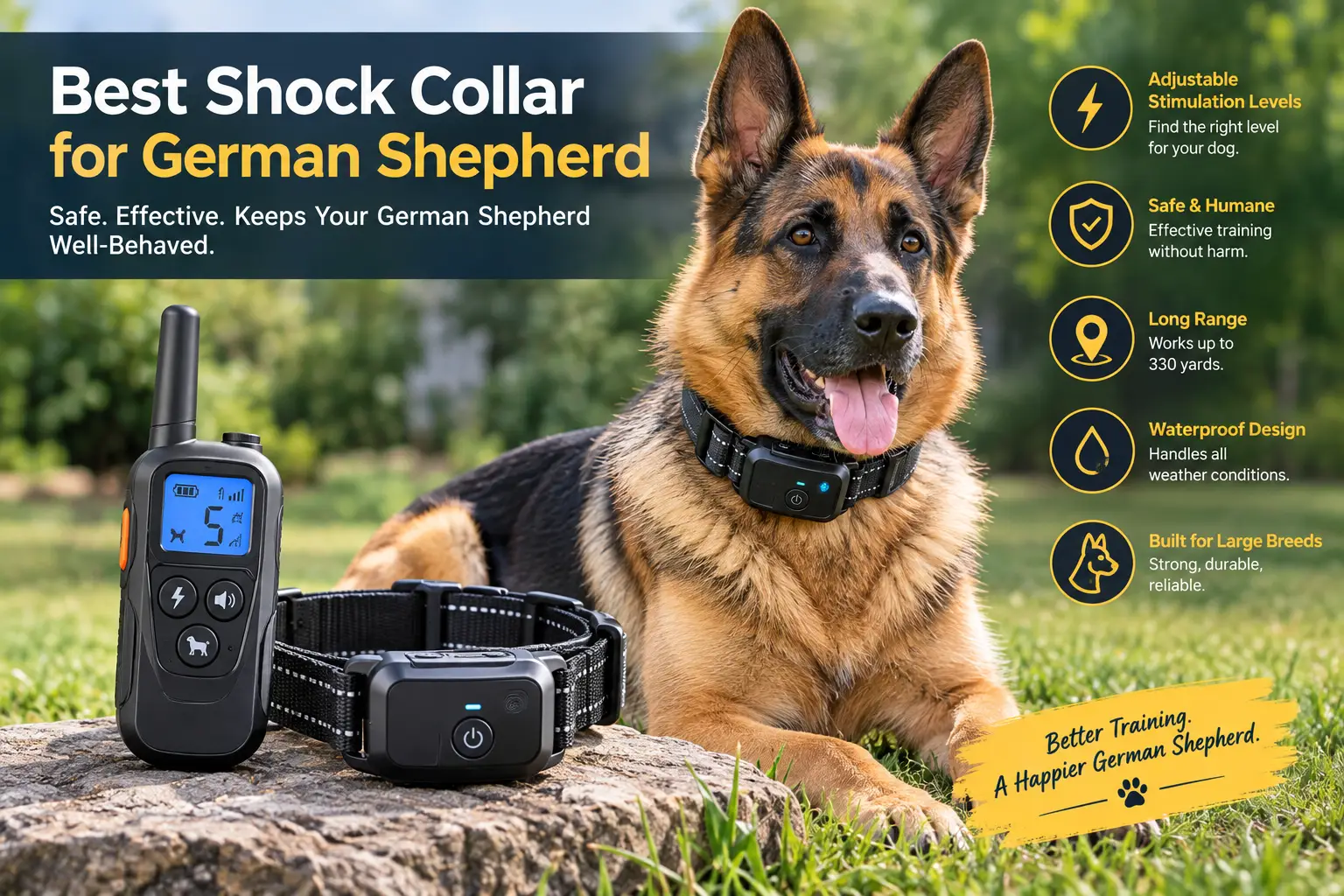
Best Shock Collar for German Shepherd: What Actually Matters in 2026
German Shepherds are brilliant, athletic, and wired to work — which is exactly why off-leash control can feel like chasing a moving target. The German Shepherd was developed in late-1800s Germany as a herding and working dog, and that heritage still shows: a Shepherd can lock onto a squirrel, a jogger, or a scent trail in half a second, and suddenly your perfect “come” falls on deaf ears. That’s usually the moment owners start searching for the best shock collar for german shepherd training — and it’s also the moment when a bad purchase can do real harm.
Let’s frame this honestly. Modern “shock collars” are more accurately called remote training collars or e-collars. The good ones deliver finely adjustable static stimulation, plus tone and vibration options that many dogs respond to without any static at all. The cheap ones are jumpy, inconsistent, and often have crude level steps that make it easy to overcorrect a sensitive dog. Either way, a collar is a communication tool. It doesn’t teach your dog anything by itself — you do.
This guide compares seven real, currently sold e-collars on range, output, level precision, fit for a 50-90 lb dog, and long-term value. Our analysis is built from manufacturer spec sheets, retailer listings, published research, and owner feedback gathered from trainer and breed communities — not from invented “hands-on tests.” You’ll also find a step-by-step introduction plan, real-world buyer scenarios, troubleshooting, and the welfare and legal context every responsible owner should know before pressing a button.
What Is the best shock collar for german shepherd?
The best shock collar for german shepherd owners is a remote e-collar with fine-grained static levels (ideally 100 steps or a smooth dial), separate tone and vibration, a receiver sized for 50-90 lb dogs, reliable range of at least 500 yards, and solid waterproofing — used at the lowest level your dog barely notices.
Quick Comparison: 7 E-Collars for German Shepherds at a Glance
| Product | Range | Static Levels | Output / Min. Dog Size | Best for |
|---|---|---|---|---|
| Dogtra 1900X | 3/4 mile | 100 + boost | Low-high / 35 lb+ | Dogtra 1900X: best overall for adult Shepherds |
| Educator ET-300 Mini | 1/2 mile | 100 + boost (1-60) | Low-normal / 5 lb+ | Educator ET-300 Mini: best value and precision |
| Educator ET-800 The Boss | 1 mile | 100 + boost (1-60) | Low-high / 20 lb+ | Educator ET-800 The Boss: high-drive, long-range work |
| Garmin Sport PRO | 3/4 mile | 10 | Medium / all sizes | Garmin Sport PRO: multi-dog households |
| SportDOG FieldTrainer 425X | 500 yards | 21 | Low-medium / 8 lb+ | SportDOG FieldTrainer 425X: simple no-look control |
| Dogtra 280X | 1/2 mile | 100 + boost | Low-medium / 10 lb+ | Dogtra 280X: adolescent or softer Shepherds |
| PetSafe 300 Yard Remote Trainer | 300 yards | 15 | Standard / 8 lb+ | PetSafe 300 Yard Remote Trainer: budget backyard training |
Looking at the table, the biggest dividing line isn’t range — it’s level precision. The Dogtra 1900X, Educator ET-300 Mini, Educator ET-800 The Boss, and Dogtra 280X all offer 100 steps, which lets you find a working level your dog notices without startling. The Garmin Sport PRO (10 levels) and PetSafe 300 Yard Remote Trainer (15 levels) make bigger jumps between steps, which matters more for a sensitive Shepherd than an unflappable one.
Range is the second filter. Most suburban owners rarely train beyond 200-300 yards, so the 1/2-mile models cover nearly everyone, while acreage owners and working-line handlers will appreciate the 3/4-mile and 1-mile options. Output class is the third: high-output receivers give you headroom for a dog in full prey drive, but low-to-medium receivers are often a better match for young or soft-tempered dogs.
💬 One click helps other shoppers make an informed choice too! 😊
Top 7 Shock Collars for German Shepherds: Expert Analysis
Each pick below is a real model sold in the US market. We translate specs into what they mean for a Shepherd’s size, coat, and drive, and we flag honestly where the evidence comes from aggregated owner feedback rather than verified testing.
1. Dogtra 1900X — best overall for adult Shepherds
If you share your home with a full-grown, high-drive Shepherd, the Dogtra 1900X gives you the most usable headroom without sacrificing low-level finesse. It’s the successor to Dogtra’s long-running 1900S, which retailers report is being phased out in favor of the newer X-Series.
Its 3/4-mile range and 100 high-output levels mean you can work at a barely-there level in the backyard and still get through when your dog is fixated at the far end of a field. The curved-fit receiver is built for dogs 35 pounds and up with necks of at least 13 inches — a natural match for most adult Shepherds. Boost and level lock let you pre-set a slightly stronger cue for big distractions while preventing accidental level jumps, and IPX9K waterproofing means pond days aren’t a worry.
Who is it for? Owners of confident adult Shepherds who train outdoors and want one system to last for years. On paper, it’s more collar than a soft-tempered adolescent needs, and the 5.6-oz receiver is chunkier than compact models.
Owner feedback on retailer pages and Shepherd forums consistently highlights Dogtra’s build quality and reliability, and a recurring theme is that the vibration alone handles many everyday reminders once a dog understands it.
Pros:
- ✅ Huge output headroom for distracted, high-drive dogs
- ✅ Boost and level lock reduce handler mistakes
- ✅ Expandable to three dogs with extra receivers
Cons:
- ❌ Receiver feels bulky on lean or young dogs
- ❌ Overkill for sensitive Shepherds who respond to very little
💲 Typically around $250-$290 at the time of writing (check the current price) — excellent long-term value if you’ll actually use the range.
2. Educator ET-300 Mini — best value with pro-level precision
The Educator ET-300 Mini is the collar professional trainers recommend most often to pet owners, and the reason is control at the very bottom of the scale.
You get 100 levels plus a user-settable boost from 1 to 60, a lock-and-set feature that saves your dog’s working level, and tone or a non-static “tapping” vibration. E-Collar Technologies describes its stimulation as “blunt,” a wider pulse many dogs seem to perceive as a nudge rather than a sting. In practice, that combination makes it easy to find a level your Shepherd notices without a flinch. The stopwatch-style remote floats and runs by feel, and the kit ships with both 5/8-inch and 3/4-inch contact points — the longer set matters for a Shepherd’s dense double coat.
The manufacturer positions it for soft-to-normal temperaments, which describes the majority of family Shepherds. A very stubborn adult male in full prey drive may outgrow its top end, which is where the ET-800 comes in.
Aggregated owner and trainer feedback consistently praises how low the working levels can go; the most common complaint is that the mode programming has a learning curve and really requires reading the manual.
Pros:
- ✅ Exceptionally fine control at low levels
- ✅ Compact, no-look remote that floats
- ✅ Long contact points included for thick coats
Cons:
- ❌ Mode setup is confusing at first
- ❌ Less top-end power than the larger Educator
💲 Usually in the $180-$220 range (prices may vary) — arguably the best value per feature on this list.
3. Educator ET-800 The Boss — most range for working-line dogs
The Educator ET-800 The Boss takes everything that makes the ET-300 popular and adds a full mile of range plus a larger receiver aimed at big, driven dogs.
It keeps the 100 levels, the 1-60 adjustable boost, lock-and-set, tone, tapping vibration, and a remote tracking light, while moving to a larger receiver on a 1-inch strap. Educator states that this receiver has its strongest top-end output, and the system is rated waterproof to 500 feet and shock-resistant. What that means in practice: the same gentle low end for daily obedience, with extra reserve for the rare moment a Shepherd is locked onto a deer at 300 yards.
This is the pick for working-line Shepherds, IGP/Schutzhund-style hobbyists, and owners with rural acreage. For a laid-back suburban dog, the bigger receiver and extra power are simply unnecessary — and extra power is only useful if the handler has the discipline not to use it.
Owner reports from large-breed and working-dog communities commonly describe it as the collar that “gets through” when smaller units don’t; the recurring caution is that inexperienced handlers can be tempted to run levels higher than needed.
Pros:
- ✅ One-mile range for open country
- ✅ Same fine low-end control as the Mini
- ✅ Rugged, fully waterproof build
Cons:
- ❌ Larger receiver than most pet dogs need
- ❌ Power reserve demands handler discipline
💲 Roughly $250-$380 depending on seller and bundle (check the current price) — worth it only if you need the range or reserve.
4. Garmin Sport PRO — easiest one-handed control for multi-dog homes
The Garmin Sport PRO shines when your Shepherd isn’t the only dog in the house and you want rugged, intuitive hardware.
A quick-turn dial clicks between 10 stimulation levels, and four buttons cover momentary and continuous stimulation, vibration, tone, and lights. A toggle lets one handheld manage up to three dogs (additional PT 10 dog devices sold separately), the collar has LED beacon lights for evening walks, and a built-in BarkLimiter offers settable levels. The handheld is rated IPX7 and floats, while the dog device is rated to 1 ATM. Both batteries are user-replaceable — a real plus for long-term ownership.
Here’s what to weigh: 10 levels means each step is a bigger jump than on a 100-level collar. Many confident Shepherds handle that fine, but a sensitive dog may find one level too soft and the next too strong.
Owner feedback consistently praises the durability and the tactile dial; breed-forum users comparing options often note that it costs about the same as a comparable Dogtra.
Pros:
- ✅ Intuitive dial you can use without looking
- ✅ Handles up to three dogs from one remote
- ✅ User-replaceable batteries extend lifespan
Cons:
- ❌ Only 10 levels limits fine-tuning
- ❌ BarkLimiter adds complexity some owners won’t use
💲 The single-dog bundle usually lands around $250-$330 at the time of writing — fair value for two- and three-dog households.
5. SportDOG FieldTrainer 425X — simplest no-look operation
The SportDOG FieldTrainer 425X is SportDOG’s smallest and lightest e-collar, and it’s the one to choose if you want something that just works without menus.
It offers a 500-yard range and 21 static levels, built from a familiar 1-7 dial with low, medium, and high ranges for each number. Depending on the transmitter mode you pick, you also get tone or vibration. DryTek waterproofing makes it submersible to 25 feet, the batteries quick-charge in about two hours and run roughly 50-70 hours, and it expands to three dogs. Both standard and long contact points are included.
The practical upside is simplicity: 500 yards is plenty for parks, trails, and suburban yards, and the dial is easy to work with gloves on. The fit caveat matters for Shepherds: the strap is rated for necks from 5 to 22 inches, so measure a big male before buying. Owners of truly stubborn dogs may want the 425XS variant instead.
Aggregated reviews praise the straightforward controls and battery life; a minority of owners on breed forums mention a brief wake-up delay on SportDOG remotes that they found annoying during fast moments.
Pros:
- ✅ Dead-simple dial operation
- ✅ Excellent waterproofing for swimmers
- ✅ Long battery life between charges
Cons:
- ❌ Strap may be tight on large males
- ❌ 21 levels is coarser than 100-step rivals
💲 Generally around $150-$180 (prices may vary) — strong value for owners who want simplicity over fine-tuning.
6. Dogtra 280X — gentler output for young or soft Shepherds
The Dogtra 280X is the collar to consider when your Shepherd is still an adolescent, on the softer side temperamentally, or when you plan to rely mainly on tone and vibration.
It delivers 100 levels of low-to-medium output with nick, continuous, boost, and level lock, plus Dogtra’s stronger XPP vibration, an audible tone, and an LED light. It covers a 1/2-mile range, carries the same IPX9K waterproof rating as its bigger sibling, charges via USB-C, and can expand to three dogs. Continuous stimulation automatically shuts off after 12 seconds — a sensible safety net if a button sticks or a handler panics.
Why pick a lower-output collar for a big breed? Because many Shepherds are surprisingly sensitive, and a lower ceiling makes it physically harder to overcorrect. The trade-off is less reserve for a mature, high-drive dog in a high-arousal moment.
Retailer feedback commonly praises the compact receiver and strong vibration. One honest note from Dogtra dealers: its level scale isn’t equivalent to the older 280C, so owners upgrading should re-find their dog’s working level.
Pros:
- ✅ Low ceiling helps prevent overcorrection
- ✅ Strong vibration for static-free cues
- ✅ Modern USB-C charging and IPX9K rating
Cons:
- ❌ Limited reserve for intense prey drive
- ❌ Half-mile range trails the 1900X
💲 Typically in the $180-$230 range (check the current price) — smart value for a growing dog.
7. PetSafe 300 Yard Remote Trainer — most affordable reputable option
The PetSafe 300 Yard Remote Trainer is the realistic choice if your budget is tight but you still want an established US brand instead of an anonymous listing.
It offers tone, vibration, and 15 static levels, with a safety lock that keeps the highest levels from being reached by accident. The collar and remote charge in about two hours, last up to 40 hours, and are waterproof, and you can add a second dog. PetSafe rates it for dogs 8 pounds and up with necks of 6-23 inches and advises against use on puppies under six months. For a Shepherd, choose the Big Dog (Standard) series rather than the Sensitive Dog (Lite) version.
The honest analysis: 300 yards is enough for backyard and neighborhood training, but 15 levels means coarser steps, and the overall build doesn’t match Dogtra or Educator.
Owner sentiment is genuinely mixed — many buyers are satisfied for basic yard work, while experienced trainers on breed forums tend to be critical of PetSafe’s reliability compared with premium brands.
Pros:
- ✅ Lowest entry price of a known brand
- ✅ Safety lock on upper levels
- ✅ Expandable to a second dog
Cons:
- ❌ Coarser levels and shorter range
- ❌ Durability opinions are mixed
💲 Roughly $80-$160 depending on seller (prices may vary) — fine for light backyard use, not for serious off-leash work.
Side-by-Side: Features That Separate the Top 7
| Product | Waterproofing | Multi-Dog | Tone / Vibration | Standout Feature | Best for |
|---|---|---|---|---|---|
| Dogtra 1900X | IPX9K | Up to 3 | Both | Boost + level lock, LED | Dogtra 1900X: adult high-drive dogs |
| Educator ET-300 Mini | Waterproof, floating remote | Up to 2 | Tone or tapping | 1-60 programmable boost | Educator ET-300 Mini: precise family training |
| Educator ET-800 The Boss | Waterproof to 500 ft | Up to 2 | Tone or tapping | One-mile range | Educator ET-800 The Boss: rural, working lines |
| Garmin Sport PRO | IPX7 remote / 1 ATM collar | Up to 3 | Both | BarkLimiter, beacon lights | Garmin Sport PRO: multi-dog homes |
| SportDOG FieldTrainer 425X | Submersible to 25 ft | Up to 3 | Mode-dependent | 50-70 hr battery | SportDOG FieldTrainer 425X: simple field use |
| Dogtra 280X | IPX9K | Up to 3 | Both | 12-sec continuous auto-shutoff | Dogtra 280X: young or soft dogs |
| PetSafe 300 Yard Remote Trainer | Waterproof | Up to 2 | Both | Upper-level safety lock | PetSafe 300 Yard Remote Trainer: budget yards |
The pattern here is clear: safety and precision features — level locks, programmable boost, auto-shutoff — cluster on the Dogtra 1900X, Dogtra 280X, and the two Educator models, which is a big reason trainers favor them. If your Shepherd swims constantly, the Dogtra 1900X, Dogtra 280X, and SportDOG FieldTrainer 425X have the most clearly documented water ratings. And if you have more than one dog, the three-dog systems save you buying a second remote later.
✨ Don’t miss these top-rated training picks!
🔍 Take your Shepherd’s off-leash training to the next level with this carefully curated lineup. Click a highlighted collar to check current pricing and availability — the right tool, used gently, can give your dog more safe freedom on trails and in open fields!
How to Choose a German Shepherd Training Collar (Step by Step)
Picking a german shepherd training collar is less about brand loyalty and more about matching the tool to your dog and your environment. Follow these steps in order:
- Assess temperament honestly. Soft or sensitive Shepherds do best on low-to-medium output collars; confident, high-drive adults may need a high-output receiver for reserve, not daily use.
- Prioritize level precision. 100-step collars let you find the lowest level your dog notices. Fewer steps mean bigger jumps — and a higher risk of overcorrecting.
- Insist on tone and vibration. Many dogs learn to respond to a non-static cue, which means you may rarely need static at all.
- Match range to reality. Suburban owners rarely need more than 1/2 mile; acreage, hunting, or tracking work justifies 3/4 to 1 mile.
- Check receiver fit. Confirm minimum dog weight, neck range, and contact point length for a thick double coat.
- Look for safety features. Level locks, boost limits, and continuous-stimulation auto-shutoff reduce handler error under stress.
- Plan for support. Replaceable batteries, add-on receivers, and a clear warranty matter more over five years than any single spec.
One more criterion that doesn’t appear on spec sheets: your own skill. Timing is everything with any training tool, and many owners get better results by booking a few sessions with a qualified trainer before using static at all. A collar with great precision in clumsy hands still sends a confusing message.
Getting Started: A 14-Day E-Collar Introduction Plan
The first two weeks decide whether your Shepherd sees the collar as a clear communication channel or a source of anxiety. Here’s a practical framework based on common manufacturer guidance.
Days 1-4: Make the collar boring
Put the receiver on (powered off) for short periods during fun activities — meals, play, walks. The goal is that the collar predicts nothing. Dogs that only wear it during corrections quickly become “collar-wise.”
Days 5-6: Find the working level
In a quiet yard, start at zero and raise one level at a time with a momentary tap. Watch for a subtle sign — an ear flick, a head turn, a curious glance at the neck. That’s the working level. A yelp, jump, or freeze means you went too high; drop back and end the session calmly.
Days 7-10: Pair with known cues
On a long line, ask for a command your dog already knows, such as “come,” and use tone or vibration (or the working level) as a gentle “pay attention” cue — then reward generously with food or a tug toy when your dog responds. The reward is what builds enthusiasm.
Days 11-14: Add distance and distraction gradually
Increase difficulty one variable at a time: longer distances first, then mild distractions. Keep the long line on as a safety backup.
First-30-days mistakes to avoid
- ✅ Rotate the receiver’s position every couple of hours to protect the skin
- ✅ Keep sessions short — 10-15 minutes beats an hour of frustration
- ❌ Never use static when you’re angry or startled
Which Collar Fits Your Shepherd? Three Real-World Scenarios
Specs only make sense in context, so here are three common US owner profiles and the reasoning behind each match.
Scenario 1: The suburban family dog
A two-year-old, 65-pound female with a moderate temperament lives in a fenced suburban home. Training happens daily in the yard and weekly at a local park, and the budget is about $200. The Educator ET-300 Mini fits best: half a mile is far more than needed, the 100 fine levels suit a moderately sensitive dog, and the compact remote is easy to carry on family walks. If the budget is tighter, the SportDOG FieldTrainer 425X is a simpler alternative.
Scenario 2: The rural working-line male
An 85-pound working-line male lives on 20 acres near woods with deer. He trains five days a week, including tracking and protection-sport foundation work, and his owner has a $300-$400 budget. The Dogtra 1900X or Educator ET-800 The Boss makes sense here: long range covers the property, and the output reserve is there for the high-arousal moments that working lines are known for — ideally under the guidance of an experienced trainer.
Scenario 3: The two-dog hiking household
A Shepherd and a Labrador hike together every weekend on mixed trails. One remote for both dogs is the priority. The Garmin Sport PRO is the cleanest solution thanks to its three-dog toggle and beacon lights, while the Dogtra 280X works well if the Shepherd is still young and the household prefers lower output.
Problem → Solution: Fixing Common E-Collar Headaches
Most “the collar doesn’t work” complaints trace back to a handful of fixable issues.
Problem 1: Your Shepherd doesn’t react at all. Solution: The contact points probably aren’t touching skin through that dense double coat. Switch to the longer points (included with the Educator ET-300 Mini and SportDOG FieldTrainer 425X), tighten the strap so one finger fits under it, and recheck the working level.
Problem 2: The dog only listens when wearing the collar. Solution: This “collar-wise” behavior happens when the collar appears only for corrections. Have your dog wear it during everyday fun, and keep rewarding responses so the behavior doesn’t depend on the collar.
Problem 3: Redness or irritation on the neck. Solution: Remove the collar at night, reposition it every couple of hours, and wash the neck and contact points regularly. Persistent sores need a veterinarian’s attention before any further use.
Problem 4: The signal cuts out at distance. Solution: Rated ranges assume open line of sight. Hills, dense trees, and buildings shorten them. Hold the remote up and away from your body, and choose a longer-range model like the Dogtra 1900X if you regularly train in wooded terrain.
Problem 5: Your dog becomes anxious, cowers, or avoids you. Solution: Stop using static immediately. Go back to tone or vibration paired with rewards, and consult a qualified trainer or veterinary behaviorist. Fear is a sign the training plan, not the dog, needs to change.
E-Collar for German Shepherd vs Other Training Approaches
An e-collar for german shepherd training is just one option, and it’s worth comparing it honestly with the alternatives before you buy.
| Approach | How It Works | Strengths | Limits | Best for |
|---|---|---|---|---|
| Remote e-collar | Tone, vibration, or static cue at a distance | Off-leash communication at range | Welfare risks if misused; requires skill | Experienced handlers needing distance cues |
| Long line + reward-based training | Food, toys, and play reinforce choices | Strong evidence base; builds relationship | Slower for distance work; needs management | Nearly every dog, especially puppies |
| Prong or slip collar | Pressure on the neck during leash pulls | Immediate leash control | Classed as aversive; leash-only | Not recommended without professional guidance |
| Head halter | Steers the head during walks | Gentle leash control for strong dogs | No off-leash use; needs desensitizing | Pullers on leash |
The evidence deserves a fair hearing. In a frequently cited UK field study, Cooper and colleagues (2014) in PLOS ONE compared 63 dogs referred for recall problems across e-collar and non-e-collar groups. Owners reported similar improvement across groups, but the researchers concluded that e-collar training showed no consistent benefit while raising greater welfare concerns, and they observed more stress-related behavior in dogs that received high-intensity stimulation without warning cues.
The practical takeaway for Shepherd owners: reward-based training should be your foundation. If you add an e-collar, lean heavily on tone and vibration, use the lowest effective level, and pair every cue with something your dog loves.
Shock Collar for German Shepherd Puppy: When (and Whether) to Start
Owners often ask about a shock collar for german shepherd puppy training, especially when a 4-month-old already seems huge and impossibly fast. The responsible answer is to wait.
PetSafe explicitly advises against using its remote trainers on puppies under six months, and the receivers on high-output models like the Dogtra 1900X are sized for adult necks. More importantly, puppyhood is the window for building recall, impulse control, and confidence through games, food rewards, and socialization. Those foundations make any future tool more effective, and many dogs never need static at all once they have them.
If you later decide an e-collar fits your plan — typically once foundational obedience is solid — a low-to-medium output collar such as the Dogtra 280X or the Educator ET-300 Mini is the more cautious starting point. Begin with tone and vibration only, and treat static as a last-resort layer rather than a teaching method.
A few practical guardrails for young Shepherds:
- ✅ Use a long line and a high-value reward for recall practice
- ✅ Enroll in a puppy class focused on reward-based methods
- ❌ Don’t use any collar to “fix” fear, mouthiness, or nipping — those are developmental and need teaching, not correction
Adolescence (roughly 6-18 months) is when many Shepherds test boundaries. That’s the period where professional help pays off most.
Remote Training Collar for Large Dogs: Getting the Fit Right on a Shepherd
Even the best remote training collar for large dogs fails if it doesn’t sit correctly. According to the American Kennel Club’s breed weight chart, German Shepherds typically weigh 50-90 pounds — and they carry one of the densest coats of any popular breed. That combination creates three fit challenges.
1. Contact point length
Standard points often can’t reach skin through a Shepherd’s undercoat, especially in winter. Long contact points are the single most common fix for a collar that “doesn’t work.”
2. Strap tension and placement
The receiver should sit high on the side of the neck, snug enough that the points touch skin but loose enough that you can slide one finger under the strap. Too loose and the cue is inconsistent; too tight and you risk pressure sores.
3. Neck size range
Check the maximum neck size before you buy. The SportDOG FieldTrainer 425X is rated up to 22 inches and the PetSafe 300 Yard Remote Trainer up to 23 inches, which may be snug for a large male. The Dogtra 1900X requires a minimum 13-inch neck, which most adult Shepherds easily exceed.
Never attach a leash to the receiver strap — use a separate flat collar or harness for leash work so the contact points aren’t yanked into the skin.
Features That Actually Matter (and Ones That Don’t)
Marketing copy on e-collar listings is loud. Here’s how to cut through it.
Features that genuinely matter
- ✅ Level granularity — 100 steps or a smooth rheostat dial lets you stay at the lowest effective level.
- ✅ Separate tone and vibration — non-static cues are often enough once your dog understands them.
- ✅ Level lock and boost limits — they protect your dog from accidental jumps when you’re stressed.
- ✅ Momentary vs. continuous modes — a quick tap and a held cue serve different training purposes.
- ✅ Verified waterproofing — Shepherds love water and mud, and electronics hate them.
Features that matter much less than they claim
- ❌ Extreme range claims on cheap collars — a huge number on a no-name listing says little about signal reliability.
- ❌ Flashy “training modes” and flashlight gimmicks — they add buttons, and more buttons mean more chances to press the wrong one.
- ❌ Step counters and app add-ons — fun, but irrelevant to communication quality.
The overall principle: buy precision and safety, not bells and whistles. That’s why established models like the Educator ET-300 Mini and Dogtra 1900X dominate trainer recommendations despite having fewer headline features than budget listings.
Common Mistakes to Avoid When Buying a Shepherd E-Collar
Most e-collar regrets come from predictable buying and handling errors.
Mistake 1: Buying the cheapest listing with the biggest numbers. Budget no-name collars often advertise thousands of feet of range and dozens of modes, but owner discussions on breed forums repeatedly describe inconsistent stimulation — exactly what you don’t want with a powerful, sensitive breed.
Mistake 2: Choosing output by size alone. A 90-pound Shepherd can be emotionally soft. Temperament, not weight, should decide whether you need a high-output receiver.
Mistake 3: Skipping the introduction phase. Putting a new collar on and correcting immediately teaches your dog that the collar predicts discomfort — and can create fear of the yard, the park, or even you.
Mistake 4: Using it as punishment. Pressing a button in frustration after a bad behavior has already happened doesn’t teach the right behavior. The cue should guide your dog toward a reward.
Mistake 5: Using an e-collar for aggression or fear on your own. Reactivity, guarding, and fear-based behaviors require a qualified professional. Adding discomfort to a fearful dog can intensify the problem.
Mistake 6: Leaving it on around the clock. Most manufacturer manuals warn about pressure sores and recommend limiting wear time and repositioning the receiver regularly.
Long-Term Cost and Maintenance
The sticker price is only part of the story. Over five years, battery life, replacement parts, and warranty support decide the real cost of ownership.
| Product | Approx. Price Range | Long-Term Cost Factors | Value Verdict |
|---|---|---|---|
| Dogtra 1900X | $250-$290 | Replaceable batteries, add-on X-Series receivers | Dogtra 1900X: high upfront, excellent lifespan |
| Educator ET-300 Mini | $180-$220 | Replaceable batteries, add-on receiver for 2nd dog | Educator ET-300 Mini: best cost per feature |
| Educator ET-800 The Boss | $250-$380 | Same ecosystem as the Mini | Educator ET-800 The Boss: pay only for needed range |
| SportDOG FieldTrainer 425X | $150-$180 | Add-a-dog collars, long battery life | SportDOG FieldTrainer 425X: low running cost |
| PetSafe 300 Yard Remote Trainer | $80-$160 | Possible earlier replacement | PetSafe 300 Yard Remote Trainer: cheapest start, uncertain lifespan |
Prices are approximate ranges at the time of writing — check current pricing before buying. Reading the table, the cheapest collar isn’t automatically the cheapest to own: if a budget unit fails within a couple of years, a premium collar that lasts five or more years can work out to similar or lower annual cost. The Garmin Sport PRO and Dogtra 1900X also stand out for user-replaceable batteries, which avoids replacing the whole system when cells wear out.
Routine maintenance is simple: rinse the receiver after mud or saltwater, clean contact points weekly, check that points are tight, charge fully before storage, and inspect the strap for cracking. Store the remote somewhere kids can’t treat it like a toy.
Safety, Regulations, and Standards
E-collars are legal to buy and use in the United States, with no federal ban at the time of writing. That doesn’t mean there are no rules. Some dog-sport organizations and events restrict electronic collars on their grounds, local animal-cruelty laws apply to any training tool, and abroad, parts of the UK — including Wales and England — have banned them. If you travel with your dog, check local rules first.
Radio-transmitting devices sold in the US are also subject to FCC equipment rules, which is one more reason to favor established brands with clear compliance documentation over anonymous imports.
The veterinary welfare position is equally important. The American Veterinary Society of Animal Behavior (AVSAB) states in its 2021 humane dog training position statement — which it has since reaffirmed — that only reward-based methods should be used for training and behavior modification, and it classifies electronic shock collars as aversive tools. Many trainers who do use e-collars argue that low-level, well-timed cues paired with rewards are humane; AVSAB’s evidence review disagrees. As an owner, you deserve to know both views.
Whatever you decide, these safety basics are non-negotiable:
- ✅ Use the lowest level your dog notices — never “whatever works”
- ✅ Watch for stress signals such as lip licking, tucked tail, or avoidance
- ✅ Remove the collar overnight and inspect the skin daily
- ❌ Never use on a dog with heart conditions, seizures, or neck injuries without veterinary approval
FAQ: Shock Collars for German Shepherds
❓ Will a shock collar work through a German Shepherd’s thick fur?
❓ Is a vibration-only collar enough for a German Shepherd?
❓ Is Dogtra or Educator better for German Shepherds?
❓ Can one remote control two German Shepherds?
❓ Do veterinarians recommend shock collars for German Shepherds?
Conclusion: Choosing the Right Collar for Your Shepherd
The best shock collar for german shepherd owners isn’t the most powerful one — it’s the one that lets you communicate clearly at the lowest possible level. For most adult, high-drive Shepherds, the Dogtra 1900X is the strongest all-around choice thanks to its range, output reserve, and safety features. If you want the most precision for the money, the Educator ET-300 Mini is hard to beat, while the Educator ET-800 The Boss makes sense for rural properties and working-line dogs.
Multi-dog households will appreciate the Garmin Sport PRO, owners who value simplicity should look at the SportDOG FieldTrainer 425X, and those with a young or sensitive Shepherd will find the Dogtra 280X a more cautious fit. On a tight budget, the PetSafe 300 Yard Remote Trainer covers basic backyard work.
Whichever you choose, build the foundation with reward-based training, introduce the collar slowly, lean on tone and vibration, and get professional help for anything involving fear or aggression. Handled that way, the right tool can give your Shepherd more safe freedom — and give you more peace of mind.
🐕 Ready to give your Shepherd safer off-leash freedom?
⚡ Click any highlighted collar above to check current pricing and availability on Amazon, compare it with your dog’s size and temperament, and start building a calmer, more confident training partnership today!
Recommended for You
- GPS Tracking Device for ATV: 7 Best Picks That Beat Thieves (2026)
- airtag collar holder: 7 Best Secure Picks for Dogs (2026)
- No Climb Dog Fence: 7 Proven Picks That Stop Escapes (2026)
Disclaimer: This post contains affiliate links. As an Amazon Associate, I earn from qualifying purchases made through these links, at no additional cost to you.
✨ Found this article helpful? Share it with someone who needs it! 💬🤗