
In This Article
Introduction: Finding the Right Shock Collar for Your German Shepherd
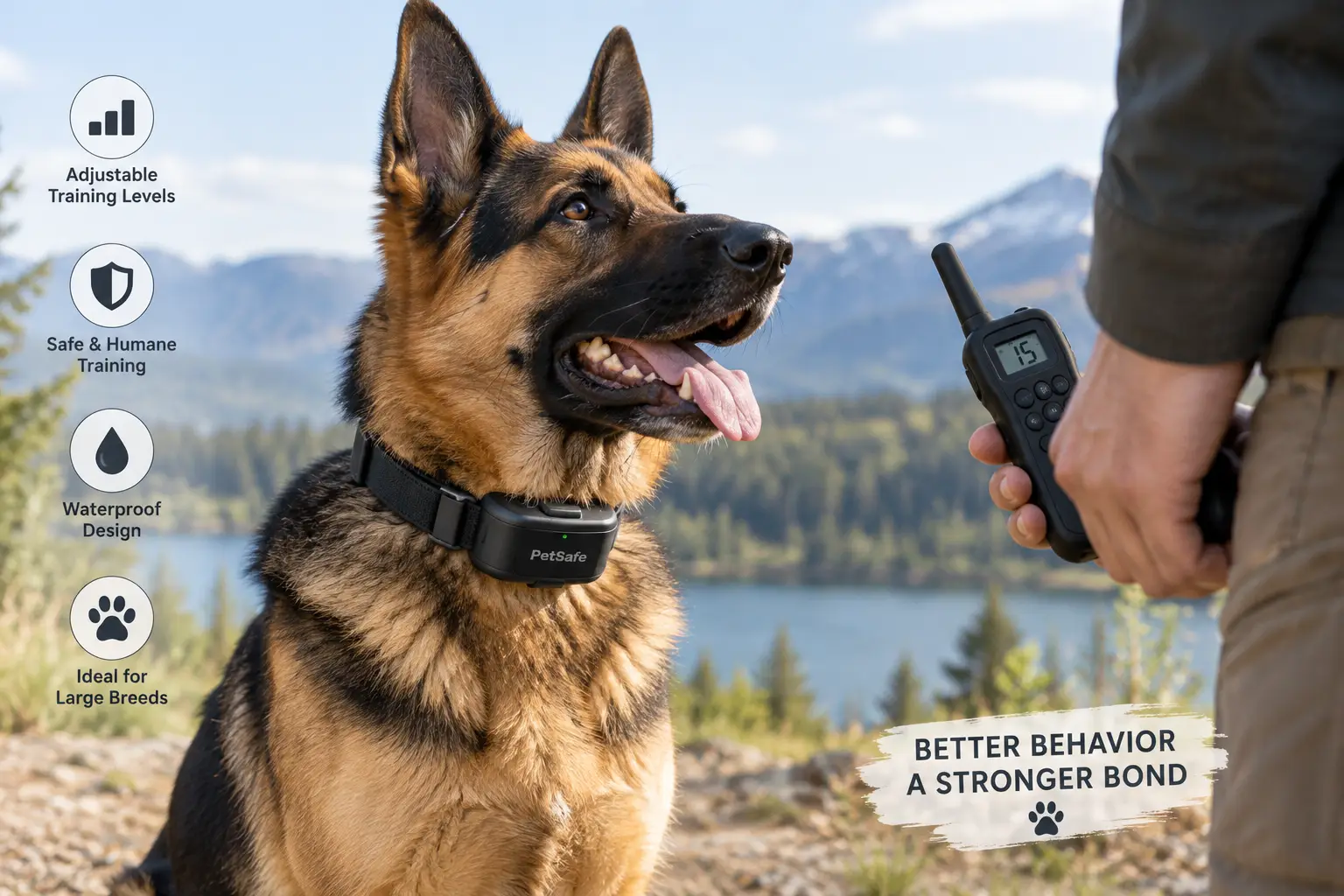
A German Shepherd doesn’t do anything halfway — not loyalty, not energy, and definitely not stubbornness. If you’ve ever tried to call your dog back from a squirrel at 40 yards while they pretend not to hear you, you already know why so many owners start researching a shock collar for german shepherd training. So what is a shock collar for a German Shepherd? It’s a remote-controlled training device with a receiver collar that delivers an adjustable static, vibration, or tone signal, used to reinforce recall, obedience, and off-leash control in a large, intelligent working breed.
This guide isn’t a rehashed spec sheet. We dug through real manufacturer data, aggregated owner feedback, and veterinary behavior research to help you separate genuinely useful features from marketing noise. German Shepherds are sensitive enough that a heavy-handed collar can backfire, and powerful enough that a weak, toy-grade collar won’t register at all — so the “best” pick depends heavily on your dog’s temperament, your training goals, and how much range you actually need. Below, you’ll find seven real, currently available products spanning entry-level to professional-grade, a full breakdown of how to introduce the tool responsibly, and an honest look at what veterinary behaviorists say about static-stimulation training so you can make an informed call either way.
Quick Comparison: Top Shock Collars for German Shepherds at a Glance
| Collar | Range | Stimulation Levels | Best For |
|---|---|---|---|
| Dogtra 1900S | 3/4 mile | 127 | Large, high-drive working dogs |
| Educator ET-300 Mini Educator | 1/2 mile | 100 | Balanced all-around training |
| SportDOG FieldTrainer 425X | 500 yards | 21 | First-time e-collar owners |
| Garmin Sport PRO | 3/4 mile | 10 | Multi-dog households with barking issues |
Looking at this shortlist, the pattern is clear: range and level count generally scale with price, but more levels aren’t automatically better for a German Shepherd specifically. This breed tends to respond well to precise, gradual correction rather than a handful of coarse settings, which is why the Dogtra 1900S and Educator ET-300 Mini Educator — both offering 100+ levels — tend to outperform simpler 10- to 21-level units for dogs with strong prey drive or stubborn streaks. That said, a lower-level-count collar like the Garmin Sport PRO still earns its spot if your priority is bark control and casual yard work rather than serious off-leash distance training.
💬 Ready to compare all seven in detail? Scroll down to find the collar that matches your German Shepherd’s exact temperament and your training goals.
Top 7 Shock Collars for German Shepherds: Expert Analysis
German Shepherds range from 50 to 90+ pounds of muscle, thick double coats, and no shortage of opinions about squirrels — so the collar that works for a mellow, house-trained adult won’t necessarily suit a high-drive working-line puppy. The seven picks below cover entry-level, mid-range, and professional-grade options, along with a couple of lesser-known configurations worth a second look.
1. Dogtra 1900S — most range and power for stubborn adults
The distinguishing feature here is raw capability: a 3/4-mile range and 127 stimulation levels built for dogs that simply don’t quit. Key specs include a rheostat dial for gradual level adjustment, Nick (momentary) and Constant correction modes, and a receiver rated waterproof and submersible to 25 feet — meaning a muddy field or a lake swim won’t take it offline mid-session. In practice, the wide level range matters more than the number itself: a 50-90 lb Shepherd with a strong prey drive needs headroom between “barely noticeable” and “gets their attention,” and 127 finely spaced levels give you that room without jumping straight to overcorrection.
Based on comparing this collar against lower-tier models, the 1900S is best suited for owners doing serious off-leash recall work, farm or property management, or training alongside hunting or working-dog routines — it’s overkill for a laid-back companion dog that mostly needs leash-manners reminders. Reviews consistently report that the rheostat dial’s tactile clicks make it easy to dial in a precise level without looking at the remote, a detail owners of high-energy Shepherds mention often when training near traffic or livestock.
Pros:
- ✅ 3/4-mile range covers large properties and open fields
- ✅ 127 levels allow very fine-tuned corrections
- ✅ Submersible to 25 feet for wet-weather reliability
Cons:
- ❌ Bulkier receiver than compact “mini” style collars
- ❌ More expensive than most entry-level options
The Dogtra 1900S typically runs in the $350-$450 range depending on the retailer and any current promotions — check the current price before buying, since Dogtra is phasing this model toward its newer X-Series lineup. For a dog that needs serious range and precision, it’s a strong value even at the higher end of this list.
2. Educator ET-300 Mini Educator — best all-around balance of range and control
The Mini Educator’s headline feature is its proprietary “blunt” stimulation technology paired with a genuinely compact remote, making it comfortable for daily use without sacrificing capability. It offers 100 stimulation levels plus a separate 1-60 boost setting, a 1/2-mile range, and a “lock and set” dial that prevents accidental level changes mid-walk — a small detail that matters a lot once you’re juggling a leash, a treat pouch, and a distracted 75-pound dog at the same time.
What most buyers overlook with this model is the boost function: rather than forcing you to recalibrate your entire working level for a high-distraction moment (say, another dog appearing across the park), you can layer a temporary boost on top of your established baseline. Based on comparing specs across this list, that’s a meaningfully more precise system than a single dial with no override. This collar suits owners who want E-Collar Technologies’ professional-trainer reputation in a size that doesn’t feel like a walkie-talkie in your pocket.
Pros:
- ✅ 100 levels plus adjustable 1-60 boost for distractions
- ✅ Fully waterproof and submersible up to 500 feet
- ✅ Compact, ergonomic remote built for one-handed use
Cons:
- ❌ Boost feature has a learning curve for first-time users
- ❌ 1/2-mile range is shorter than top-tier competitors
Expect to pay in the $150-$200 range for the single-dog ET-300 — always check the current price, as E-Collar Technologies periodically bundles it with contact points or a second collar for multi-dog households.
3. SportDOG FieldTrainer 425X — best value for first-time e-collar owners
The 425X’s short-hand pitch is simplicity: 21 stimulation levels accessed through a single dial, plus separate tone and vibration buttons, in SportDOG’s smallest and lightest housing. The rechargeable lithium-ion batteries last roughly 40-60 hours per charge and recharge in about two hours, so it’s realistic for daily training without constant battery anxiety.
The spec sheet doesn’t say this, but user feedback suggests the 425X earns its “starter collar” reputation because the learning curve is genuinely short — new owners don’t need to memorize a multi-function remote to get consistent results. For a German Shepherd puppy or a newly adopted adult still learning basic recall, that simplicity is a real feature, not a limitation. It’s expandable to control up to three dogs with additional Add-A-Dog collars, which is a nice bonus if your household grows.
Pros:
- ✅ Simple, no-look dial operation for quick learning
- ✅ Waterproof and submersible to 25 feet
- ✅ Expandable to train up to three dogs
Cons:
- ❌ 500-yard range is limiting for large open properties
- ❌ Fewer levels than premium models for very stubborn dogs
Pricing typically falls in the $150-$180 range at the time of writing, making the 425X one of the more approachable entry points on this list without feeling like a toy-grade product.
4. Garmin Sport PRO — best for multi-dog households and bark control
The Sport PRO’s standout feature is its built-in BarkLimiter with AutoRise technology, which escalates correction automatically if nuisance barking continues, then resets — useful for Shepherds that alert-bark at every passerby. It offers 10 stimulation levels via a quick-turn dial, a 3/4-mile range, and LED beacon lights for locating your dog after dark, plus one-handed operation across up to three dogs with additional collar devices.
Here’s what to weigh: 10 levels sounds thin next to a 100-level Educator, but Garmin’s dial uses distinct “positive click” stops that most owners find easier to calibrate precisely than scrolling through a hundred barely-different settings. Reviews consistently report the transmitter’s floating, waterproof design as a practical plus for owners who train near water or in wet climates. This collar is best for households managing multiple dogs, or Shepherds whose main issue is barking rather than off-leash roaming.
Pros:
- ✅ Built-in adaptive bark limiter with auto-escalation
- ✅ 3/4-mile range with one-handed dial operation
- ✅ Expandable to manage up to three dogs at once
Cons:
- ❌ Only 10 stimulation levels versus 100+ on premium models
- ❌ Higher price point for a mid-tier level count
The Sport PRO generally sits in the $250-$300 range — at the time of writing, bundle pricing with an extra collar unit can shift that upward for multi-dog setups.
5. PetSafe Big Dog Remote Trainer — most budget-friendly option for large breeds
This collar’s short-hand pitch is accessibility: a sub-$150 entry point purpose-built for dogs 40 lbs and up, with 16 correction levels plus a tone-only mode and an instant “+2 boost” button for sudden distractions. The digital remote has an easy-to-read display, and both collar and remote are waterproof, running on standard CR2032 batteries rather than a proprietary rechargeable pack.
Based on comparing the specs, the +2 boost button covers a real gap in budget collars: instead of scrambling to twist a dial up several notches when your Shepherd bolts after a rabbit, one button press temporarily raises the correction without losing your baseline setting. What the spec sheet doesn’t say, but aggregated buyer feedback suggests, is that the 100-yard range is genuinely limiting for anyone doing serious field or off-leash park training — this collar is best suited to yard work, leash-adjacent training, and basic obedience reinforcement rather than long-distance recall.
Pros:
- ✅ Purpose-built for large breeds 40 lbs and up
- ✅ Instant +2 boost button for sudden distractions
- ✅ One of the most affordable options on this list
Cons:
- ❌ 100-yard range is short for open-field training
- ❌ Uses disposable batteries instead of rechargeable packs
Pricing generally falls under $150 — check the current price, as PetSafe frequently runs seasonal promotions on this model through major retailers.
6. Dogtra 280C — lightest and most compact for a natural collar feel
The 280C’s defining trait is size: at just 2.2 oz, the receiver is one of the lightest on the market, built for dogs as small as 10 lbs but fully capable on a German Shepherd that simply doesn’t need Dogtra’s bulkier professional units. It shares the same 127-level stimulation range and LCD display as its bigger siblings, with a 1/2-mile range and both Nick and Constant correction modes, all in a fully waterproof housing rated submersible to 25 feet.
What most buyers overlook with this model is that “compact” doesn’t mean “underpowered” here — Dogtra kept the full 127-level rheostat dial and LCD readout from its higher-end lineup, just in a smaller housing. Reviews consistently report that owners of coated, double-layered breeds like German Shepherds appreciate the lighter receiver during long summer training sessions, since a heavier unit can tug at the fur and skin during active movement. This is a strong pick for owners who want Dogtra’s precision without the size and weight of the 1900S.
Pros:
- ✅ Ultra-lightweight 2.2 oz receiver reduces neck strain
- ✅ Full 127-level stimulation range with LCD display
- ✅ Fully waterproof, submersible to 25 feet
Cons:
- ❌ 1/2-mile range is shorter than Dogtra’s flagship models
- ❌ No safety lock or boost feature, unlike the 280X variant
Expect a price range of roughly $190-$235 depending on retailer and current promotions — the two-dog 282C version runs higher, so check the current price for your configuration before ordering.
7. Dogtra ARC — most discreet design for everyday walks
The ARC’s short-hand hook is subtlety: a slim receiver profile designed to resemble a standard collar rather than an obvious training device, paired with the same 127-level stimulation range now shared across Dogtra’s compact lineup. It offers a 3/4-mile range, a rechargeable lithium-ion battery system, and an ergonomic transmitter with an LCD screen showing exact stim level and remaining battery life.
Here’s what to weigh: the ARC essentially splits the difference between the ultra-compact 280C and the long-range 1900S, giving you 3/4-mile coverage in a receiver built for everyday wear rather than field-trial bulk. Based on comparing the specs, this makes it a strong option for owners who walk their Shepherd through neighborhoods or public parks and would rather not have a bulky remote-trainer receiver drawing attention. It’s a pet-owner-first design more than a working-dog tool, though the 127-level range keeps it perfectly capable for serious training if needed.
Pros:
- ✅ Discreet, low-profile receiver for everyday wear
- ✅ 3/4-mile range matches higher-tier Dogtra models
- ✅ Full 127-level stimulation with LCD readout
Cons:
- ❌ Premium pricing relative to similarly specced competitors
- ❌ Streamlined design offers fewer accessory/contact-point options
The Dogtra ARC generally lists in the $200-$250 range — prices may vary by retailer, so it’s worth checking current listings before committing to this one over the 280C.
Full Feature Comparison: Weighing the Top 7
| Collar | Waterproof Rating | Key Standout Feature | Price Range |
|---|---|---|---|
| Dogtra 1900S | Submersible to 25 ft | Rheostat dial, 127 levels | $350-$450 |
| Educator ET-300 Mini Educator | Waterproof to 500 ft | Boost function + lock & set | $150-$200 |
| SportDOG FieldTrainer 425X | Submersible to 25 ft | Simple 21-level dial | $150-$180 |
| Garmin Sport PRO | IPX7 rated, floats | Adaptive BarkLimiter | $250-$300 |
| PetSafe Big Dog Remote Trainer | Waterproof | +2 instant boost button | Under $150 |
| Dogtra 280C | Submersible to 25 ft | 2.2 oz ultra-light receiver | $190-$235 |
| Dogtra ARC | Waterproof, rechargeable | Discreet, low-profile design | $200-$250 |
Stacking these side by side, the value pattern is fairly clear: the Educator ET-300 Mini Educator offers the strongest feature-to-price ratio for most German Shepherd owners, since it pairs a genuinely high level count with a mid-range price tag. If budget is the deciding factor, the PetSafe Big Dog Remote Trainer gets the basics right without unnecessary extras, while the Dogtra 1900S justifies its higher price only if you actually need the extended range and power it offers.
How to Introduce Your German Shepherd to a Shock Collar (First 30 Days)
Getting the tool right matters less than getting the introduction right — a badly introduced e-collar can create more problems than it solves, especially with a breed as sensitive to handler tension as the German Shepherd. Start with the collar powered on but set to the lowest stimulation level (or vibration/tone-only mode) for the first few sessions, and let your dog wear it during normal, relaxed activities like mealtime or a calm walk, with zero corrections at all. This builds a neutral or even positive association with the physical sensation of wearing it before you ever introduce a correction.
Once your Shepherd is comfortable wearing the collar, find their “working level” — the lowest setting that produces a subtle response, like a head tilt or brief ear flick, not a yelp or flinch. This is almost never the collar’s mid-range setting; for most Shepherds it’s surprisingly low. Pair the stimulation with a command you’ve already taught using positive reinforcement, never as the first introduction to a new cue. In the first 30 days, the most common mistake owners make is escalating the level too quickly out of frustration when a dog “ignores” a low setting — more often than not, the dog genuinely didn’t feel it yet, and the fix is a slightly higher working level, not repeated corrections at the same intensity. Keep sessions short (5-10 minutes), end on a success, and always pair a correction with continued reward-based training rather than using the collar as a standalone system.
Real-World Scenarios: Matching the Collar to Your German Shepherd’s Life
Different households need genuinely different tools, and the “best” shock collar for german shepherd training really does depend on daily context more than raw spec sheets.
The acreage owner with a working-line adult. If you’ve got several fenced (or partially fenced) acres and a high-drive Shepherd bred for herding or protection work, range and power matter more than subtlety. The Dogtra 1900S or Dogtra ARC fit this profile — both offer 3/4-mile range, which covers the realistic distance a fast-moving Shepherd can put between you and them in under 30 seconds.
The apartment or suburban household with a reactive barker. For owners managing a Shepherd that alert-barks at hallway noise, delivery trucks, or neighboring dogs, the Garmin Sport PRO‘s adaptive BarkLimiter directly targets that specific behavior without requiring you to hold the remote for every correction, since the bark-triggered escalation happens automatically on the collar itself.
The first-time e-collar owner with a young, food-motivated puppy. If this is your first static-stimulation tool and your dog already responds well to treats and praise, start conservative. The SportDOG FieldTrainer 425X or PetSafe Big Dog Remote Trainer offer a manageable learning curve, lower price risk if the tool isn’t the right fit for your training style, and simple enough interfaces that you can focus on technique rather than remote functions.
How to Choose a Shock Collar for a German Shepherd
Picking the right collar comes down to a handful of concrete decision points rather than chasing the highest level count or longest range on the box.
- Match the range to your actual use case. A backyard or suburban walk rarely needs more than 500 yards; open fields, farms, or hunting-adjacent training genuinely benefit from 3/4-mile coverage.
- Prioritize level count for sensitive or reactive dogs. More stimulation levels mean finer gradation, which reduces the risk of overcorrecting a dog that startles easily.
- Check the waterproof rating against your climate and activities. A Shepherd that swims, works in rain, or lives somewhere humid needs a fully submersible receiver, not just “splash resistant.”
- Confirm the neck-size and weight range fit your dog. Most collars list a minimum weight (often 8-15 lbs) and neck-size range; oversized straps or undersized receivers both cause fit and comfort problems.
- Decide whether you need multi-dog expandability now, not later. Buying a single-dog system when you’re likely to add a second dog within a year usually costs more long-term than buying an expandable system upfront.
- Factor in battery type and charge time. Rechargeable lithium-ion systems cost less over time than collars running on disposable coin batteries, but need a charging routine you’ll actually follow.
- Weigh boost or lock features if your dog has a strong prey drive. A dedicated boost button (like PetSafe’s +2 or Educator’s 1-60 boost) handles sudden high-distraction moments more precisely than manually spinning a dial.
Common Mistakes to Avoid When Using a Shock Collar on a German Shepherd
Even a well-chosen collar can undermine training if it’s used inconsistently or introduced too aggressively. The most frequent mistake is starting at too high a stimulation level — since German Shepherds are a working breed, some owners assume they need a “strong” setting to get through to them, when in reality most dogs respond to levels far lower than expected. A second common error is using the static correction as the first and only signal for a command the dog hasn’t already learned through positive reinforcement; the collar should reinforce known behaviors, not teach brand-new ones from scratch. Inconsistent timing is a third issue — a correction delivered even a few seconds after the unwanted behavior teaches the dog very little, since dogs associate consequences with whatever they’re doing at the exact moment the correction lands. Finally, leaving the collar on for extended periods (longer than 8-12 hours) without repositioning it can cause pressure irritation from the contact points, particularly on a Shepherd’s thick double coat where consistent skin contact already requires slightly longer contact points.
Shock Collar vs. Positive-Reinforcement-Only Training
| Factor | Shock/E-Collar Training | Positive-Reinforcement-Only |
|---|---|---|
| Off-leash distance control | Strong, especially at range | Requires extensive proofing |
| Learning curve for owner | Moderate to steep | Simple but time-intensive |
| Risk of stress response | Present if misused | Minimal when done correctly |
| Professional endorsement | Mixed; opposed by AVSAB | Broadly recommended |
| Best for | Recall at distance, high-drive dogs | Most obedience and manners work |
This comparison isn’t a clean win for either method, and that’s the honest answer. E-collar training tends to produce faster results for off-leash recall at real distance — the kind of scenario where a leash or a treat pouch simply isn’t in play — while positive-reinforcement-only methods carry essentially no risk of a stress response when used correctly, and are the approach most broadly recommended by veterinary behavior organizations. Many experienced trainers land somewhere in the middle: building the foundation entirely through reward-based methods, then introducing a low-level e-collar strictly as a long-distance “reminder” for behaviors the dog has already mastered up close.
Long-Term Cost and Maintenance
The upfront price tag is only part of the real cost of owning a remote training collar. Rechargeable lithium-ion units like the Educator ET-300 or Dogtra models typically last 2-4 years of regular use before the battery noticeably degrades, at which point most manufacturers sell replacement battery packs rather than requiring a full new unit — worth checking before you buy if you want a system you can maintain long-term. Contact points (the metal prongs that touch your dog’s skin) wear down or corrode over months of use and typically run $10-$25 for a replacement set; budget-tier collars using standard disposable batteries like the PetSafe Big Dog Trainer avoid battery-degradation costs entirely but mean an ongoing expense of $5-$10 every few weeks of regular use. Collar straps themselves need periodic replacement as they stretch or fray, generally $10-$20 depending on brand. Factoring in these smaller recurring costs, a $180 mid-range collar with a 3-4 year lifespan often works out cheaper per year of use than a $100 budget model that needs constant battery replacement and earlier strap wear.
Features That Actually Matter (and Ones That Don’t)
Marketing copy on training-collar packaging loves to tout raw level counts — “124 levels!” — but the number itself matters far less than how evenly those levels are spaced and how the remote lets you access them. A collar with 21 well-calibrated levels and a tactile dial, like the SportDOG 425X, can be more usable in practice than a poorly spaced 100-level system where levels 40-60 all feel identical. Range is another spec worth scrutinizing against your actual needs rather than the biggest number on the box — most suburban and backyard training scenarios rarely exceed 200-300 feet of real working distance, meaning the extra 3/4-mile capacity on premium collars is genuinely useful only for acreage, hunting, or serious off-leash fieldwork. Features that consistently do matter: a genuine boost or override function for sudden distractions, a lock feature that prevents accidental level changes, submersible (not just splash-resistant) waterproofing if you live somewhere wet, and battery life rated in real hours rather than vague “long-lasting” language. Features that matter far less than their marketing suggests: extreme maximum range for owners who only ever train in a backyard, night-tracking lights unless you specifically walk after dark, and flashy LCD displays that mostly just replicate information a simple indicator light could convey just as well.
Safety, Regulations, and Standards
Before buying, it’s worth understanding that shock collars are a genuinely contested topic within veterinary and behavioral science, not just a matter of picking the right model. The American Veterinary Society of Animal Behavior’s position statement recommends reward-based methods and advises against electronic collars and other aversive training tools, citing concerns about stress-related behaviors and potential welfare impacts when these tools are used incorrectly or as a first-line approach. That said, the research isn’t entirely one-sided — a 2024 study published in the journal Animals found that e-collar training stopped chasing behavior in dogs more effectively than food-reward-only methods across the sessions tested, while noting that the tool’s welfare impact depends heavily on the skill of the person using it. The most balanced approach most professionals agree on: use the lowest effective stimulation level, always pair static correction with positive reinforcement rather than using it standalone, and consult a certified trainer or veterinary behaviorist before starting, particularly for a dog with any history of anxiety, fear-based reactivity, or aggression.
Legally, there is no federal ban on shock collars in the United States, and most states currently allow their sale and use, though this is an active and evolving area. Legislation has been introduced in several states — for example, New York’s proposed Senate Bill S7723 addresses training standards for professional dog trainers — so it’s worth a quick check of your state and local ordinances before purchasing, since city- or county-level restrictions occasionally exist even where state law is silent. Look for collars that carry a clear IPX waterproof rating (IPX7 or higher for full water resistance) and that ship with a printed training guide, since neither the AVMA nor any federal agency currently certifies these devices for safety in the way ENERGY STAR or UL certification applies to electronics.
✨ Want a collar that fits both your training style and your comfort level with static correction? Compare the full lineup above before making your final call.
Frequently Asked Questions
❓ What stimulation level should I start at for a German Shepherd?
❓ Is a shock collar safe for a German Shepherd puppy?
❓ How long can a German Shepherd wear a shock collar each day?
❓ What's the difference between a shock collar and a vibration collar for a German Shepherd?
❓ Do shock collars actually work for German Shepherd recall training?
Conclusion
Choosing the right shock collar for german shepherd training isn’t about grabbing the model with the highest level count or longest range — it’s about matching the tool to your dog’s temperament, your typical training environment, and how much hands-on control you actually need day to day. A high-drive working-line adult training across open acreage calls for a different collar than an apartment-dwelling puppy still learning basic manners. Across the seven models covered here, the Educator ET-300 Mini Educator stands out as the strongest all-around balance of precision and price for most Shepherd owners, while the Dogtra 1900S and SportDOG FieldTrainer 425X anchor the high-power and budget-friendly ends of the spectrum, respectively.
Whatever you choose, the collar itself is only half the equation. The research is genuinely mixed on aversive training tools, and organizations like AVSAB recommend reward-based methods as the primary approach for good reason — so treat any e-collar as a supplement to positive reinforcement, not a replacement for it, introduce it gradually, and don’t hesitate to bring in a certified trainer if your Shepherd shows any signs of stress rather than simple attentiveness. Used thoughtfully, at the lowest effective level, a well-chosen collar can genuinely strengthen off-leash reliability and safety for a breed that thrives on clear, consistent communication.
Recommended for You
- 4G GPS Tracker Guide: 7 Best Real-Time Picks for 2026
- Best Dog Shock Collar in 2026: 7 Top Picks & Buying Guide
- In Ground Pet Fence: 7 Best Options for a Safer Yard
Disclaimer: This post contains affiliate links. As an Amazon Associate, I earn from qualifying purchases made through these links, at no additional cost to you.
✨ Found this article helpful? Share it with someone who needs it! 💬🤗