
In This Article
Why a GPS Tracking Device for ATV Matters More Than Ever
Here’s a number that should make every quad owner a little uneasy: of the 11,050 ATVs reported stolen in the US in 2025, only about 23% were ever recovered, the lowest recovery rate of any recreational vehicle category, according to the National Insurance Crime Bureau’s 2025 recreational vehicle theft analysis. The same report notes that more than half of recreational vehicle recoveries happen within two weeks of the theft report. Translation: speed is everything, and a gps tracking device for atv is the single most practical way to buy yourself that speed.
ATVs are almost designed to be stolen. They’re light enough to roll onto a trailer in under a minute, most have no factory immobilizer worth mentioning, and they spend a lot of time parked in sheds, barns, and trailheads where nobody’s watching.
What Is a GPS Tracking Device for ATV?
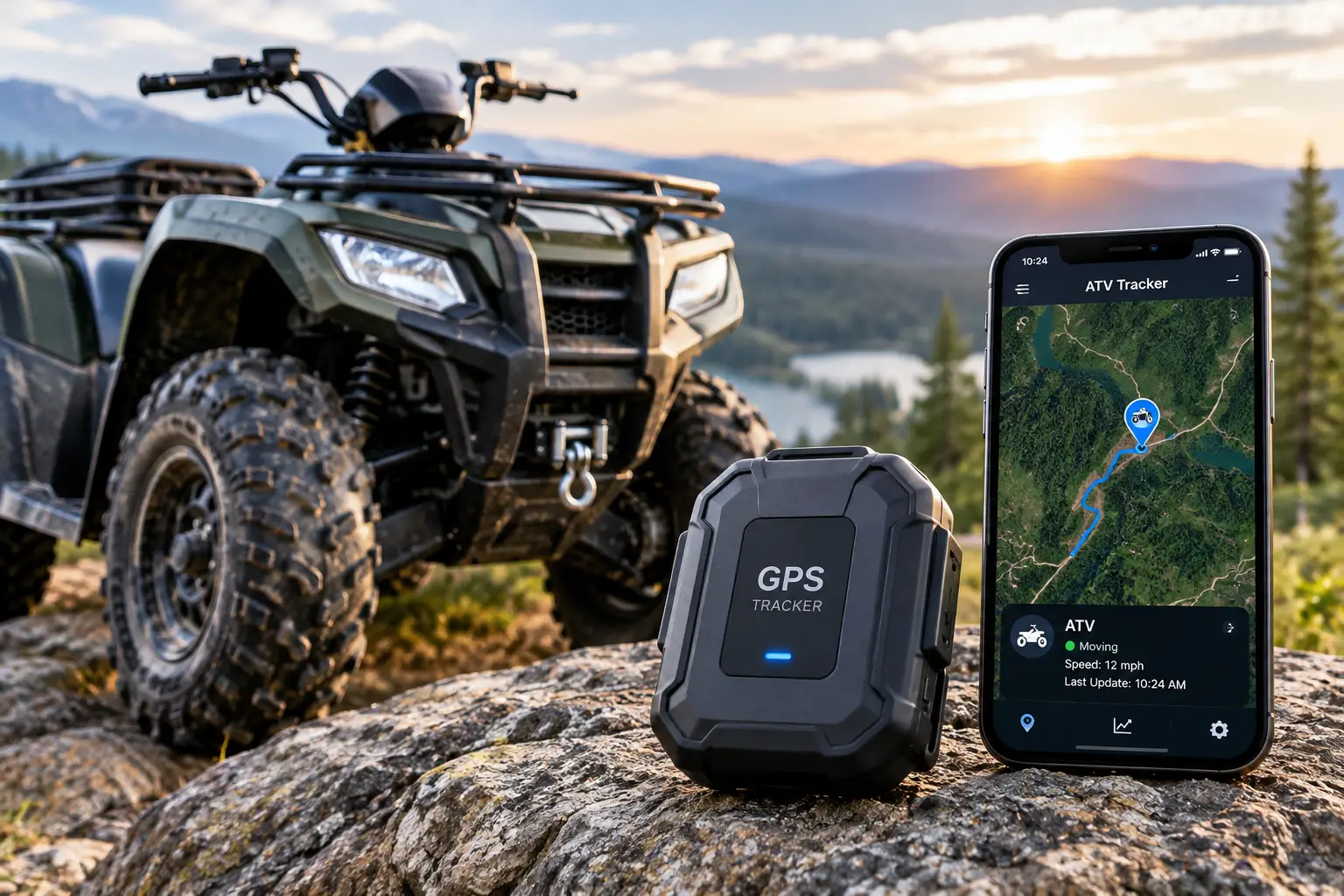
A gps tracking device for atv is a small, rugged, usually waterproof unit that uses GPS satellites to pinpoint your quad’s location, then sends that position to your phone over a cellular (or satellite) network. Most add motion alerts, geofences, and trip history, so you know the moment your machine moves without you.
In this guide, you’ll get an honest, spec-driven breakdown of seven real trackers sold to US buyers, what each one actually means for a muddy, vibrating, rarely-plugged-in vehicle, and how to pick, hide, and maintain your atv gps tracker so it’s still alive when it matters. No fake “I tested this” stories here: just spec sheets, aggregated owner feedback, and careful reasoning.
Quick Comparison: The 7 Best ATV GPS Trackers at a Glance
| Tracker | Network | Battery (claimed) | Weather Rating | Price Range (device) | Best for |
|---|---|---|---|---|---|
| LandAirSea 54 | 4G LTE | Up to ~2 weeks average use | IP67 | Under $50 | LandAirSea 54: all-round magnetic tracking |
| Trak-4 GPS Tracker | 4G LTE + Wi-Fi fallback | 12–18 months | Waterproof (no published IP) | Around $50 | Trak-4: stored ATVs, lowest monthly cost |
| Optimus 3.0 | 4G LTE | 1–2 months at 1-min updates | Waterproof twin-magnet case | Under $50 | Optimus 3.0: budget live tracking |
| Tracki Pro | 4G LTE | 2–12 months | IP67 | Under $100 | Tracki Pro: big battery, flexible mounting |
| Monimoto 9 | LTE-M | Up to 12 months | IP68 | Around $170–$180 | Monimoto 9: phone-call theft alerts |
| Invoxia GPS Tracker Pro Max | LTE-M | Up to 6 months | IP67 | In the $150–$200 range | Invoxia Pro Max: second-by-second live tracking |
| SPOT Trace | Globalstar satellite | Days to months (AAA) | IP67 | Around $100–$130 | SPOT Trace: no cell signal at all |
Looking at the table, the real split isn’t price, it’s power strategy. The Trak-4 and Monimoto 9 are built to sit hidden for many months without attention, while the LandAirSea 54 and Optimus 3.0 trade battery life for faster updates and lower upfront cost. The SPOT Trace is the odd one out on purpose: it’s the only pick here that doesn’t need a cell tower, which matters if your ATV lives at a remote hunting camp.
💬 One click helps other shoppers make an informed choice too! 😊
Top 7 GPS Trackers for ATVs: Expert Analysis
1. LandAirSea 54 — best all-round magnetic tracker
The LandAirSea 54 is the tracker most ATV owners should look at first, because it balances price, toughness, and update speed better than almost anything at this level.
It’s an IP67-rated waterproof unit with a strong internal magnet and a rechargeable 1,500 mAh battery that LandAirSea rates at up to two weeks of average use. In practice, IP67 means it shrugs off creek crossings and pressure-washer overspray, while the magnet lets you slap it onto a steel frame rail in seconds. The motion-activated sleep mode is the quiet hero: when the quad sits, the tracker naps instead of burning battery. LandAirSea also offers fast update tiers (down to seconds), so if your ATV moves, you can watch it nearly live.
Based on the specs, this is ideal for riders who use their ATV weekly and can recharge every week or two. If your quad sits untouched for months, look at the Trak-4 or Monimoto 9 instead.
The LandAirSea 54 carries a #1 Best Seller badge in its amazon.com category and a large review base; recurring themes in reviews and roundups are easy setup and weather resilience, while the most consistent complaint is that the fastest update tiers get pricey.
Pros:
- ✅ IP67 housing handles mud and water crossings
- ✅ Strong built-in magnet, no tools required
- ✅ Lifetime warranty from a US-based company
Cons:
- ❌ Roughly two-week battery means regular recharging
- ❌ Fastest update plans cost $40+ per month
Typically under $50 for the device (check the current price), making the LandAirSea 54 strong value if you choose a moderate update plan.
2. Trak-4 GPS Tracker — longest battery for stored quads
The Trak-4 GPS Tracker wins on endurance, period: it’s the “install it and forget it for a year” option.
Trak-4 rates its rechargeable unit at 12–18 months per charge, depending on reporting frequency. It combines GPS with Wi-Fi positioning, so it can still estimate location inside a barn or garage where satellites can’t see it. That’s a meaningful edge for ATVs, which are often stolen from enclosed storage. Subscriptions start around $6.99/month (paid annually) for hourly reporting, with 10-minute and 1-minute tiers if you want more detail.
Here’s what to weigh: hourly reporting is great for battery life but slow for an active theft. The smart play is the 10-minute tier, which gives a much fresher location if your quad gets loaded onto a trailer. Ranchers and hunting-property owners with several machines will appreciate the commercial-grade housing and low per-unit cost.
Owners in review roundups praise battery life above everything else; the main critique is that the casing is described as waterproof without an official IP rating.
Pros:
- ✅ 12–18 months per charge on hourly reporting
- ✅ Wi-Fi fallback helps locate quads indoors
- ✅ One of the lowest monthly plans available
Cons:
- ❌ Hourly default is too slow for live chases
- ❌ No published IP rating for the housing
Around $50 for the device, and the Trak-4 GPS Tracker delivers the lowest long-term cost in this lineup.
3. Optimus 3.0 — budget pick with a twin-magnet case
The Optimus 3.0 is the budget-friendly way to get true live tracking without fussing over accessories.
It ships with a heavy-duty waterproof case and twin magnets, and Optimus rates the battery at roughly one to two months at the default 1-minute update interval. You can push updates as fast as every 10 seconds, which turns your phone into a live chase map during a theft. The twin magnets matter more than they sound: ATVs vibrate hard on washboard trails, and a single weak magnet is how trackers end up lying in a ditch.
On paper, the Optimus 3.0 suits riders who want minute-by-minute tracking on a tight upfront budget and don’t mind a monthly plan around $19.95. It’s a good fit for UTV owners too, since the case mounts easily under a cargo bed.
Customer feedback on battery life is genuinely mixed: some buyers report about a month, while others say it lasted only a little over a week, likely depending on update settings and signal strength.
Pros:
- ✅ Waterproof twin-magnet case included
- ✅ Updates as fast as every 10 seconds
- ✅ Low upfront device cost
Cons:
- ❌ Battery life varies widely in user reports
- ❌ Monthly plan costs more than Trak-4 or Monimoto
Usually under $50 for the device, the Optimus 3.0 is good value upfront but pricier to run over several years.
4. Tracki Pro — massive battery in a rugged shell
The Tracki Pro takes the popular Tracki platform and gives it the stamina and toughness an ATV actually needs.
The headline spec is a 10,000 mAh battery that Tracki rates for 2 to 12 months per charge, depending on mode and cell conditions. It’s IP67 waterproof out of the box, unlike the smaller standard Tracki, which typically needs an add-on waterproof case. It uses 4G LTE with geofencing and speed alerts. What that means in practice: you can set a geofence around your property and get alerted the moment your quad leaves the yard.
Who’s it for? Owners who want long battery life without paying Monimoto money, and who like Tracki’s flexible app. The trade-off is size: a battery that big makes the Tracki Pro bulkier to hide on a compact sport quad.
Across the wider Tracki line, reviews consistently flag mixed battery-life experiences and some frustration with subscription costs; the Pro model’s larger battery exists precisely to address that first complaint.
Pros:
- ✅ 10,000 mAh battery for months of standby
- ✅ IP67 waterproof without extra accessories
- ✅ Geofence and speed alerts built in
Cons:
- ❌ Bulky to hide on small sport ATVs
- ❌ Requires an ongoing subscription plan
Generally under $100, the Tracki Pro is a solid mid-range value for long-term mounted use.
5. Monimoto 9 — calls your phone when thieves strike
The Monimoto 9 is built around one brilliant idea: a push notification is easy to miss, but a phone call at 2 a.m. isn’t.
It pairs with a small key fob you carry. If the ATV moves without the fob nearby, the tracker calls your phone and starts sending GPS coordinates to the app. It’s IP68-rated (dust-tight and submersion-resistant), runs on LTE-M, and Monimoto rates the USB-C rechargeable battery at up to 12 months per charge. Because it isn’t wired into the ATV, it keeps working even if a thief disconnects the vehicle battery.
What most buyers overlook: the Monimoto 9 is an alarm-plus-tracker, not a ride logger. If you want trip history and live maps of every trail ride, choose the LandAirSea 54 or Invoxia Pro Max. If theft is your main fear, this is the one.
A long-term review from The Drive found it reliable and easy to live with, with cost cited as the biggest drawback; Monimoto’s own listings show 2 months of service included, then $49/year.
Pros:
- ✅ Automatic phone-call alerts, not just notifications
- ✅ IP68 rating and up to 12-month battery
- ✅ Key fob auto-arms and disarms
Cons:
- ❌ Higher upfront cost than most trackers
- ❌ Not designed for detailed trip logging
Around $170–$180 at the time of writing, the Monimoto 9 earns its price through very low yearly running costs.
6. Invoxia GPS Tracker Pro Max — second-by-second live tracking
The Invoxia GPS Tracker Pro Max is the pick if you want both long battery life and a genuinely live chase view.
Invoxia rates it at up to six months per charge from a 2,000 mAh battery, with Live Tracking up to one position per second once a theft alert triggers. It uses 4G LTE-M plus Wi-Fi positioning, is IP67-rated, charges over USB-C, and weighs about 70 g. On a trail, one-second updates mean police can follow a moving trailer almost street by street rather than guessing between pings.
Based on comparing the specs, the Invoxia Pro Max sits in a sweet spot between the Monimoto 9 (best alerts) and the LandAirSea 54 (best value). It suits riders who travel, since Invoxia advertises coverage in 35+ countries.
Honest note: this is a newer model, and verified US review volume is still limited, so long-term reliability on ATVs isn’t yet well documented. Subscription bundles also vary: Invoxia’s site lists one year included, while one amazon.com listing advertises a 3-year SIM, so read the listing carefully.
Pros:
- ✅ Live tracking up to one position per second
- ✅ Up to six-month battery, USB-C charging
- ✅ IP67 and international LTE-M coverage
Cons:
- ❌ Limited long-term US owner feedback so far
- ❌ Included subscription length varies by listing
In the $150–$200 range (check current pricing), the Invoxia GPS Tracker Pro Max is premium value for riders who want live data.
7. SPOT Trace — tracks where cell towers don’t reach
The SPOT Trace is the only tracker here that doesn’t care whether your phone has bars.
It sends location via the Globalstar satellite network, runs on four AAA lithium batteries (with optional USB or DC line power), and is rated IP67 and vibration-tested to SAE J1455, the same type of vibration standard used for heavy-duty vehicle electronics. Tracking intervals run from 5 to 60 minutes on basic plans, or down to 2.5 minutes on extreme tracking. For a quad stored at a backcountry cabin, that’s the difference between a location and nothing at all.
The trade-off is speed: this isn’t real-time. Battery life also varies hugely; SPOT’s own estimates range from about 8 days of constant movement at 5-minute tracking to roughly 25 days at eight hours of motion per day. Hardwiring to the ATV’s 12V system solves that if you’re comfortable with a DC cable.
In retailer reviews, the most common criticism is the plan structure: the lower-cost plan carries a 12-month term, and a flexible monthly plan costs more.
Pros:
- ✅ Works with zero cellular coverage
- ✅ Field-swappable AAA batteries
- ✅ Vibration-rated for rough terrain
Cons:
- ❌ Updates every few minutes, not live
- ❌ Activation fee plus contract-style plans
Around $100–$130 for the device, the SPOT Trace is the best value for remote properties without cell service.
How to Install a Hidden GPS Tracker for ATV (Step-by-Step)
A hidden gps tracker for atv only works if a thief can’t find it in the 30 seconds they spend looking. Here’s a practical first-week plan.
Step 1: Charge, activate, and test indoors
Fully charge the tracker, activate the subscription, and confirm it reports location in the app before it ever touches the quad. Troubleshooting a tracker that’s already zip-tied under a skid plate is miserable.
Step 2: Pick a spot with a sky view through plastic
GPS signals pass through plastic fenders and seat bases but struggle through thick steel. The best hiding spots are:
- ✅ Under the seat, inside the plastic tool compartment
- ✅ Behind front or rear body panels, away from the exhaust
- ✅ Inside a storage box on the rack (for satellite units like the SPOT Trace)
Avoid mounting directly against the engine, exhaust, or muffler: heat shortens battery life fast.
Step 3: Secure it twice
Magnets alone aren’t enough on washboard trails. Add a zip tie or a strip of heavy-duty hook-and-loop fastener as a backup. The Optimus 3.0‘s twin-magnet case and the Monimoto 9‘s included straps help here.
Step 4: Run a “theft drill”
Have a friend ride the ATV a mile away while you watch the app. Check alert timing, update frequency, and accuracy. Then set a geofence around your property.
Step 5: Common mistakes in the first 30 days
Forgetting to set low-battery alerts, leaving the default hourly reporting on a theft-focused tracker, and telling everyone where it’s hidden. Keep the location to yourself; that secrecy is half the protection.
Real-World Scenarios: Matching the Right Tracker to Your Situation
Specs only matter in context, so here are three common US owner profiles and the reasoning behind each match.
Profile 1: The weekend trail rider in the suburbs
You ride most weekends, store the quad in an attached garage, and your budget is around $100 upfront. The LandAirSea 54 is the natural pick: you’ll naturally recharge it when you ride, and IP67 protection handles the trail. Pair it with a geofence around your driveway. If you’d rather never think about charging, the Trak-4 GPS Tracker on a 10-minute plan is the low-maintenance alternative.
Profile 2: The rural landowner with several machines
You’ve got two ATVs and a UTV spread across a barn and a back pasture, and you check on them maybe once a month. Long battery life and low monthly cost beat everything else here. The Trak-4 GPS Tracker wins on cost per machine, and its Wi-Fi fallback helps inside the barn. Add one Monimoto 9 on your most valuable machine for phone-call alerts.
Profile 3: The hunter with a remote cabin
Your ATV lives at a cabin two hours away, where your phone shows “No Service.” Cellular trackers like the Tracki Pro can’t report from there, because they need a tower. The SPOT Trace is the only realistic option, ideally hardwired to a maintained 12V battery or a small solar charger so AAA cells don’t run out during the off-season.
Across all three, the pattern holds: match the power strategy to how often you’ll physically touch the machine, then match the network to where it lives.
🚀 Ready to protect your ride?
🔍 Take your ATV security to the next level with this carefully curated lineup. Click a highlighted tracker to check current pricing and availability. These picks will help you sleep better knowing exactly where your quad is!
Problem → Solution: Fixing the Most Common ATV Tracker Headaches
Even the best atv gps tracker can act up. Here’s how to fix the issues owners report most.
Problem 1: The battery dies way faster than advertised. Solution: Advertised figures assume ideal settings and strong signal. Lengthen the update interval while parked, enable motion-activated sleep, and avoid hot mounting spots. If you need months of standby, the Trak-4 GPS Tracker or Monimoto 9 are simply better suited.
Problem 2: The location jumps around or seems off by a block. Solution: Consumer GPS accuracy is a few meters at best, and the official GPS.gov accuracy guidance explains that what you receive depends on satellite geometry, signal blockage, and receiver quality, with accuracy worsening near buildings and trees. Move the tracker to a spot with less metal overhead.
Problem 3: No updates while the ATV is in the barn. Solution: Steel buildings block GPS. Choose a tracker with Wi-Fi positioning, like the Trak-4 or Invoxia Pro Max, which can estimate location indoors.
Problem 4: The tracker fell off on the trail. Solution: Always add a mechanical backup (zip tie or strap) to magnetic mounts.
Problem 5: You missed the alert. Solution: Turn on critical alerts in your phone’s settings, or choose the Monimoto 9, which calls you instead of relying on notifications.
How to Choose a GPS Tracking Device for ATV
Picking a gps tracking device for atv comes down to seven decisions, in this order:
- Decide where the ATV lives. Cell coverage at your storage spot determines whether you need cellular or satellite. Check your phone’s bars there first.
- Pick a power strategy. Battery units hide easily; hardwired units never need charging but are easier for thieves to trace via wires.
- Set your update speed. Faster updates help recovery but drain the battery. Ten minutes while parked plus live mode on alert is the sweet spot.
- Demand real weatherproofing. Look for IP67 or IP68. “Water-resistant” alone isn’t enough for creek crossings.
- Check mounting hardware. Magnets plus a strap mount beats either alone.
- Calculate three-year cost. Subscription fees usually outweigh device price within a year or two.
- Prioritize the alert style. If theft is your top concern, phone-call or critical alerts matter more than pretty maps.
Run through those in order and two or three trackers from the list above will rise to the top for your situation.
ATV GPS Tracker No Subscription: What’s Actually Possible?
Search for “atv gps tracker no subscription” and you’ll find plenty of listings promising zero monthly fees. Here’s the honest picture.
Any tracker that reports its location over cellular or satellite networks pays someone for that data. Devices advertised as atv gps tracker no subscription options generally fall into three buckets:
- Bluetooth tags (like AirTag-style trackers) that rely on nearby phones. They’re cheap and have no fees, but in a rural field or the woods there may be no phones nearby to relay a location. They’re a useful backup, not a primary theft tracker.
- Bundles with prepaid service baked into the price, such as some Invoxia GPS Tracker Pro Max listings that include multi-year service. You still pay for data; it’s just upfront.
- SIM-your-own devices that need a separate data SIM, which shifts the subscription to your carrier.
That’s why the smarter question isn’t “no subscription?” but “lowest total cost?” At about $49 per year, the Monimoto 9 costs roughly $4 a month to run, and the Trak-4 starts near $7 a month paid annually. Those are about as close as you’ll get to an atv gps tracker no subscription experience while keeping real-time, anywhere coverage.
Long-Term Cost: Three-Year Ownership Breakdown
| Tracker | Device (approx.) | Service Cost Basis | Approx. 3-Year Total | Best for |
|---|---|---|---|---|
| Trak-4 GPS Tracker | Around $50 | From ~$6.99/mo, paid annually | Around $300 (hourly plan) | Trak-4: lowest running cost |
| Monimoto 9 | Around $170–$180 | $49/year after 2 free months | Around $320–$330 | Monimoto 9: cheapest premium alerts |
| SPOT Trace | Around $100–$130 | ~$11.95/mo (12-mo term) + activation | Around $560–$600 | SPOT Trace: off-grid only |
| Optimus 3.0 | Under $50 | ~$19.95/mo | Around $750 | Optimus 3.0: low upfront, short-term use |
The table flips the usual buying logic on its head: the Monimoto 9 looks expensive at checkout but ends up nearly tied with the Trak-4 after three years, while the cheap-upfront Optimus 3.0 becomes the priciest. The LandAirSea 54, Tracki Pro, and Invoxia Pro Max are left out because their totals swing heavily with plan tier or bundle, so price your specific plan before buying. Subscription prices can change, so confirm current terms.
GPS Tracker vs. Traditional ATV Security
| Security Method | Locates a Stolen ATV? | Alerts You in Real Time? | Works if Lock Is Cut? | Best for |
|---|---|---|---|---|
| Cellular GPS tracker (e.g., LandAirSea 54) | ✅ Yes | ✅ Yes | ✅ Yes | LandAirSea 54: most owners |
| Satellite tracker (SPOT Trace) | ✅ Yes | ⚠️ Delayed | ✅ Yes | SPOT Trace: no-signal areas |
| Bluetooth tag | ⚠️ Only near phones | ❌ No | ✅ Yes | Backup only |
| Wheel or disc lock | ❌ No | ❌ No | ❌ No | Deterrent layer |
| Insurance alone | ❌ No | ❌ No | N/A | Financial recovery |
Locks and insurance still matter, but notice that only a real tracker answers the question “where is it right now?” A wheel lock buys time; a tracker turns that time into a recovery. The strongest setup combines a visible deterrent with a hidden tracker the thief never sees.
GPS Tracker for ATV Anti Theft: Building a Layered Defense
A gps tracker for atv anti theft works best as the final layer, not the only one. Think of it like a home: you lock the door and still keep an alarm.
Layer 1: Make it slow to steal
Visible wheel locks, a cable lock through the frame to a ground anchor, and removing the key all add precious minutes. Many thieves skip a machine that looks like work.
Layer 2: Make it hard to move unnoticed
Motion sensors and geofences turn a silent theft into an immediate alert. This is where a gps tracker for atv anti theft setup earns its keep: the Monimoto 9 calls you, while the Invoxia GPS Tracker Pro Max switches to second-by-second tracking.
Layer 3: Make it easy to recover
Record your VIN, take current photos, and keep your tracker app logged in on two phones. NICB data shows faster reports mean better recovery odds, so share the live location with police immediately rather than chasing the ATV yourself.
Layer 4: Consider redundancy
Serious owners sometimes run two devices: one obvious decoy and one deeply hidden. Even a cheap Bluetooth tag as a second layer gives a thief one more thing to find. A two-device gps tracker for atv anti theft setup costs little compared with replacing a $10,000 quad.
Features That Actually Matter (and Ones That Don’t)
Marketing pages love long feature lists. Here’s the cut-through version for ATV use.
Features that matter
- ✅ Real weatherproofing (IP67/IP68): ATVs get sprayed, submerged, and baked. The Monimoto 9‘s IP68 rating is the strongest here.
- ✅ Motion-activated sleep: This is how battery trackers stretch from days to months.
- ✅ Indoor fallback (Wi-Fi or cell positioning): Most ATV thefts start in a shed or garage.
- ✅ Alert reliability: Phone calls or critical alerts beat buried notifications.
- ✅ Battery independence: A tracker on its own battery keeps working if a thief disconnects the ATV’s battery.
Features that matter less than you’d think
- ❌ Three-second updates 24/7: Great on paper, but they drain batteries and raise plan prices. You only need fast updates during an actual theft.
- ❌ Speed alerts for adults: Useful for kids’ quads, mostly noise otherwise.
- ❌ Fancy dashboards: A clear map and a reliable alert beat a dozen charts.
Common Mistakes to Avoid When Buying an ATV GPS Tracker
Most disappointment with an atv gps tracker comes from avoidable buying mistakes, not bad hardware.
Mistake 1: Ignoring coverage where the ATV is stored. A brilliant LTE tracker is useless at a cabin with no signal. Check bars at your storage spot first.
Mistake 2: Comparing device prices instead of total cost. As the cost table shows, a sub-$50 device can be the most expensive over three years.
Mistake 3: Buying a car OBD-II tracker. Plug-in OBD-II trackers are designed for cars and most ATVs don’t have that port. Stick with battery-powered or 12V-hardwire models.
Mistake 4: Trusting “waterproof” without a rating. Look for IP67 or IP68 on the spec sheet or a sealed case.
Mistake 5: Choosing the tiniest tracker. Small batteries mean frequent charging. For ATVs, slightly bigger often means months instead of days.
Mistake 6: Skipping the theft drill. Test alerts before you need them; a misconfigured setting discovered after a theft is a painful lesson.
Safety, Regulations, and Legal Considerations
A gps tracking device for atv sits in an interesting legal space, so a few US-specific points are worth knowing.
Track only what you own
Federal and state laws generally allow you to track vehicles you own. Tracking someone else’s vehicle or a person without consent can violate state privacy and stalking laws, which vary widely. If a family member rides your ATV, it’s good practice to tell them it’s tracked. Reputable makers such as Tracki state their devices are intended for property you own or are authorized to track.
Look for FCC certification
Any cellular or satellite tracker sold in the US should carry FCC certification. The Monimoto 9 US version, the Invoxia GPS Tracker Pro Max, and the SPOT Trace all list FCC compliance. Uncertified gray-market devices may not work reliably on US carriers.
Lithium battery care
Rechargeable lithium trackers shouldn’t be charged in extreme heat or cold. Bring them indoors to charge, and don’t leave them baking against an exhaust.
Never track while riding unsafely
A tracker can help family find you after a breakdown, but it’s no substitute for safe riding. The CPSC’s ATV Safety Information Center reports an annual average of more than 800 deaths and roughly 100,000 emergency-room-treated injuries involving off-highway vehicles, and it recommends helmets, hands-on training, and age-appropriate machines. A tracker protects your ATV; good gear and training protect you.
FAQ: GPS Tracking Device for ATV
❓ Will a GPS tracker drain my ATV battery?
❓ Can thieves detect a hidden gps tracker for atv?
❓ Do ATV GPS trackers work in the mountains or deep woods?
❓ Can I move one tracker between my ATV and UTV?
❓ Does a GPS tracker lower ATV insurance costs?
Conclusion: Pick the Tracker That Matches Your Ride
The right gps tracking device for atv isn’t the one with the longest feature list; it’s the one whose power strategy and network match how you actually use and store your machine. With fewer than one in four stolen ATVs recovered, a working tracker is one of the few things that genuinely tilts the odds in your favor.
Quick recap: the LandAirSea 54 is the best all-rounder for active riders. The Trak-4 GPS Tracker is the low-maintenance, low-cost choice for stored machines and multi-vehicle properties. The Optimus 3.0 gets you live tracking cheaply upfront. The Tracki Pro delivers months of standby in a rugged shell. The Monimoto 9 is the theft-alarm specialist that literally calls you. The Invoxia GPS Tracker Pro Max gives you a second-by-second chase view, and the SPOT Trace is the answer when there’s no cell signal at all.
Whichever you choose, hide it well, secure it twice, run a theft drill, and set low-battery alerts. Then layer it with a visible lock and keep your VIN and photos handy. Do that, and your quad becomes a frustrating, risky target that most thieves will simply pass by.
✨ Don’t miss these top-rated ATV trackers!
🔍 Take your ATV security to the next level with this carefully curated lineup. Click a highlighted tracker to check current pricing and availability. These picks will help you ride, park, and sleep with real peace of mind!
Recommended for You
- Airtag Dog Collar Waterproof: 7 Best Swim-Proof Picks for 2026
- What Do Trackers Look Like? 7 Best Picks Revealed (2026)
- What Are E Collars? 7 Best Picks & Honest Guide for 2026
Disclaimer: This post contains affiliate links. As an Amazon Associate, I earn from qualifying purchases made through these links, at no additional cost to you.
✨ Found this article helpful? Share it with someone who needs it! 💬🤗