
In This Article
No Climb Dog Fence: Why Your Escape Artist Keeps Winning
You built a perfectly respectable 4-foot fence. Your dog looked at it, sized it up, and treated it like a ladder. If that sounds familiar, you’re not dealing with a jumper — you’re dealing with a climber, and that changes everything about how you fix the problem.
A no climb dog fence solves a very specific failure: dogs that hook their paws into chain link, scramble up the rails of a wood fence, or use a horizontal crossbar like a stair step. Huskies, hounds, terriers, and a surprising number of determined Labs all fall into this camp. Simply adding height rarely helps, because a climber doesn’t need to clear the fence in one bound — it just needs a foothold every few inches.
What Is a No Climb Dog Fence?
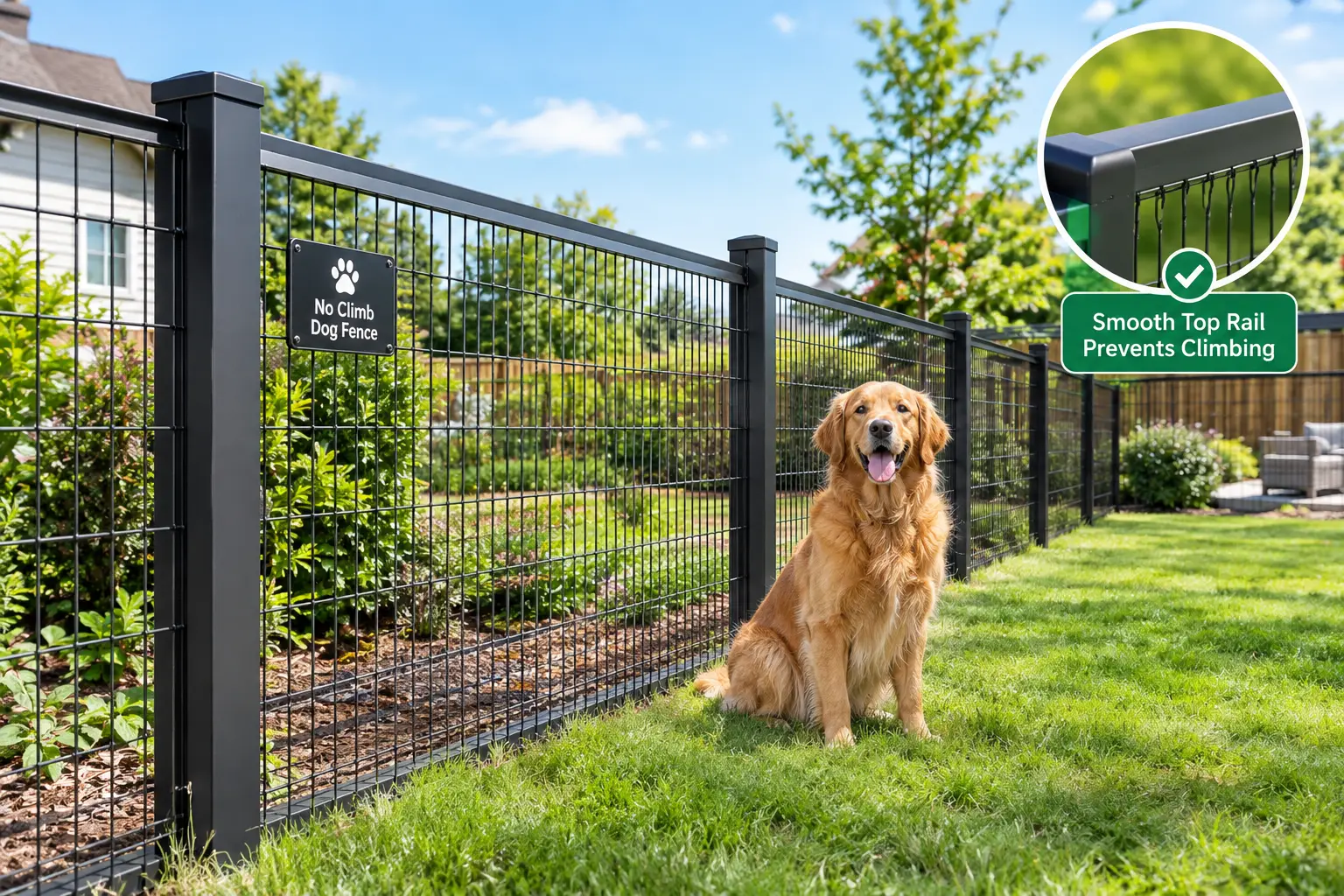
A no climb dog fence is any barrier designed to deny a dog the grip or leverage it needs to scale it. That usually means tight woven-wire mesh (typically 2″ x 4″) with openings too small for a paw, or a topper — an inward-angled extension, spinning roller, or paddle — that defeats the final pull over the top.
The good news is that there are two very different routes to that goal, and you don’t have to rip out your existing fence to get there. You can install a fence that’s hard to climb from the ground up, or you can retrofit the top of the fence you already own. The animal-welfare group Best Friends Animal Society outlines several of these approaches — rollers, inward-facing flat tops, and angled extensions — in its guide to fencing options for escape-artist dogs, and the products below map neatly onto those categories.
In this guide, you’ll find seven real products available on or through amazon.com, honest analysis grounded in spec sheets and aggregated owner feedback, and the practical installation advice that product listings never include.
Quick Comparison: No Climb Dog Fence Options at a Glance
Before diving into the details, here’s the 30-second version. The right choice depends mostly on one question: are you building new, or upgrading what you already have?
| Product | Type | Height / Coverage | Approx. Price Range | Best for |
|---|---|---|---|---|
| Red Brand Non-Climb Horse Fence (48″) | Woven 2″x4″ wire mesh | 48″ x 100′ roll | $230–$300 | Red Brand Non-Climb Horse Fence (48″): new perimeter fences |
| Red Brand Non-Climb Horse Fence (60″) | Woven 2″x4″ wire mesh | 60″ x 100′ roll | $240–$330 | Red Brand Non-Climb Horse Fence (60″): big climbers and jumpers |
| Dog-Proofer Curved Extension | Inward-curved topper | Adds up to 2′ | Varies by kit length | Dog-Proofer Curved Extension: dedicated climbers |
| Dog-Proofer Vertical Extension | Straight topper | Adds up to 3′ | Varies by kit length | Dog-Proofer Vertical Extension: jumpers on short fences |
| Coyote Roller 8-Foot Kit | Spinning aluminum roller | 8′ of fence line | Around $80–$100 | Coyote Roller 8-Foot Kit: wood, vinyl, block walls |
| Oscillot Dog-Proof Kit | Spinning paddle system | 16′ kit (others available) | Around $200 | Oscillot Dog-Proof Kit: 6’+ fences, mixed pets |
| Tenax Pet Fence Premium | Polypropylene mesh | 5′ x 200′ roll | Roughly $150–$250 | Tenax Pet Fence Premium: budget, low-visibility runs |
Looking at the table, the split is obvious: the two Red Brand rolls are the foundation of a brand-new no climb dog fence, while the Dog-Proofer, Coyote Roller 8-Foot Kit, and Oscillot Dog-Proof Kit are retrofits that turn an existing fence into a climb-resistant one. The Tenax Pet Fence Premium sits in its own lane as the low-cost, low-visibility option — great for gentle dogs, a weak link for chewers. Prices are approximate at the time of writing and vary by seller and roll length, so always check the current listing.
💬 One click helps other shoppers make an informed choice too! 😊
Top 7 No Climb Dog Fence Picks: Expert Analysis
Each pick below is evaluated on how well it actually stops climbing, not just on spec-sheet numbers. Where independent owner reviews were limited, that’s stated plainly rather than papered over.
1. Red Brand Non-Climb Horse Fence (48″ x 100′, Model 70310) — the gold-standard ground-up mesh
If you’re building a fence from scratch, this is the material most farm-supply pros reach for first. The Red Brand Non-Climb Horse Fence (48″) uses a woven 2″ x 4″ mesh with 12.5-gauge filler wire and heavier 10-gauge top and bottom line wires, all Class 1 galvanized and made in the USA.
What those numbers mean in practice: the 2-inch horizontal spacing is too narrow for most medium and large dogs to wedge a paw in for a foothold, which is the whole trick of a no climb dog fence. The 10-gauge top and bottom wires resist the sagging that creates climbing “steps,” and because the fence is woven with Red Brand’s Square Deal knot rather than welded, it flexes on impact instead of snapping at the joints.
Based on the specs, this is the right pick for homeowners with medium-to-large climbers and at least a weekend to set posts. At roughly 119 pounds per roll, it’s not a solo carry, and it needs proper stretching to perform.
Aggregated retailer listings show it’s widely stocked by farm-supply stores, but a large volume of dog-specific Amazon reviews couldn’t be verified for this exact model; most published feedback comes from horse owners praising its durability.
Pros:
- ✅ Woven 2″x4″ mesh denies paw footholds
- ✅ Made in the USA with Class 1 galvanizing
- ✅ Flexes on impact rather than breaking welds
Cons:
- ❌ Heavy roll requires two people and a stretcher
- ❌ 48″ height may be low for big jumpers
Expect to pay around $230–$300 per 100-foot roll — excellent value per foot for a fence that should last well over a decade.
2. Red Brand Non-Climb Horse Fence (60″ x 100′, Style 1660-2-12½) — extra height for athletic climbers
Same proven weave, one more foot of height — and for some dogs, that foot is the difference. The Red Brand Non-Climb Horse Fence (60″) keeps the 2″ x 4″ mesh, 12.5-gauge filler, and 10-gauge top/bottom wire construction, with a red top line wire on the Amazon-listed version that improves visibility.
In practice, 60 inches stops two kinds of dogs at once: the climber who can’t get a grip, and the jumper who might clear 4 feet with a running start. The added height also makes it a smarter base if you later want to add a roller or inward topper, since toppers work best on taller fences. At roughly 145 pounds per roll, it’s heavier still, so plan your post spacing and stretching carefully.
Based on comparing the two Red Brand heights, the 60-inch roll is the better buy for German Shepherds, Huskies, Malinois, and athletic hounds. For a 30-pound beagle, the 48-inch roll is usually enough.
Published reviews for this specific style on Amazon are sparse, so treat any star ratings with caution; retailer descriptions and equine owners consistently highlight its stiffness and lifespan.
Pros:
- ✅ Taller profile stops both climbing and jumping
- ✅ Visible red top wire helps dogs respect boundaries
- ✅ Excellent base for adding a roller later
Cons:
- ❌ Roughly 145 pounds per roll makes installation demanding
- ❌ Taller posts add noticeable cost to the project
At around $240–$330 per roll, it costs only modestly more than the 48-inch version — the posts, not the wire, drive the price difference.
3. Dog-Proofer Houdini-Proof Curved Fence Extension System — built specifically for climbers
This is the retrofit designed for the dog that scales your fence like a rock wall. The Dog-Proofer Curved Extension uses galvanized steel arms that curve inward over your yard, paired with either poly mesh or a heavy-duty welded wire option, and adds up to 2 feet of height to an existing fence of 4 feet or more.
The curve is what matters here. A dog that reaches the top of the fence finds itself hanging under an overhang, with no way to lean back and pull over. Dog-Proofer recommends the welded wire version — black vinyl-coated galvanized steel with 1.7″ x 1.7″ openings — for dogs that test barriers with their teeth or claws, while the lighter poly mesh is easier to install.
Owner reviews posted on the manufacturer’s site consistently describe huskies, hounds, and standard poodles that stopped escaping after installation. The recurring complaints: the 50-foot wire rolls are a two-person job, the arms can scratch fence paint, and the return policy carries restocking fees.
Pros:
- ✅ Inward curve directly defeats the climbing motion
- ✅ Works on chain link, wood, vinyl, and iron
- ✅ Welded wire option resists chewing and clawing
Cons:
- ❌ Welded wire version is heavy and awkward to hang
- ❌ Restocking fees make sizing mistakes expensive
Kit pricing varies by length and mesh type, so check the current price — but for a determined climber, it’s a fraction of the cost of replacing a fence.
4. Dog-Proofer Vertical Fence Extension System (Poly Mesh, 100-Foot Kit) — the most height for your money
Not every escape is a climb. The Dog-Proofer Vertical Extension extends an existing fence straight up by as much as 3 feet using galvanized steel extenders and industrial poly mesh, sold on Amazon as a 100-foot kit.
Height is the obvious feature, but the material choice is the hidden advantage. Poly mesh is flexible, so a dog trying to climb it finds nothing rigid to push against — the mesh simply gives under its weight. It’s also much lighter than metal, so one person can usually manage the mesh while a second handles the extenders.
Here’s what to weigh honestly: the manufacturer itself points climbers toward the curved system, and chewers toward welded wire. The vertical poly kit shines for jumpers on a short 4-foot fence and for mild climbers who give up once the top gets wobbly. It’s not a cure for a dog that chews through barriers.
Aggregated feedback on the brand’s site praises how the mesh nearly disappears visually, which matters for HOA neighborhoods, while one owner candidly reported a high-prey-drive boxer clearing a 7-foot extended fence — a reminder that no product is universal.
Pros:
- ✅ Adds up to 3 feet of height
- ✅ Lightweight poly mesh is easy to install
- ✅ Low visibility keeps the yard looking open
Cons:
- ❌ Poly mesh is vulnerable to determined chewers
- ❌ Straight design is weaker against true climbers
Kit pricing depends on length; check the current price — it’s typically one of the more affordable ways to add serious height to 100 feet of fence.
5. Coyote Roller 8-Foot Kit — no-climb physics in a tube
The Coyote Roller 8-Foot Kit includes two 4-foot rollers, four mounting brackets, and an end cap. Each roller is an extruded aluminum tube that spins freely on its bracket, so a dog that reaches the top grabs a surface that simply rolls away under its paws.
That spin is the entire mechanism, and it’s clever: no electricity, no batteries, no moving parts to wear out beyond the roller itself. The aluminum won’t rust, the maker says the system is maintenance-free and made in the USA, and standard colors include raw aluminum, beige, white, and black to blend into most fences. Different bracket versions exist for wood flat tops, vinyl, wrought iron, and block walls, so match the kit to your fence top before buying.
Based on the design, it’s ideal for solid fences of at least 5–6 feet where a dog jumps up and tries to hook its front paws over the top. It’s less effective on short fences, where a dog can clear the roller entirely.
Independent review volume is limited; available buyer feedback (including one marketplace buyer who reported it worked well against a climbing dog when installed in corners) and manufacturer testimonials are positive, but large-scale verified data is thin.
Pros:
- ✅ Spinning roller removes any grip at the top
- ✅ Rust-proof aluminum needs essentially no maintenance
- ✅ Humane design with no power source
Cons:
- ❌ Costs add up quickly over long fence runs
- ❌ Needs a tall fence to work properly
At around $80–$100 per 8-foot kit, it’s affordable for problem corners — but a full 100-foot run approaches $900 on the maker’s site.
6. Oscillot Dog-Proof Fence Kit (16-Foot) — the most refined spinning system
Where the roller is a tube, the Oscillot Dog-Proof Kit is a four-bladed aluminum paddle shaped like an “X.” The 16-foot kit includes four 4-foot paddles and five reinforced dual-knuckle post kits, designed to hold the weight of a dog or coyote grabbing the top.
The X-shaped paddle is the design advantage: a dog can’t rest its paws on a flat surface before trying to pull up, and the paddle spins the moment weight is applied. Paddles can be cut to size for short sections and gates. Oscillot specifies a minimum fence height of 6 feet, which is the honest catch — this is a topper for tall fences, not a fix for a 4-foot chain link.
Based on comparing the specs with the Coyote Roller 8-Foot Kit, the Oscillot is the better pick for multi-pet households, since the same system was originally designed to contain cats. The maker lists a 3-year warranty and a 60-day money-back guarantee.
Oscillot is endorsed by Nature Canada and Australian animal-welfare organizations, but verified U.S. dog-owner review volume couldn’t be confirmed; note that Amazon currently lists Oscillot spare paddles, while complete dog kits are also sold directly by the brand.
Pros:
- ✅ X-shaped paddle prevents paws from resting
- ✅ Reinforced knuckles handle large-dog weight
- ✅ Doubles as a cat-containment system
Cons:
- ❌ Requires a fence at least 6 feet tall
- ❌ Imported system with limited U.S. reviews
Expect around $200 for the 16-foot kit; longer kits scale to roughly $1,000 for 80 feet — premium pricing for a premium mechanism.
7. Tenax Pet Fence Premium (5′ x 200′, Model 2A140078) — the budget, low-visibility option
The Tenax Pet Fence Premium is a black polypropylene mesh rated for a 750-pound breaking load, UV-treated, and made in the USA. Tenax claims an expected lifespan of 15–20 years outdoors, and the mesh is designed to fade from view at a short distance.
Why include plastic in a no climb dog fence roundup? Because flexibility works against climbers: a loosely tensioned mesh gives way under a dog’s weight rather than providing a rigid ladder. A 200-foot roll at 5 feet tall also covers a lot of yard for very little money, and it’s light enough for one person to handle.
The honest limitation: polypropylene is not chew-proof. For a dog that tests fences with its teeth, this should be paired with a metal bottom section or reserved for temporary runs and secondary barriers. It’s a strong choice for gentle dogs, rentals, and garden zones.
Amazon listing summaries indicate that most buyers report it works well as an animal barrier — particularly against deer — but dog-specific review data for this exact roll is limited.
Pros:
- ✅ Lowest cost per foot in this lineup
- ✅ Nearly invisible once installed
- ✅ Rust-proof and lightweight for solo installs
Cons:
- ❌ Not suitable for dogs that chew
- ❌ Needs good posts and tension to look tidy
At roughly $150–$250 depending on the seller, it’s the best value for covering a large area — check the current price before ordering.
Side-by-Side: How the 7 Picks Stack Up
Now that you’ve seen each option in detail, here’s a feature-level comparison focused on the things that actually stop climbing.
| Product | Anti-Climb Mechanism | Material | Min. Fence Needed | Chew Resistance | Best for |
|---|---|---|---|---|---|
| Red Brand Non-Climb Horse Fence (48″) | Tight 2″x4″ mesh | Galvanized steel | None (it’s the fence) | High | Red Brand Non-Climb Horse Fence (48″): new builds |
| Red Brand Non-Climb Horse Fence (60″) | Tight mesh + height | Galvanized steel | None (it’s the fence) | High | Red Brand Non-Climb Horse Fence (60″): big dogs |
| Dog-Proofer Curved Extension | Inward overhang | Steel + wire or poly | 4′ | High (wire version) | Dog-Proofer Curved Extension: climbers |
| Dog-Proofer Vertical Extension | Added height, flexible mesh | Steel + poly | 4′ | Low–medium | Dog-Proofer Vertical Extension: jumpers |
| Coyote Roller 8-Foot Kit | Spinning roller | Aluminum | ~5–6′ | N/A (top only) | Coyote Roller 8-Foot Kit: solid fences |
| Oscillot Dog-Proof Kit | Spinning X-paddle | Aluminum | 6′ | N/A (top only) | Oscillot Dog-Proof Kit: tall fences, multi-pet |
| Tenax Pet Fence Premium | Flexible mesh | Polypropylene | None (it’s the fence) | Low | Tenax Pet Fence Premium: gentle dogs, budgets |
The pattern here is that the mechanism matters more than the price. A dog that climbs mesh needs either tighter mesh (Red Brand) or an overhang (Dog-Proofer Curved Extension); a dog that leaps and hooks the top of a solid fence is better served by the Coyote Roller 8-Foot Kit or Oscillot Dog-Proof Kit. Chewers should steer clear of the poly-based options unless they’re backed by metal.
✨ Don’t miss these escape-proof upgrades!
🔍 Take your dog’s backyard freedom to the next level with this carefully curated lineup. Click a highlighted product to check current pricing and availability. These picks will help you get a secure, worry-free yard the whole family will enjoy!
How to Install a No Climb Dog Fence: A Practical Step-by-Step Guide
Product listings tell you what’s in the box. They rarely tell you how to make it work. Here’s how to get a woven-wire no climb dog fence right the first time.
Step 1: Mark utilities and the line
Before you dig a single post hole, contact 811 (covered in the safety section below) and wait for underground lines to be marked. Then run a string line between your corner posts so your fence stays straight — wavy fences are hard to stretch tight.
Step 2: Set strong corners first
Corner and end posts carry the tension of the entire run. Use wood posts or heavy steel set in concrete, braced with an H-brace. Line posts (T-posts work well) go every 8–10 feet. Weak corners are the #1 reason woven wire sags, and sag creates exactly the footholds you’re trying to eliminate.
Step 3: Stretch, don’t just staple
Woven fence like the Red Brand Non-Climb Horse Fence (48″) must be tensioned with a fence stretcher bar and come-along before attaching. Install it with the smooth side of the knots facing your dog. A properly stretched fence feels firm when pushed in the middle of a span.
Step 4: Close the bottom gap
Climbers often double as diggers. Keep the bottom wire within an inch or two of the ground, or bury an L-shaped apron of wire 12 inches outward.
Step 5: Add the topper last
If you’re adding a Coyote Roller 8-Foot Kit or Dog-Proofer Curved Extension, install it after the fence is tight — brackets mounted on a sagging rail will misalign.
Common mistakes in the first 30 days
Supervise every yard session for the first few weeks. Most dogs probe the fence systematically, and corners and gates are where they’ll find weak spots first.
Real-World Scenarios: Matching the Right Fence to Your Dog
Specs only mean something once they’re attached to a real dog and a real yard. Here are three common situations and the reasoning behind each recommendation.
Scenario 1: The chain-link climber in the suburbs
You own a 70-pound Husky mix and a 4-foot chain-link fence. She climbs it like a ladder, paw over paw. Chain link’s diamond openings are practically handholds, so adding height alone won’t help. The Dog-Proofer Curved Extension with welded wire is the logical fix: it keeps your existing fence, adds up to 2 feet, and the overhang defeats the final pull. Budget-wise, you’re spending a fraction of a full replacement.
Scenario 2: The rural acreage with a new build
You’re fencing a half-acre for two hounds that roam. This is where the Red Brand Non-Climb Horse Fence (60″) earns its place. You’re setting posts anyway, so build the anti-climb feature into the fence itself. With roughly 150–200 feet of fence per side, the per-foot economics of woven wire beat any topper system, and the steel won’t care what the hounds do to it.
Scenario 3: The 6-foot privacy fence and the leaping terrier
Your solid wood fence is plenty tall, but your terrier jumps, grabs the top with his front paws, and scrambles over. Here a roller or paddle beats everything else. The Coyote Roller 8-Foot Kit handles a few problem sections affordably; if your whole perimeter is at risk — or you also have a cat — the Oscillot Dog-Proof Kit is the more complete system.
Notice the theme: the existing fence and the dog’s specific technique decide the product, not the brand name.
Problem → Solution: Fixing the 5 Most Common Escape Routes
Even a good fence can fail at specific points. Here are the problems owners report most often, with precise fixes.
Problem 1: The dog climbs at the corners
Corners give dogs two surfaces to push against. Solution: Install a Coyote Roller 8-Foot Kit on the 4 feet either side of each corner — this is one of the most cost-effective uses of rollers, and it matches how some buyers report using them successfully.
Problem 2: The dog uses a horizontal rail as a step
Wood and vinyl fences with exposed rails on the inside are stairways. Solution: Cover the inside face with 2″x4″ woven wire or flip the fence so smooth pickets face the dog.
Problem 3: The dog launches off furniture or a woodpile
A grill, bench, or doghouse near the fence adds 2–3 feet of effective height. Solution: Keep a 4–5 foot clear zone along the fence line — the Oscillot maker gives similar advice for coyotes.
Problem 4: The dog chews through mesh
Solution: Swap poly mesh for welded wire (the Dog-Proofer Curved Extension offers this) or run a 2–3 foot band of metal mesh along the bottom of a Tenax Pet Fence Premium installation.
Problem 5: The dog escapes at the gate
Gates often sag, leaving gaps and climbing angles. Solution: Add a gate wheel or anti-sag kit, and extend the topper across the gate frame.
How to Choose a No Climb Fence for Dogs
Use these steps to narrow down the right option in a few minutes:
- Watch your dog’s technique. Climbers need mesh control or overhangs; jumpers need height; hook-and-pull dogs need rollers.
- Measure your existing fence. Rollers and paddles generally need 5–6 feet; curved extensions work from 4 feet.
- Check for chewing. If your dog chews, rule out poly mesh unless it’s backed by metal.
- Calculate total linear feet. Topper costs scale per foot, while woven wire gets cheaper per foot as runs grow.
- Match the fence material. Brackets differ for wood, vinyl, chain link, iron, and block, so buy the right version.
- Check HOA and local rules. Height limits can rule out tall extensions before you spend a dime.
- Plan for weather. In wet or coastal climates, prioritize galvanized steel and aluminum over thin coatings.
Following this order prevents the most expensive mistake: buying a great product that doesn’t match your dog’s actual escape method.
Anti Climb Dog Fence vs Traditional Fencing
It’s tempting to think any tall fence will do. The table below shows why purpose-built anti-climb solutions outperform common alternatives.
| Fence Type | Climbability | Typical Weakness | Anti-Climb Upgrade | Best for |
|---|---|---|---|---|
| Chain link | High (diamond footholds) | Paws hook into mesh | Dog-Proofer Curved Extension | Retrofitting existing yards |
| Wood privacy (rails inside) | Medium–high | Rails act as steps | Coyote Roller 8-Foot Kit | Solid fences 6’+ |
| Welded wire field fence (wide mesh) | Medium | Weld joints break, wide openings | Red Brand Non-Climb Horse Fence (48″) | Rural properties |
| Woven 2″x4″ no-climb | Low | Weight and install effort | Add Oscillot Dog-Proof Kit if 6’+ | Long-term perimeters |
| Wireless/invisible fence | Not physical | Dogs can run through correction | Not applicable | Not recommended for climbers |
The key takeaway is that traditional fences fail for predictable, mechanical reasons — footholds, steps, and weak joints — and each anti-climb product targets one of those failures directly. Invisible fences deserve a special warning: they don’t stop a motivated dog physically, and they do nothing to keep other animals out.
2×4 No Climb Fence: Features That Actually Matter (and Ones That Don’t)
Shopping for woven wire means wading through gauges, coatings, and knot types. Here’s what actually affects your dog’s ability to escape.
Features that matter
Mesh spacing. The 2″ x 4″ opening is the heart of a 2×4 no climb fence. Standard field fence often has much wider openings that give paws a foothold.
Wire gauge. Lower numbers mean thicker wire, a quirk explained in the history of wire gauge systems. The 12.5-gauge filler used by Red Brand is thick enough to resist bending under a large dog’s weight, while its 10-gauge top and bottom wires anchor the shape.
Woven vs. welded. Woven fence flexes and redistributes impact; welded joints can snap, opening holes and sharp ends. For a dog that hits the fence hard, woven wins.
Galvanization class. Zinc coating protects steel from rust; you can read how the process works in this overview of galvanization. Class 1 is standard; Class 3 carries heavier zinc for wetter climates and generally lasts longer.
Features that don’t matter as much
Color. Black coating looks nicer but doesn’t change climbability. “Heavy-duty” marketing labels mean little without a gauge number. Kit accessories like gloves or zip ties are nice extras, not reasons to buy.
The bottom line: judge a fence by spacing, gauge, construction, and coating — in that order.
Coyote Roller Fence and Other Toppers: What to Expect in Everyday Use
Spinning toppers sound almost too simple to work, so it helps to understand what daily life with one looks like.
The first week
Expect your dog to test the system. With a Coyote Roller 8-Foot Kit, a dog that jumps and grabs the top will find its paws rolling backward, and it typically drops back down. Many dogs try a few times, then stop. Supervise during this phase, because a dog that finds an un-rollered gap will exploit it immediately.
Noise, appearance, and neighbors
Aluminum rollers are quiet in normal use and come in colors that blend with most fences. Some owners note fewer HOA complaints compared to angled extensions, because rollers sit flush along the top rather than projecting outward. The Oscillot Dog-Proof Kit is slightly more visible due to its paddle shape but similarly understated.
Weather and wear
Aluminum doesn’t rust, which is why these systems are described as essentially maintenance-free. Check after storms that brackets are tight and that leaves or debris haven’t jammed a roller — a stuck roller is just a handle.
Realistic expectations
A coyote roller fence is excellent at stopping the final pull-over. It does nothing about digging, gaps, or a fence too short to reach the top of. Treat it as one layer of a complete system, not a magic fix.
Long-Term Cost and Maintenance
Upfront price is only part of the story. Here’s how the options compare over a realistic 10-year horizon for a 100-foot run.
| Product | Approx. Material Cost (100 ft) | Expected Lifespan | Ongoing Maintenance | Best for |
|---|---|---|---|---|
| Red Brand Non-Climb Horse Fence (48″) | $230–$300 + posts | 15+ years if tensioned | Re-tension occasionally | Red Brand Non-Climb Horse Fence (48″): lowest long-term cost |
| Dog-Proofer Curved Extension | Varies by kit | Many years (wire version) | Check clips and ties | Dog-Proofer Curved Extension: retrofit value |
| Coyote Roller 8-Foot Kit | Approaching $900 for ~100 ft | Lifetime claim (aluminum) | Clear debris | Coyote Roller 8-Foot Kit: low-maintenance tops |
| Oscillot Dog-Proof Kit | Roughly $1,000+ for 80–100 ft | Long; 3-year warranty | Minimal | Oscillot Dog-Proof Kit: premium tall fences |
| Tenax Pet Fence Premium | Roughly $150–$250 (200 ft) | 15–20 years (maker claim) | Repair chew damage | Tenax Pet Fence Premium: cheapest per foot |
The math favors woven wire for new builds and long runs, while rollers and paddles make the most sense for targeted problem areas or tall fences you already own. Remember that posts, concrete, and hardware can equal or exceed the cost of the wire itself for a new installation.
Simple maintenance schedule
- Monthly: Walk the fence line looking for sag, chew marks, and dig spots.
- Seasonally: Tighten hardware, clear debris from rollers, and trim vegetation that pulls on mesh.
- Annually: Re-tension woven wire and inspect posts for rot or heaving after freeze-thaw cycles.
Safety, Regulations, and Standards
A no climb dog fence is a construction project, and a few rules apply that product pages rarely mention.
Call 811 before you dig
Federal law designates 811 as the national “call before you dig” number. Contact them through Call 811 a few days before setting posts so utility lines are marked for free. Hitting a buried gas or electric line can be dangerous and expensive.
Local codes and HOA rules
Many municipalities cap residential fence heights — commonly around 6 feet in back yards and lower in front yards — and some require permits. HOAs frequently restrict materials, colors, and toppers. Check before buying a tall extension or roller system, since a forced removal wipes out your investment.
Animal safety
Install woven wire with the smooth side of the knots facing your dog, and avoid barbed wire or sharp-tipped “anti-climb spikes” sold for security — they can seriously injure pets. Spinning rollers and inward curves are humane alternatives that deter without causing harm.
Electrical add-ons
If you consider adding a hot wire to stop climbing, use a properly rated charger and post warning signs where required locally. For most family dogs, physical barriers are the safer first choice.
Pool and neighbor considerations
If your yard includes a pool, local barrier codes may impose separate requirements. And remember: a fence keeps your dog safe and keeps neighbors’ children and pets from reaching it.
Common Mistakes to Avoid When Buying a Dog Proof Fence
Even careful buyers make these errors. Avoiding them saves money and frustration.
Mistake 1: Buying height when the problem is grip. A dog proof fence isn’t just tall — it’s ungrippable. Adding 2 feet of chain link to a chain-link climber gives it 2 more feet of ladder.
Mistake 2: Ignoring the minimum fence height for toppers. Oscillot specifies 6 feet minimum. Installing paddles on a 4-foot fence just gives a jumper a target to aim past.
Mistake 3: Choosing plastic for a chewer. Poly mesh is excellent for gentle dogs and terrible for dedicated chewers.
Mistake 4: Underestimating linear footage. Measure the full perimeter, including gates and both sides of corners, before comparing prices. Topper kits look cheap until you multiply them.
Mistake 5: Skipping tension. An unstretched woven fence sags, and sag creates steps. Rent or buy a stretcher.
Mistake 6: Forgetting the bottom. Many climbers become diggers once the top is blocked. Plan for both.
Mistake 7: Expecting a fence to replace training and exercise. Bored, under-exercised dogs escape more. A fence is containment; exercise and enrichment address the motivation.
Frequently Asked Questions
❓ What is the best no climb dog fence for a large dog?
❓ Are coyote rollers worth it for dogs?
❓ Can I make my chain link fence no climb for dogs?
❓ How much does a no climb dog fence cost per foot?
❓ Is plastic mesh fencing strong enough for dogs?
Conclusion: Build the Fence Your Dog Can’t Outsmart
The best no climb dog fence isn’t the most expensive one — it’s the one that targets your dog’s specific escape technique. Climbers need ungrippable surfaces or overhangs, jumpers need height, and hook-and-pull dogs need tops that spin.
If you’re starting from bare ground, the Red Brand Non-Climb Horse Fence (48″) or the taller Red Brand Non-Climb Horse Fence (60″) builds climb resistance into the fence itself at a very reasonable cost per foot. If you already own a fence, the Dog-Proofer Curved Extension is the strongest fix for climbers, the Dog-Proofer Vertical Extension adds the most height for jumpers, and the Coyote Roller 8-Foot Kit or Oscillot Dog-Proof Kit shut down the final pull-over on tall solid fences. And when budget is the priority for a gentle dog, the Tenax Pet Fence Premium covers a lot of ground for very little money.
Whatever you choose, install it with care: strong corners, real tension, a closed bottom gap, and a clear zone along the fence line. Then supervise those first few weeks while your dog tests the new rules. A well-built fence gives your dog freedom and gives you peace of mind — and that’s a trade every owner wants.
🐾 Ready to end the great escape?
🔍 Pick the option that matches your dog’s escape style and click a highlighted product to check current pricing and availability. A secure yard is the best gift you can give your four-legged family member!
Recommended for You
- Airtag Dog Collar Waterproof: 7 Best Swim-Proof Picks for 2026
- What Do Trackers Look Like? 7 Best Picks Revealed (2026)
- What Are E Collars? 7 Best Picks & Honest Guide for 2026
Disclaimer: This post contains affiliate links. As an Amazon Associate, I earn from qualifying purchases made through these links, at no additional cost to you.
✨ Found this article helpful? Share it with someone who needs it! 💬🤗