
In This Article
Dog Fence Designs in 2026: Why the Right Barrier Matters More Than the Price Tag
Every dog owner has a version of the same story. You open the back door, turn around for ten seconds, and suddenly your Lab is three houses down, chasing a squirrel with the focus of a heat-seeking missile. That moment is exactly why dog fence designs deserve more thought than “whatever the hardware store has on sale.”
The good news? In 2026, you have more options than ever. Dog fence designs now range from a $40 folding exercise pen to GPS collars that draw a virtual boundary from your phone. The bad news is that more choice means more ways to buy the wrong thing. A gorgeous decorative panel fence won’t stop a 70-pound jumper, and a wireless boundary won’t keep the neighbor’s off-leash dog out of your yard.
This guide cuts through that confusion. Instead of rehashing product listings, we compare seven real products available to US shoppers — physical pens, no-dig panels, wireless systems, an in-ground kit, and a GPS collar — and explain what their specs mean in your actual backyard. You’ll also find a decision framework, a first-30-days setup plan, a problem-and-solution guide for escape artists, and an honest look at total cost of ownership.
One quick note on how we built this: we didn’t personally test these products. Every recommendation here comes from manufacturer spec sheets, aggregated customer feedback, and guidance from veterinary and animal-welfare organizations. Where something can’t be verified, we say so.
By the end, you’ll know which of these dog fence ideas fits your dog’s size, energy, and escape habits — and which ones to skip entirely. Let’s get into it. 🐕
What Are Dog Fence Designs?
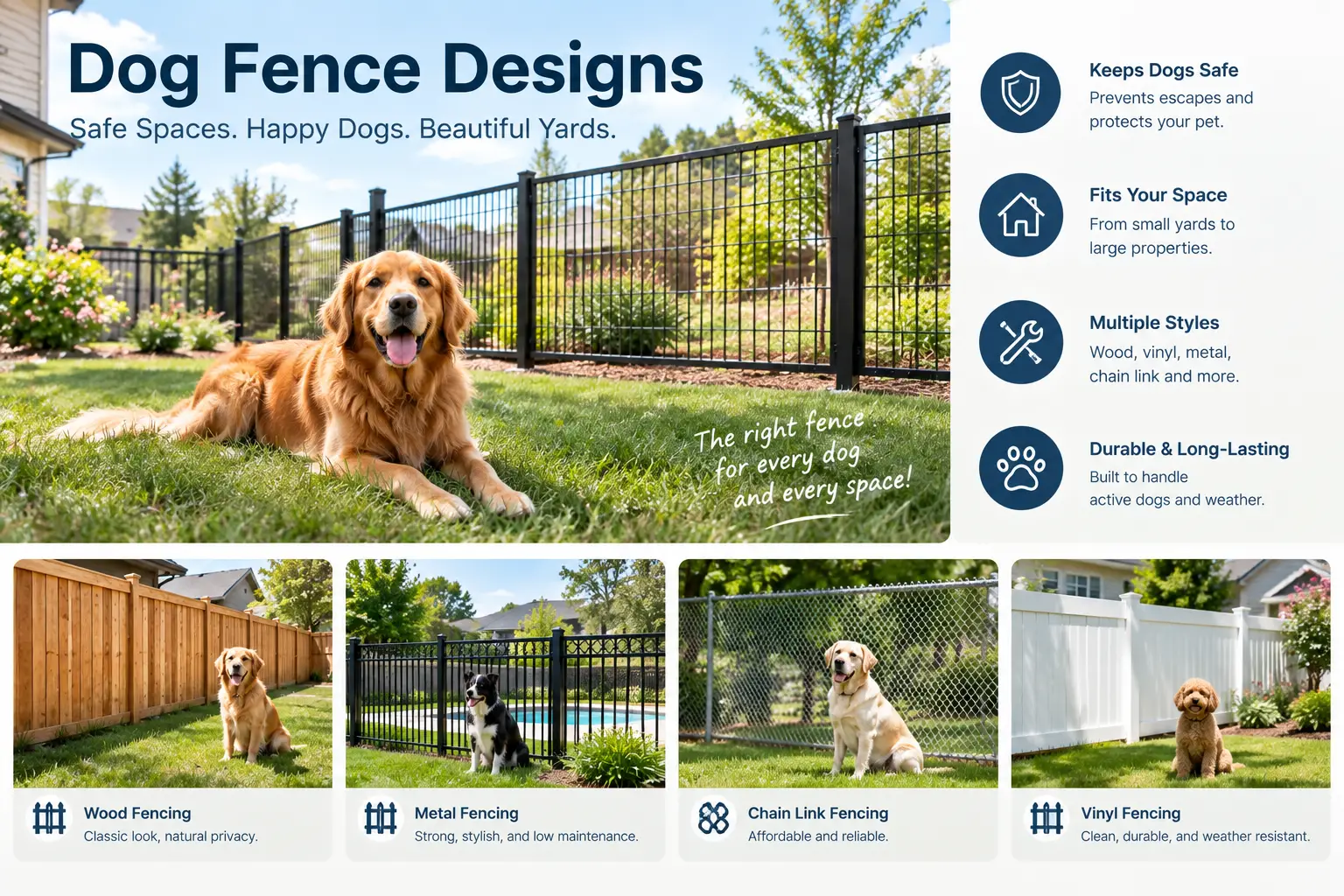
Dog fence designs are the different ways of creating a boundary that keeps a dog safely within a defined area. They fall into three broad families: physical barriers (wood, metal, vinyl, mesh, playpens), electronic boundaries (in-ground wire or wireless radio systems), and GPS-based virtual fences managed through an app.
That’s the short answer. The longer answer is that each family solves a different problem. A physical fence blocks your dog and keeps other animals out. An electronic system relies on training and a receiver collar, so it only works on the dog wearing it. A GPS fence adds tracking and app control but introduces battery and subscription dependencies.
The American Kennel Club’s overview of dog fence types makes a point worth repeating: your dog’s habits — chasing wildlife, digging, jumping — should drive the decision, not just your budget or curb appeal. A relaxed couch-potato breed can live happily behind a low decorative fence. A prey-driven terrier needs height, strength, and something underground to stop tunneling.
So when you compare dog fence designs, you’re really comparing three variables: how the boundary is enforced (physical vs. collar), how much area it covers, and how much ongoing upkeep it demands. Keep those three in mind as you read the product breakdowns below.
Quick Comparison: 7 Dog Fence Designs at a Glance
| Product | Design Type | Coverage | Approx. Price Range | Best for |
|---|---|---|---|---|
| MidWest Foldable Metal Exercise Pen | Folding wire pen | 16 linear ft | $35–$135 | MidWest Foldable Metal Exercise Pen: puppies and recovery |
| FXW Rollick Dog Playpen | Modular metal panels | Expandable | $50–$200 | FXW Rollick Dog Playpen: RV trips and flexible layouts |
| FXW No Dig Garden Fence | Decorative no-dig panels | ~36 ft per 16-panel kit | Low-to-mid $100s | FXW No Dig Garden Fence: small dogs, garden borders |
| PetSafe Stay & Play Compact Wireless Fence | Wireless radio boundary | Up to 3/4 acre | $250–$325 | PetSafe Stay & Play Compact Wireless Fence: renters, travel |
| PetSafe Stay & Play Wireless Fence for Stubborn Dogs | Wireless radio boundary | Up to 3/4 acre | $275–$400 | PetSafe Stay & Play Wireless Fence for Stubborn Dogs: persistent dogs |
| SportDOG Rechargeable In-Ground Fence | Buried-wire boundary | 1 1/3 acres, expandable to 100 | $200–$300 | SportDOG Rechargeable In-Ground Fence: large or odd-shaped lots |
| Halo Collar 5 | GPS virtual fence | 900 sq ft up to very large properties | $500–$600 + plan | Halo Collar 5: rural land, tech-savvy owners |
Looking at this table, the clearest dividing line isn’t price — it’s whether you need a physical barrier. The three panel-based picks (MidWest Foldable Metal Exercise Pen, FXW Rollick Dog Playpen, FXW No Dig Garden Fence) block your dog from the outside world, while the other four rely on a collar and training. If budget is the main constraint and your dog is small, the pens deliver the most security per dollar; if you have acreage, the SportDOG Rechargeable In-Ground Fence and Halo Collar 5 are the only realistic options.
💬 One click helps other shoppers make an informed choice too! 😊
Top 7 Dog Fence Designs on Amazon: Expert Analysis
1. MidWest Foldable Metal Exercise Pen — the budget workhorse for puppies
If you want a reliable, no-drama enclosure without spending much, this is the classic starting point. The MidWest Foldable Metal Exercise Pen uses eight hinged panels, each 24 inches wide, for 16 linear feet of fencing. It comes in five heights from 24 to 48 inches, has a rust-resistant black E-coat finish, and includes ground anchors for outdoor use. In practice, 16 linear feet makes roughly a 4-by-4-foot square — enough for a puppy, a crate, and a potty pad, but not a zoomie arena.
Based on the specs, this pen is best for short-term confinement: house training, post-surgery rest, or settling in a newly adopted dog. One detail most buyers overlook: MidWest’s own Q&A notes the panels aren’t designed to be removed and reattached, so you can’t easily shrink it. You can, however, buy two and join them.
Customer feedback on retailer sites consistently mentions using it for rescue dogs and dogs recovering from knee surgery, with owners praising its sturdiness for the price. A recurring note is that the base model has no door, so you’ll be stepping over the panels.
Pros:
- ✅ Very affordable entry point into physical fencing
- ✅ Five heights cover toy breeds through large dogs
- ✅ Folds flat for storage in seconds
Cons:
- ❌ Base version has no door
- ❌ Panels aren’t meant to be removed or rearranged
At roughly $35 to $135 depending on height (check the current price), it’s the best value here for temporary containment.
2. FXW Rollick Dog Playpen — most flexible layout for travel and yards
Where the MidWest pen is fixed, the FXW Rollick Dog Playpen is built like LEGO for dog owners. The panels can be added or removed freely, and FXW sells individual panels and poles so you can expand later. It’s offered in 24, 32, 40, 45, and 50-inch heights, and outdoor kits include stakes to anchor it. Practically, that modularity means one purchase can work as an indoor puppy zone this year and a backyard play yard next year.
Here’s what to weigh: the 24-inch version is popular, but third-party reviewers consistently warn that athletic medium-size dogs can clear it. If your dog jumps onto the couch without trying, skip straight to the 40-inch or taller option.
Aggregated review sentiment across roundups is strongly positive about quick setup and stability — several call it a go-to for RV camping. The main recurring complaint is about choosing too short a height, not the build itself.
Pros:
- ✅ Panels can be added or removed freely
- ✅ Five height options up to 50 inches
- ✅ Expansion panels sold separately for growth
Cons:
- ❌ Short versions won’t stop athletic jumpers
- ❌ Large kits can ship in multiple boxes
Expect anywhere from about $50 for small kits to around $200 for tall 16-panel sets — strong value given the expandability.
3. FXW No Dig Garden Fence — best-looking option for small dogs
Some dog fence ideas look like dog fences. This one looks like landscaping. The FXW No Dig Garden Fence comes as a 16-panel kit that’s 40 inches tall and about 36.4 feet long, with black metal panels and rounded ball-top finials. The no-dig design means you push the stakes into soil instead of setting posts in concrete — a real plus for renters or anyone avoiding a weekend of post-hole digging.
On paper, 40 inches works for small to many medium breeds, but it’s not a perimeter fence for a large or determined dog. Think of it as a garden border that keeps a Corgi out of the tomatoes, or a defined play area off the patio.
Verified review data for this specific model is thinner than for the playpens. What we could confirm is that reviewers in third-party roundups highlight its decorative look; we couldn’t verify long-term durability data, so treat claims about rust resistance as manufacturer-stated.
Pros:
- ✅ Decorative look blends into garden design
- ✅ No concrete or post-hole digging required
- ✅ 40-inch height suits small and mid-size dogs
Cons:
- ❌ Stakes can loosen in soft or wet soil
- ❌ Not tall enough for large jumpers
Generally priced in the low-to-mid $100s for a full kit at the time of writing — good value if aesthetics matter to you.
4. PetSafe Stay & Play Compact Wireless Fence — easiest no-dig setup for renters
This is the wireless option you can set up in an afternoon. The PetSafe Stay & Play Compact Wireless Fence plugs into a wall outlet indoors and creates a circular boundary that adjusts to cover up to 3/4 acre. PetSafe says setup takes 1-2 hours, the collar is rechargeable and waterproof, and stimulation stops automatically after 15 seconds. It also doesn’t correct the dog when returning to the safe zone — a thoughtful detail that removes one big reason dogs refuse to come back.
The catch most buyers overlook is the word circular. Your boundary is a circle around the transmitter, so a long, narrow lot means wasted coverage on one side and a too-short boundary on the other. PetSafe also notes range can be affected by terrain and metal objects.
Review roundups across 2026 repeatedly name it a best-value wireless pick. The most common caveat is the circle limitation, and that it doesn’t work during power outages because the transmitter needs AC power.
Pros:
- ✅ No wires to bury, setup in hours
- ✅ Portable for camping trips (outlet needed)
- ✅ No correction when the dog returns home
Cons:
- ❌ Circular boundary wastes space on rectangular lots
- ❌ Stops working during power outages
At roughly $250 to $325, it’s fair value for renters who can’t install anything permanent.
5. PetSafe Stay & Play Wireless Fence for Stubborn Dogs — built for persistent escape artists
Same transmitter concept, different collar personality. The PetSafe Stay & Play Wireless Fence for Stubborn Dogs also covers up to 3/4 acre (adjustable 5 to 105 feet in all directions), but its receiver collar offers a tone-only mode plus five static levels. It fits dogs 5 pounds and up with necks from 6 to 28 inches.
Based on comparing the specs with the PetSafe Stay & Play Compact Wireless Fence, the practical difference is headroom: more correction range for dogs that learn to ignore the warning. That’s useful — but it’s also exactly where welfare concerns grow. PetMD’s analysis of invisible fences points out that high-drive dogs may push through the correction when a cat or bike appears, and sensitive dogs can develop fear of any beep. A stronger collar doesn’t fix a training gap.
Review roundups frequently list it as an editor’s pick for difficult breeds. Common themes include strong containment for persistent dogs and the same circular-boundary trade-off as its sibling.
Pros:
- ✅ Tone-only mode for gentler training starts
- ✅ Wide neck fit from 6 to 28 inches
- ✅ Adjustable radius from 5 to 105 feet
Cons:
- ❌ Higher correction levels raise welfare concerns
- ❌ Still limited to a circular boundary
Typically $275 to $400; worth it only if you’ve already done thorough boundary training.
6. SportDOG Rechargeable In-Ground Fence — the acreage champion
For big or oddly shaped property, buried wire still wins on flexibility. The SportDOG Rechargeable In-Ground Fence includes 1,000 feet of wire and 100 flags, enough for about 1 1/3 acres, and the transmitter can cover up to 100 acres with additional wire-and-flag kits. Because the wire follows any path you bury, you can loop around a pool, exclude a garden, or trace an L-shaped lot — something no circular wireless system can do.
The SDF-100 family is known for a wire-break alarm and built-in lightning protection, and the collar offers tone, vibration, and multiple static levels. In practice, the wire-break alarm matters more than people expect: a mower blade or burrowing animal can silently cut a wire, and your fence stops working.
Aggregated owner feedback on the SDF-100 line is largely positive. Several reviewers report it connected straight to an existing buried wire from an older system. The most consistent complaint is that the collar is large and bulky for smaller dogs.
Pros:
- ✅ Expands up to 100 acres with add-on kits
- ✅ Wire follows any boundary shape
- ✅ Wire-break alarm flags hidden damage
Cons:
- ❌ Collar is bulky for small dogs
- ❌ Installation requires trenching and utility checks
Generally in the $200 to $300 range — excellent per-acre value for large lots.
7. Halo Collar 5 — the high-tech GPS boundary
The Halo Collar 5 skips the wire and transmitter entirely. You draw fences in an app, and the collar uses dual-frequency GPS to enforce them with tone, vibration, and optional static. Halo states its smallest fence is 900 square feet, claims accuracy under 2 feet with its Precision+ feature, and quotes up to 48 hours of battery life. Because the collar carries the boundaries itself, a home power outage doesn’t disable the fence.
What the spec sheet doesn’t emphasize: a subscription plan is required to keep the collar active, starting around $10 a month. Those accuracy figures are also manufacturer claims from Halo’s own comparison pages, not independent lab results. And a 48-hour battery means charging becomes part of your routine — miss a charge and there’s no fence.
Third-party roundups in 2026 regularly name it the top GPS pick. Recurring caveats in reviews center on total cost and GPS reliability near tall trees or buildings, which affects every GPS collar.
Pros:
- ✅ Draw and resize fences in the app
- ✅ Works during home power outages
- ✅ Adds live location tracking if the dog escapes
Cons:
- ❌ Required monthly subscription adds ongoing cost
- ❌ Frequent charging is mandatory
Around $500 to $600 for the collar plus the plan — premium, but unmatched for large rural properties.
Top 7 Dog Fence Designs Compared Feature by Feature
| Feature | MidWest Foldable Metal Exercise Pen | FXW Rollick Dog Playpen | FXW No Dig Garden Fence | PetSafe Stay & Play Compact Wireless Fence | PetSafe Stay & Play Wireless Fence for Stubborn Dogs | SportDOG Rechargeable In-Ground Fence | Halo Collar 5 |
|---|---|---|---|---|---|---|---|
| Keeps other animals out | Yes | Yes | Partly | No | No | No | No |
| Boundary shape | Any (16 ft) | Any, expandable | Any (~36 ft) | Circle | Circle | Any shape | Any shape |
| Needs power | No | No | No | Wall outlet | Wall outlet | Wall outlet | Collar battery |
| Subscription | No | No | No | No | No | No | Yes |
| Max height | 48 in | 50 in | 40 in | — | — | — | — |
| Best for | Puppies | RV travel | Small dogs | Renters | Stubborn dogs | Acreage | Rural tech fans |
Reading across the rows, the big story is the “keeps other animals out” line: only the panel designs protect your dog from wandering dogs or wildlife. Among the electronic options, the SportDOG Rechargeable In-Ground Fence and Halo Collar 5 win on boundary shape, while the two PetSafe systems win on setup speed. The Halo Collar 5 is the only pick that keeps working in a power outage — but it’s also the only one with a recurring bill.
💬 Found your match? Check current pricing and help other shoppers by sharing this guide! 😊
Physical Fences vs. Invisible Fences: Which Design Wins?
This is the most important decision in the whole guide, so let’s be direct.
| Factor | Physical Fence (wood, metal, panels) | Invisible/Wireless/GPS Fence |
|---|---|---|
| Blocks your dog | Yes, physically | Only with training + collar |
| Keeps others out | Yes | No |
| Upfront cost | Moderate to high | Low to moderate |
| Works without training | Mostly | No |
| Visual impact | Visible | Nearly invisible |
| Best for | Most dogs, especially reactive or high-drive | Calm, well-trained dogs; large or restricted properties |
The table makes it clear: physical fences are the safer default, and invisible systems are a tool for specific situations. Electronic boundaries make sense when a solid fence is impractical — acreage, HOA restrictions, or rentals — but they depend entirely on training quality and a charged collar.
Physical fences: the protective choice
A solid fence doesn’t just keep your dog in; it keeps loose dogs, coyotes, and curious kids out. That two-way protection is something no collar can provide. For reactive dogs, a solid privacy fence also blocks the visual triggers that cause fence-running and barking.
Invisible fences: the flexible choice
Wireless and in-ground systems shine where physical fencing can’t go. They’re cheaper per acre, preserve open views, and adapt to odd layouts. But they only stop a dog that chooses to stop. A dog chasing a deer at full speed may cross the line — and then face a correction if it tries to come back, unless the system (like the PetSafe models) disables correction on re-entry.
Our honest take: if your dog is reactive, anxious, or intensely prey-driven, start with a physical design. Use electronic boundaries as a supplement, not a substitute.
How to Choose Dog Fence Designs: 7 Steps
- Measure your dog’s jump, not just its height. Watch what your dog clears when excited. A fence should exceed that “best day” jump with margin to spare.
- Check for digging. Diggers need an underground barrier — buried mesh, an L-footer, or a boundary wire — regardless of fence height.
- Map your property shape. Rectangular or irregular lots favor in-ground wire or GPS over circular wireless systems.
- Decide if you need two-way protection. If wildlife or loose dogs are common, only a physical barrier keeps them out.
- Read your HOA and local rules. Many communities restrict height, material, or front-yard fences — which can make invisible designs the only legal choice.
- Count total cost of ownership. Add collars, batteries, subscriptions, and repair kits to the sticker price.
- Be honest about training time. Electronic designs need weeks of consistent flag training; skip it and the system will fail.
The most overlooked step is number seven. Plenty of people buy an electronic boundary as a “no-effort” solution, then wonder why their dog bolts through it. Any collar-based design is really a training program with hardware attached.
🛒 Ready to compare your options?
🔍 Narrow it down using the steps above, then click any highlighted product to check current pricing and availability. The right fence means more freedom for your dog and more peace of mind for you!
Getting Started: Setting Up Your New Dog Fence the Right Way
Unboxing is the easy part. The first 30 days decide whether your fence actually works.
Before installation (Day 0)
For any in-ground design like the SportDOG Rechargeable In-Ground Fence, contact 811, the national “call before you dig” service, a few days before trenching. It’s free, and it marks buried utility lines so you don’t slice through a gas or cable line while laying boundary wire. Even no-dig stakes can go deeper than you think in soft soil.
Physical pens and panels (Days 1–7)
- Anchor every stake fully — loose panels are the number-one escape route for pens.
- Place the pen away from furniture, coolers, or anything your dog can use as a launching pad.
- Start with short sessions and treats inside the pen so it feels like a good place, not a jail.
Electronic boundaries (Days 1–30)
- Week 1: Collar on, correction OFF or tone-only. Walk the flagged boundary on leash and reward your dog for turning back at the tone.
- Week 2: Introduce the lowest effective correction level while still on leash. Add mild distractions.
- Week 3: Add bigger distractions — a toy tossed past the line, a family member walking outside.
- Week 4: Supervised off-leash time. Remove flags gradually, not all at once.
Common first-month mistakes
Skipping flag training, starting at a high correction level, leaving the collar on 24/7 (it can irritate skin), and assuming a dead collar battery won’t happen. Set a weekly charging reminder on your phone, especially for the Halo Collar 5.
Real-World Scenarios: Matching the Fence to Your Household
Specs are abstract. People aren’t. Here are three realistic profiles and the design that fits each.
Scenario 1: First-time puppy owner in an apartment
Budget: under $100. Use: daily, indoors. A 10-week-old Cavalier needs a safe zone while the owner works from home. The MidWest Foldable Metal Exercise Pen in the 24- or 30-inch height is the obvious pick: cheap, quick, and big enough for a bed and potty pad. When the puppy grows, the pen moves to the patio for supervised outdoor time.
Scenario 2: Family renting a suburban home with a Golden Retriever
Budget: $250–$400. Use: daily backyard play. The lease forbids permanent fencing, and the yard is roughly square. The PetSafe Stay & Play Compact Wireless Fence fits because nothing is installed and the circle suits a square lot. Since Goldens are typically eager to please, tone-first training is realistic. If the dog proves stubborn, the PetSafe Stay & Play Wireless Fence for Stubborn Dogs collar is the fallback — though a training session with a professional is the smarter first upgrade.
Scenario 3: Rural homeowner with five acres and a Border Collie
Budget: flexible. Use: all day, every day. Physical fencing five acres is expensive. The SportDOG Rechargeable In-Ground Fence covers it with add-on wire kits and no subscription. If the owner wants escape alerts and live tracking too, the Halo Collar 5 is worth the ongoing cost — but only with a strict charging routine.
The pattern across all three: match the design to the living situation first, then to the dog.
Problem → Solution: Fixing the 5 Most Common Escape Tricks
Even good dog fence designs fail when they meet a creative dog. Here’s how to fix the usual suspects.
🐾 Problem 1: The digger. Your dog tunnels under panels. Solution: Bury galvanized wire mesh 6–12 inches below the fence line, bent outward in an “L.” For the FXW No Dig Garden Fence, add landscaping stones along the base.
🦘 Problem 2: The jumper. Your dog clears the top. Solution: Go taller — the FXW Rollick Dog Playpen comes in heights up to 50 inches. Clear anything near the fence your dog can launch off (bins, benches, wood piles).
⚡ Problem 3: The wireless “push-through.” Your dog ignores the boundary when excited. Solution: Go back to on-leash training with bigger distractions. Check collar fit — contact points must touch skin. If it persists, the dog likely needs a physical barrier.
🔋 Problem 4: The silent failure. The fence “stopped working.” Solution: Check batteries first, then the wire-break alarm on in-ground systems, then the power supply for wireless transmitters.
🐕 Problem 5: The fence-runner. Your dog barks and charges at passersby. Solution: Electronic boundaries can worsen this by linking passersby with discomfort. A solid privacy panel along the street side is the real fix.
Common Mistakes to Avoid When Buying a Dog Fence
The most expensive dog fence is the one you buy twice. Here are the mistakes that cause that.
Buying for today’s puppy, not tomorrow’s dog
A Labrador puppy fits behind a 24-inch pen. A one-year-old Lab will laugh at it. Buy for adult size — or pick a modular design like the FXW Rollick Dog Playpen that grows with taller panels.
Ignoring yard shape with circular wireless systems
Both PetSafe Stay & Play models project a circle. On a 50-by-200-foot lot, that means either the dog can wander into the street on one side or loses most of the yard on the other. Map your yard on graph paper (or a satellite view) before buying.
Treating “invisible” as “maintenance-free”
Buried wire gets cut. Batteries die. Subscriptions lapse. Every electronic design trades visible upkeep for hidden upkeep.
Underestimating your dog’s motivation
A calm dog in a quiet cul-de-sac is a different challenge from a hound next to a deer trail. Be realistic about what’s outside your fence, not just what’s inside.
Skipping the welfare question
Some dogs simply aren’t good candidates for correction-based containment — fearful, reactive, or very sensitive dogs especially. Ask your vet or a certified trainer before choosing an electronic design for a dog with any anxiety history.
Long-Term Cost and Maintenance
Sticker price tells maybe half the story. Here’s a realistic look at ownership costs over five years.
| Product | Upfront (approx.) | Ongoing costs | 5-year outlook | Best for |
|---|---|---|---|---|
| MidWest Foldable Metal Exercise Pen | $35–$135 | Almost none | Lowest total cost | MidWest Foldable Metal Exercise Pen: tight budgets |
| FXW Rollick Dog Playpen | $50–$200 | Optional add-on panels | Low | FXW Rollick Dog Playpen: growing dogs |
| PetSafe Stay & Play Compact Wireless Fence | $250–$325 | Extra collars for added dogs | Moderate | PetSafe Stay & Play Compact Wireless Fence: single-dog renters |
| SportDOG Rechargeable In-Ground Fence | $200–$300 | Wire repair kits, extra wire | Moderate, best per acre | SportDOG Rechargeable In-Ground Fence: big lots |
| Halo Collar 5 | $500–$600 | Required plan (~$10+/month) | Highest | Halo Collar 5: large rural land |
Over five years, a required plan around $10 a month adds roughly $600 or more to the Halo Collar 5, effectively doubling its cost. The SportDOG Rechargeable In-Ground Fence looks moderate upfront but delivers the lowest cost per acre if your property is large. Panel designs are nearly maintenance-free, which makes them the long-term budget winners for small spaces.
Maintenance checklist
- Monthly: Walk the perimeter. Check stakes, clips, and gaps at ground level.
- Weekly (electronic): Test the collar and confirm battery charge.
- Seasonally: Inspect in-ground wire after aerating or heavy storms; lightning can damage transmitters even with built-in protection.
- Yearly: Replace worn collar straps and check contact points.
Features That Actually Matter (and Ones That Don’t)
Marketing copy loves big numbers. Here’s how to tell useful features from noise.
✅ Features that matter
- Height options. For physical designs, the available height range matters more than almost anything else. That’s why the FXW Rollick Dog Playpen and MidWest Foldable Metal Exercise Pen score well — you can match the fence to the dog.
- Correction-free re-entry. On electronic systems, a dog that won’t get corrected for coming home is far more likely to come home.
- Tone-only mode. It lets you train with sound alone before introducing anything stronger.
- Wire-break alarm. On in-ground systems, it turns invisible failure into a visible alert.
- Over-stimulation protection. Automatic cutoffs (like PetSafe’s 15-second limit) are an important safety backstop.
❌ Features that matter less than you think
- “Unlimited dogs.” Technically true for many systems, but each dog needs its own collar — the real cost scales with your pack.
- Maximum acreage claims. A 100-acre ceiling is irrelevant on a quarter-acre lot.
- Accuracy figures without context. GPS accuracy claims come from ideal conditions. Tree cover and buildings reduce real-world precision for every brand.
The rule of thumb: prioritize features that reduce failure and stress, not features that sound impressive.
Safety, Regulations, and Standards
Fencing touches more rules than most people realize.
Local codes and HOAs
Most US municipalities regulate fence height — commonly lower limits in front yards than backyards — and many HOAs restrict materials and colors. Check before you buy, because a non-compliant fence can mean fines or forced removal. In heavily restricted neighborhoods, this is often why owners turn to invisible dog fence designs.
Underground utilities
Federal and state “dig safe” laws make calling 811 the standard first step before trenching for buried boundary wire. It’s free and protects you from damaging gas, power, or fiber lines.
Electronic device rules
Consumer radio products sold in the US, including wireless containment transmitters, are generally subject to FCC equipment rules. Look for FCC labeling on the transmitter and avoid uncertified gray-market units.
Animal welfare guidance
This is where honest advice matters most. The MSPCA-Angell’s position on electronic containment raises concerns that some dogs react fearfully to the aversive stimulus and that dogs who break through may hesitate to cross back into the yard. It discourages these systems as a complete solution. That doesn’t mean every electronic fence is wrong for every dog — but it does mean you should supervise outdoor time, use the lowest effective setting, and consider a physical design for sensitive dogs.
Physical safety
Check panels for sharp edges or broken wire, and make sure gaps are too narrow for small heads to get stuck.
Dog Fence Ideas for Puppies, Seniors, and Small Breeds
Not every dog needs a six-foot privacy wall. Some need the opposite.
Puppies
Puppies need a small, safe zone more than a big yard. A 24- or 30-inch MidWest Foldable Metal Exercise Pen keeps them close to a crate and potty area while they learn house rules. Electronic collars aren’t appropriate for young puppies; manufacturers set minimum weights (PetSafe’s Stay & Play systems list 5 pounds and up), and training maturity matters more than weight.
Seniors and recovering dogs
Older dogs and dogs recovering from surgery need restriction, not freedom. A low pen prevents running and jumping during healing. A low-height FXW Rollick Dog Playpen works here too, with the bonus of a lower step-over height for you.
Small breeds
Small dogs are escape artists through gaps, not over tops. Look at spacing between bars before height. The FXW No Dig Garden Fence can work for small dogs in a garden setting, but check that the gaps between pickets are smaller than your dog’s head.
Multi-dog households
Electronic systems need one collar per dog, and dogs learn at different speeds. A physical fence treats every dog equally — another point in its favor for packs.
FAQ: Dog Fence Designs
❓ What is the cheapest dog fence that actually works?
❓ How tall should a dog fence be for a large dog?
❓ Can I install a dog fence without digging?
❓ Do wireless dog fences work on rectangular yards?
❓ Is a GPS dog fence worth the subscription?
Conclusion: Pick the Design That Fits Your Dog, Not the Hype
The best dog fence designs aren’t the most expensive or the most high-tech — they’re the ones that match your dog’s habits, your property, and your willingness to train and maintain.
If you want the simplest recap: choose the MidWest Foldable Metal Exercise Pen for puppies and recovery on a budget, and the FXW Rollick Dog Playpen if you need a flexible, expandable pen for home and travel. The FXW No Dig Garden Fence is the stylish pick for small dogs and garden borders. Renters with square yards will appreciate the PetSafe Stay & Play Compact Wireless Fence, while the PetSafe Stay & Play Wireless Fence for Stubborn Dogs serves persistent dogs that have already completed solid boundary training. For big or irregular lots, the SportDOG Rechargeable In-Ground Fence offers the best value per acre, and the Halo Collar 5 is the premium choice for rural land when you want tracking, too.
Above all, remember the biggest lesson from this guide: a physical barrier protects your dog in both directions, while electronic designs depend on training, batteries, and supervision. Start with your dog’s personality, use the decision steps and scenarios above, and you’ll avoid buying a fence twice.
🐶 Give your dog safe freedom today!
✨ Click any highlighted product above to check current pricing and availability. The right fence means happier playtime, fewer escapes, and a lot more peace of mind for the whole family!
Recommended for You
- Digital Tracker: 7 Best Smart Tracking Devices
- Luggage Locator Tags: 7 Best Picks That Actually Work in 2026
- Best Shock Collar for German Shepherd: 7 Smart Picks for 2026
Disclaimer: This post contains affiliate links. As an Amazon Associate, I earn from qualifying purchases made through these links, at no additional cost to you.
✨ Found this article helpful? Share it with someone who needs it! 💬🤗