
In This Article
Long Distance Shock Collar Guide: Why Range Changes Everything in 2026
Picture this: your dog catches a scent at the edge of a 40-acre field, and in three seconds they’re 300 yards out and still accelerating. Your voice is useless. Your whistle is a suggestion. That gap between “my dog can hear me” and “my dog is listening to me” is exactly the problem a long distance shock collar is built to solve.
But here’s the catch nobody puts on the box: range is only half the story. A long distance shock collar with a mile of advertised reach is worthless if the lowest stimulation level is too strong for your dog, if the receiver dies mid-hunt, or if the signal falls apart the moment a hill gets between you. And with dozens of near-identical budget listings promising “3,300 ft” or “4,500 ft,” it’s genuinely hard to tell engineering from marketing.
This guide cuts through that. We compared manufacturer spec sheets, retailer listings, and the aggregated customer feedback available at the time of writing for seven real models, from a budget collar under $75 to the one-mile systems professional trainers rely on. You’ll get honest analysis of who each collar is for, what the specs mean in the field, and how to use any of them responsibly.
One honest note up front: e-collars are a debated tool. Several veterinary and welfare bodies favor reward-based training, and we’ll cover that research later rather than pretend it doesn’t exist. If you do choose a long range dog training collar, the goal is the lowest level your dog notices, layered on top of commands your dog already knows. Used that way, range becomes a safety tool, not a punishment tool.
What Is a Long Distance Shock Collar?
A long distance shock collar is a remote training system, made up of a handheld transmitter and a collar-mounted receiver, that lets you send a tone, vibration, or adjustable static stimulation to your dog from roughly half a mile to a mile away (sometimes more, on paper). It’s used mainly for off-leash recall, hunting, and large-property work.
You’ll also see these devices called e-collars, remote trainers, or electronic training collars; the Wikipedia overview of shock collars is a useful primer on the terminology and the history of the debate. Modern systems usually give you three communication channels:
- ✅ Tone: an audible beep, often used as a “come back” cue or a warning before stimulation.
- ✅ Vibration (or “tapping”): a non-electrical buzz that many dogs respond to on its own.
- ✅ Static stimulation: adjustable electrical stimulation, delivered as a brief “nick” or a continuous press.
What separates a long-distance model from a backyard collar isn’t just a bigger antenna. It’s the combination of radio power, receiver battery life, waterproofing, and, critically, fine-grained low-level stimulation, so you can communicate softly at 1,000 yards instead of shouting electronically.
Quick Comparison: The 7 Best Long Distance Shock Collar Picks
| Model | Advertised Range | Stim Levels | Waterproofing | Price Range | Best For |
|---|---|---|---|---|---|
| Educator ET-800 “The Boss” | 1 mile | 1–100 + boost (1–60) | Waterproof receiver, floating remote | $250–$300 | Precise low-level work on stubborn dogs |
| Dogtra 1900X Black Edition | 1 mile | 0–100 | IPX9K | $300–$330 | Pros and multi-dog households (up to 3) |
| SportDOG SportHunter 1825X | 1 mile | 21 (low/med/high) | Submersible to 25 ft | $300–$360 | Hunters running up to 6 dogs |
| Dogtra 1900S Black Edition Boost & Lock | 1 mile | 0–127 | IPX9K | $290–$320 | Single working dog, finest dial control |
| Garmin Sport PRO | 3/4 mile | 10 (momentary + continuous) | IPX7 remote, 1 ATM collar | $250–$300 | No-look, one-handed field use |
| Educator ET-300 Mini | 1/2 mile | 1–100 | Waterproof | $180–$220 | Smaller dogs needing a lighter receiver |
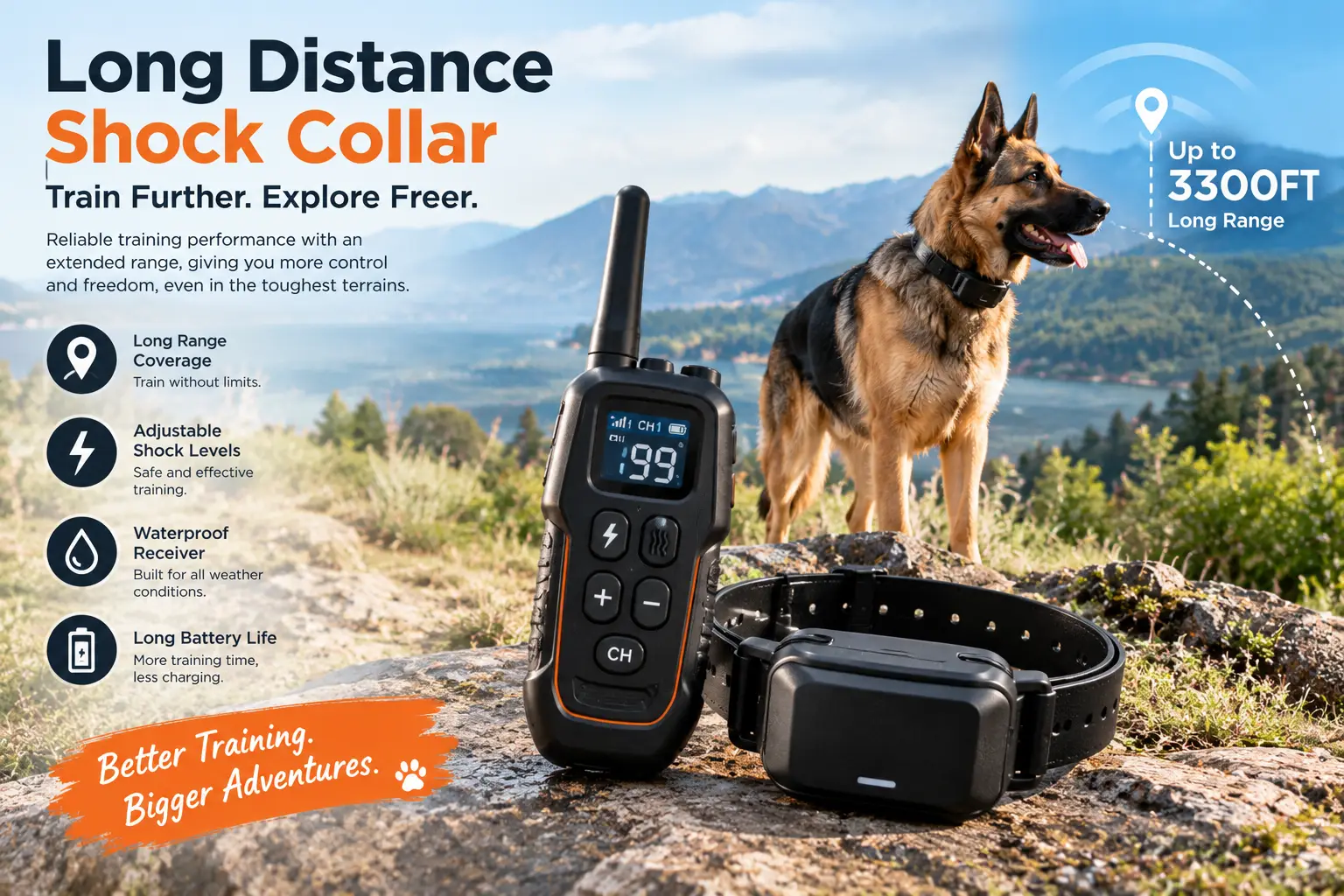
| Bousnic 3300ft Dog Training Collar | 3,300 ft (≈0.6 mile) | Shock 1–99, vibration 1–16, beep 1–8 | IP67 receiver only | $40–$75 | Tight budgets and casual property use |
Looking at the table, the real split isn’t range; it’s stimulation granularity and build quality. The Educator ET-800 “The Boss”, the Dogtra 1900S Black Edition Boost & Lock, and the Dogtra 1900X Black Edition give you 100+ steps, which matters enormously for sensitive dogs, while the SportDOG SportHunter 1825X and Garmin Sport PRO trade fine steps for rugged, simple field controls. The Bousnic 3300ft Dog Training Collar costs a fraction of the others, but its non-waterproof remote and budget build put it in a different category altogether.
💬 One click helps other shoppers make an informed choice too! 😊
Top 7 Long Distance Shock Collar Models: Expert Analysis
1. Educator ET-800 “The Boss” — finest low-level control at one mile
The Educator ET-800 “The Boss” earns its nickname by pairing a full mile of range with some of the most adjustable stimulation in the category. You get levels 1–100 plus a separate user-set boost of 1–60, which means you can work at a whisper most of the time and still have a stronger, pre-chosen level a single button away. The “lock and set” dial matters more than it sounds: it stops an accidental thumb-roll from jumping your dog from level 12 to 45 mid-session. Educator markets its “blunt” stimulation as feeling more like a firm tap than a sharp sting, and the separate “tapping” vibration mode is notably stronger than typical pager buzz, so many dogs respond without any static at all.
Based on the specs, this is the collar for stubborn, high-drive medium-to-large dogs whose owners want a wide working range without a big jump between settings. Retail listings size it for dogs from about 15–20 lbs up, so tiny breeds should look elsewhere. In the long-term owner feedback we found, Educator’s US-based customer support comes up repeatedly as a reason buyers stay loyal to the brand.
Pros:
- ✅ 100 levels plus adjustable boost for precise corrections
- ✅ Lock-and-set dial prevents accidental level jumps
- ✅ Strong tapping mode often replaces static entirely
Cons:
- ❌ Receiver is bulky for dogs under about 20 lbs
- ❌ Stopwatch-style remote takes practice to use blind
Typically priced between $250 and $300, it’s excellent value for owners who want pro-level precision without the top-tier sticker.
2. Dogtra 1900X Black Edition — toughest build, expandable to three dogs
The Dogtra 1900X Black Edition is the longest-range model in Dogtra’s X-Series, and it’s engineered like a piece of tactical gear. It’s fully IPX9K rated, a standard that covers high-pressure, high-temperature water jets, not just rain, so mud, creek crossings, and hose-downs are non-events. Levels run 0–100 with a quick Boost button and a Safety Level Lock, and the XPP vibration is designed to be sharp enough to work as a standalone cue.
What most buyers overlook are the practical extras. It includes removable contact points so your dog can wear the receiver without stim capability, which is a smart way to keep the collar from becoming a “cue” in itself. There’s also a 1000-lux LED for night tracking and USB-C charging. The manufacturer lists it for dogs 35 lbs and up, with a 5.6 oz receiver, so this is a big-dog tool. It expands to three dogs, which suits trainers and serious multi-dog homes. We couldn’t verify a large, edition-specific body of customer reviews at the time of writing, so weigh the spec sheet and Dogtra’s long track record rather than star counts.
Pros:
- ✅ IPX9K waterproofing survives the harshest conditions
- ✅ Non-stim contact points for conditioning wear
- ✅ Expandable to three dogs with one remote
Cons:
- ❌ Rated only for dogs 35 lbs and up
- ❌ Heavier receiver than compact competitors
At around $300 to $330, it’s a premium buy that makes sense if durability is your top priority.
3. SportDOG SportHunter 1825X — best for big hunting packs
The SportDOG SportHunter 1825X is the longest-range model in SportDOG’s SportHunter family and the most expandable, supporting up to six dogs with Add-A-Dog collars. That single feature makes it a natural fit for upland hunters and field trainers running a string of dogs. You get 21 static levels split across low, medium, and high ranges, plus tone and vibration, and both remote and receiver are submersible to 25 feet thanks to DryTek waterproofing.
Twenty-one levels sounds coarse next to Educator’s 100, and it is, but it’s a deliberate trade. The remote is built for no-look operation: a small dial movement and a button press, so you’re watching the dog, not the screen. For a retriever crashing through cattails, that speed matters more than fine increments. It fits dogs from 8 lbs with 5″–22″ necks, so it’s more size-flexible than the Dogtra above, and the lithium-ion batteries recharge in about two hours. Review data specific to this model was limited in the sources we checked; the consistent theme in retailer descriptions is ease of field use.
Pros:
- ✅ Expandable to six dogs on one system
- ✅ Submersible to 25 feet, remote included
- ✅ Fast two-hour recharge between sessions
Cons:
- ❌ Only 21 levels limits fine-tuning for soft dogs
- ❌ Add-A-Dog collars raise total cost quickly
Usually found in the $300 to $360 range, it’s strong value per dog if you actually use the expansion.
4. Dogtra 1900S Black Edition Boost & Lock — the most granular dial here
The Dogtra 1900S Black Edition Boost & Lock is the one-mile, single-dog version of Dogtra’s long-running 1900S line, upgraded with the same Boost button and Safety Level Lock found on newer models. Its standout spec is the rheostat dial with 0–127 stimulation levels, the finest granularity in this lineup. In practice, that means you can find the exact threshold where your dog notices the stimulation (often an ear flick or head turn) instead of rounding up to the nearest coarse step.
Here’s what to weigh: the 1900S is a single-dog system, while the Dogtra 1900X Black Edition expands to three. If you have one serious working dog, think a German shorthaired pointer or a protection-sport Malinois, the 1900S gives you finer control for similar money. It’s also IPX9K rated and comes with a matte black finish and blue LED. Retailers note that Dogtra products can’t ship outside the US, which isn’t an issue for American buyers but matters if you travel or relocate.
Pros:
- ✅ 127 levels offer the finest control we found
- ✅ Boost and lock features prevent dial mistakes
- ✅ IPX9K durability for extreme field conditions
Cons:
- ❌ Single-dog only, with no expansion option
- ❌ Rheostat dial feels less precise with gloves
At roughly $290 to $320, it’s a top choice for one-dog handlers who prize precision.
5. Garmin Sport PRO — simplest one-handed operation
The Garmin Sport PRO takes a minimalist approach: a compact handheld with a fixed antenna (nothing to snap off in the brush), a clicking dial with 10 stimulation levels, and four buttons for momentary or continuous stimulation, tone, vibration, and beacon lights. Range is 3/4 mile, a bit shorter than the one-mile models but plenty for most properties and many hunting situations.
The design philosophy is the selling point. Positive clicks between levels mean you can change settings by feel without looking down. The built-in BarkLimiter with settable levels adds a second job for the collar, and the system expands to three dogs. The handheld is IPX7 and floats; the dog device is rated to 1 ATM (about 10 meters). Battery life is listed at up to 60 hours for the dog device. Garmin also notes that indoor range is limited because walls and appliances block radio signals, a useful reminder that every advertised range assumes open ground. It’s the obvious pick if you already use Garmin gear and value fast, intuitive operation over micro-adjustment.
Pros:
- ✅ Fixed antenna eliminates a common breakage point
- ✅ Tactile clicking dial for true no-look use
- ✅ Built-in bark limiter adds everyday usefulness
Cons:
- ❌ Only 10 stim levels, the coarsest premium option
- ❌ Shorter 3/4-mile range than the top tier
Usually in the $250 to $300 range, it’s good value for hunters who prioritize simplicity.
6. Educator ET-300 Mini — best long-range option for smaller dogs
The Educator ET-300 Mini brings Educator’s 100-level blunt stimulation and tapping vibration to a smaller, lighter receiver with a half-mile range. That’s shorter than most picks here, but half a mile is still more than enough for parks, trails, and most suburban or small-acreage properties, and it’s where many owners actually train.
Based on comparing the specs, this is the sensible pick if your dog is too small for the Educator ET-800 “The Boss” or the Dogtra 1900X Black Edition. A terrier mix, a beagle, or a lean sporting dog will carry it far more comfortably. You keep the same 1–100 range of levels, so you can stay at very low settings, plus a night-tracking light. The trade-off is power and reach: if your dog runs big in open country, half a mile can disappear fast. In the review summaries we found, owners often describe the Mini as a “first serious e-collar” that they keep long after upgrading for bigger dogs, though we’d treat that as anecdotal sentiment rather than data.
Pros:
- ✅ Lightweight receiver suits small and medium dogs
- ✅ Same 100-level dial as pricier Educator models
- ✅ Night light helps locate dogs after dark
Cons:
- ❌ Half-mile range is short for big-running dogs
- ❌ Less maximum output than the ET-800
Generally priced between $180 and $220, it delivers strong value for owners of smaller dogs.
7. Bousnic 3300ft Dog Training Collar — the budget long-range entry point
The Bousnic 3300ft Dog Training Collar is one of the best-selling budget e-collars on Amazon, and it’s easy to see why: a claimed 3,300-foot range, beep (1–8), vibration (1–16), and shock (1–99) modes, and a fit range of 5–120 lbs, usually for well under $75. The receiver is rated IP67 and the brand claims up to 15 days of battery life in working mode.
Here’s the honest analysis: those 99 static levels are not comparable to Educator’s 100. Budget collars rarely publish output specs, so the numbers tell you how many steps exist, not how consistent or well-calibrated they are. More importantly, the remote is not waterproof; the manufacturer says to keep it away from water, a real limitation for hunting or wet climates. Aggregated customer reviews are genuinely mixed. Many owners report that the beep and vibration alone handle most recall needs. However, a recurring complaint is inconsistent response, including no reaction at the lowest shock levels and reports of the collar not stimulating reliably at longer distances.
Pros:
- ✅ Very low cost for a long-range system
- ✅ Beep and vibration often work without static
- ✅ Wide 5–120 lb dog size range
Cons:
- ❌ Remote is not waterproof
- ❌ Reports of inconsistent stimulation at distance
At around $40 to $75, it’s a reasonable trial tool, but not a substitute for a professional-grade system in high-stakes situations.
Long Range Shock Collar Specs Compared Side by Side
| Model | Max Dogs | Dog Size (Listed) | Battery / Charging | Standout Extra | Best For |
|---|---|---|---|---|---|
| Educator ET-800 “The Boss” | 1 (2-dog ET-802 available) | ~15–20 lbs and up | Rechargeable | Lock-and-set dial, night light | Stubborn dogs, low-level work |
| Dogtra 1900X Black Edition | 3 | 35 lbs and up | USB-C rechargeable | Non-stim contact points, 1000-lux LED | Big dogs, pros |
| SportDOG SportHunter 1825X | 6 | 8 lbs and up | ~2-hour Li-ion charge | 25 ft submersible | Hunting packs |
| Dogtra 1900S Black Edition Boost & Lock | 1 | Medium–large | Rechargeable | 127-level rheostat | One working dog |
| Garmin Sport PRO | 3 | Most sizes | Up to 60 hrs (dog device) | BarkLimiter, fixed antenna | No-look field use |
| Educator ET-300 Mini | 1 | Small–medium | Rechargeable | Compact receiver | Smaller dogs |
| Bousnic 3300ft Dog Training Collar | 1 (2-dog version available) | 5–120 lbs | Up to 15 days (claimed) | Lowest cost | Budget buyers |
This table shows why “best” depends entirely on your situation. If you run multiple dogs, the SportDOG SportHunter 1825X is in a class of its own; if you have one dog and want maximum control, the Dogtra 1900S Black Edition Boost & Lock or Educator ET-800 “The Boss” wins. Small-dog owners are best served by the Educator ET-300 Mini, since the heavier Dogtra receivers simply aren’t sized for them.
How to Introduce a Long Range Dog Training Collar: Your First 30 Days
A long range dog training collar is only as good as the groundwork behind it. Most problems people blame on the hardware are really introduction problems. Here’s a sensible 30-day progression.
Days 1–5: Wear it, don’t use it. Fit the collar snugly enough that contact points touch skin (you should fit one finger under the strap), and let your dog wear it during fun activities. If your model has non-stim contact points, like the Dogtra 1900X Black Edition, use them. You want the collar to predict nothing.
Days 6–10: Find the working level. In a quiet yard, start at level 0 or 1 and increase one step at a time while your dog is relaxed. Watch for the faintest sign of awareness: an ear twitch, a head turn, a pause in sniffing. That’s your working level, and it’s usually far lower than owners expect. Write it down.
Days 11–20: Layer on known commands. Use tone or vibration first, then pair your working level with commands your dog already knows on a long line, like “come.” Release the stimulation the instant your dog turns toward you, and reward generously. The long line stays on as a safety net.
Days 21–30: Add distance gradually. Extend from 30 feet to 100 yards and beyond, only as reliability holds. This is when range finally matters.
⚡ Common first-month mistakes: cranking levels when your dog is distracted instead of reducing distractions; leaving the collar on for 12+ hours (rotate it to avoid skin irritation); and skipping the long line too early.
🔍 Ready to build reliable recall? Click a highlighted collar above to check current pricing and availability, and pick the system that matches your dog’s size and drive!
Real-World Scenarios: Matching the Right Collar to Your Dog
Specs make more sense when you attach them to real lives. Here are three common profiles and the reasoning behind each match.
🦆 The weekend waterfowl hunter with two Labs. Budget: up to about $350. Use: marshes, cold water, twice a week in season. The SportDOG SportHunter 1825X fits best. Its 25-foot submersion rating covers both remote and receiver, and expandability means adding a third dog later costs only an Add-A-Dog collar. Coarser 21-level steps are fine for confident retrievers who mostly need a quick, clear cue.
🏡 The rural homeowner with one stubborn husky mix. Budget: around $300. Use: 10 acres bordering a road, daily recall practice. The Educator ET-800 “The Boss” makes sense here. Huskies are notorious for selective hearing, and the fine 100-level dial plus strong tapping vibration lets you communicate at very low levels day to day. The lock-and-set dial also prevents the panicky over-correction that happens when a dog bolts toward traffic.
🌲 The trail hiker with a 25-lb beagle. Budget: about $200. Use: weekend hikes, scent-driven wandering. The Educator ET-300 Mini is the clear match. A beagle can’t comfortably carry the 35-lb-minimum Dogtra 1900X Black Edition, and half a mile covers most trail situations. The night light is a bonus at dusk.
What about the Bousnic 3300ft Dog Training Collar? It’s a reasonable way to test whether vibration and tone alone work for your dog before investing. Just don’t rely on it near water or roads where consistency is non-negotiable.
Problem → Solution: Fixing the Most Common E-Collar Headaches
Problem 1: “My dog ignores the collar at distance.” Usually the working level found in a quiet yard is too low against high-value distractions like deer scent. Solution: rebuild distraction tolerance at closer range on a long line rather than simply turning the dial up. Confirm contact points actually touch skin, since thick-coated dogs often need longer points.
Problem 2: “The signal drops in the woods.” Advertised range assumes line of sight. Solution: hold the transmitter high and vertical, and keep the antenna clear of your body. Treat roughly half the advertised range as your dependable working distance in dense cover. Models with fixed antennas, like the Garmin Sport PRO, avoid the bent-antenna problem.
Problem 3: “My dog is collar-wise and only listens when wearing it.” Solution: have your dog wear the collar (or non-stim contact points) often without it predicting anything, and keep rewarding good behavior heavily so obedience doesn’t depend on the device.
Problem 4: “Red spots or irritation on the neck.” Solution: rotate the receiver position every few hours, never exceed manufacturer wear guidance, and wash the neck and contact points regularly. Pressure sores come from tightness and duration, not stimulation.
Problem 5: “The battery dies mid-hunt.” Solution: charge after every outing and check the low-battery indicators that the SportDOG SportHunter 1825X and Educator ET-800 “The Boss” include.
How to Choose a Long Distance Shock Collar
Use these steps in order; each narrows your options quickly.
- Measure your real-world distance. Most owners need far less than a mile. A half mile covers most properties; true open-country hunters benefit from a full mile.
- Match receiver size to your dog. Check minimum weight ratings. A 35-lb minimum rules out the Dogtra 1900X Black Edition for smaller breeds.
- Prioritize low-level granularity. More steps (100–127) let you find your dog’s threshold precisely; 10–21 steps suit confident, less sensitive dogs.
- Demand tone and vibration. Many dogs respond to these alone, letting you use static rarely or never.
- Check waterproofing on both parts. A waterproof collar with a non-waterproof remote is a common budget trap.
- Count your dogs, now and later. Expansion support ranges from none to six dogs.
- Look for safety locks. Level locks prevent accidental high stimulation.
For a deeper look at how e-collar training compares with reward-based methods in controlled studies, the peer-reviewed Frontiers in Veterinary Science commentary on e-collar efficacy is worth reading before you buy.
Advertised Range vs. Real-World Range: What a 1 Mile E-Collar Really Delivers
A 1 mile e-collar is tested on flat, open, unobstructed ground, the best possible conditions. Your reality probably includes trees, rolling hills, buildings, and a dog whose collar might be partially submerged. Each of these eats into signal strength.
Think of it like a cell phone: full bars in an open field, one bar in a basement. Radio signals between the remote and receiver behave similarly. Thick timber, terrain between you and the dog, and even your own body blocking the antenna all reduce effective range. Garmin explicitly notes that indoor range is limited by walls and appliances, and the same physics applies outdoors to hills and dense cover.
So what does this mean for buying? Two things. First, extra advertised range is a buffer, not a promise. A one-mile system like the SportDOG SportHunter 1825X or Dogtra 1900S Black Edition Boost & Lock is more likely to stay reliable at a quarter mile in timber than a half-mile collar pushed to its limit. Second, be skeptical of budget listings advertising 4,000+ feet with no brand history. Without published testing methods, those figures are hard to verify, and customer feedback on some budget models, including the Bousnic 3300ft Dog Training Collar, includes reports of stimulation failing at longer distances.
The practical rule: buy roughly double the distance you need and you’ll rarely hit the wall.
Remote Training Collar for Hunting Dogs vs. GPS Tracking Collars and Other Tools
A remote training collar for hunting dogs and a GPS tracking collar solve different problems. A remote trainer communicates; a GPS collar locates. Many hunters eventually want both, and some premium systems combine them, though at a much higher cost than anything in this guide.
| Tool | What It Does | Range | Price Range | Best For |
|---|---|---|---|---|
| Remote e-collar (e.g., SportDOG SportHunter 1825X) | Tone, vibration, static cues | 1/2–1 mile | $180–$360 | Off-leash recall and steadiness |
| GPS tracking collar | Shows dog’s location on a map | Several miles (varies) | Higher; often $400+ | Big-running hounds, finding lost dogs |
| Long line (30–50 ft) | Physical control during training | Line length only | Under $40 | Foundation recall training |
| Whistle / voice | Audible cue | Wind- and distance-dependent | Under $15 | Well-trained dogs at short range |
The table highlights a key point: no single tool does everything. Long lines and whistles are essential for building the foundation that makes an e-collar fair, while GPS tracking answers “where is my dog?” rather than “is my dog listening?” For most owners, a remote trainer plus a long line during training is the practical, affordable combination.
Features That Actually Matter (and Ones That Don’t)
Marketing loves big numbers. Here’s how to separate signal from noise.
✅ Matters: low-level resolution. The ability to work at the faintest perceptible level is the single most important feature for humane, effective training. That’s why the Educator ET-800 “The Boss” and Dogtra 1900S Black Edition Boost & Lock dominate serious training circles.
✅ Matters: safety locks. A locked dial prevents accidental jumps during an adrenaline-filled moment, exactly when mistakes happen.
✅ Matters: true waterproofing on both units. IPX9K, submersion ratings, and floating remotes are worth paying for if you’re near water.
✅ Matters: fixed or durable antennas. Broken antennas are a classic failure point. The Garmin Sport PRO‘s fixed antenna sidesteps it.
❌ Overrated: “4,500 ft” claims from unknown brands. Without published testing, treat these as optimistic.
❌ Overrated: sheer number of modes. A “4-mode” or “7-mode” collar sounds versatile, but tone, vibration, and well-calibrated static cover nearly every need.
❌ Overrated: maximum power. Many owners never use upper levels. A high ceiling is useful only for rare, high-distraction emergencies, and it means nothing if the low end is coarse.
⚠️ Depends: number of levels. 99 levels on a budget collar aren’t automatically equivalent to 100 on a pro model, since calibration and consistency differ. Compare reputation and output consistency, not just counts.
Common Mistakes to Avoid When Buying a Long Distance Shock Collar
Buying range you’ll never use. A mile of range on a quarter-acre yard is wasted money and extra receiver weight. Be honest about your environment.
Ignoring dog-size ratings. Putting a 5.6 oz receiver on a 20-lb dog is uncomfortable and can cause pressure issues. Check minimum weights before falling for a spec sheet.
Choosing by price alone. The gap between the Bousnic 3300ft Dog Training Collar and the Educator ET-300 Mini is real money, but it buys consistency, waterproofing, and support. If recall near a highway is your goal, reliability is a safety feature.
Forgetting expansion costs. Expandable systems like the SportDOG SportHunter 1825X need additional collars for each dog, and those add up. Budget for the whole pack.
Skipping a level lock. Without one, a pocket bump can raise the level unnoticed.
Not checking local rules. E-collar regulations vary internationally and are being debated in some US cities (more below). Know your local situation, especially if you travel.
Expecting the collar to train for you. An e-collar reinforces known commands; it doesn’t teach new ones. Plan for training time, or budget for a qualified trainer.
Long-Term Cost and Maintenance
The sticker price is only the start. Here’s how ownership costs really stack up over several years.
| Model | Upfront Range | Extra Dog Cost | Durability Outlook | Best For (Value) |
|---|---|---|---|---|
| Bousnic 3300ft Dog Training Collar | $40–$75 | 2-dog kit available | Budget build; remote not waterproof | Short-term or trial use |
| Educator ET-300 Mini | $180–$220 | N/A (single-dog model) | Solid; established US brand | Small-dog owners long term |
| Educator ET-800 “The Boss” | $250–$300 | Buy ET-802 for 2 dogs | Strong | One-dog precision value |
| Garmin Sport PRO | $250–$300 | Additional dog devices | Fixed antenna reduces breakage | Simple multi-dog use |
| SportDOG SportHunter 1825X | $300–$360 | Add-A-Dog collars | Submersible design | Large hunting packs |
Value is about cost per reliable year, not upfront price. A budget collar that fails or needs replacing in one season can cost more over five years than a well-supported mid-range system, and reliability failures carry safety costs no table captures. The premium tier makes the most sense when you’ll use the collar weekly for years.
🔋 Maintenance checklist:
- ✅ Charge after each use; avoid storing fully drained lithium batteries for months.
- ✅ Clean contact points and the strap weekly to prevent skin irritation.
- ✅ Check contact point tightness regularly, since loose points mean inconsistent stimulation.
- ✅ Test with the included test light before hunting season.
- ✅ Replace worn straps; Biothane straps (common on Educator models) resist odor and water better than nylon.
Safety, Welfare Research, and Regulations
Any honest guide to a long distance shock collar has to address the welfare debate directly. Researchers and veterinary organizations disagree with many e-collar trainers about whether these tools are necessary.
A widely cited literature review on aversive-based training methods found that studies generally link aversive methods with stress-related behaviors and other welfare concerns, while also noting the limitations of that research, including small, specialized dog populations. The Scottish Animal Welfare Commission’s report on remote-controlled e-collars concluded that reward-based methods were at least as effective in multiple scenarios, and Scotland and several European countries have restricted use. In the US, e-collars are legal at the federal level, though local proposals to restrict them have surfaced, so check your city and state.
What does this mean in practice? If you use an e-collar:
- ✅ Start with tone and vibration; many dogs never need static.
- ✅ Use the lowest level your dog perceives, not a level that causes yelping or panic.
- ✅ Pair the collar with rewards and teach commands before using it to reinforce them.
- ✅ Never use it on puppies too young for the manufacturer’s minimum, or on dogs with heart conditions or neck injuries without veterinary advice.
- ✅ Watch for stress signals: tucked tail, lip licking, avoidance. If you see them, stop and reassess with a qualified trainer.
Responsible use, not range, is what keeps both your dog and your training on track.
FAQs
❓ What is the best long distance shock collar for large hunting dogs?
❓ How much does a long distance shock collar cost?
❓ Can a long range shock collar work through trees and hills?
❓ Is a 1 mile e-collar worth it for a backyard?
❓ Can I buy a long distance shock collar for a small dog?
Conclusion
Choosing a long distance shock collar isn’t about chasing the biggest range number on Amazon. It’s about matching range, stimulation precision, durability, and receiver size to your actual dog and your actual terrain.
If you want one-dog precision, the Educator ET-800 “The Boss” and Dogtra 1900S Black Edition Boost & Lock offer the finest low-level control. For durability and up to three dogs, the Dogtra 1900X Black Edition is built like field gear. Hunters running packs will find the SportDOG SportHunter 1825X hard to beat, while the Garmin Sport PRO rewards anyone who values fast, no-look operation. Smaller dogs are best served by the Educator ET-300 Mini, and the Bousnic 3300ft Dog Training Collar remains a reasonable low-cost way to test whether tone and vibration alone work for your dog.
Whatever you pick, remember the three habits that matter more than any spec: find the lowest level your dog notices, layer the collar on commands your dog already knows, and keep rewards at the center of your training. Do that, and a long range dog training collar becomes what it should be: a quiet safety line that lets your dog enjoy more freedom, not less.
✨ Don’t miss the right fit for your dog! 🐕 Take your off-leash training to the next level with this carefully curated lineup. Click a highlighted collar to check current pricing and availability, and give your dog the freedom of reliable recall the whole family will love!
Recommended for You
- Dog Fence Designs: 7 Best Picks That Actually Work (2026)
- Halo Harness: 7 Best Picks for Blind Dogs (Honest 2026 Guide)
- Heavy Duty Dog Fence: 7 Best Escape-Proof Picks (2026 Guide)
Disclaimer: This post contains affiliate links. As an Amazon Associate, I earn from qualifying purchases made through these links, at no additional cost to you.
✨ Found this article helpful? Share it with someone who needs it! 💬🤗