
In This Article
Why Underground Electric Fence Wire for Dogs Deserves More Attention Than the Collar
Here’s a truth most fence-kit boxes won’t print in big letters: the collar gets all the marketing, but the wire does all the work. Underground electric fence wire for dogs is the one component you bury, forget about, and then desperately wish you’d chosen more carefully the first time a mower blade, a shovel, or a curious gopher finds it. When the loop breaks, the whole system goes silent, and your dog’s “invisible” boundary becomes, well, genuinely invisible.
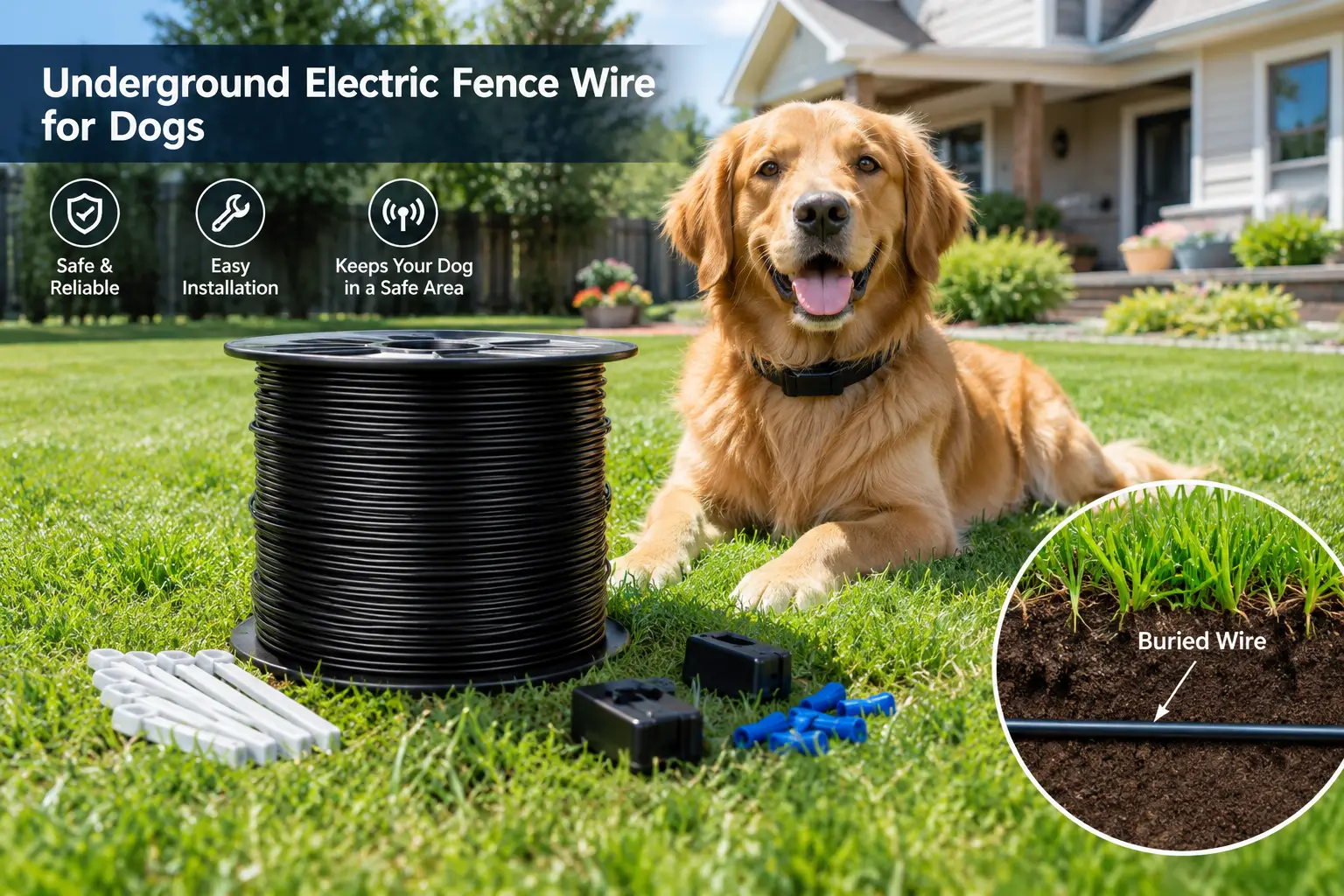
What is underground electric fence wire for dogs? It’s insulated, burial-rated copper wire laid in a continuous loop around your property and connected to a wall-mounted transmitter. The transmitter sends a low-power radio signal through the loop, and your dog’s receiver collar responds with a warning tone, vibration, or static correction as it approaches the boundary.
The concept isn’t new. The modern electronic pet fence traces back to a patent filed in the early 1970s, and the basic idea (a buried loop plus a receiver collar) hasn’t changed much since. What has changed is the wire. Today you can choose between thin 20-gauge factory wire, mid-weight 18- and 16-gauge options, and heavy 14-gauge “pro-grade” cable with jackets up to 60 mil thick.
That choice matters more than it sounds. A thin wire saves you money on day one; a thick wire saves you weekends of hunting for breaks with a radio and a flashlight. In this guide, you’ll find seven real options available to US buyers, ranging from inexpensive replacement spools to complete in-ground fence kits, along with honest analysis of what each spec actually means in your yard. You’ll also get an installation walkthrough, a troubleshooting guide, and a clear framework for picking the right gauge for your property size, soil, and dog.
Quick Comparison: The 7 Best Underground Dog Fence Wire Options at a Glance
Before diving into the details, here’s a scannable overview. Price ranges reflect what we observed at the time of writing; always check the current price, since spool and kit prices move frequently.
| Product | Type | Gauge | Included Length | Approx. Coverage | Price Range | Best For |
|---|---|---|---|---|---|---|
| eXtreme Dog Fence Max Grade 14-Gauge Wire | Wire only | 14 AWG, 60 mil jacket | 1,000 ft | ~1 acre | $230–$280 | Harsh soil, long-term installs |
| eXtreme Dog Fence Pro-Grade 14-Gauge Wire | Wire only | 14 AWG, 45 mil jacket | 1,000 ft | ~1 acre | $180–$240 | Pro-style DIY upgrades |
| eXtreme Dog Fence 16-Gauge Wire | Wire only | 16 AWG, 30 mil jacket | 1,000 ft | ~1 acre | $120–$160 | Best value upgrade |
| PetSafe 20-Gauge Boundary Wire | Wire only | 20 AWG | 500 ft | ~1/3 acre | $25–$45 | Budget expansion of a PetSafe kit |
| PetSafe Basic In-Ground Fence | Full kit | 20 AWG (included) | 500 ft | 1/3 acre (to 5 acres) | $130–$190 | First-time buyers, small yards |
| PetSafe YardMax Rechargeable In-Ground Fence | Full kit | Accepts 14–20 AWG | 500 ft | 1/3 acre (expandable) | $230–$320 | Maximizing usable yard space |
| SportDOG Rechargeable In-Ground Fence (SDF-100C) | Full kit | Included factory wire | 1,000 ft | 1 1/3 acres (to 100) | $280–$380 | Large properties, active breeds |
Looking at the table, the split is obvious: the first four rows are wire you buy to build or repair a loop, while the last three are complete systems with transmitters and collars. If you already own a working transmitter, the eXtreme Dog Fence 16-Gauge Wire delivers the biggest durability jump per dollar. If you’re starting from zero, the SportDOG Rechargeable In-Ground Fence (SDF-100C) gives you twice the wire of most kits, while the PetSafe Basic In-Ground Fence is the lowest-cost way in.
💬 One click helps other shoppers make an informed choice too! 😊
Top 7 Underground Electric Fence Wire for Dogs: Expert Analysis
Each pick below was chosen based on published spec sheets, manufacturer documentation, and aggregated customer-review themes from major US retailers. We haven’t field-tested these products ourselves, so the commentary that follows is analysis, not a hands-on test log.
1. eXtreme Dog Fence Max Grade 14-Gauge Wire — thickest jacket you can bury
If you only want to bury wire once in your life, this is the spool built for that goal. The eXtreme Dog Fence Max Grade 14-Gauge Wire is a solid-core 14 AWG conductor wrapped in a 60 mil high-density polyethylene jacket, sold as 1,000 continuous feet (enough for a simple loop around roughly one acre).
What does that mean in practice? The 60 mil jacket is about as thick as pet fence wire gets, which matters most in rocky soil, freeze-thaw climates, and yards where you’ll be edging and aerating right over the line. A continuous 1,000-foot run also means fewer splices, and splices are the most common failure point in any buried loop. The manufacturer says it’s made in the USA with imported parts and works with any wired dog fence brand, as well as other low-voltage uses like robotic mower boundaries.
Based on comparing the specs, this is overkill for a small suburban lot with soft loam. It shines on acreage, clay, or gravel where cheaper wire gets nicked during installation. Customer feedback on the manufacturer’s page is limited but consistently points to the quality of the insulation.
Pros:
- ✅ Thickest jacket in this roundup for maximum abrasion resistance
- ✅ Universal compatibility with all wired transmitters
- ✅ Continuous spool reduces splice points
Cons:
- ❌ Stiffer and harder to twist or bend around corners
- ❌ Highest cost per foot in this lineup
Expect it in the $230–$280 range for 1,000 feet; it’s a strong value only if replacing wire later would be costly or miserable.
2. eXtreme Dog Fence Pro-Grade 14-Gauge Wire — installer-grade without the extreme price
This spool is the sweet spot for people who want the durability professional installers rely on, without paying for the thickest possible jacket. The eXtreme Dog Fence Pro-Grade 14-Gauge Wire pairs a solid 14 AWG core with a 45 mil polyethylene jacket, sold in a 1,000-foot continuous length.
Here’s why the numbers matter. A 14-gauge conductor carries roughly four times the copper cross-section of 20-gauge wire, so it’s far more resistant to snapping when soil shifts or a tree root pushes against it. The 45 mil jacket is thinner than the Max Grade version, which makes it a bit easier to handle when you’re running it through a lawn-edger slot or twisting your lead-in pairs. The seller lists it as compatible with all electric dog fence brands, including Invisible Fence® brand systems.
What most buyers overlook: gauge has little effect on signal quality unless your system is running near its rated maximum length. You’re buying this wire for mechanical toughness, not for a “stronger” fence. Retail listings describe it as a common upgrade for the thin wire bundled in DIY kits.
Pros:
- ✅ Professional-grade 14 AWG core resists breaks
- ✅ Easier to work with than 60 mil wire
- ✅ Covers roughly one acre per spool
Cons:
- ❌ Costs several times more than 20-gauge kit wire
- ❌ Heavier spools are awkward to unroll alone
Typically priced between $180 and $240 for 1,000 feet, it’s a smart buy for medium-to-large yards that will see years of lawn care.
3. eXtreme Dog Fence 16-Gauge Wire — best value per foot of durability
For most homeowners, this is the pick that makes the most sense. The eXtreme Dog Fence 16-Gauge Wire offers a solid copper core with a 30 mil polyethylene jacket that’s UV-resistant and rated for direct burial, and it’s sold in lengths from 500 feet to several thousand.
Translating the spec sheet: 16 AWG sits in the middle of the durability curve. It’s noticeably tougher than the 20-gauge wire in most kits, yet still flexible enough to bury 1 to 3 inches deep using a lawn edger, a trencher, or even a garden hoe. The jacket is polyethylene rather than PVC, which matters because polyethylene tolerates moisture and temperature swings better over the long haul. The brand markets it as a replacement for factory wire included with PetSafe, SportDOG, Dogtra, and other kits.
Our honest take: if you have a typical suburban lot and a working transmitter, this wire balances cost and longevity better than anything else here. The 500-foot version is also sold bundled with training flags, which is convenient for small-yard projects.
Pros:
- ✅ Significant upgrade over typical 20-gauge kit wire
- ✅ Flexible enough for easy DIY burial
- ✅ Available in many spool lengths
Cons:
- ❌ Thinner jacket than the 14-gauge options
- ❌ Overkill if you’re only patching a short break
At roughly $120–$160 for 1,000 feet, it’s the best value-for-durability ratio in this roundup.
4. PetSafe 20-Gauge Boundary Wire — cheapest way to extend a PetSafe loop
Sometimes you don’t need an upgrade; you just need more wire. The PetSafe 20-Gauge Boundary Wire is PetSafe’s own 500-foot spool of solid-core copper rated for direct burial, covering about one-third of an acre per spool.
In practical terms, this is the wire matched to what ships in most PetSafe kits, so it’s the natural choice when you’re extending an existing boundary and want to avoid mixing gauges. Mixing wire types mid-loop is a common beginner mistake, since it creates mismatched splice points that can fail sooner. PetSafe specifically recommends its gel-filled splice kit (RFA-366), sold separately, to keep new connections waterproof.
Who is it for? Budget-conscious owners with small yards, soft soil, and no plans to run heavy equipment over the line. Aggregated reviews at retailers such as Tractor Supply are generally positive, with buyers calling it sturdy and weather-resistant, while a recurring theme is that it won’t survive a lawn mower or careless edging. Independent installers routinely describe 20-gauge wire as the most fragile option.
Pros:
- ✅ Very low cost per spool
- ✅ Matches wire in most PetSafe kits
- ✅ Light and easy to bend around corners
Cons:
- ❌ Thinnest wire here and most prone to breaks
- ❌ Splice kit sold separately
Usually found in the $25–$45 range, it’s excellent value for small expansions but a false economy for large installs.
5. PetSafe Basic In-Ground Fence — easiest full-kit entry point
If you don’t own a system yet, the PetSafe Basic In-Ground Fence bundles everything you need for a small yard: a transmitter, 500 feet of wire, flags, and one Deluxe UltraLight receiver collar. It covers one-third of an acre out of the box and expands to five acres with additional wire.
The collar offers a tone-only mode plus four static correction levels, fits pets from 8 pounds with neck sizes of 6 to 26 inches, and runs on a replaceable RFA-67 battery. Two safety features are worth understanding. First, run-through prevention increases correction intensity if your dog pushes past the boundary. Second, over-correction protection shuts off static after 30 seconds if your pet stays in the correction zone, which protects a panicked or confused dog.
Here’s what to weigh: the included wire is standard 20-gauge, so many owners pair this kit with a heavier spool from the start. The five-acre cap also makes it a poor fit for rural properties. For a first-time buyer with a modest yard, though, it’s the most straightforward setup here. We couldn’t verify a single dominant review theme across retailers, so treat the kit’s reputation as solid but unremarkable.
Pros:
- ✅ Complete kit at an entry-level price
- ✅ Tone-only mode supports gentle training
- ✅ Automatic 30-second correction shut-off
Cons:
- ❌ Included 20-gauge wire is fragile
- ❌ Replaceable collar batteries add ongoing cost
Expect roughly $130–$190; it’s excellent value if you upgrade the wire at the same time.
6. PetSafe YardMax Rechargeable In-Ground Fence — up to 30% more usable yard
The PetSafe YardMax Rechargeable In-Ground Fence solves a problem most owners don’t notice until installation: standard systems correct your dog before it reaches the wire, which quietly shrinks the play area. In YardMax mode, correction starts at or beyond the buried wire, and PetSafe claims this gives pets up to 30% more usable space.
The kit includes 500 feet of wire (one-third acre) and a waterproof rechargeable collar with tone-only mode and five static levels, fitting pets from 5 pounds with 6- to 28-inch necks. Static-free reentry lets a dog that bolts through the boundary return home without being corrected, which is a genuinely humane touch. Retailer listings note compatibility with 14- to 20-gauge insulated copper wire, and Petco’s product Q&A states the system can drive about 2,800 feet of wire.
Our analysis: this is the best kit for narrow lots, townhome yards, and properties where every foot counts. Because it accepts 14-gauge wire, it pairs well with a heavy spool from our top three. Reviews on Petco commonly mention that wire installation takes time and the instructions feel long, while others report dogs learning to stop at the boundary.
Pros:
- ✅ Correction zone starts at the wire, not before
- ✅ Rechargeable, waterproof collar
- ✅ Accepts heavy-gauge upgrade wire
Cons:
- ❌ Only YardMax collars are compatible
- ❌ Detailed setup takes patience
Priced around $230–$320, it justifies the premium for small or oddly shaped yards.
7. SportDOG Rechargeable In-Ground Fence (SDF-100C) — built for acreage and athletic dogs
For big properties and high-drive breeds, the SportDOG Rechargeable In-Ground Fence (SDF-100C) is the heavyweight here. It ships with 1,000 feet of wire (two 500-foot rolls plus splice kits) and 100 flags, covering 1 1/3 acres out of the box and expanding to 100 acres with additional wire.
That 100-acre ceiling is the headline spec, and it matters: most consumer kits top out at 5 to 25 acres. The collar uses DryTek waterproofing rated to 25 feet, making it well suited to retrievers and farm dogs that swim. A wire-break alarm on the transmitter alerts you immediately if the loop is cut, and the adjustable boundary width runs 16 to 24 feet. It fits dogs from 10 pounds with neck sizes of 8 to 28 inches, and it supports unlimited dogs with add-on collars.
Here’s the catch, according to aggregated reviews of the SportDOG in-ground line: owners of large properties generally praise the coverage, but a recurring complaint is that the included wire is too thin for machine installation and prone to breaking. Several installer blogs recommend upgrading the wire for large installs, and some owners find the collar bulky on smaller dogs.
Pros:
- ✅ Expands to 100 acres with extra wire
- ✅ Waterproof collar rated to 25 feet
- ✅ Transmitter alarm flags wire breaks instantly
Cons:
- ❌ Included wire benefits from an upgrade
- ❌ Collar feels bulky on small dogs
Typically $280–$380, it’s the best long-term value for rural properties.
✨ Build a boundary that lasts for years!
🔍 Protect your pup with the right wire from day one. Click a highlighted product to check current pricing and availability, and give your dog a yard full of safe, happy zoomies! 🐕
How to Install Underground Dog Fence Wire: A Step-by-Step Guide
A great spool of underground electric fence wire for dogs won’t help if the install goes sideways. Here’s a practical sequence that avoids the most common first-weekend problems.
Plan the loop on paper first
Sketch your yard, mark where the transmitter will live (a garage or covered wall near an outlet), and draw one continuous loop that starts and ends at the transmitter. Every system needs a closed circuit; a dead-end line won’t work. Measure the perimeter and add 10–15% for corners, lead-ins, and mistakes.
Contact 811 before any digging
Even a 1- to 3-inch trench can hit a shallow cable or irrigation line. Request a free utility locate a few business days ahead (more on this in the safety section below).
Lay the wire on the surface and test
Before burying anything, unroll the full loop on the grass, connect it to the transmitter, and walk the perimeter with the collar in test mode. This catches layout problems while fixing them is still free.
Twist your lead-in wire
Where the wire runs from the transmitter to the boundary, and anywhere two sections must run side by side without creating a boundary (like a driveway double-back), twist the two strands together. Installers recommend at least one twist per inch; twisted wire cancels the signal so your dog can cross that path freely.
Bury 1–3 inches deep
A lawn edger or a rented trencher is fastest. Across driveways, use an existing expansion joint or cut a shallow slot with a masonry blade and seal it.
Waterproof every splice
Use gel-filled splice capsules, never bare electrical tape. A single unsealed splice is the most common cause of intermittent failures months later.
Flag the boundary and start training
Place flags every 10–15 feet at the warning zone and keep training sessions short and positive for about two weeks before letting your dog roam unsupervised.
Troubleshooting Guide: Common Wire Problems and How to Fix Them
Even well-installed loops develop issues. Here are the five problems owners run into most often, with fixes grounded in how these systems actually work.
Problem 1: The transmitter alarm is beeping
Solution: You likely have a full break. Unplug the transmitter, disconnect the boundary wire, and connect a short test loop (a few feet of wire) directly to the terminals. If the alarm stops, the fault is in the yard. Walk the perimeter looking for recent digging, edging, or animal activity. The SportDOG Rechargeable In-Ground Fence (SDF-100C) makes this easier with its dedicated wire-break alarm.
Problem 2: The collar works in some spots but not others
Solution: This usually signals a partial break or a corroded splice that’s leaking signal into wet soil. Check every splice first, then inspect areas near trees and driveways. PetSafe publishes support guides specifically for locating partial breaks.
Problem 3: The boundary width keeps changing
Solution: Signal can fluctuate when wet soil contacts exposed copper. Replace damaged sections with continuous wire rather than adding more splices, and consider upgrading to the eXtreme Dog Fence 16-Gauge Wire or a 14-gauge option in problem areas.
Problem 4: My dog gets corrected on the driveway path
Solution: Your lead-in or double-back section isn’t twisted tightly enough. Re-twist at one twist per inch or more.
Problem 5: The system stopped working after a thunderstorm
Solution: Lightning surges travel through long wire loops. Check the transmitter and install a surge protector with a proper ground rod. SportDOG kits include surge-protection hardware, a thoughtful inclusion for rural properties.
Real-World Scenarios: Matching the Right Wire to Your Yard
Specs make more sense with context. Here are three common profiles and the reasoning behind each recommendation.
Scenario 1: The suburban family with a quarter-acre lot
You have a Labrador, a soft lawn, and a weekly mowing routine. Budget: around $250 total. Recommendation: the PetSafe Basic In-Ground Fence paired with a 500-foot spool of the eXtreme Dog Fence 16-Gauge Wire instead of the thin included wire. Why? The upgrade costs relatively little but dramatically reduces the chance of a mower-edge nick breaking the loop. The Basic kit’s tone-only mode also suits a family introducing a first-time trainee.
Scenario 2: The townhome owner with a narrow yard and a small terrier
Your yard is long and skinny, and every foot of play space matters. Budget: $300–$400. Recommendation: the PetSafe YardMax Rechargeable In-Ground Fence. Its correction starts at the wire rather than several feet before it, which could reclaim a meaningful share of a narrow yard. The collar fits dogs from 5 pounds, so small breeds are covered. If your terrier digs, upgrade to the eXtreme Dog Fence Pro-Grade 14-Gauge Wire.
Scenario 3: The rural owner with five acres and two working dogs
You have pasture, gravel paths, and dogs that swim in a pond. Budget: $600–$900. Recommendation: the SportDOG Rechargeable In-Ground Fence (SDF-100C) with the included wire swapped for the eXtreme Dog Fence Max Grade 14-Gauge Wire in rocky stretches. The 100-acre ceiling, waterproof collar, and wire-break alarm matter far more at this scale, where walking thousands of feet to find a break costs you an entire afternoon.
How to Choose Underground Electric Fence Wire for Dogs
Use these seven criteria, in order, to narrow your choice quickly.
- Measure your perimeter accurately. A 500-foot spool covers about one-third acre; 1,000 feet covers about one acre for a simple loop. Irregular shapes and double-backs use more.
- Match gauge to property size and soil. Small, soft yards can manage with 18 or 20 gauge; large or rocky properties benefit from 16 or 14 gauge.
- Check the jacket thickness and material. Look for polyethylene rated for direct burial; thicker jackets (30–60 mil) resist nicks and moisture better.
- Choose solid core for burial. Solid-core copper is the standard for in-ground loops and holds up well once buried.
- Confirm your transmitter’s limits. Every system has a maximum wire length or acreage. Heavier wire only matters electrically when you approach that limit.
- Avoid mixing gauges mid-loop. When repairing or extending, match your existing wire to keep splices consistent.
- Budget for accessories. Gel-filled splices, twisted lead-in wire, flags, and surge protection round out a reliable install.
If the numbers on those spools confuse you, the American Wire Gauge system explains why a smaller number means a thicker wire, and why each step down adds meaningful copper.
14 vs 16 vs 18 vs 20 Gauge: Which Dog Fence Wire Actually Wins?
Gauge is where most buyers get stuck, so let’s put the four common sizes side by side.
| Gauge | Relative Thickness | Typical Jacket | Durability | Best For |
|---|---|---|---|---|
| 20 AWG | Thinnest | Basic | Low; breaks easily with tools | Small yards, patching kits like the PetSafe 20-Gauge Boundary Wire |
| 18 AWG | Thin-medium | Moderate | Fair | Budget upgrades, above-ground runs |
| 16 AWG | Medium-thick | ~30 mil | Good | Most suburban yards (eXtreme Dog Fence 16-Gauge Wire) |
| 14 AWG | Thickest | 45–60 mil | Excellent | Acreage, rocky soil (eXtreme Dog Fence Pro-Grade 14-Gauge Wire, eXtreme Dog Fence Max Grade 14-Gauge Wire) |
The pattern is simple: durability climbs steeply as gauge numbers drop, while cost climbs too. Industry sources note that professional installers overwhelmingly favor 14- or 16-gauge wire, while DIY kits ship with 20-gauge largely to keep packaging and shipping costs down. For a typical homeowner, 16 gauge is the honest middle ground, and 14 gauge earns its price mainly on large or rough properties.
One point worth stressing: a thicker wire won’t make your fence “stronger” in the sense of a wider boundary or harsher correction. That’s controlled by the transmitter and collar settings. Wire gauge is about longevity and resistance to breaks, not about how the dog experiences the boundary.
Underground Dog Fence vs Traditional Fencing vs Wireless Systems
An in-ground electric fence isn’t the only way to contain a dog. Here’s how the three main approaches compare.
| Factor | Underground Wire System | Traditional Physical Fence | Wireless (Circular) Fence |
|---|---|---|---|
| Upfront cost | Low–moderate | High | Low–moderate |
| Custom boundary shape | Yes | Yes | No (circle only) |
| Keeps other animals out | No | Yes | No |
| HOA-friendly | Usually | Often restricted | Usually |
| Portability | No | No | Yes |
| Best for | Custom yards on a budget | Maximum security | Renters, travel |
The analysis is fairly clear: a buried loop beats wireless systems whenever your yard isn’t a neat circle, and it beats physical fencing on cost and HOA flexibility. What it can’t do is keep coyotes, stray dogs, or people out, and it relies on your dog being trained and wearing a charged collar. If your dog has high prey drive or your area has wildlife pressure, a physical fence (or a combination) may be the safer bet.
Features That Actually Matter (and Ones That Don’t)
Marketing copy on wire spools and kits loves superlatives. Here’s how to separate what counts from what’s noise.
Features that matter
- ✅ Jacket material: Polyethylene is the gold standard for buried low-voltage wire. As a material, polyethylene resists moisture and many chemicals, which is exactly what you want in fertilized, wet soil.
- ✅ Jacket thickness: The jump from a thin factory jacket to 30 mil, and from 30 to 45 or 60 mil, directly affects how well the wire survives edging and aeration.
- ✅ Continuous spool length: Fewer splices means fewer failure points. A 1,000-foot spool beats two 500-foot spools joined in the middle.
- ✅ Burial rating: Only buy wire explicitly rated for direct burial.
Features that matter less than you’d think
- ❌ “Stronger signal” claims: Unless you’re near your system’s maximum length, gauge barely affects signal.
- ❌ Wire color: Green blends into lawns; yellow is easier to spot during repairs. Neither affects performance.
- ❌ Brand matching: Wire is universal. The eXtreme Dog Fence 16-Gauge Wire works with PetSafe and SportDOG transmitters just as well as those brands’ own spools, apart from the specific collar compatibility rules each system has.
Long-Term Cost and Maintenance of an In-Ground Dog Fence
The sticker price of a wire spool is only part of the story. Here’s a realistic look at total cost of ownership over roughly five years for a one-acre loop.
| Cost Item | Thin 20-Gauge Setup | 16-Gauge Upgrade | 14-Gauge Pro Setup |
|---|---|---|---|
| Wire (1,000 ft) | ~$50–$90 | ~$120–$160 | ~$180–$280 |
| Likely repairs over 5 years | Higher | Moderate | Lower |
| Splice kits & time spent | More frequent | Occasional | Rare |
| Best for | PetSafe 20-Gauge Boundary Wire buyers | eXtreme Dog Fence 16-Gauge Wire | eXtreme Dog Fence Pro-Grade 14-Gauge Wire |
The math tends to favor thicker wire for anyone with a large yard or active lawn care routine. A single break can cost an afternoon of searching plus splice supplies, and those afternoons add up quickly on thin wire. For small yards with light maintenance, the savings on 20-gauge wire can hold up, but beyond half an acre, the 16- or 14-gauge upgrade usually pays for itself in avoided hassle.
Beyond the wire, budget for collar batteries (for battery models like the PetSafe Basic In-Ground Fence) or occasional collar replacement for rechargeable models like the PetSafe YardMax Rechargeable In-Ground Fence. Check the transmitter’s surge protection each spring and fall, and re-inspect areas where roots, gophers, or new landscaping could have disturbed the loop.
Common Mistakes to Avoid When Buying Dog Fence Wire
Even careful shoppers fall into these traps. Knowing them in advance saves money and frustration.
Buying exactly the perimeter length
Real installs consume more wire than a tape measure suggests. Corners, lead-ins, twisted sections, and slack at splices all add up. Buy 10–15% extra.
Assuming “any copper wire” will do
Indoor electrical wire isn’t designed for direct burial and can degrade quickly in wet soil. Always choose burial-rated wire with a polyethylene jacket.
Mixing gauges in the same loop
Switching from 20 gauge to 14 gauge halfway through creates mismatched splices that fail more often. If you’re upgrading, replace the full loop or at least full sections.
Ignoring the transmitter’s limit
A kit rated for five acres won’t power a ten-acre loop no matter how thick the wire is. Check capacity before buying extra spools.
Skipping the splice kit
Electrical tape and a wire nut might work for a week. Gel-filled capsules keep water out for years.
Treating the wire as the training
No wire, however thick, replaces a structured two-week training period with flags, praise, and patience. The boundary is a teaching tool, not a substitute for teaching.
Safety, Regulations, and Standards for Underground Dog Fences
Installing underground electric fence wire for dogs involves both digging safety and animal welfare. Both deserve attention.
Digging safety and the law
Before you trench, contact 811, the free national call-before-you-dig service, or your state’s 811 center. Utility companies will mark buried gas, electric, water, and communication lines with flags or paint. Many states legally require notice a few business days before digging, and even shallow trenches can strike lines buried closer to the surface than expected. Keep in mind that privately owned lines (like a cable you ran to a shed) typically aren’t marked, so you’ll need to account for those yourself.
Electrical safety
Pet fence transmitters operate at low voltage, but the long wire loop can act as an antenna during lightning storms. Use a surge protector with a proper ground rod, keep the transmitter in a dry, covered location, and never splice boundary wire into household electrical circuits.
Animal welfare considerations
Static correction is controversial among some trainers and welfare groups, so use these systems responsibly. Start with tone-only or vibration modes, use the lowest effective correction level, and never leave a collar on for 24 hours straight. Features like the 30-second over-correction shut-off on the PetSafe Basic In-Ground Fence and static-free reentry on the PetSafe YardMax Rechargeable In-Ground Fence exist for good reason. If your dog shows persistent fear or stress, stop and consult a veterinarian or certified trainer.
Local rules
Some municipalities and HOAs have leash or containment ordinances that don’t recognize electronic fences as adequate restraint. Check local rules before relying on one as your sole containment method.
Underground Dog Fence Wire for Large Properties and Stubborn Dogs
Large acreage and determined escape artists are where wire choice matters most, so this deserves its own look.
For properties over two acres
Scale changes everything. Finding a break in a 500-foot loop takes minutes; finding one in a 4,000-foot loop can take hours. That’s why the SportDOG Rechargeable In-Ground Fence (SDF-100C) and its wire-break alarm make sense here, and why so many large-property owners replace its included wire with the eXtreme Dog Fence Pro-Grade 14-Gauge Wire or eXtreme Dog Fence Max Grade 14-Gauge Wire during installation rather than after the first break. Use continuous spools wherever possible, keep a map of every splice location, and mark spots near gates and drainage channels.
For stubborn or high-drive dogs
Wire gauge won’t change your dog’s motivation; the collar and training will. A kit with vibration plus static options, like the SportDOG system, gives you more steps to work through before reaching higher correction levels. Aggregated SportDOG reviews note that a dog sprinting after wildlife can blow through the boundary before the correction registers, then find itself unable to return. That’s why systems with static-free reentry, like the PetSafe YardMax Rechargeable In-Ground Fence, deserve consideration if your dog tends to chase.
Mixed terrain tips
Where the wire crosses streams, gravel paths, or rocky outcrops, consider running it above ground secured with landscape staples, or inside a protective conduit. Heavy-jacket wire like the eXtreme Dog Fence Max Grade 14-Gauge Wire handles those transitions far better than thin factory wire.
FAQ: Underground Electric Fence Wire for Dogs
❓ Can I use regular electrical wire for an underground dog fence?
❓ How many feet of dog fence wire do I need for one acre?
❓ Does thicker dog fence wire increase the boundary range?
❓ Will 14 gauge wire work with a PetSafe in-ground fence?
❓ How long does buried dog fence wire last?
Conclusion: Invest in the Wire You’ll Never Want to Dig Up Again
Choosing underground electric fence wire for dogs comes down to one honest question: how much do you want to avoid digging up your yard later? For small, soft-soil lots and budget expansions, the PetSafe 20-Gauge Boundary Wire gets the job done. For most suburban homeowners, the eXtreme Dog Fence 16-Gauge Wire offers the best balance of cost and toughness. And for acreage, rocky soil, or heavy lawn care, the eXtreme Dog Fence Pro-Grade 14-Gauge Wire and eXtreme Dog Fence Max Grade 14-Gauge Wire are built to be buried once and forgotten.
If you’re starting from scratch, match the kit to your yard. The PetSafe Basic In-Ground Fence is the simplest entry point, the PetSafe YardMax Rechargeable In-Ground Fence squeezes more play space out of tight lots, and the SportDOG Rechargeable In-Ground Fence (SDF-100C) is built for big properties and athletic dogs. Whatever you pick, consider upgrading the included wire at installation time, since it’s far easier than replacing it later.
Finally, remember that wire is only one part of a safe containment plan. Call 811 before digging, waterproof every splice, protect the transmitter from surges, and invest two patient weeks in training. Get those basics right, and your dog gets something priceless: room to run, with a boundary that simply works.
🐾 Ready to give your dog safe freedom?
🔍 Pick the wire or kit that fits your yard, click a highlighted product to check current pricing and availability, and turn this weekend’s project into years of worry-free outdoor play! ✨
Recommended for You
- Sticker GPS System: 7 Best Trackers That Actually Work (2026)
- Electric Fence Control: 7 Best Energizers That Actually Work (2026)
- Best Dog Training Collar for Small Dogs: 7 Gentle Picks (2026)
Disclaimer: This post contains affiliate links. As an Amazon Associate, I earn from qualifying purchases made through these links, at no additional cost to you.
✨ Found this article helpful? Share it with someone who needs it! 💬🤗