
In This Article
If you already own an in-ground dog fence, chances are good that a stretch of underground pet fence wire is the reason it stopped working — not the collar, not the transmitter, just a nicked or corroded run of copper somewhere under your lawn. Underground pet fence wire is the buried copper cable that carries the boundary signal from your transmitter to your dog’s receiver collar, and it’s the single most failure-prone part of any wired containment system. Whether you’re replacing a broken loop, expanding your yard, or building a system from scratch, the wire you choose determines how long that fence actually lasts.
Most people treat wire as an afterthought, grabbing whatever spool is cheapest at checkout. That’s a mistake. Gauge, jacket material, and copper purity all affect signal strength, resistance to lawnmower nicks, and how many winters the wire survives before it snaps underground where you can’t see it. This guide breaks down what actually matters, compares seven real wire products sold on Amazon spanning budget to professional-grade, and walks through installation, common failure points, and the regulatory context you should know before you start digging. We’ll also be upfront about what installing this kind of containment means for your dog, so you can make a fully informed call.
What Is Underground Pet Fence Wire? Quick Comparison
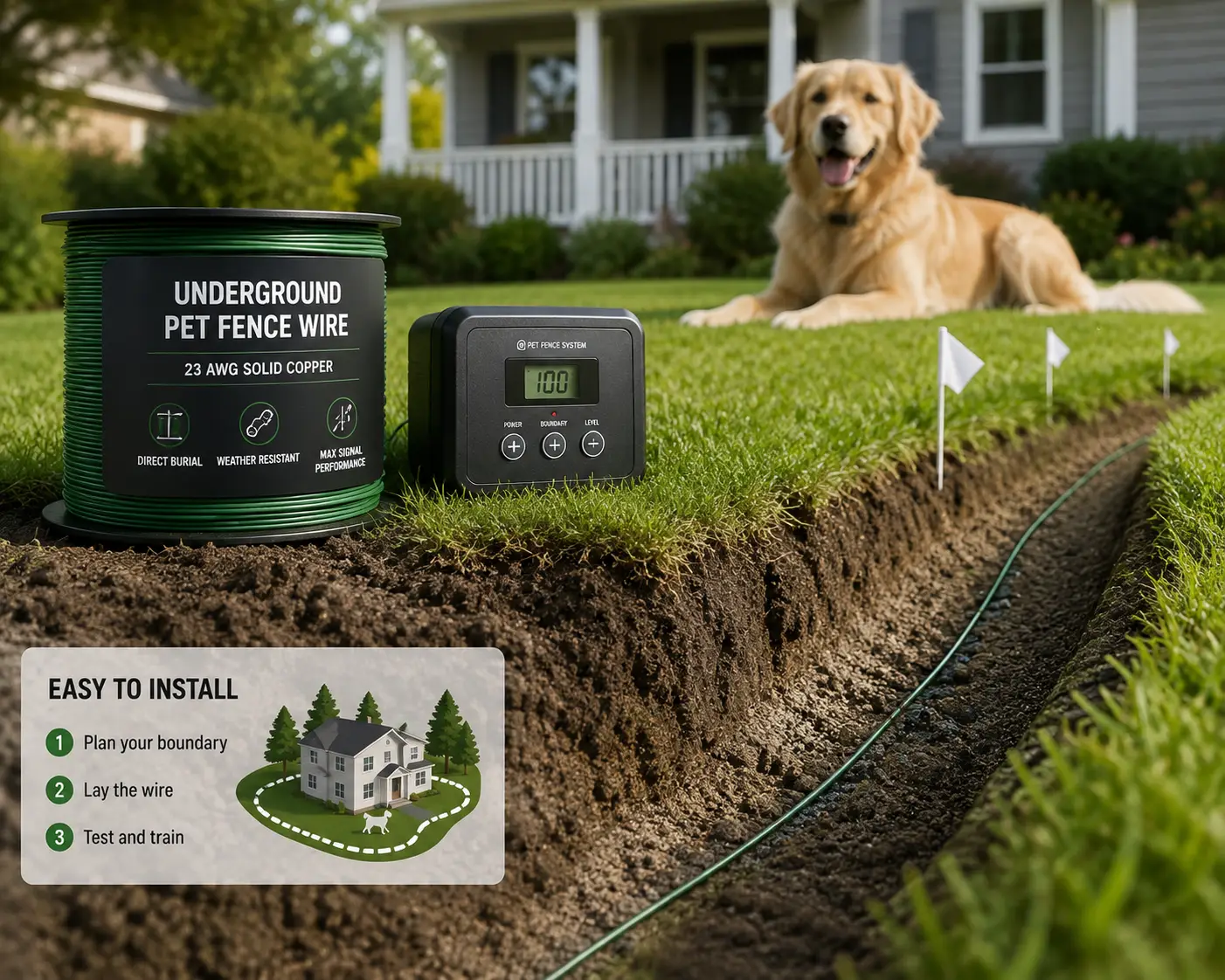
Underground pet fence wire is a solid-core, direct-burial-rated copper cable — typically 14 to 20 AWG — that’s buried a few inches below ground to form a closed loop connected to an in-ground fence transmitter. As current runs through the wire, it emits a low-power radio signal that a dog’s receiver collar detects, triggering a tone, vibration, or static correction as the animal approaches the boundary line. This general setup is what’s broadly known as a pet containment fence, and only pets wearing a compatible receiver collar actually respond to the buried signal.
Before diving into full reviews, here’s a fast snapshot of how the seven picks stack up by use case:
| Category | Pick | Price Range | Best For |
|---|---|---|---|
| Best Overall | Extreme Dog Fence 14-Gauge Boundary Wire | around $65–$80 | Most yards, any brand of fence |
| Best Budget | PetSafe 20-Gauge Boundary Wire | around $25–$35 | Small yards, tight budgets |
| Best Starter Kit | SportDOG Wire & Flag Kit | around $35–$45 | First-time DIY installs |
| Best Brand-Name Upgrade | PetSafe 16-Gauge Boundary Wire | around $45–$60 | PetSafe system owners wanting durability |
| Best for Large Properties | Extreme Dog Fence Yellow Maximum Performance Wire (1,500 ft) | around $150–$190 | Acreage, rural lots |
| Best Value Per Foot | Extreme Dog Fence Pure Copper Wire (2,000 ft) | around $180–$230 | Multi-acre coverage on a budget |
| Best Budget Alternative Brand | TRESSON Underground Dog Fence Wire | around $25–$35 | Occasional use, backup spool |
Looking at this table, the pattern is straightforward: gauge and length drive price far more than brand does, and the “best overall” pick isn’t the cheapest or the most expensive option — it’s the one that balances signal reliability with a jacket thick enough to survive years underground. If your yard is under a third of an acre, a 20-gauge spool is often plenty; anything larger, and stepping up to 14-gauge stops being optional. We’ll unpack exactly why gauge matters so much in the sections below.
💬 Bookmark this guide — you’ll want to reference the comparison table again once you’ve measured your yard’s perimeter.
Top 7 Underground Pet Fence Wire Picks for 2026
Each of these seven products is a real, currently listed item on Amazon. We pulled specs from manufacturer listings and cross-referenced aggregated customer feedback rather than inventing quotes or ratings — where verified review sentiment exists, we say so; where it’s thin, we say that too.
1. Extreme Dog Fence 14-Gauge Boundary Wire — best all-around universal upgrade
This 500-foot spool is the wire most installers reach for when they want a genuine upgrade over factory-included cable. The 14-gauge solid copper core is roughly five times thicker than the 18- or 20-gauge wire bundled with most starter kits, which matters because thicker copper carries a stronger signal over longer distances and resists breaking when a shovel or aerator gets too close. It’s wrapped in a polyethylene jacket rated for UV exposure, temperature swings, and direct burial, and the brand states it’s manufactured in the US and compatible with essentially every wired containment brand on the market, including PetSafe, Invisible Fence, SportDOG, and Dogtra. What most buyers overlook with 14-gauge wire is that it doesn’t just last longer — it also reduces “signal drop-off” at the far end of a large loop, which is often the real culprit behind a dog slipping through a boundary that used to hold. Reviews consistently report that this wire installs and splices exactly like the thinner factory wire, just with noticeably less breakage after the first hard freeze-thaw cycle. It’s a strong fit for anyone replacing a failed loop or expanding an existing system, especially on properties with rocky or root-heavy soil where thin wire tends to nick.
Pros:
- ✅ Compatible with virtually every in-ground fence brand
- ✅ Thick 14-gauge core resists nicks and breaks
- ✅ UV- and weather-resistant polyethylene jacket
Cons:
- ❌ Stiffer to work with than thin factory wire
- ❌ Costs noticeably more per foot than 20-gauge options
At around $65–$80 for 500 feet, it lands solidly mid-pack in price but delivers a meaningfully longer service life, which makes it a strong value if you’re not planning to dig this up again anytime soon.
2. PetSafe 16-Gauge Boundary Wire — most trusted brand-name wire
PetSafe is the parent company behind the Invisible Fence brand name many people use generically, and its 500-foot, 16-gauge solid copper spool is the manufacturer’s own recommended upgrade wire for expanding or repairing any PetSafe in-ground system. The 16-gauge core sits between the ultra-thin 20-gauge wire PetSafe ships in most starter boxes and the heavier 14-gauge wire aftermarket brands sell, giving you a real durability bump without needing thicker splice connectors or new tools. In practice, that middle-ground gauge means better resistance to lawn equipment and burial stress than stock wire, while still being flexible enough for tight corners around flower beds or trees. Reviews of PetSafe’s boundary wire line frequently mention that buyers upgraded specifically after a factory-thin wire snapped within a year or two, and that the thicker 16-gauge spool solved recurring signal-loss issues without needing a new transmitter. It’s the safest choice if you want zero compatibility guesswork with an existing PetSafe collar and transmitter setup.
Pros:
- ✅ Made by the same company as your PetSafe system
- ✅ Thicker than PetSafe’s stock 20-gauge starter wire
- ✅ Includes gel-filled splice capsules for waterproof joins
Cons:
- ❌ Only sold in 500-foot spools, no bulk option
- ❌ Not the thickest gauge available for very large lots
Expect to pay somewhere in the $45–$60 range, which is a fair premium for brand-matched compatibility and PetSafe’s included splice hardware.
3. SportDOG Wire & Flag Kit — best starter kit with flags included
SportDOG’s wire and flag kit bundles 500 feet of 20-gauge boundary wire with 50 training flags, two wire nuts, and two waterproof gel-filled splice capsules — everything a first-time installer needs beyond a shovel. The flags matter more than people expect: your dog’s initial training period relies on a visible line they can see and associate with the correction zone, and skipping that step is one of the most common reasons DIY in-ground fences fail to actually contain a dog. At 20-gauge, the wire itself is thinner than the heavy-duty options on this list, which is fine for adding up to roughly a third of an acre to an existing SportDOG loop but starts to show signal weakness on larger, more complex layouts. Aggregated customer feedback on this kit is largely positive, with buyers noting the splice hardware works cleanly with SportDOG, PetSafe, and Dogtra receivers alike, and that having flags included saved a separate purchase. If you’re setting up your very first system rather than repairing one, this bundle removes the guesswork of buying components separately.
Pros:
- ✅ Everything needed for a first install in one box
- ✅ Splice capsules are already waterproof-rated
- ✅ Compatible with most major in-ground fence brands
Cons:
- ❌ 20-gauge wire is thinner than heavy-duty alternatives
- ❌ Less ideal for properties over one acre
Priced around $35–$45, this kit’s value comes from convenience and bundled accessories rather than raw wire thickness — a fair trade for someone installing a system for the first time.
4. PetSafe 20-Gauge Boundary Wire (Pawz Away) — best budget pick for small yards
For a tight budget or a small, fenced-in yard where the wire run is short and mostly protected from foot traffic, PetSafe’s 20-gauge solid-core copper spool is the most affordable path to a working loop or repair. At 500 feet, it covers roughly a third of an acre and is rated for direct burial, though the thinner core means it’s more prone to breaking under stress than 14- or 16-gauge alternatives. What the spec sheet doesn’t say, but installer experience reveals, is that 20-gauge wire is genuinely fine for small, simple rectangular yards with soft soil — it’s large, irregular properties or rocky ground where the thinner gauge becomes a liability. This is standard PetSafe factory-grade wire, essentially the same spool that ships inside most PetSafe starter kits, so compatibility with any PetSafe transmitter is guaranteed. Reviews commonly describe it as reliable for basic repairs and small expansions, with the caveat that buyers planning larger loops upgraded to 16-gauge after a season or two.
Pros:
- ✅ Lowest cost per foot of any PetSafe wire option
- ✅ Guaranteed compatibility with any PetSafe transmitter
- ✅ Easy to splice with standard connectors
Cons:
- ❌ Thin gauge is more vulnerable to nicks and breaks
- ❌ Not ideal for yards over a third of an acre
At roughly $25–$35 for 500 feet, this is the entry point of the category — a sound choice for small yards, but budget-conscious buyers with larger properties should weigh the long-term repair cost against paying more upfront for thicker wire.
5. TRESSON Underground Dog Fence Wire — best budget alternative brand
TRESSON is a smaller, lesser-known brand offering a 500-foot spool of underground boundary wire marketed as compatible with most wireless and wired in-ground pet containment systems. It occupies similar territory to PetSafe’s 20-gauge spool — an affordable, functional option for small yards or as a spare/backup spool for future repairs — but without the brand recognition or manufacturer-matched splice kit that comes with PetSafe or SportDOG wire. Based on comparing available specs, TRESSON’s wire appears to use a standard polyethylene-jacketed copper core similar to other budget options in this space, though verified, large-sample third-party review data is thinner for this brand than for the established names on this list, so we’d flag that as a genuine unknown rather than a mark against it. For buyers who simply need a working spool of compatible wire without paying a brand premium, and who are comfortable sourcing their own splice connectors separately, it’s a reasonable low-cost option — just go in expecting less of a track record than PetSafe or Extreme Dog Fence.
Pros:
- ✅ Competitive price against name-brand budget wire
- ✅ Marketed as broadly compatible with major systems
- ✅ Good option as a backup or repair spool
Cons:
- ❌ Thinner verified review history than established brands
- ❌ Splice hardware not included in most listings
Expect a price in the $25–$35 range, putting it directly against PetSafe’s 20-gauge spool — worth considering if you want to compare a couple of budget options before committing.
6. Extreme Dog Fence Yellow Maximum Performance Wire (1,500 ft) — best for large properties
When a property runs past an acre, spool length and jacket thickness start to matter as much as gauge. Extreme Dog Fence’s Yellow Maximum Performance line pairs a 14-gauge copper core with what the manufacturer describes as a 60-mil polyethylene jacket — roughly double the thickness of standard dog fence wire insulation — specifically engineered to reduce signal loss over long, continuous runs. On paper, this means a single 1,500-foot spool can realistically cover several acres in one continuous loop without needing multiple splices, and fewer splices directly translates to fewer potential failure points buried in your yard. That thicker jacket also does double duty protecting against rodent damage and abrasion from roots or rocks, both common causes of wire breaks on large, less-maintained rural lots. Reviews of Extreme Dog Fence’s heavier wire lines frequently praise the reduced number of “phantom corrections” — false triggers caused by a weak or degraded signal — that buyers experienced after switching from thinner wire on big properties. This is a premium pick, and it’s priced like one, but for acreage where a professional installation would otherwise cost hundreds more, it’s a legitimate value play.
Pros:
- ✅ Extra-thick 60-mil jacket built for long, continuous runs
- ✅ 14-gauge core minimizes signal loss over distance
- ✅ Fewer splices needed thanks to spool length
Cons:
- ❌ Higher upfront cost than standard-length spools
- ❌ Overkill for yards under half an acre
At around $150–$190 for 1,500 feet, the per-foot cost is actually competitive with smaller spools once you account for the reduced number of splice kits and repair trips you’ll need over the wire’s lifespan.
7. Extreme Dog Fence Pure Copper Wire (2,000 ft) — best value per foot for acreage
For the largest properties — multi-acre lots, farms, or anyone fencing off a genuinely sprawling yard — Extreme Dog Fence’s 2,000-foot, 14-gauge pure copper spool offers the lowest effective cost per foot of any product on this list while keeping the same heavy-duty gauge as the brand’s shorter spools. The listing specifies a solid copper core (not copper-clad aluminum, which some cheaper competitors substitute to cut costs) wrapped in weatherproof insulation rated for direct burial. Here’s what to weigh: solid copper carries a stronger, more consistent signal than copper-clad aluminum wire of the same gauge, and it resists the corrosion-driven resistance increase that gradually weakens signal strength in cheaper wire over several seasons underground. For a property this size, buying one continuous 2,000-foot spool instead of stitching together multiple shorter ones also means far fewer buried splices, each of which is a potential point of water intrusion and failure. Aggregated feedback on Extreme Dog Fence’s pure copper line echoes the brand’s other offerings — buyers frequently mention it as the wire they wish they’d bought the first time, after cheaper thin-gauge wire failed within a season or two on a large property.
Pros:
- ✅ Lowest cost per foot for large-acreage coverage
- ✅ Solid copper core, not copper-clad aluminum
- ✅ Minimizes buried splices on long perimeter runs
Cons:
- ❌ Large spool is heavy and awkward to handle solo
- ❌ Unnecessary expense for anything under an acre
Pricing typically falls in the $180–$230 range for 2,000 feet, which — spread across that much wire — actually undercuts the per-foot price of several shorter 14-gauge spools on this list.
Comparing the Top 7 Side by Side
| Product | Gauge | Length | Jacket | Price Range | Best For |
|---|---|---|---|---|---|
| Extreme Dog Fence 14-Gauge Wire | 14 AWG | 500 ft | Standard PE | $65–$80 | Universal upgrade |
| PetSafe 16-Gauge Wire | 16 AWG | 500 ft | Standard PE | $45–$60 | PetSafe system owners |
| SportDOG Wire & Flag Kit | 20 AWG | 500 ft | Standard PE | $35–$45 | First-time installs |
| PetSafe 20-Gauge Wire | 20 AWG | 500 ft | Standard PE | $25–$35 | Small yards, tight budget |
| TRESSON Wire | ~20 AWG | 500 ft | Standard PE | $25–$35 | Backup/repair spool |
| Extreme Dog Fence Yellow Max | 14 AWG | 1,500 ft | 60-mil PE | $150–$190 | Large properties |
| Extreme Dog Fence Pure Copper | 14 AWG | 2,000 ft | Heavy PE | $180–$230 | Multi-acre coverage |
Read across this table and the pattern holds up: gauge and jacket thickness climb together with price, and length is really the variable that should drive your decision once yard size passes a third of an acre. For a typical suburban quarter-acre to half-acre lot, either the PetSafe 16-Gauge Wire or the Extreme Dog Fence 14-Gauge Wire hits the sweet spot between durability and cost, while anything over an acre should push you toward the two long-spool options at the bottom of the table.
💬 One click helps other shoppers make an informed choice too! 😊
How to Install Underground Pet Fence Wire the Right Way
Getting the wire in the ground correctly matters more than which spool you bought — even premium wire fails early if it’s buried wrong or spliced poorly. Here’s the process that avoids the most common first-30-days mistakes.
Start by mapping your loop on paper before you touch a shovel, marking the transmitter location, the boundary path, and any twisted-wire sections needed to route the signal to areas you want the dog to access safely (like a dog door or path to a shed). Before digging anywhere, contact your local utility marking service — in the US, that’s a free call to 811, which sends someone out to flag buried gas, electric, and communication lines so you don’t cut into something far more dangerous than a fence wire. Once your path is clear, aim for a burial depth of roughly 1 to 3 inches: shallow enough to avoid excessive digging, deep enough that mowing, aerating, or light foot traffic won’t expose or nick the line. Use a flat-blade edger or a wire-laying tool to cut a narrow slit rather than a wide trench, which minimizes lawn disruption and speeds up the whole project considerably.
Every splice — and on a mid-size yard you’ll likely need at least one — should use a gel-filled, direct-burial-rated connector, never household electrical tape or a twist-and-tape job, both of which fail within a season once moisture gets in. Test signal continuity at the transmitter before you finish backfilling any section, because finding a bad splice while the trench is still open takes minutes; finding it after the lawn has grown back over it takes hours. Finally, walk the completed loop with a flag every 10 feet during the first two weeks of training, since a visible boundary is what actually teaches your dog where the line is — the wire alone does nothing for training on its own.
Real-World Scenarios: Matching Wire to Your Situation
Different yards call for genuinely different wire choices, and seeing a few concrete profiles makes the decision easier than specs alone.
Consider a family with a standard suburban quarter-acre lot and a stock PetSafe fence that shipped with thin factory wire. Their dog escaped twice last spring after the original wire cracked near an old splice. For this profile, the PetSafe 16-Gauge Boundary Wire is the logical repair: same-brand compatibility, a real durability upgrade over the factory spool, and a spool length that comfortably covers the whole loop with wire to spare for a clean splice or two.
Now picture a rural household on eleven acres, currently using flags and a single strand of thin wire that keeps losing signal at the far end of the property. Signal degradation over distance is a textbook 20-gauge problem, and the fix isn’t a new transmitter — it’s the Extreme Dog Fence Pure Copper Wire (2,000 ft), whose thicker core and lower resistance per foot solve exactly this kind of long-run signal loss without needing a second transmitter or repeater.
Finally, think about a first-time dog owner installing an in-ground fence from scratch on a modest half-acre yard, with zero fencing experience and a tight timeline before a new puppy arrives. The SportDOG Wire & Flag Kit removes the most friction here: pre-bundled wire, flags for training, and splice hardware in one purchase, so the only decision left is where to bury the loop.
✨ Don’t miss these exclusive deals!
🔍 Take your yard containment project to the next level with this carefully curated lineup. Click a highlighted item to check current pricing and availability. These picks will help you get a secure, reliable boundary the whole family — dog included — can count on!
How to Choose Underground Pet Fence Wire
Six criteria decide whether a spool of wire will hold up for years or fail within a season. Work through these in order before you buy.
- Match the gauge to your property size. Under a third of an acre, 20-gauge is usually adequate; between a third and one acre, 16-gauge is the safer middle ground; anything larger genuinely calls for 14-gauge to avoid signal drop-off at the far end of the loop. (Gauge numbers work in reverse of what you’d expect — a lower AWG number means a thicker wire, so 14-gauge is thicker than 20-gauge, not thinner.)
- Check jacket thickness, not just gauge. A thin jacket on thick wire still cracks in freeze-thaw cycles — look for polyethylene jackets explicitly rated for direct burial and UV exposure, since exposed segments (around gates, driveways) take sun damage stock wire often can’t handle.
- Confirm brand compatibility only if it matters to you. Most boundary wire is genuinely universal across PetSafe, SportDOG, Invisible Fence, and Dogtra transmitters — brand-matched wire buys convenience and matched splice hardware, not a functional advantage.
- Buy 15–20% more length than your measured perimeter. Twisted-wire sections (where the signal needs to “cancel out” near walkways or doors) eat up footage fast, and running short mid-installation means a second trip to the store.
- Prioritize solid copper over copper-clad aluminum. Solid copper carries signal more consistently over years of underground exposure and resists the slow resistance creep that weakens cheaper wire’s signal strength over time.
- Budget for splice kits separately if they’re not included. A handful of gel-filled, direct-burial splice connectors costs very little compared to the wire itself, and skipping proper splices is the single most common cause of early failure.
Common Mistakes to Avoid When Buying Underground Pet Fence Wire
Even careful buyers trip over a handful of predictable pitfalls. Watch for these before you check out.
Buying based on price-per-foot alone is the most common misstep — a rock-bottom 20-gauge spool that has to be dug up and replaced in eighteen months costs more in total than a 14-gauge spool that lasts a decade. Underestimating footage is a close second: measuring only the straight perimeter and forgetting twisted-wire runs near doors, driveways, or garden beds routinely leaves installers 50–100 feet short. Skipping splice-rated connectors in favor of whatever’s in the garage — electrical tape, wire nuts not rated for burial — is a near-guaranteed early failure point, since standard connectors let moisture in within a few wet seasons. Finally, some buyers assume all copper wire is interchangeable and grab generic electrical wire instead of direct-burial-rated dog fence wire; standard household wire’s insulation isn’t engineered for years of soil contact and will degrade far faster than purpose-built boundary wire.
Underground Pet Fence Wire vs. Wireless and Physical Fences
Wired in-ground systems aren’t the only containment option, and it’s worth being clear-eyed about the alternatives before committing to a buried-wire installation.
| System Type | Visual Barrier | Typical Setup Cost | Best For |
|---|---|---|---|
| Underground wire fence | None | Low–Moderate | Irregular lots, HOA restrictions on visible fencing |
| Wireless/GPS fence | None | Low–Moderate | Renters, temporary setups, simpler terrain |
| Physical fence | Yes | Moderate–High | Multi-pet households, properties bordering roads or wildlife |
Wired underground systems generally hold a more precise, consistent boundary than GPS-based wireless fences, which can drift several feet depending on satellite signal quality — a meaningful difference if your yard borders a road. Both wired and wireless electronic systems work on the same basic principle: a collar warns the pet as it nears the boundary, then delivers a stronger correction if the pet crosses it, and only an animal wearing that receiver actually responds to the signal. That one-way design means neither type stops other animals, loose dogs, or people from entering your yard the way a physical fence does. If your property borders busy roads, wildlife corridors, or you’re concerned about strange dogs approaching your pet, that gap is worth weighing seriously against the lower cost and unobstructed views underground wire offers.
Underground Pet Fence Wire for Large Rural Properties
Acreage changes the math on almost every decision covered so far. Signal loss over distance becomes the dominant concern rather than an edge case, which is why 14-gauge (or thicker) wire stops being a luxury upgrade and becomes close to mandatory once your loop exceeds roughly two acres. Continuous spool length also matters more here than on a suburban lot — every splice buried across a sprawling perimeter is a future point of failure, and on properties with rocky or uneven terrain, fewer splices means fewer places for water to work its way in over a decade of freeze-thaw cycles. Rural installations also frequently need twisted-wire runs to safely route the signal past driveways, barns, or livestock areas without cutting off access, which eats into your total footage faster than most first-time installers expect — budget the extra 20% mentioned earlier generously rather than conservatively. Finally, on land with limited cell coverage, a wired system’s independence from GPS or cellular signal is a genuine practical advantage over wireless alternatives, which can struggle with accuracy in areas with poor satellite visibility under heavy tree cover.
Long-Term Cost and Maintenance
The sticker price on a spool of wire is only part of the real cost of ownership. A cheap 20-gauge spool that needs replacing every 18–24 months on a mid-size yard can easily cost more over a five-year span than a single 14-gauge spool bought once, once you factor in the labor of re-digging and re-splicing. Splice kits are a recurring but minor expense — budgeting for one or two direct-burial splice capsules per year of active use is realistic, especially in yards with freeze-thaw winters that stress buried connections. Seasonal maintenance is light but not zero: walking the loop each spring to check for exposed segments after frost heave, and testing signal continuity at the transmitter after any major landscaping work, catches most problems before they turn into an escaped dog. Over a typical 7–10 year ownership window, buyers who invested in 14- or 16-gauge wire upfront consistently report fewer total repairs than those who started with the thinnest factory-included wire, which tracks with the physical reality that thicker copper simply degrades more slowly underground.
Safety, Regulations, and Standards
Before installing any underground pet fence wire, a few practical regulatory points are worth knowing. In the US, contacting 811 before digging is required by law in most states any time you’re breaking ground, including for a dog fence — utility companies mark buried gas, electric, and communication lines for free, and skipping this step risks real injury as well as fines. Boundary wire itself carries very low voltage and isn’t federally regulated as an electrical hazard the way household wiring is, but local ordinances and HOA rules occasionally restrict burial depth near property lines or shared easements, so a quick check with your HOA or municipal code office before installation is worth the ten minutes it takes.
It’s also worth being transparent about the containment method itself, separate from the wire. Veterinary behavior organizations, including the American Veterinary Society of Animal Behavior and the American Animal Hospital Association, have published position statements favoring reward-based training and raising welfare concerns about aversive, correction-based methods — the same underlying mechanism behind static-correction in-ground fences. That doesn’t mean every dog or every household experiences these systems the same way, but it’s context worth weighing alongside training approach, your dog’s temperament, and whether a tone-and-vibration-only mode (available on many modern transmitters) might be a gentler starting point than static correction.
Features That Actually Matter (and Ones That Don’t)
Marketing copy on wire listings tends to bury the two or three specs that genuinely affect performance under a pile of ones that don’t move the needle much. Gauge and jacket thickness are the two that matter most — they directly determine signal strength over distance and how many winters the wire survives underground, and neither can really be substituted for by anything else on the spec sheet. Solid copper versus copper-clad aluminum is the next real differentiator, since it affects long-term resistance and signal consistency even when the gauge number looks identical on paper. What matters far less: wire color (purely cosmetic, doesn’t affect function), and claims of “universal compatibility,” which is true of nearly every dog fence wire on the market regardless of brand, since the wire itself is a passive conductor rather than a proprietary component. Spool packaging and included documentation are nice-to-haves, not differentiators worth paying a premium for on their own.
Frequently Asked Questions
❓ What gauge wire is best for an underground pet fence?
❓ How deep should you bury underground pet fence wire?
❓ Can I use any brand of wire with my in-ground dog fence?
❓ How much underground pet fence wire do I need?
❓ Can underground pet fence wire be run above ground or through PVC pipe?
Conclusion
Underground pet fence wire isn’t the exciting part of setting up an in-ground containment system, but it’s the part that determines whether your setup lasts two years or ten. The right choice comes down to matching gauge and spool length to your actual property size: a small suburban yard rarely needs more than 16-gauge, while acreage genuinely benefits from the thicker, longer spools like the Extreme Dog Fence Yellow Maximum Performance Wire or Extreme Dog Fence Pure Copper Wire. Budget-conscious buyers with modest yards can get years of reliable service from options like the PetSafe 20-Gauge Boundary Wire or TRESSON Underground Dog Fence Wire, while anyone starting completely from scratch will appreciate the all-in-one convenience of the SportDOG Wire & Flag Kit. Whichever spool you land on, pair it with proper direct-burial splices, a call to 811 before you dig, and a real training period with visual flags — the wire only does half the job, and a thoughtful installation does the rest.
✨ Ready to stop guessing and get your yard boundary right the first time? Check current pricing on the pick that matches your property size, and give your dog the secure, reliable run of the yard they deserve.
Recommended for You
- Best Shock Collars for Large Dogs: 7 Proven Picks for 2026
- Best E Collar for Large Dogs: 7 Top-Rated Picks (2026 Guide)
- 7 Best Proximity Dog Collars in 2026: Ultimate Buying Guide
Disclaimer: This post contains affiliate links. As an Amazon Associate, I earn from qualifying purchases made through these links, at no additional cost to you.
✨ Found this article helpful? Share it with someone who needs it! 💬🤗