
In This Article
Why an Above Ground Invisible Fence Makes Sense in 2026
Your dog has discovered the gap under the hedge. Again. You priced out a wooden fence, choked a little at the quote, and then learned your HOA doesn’t even allow one. That’s the exact moment most people start searching for an above ground invisible fence — a containment system that keeps your dog in the yard without trenching wire through your lawn or building anything you can see.
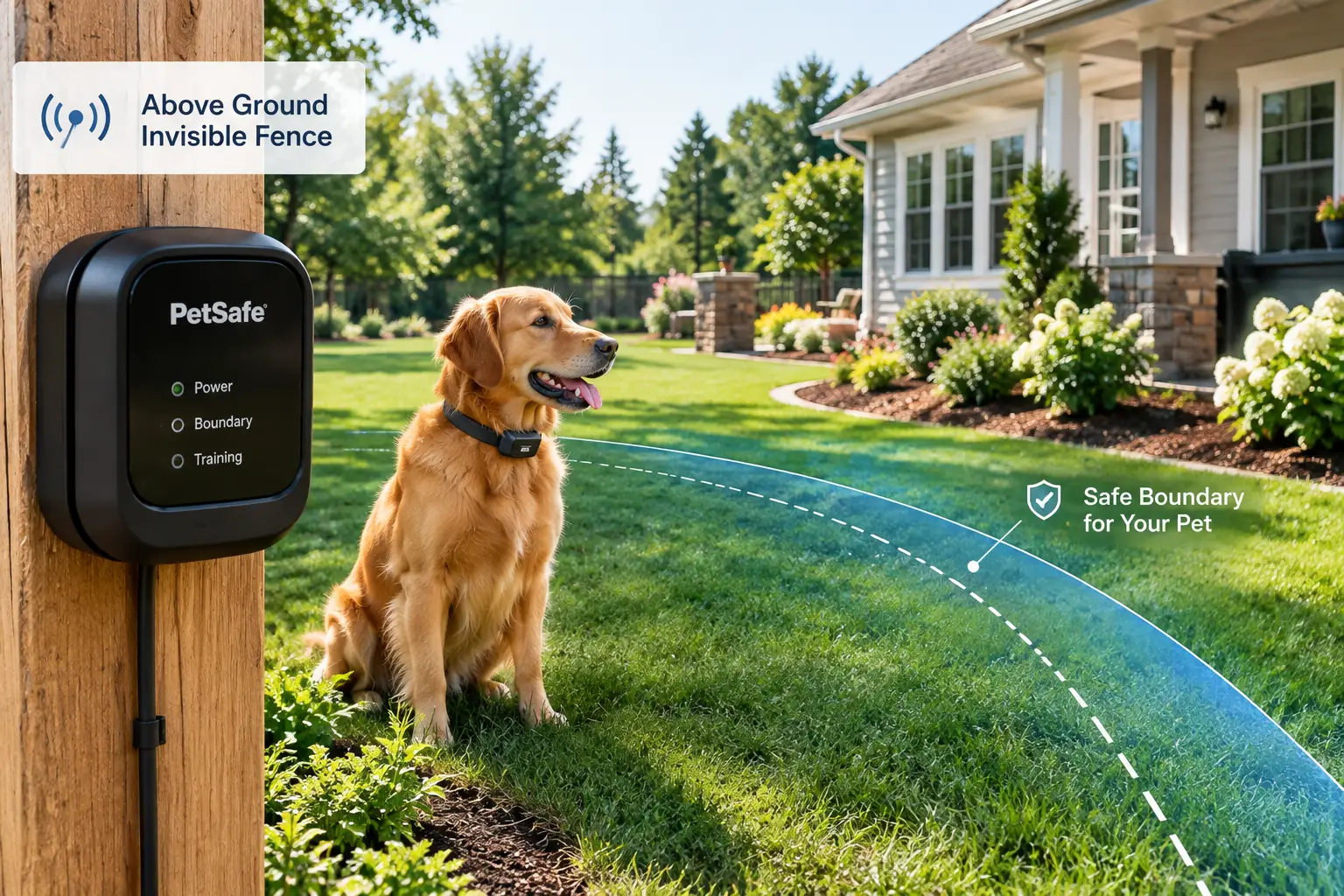
An above ground invisible fence (you’ll also see it sold as a wireless dog fence, no dig dog fence, or GPS dog fence) creates an invisible boundary using either a radio signal from an indoor transmitter or satellite positioning inside the collar. When your dog approaches that boundary, the collar gives a warning tone and, depending on the model and your settings, a vibration or a static correction. Nothing gets buried, and most systems pack up and travel with you.
Here’s the honest catch before we dive in: these systems are only as good as two things — the technology’s fit with your yard, and the training you put in. A circular radio fence can be brilliant on a flat, open half-acre and frustrating on a narrow, tree-lined lot. A GPS collar can be a game-changer on three wooded acres and a false-alarm machine on a small suburban plot.
This guide compares seven real systems available on amazon.com, from budget radio kits to premium GPS collars. We built it from manufacturer spec sheets, published hands-on reviews, and the aggregated sentiment in customer reviews — then translated all of it into plain-English advice. You’ll find a quick comparison, deep product analysis, a 30-day setup plan, troubleshooting fixes, and a straight talk on long-term costs and humane training.
What Is an Above Ground Invisible Fence?
An above ground invisible fence is a no-dig pet containment system that sets a boundary with radio signals or GPS instead of buried wire. The dog wears a receiver collar that warns with a tone — and optionally vibration or static — as it nears the edge, so you can contain pets without trenching or building a physical fence.
The two technologies behave very differently. Radio systems broadcast a circle from a plug-in transmitter. GPS systems calculate your dog’s position from satellites, which is why accuracy matters so much: according to GPS.gov’s official accuracy guidance, GPS-enabled phones are typically accurate to about 16 feet under open sky, with accuracy degrading near buildings, bridges, and trees. Dedicated fence collars use better antennas than phones, but that physics still explains why every GPS fence brand sets a minimum yard size.
Quick Comparison: 7 Best Above Ground Invisible Fence Systems
| Product | Technology | Coverage | Subscription | Collar Power | Best for |
|---|---|---|---|---|---|
| PetSafe Stay & Play Compact | Radio (circular) | Up to 3/4 acre | None | Rechargeable | PetSafe Stay & Play Compact — best all-round for small–medium flat yards |
| PetSafe Stay & Play for Stubborn Dogs | Radio (circular) | Up to 3/4 acre | None | Rechargeable | PetSafe Stay & Play for Stubborn Dogs — determined, high-drive dogs |
| PetSafe PIF-300 | Radio (circular) | Up to 1/2 acre | None | Replaceable battery | PetSafe PIF-300 — lowest upfront cost |
| Pawious F900 | Radio/radar positioning (circular) | Up to 5 acres (claimed) | None | Rechargeable | Pawious F900 — large, open rural lots on a budget |
| PetSafe Guardian GPS | GPS (custom shape) | 3/4 acre and up | None | Rechargeable, up to 5 days | PetSafe Guardian GPS — custom shapes without monthly fees |
| Halo Collar 5 | GPS (custom shape) | 900 sq ft and up | Required | Rechargeable, ~48 hrs | Halo Collar 5 — tracking, travel, and training in one |
| SpotOn Nova | Dual-band GPS (custom shape) | 1/3 acre and up | Optional | Rechargeable | SpotOn Nova — wooded or large properties needing top accuracy |
Looking at the table, the dividing line isn’t really price — it’s boundary shape. The three PetSafe radio kits and the Pawious F900 all draw a circle around the transmitter, which is perfect if your yard is roughly square and your house sits near the middle. If your property is long, narrow, or oddly shaped, you’re shopping in the GPS rows, and the real question becomes whether you’d rather pay more upfront (SpotOn Nova, PetSafe Guardian GPS) or pay monthly (Halo Collar 5).
💬 One click helps other shoppers make an informed choice too! 😊
Top 7 Above Ground Invisible Fence Systems: Expert Analysis
1. PetSafe Stay & Play Compact Wireless Fence — best all-round circular coverage
This is the system most people should look at first, because it solves the “flat suburban yard” problem with almost no setup drama. The PetSafe Stay & Play Compact (model PIF00-12917) uses a small indoor transmitter that projects an adjustable circle from 22 to 105 feet in every direction — up to roughly 3/4 acre. An LCD display on the base shows your boundary size, which removes the guesswork that plagued older dial-only units.
The waterproof, rechargeable collar fits dogs from 5 pounds with necks from 6 to 28 inches, so it works for a Chihuahua mix as well as a Lab. You get a tone-only mode plus five static levels, and “static-free reentry” means a dog that does slip out isn’t corrected for coming home — a thoughtful design choice, since punishing a return teaches exactly the wrong lesson.
Who is it for? Owners of reasonably flat, open yards where a circle fits the property. Portability is the underrated perk: RV owners and vacation-rental travelers can pack it up. Reviews consistently praise the quick setup and the lighter collar, while a recurring complaint is boundary inconsistency — dealers note that hills, dense trees, metal structures, and stucco siding can all disrupt the radio signal.
Pros:
- ✅ Sets up in one to two hours with no digging
- ✅ Rechargeable collar fits dogs as small as 5 pounds
- ✅ LCD display makes boundary size easy to read
Cons:
- ❌ Circular boundary can’t follow irregular property lines
- ❌ Signal can wobble near metal, stucco, or slopes
Typically in the $250–$350 range at the time of writing (check the current price) — strong value for a no-subscription, rechargeable system.
2. PetSafe Stay & Play Wireless Fence for Stubborn Dogs — built for escape artists
Some dogs treat a boundary tone like a suggestion. The PetSafe Stay & Play for Stubborn Dogs (model PIF00-13663) keeps the same up-to-3/4-acre circular coverage but pairs it with PetSafe’s stubborn-dog receiver collar, designed with a firmer correction range for high-drive, easily distracted dogs.
Feature-wise, you still get tone-only mode plus five adjustable static levels, a rechargeable waterproof collar, and static-free reentry. The listing specifies an adjustable radius from 5 to 105 feet, which gives you more room to shrink the circle on small lots than the Compact’s 22-foot minimum. In practice, that small detail matters: a townhouse-sized yard can actually work with this kit.
Based on comparing the two kits, the real question isn’t “is my dog stubborn?” but “has my dog already blown through a standard collar during proper training?” If yes, this kit makes sense. If you haven’t trained at all yet, start with lower settings on either kit — more stimulation is not a substitute for teaching the boundary. Aggregated review sentiment generally reports better results with hunting breeds and terriers, while PetSafe’s own support library includes troubleshooting for inconsistent boundaries and shorter-than-expected battery life on this collar.
Pros:
- ✅ Stronger collar suited to determined, high-drive dogs
- ✅ Radius shrinks to 5 feet for small spaces
- ✅ Same easy, portable setup as the standard kit
Cons:
- ❌ Firmer correction is inappropriate for sensitive dogs
- ❌ Still limited to a circular boundary shape
Usually in the $300–$400 range at the time of writing — worth it only if a standard collar truly isn’t enough.
3. PetSafe Wireless Pet Containment System (PIF-300) — lowest upfront cost
The PetSafe PIF-300 is the system that launched the wireless containment category, and it’s still widely sold because it’s simple and affordable. Its transmitter broadcasts a circle up to 90 feet in every direction, which works out to about 1/2 acre (180 feet across).
The collar suits dogs 8 pounds and up with necks from 6 to 28 inches and offers five static levels plus tone-only mode. It runs on a replaceable 6-volt RFA-67 battery rather than a rechargeable cell. In practical terms, that means no nightly charging — but it also means an ongoing cost. Outdoor Life’s reviewer, who owned one, singled out the proprietary, pricey batteries as the main downside.
Who’s it for? Budget-conscious owners with a smaller, flat yard who don’t want to think about charging. One more practical note: the transmitter is noticeably bulkier than the Stay & Play base — roughly 9 inches on each side — and must be mounted indoors 2–4 feet off the ground, away from appliances and metal. If you have a second dog, extra PIF-275 collars can be added. Reviews over many years consistently describe it as reliable on open lots and less so near metal siding or large appliances.
Pros:
- ✅ Lowest entry price among name-brand radio kits
- ✅ No charging — swap the battery every few months
- ✅ Two transmitters can overlap to expand coverage
Cons:
- ❌ Proprietary batteries add up over the years
- ❌ Bulky transmitter needs careful indoor placement
Commonly in the $200–$300 range at the time of writing — good starting value, but budget for batteries.
4. Pawious Wireless Dog Fence N5-F900 — big-lot coverage on a budget
The Pawious F900 targets a gap the PetSafe radio kits can’t fill: owners with far more than an acre who don’t want to pay GPS-collar prices. Pawious claims up to 5 acres of circular coverage and uses what it calls radar positioning, and the transmitter shows your dog’s real-time distance and beeps when the dog approaches or crosses the boundary.
That transmitter alert is a genuinely useful difference. With the PetSafe kits, you only find out about an escape by looking outside; here, the base itself warns you. The brand also sells a “forbidden area” version (F900Plus) for keeping dogs out of a zone, and multi-dog sets for up to three collars. Keep in mind the manufacturer’s own caveat: terrain, weather, wireless interference, and obstructions can reduce effective range, so “5 acres” is a best-case figure.
Our read, based on the specs: this is for rural owners with wide, open land. The collar is designed for medium and large dogs, so small breeds should look elsewhere. Honestly, owner feedback is more mixed than for the PetSafe units — satisfied buyers highlight quick setup and accuracy, while critical reviews on the brand’s own site describe collar signal dropouts. We couldn’t verify a large, consistent body of independent reviews, so treat this as a value pick with some risk.
Pros:
- ✅ Far larger claimed coverage than PetSafe radio kits
- ✅ Transmitter shows distance and alerts you
- ✅ No subscription and no wire to bury
Cons:
- ❌ Real-world range varies with terrain and interference
- ❌ Less established track record than PetSafe or SpotOn
Generally in the $250–$350 range at the time of writing, depending on dog count — solid value if your land is wide open.
5. PetSafe Guardian GPS Dog Fence — custom shapes, zero monthly fees
The PetSafe Guardian GPS (model PIF00-17933) is the answer for owners who need a boundary that follows the property line but refuse to take on another subscription. You draw the fence in the My PetSafe app in any shape, and PetSafe’s AccuGuard technology combines GPS data with motion detection and AI filtering to reduce false triggers.
The collar is waterproof and rechargeable with up to five days of battery life — noticeably longer than subscription GPS collars — and lets you choose tone and vibration, or up to 10 static levels. The system supports up to five dogs with add-on collars. The trade-off is clear in the fine print: it’s designed for properties larger than 3/4 acre and for dogs over 25 pounds with 13–28 inch necks. There’s also no location tracking or portability on this version; PetSafe sells a separate Guardian GPS + Tracking model with a subscription for that.
Who is it for? Owners of larger, oddly shaped lots with medium or big dogs who value predictable ownership costs. Aggregated reviews highlight the no-fee model and comfortable collar, while the most common limitation noted is the 3/4-acre minimum ruling out typical suburban yards.
Pros:
- ✅ Custom-shaped fence drawn in the app
- ✅ No subscription required for containment
- ✅ Up to five days per charge
Cons:
- ❌ Not suitable for yards under about 3/4 acre
- ❌ Only for dogs over 25 pounds
Typically in the $450–$500 range at the time of writing — excellent long-term value if your property qualifies.
6. Halo Collar 5 — tracking, fencing, and training in one collar
The Halo Collar 5 is less a fence and more a full smart-collar platform. It builds GPS fences in the Halo app — from as small as 900 square feet — and Best Buy’s listing describes 20 location updates per second and up to 48 hours of battery with a roughly one-hour recharge.
What that means in practice: faster updates help the collar react to a sprinting dog more quickly, and the low minimum fence size makes it one of the few GPS options that can even attempt smaller yards (though GPS drift still applies). Halo adds activity tracking, a training program developed with Cesar Millan, and optional Zone Beacons to create indoor or garden no-go areas.
The big caveat is cost structure. A subscription is required — Outdoor Life notes the cheapest monthly option runs about $10 for five fences, with higher tiers adding features — and without an active plan, boundary enforcement is limited. This is the best fit for travelers, hikers, and owners who want real-time tracking alongside containment. Reviews widely praise setup and reliability, with the most frequent complaints being the total cost and the need for regular charging.
Pros:
- ✅ Works in small fences down to 900 square feet
- ✅ Real-time tracking and activity monitoring built in
- ✅ Beacons add indoor or garden keep-out zones
Cons:
- ❌ Mandatory subscription raises long-term cost
- ❌ Roughly two-day battery means frequent charging
Around $600 upfront at the time of writing, plus the subscription — best value for owners who’ll actually use the tracking.
7. SpotOn GPS Dog Fence (Nova Edition) — the accuracy benchmark
The SpotOn Nova, launched in January 2026, is the premium pick for owners who’ve been burned by GPS drift. It pairs an active dual-band, dual-feed antenna with a dual-band receiver and pulls from a 151-satellite network; SpotOn claims boundary accuracy under five feet and recommends properties of 1/3 acre or more.
Why does dual-band matter? As GPS.gov explains, using two frequencies corrects atmospheric signal distortion — a real advantage under tree cover, where single-band collars wander. SpotOn also lets you draw any fence shape, create unlimited fences, and set a “home zone” so the collar doesn’t correct your dog indoors. Warning tones start roughly 10 feet inside the boundary, and static correction is optional. Containment works without a subscription; an optional plan adds tracking and breach alerts.
Who’s it for? Owners of wooded, rural, or multi-acre properties, and families who move between locations. Reviewers who tested the Nova report it largely delivered on accuracy, and SpotOn includes a free 30-minute trainer consultation. On the downside, customer reviews repeat two themes: the price is steep, and battery life can fall short of what’s advertised.
Pros:
- ✅ Dual-band GPS holds accuracy under tree cover
- ✅ No subscription needed for containment
- ✅ Unlimited custom fences for home and travel
Cons:
- ❌ Highest upfront price in this lineup
- ❌ Some owners report shorter battery life than advertised
Around $1,000 at the time of writing — expensive, but often cheaper than fencing several acres.
Top 7 Side-by-Side: Key Specs
| Product | Min. Dog Size | Correction Options | Boundary Shape | Price Range | Best for |
|---|---|---|---|---|---|
| PetSafe Stay & Play Compact | 5 lb | Tone + 5 static | Circle (22–105 ft radius) | $250–$350 | PetSafe Stay & Play Compact: small/medium flat yards |
| PetSafe Stay & Play for Stubborn Dogs | 5 lb | Tone + 5 static (stubborn collar) | Circle (5–105 ft radius) | $300–$400 | PetSafe Stay & Play for Stubborn Dogs: persistent escapers |
| PetSafe PIF-300 | 8 lb | Tone + 5 static | Circle (up to 90 ft radius) | $200–$300 | PetSafe PIF-300: tight budgets |
| Pawious F900 | Medium/large dogs | Tone, vibration, static | Circle (up to 5 acres claimed) | $250–$350 | Pawious F900: wide rural land |
| PetSafe Guardian GPS | 25 lb | Tone + vibration or 10 static | Custom (3/4 acre+) | $450–$500 | PetSafe Guardian GPS: fee-free custom shapes |
| Halo Collar 5 | Small to large | Sound, vibration, static | Custom (900 sq ft+) | ~$600 + plan | Halo Collar 5: travel + tracking |
| SpotOn Nova | 10–26 in neck | Tones + optional static | Custom (1/3 acre+) | ~$1,000 | SpotOn Nova: wooded or large properties |
Reading down the dog-size column is the fastest way to eliminate options: toy and small breeds are really limited to the Stay & Play kits or the Halo Collar 5, since the PetSafe Guardian GPS starts at 25 pounds and the Pawious F900 targets medium and larger dogs. Meanwhile, the price column shows a clean jump from radio (roughly $200–$400) to GPS ($450 and up), and that jump buys you shape flexibility — not necessarily better containment on a simple, flat yard.
🐾 Ready to Give Your Dog Safe Freedom?
🔍 Take your dog’s outdoor time to the next level with this carefully curated lineup. Click a highlighted system to check current pricing and availability. The right pick will give you peace of mind and give your pup room to run!
Getting Started: Your First 30 Days with an Above Ground Invisible Fence
Unboxing is the easy part. The first month decides whether your fence works for years or ends up in a drawer. Here’s a practical plan that mirrors the phased training most manufacturers recommend.
Days 1–2: Set up and test before your dog is involved
- Place the transmitter (radio systems) centrally, indoors, 2–4 feet off the ground, away from metal appliances and breaker panels.
- Walk the boundary with the collar in your hand to find where it actually triggers — not where you think it should.
- Plant boundary flags every 10 feet or so at that true trigger line. For GPS systems, draw your fence in the app, then walk it anyway.
Days 3–10: Teach the boundary, not the correction
Start in tone-only mode. On a leash, walk your dog toward the flags; when the tone sounds, cheerfully guide them back and reward generously. Keep sessions short — about 10–15 minutes, two or three times a day. The goal is for your dog to learn “tone means turn around,” with treats doing the heavy lifting.
Days 11–20: Add distractions gradually
Introduce the temptations your dog will actually face: a family member walking outside the boundary, a tossed toy, a neighbor’s dog. If you use static at all, begin at the lowest level that gets your dog’s attention — not the highest one your dog tolerates.
Days 21–30: Supervised off-leash time
Let your dog explore off-leash while you stay outside. Remove flags slowly, a few at a time, only after your dog reliably turns back.
The most common first-month mistakes
- ❌ Skipping the flags because “the dog is smart”
- ❌ Starting on a high correction level
- ❌ Leaving a newly trained dog outside unsupervised
- ❌ Forgetting to charge the collar — a dead collar is no fence at all
Stick to that plan and most dogs understand the boundary within about two weeks, which lines up with PetSafe’s own training timeline.
Which System Fits Your Yard? Three Real-World Scenarios
Specs mean little until you map them onto an actual home. Here are three common profiles and the reasoning behind each match.
Scenario 1: The suburban family with a 1/3-acre square lot
A family with a 40-pound beagle mix, a roughly square yard, and the house near the center. The dog is outside several times a day. Best match: PetSafe Stay & Play Compact. A 1/3-acre lot is well within its circular range, the collar is rechargeable, and there’s no subscription. GPS systems are a poor fit here: the PetSafe Guardian GPS requires 3/4 acre, and at this size GPS drift would cause frequent false warnings on most collars. Budget: roughly $250–$350, one time.
Scenario 2: The rural couple with 4 wooded acres
Two hounds, heavy tree cover, a long driveway, and property lines that zigzag around a creek. Best match: SpotOn Nova. A circle can’t follow that property line, and single-band GPS tends to drift under canopy — precisely where the Nova’s dual-band hardware earns its price. If budget is tight and the land were open rather than wooded, the PetSafe Guardian GPS would be the value alternative. Budget: about $1,000 per collar, with no mandatory monthly fees.
Scenario 3: The frequent traveler with an RV and a 25-pound terrier
Weekends at campgrounds, weekdays at a townhouse with a tiny yard, and a dog who loves to wander. Best match: Halo Collar 5. Its small minimum fence size, saved fences for multiple locations, and real-time tracking suit a life on the move. The subscription is the trade-off — budget about $600 upfront plus the monthly plan. A cheaper alternative is the PetSafe Stay & Play Compact, which also packs into an RV, but you’d give up tracking.
The pattern across all three? Yard shape and tree cover pick the technology first; budget and dog size then narrow the brand.
Troubleshooting: Common Problems and How to Fix Them
Even well-installed systems hiccup. Here are the issues owners report most often, with practical fixes.
Problem 1: The boundary seems to “move” day to day (radio systems). Radio signals bounce off metal and certain building materials. Move the transmitter away from appliances, metal siding, and breaker panels, and raise it 2–4 feet off the floor. On the PetSafe Stay & Play Compact, re-walk the boundary after relocating and re-flag it.
Problem 2: The collar corrects the dog inside the house (GPS systems). GPS struggles indoors, so the collar can “think” your dog is outside the fence. Set a home zone (SpotOn Nova), rely on the collar’s motion and AI filtering (PetSafe Guardian GPS), or simply remove the collar indoors.
Problem 3: Your dog runs straight through the boundary. This usually signals incomplete training or a loose fit — the contact points must touch skin. Check the fit first, then return to leashed training with a higher-value reward. For persistent dogs who’ve been properly trained, the PetSafe Stay & Play for Stubborn Dogs collar exists for exactly this.
Problem 4: False warnings near trees or the house. Keep GPS boundaries well away from structures (SpotOn advises about 30 feet from the house and 15 feet from roads) and make sure the fence is wide enough — SpotOn recommends at least 80 feet at the narrowest point.
Problem 5: Batteries die at the worst moment. Build a routine: charge Halo Collar 5 nightly, check the PetSafe Guardian GPS every few days, and keep a spare RFA-67 battery on hand for the PetSafe PIF-300.
How to Choose an Above Ground Invisible Fence
Choosing the right system comes down to seven decisions, made in this order:
- Measure your yard and its shape. If a circle fits your property, radio systems are simpler and cheaper; irregular or narrow lots point to GPS.
- Check your tree cover and structures. Dense canopy and metal buildings degrade both radio and GPS signals; dual-band GPS handles trees best.
- Match the collar to your dog’s size. Minimums range from 5 pounds (Stay & Play kits) to 25 pounds (PetSafe Guardian GPS), and a poorly fitting collar won’t work.
- Decide how you feel about subscriptions. Radio kits, the PetSafe Guardian GPS, and the SpotOn Nova contain without fees; the Halo Collar 5 needs a plan.
- Consider portability. Radio transmitters and GPS collars both travel, but only GPS collars can store multiple fence locations.
- Look for gentle correction options. Tone-only and vibration modes let you train with the least aversive setting that works.
- Count your dogs. Every dog needs its own collar, so multiply the collar cost before comparing totals.
Work through the list honestly and you’ll usually find only one or two systems survive — which makes the final decision much easier than scrolling endless listings.
Wireless Dog Fence vs GPS Dog Fence vs In-Ground Wire
These three are often lumped together as “invisible fences,” but they behave like different products.
A wireless dog fence (radio) is the plug-and-play option. It’s affordable, needs no app, and works the moment the transmitter is on. Its weakness is geometry: it only makes circles, and the circle is centered on your house. PetSafe’s radio kits top out around 3/4 acre, so a larger lot means overlapping transmitters or a different technology.
A GPS dog fence trades simplicity for flexibility. You can draw a fence that hugs a winding creek, excludes a pool, or follows a long driveway. However, GPS has inherent drift, which is why brands set minimum property sizes — 1/3 acre for SpotOn and 3/4 acre for PetSafe’s Guardian.
An in-ground wired fence remains the precision benchmark for custom shapes on small, irregular lots, but it requires trenching, can be cut by landscaping, and doesn’t travel.
Above Ground Systems vs Traditional Alternatives
| Factor | Radio (Above Ground) | GPS (Above Ground) | In-Ground Wire | Physical Fence |
|---|---|---|---|---|
| Installation | 1–2 hours, no digging | 1–2 hours, app setup | Trenching required | Days + contractor |
| Boundary shape | Circle only | Any shape | Any shape | Any shape |
| Portability | Yes | Yes | No | No |
| Keeps other animals out | No | No | No | Yes |
| Best for | PetSafe Stay & Play Compact buyers with flat, square yards | SpotOn Nova or PetSafe Guardian GPS buyers with large, irregular land | Small, oddly shaped lots | Maximum security |
The “keeps other animals out” row is the one people forget. No electronic fence stops a loose dog, coyote, or person from entering your yard, so a physical fence is still the right call where wildlife or roaming dogs are a real risk. For everyone else, the table shows why above ground systems win on install time and portability — and why the choice between radio and GPS is really a choice about shape.
Features That Actually Matter (and Ones That Don’t)
Marketing pages love superlatives. Here’s how to separate the useful from the fluff.
Features that matter
- Static-free reentry. If your dog slips out, it shouldn’t be punished for coming back. The Stay & Play kits include this, and it’s worth insisting on.
- Tone-only and vibration modes. These let you train with the mildest effective cue and reserve static for later — or never use it at all.
- Dual-band GPS. On wooded land, this is the single spec most tied to fewer false warnings. It’s the headline feature of the SpotOn Nova.
- Home or indoor zones. Essential for GPS systems to avoid indoor corrections.
- Realistic battery life. Five days (PetSafe Guardian GPS) versus about two days (Halo Collar 5) changes your daily routine more than any app feature.
Features that matter less than you think
- Huge maximum ranges. “Up to 5 acres” or “100,000 acres” looks impressive, but your actual lot size is what counts.
- Activity tracking. Nice to have, but it doesn’t keep your dog in the yard.
- “AI” labels. Motion filtering can genuinely reduce false triggers — but judge it by reviews on your kind of property, not by the buzzword.
The takeaway: buy for boundary reliability and humane training options first, and treat everything else as a bonus.
Long-Term Cost and Maintenance
The sticker price is only the start. Over three years — a reasonable lifespan for most collars, and Halo itself estimates its collar lasting three to five years — the real cost picture shifts noticeably.
Radio kits have the lowest ongoing costs. The rechargeable Stay & Play kits mostly cost you electricity and the eventual replacement collar. The PetSafe PIF-300 is cheaper upfront, but its RFA-67 batteries typically last one to three months each, so budget for replacements.
GPS systems split sharply. The PetSafe Guardian GPS and SpotOn Nova need no subscription for containment, making their total cost predictable. The Halo Collar 5, by contrast, adds at least roughly $10 a month — around $360 over three years on the cheapest plan — on top of about $600 upfront.
Estimated 3-Year Cost of Ownership (One Dog)
| Product | Upfront (approx.) | Ongoing Costs | Est. 3-Year Total | Best for |
|---|---|---|---|---|
| PetSafe PIF-300 | $200–$300 | Replacement batteries | ~$300–$450 | PetSafe PIF-300: lowest cost small lots |
| PetSafe Stay & Play Compact | $250–$350 | Minimal | ~$250–$350 | PetSafe Stay & Play Compact: best all-round value |
| PetSafe Guardian GPS | $450–$500 | None required | ~$450–$500 | PetSafe Guardian GPS: fee-free GPS |
| Halo Collar 5 | ~$600 | ~$10+/month plan | ~$960+ | Halo Collar 5: tracking users |
| SpotOn Nova | ~$1,000 | Optional plan | ~$1,000 | SpotOn Nova: large wooded land |
Over three years, the gap between the Halo Collar 5 and the SpotOn Nova nearly closes, which reframes the “SpotOn is too expensive” objection. Meanwhile, the PetSafe Stay & Play Compact remains the clear value champion for yards where a circle works. For multi-dog homes, multiply collar costs — the difference between radio and GPS grows quickly with every extra dog.
Common Mistakes to Avoid When Buying an Above Ground Invisible Fence
A few predictable errors account for most disappointed buyers:
- Buying GPS for a small yard. If your lot is under 1/3 acre, most GPS fences will struggle with drift. A radio kit or the small-fence capability of the Halo Collar 5 is more realistic.
- Ignoring the circle. Radio systems draw a circle centered on the transmitter. If your house sits at the front edge of the lot, much of the circle falls over the street — sketch it before you buy.
- Overlooking dog size limits. The PetSafe Guardian GPS requires dogs over 25 pounds; a 12-pound Shih Tzu won’t be a match.
- Assuming it replaces supervision. No electronic fence stops other animals from entering, and a highly motivated dog may still run through.
- Forgetting per-dog costs. Every dog needs its own collar, so a three-dog household may pay significantly more than the headline price.
- Skipping the return policy check. Test the system on your actual property early, within the return window, before committing to months of training.
Avoiding these six mistakes solves most “it doesn’t work” complaints before they happen.
Safety, Humane Training, and Standards
This is the section too many product roundups skip. Static-correction collars are aversive tools, and the veterinary behavior community is clear about its concerns. The American Veterinary Society of Animal Behavior’s position statement on humane dog training recommends reward-based methods for all dog training and advises against aversive tools, including electronic shock collars, citing evidence of stress-related behaviors in dogs trained with them.
What does that mean for you as a buyer? It doesn’t mean you can’t use an above ground invisible fence. It means you should use it thoughtfully:
- Start with tone-only or vibration modes. Every system in this guide offers a non-static warning option. Many dogs never need more.
- Pair every boundary cue with rewards. Turning back from the tone should earn treats and praise — that’s what actually teaches the boundary.
- Use the lowest effective setting. If you do use static, choose the level that gets attention, not a level that frightens.
- Check the fit daily. Contact points that rub the same spot for hours can irritate skin; rotate the collar position and remove it for part of each day.
- Consult a professional first for anxious, reactive, or aggressive dogs. The AVMA’s coverage of the AVSAB statement explains why behaviorists see no role for aversive methods in behavior modification plans.
On the regulatory side, electronic dog collars and transmitters sold in the U.S. are radio devices that fall under FCC equipment rules, so look for FCC compliance information in the manual. Also check HOA rules and local leash ordinances — an invisible boundary doesn’t change your legal responsibility if your dog leaves the property.
FAQ: Above Ground Invisible Fence
❓ Is an above ground invisible fence worth buying over a physical fence?
❓ What is the cheapest above ground invisible fence that actually works?
❓ Do GPS dog fences work in small backyards?
❓ Can I use a wireless dog fence for two dogs?
❓ Which no dig dog fence is best for wooded property?
Conclusion: Picking the Right Above Ground Invisible Fence for Your Dog
The best above ground invisible fence isn’t the one with the flashiest spec sheet — it’s the one that matches your yard’s shape, your tree cover, your dog’s size, and your tolerance for monthly fees.
For most suburban owners with flat, reasonably square yards, the PetSafe Stay & Play Compact is the smartest starting point: affordable, rechargeable, portable, and fee-free. If your dog has already proven a standard collar isn’t enough after real training, step up to the PetSafe Stay & Play for Stubborn Dogs. On a tight budget, the PetSafe PIF-300 still does the job, as long as you plan for batteries. For wide, open rural land, the Pawious F900 offers big coverage for the money, with a bit more uncertainty.
When a circle simply won’t fit, move to GPS. The PetSafe Guardian GPS delivers custom shapes with no subscription on larger lots. The Halo Collar 5 is the most versatile for travelers who want tracking. And the SpotOn Nova sets the accuracy bar for wooded and multi-acre properties.
Whichever you choose, remember that the collar is only half the system. Two weeks of patient, reward-based training — starting with tone or vibration — is what turns an invisible line into a boundary your dog genuinely understands.
🏡 Find Your Dog’s Perfect Boundary Today!
✨ Don’t wait for the next great escape. Click any highlighted system above to check current pricing and availability — and give your dog the safe freedom to run, sniff, and play in the yard you both love!
Recommended for You
- Sticker GPS System: 7 Best Trackers That Actually Work (2026)
- Electric Fence Control: 7 Best Energizers That Actually Work (2026)
- Best Dog Training Collar for Small Dogs: 7 Gentle Picks (2026)
Disclaimer: This post contains affiliate links. As an Amazon Associate, I earn from qualifying purchases made through these links, at no additional cost to you.
✨ Found this article helpful? Share it with someone who needs it! 💬🤗