
In This Article
What Is a Sticker GPS System? (And Why the Name Is Misleading)
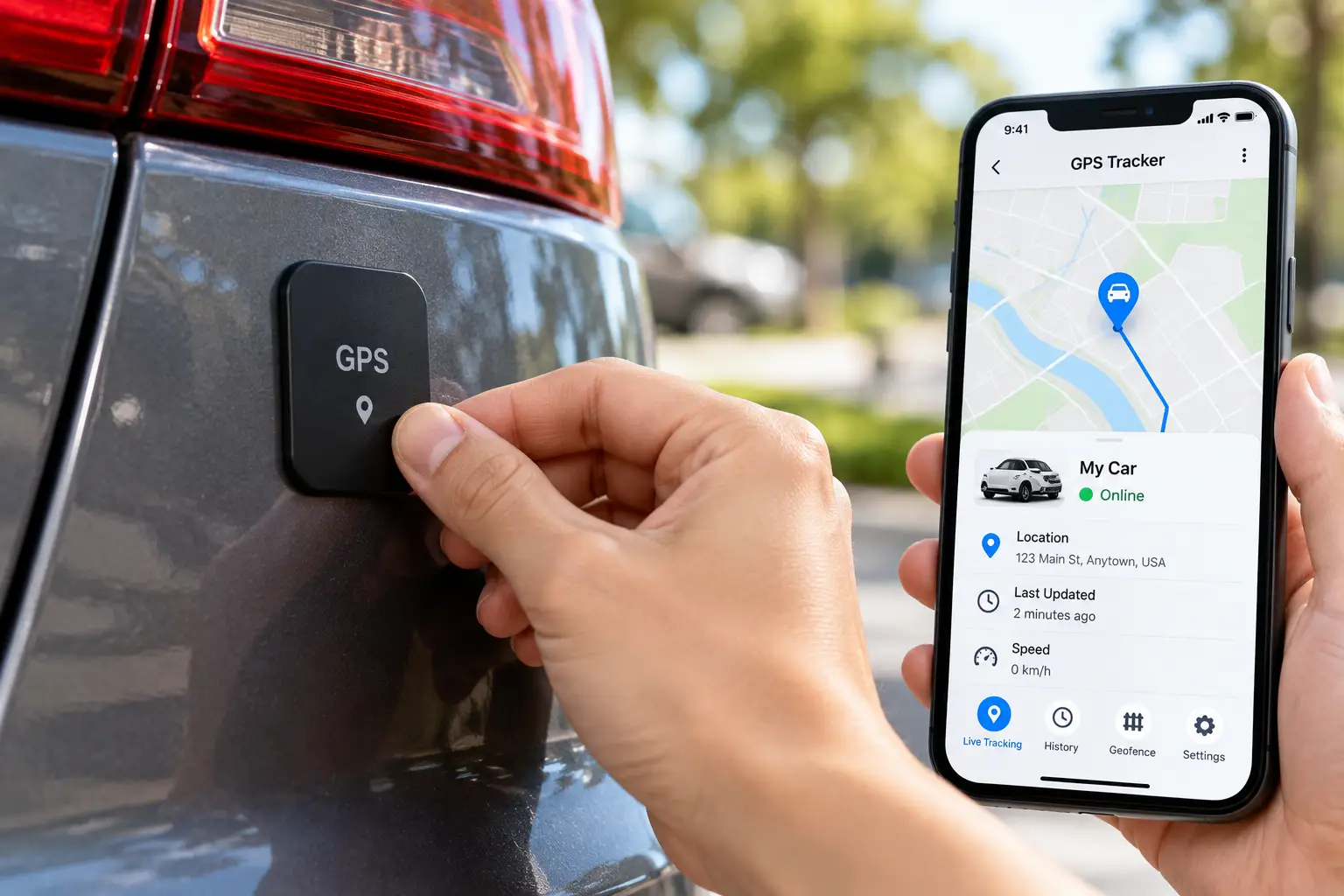
A sticker gps system is a small, flat, often adhesive-backed tracking device you attach to an item — a remote, a bike frame, a laptop, a car — so you can locate it from your phone. Some models use true satellite GPS plus a cellular connection; most “sticker” models actually rely on Bluetooth and a crowd-sourced finding network.
That second sentence is the part most product listings skip, and it’s the part that decides whether your purchase succeeds or disappoints. Picture this: you stick a $25 tag on your e-bike, the bike vanishes from a train station, and you open the app expecting a moving blue dot on a map. Instead, you get a “last seen 3 hours ago” pin — because there was no phone nearby to relay the signal. That’s not a defect. That’s simply how Bluetooth trackers work.
A real GPS tracking unit calculates its own position from satellites and then needs a way to send that location somewhere — usually a cellular modem with a data plan. A Bluetooth sticker tracker, by contrast, has no GPS chip at all; it borrows the GPS of whatever nearby phone happens to detect it.
Neither approach is “better” in the abstract. Bluetooth sticker trackers are cheap, tiny, and run for a year or more with no monthly fee. Cellular GPS trackers report live location anywhere with coverage, but they’re bulkier, need recharging, and almost always carry a subscription.
In this guide, you’ll find seven real products spanning both technologies, from a paper-thin sticker to a year-long-battery vehicle tracker. For each one, you’ll get honest analysis grounded in published specs and aggregated review data — plus setup tips, cost-of-ownership math, and the legal ground rules nobody mentions on the box. By the end, you’ll know exactly which sticker gps system fits your situation, and which ones would waste your money.
Quick Comparison: The 7 Best Sticker GPS System Options at a Glance
| Product | Technology | Battery | Monthly Fee | Price Range | Best for |
|---|---|---|---|---|---|
| Tile Sticker (2024) | Bluetooth + Tile network | ~3 years, sealed | None (optional premium) | Under $30 | Tile Sticker (2024): remotes, flat gadgets, mixed iPhone/Android homes |
| Apple AirTag (2nd Gen) | Bluetooth + UWB + Find My | ~1 year, CR2032 | None | Around $29 (4-pack under $100) | Apple AirTag (2nd Gen): iPhone users, luggage, keys |
| Samsung Galaxy SmartTag2 | Bluetooth 5.3 + UWB + Galaxy Find | Up to 500–700 days | None | Around $25–$30 | Samsung Galaxy SmartTag2: Galaxy phone owners |
| Tracki 4G Mini | GPS + 4G LTE | Days to ~1 month | Yes | Hardware under $25 | Tracki 4G Mini: budget real-time tracking |
| LandAirSea 54 | GPS + 4G LTE | ~1–2 weeks | Yes | Under $100 hardware | LandAirSea 54: fast live vehicle updates |
| Invoxia Cellular GPS Tracker | GPS + LTE-M | ~2 weeks to 4 months | First year included | Around $100–$130 | Invoxia Cellular GPS Tracker: bikes, low ongoing cost |
| Tracki Pro | GPS + 4G LTE | Up to ~12 months | Yes | Check current price | Tracki Pro: parked vehicles, trailers, equipment |
Reading down the “Technology” column tells you most of what you need to know. The first three rows are Bluetooth trackers: no fees, long battery life, but location depends on nearby phones. The last four are true cellular GPS trackers that report live wherever there’s signal — and every one of them either charges a subscription or bundles a year of service into the price.
If your main worry is misplaced keys or a lost remote, the top three rows are the smart money. If your main worry is theft — a car, a trailer, a $3,000 e-bike — you should be looking at the bottom four, because a thief isn’t going to walk past enough phones on your schedule.
💬 One click helps other shoppers make an informed choice too! Tap a highlighted product name to check today’s price and availability. 😊
Top 7 Sticker GPS System Picks: Expert Analysis
1. Tile Sticker (2024) — smallest true stick-on tracker
The Tile Sticker (2024) is the product that most literally matches the phrase “sticker tracker”: a coin-sized, adhesive-backed disc you press onto a flat surface and forget about.
Tile lists a Bluetooth range of 250 feet and a roughly three-year sealed battery. In practice, that sealed battery means zero maintenance for years — but also that the whole device becomes e-waste when it dies. The adhesive back is the real selling point: it sticks to TV remotes, drone controllers, and bike frames where a keyring tag simply won’t fit. Since Life360 bought Tile, 2024 models also support an SOS button feature through the Life360 app.
Based on comparing the specs, this is the tracker for households with both iPhones and Android phones, because the Tile app works on both — unlike AirTag or SmartTag2. It’s a “find it around the house” device first and a “find it across town” device second.
Reviews consistently report that real-world range falls well short of the 250-foot claim; Tom’s Guide’s testing measured roughly 30 to 55 feet in their trials. Separately, reviewers noted that the Tile and Life360 platforms suffered data-security incidents in 2024, which privacy-minded buyers should weigh.
Pros:
- ✅ Genuinely stick-on design fits flat objects
- ✅ Works on both iPhone and Android
- ✅ No charging for roughly three years
Cons:
- ❌ Real-world range far below the advertised spec
- ❌ Battery can’t be replaced when it dies
At under $30, the Tile Sticker (2024) is solid value for in-home item finding, but not a theft-recovery tool.
2. Apple AirTag (2nd Gen) — best network for iPhone owners
The Apple AirTag (2nd Gen), launched in January 2026, isn’t a sticker out of the box — but paired with an inexpensive adhesive holder, it becomes the most capable sticker-style tracker for Apple users.
Apple’s second-generation Ultra Wideband chip extends Precision Finding by up to 50 percent compared with the original, according to Apple’s official announcement. What that means in practice: the on-screen arrow that walks you to your item now kicks in from across a parking lot, not just across a room. The speaker is also noticeably louder, and Apple Watch Series 9, Ultra 2, and newer can now do Precision Finding directly. It keeps a user-replaceable CR2032 battery and an IP67 rating.
The fine print matters: the extended Precision Finding needs an iPhone 15 or later (excluding the iPhone 16e) or iPhone Air. On an older iPhone, you get roughly first-gen range. And if you use Android, skip it entirely.
Across major reviews, the sentiment is consistent: same design, meaningfully better finding. Several reviewers reported the “getting closer” guidance appearing at roughly 75–80 feet in their tests.
Pros:
- ✅ Enormous Find My network means frequent location updates
- ✅ Replaceable battery costs a few dollars yearly
- ✅ Strong built-in anti-stalking protections
Cons:
- ❌ Useless for Android households
- ❌ Needs a separate adhesive mount to “stick”
Around $29 each (or under $100 for a four-pack), the Apple AirTag (2nd Gen) is the best-value Bluetooth option if everyone in your home uses iPhone.
3. Samsung Galaxy SmartTag2 — longest battery among tag trackers
The Samsung Galaxy SmartTag2 is Samsung’s answer to AirTag, and its headline feature is stamina: Samsung rates it for up to 500 days in normal mode and up to 700 days in Power Saving Mode.
That battery figure translates into nearly two years between coin-cell swaps — and because it uses a standard, replaceable CR2032, “replacing” means a two-dollar battery, not a new device. It pairs Bluetooth LE 5.3 with UWB, so compatible Galaxy phones get Compass View, a directional arrow similar to Apple’s Precision Finding. It’s IP67 rated, and in Lost Mode, anyone with an NFC-capable phone can tap it to see your contact details.
Here’s what to weigh: the Samsung Galaxy SmartTag2 only works with Samsung Galaxy phones via SmartThings Find. For a Galaxy-only household, that’s not a drawback at all; for anyone else, it’s a dealbreaker. The large keyhole loop also makes it pet-collar friendly without extra accessories.
Reviews consistently praise battery life and quick setup on Galaxy phones, while the most common complaint is the ecosystem lock-in. Some reviewers measured shorter projected battery life in normal mode than Samsung’s lab figure.
Pros:
- ✅ Up to 700 days in power-saving mode
- ✅ UWB directional finding on supported Galaxy phones
- ✅ Doubles as a smart-home button for routines
Cons:
- ❌ Galaxy phones only — no iPhone or Pixel support
- ❌ Too thick for wallet tracking
In the $25–$30 range, the Samsung Galaxy SmartTag2 is an easy recommendation for Galaxy owners.
4. Tracki 4G Mini — cheapest entry to real GPS
The Tracki 4G Mini is where this list crosses from Bluetooth tags into true GPS — and it does so at a hardware price that looks almost too low.
That low price is the business model: the device is inexpensive, but a monthly plan is mandatory for it to report anything. Measuring about 1.75 × 1.5 × 0.5 inches, it’s small enough for a backpack pocket or glovebox, and it includes a SIM that works in most countries. You get real-time location, geofencing, and history through the app. Battery life is the trade-off: frequent updates drain it in days, while battery-save mode stretches it toward a month.
Based on comparing the specs, the Tracki 4G Mini suits people who need live location for a short trip, a teen’s first road trip, or a rental — situations where recharging every few days is acceptable.
SafeWise’s hands-on review found accuracy consistently around 40 feet and battery life of about six days at 10-minute updates. Aggregated customer feedback is positive on accuracy but mixed on battery longevity, and several reviewers criticized how the app surfaces subscription details.
Pros:
- ✅ Very low upfront hardware cost
- ✅ True live GPS with unlimited distance
- ✅ Works internationally with the included SIM
Cons:
- ❌ Short battery life at frequent update rates
- ❌ Subscription required for any tracking at all
The hardware is typically under $25, but budget for the plan — the Tracki 4G Mini is cheap to buy, not cheap to own.
5. LandAirSea 54 — fastest live updates for vehicles
The LandAirSea 54 is a puck-shaped, magnetic 4G tracker that’s become a best-seller for one reason: it reports location as often as every three seconds on the right plan.
That refresh rate is the difference between seeing where a stolen car was and following where it is. Its internal magnet grabs any steel surface — frame rail, wheel well, trailer tongue — with no tools. It’s waterproof, uses a 1,500 mAh rechargeable battery rated for up to about two weeks, and keeps up to a year of history playback. An optional hardwire kit removes the charging chore entirely.
This is the pick for vehicle owners who want professional-grade tracking without paying for professional installation. The company also highlights US assembly and US-based data storage, which matters to some buyers.
Aggregated reviews are strongly positive about accuracy and the SilverCloud app. The most common complaints involve subscription cost and battery life dropping sharply at the fastest refresh rates — and without a plan, the device won’t report its position at all.
Pros:
- ✅ Refresh rates as fast as three seconds
- ✅ Strong magnet makes installation take seconds
- ✅ Optional hardwire kit for unlimited runtime
Cons:
- ❌ Plans get pricey at faster refresh rates
- ❌ Two-week battery needs regular recharging
Hardware usually sits under $100; the LandAirSea 54 earns its plan cost if live vehicle recovery is your priority.
6. Invoxia Cellular GPS Tracker — lowest ongoing cost for GPS
The Invoxia Cellular GPS Tracker solves the subscription headache differently: its purchase price includes the first year (some bundles include two) of LTE-M service.
LTE-M is a low-power cellular standard designed for IoT devices, which is why this tracker lasts far longer than most GPS units its size: roughly 15 days to seven weeks depending on update frequency, and up to about four months in vehicle-optimized mode. At around 1 oz, it slips into a bike seat bag or motorcycle tool pouch. When you get close, a Bluetooth “near me” mode helps with the final search.
Here’s what to weigh: after year one, reviewers report renewal around $40 per year — dramatically less than a typical $10–$20 monthly plan. The catch is that location updates are periodic rather than second-by-second, so it’s a recovery tool, not a live-tracking tool.
Aggregated reviews praise the battery life and low fees; the recurring complaint on earlier units is limited water resistance (one review cited an IP33 rating), so riders often bag it. One reviewer estimated accuracy around 60 feet.
Pros:
- ✅ First year of service included in price
- ✅ Weeks-to-months battery life on LTE-M
- ✅ Light enough to hide on a bicycle
Cons:
- ❌ Not suited for second-by-second tracking
- ❌ Limited water resistance on some versions
Around $100–$130 upfront, the Invoxia Cellular GPS Tracker has the best three-year cost of any true GPS option here.
7. Tracki Pro — up to a year on one charge
The Tracki Pro exists for one scenario: you want to attach a GPS tracker to something and not think about it again for months.
Its 10,000 mAh battery — roughly ten times the Mini’s capacity — is rated for two to twelve months per charge depending on mode. It’s waterproof, magnet-mounted, and measures about 3.5 × 2.5 × 1.5 inches, so it hides under a trailer or inside equipment but won’t disappear into a pocket. Update rates range from about 15 seconds to one minute, depending on the plan.
Based on comparing the specs, the Tracki Pro is ideal for boats in storage, construction equipment, RVs over winter, or a second car that sits parked. That year-long rating only holds at slow reporting intervals, so don’t expect a year of live tracking.
Reviewers generally frame it as the “set it and forget it” version of the Tracki line. Customer feedback on the Tracki brand highlights responsive support and a lifetime warranty offer, while noting the same mandatory subscription as the Mini.
Pros:
- ✅ Months of runtime between charges
- ✅ Rugged, waterproof, magnetic housing
- ✅ Same app and plans as other Tracki models
Cons:
- ❌ Too bulky for bags or pockets
- ❌ Subscription still required to function
Check the current price — for long-term asset protection, the Tracki Pro justifies its premium over the Mini.
How to Set Up Your Sticker GPS System in the First 30 Days
A tracker is only as good as its setup. Here’s a practical first-month plan that listing pages never give you.
Day 1: Pair before you stick
Pair and name the device in its app before you attach it. Ring it once to confirm the speaker works, and for cellular models, confirm the subscription is active and the map shows a fix. Adhesive backing on the Tile Sticker (2024) is designed for one application — peeling and re-sticking weakens it.
Day 2: Clean, dry, and flat
Wipe the surface with rubbing alcohol and let it dry. Adhesive fails most often on textured plastic and curved surfaces, so choose the flattest spot available. For the Apple AirTag (2nd Gen) or Samsung Galaxy SmartTag2, buy a purpose-made adhesive holder rather than taping the tag directly.
Week 1: Test placement for signal
For cellular trackers like the LandAirSea 54, metal and thick walls block signal. Mount it, drive a short loop, and check that updates arrive. If they don’t, move it toward plastic body panels or higher on the frame — away from the exhaust, which gets hot.
Week 2: Tune alerts to protect battery
Set a geofence around home so you aren’t pinged every time the car moves in the driveway. Lower the update frequency for parked assets. Reviewers of the Invoxia Cellular GPS Tracker noted battery drain dropped noticeably after switching off unnecessary motion alerts.
Week 4: Set a maintenance calendar
Add recurring reminders: recharge cellular units before they hit 20%, check adhesive every few months, and note the coin-cell replacement date for Bluetooth tags. The most common first-month mistake? Forgetting to recharge — and discovering the tracker is dead exactly when you need it.
Real-World Scenarios: Matching the Right Tracker to Your Life
Specs only make sense in context, so here are three realistic profiles.
The commuter with a $2,500 e-bike
Maya rides eight miles each way and locks her bike at a busy transit station. Theft is her real fear. A Bluetooth tag alone is risky, because a bike stashed in a garage may not pass a compatible phone for days. The Invoxia Cellular GPS Tracker is the better fit: it’s light, lasts weeks per charge, and its included year of service keeps ongoing cost low. Her smart move is pairing it with an Apple AirTag (2nd Gen) hidden elsewhere on the frame as a backup — two different technologies, two different chances.
The family with mixed phones and constantly lost remotes
The Garcias have two iPhones and two Android phones, three remotes that migrate into couch cushions, and a teen who loses a school backpack weekly. The Tile Sticker (2024) wins here, because it’s the one tracker every family member can use. Budget: a few Stickers for under $100 total, with no subscription. For the backpack, a tag on a keyring works better than an adhesive.
The small business owner with a work trailer
Dan owns a landscaping company. His enclosed trailer sits at job sites overnight and contains roughly $15,000 in equipment. He doesn’t need second-by-second updates; he needs to know within minutes if the trailer moves at 2 a.m. The Tracki Pro fits: a magnetic mount under the frame, months between charges, and a movement alert. If he later adds company trucks, the LandAirSea 54 with a hardwire kit gives faster live tracking without battery worries.
Notice the pattern: the right answer depends on what you’re protecting, where it spends its time, and how quickly you need to act. That’s the decision framework the rest of this guide builds on.
🚀 Ready to protect what matters most?
🔍 Take your peace of mind to the next level with this carefully curated lineup. Click a highlighted product name to check current pricing and availability — the right tracker today beats a police report tomorrow!
Problem → Solution: Fixing the Most Common Tracker Headaches
Problem 1: “My tracker says ‘last seen’ hours ago.” Solution: That’s normal Bluetooth behavior when no phone is nearby. If you need live location, switch to a cellular model like the LandAirSea 54 or Tracki 4G Mini. For Bluetooth tags, choose the network with the most users around you — Find My for iPhone-heavy areas.
Problem 2: “The battery died way faster than advertised.” Solution: Advertised battery life assumes conservative settings. Lengthen update intervals, use sleep or power-saving modes, and set geofences. Samsung’s own figure for the Samsung Galaxy SmartTag2 assumes typical use; heavy ringing and frequent finding shorten it.
Problem 3: “The sticker fell off.” Solution: Clean with alcohol, apply at room temperature, press firmly for 30 seconds, and wait 24 hours before exposing it to water or heat. On curved surfaces, use a holder or zip-tie mount instead.
Problem 4: “My GPS location is off by half a block.” Solution: Consumer GPS accuracy degrades near tall buildings, under bridges, and indoors. GPS.gov explains that signal blockage, reflections, and receiver quality all affect results. Use Bluetooth or UWB “nearby” modes for the final search.
Problem 5: “I got an alert that an unknown tracker is traveling with me.” Solution: Take it seriously. Both iPhone and Android now warn you about unknown trackers moving with you. Use the alert to locate and identify the device; if you feel unsafe, contact local law enforcement before disabling it.
How to Choose a Sticker GPS System: 7 Criteria That Actually Matter
- Decide: finding or recovering? Misplaced items need Bluetooth; stolen items need cellular GPS. This single choice eliminates half your options.
- Match your phone ecosystem. AirTag requires iPhone; SmartTag2 requires Galaxy; Tile works on both. Buying outside your ecosystem guarantees frustration.
- Check the real update rate. “Real-time” can mean three seconds or thirty minutes. For vehicles in motion, faster matters; for parked assets, slower saves battery.
- Calculate three-year cost, not sticker price. A $15 tracker with a $20 monthly plan costs over $700 across three years.
- Compare battery type. Sealed batteries mean replacing the device; coin cells mean cheap swaps; rechargeables mean a charging routine.
- Verify durability ratings. IP67 handles rain and brief submersion. Anything mounted outside a vehicle should be fully waterproof.
- Consider form factor. Flat and adhesive for remotes, keyring loops for keys, magnetic pucks for vehicles, larger cases for long-battery assets.
These criteria work in order: once you’ve answered the first two, you’re usually left with one or two realistic candidates.
Bluetooth Sticker Trackers vs. Cellular GPS Trackers
This is the most important comparison in the entire category, and it’s where most buyers go wrong.
| Factor | Bluetooth sticker tracker | Cellular GPS tracker | Traditional alternative (no tracker) |
|---|---|---|---|
| How location works | Nearby phones relay position | Own GPS + cellular modem | Memory, police report |
| Live tracking | No | Yes | No |
| Monthly fee | None | Usually $10–$20 | None |
| Battery | 1–3 years | Days to months | N/A |
| Size | Coin-sized | Matchbox to power-bank | N/A |
| Best for | Tile Sticker (2024), Apple AirTag (2nd Gen): keys, remotes, luggage | LandAirSea 54, Tracki Pro: vehicles, trailers | Low-value items only |
The table shows why the “sticker GPS” label causes so much confusion: the devices people picture (tiny, stick-on, no fees) and the devices that actually deliver live GPS (bigger, rechargeable, subscribed) are different categories. Bluetooth tags win decisively on size and cost, while cellular trackers are the only choice when you need to follow something in motion. Compared with using nothing, even a basic tag dramatically improves your odds of recovering misplaced items.
Think of Bluetooth trackers as a lost-and-found system powered by strangers’ phones — incredibly effective in cities and airports, patchy in rural areas. Cellular trackers are more like a private phone line for your stuff: reliable wherever there’s coverage, but you pay the phone bill. Many people end up owning both: tags for everyday items and one cellular tracker for the vehicle.
Common Mistakes to Avoid When Buying a Sticker GPS System
Believing “GPS” on a Bluetooth product. Some listings use “GPS” loosely. If a tracker has no subscription and a multi-year coin battery, it almost certainly has no GPS chip — it relies on nearby phones.
Trusting advertised range. Bluetooth range claims are measured in open, obstruction-free conditions. Independent testers routinely measure a fraction of the listed figure indoors.
Ignoring the plan’s fine print. Cellular plans often price by refresh rate. The three-second updates that make the LandAirSea 54 appealing typically sit on higher-priced tiers.
Buying for the wrong phone. An Apple AirTag (2nd Gen) gifted to an Android user is a paperweight. Check every household member’s phone first.
Hiding a tracker too well. Wrapping a cellular unit in foil, burying it deep inside a steel frame, or mounting it under a metal toolbox can block signal entirely. Test before you trust.
Assuming a tracker prevents theft. It doesn’t. It aids recovery. Pair it with physical deterrents: a quality U-lock, a steering-wheel lock, or a hitch lock.
Long-Term Cost and Maintenance: The Three-Year View
The price you see at checkout is often the smallest part of what you’ll spend.
| Product | Upfront (approx.) | Ongoing cost | Approx. 3-year total | Best for |
|---|---|---|---|---|
| Tile Sticker (2024) | Under $30 | Replace device at ~3 years | Under $30 | Tile Sticker (2024): lowest total cost |
| Apple AirTag (2nd Gen) | Around $29 | A few dollars/year in batteries | Around $35–$40 | Apple AirTag (2nd Gen): iPhone value |
| Invoxia Cellular GPS Tracker | Around $100–$130 | ~$40/year after year one | Around $180–$210 | Invoxia Cellular GPS Tracker: cheapest true GPS |
| Tracki 4G Mini | Under $25 | Monthly plan (~$10–$20) | Roughly $380–$740 | Tracki 4G Mini: short-term live tracking |
The gap is striking: across three years, a cellular tracker on a monthly plan can cost 10 to 20 times more than a Bluetooth tag. The Invoxia Cellular GPS Tracker stands out because its annual renewal structure keeps true GPS under a few hundred dollars. Plan prices change, so treat these as estimates at the time of writing and check current terms before buying.
Maintenance is equally predictable. Coin-cell tags need a battery swap every one to two years — keep CR2032 cells (which Apple and Samsung both use) in a drawer. Rechargeable units need a charging routine; a phone calendar reminder avoids the classic “dead when stolen” failure. Wipe charging ports clear of grit on vehicle-mounted units, and inspect magnets for rust after winter road salt.
Finally, consider replacement cycles. Sealed-battery trackers like the Tile Sticker (2024) are effectively disposable at end of life; check local e-waste rules rather than tossing them in household trash.
Features That Actually Matter (and Ones That Don’t)
Matters: network size. For Bluetooth trackers, the number of nearby participating phones matters more than the tag’s own specs. Apple’s Find My network is the largest, which is why the Apple AirTag (2nd Gen) tends to update more often in public spaces.
Matters: UWB directional finding. Ultra Wideband turns “it’s somewhere nearby” into an arrow and a distance. Both the Apple AirTag (2nd Gen) and Samsung Galaxy SmartTag2 support it with compatible phones — genuinely useful in parking garages and crowded venues.
Matters: geofencing and movement alerts. For theft protection, the alert that your car moved at 3 a.m. is more valuable than a detailed history report.
Overrated: maximum Bluetooth range. A 400-foot claim versus a 250-foot claim rarely changes outcomes, since walls and bodies cut real range drastically.
Overrated: “unlimited distance” marketing. Every cellular tracker has unlimited distance where there’s cell coverage. The real question is coverage quality where your asset goes.
Situational: SOS buttons. Tile’s Life360-linked SOS feature is handy for family safety, but it’s a supplement to — not a replacement for — a phone.
Situational: speaker volume. Louder speakers matter when items hide under cushions or in cluttered bags; much less so for vehicles.
Sticker GPS System for Car Owners: Theft Recovery Done Right
Vehicle theft remains a serious issue in the US; the National Insurance Crime Bureau tracks national theft data and reported roughly 850,000 vehicles stolen in 2024. A tracker doesn’t stop a thief, but it gives police a live location to act on.
For cars, true GPS beats Bluetooth for three reasons. First, a stolen car often ends up in a chop shop or rural lot where few phones pass. Second, thieves increasingly scan for Bluetooth tags, and both Apple and Google now alert people to unknown trackers moving with them — which, while an important anti-stalking protection, also warns a thief. Third, cellular trackers provide the movement alerts that let you report theft within minutes.
A practical car setup: the LandAirSea 54 on the frame for live tracking, plus a hardwire kit if you want to eliminate charging. For a second vehicle that rarely moves, the Tracki Pro‘s months-long battery reduces upkeep. If you want a budget backup, hide an Apple AirTag (2nd Gen) or Samsung Galaxy SmartTag2 inside the cabin — useful as a second clue, even if not as a primary tool.
One golden rule: if you locate your stolen vehicle, call the police. Don’t attempt recovery yourself.
Safety, Regulations, and Legal Ground Rules
Trackers are legal to own and use on your own property, but using one on someone else is a different story.
Tracking people and vehicles you don’t own. State laws vary widely, and many states restrict or prohibit attaching a tracking device to a vehicle without the owner’s consent (California, for example, has a specific statute on electronic tracking devices). Tracking a vehicle you own, or with the explicit consent of the person being tracked, is generally the safe ground — but check your state’s rules, especially for shared or co-owned vehicles.
Anti-stalking protections. Apple and Google have built cross-platform unknown-tracker alerts into iOS and Android. Apple’s second-generation AirTag also sounds an alert when separated from its owner after a random window of roughly 8 to 24 hours. These features exist because trackers have been misused; respect them.
FCC compliance. Any tracker with a radio sold legally in the US should carry an FCC ID. Ultra-cheap, unbranded “GPS stickers” without one are a red flag for both performance and legality.
Battery safety. Coin cells like CR2032 are a serious ingestion hazard for young children. Keep spare batteries locked away, and choose trackers with secure battery compartments in homes with toddlers.
Data privacy. Cellular trackers store location history on company servers. Read the privacy policy, use a strong unique password, and enable two-factor authentication where offered.
FAQ: Sticker GPS System Questions Answered
❓ Is there a sticker GPS tracker with no subscription?
❓ Can I put an AirTag on my car instead of a GPS tracker?
❓ What's the best sticker GPS tracker for Android?
❓ How long do sticker GPS tracker batteries last?
❓ Do sticker GPS trackers work in other countries?
Conclusion: Choosing the Right Sticker GPS System for You
The biggest takeaway from this guide is simple: the words “sticker” and “GPS” usually describe two different kinds of products, and knowing which one you need saves both money and frustration.
If your goal is finding everyday items — remotes, keys, luggage, a backpack — a Bluetooth tag is the smart, subscription-free choice. Pick the Apple AirTag (2nd Gen) for iPhone households, the Samsung Galaxy SmartTag2 for Galaxy households, and the Tile Sticker (2024) when you need a truly stick-on design or mixed-phone compatibility.
If your goal is theft recovery, invest in true cellular GPS. The LandAirSea 54 delivers the fastest live updates for vehicles, the Invoxia Cellular GPS Tracker offers the lowest long-term cost for bikes and motorcycles, the Tracki Pro runs for months on parked assets, and the Tracki 4G Mini is the lowest-cost entry for short-term live tracking.
Whatever you choose, run the three-year cost math, match the tracker to your phone, test placement before you rely on it, and use trackers only on property you own or with clear consent. A well-chosen sticker gps system won’t prevent every loss — but it can turn “gone forever” into “found in an hour.”
✨ Don’t miss the right tracker for your needs!
🔍 Take your item security to the next level with this carefully curated lineup. Click a highlighted product name to check current pricing and availability. These picks will help you find what matters faster — and keep the whole family’s gear where it belongs!
Recommended for You
- Best Dog Training Collar for Small Dogs: 7 Gentle Picks (2026)
- E Collars for Small Dogs: 7 Best Gentle Picks for 2026
- Vibration Collar for Small Dogs: 7 Best Gentle Picks for Safer Training (2026)
Disclaimer: This post contains affiliate links. As an Amazon Associate, I earn from qualifying purchases made through these links, at no additional cost to you. Prices and subscription terms change frequently; check current details before purchasing.
✨ Found this article helpful? Share it with someone who needs it! 💬🤗