
In This Article
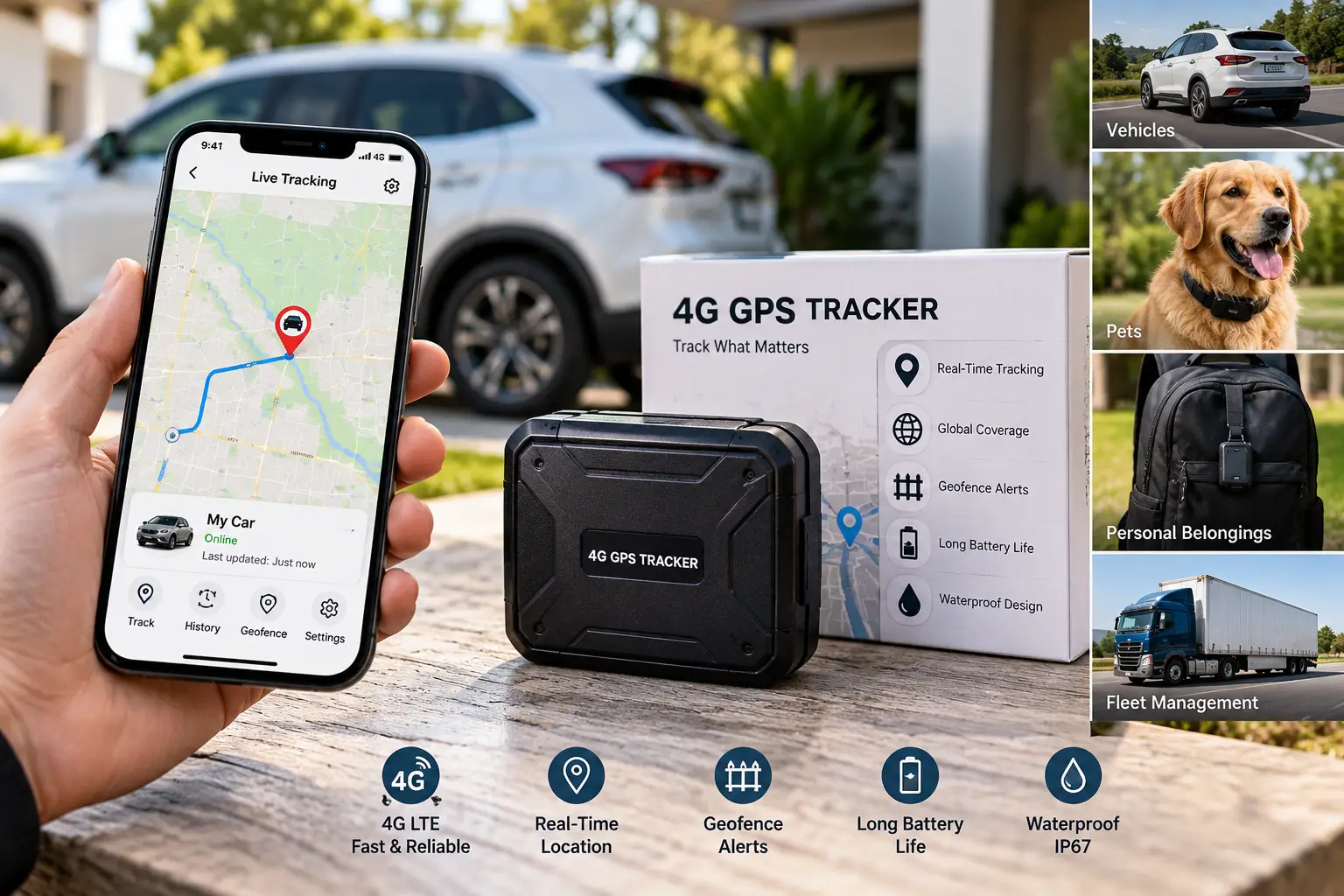
Losing track of a car, a teenager, or an aging parent for even twenty minutes can feel like the longest twenty minutes of your life. That’s the gap a 4g gps tracker is built to close. Unlike the Bluetooth “item finders” that only work within a hundred feet of your phone, a 4g gps tracker uses cellular data to report a location from anywhere there’s coverage — across town, across the state, or across the country. That distinction matters more than most shoppers realize until they’ve actually needed it.
This guide focuses specifically on trackers that run on 4G LTE networks, since the carriers that once supported 2G and 3G devices have already shut those networks down nationwide, according to the Federal Communications Commission. Any tracker still relying on those older networks is effectively dead hardware. Below, you’ll find seven real, currently available 4G GPS tracker options — covering budget picks, no-monthly-fee OBD trackers, and long-battery magnetic pucks — along with honest analysis of what each one does well, where it falls short, and who it actually fits. We’ll also walk through how to choose a 4G GPS tracker for your specific situation, what these devices cost to own over a year, and what US law actually says about where you can and can’t place one.
Disclosure: This post contains affiliate links. As an Amazon Associate, we may earn a commission from qualifying purchases, at no additional cost to you.
Quick Comparison: Best 4G GPS Tracker by Category
If you’re short on time, here’s the fast answer. The table below sums up which of our seven picks wins in each common use case, and the full reviews follow right after.
| Category | Top Pick | Why It Wins |
|---|---|---|
| Best Overall | LandAirSea 54 | Updates as fast as every 3 seconds; USA-designed hardware |
| Best No Monthly Fee | Vyncs Premium | OBD-powered, no recurring bill for the first year |
| Best Long Battery | Tracki Pro | 10,000mAh cell rated up to 12 months in saver mode |
| Best for Teen Drivers | Bouncie | Driving-behavior scoring plus automatic accident alerts |
| Most Budget-Friendly | Optimus 2.0 | Sub-$30 device with over a month of battery life |
Looking at this table, it’s clear there’s no single “best” 4g gps tracker — the right pick depends entirely on whether you’re watching a parked asset, a daily driver, or a person. The LandAirSea 54 earns the overall nod because its update speed and magnetic mounting cover the widest range of situations without major compromises, but if a monthly bill is your dealbreaker, the Vyncs Premium flips that math entirely by folding the data cost into the device price.
💬 Comparing these picks side by side already? Tap any highlighted product below to check its current price and availability.
The 7 Best 4G GPS Trackers of 2026
We evaluated each of these seven picks on real spec sheets, verified pricing structures, and aggregated customer review sentiment pulled from retailer listings and independent tech review sites. Every device here runs on genuine 4G LTE cellular connectivity rather than the discontinued 2G/3G networks still lingering in some budget listings.
1. Tracki 4G Mini GPS Tracker — smallest everyday carry option
The Tracki 4G Mini GPS Tracker is built around a single idea: disappear into a bag, a glovebox, or a jacket pocket without anyone noticing. At roughly 1.8 x 1.6 x 0.7 inches and about 1.26 ounces, it’s genuinely one of the smallest cellular trackers on the market, and it ships with a magnet, a waterproof silicone cover, a belt clip, a key ring, and a lanyard, so you’re not stuck buying accessories separately.
On the spec sheet, the Tracki 4G Mini runs on 4G LTE with automatic 3G/2G fallback and works across 190-plus countries, which matters if you or a family member travels internationally. The rechargeable battery lasts roughly 2 to 5 days with real-time updates every 1 to 5 minutes, or up to 60 days in battery-saver mode reporting every few hours — a tradeoff worth understanding before you buy, since “long battery life” advertising almost always assumes the saver setting, not live tracking.
Aggregated reviews consistently praise the tracker’s size and the breadth of its included accessories, while a recurring theme in customer feedback is that the standard battery feels short for anyone expecting week-long real-time tracking without recharging. Based on comparing the specs against the rest of this list, the Tracki 4G Mini is best suited to buyers who want a general-purpose, grab-and-go tracker for luggage, a teen’s backpack, or a secondary vehicle — not a long-term “install it and forget it” solution.
Pros:
- ✅ Extremely compact and easy to conceal
- ✅ Comes with a full accessory bundle included
- ✅ Works internationally across 190+ countries
Cons:
- ❌ Real-time battery life is short at 2-5 days
- ❌ Requires an active monthly subscription to function
The device itself runs under $30, with subscription plans starting as low as $9.95 a month on longer prepaid terms, or around $19.95 month-to-month — check the current price before ordering, since GPS subscription pricing shifts periodically. For casual, portable tracking needs, it’s a reasonably priced entry point into the 4g gps tracker category.
2. Tracki Pro GPS Tracker — longest battery life for stationary assets
Where the standard Tracki trades battery size for portability, the Tracki Pro GPS Tracker goes the opposite direction. It’s built around a 10,000mAh battery that the manufacturer rates for up to 12 months of runtime in power-save mode, housed in a rugged, IP67-waterproof shell designed for outdoor and industrial conditions rather than a jacket pocket.
That battery capacity is the headline feature, and what most buyers overlook is how heavily that 12-month figure depends on reporting frequency. At standard real-time intervals, expect weeks rather than months of runtime — the year-long claim only holds at slow, infrequent update settings, which is fine for a trailer or a piece of equipment that mostly sits still, but less useful if you want minute-by-minute location on a daily driver. The Tracki Pro also includes 4G connectivity with 3G/2G fallback, Wi-Fi positioning as a backup, and a built-in accelerometer for motion-triggered alerts.
Reviews of the Tracki Pro tend to favor its magnetic case and long-haul battery for parked vehicles, boats, or construction equipment that isn’t moved daily. A common thread in aggregated feedback is that GPS accuracy under open sky performs like a typical consumer receiver, with weaker fixes indoors or under heavy cover — a limitation shared by nearly every tracker on this list, not a flaw unique to this one.
Pros:
- ✅ Battery rated for up to 12 months on saver mode
- ✅ Rugged IP67 waterproof build for harsh conditions
- ✅ Wi-Fi and accelerometer add backup positioning data
Cons:
- ❌ Real-world battery life drops fast at frequent updates
- ❌ Bulkier and heavier than the standard Tracki Mini
Pricing for the Tracki Pro typically lands in the $35 to $40 range for the device, plus a required data plan starting around $9.95 a month on annual terms. For anyone monitoring a boat, trailer, or seasonal vehicle that sits for long stretches, the value proposition of the Tracki Pro is hard to beat on pure battery math.
3. Spytec Atlas GL300 GPS Tracker — best for real-time accuracy
The Spytec Atlas GL300 GPS Tracker, sold under the long-running Spytec GPS brand, has been refined across several hardware generations, and the current version leans hard into update speed and positioning precision. It reports location as often as every 60 seconds on standard plans and offers faster paid tiers, backed by GPS-plus-GLONASS hybrid positioning that Spytec advertises at under 2.5 meters of accuracy in ideal conditions.
What the spec sheet doesn’t say, but reviews reveal, is that the recent migration to Spytec’s new Hapn app platform has been a mixed transition for some longtime users still learning the new interface. On the hardware side, the Spytec Atlas GL300 ships in a magnetic, weatherproof case, runs on worldwide 4G LTE, and delivers roughly 14 days of battery life at 60-second update intervals — genuinely competitive for a device this size.
Aggregated Amazon and retailer reviews for the GL300 line land around 4.3 out of 5 stars, with the most common praise centered on tracking accuracy and the most common criticism aimed at customer support responsiveness and the ongoing subscription cost. For buyers who specifically prioritize how often the dot on the map updates, the Spytec Atlas GL300 earns its “best for real-time accuracy” distinction on this list.
Pros:
- ✅ Frequent 60-second updates on standard plans
- ✅ Roughly 14 days of battery life per charge
- ✅ Included weatherproof magnetic mounting case
Cons:
- ❌ Subscription starts around $24.95 a month
- ❌ Customer support experiences vary in reviews
Device pricing for the Spytec Atlas GL300 generally falls in the $50 to $150 range depending on bundle, at the time of writing, with monthly plans starting near $24.95. If real-time precision matters more to you than saving a few dollars a month, the Spytec Atlas GL300 is worth the premium.
4. Vyncs Premium OBD GPS Tracker — best for no monthly fee
The Vyncs Premium OBD GPS Tracker takes an entirely different approach than the rest of this list: instead of an internal battery, it plugs directly into your vehicle’s OBD-II port and draws power straight from the car, which means there’s no recharging cycle to manage, ever. That single design choice is also what enables its standout feature — no required monthly subscription, since the device ships with a full year of data included in the purchase price.
Beyond location, the Vyncs Premium pulls real vehicle diagnostic data through the OBD port: fuel economy, battery voltage, engine fault codes, and maintenance reminders, alongside standard geofencing and speed alerts. For parents of new drivers, it also includes trip scoring and teen-driver safety monitoring. Based on comparing the specs against pure GPS-only trackers, the Vyncs Premium delivers meaningfully more data per dollar for anyone who owns the vehicle being tracked.
Reviews consistently report that the no-monthly-fee model is the single biggest draw, with several long-term users noting they’ve kept the device running for years past the first year specifically to avoid subscription costs. A recurring complaint in customer feedback involves occasional GPS location lag of a few minutes and, in isolated cases, unresponsive customer service on hardware disputes — worth knowing going in.
Pros:
- ✅ No monthly fee for the first year of use
- ✅ Never needs charging — powered by the vehicle
- ✅ Includes fuel, diagnostic, and maintenance data
Cons:
- ❌ Only works with OBD-II-compatible vehicles (1996+)
- ❌ Renewal after year one runs roughly $85 annually
Expect to pay in the $80 to $100 range for the Vyncs Premium device itself, at the time of writing. Given that the price essentially bundles a year of “subscription,” the total first-year cost genuinely undercuts several battery-powered competitors on this list.
5. LandAirSea 54 GPS Tracker — best overall for near real-time tracking
Made in the USA by a company with more than two decades in GPS hardware, the LandAirSea 54 GPS Tracker is a compact magnetic puck — about 2.275 x 0.945 inches — designed to snap onto the underside of a vehicle, trailer, or piece of equipment in seconds. On its top-tier plan, it can report location as frequently as every 3 seconds, which is meaningfully faster than most trackers in this roundup.
The 1500mAh battery lasts roughly two weeks under average use, and the device’s motion-activated sleep mode helps stretch that further by powering down when the tracked object sits still. What most buyers overlook with the LandAirSea 54 is that the eye-catching 3-second update rate is tied to the premium subscription tier — the base plan reports less frequently, so matching your plan to your actual needs avoids paying for speed you won’t use. LandAirSea backs the hardware with an unconditional lifetime warranty against manufacturing defects, which is a longer guarantee than most competitors offer.
Aggregated reviews across retailers consistently rate the LandAirSea 54 highly for accuracy — commonly cited within about 6 feet of actual position — and for the strength of its built-in magnet, which reviewers describe as secure even at highway speeds. The most common criticism is that fast update intervals shorten battery life noticeably, which is simply the physics of frequent cellular check-ins rather than a defect.
Pros:
- ✅ Update rate as fast as 3 seconds on top plans
- ✅ USA-designed with an unconditional lifetime warranty
- ✅ Strong magnet mount and IP67 waterproof housing
Cons:
- ❌ Fastest updates require the priciest subscription tier
- ❌ Battery life drops sharply at frequent reporting
The LandAirSea 54 device typically runs in the $25 to $35 range, with subscription plans starting around $9.95 a month on prepaid multi-year terms and rising toward $25 a month for the fastest real-time tier. As the most well-rounded pick on this list, the LandAirSea 54 is our overall recommendation for most shoppers.
6. Bouncie GPS Tracker — best for teen drivers and driving behavior
The Bouncie GPS Tracker is another OBD2 plug-in device, but it’s built less around simple location tracking and more around understanding how a vehicle is being driven. Beyond real-time location, it scores hard braking, rapid acceleration, and speeding events, and it automatically detects and sends alerts after a collision — a genuinely useful safety feature that few competitors bundle in at this price.
Since it draws power from the OBD2 port like the Vyncs Premium, there’s no internal battery to maintain, and installation typically takes under 15 minutes from unboxing to live data. Here’s what to weigh: Bouncie requires a flat monthly subscription of roughly $9.65, but that fee is genuinely all-inclusive — unlimited data, unlimited trip history, and no activation or cancellation fees, plus included roadside assistance that most competing trackers charge extra for.
Reviews consistently highlight how quickly parents of new drivers get actionable insight — not just where the car is, but how it’s being driven — and the accident-detection alerts have reportedly helped several reviewers respond faster after real incidents. A common limitation in aggregated feedback is that OBD-only design means a determined person can simply unplug the device, unlike a hidden magnetic tracker.
Pros:
- ✅ Flat, all-inclusive monthly fee with no hidden costs
- ✅ Automatic accident detection sends real-time alerts
- ✅ Includes roadside assistance most trackers charge extra for
Cons:
- ❌ Device can be unplugged by anyone with port access
- ❌ Only works in vehicles with a standard OBD-II port
The Bouncie device generally sells in the $80 to $90 range, with the subscription running around $9 to $10 a month. For families specifically focused on new-driver safety and driving behavior rather than covert asset recovery, the Bouncie is purpose-built for the job.
7. Optimus 2.0 GPS Tracker — most budget-friendly long-battery option
Closing out the list, the Optimus 2.0 GPS Tracker targets buyers who want solid battery life without paying premium prices for it. Housed in a heavy-duty, twin-magnet waterproof case, it’s rated for over a month of battery life at the default 1-minute reporting interval, thanks to a motion sensor that puts the unit into standby when nothing’s moving.
At roughly 3 x 1.5 x 1.75 inches, the Optimus 2.0 isn’t the smallest tracker here, but it’s compact enough to stash under a bumper or inside a wheel well. It’s FCC and PTCRB certified, includes real-time reporting as frequent as every 10 seconds on request, and covers movement, speed, geofence, low-battery, and SOS-button alerts through its smartphone app. Reviews consistently describe setup as straightforward, and aggregated feedback on the manufacturer’s site points to the battery life claims holding up reasonably well in typical use — a meaningful advantage over trackers requiring weekly charging.
What most buyers overlook is that Optimus offers meaningful subscription discounts for committing longer term: 5% off quarterly, 10% off bi-annual, and 20% off annual plans, which can noticeably soften the ongoing cost compared to paying month to month.
Pros:
- ✅ Over a month of battery life on default settings
- ✅ FCC and PTCRB certified hardware
- ✅ Discounts available for longer subscription commitments
Cons:
- ❌ Base monthly fee runs higher than some OBD alternatives
- ❌ Bulkier housing than the smallest Tracki Mini option
The Optimus 2.0 device typically costs under $30, with subscription plans around $19.95 a month before term discounts. As the most budget-conscious pick on this list without sacrificing battery life, the Optimus 2.0 is a smart starting point for first-time tracker buyers.
Quick Reference: All 7 4G GPS Trackers Compared
| Tracker | Battery Life | Power Source | Monthly Cost (approx.) | Best For |
|---|---|---|---|---|
| Tracki 4G Mini | 2-5 days real-time | Internal rechargeable | $9.95-$19.95 | Portable, everyday carry |
| Tracki Pro | Up to 12 months (saver) | Internal 10,000mAh | $9.95-$19.95 | Stationary assets |
| Spytec Atlas GL300 | ~14 days | Internal rechargeable | $24.95+ | Real-time accuracy |
| Vyncs Premium | N/A (vehicle-powered) | OBD-II port | $0 first year | No monthly fee |
| LandAirSea 54 | ~2 weeks | Internal 1500mAh | $9.95-$25 | Overall use |
| Bouncie | N/A (vehicle-powered) | OBD-II port | ~$9.65 | Teen drivers |
| Optimus 2.0 | 1+ month | Internal rechargeable | ~$19.95 | Budget long-battery |
Scanning across this table, the split between OBD-powered trackers (Vyncs Premium, Bouncie) and battery-powered magnetic trackers (everything else) is really the first decision point for most buyers. If you own the vehicle and want zero charging maintenance, the OBD route wins outright; if you need to track something without a diagnostic port — a trailer, a bag, a person — a battery-powered option like the LandAirSea 54 or Tracki 4G Mini is the only path forward.
💬 One click helps other shoppers make an informed choice too! 😊
How to Set Up and Get the Most From Your 4G GPS Tracker
Buying the right hardware is only half the job — how you set it up determines whether you actually get reliable data six months from now. Most first-time buyers make the same handful of mistakes in the first 30 days, so here’s how to avoid them.
Start by fully charging the device before activating the SIM or subscription, since many trackers ship at a partial charge that can trigger false low-battery alerts on day one. Once charged, mount it somewhere with a clear line to the sky where possible — under a rear bumper, inside a wheel well, or in a glovebox works better than a fully enclosed metal toolbox, since GPS signals struggle to penetrate solid metal enclosures. If you’re using a magnetic tracker like the LandAirSea 54 or Optimus 2.0, test the magnet’s grip on the actual mounting surface at low speed before trusting it on the highway; some undercarriage surfaces have more road grime or texture than expected, which can weaken magnetic contact over time.
Set your update interval intentionally rather than defaulting to the fastest option. Real-time, 10-second reporting drains a battery dramatically faster than 5-minute intervals, so match the setting to your actual need — a stationary trailer doesn’t need the same reporting frequency as a teen driver’s daily commute. Finally, set up geofence and speed alerts during initial setup rather than after something goes wrong; most apps let you draw a boundary around home, school, or work in under a minute, and that single step is often what turns a tracker from a passive log into an actual early-warning system.
For ongoing maintenance, recharge battery-powered units on a predictable schedule — many owners tie it to a monthly bill-pay routine — rather than waiting for a low-battery notification, since a dead tracker in an emergency defeats the entire purpose of owning one.
Real-World Scenarios: Which 4G GPS Tracker Fits Your Situation
Reading spec sheets only gets you so far — seeing how these trackers map onto real situations tends to make the decision clearer.
Consider a family with a new sixteen-year-old driver. Budget matters, but so does understanding driving habits, not just location. In that situation, the Bouncie is the more natural fit than a pure location tracker, since its hard-braking and speeding alerts give parents insight into behavior behind the wheel, and the automatic accident detection provides real peace of mind during those first solo highway drives. Vehicle theft remains a genuine concern for any car owner — even with US thefts falling to a historic low of roughly 660,000 reported vehicles in 2025, according to the National Insurance Crime Bureau, that’s still hundreds of thousands of families dealing with a stolen car every year, and a hidden magnetic tracker like the LandAirSea 54 gives law enforcement a real shot at rapid recovery.
Now picture someone managing a small landscaping business with three trucks and a trailer that isn’t driven daily. Here, the Tracki Pro‘s extended battery life is the deciding factor — a device that needs recharging every two weeks isn’t practical for equipment that sits in a lot most of the week, while a 10,000mAh battery rated for months of standby actually matches the use pattern.
Finally, think about an adult child monitoring an aging parent’s driving without wanting an ongoing subscription bill added to a fixed income. The Vyncs Premium‘s no-monthly-fee-for-a-year model, combined with its ability to flag hard braking or unusual routes, solves both the cost concern and the safety concern in a single purchase — without asking a parent to plug in or charge anything themselves.
What Is a 4G GPS Tracker?
A 4G GPS tracker is a small device that uses satellite GPS signals to determine its location, then transmits that location over a 4G LTE cellular network to an app or web dashboard, letting you view real-time or historical movement from virtually anywhere with cell coverage. Unlike Bluetooth trackers, it doesn’t depend on proximity to your phone.
The “4G” part matters more than marketing copy usually explains. Every major US carrier has already phased out its 2G and 3G networks — AT&T finished in February 2022, T-Mobile in July 2022, and Verizon by the end of that year, per the FCC’s own consumer guidance. Any tracker still marketed as “3G” or without a clear 4G LTE spec is effectively obsolete hardware that will stop functioning entirely, regardless of how cheap it looks in search results.
How to Choose a 4G GPS Tracker
Picking the right device comes down to matching a handful of specs to your actual use case, not chasing the longest feature list. Here’s the reasoning we’d walk a friend through.
- Decide what you’re tracking first. A vehicle you own supports an OBD-II tracker like Vyncs Premium or Bouncie; a trailer, bag, or person needs a self-contained battery unit like the LandAirSea 54 or Tracki 4G Mini.
- Match update frequency to your real need. Real-time, second-by-second tracking burns battery fast — reserve it for active monitoring situations, and use slower intervals for parked assets.
- Factor in total subscription cost, not just device price. A cheap $15 device with a $25/month plan costs far more over a year than a $40 device with a $10/month plan.
- Check the battery-life claim’s fine print. “Up to 12 months” almost always means the slowest reporting setting — read the real-time figure separately.
- Confirm coverage in your actual area. Cellular trackers depend on carrier signal strength, so a device that thrives in a city may struggle in a rural gap.
- Look at concealment needs. OBD trackers are visible near the dashboard; magnetic pucks can be hidden underneath a vehicle for covert monitoring.
- Weigh warranty and support reputation. Aggregated reviews across every brand in this guide mention customer service inconsistency at some point — a longer warranty, like LandAirSea’s lifetime coverage, reduces your exposure to that risk.
4G GPS Tracker vs. Bluetooth Trackers
It’s tempting to lump a $30 Bluetooth item finder in with a genuine 4g gps tracker, but the two solve fundamentally different problems, and understanding the gap prevents a frustrating purchase.
| Feature | 4G GPS Tracker | Bluetooth Tracker |
|---|---|---|
| Range | Unlimited (cellular coverage) | ~100-400 feet, or reliant on crowd network |
| Subscription | Usually required | Rarely required |
| Real-time location | Yes, continuous | Only if nearby devices detect it |
| Battery life | Days to months | Months to a year |
| Best for | Vehicles, assets, people | Keys, wallets, luggage nearby |
A Bluetooth tracker like an AirTag relies on other nearby phones running the same network to relay a location — genuinely clever for a lost bag in a busy airport, but functionally useless if a car is driven to a remote area with no passing devices to relay a signal. A 4g gps tracker sidesteps that limitation entirely by talking directly to cell towers, which is exactly why every product in this guide uses cellular rather than Bluetooth connectivity. The tradeoff is cost: cellular data isn’t free, so nearly every GPS tracker here carries some kind of subscription, while Bluetooth trackers typically don’t.
Common Mistakes to Avoid When Buying a 4G GPS Tracker
Even careful shoppers tend to trip over the same handful of issues, so it’s worth calling them out directly.
The most common mistake is buying based on device price alone and ignoring the subscription cost, which over a year or two almost always dwarfs what you paid for the hardware itself. A close second is assuming “waterproof” and “IP67-rated” mean the same level of protection as the fine print suggests — IP67 handles rain and brief submersion, not sustained underwater use, so don’t mount a non-marine-rated tracker permanently below a waterline. Buyers also frequently overestimate battery life by taking the manufacturer’s best-case “up to X months” figure at face value instead of checking the real-time-tracking number separately, which is often a fraction of the headline claim.
Another frequent misstep involves legal boundaries — placing a tracker on a vehicle you don’t own or fully control, without consent, crosses into territory that several states treat as a criminal offense (more on that in the next section). Finally, some buyers skip reading the app’s actual interface reviews before committing to a multi-year subscription plan, only to discover the mapping software feels dated or the alerts are unreliable — a mistake that’s easy to avoid with five minutes of research before checkout.
Features That Actually Matter (and Ones That Don’t)
Marketing copy for GPS trackers tends to pile on buzzwords, so it’s worth separating what genuinely affects your day-to-day experience from what’s mostly noise.
Update frequency, true battery life under real-time use, and cellular coverage in your specific area are the three specs that actually determine whether a tracker works for you — everything else is secondary. Waterproofing rated IP67 or higher is worth paying for if the device will live outdoors or under a vehicle; a marginal IP54 rating is not, if that’s the only difference between two otherwise similar units. On the other hand, headline claims like “military-grade encryption” sound impressive but rarely change the practical experience for a family or small-business buyer, since the real vulnerability in most tracker setups is a weak account password, not the encryption standard on the data itself. Similarly, GPS accuracy claims under a few meters matter enormously for pinpointing a stolen vehicle in a parking structure, but are functionally irrelevant for simply confirming a teen driver made it to school on time — know which one you’re actually solving for before paying a premium for precision you won’t use.
✨ Ready to stop guessing where your vehicle or valuables are?
🔍 Compare the seven 4G GPS tracker options above and pick the one that matches how you’ll actually use it. Click a highlighted product to check its current availability and pricing before plans or stock change. The right tracker turns anxious guesswork into a quick glance at your phone.
Long-Term Cost and Maintenance
The sticker price on a GPS tracker is almost never the real cost of ownership, so it’s worth running the numbers before you commit to a full year.
| Cost Component | Battery-Powered Trackers | OBD-Powered Trackers |
|---|---|---|
| Device price | Under $30 to around $150 | Around $80 to $100 |
| Monthly subscription | ~$10-$25/month | $0-$10/month |
| Estimated 1-year total | ~$150-$400 | ~$85-$200 |
| Charging maintenance | Every 1-8 weeks | None (vehicle-powered) |
Looking at the table above, OBD-powered trackers like the Vyncs Premium and Bouncie consistently come out ahead on total cost of ownership specifically because they eliminate the recurring charging cycle and, in Vyncs’s case, the monthly bill entirely for the first year. Battery-powered trackers like the LandAirSea 54 or Spytec Atlas GL300 cost more to run long-term, but they buy flexibility — you’re not limited to tracking something with an OBD port, which matters enormously if you’re monitoring a trailer, a bag, or a person rather than a car you own outright.
Beyond the subscription math, factor in replacement costs. Magnetic trackers exposed to road salt, gravel, and highway speeds do occasionally fall off or get damaged, and most warranties don’t cover loss — only manufacturing defects. Budgeting for an occasional replacement, especially with a budget pick like the Optimus 2.0, is a more realistic way to plan than assuming any single device will last indefinitely.
Safety, Regulations, and Legal Use of GPS Trackers
Before placing any tracker, it’s worth understanding the legal boundaries, because they’re stricter than most first-time buyers expect. Tracking a vehicle you personally own is legal in all 50 states, and that covers the overwhelming majority of use cases in this guide — a parent tracking a family car, a business tracking a company vehicle, or an individual protecting their own asset from theft.
The line moves the moment you place a tracker on a vehicle you don’t own, or that someone else drives without their knowledge. Several states have passed specific statutes criminalizing covert tracking without consent, and even where no dedicated statute exists, the conduct can be charged under general stalking or harassment laws. On the law-enforcement side, the U.S. Supreme Court settled a related question in United States v. Jones (2012), ruling that attaching a GPS device to a vehicle to monitor its movements constitutes a search under the Fourth Amendment, meaning police generally need a warrant first — a useful bit of context on how seriously US courts treat covert vehicle tracking, as summarized by GPS.gov’s official case review.
Practically, this means two things for shoppers: if you’re tracking your own vehicle or a minor child’s device for safety, you’re almost certainly on solid legal ground, but if a driver other than you regularly uses the vehicle — an employee, a co-owner, a spouse — written notice or explicit consent is the safer, and in some states legally required, path forward. It costs nothing to mention the tracker out loud, and it closes off any question about intent later.
Frequently Asked Questions
❓ Does a 4G GPS tracker need a SIM card?
❓ How accurate is a 4G GPS tracker?
❓ Can I use a 4G GPS tracker without a monthly subscription?
❓ Will a 4G GPS tracker work if my phone is off?
❓ Is it legal to put a 4G GPS tracker on my own car?
Conclusion
A reliable 4g gps tracker turns a stressful “where is it right now” moment into a quick glance at an app, and as this guide shows, the right pick really does depend on what you’re tracking. If you want the most balanced all-around performer, the LandAirSea 54 covers the widest range of situations with its fast update rate and lifetime warranty. If a monthly bill is the dealbreaker, the Vyncs Premium solves that outright by drawing power and covering data costs through the vehicle itself. And if you’re specifically watching a new driver’s habits rather than just their location, the Bouncie‘s driving-behavior scoring and accident alerts are hard to match at its price point.
Whichever direction you go, remember that the device is only half the equation — matching your update frequency and mounting choice to your actual situation is what separates a tracker that quietly does its job from one that dies with a flat battery right when you need it most. Take the time to weigh subscription costs against device price before committing to a full year, and you’ll end up with a setup that genuinely earns its place in your glovebox, your car’s OBD port, or your teenager’s backpack.
✨ Found the right 4G GPS tracker for your situation?
🔍 Take a closer look at any of the seven picks above and check current pricing before you decide. A few minutes of comparison now can save real stress the next time you need to know exactly where something — or someone — is.
Recommended for You
- Spot On GPS: 7 Best Satellite Trackers for 2026 (Ranked)
- GPS Tracker Small : 9 Best Picks for 2026 (Pros & Cons)
- Miniature Tracker: 7 Best Picks for 2026 (Pros, Cons & Prices)
Disclaimer: This post contains affiliate links. As an Amazon Associate, I earn from qualifying purchases made through these links, at no additional cost to you.
✨ Found this article helpful? Share it with someone who needs it! 💬🤗