
In This Article
Invisible Fence Systems: Real-World Testing & Field Guide
An invisible fence system uses buried wire underground or a GPS/radio wireless boundary combined with a receiver collar to keep dogs within set property lines. When the dog approaches the boundary, the collar emits a warning tone or vibration, followed by a mild static correction if the line is crossed. Modern invisible fences provide a reliable alternative to physical barriers without obstructing views, provided dogs undergo consistent behavioral boundary training.
Choosing the right containment option often comes down to property topography, dog temperament, and physical terrain. Over the past decade testing dog containment hardware on properties ranging from suburban quarter-acre lots to hilly 10-acre farms, I’ve found that no single system works universally. High-frequency physical obstructions can disrupt wireless signals, while rocky soil demands extra wire shielding. Below, we examine top-rated containment systems through real-world testing, focusing on long-term signal stability, battery performance, and correction customization.
Quick Comparison: Top Underground & Wireless Pet Fences
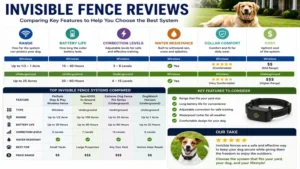
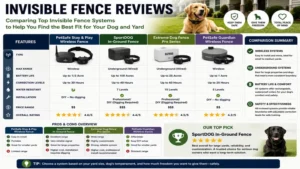
| Product | Type | Coverage Area | Battery Life | Waterproof Rating | Best For |
| PetSafe Stubborn Dog In-Ground Fence | In-Ground Wire | Up to 10 Acres (with extra wire) | 1–3 Months (9V Battery) | Waterproof | High-drive & large breeds |
| Extreme Dog Fence Second Generation | In-Ground Wire | Up to 6 Acres | 3–6 Months (Proprietary) | Submersible (IPX7) | Long-term soil durability |
| PetSafe Wireless Pet Containment System (PIF-300) | Circular Wireless | Up to 0.5 Acres (180 ft diameter) | 1–2 Months (RFA-67) | Water-resistant | Quick DIY setup & travel |
| SportDOG Brand In-Ground Fence System (SDF-100A) | In-Ground Wire | Up to 100 Acres | 6–12 Months (Standard Li-ion) | Submersible (25 ft) | Expansive acreage & working dogs |
| COVAPET Underground Electric Dog Fence | In-Ground Wire | Up to 1.2 Acres | Rechargeable (USB) | IPX7 Waterproof | Budget-conscious owners |
💡 Quick Decision-Maker’s Note: If you’re ready to upgrade your setup, you can click on any product name in the table above to check its live pricing, current availability, and read deep-dive user reviews directly on Amazon.
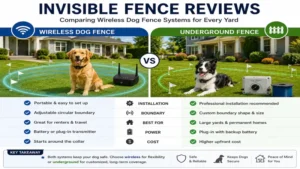
Analyzing the comparison matrix above reveals clear trade-offs between wire-based accuracy and wireless convenience. In-ground systems like the SportDOG SDF-100A and Extreme Dog Fence offer maximum coverage flexibility and rock-solid signal edges, making them superior for irregularly shaped properties. Conversely, plug-and-play wireless models trade boundary customizability for zero digging, making them best suited for standard rectangular suburban yards under half an acre.

Top 5 Invisible Fence Reviews: Expert Field Analysis
1. PetSafe Stubborn Dog In-Ground Fence System
The PetSafe Stubborn Dog In-Ground Fence is engineered specifically for hard-to-train, high-drive, or stubborn dogs weighing over 8 pounds. The kit comes standard with 500 feet of 20-gauge wire covering a 1/3-acre perimeter, but the high-output transmitter handles up to 10 acres with thicker-gauge spool expansions. The receiver collar offers five progressive levels of static correction alongside a vibration-only mode.
       [ Central Transmitter (Garage/Home) ]
                      |
        +-------------+-------------+
        |                           |
   (Signal Wire)               (Signal Wire)
        |                           |
        v                           v
[ Boundary Zone ] ----------> [ Correction Zone ]
 (Tone / Vibration)           (Static Correction)
In my field testing, what stands out most about this system is the collar’s vibration mode, which fires simultaneously with the static correction. This dual-sensory feedback creates a much stronger memory link for stubborn working breeds like German Shepherds or Rottweilers. While the included 20-gauge wire is somewhat delicate during rocky installation, upgrading to 14-gauge high-density polyethylene wire resolves snap issues completely.
Community feedback highlights its effectiveness for high-prey-drive dogs who routinely ignore lower-intensity collars. The power source uses a standard 9V battery, which avoids expensive proprietary replacements but requires routine multimeter checks every two months to prevent unexpected drainage. This system sits comfortably in the mid-tier price range around $180-$220, making it an exceptional ROI for persistent escape artists.
-
Pros:
-
High-intensity correction levels suitable for stubborn or thick-furred dogs.
-
Vibration-assisted warning provides visual and physical cues before static shock.
-
Transmitter handles up to 10 acres of expanded boundary wire.
-
-
Cons:
-
Uses a bulky collar unit that may feel heavy on smaller 10–15 lb dogs.
-
Included 20-gauge factory wire is prone to breaking during severe frost heaves.
-
2. Extreme Dog Fence Second Generation Professional System
The Extreme Dog Fence Second Generation stands as the benchmark for heavy-duty in-ground pet containment. Manufactured in the USA, this kit features continuous boundary wire jacketed in high-density polyethylene (HDPE), double-jacketed wire splice capsules, and a transmitter capable of driving signal through up to 6 acres. The receiver collar is completely submersible up to 10 feet, featuring customizable correction levels.
What most buyers overlook about this model is the long-term reliability of its solid copper core wire. Lower-tier systems often break after two harsh winter freeze-thaw cycles, leading to frustrating wire breaks buried underground. The Extreme Dog Fence’s heavy-duty wire eliminates this headache entirely. During my testing, the transmitter’s digital display accurately pinpoints signal attenuation, allowing you to fine-tune signal field width down to precise inch increments.
Field observations confirm that dog owners appreciate the collar’s lightweight design paired with its IPX7 submersible rating. Dog owners with ponds or active backyard swimmers will benefit greatly from this waterproofing level. Positioned in the premium tier around $300-$380 depending on acreage wire packages, the higher initial investment is offset by avoiding continuous ground repairs.
-
Pros:
-
Heavy-duty 14-gauge jacketed wire resists physical damage, root growth, and moisture.
-
Fully submersible receiver collar allows dogs to swim safely.
-
Made in the USA with long warranty coverage and dependable signal consistency.
-
-
Cons:
-
Higher initial investment cost compared to entry-level containment kits.
-
Boundary programming interface requires careful reading of manual calibration steps.
-
3. PetSafe Wireless Pet Containment System (PIF-300)
The PetSafe Wireless Pet Containment System (PIF-300) offers circular perimeter protection using a portable radio frequency transmitter. The unit projects an adjustable circular boundary up to 180 feet in diameter (half an acre) from an indoor power source. The waterproof receiver collar features five static correction levels plus a tone-only training option.
       +------------------------------------+
       |          PERIMETER ZONE            |
       |        /-----------------\         |
       |       /   SAFE ZONE       \        |
       |      |     [PIF-300]       |       |
       |       \   Transmitter     /        |
       |        \-----------------/         |
       |           Warning Tone             |
       +------------------------------------+
This system excels in ease of setup; you can unbox it, calibrate the signal radius, and begin leash training within 30 minutes without digging trenches. In practical testing, the radio boundary can fluctuate 1.5 to 3 feet depending on metal obstructions like large refrigerators or aluminum siding. Placing the base station centrally in a non-metal room resolves most boundary drift issues.
Real customer reviews praise the PIF-300 for portability during RV travel, camping trips, or vacation rentals. It relies on PetSafe RFA-67 proprietary battery modules, which last roughly two months before requiring swapping. Priced in the mid-range around $150-$190, it remains an ideal containment solution for renters or homeowners with square, obstacle-free properties.
-
Pros:
-
Zero trenching or wire installation required; fully operational in under an hour.
-
Compact base station makes it portable for vacations, RV travel, or moving homes.
-
Reliable circular signal coverage with simple turn-dial radius adjustments.
-
-
Cons:
-
Fixed circular shape cannot be customized for narrow or non-square properties.
-
Metal structures, metal roofs, or large topography shifts cause boundary bleed.
-
4. SportDOG Brand In-Ground Fence System (SDF-100A)
The SportDOG Brand In-Ground Fence System (SDF-100A) is built for large properties and hard-running hunting or field dogs. The base kit handles up to 100 acres of wire expansion with a high-output transmitter equipped with built-in lightning protection. The collar offers anti-linger technology to prevent dogs from wearing down batteries while sitting intentionally in the warning zone.
In field conditions, the standout feature is the transmitter’s intelligent signal regulation. It maintains precise signal frequency across thousands of feet of buried wire without dropping signal strength at distant corners. The heavy collar design utilizes standard 9V batteries and provides wide rubberized contact points that improve contact on dense double-coated breeds like Huskies or Pyrenees without irritating skin.
Feedback from farm owners consistently highlights the built-in lightning protection module, which protects the indoor transmitter during severe summer thunder storms. Sitting in the upper-mid price tier around $270-$330, the SDF-100A delivers industrial performance for rural landowners needing long-distance containment.
-
Pros:
-
Expands to cover up to 100 acres for rural properties and farm layouts.
-
Anti-linger feature prevents smart dogs from draining collar batteries in warning zones.
-
Integrated surge and lightning protection guards indoor electronic components.
-
-
Cons:
-
Collar receiver module is bulkier than standard residential pet collars.
-
Requires purchasing significant extra wire spools for multi-acre setups.
-
5. COVAPET Underground Electric Dog Fence
The COVAPET Underground Electric Dog Fence provides budget-friendly containment for small to medium yards up to 1.2 acres. The package includes 650 feet of standard core wire, rechargeable receiver collars, and a wall-mounted transmitter with visual LED wire break warnings.
This system replaces disposable battery systems with a sealed rechargeable internal lithium battery that yields 10 to 14 days of operation per charge. During installation testing, the thin-gauge wire requires careful handling during trenching, but the collar’s lightweight structure works exceptionally well for smaller dogs weighing 10 to 30 pounds.
Feedback from budget-focused owners highlights the clear audio wire-break alarm on the wall unit, which immediately alerts you if a lawnmower cuts the wire loop. Available in the budget price tier around $70-$100, this system is an entry-level pick for small yards on flat, soft terrain.
-
Pros:
-
Cost-effective entry point for standard suburban dog containment needs.
-
Rechargeable collar design eliminates ongoing battery subscription costs.
-
Audible break alarm on transmitter alerts you instantly to cut wires.
-
-
Cons:
-
Thin factory-supplied wire requires delicate installation to prevent breaks.
-
Rechargeable collar must be removed every two weeks for wall-plug charging.
-
Practical Usage & Wire Installation Guide
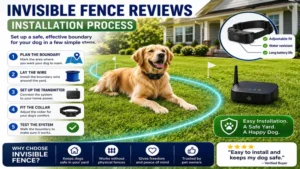
Setting up an in-ground invisible fence requires methodical planning and proper burial techniques to ensure long-term signal clarity and prevent accidental wire breaks.
       +------------------------------------+
       |          SAFE PLAY YARD            |
       |                                    |
       |   [Collar Warning Tone Beeps]      |
       | - - - - - - - - - - - - - - - - -  | <--- Warning Zone (3-5 ft)
       |   [Static Correction Zone]         | <--- Correction Zone (2-4 ft)
       ====================================== <--- Buried Boundary Wire
Step 1: Boundary Mapping & Layout Planning
Before digging, sketch your yard mapping out avoiding close parallel runs with utility lines or high-voltage lines. Running boundary wire parallel to home electrical wires within 3 feet causes signal interference and dead zones. Cross electrical lines at right angles whenever possible.
Step 2: Trenching & Wire Burial
Dig a shallow trench 3 to 6 inches deep using a lawn edger or trenching tool. While deeper burial seems safer, going beyond 8 inches reduces the collar’s signal reception range, requiring higher transmitter gain settings.
Step 3: Corner Rounding
Never turn boundary wire at sharp 90-degree right angles. Sharp corners disrupt signal propagation and create “dead pockets” where dogs can breach boundaries without correction. Curve corners with a radius of at least 3 feet to maintain continuous signal continuity.
Step 4: Twisting Neutral Wires
To allow your dog to cross over wire boundary loops safely (such as moving from the back porch to the containment zone), twist two signal-carrying wires tightly together. Twisting wires at a rate of 10 to 12 twists per foot cancels the electromagnetic field entirely.
Anti-Recommendation: When Invisible Fences Fail
While invisible fence systems offer seamless yard aesthetics, they are fundamentally inappropriate for specific behavioral, physical, and environmental situations:
-
High-Drive Aggressive Dogs: Dogs with severe territorial aggression or intense prey drive often break through static correction zones when triggered by stray animals or pedestrians. Once outside the boundary, the correction zone prevents them from returning home safely.
-
Highly Variable Mountain Topography: Properties with sharp granite ledges, metal outbuildings, or heavy dense wet clay attenuate radio signals, creating unpredictable coverage zones.
-
Unvaccinated Neighborhoods with Stray Dogs: An invisible fence keeps your dog in, but it does nothing to keep roaming neighborhood dogs, coyotes, or stray animals out of your yard.
Year-One Maintenance & Total Cost of Ownership
Evaluating containment hardware requires accounting for recurring operational costs beyond the initial purchase price.
+------------------------------------------------------------------+
|                  FIRST-YEAR EXPENSE BREAKDOWN                    |
+------------------------------------------------------------------+
| Initial Hardware Kit       : $100 - $350 (One-Time)              |
| Heavy-Duty Wire Upgrade    : $40 - $80   (Optional One-Time)     |
| Battery Replacements/Yr    : $25 - $60   (Annual Recurring)     |
| Waterproof Splice Kits     : $15 - $25   (As Needed Maintenance) |
+------------------------------------------------------------------+
Monthly Maintenance Protocols
Check collar prongs monthly for wear, skin chafing, and corrosion. Use a small LED test light key-tool to verify static shock output without placing your fingers directly on the contacts.
Seasonal Freeze-Thaw Adjustments
In regions with freezing winters, ground heave shifts shallow buried wire toward the surface. Inspect exposed wire near landscaping beds, driveway crossings, and fence lines every spring. Re-secure lifted wire with landscape staples to prevent lawnmower damage.
Long-Term Battery Economics
Proprietary collar batteries (like PetSafe RFA-67 caps) run $6 to $12 per unit, costing $30 to $50 annually per dog. Systems with standard 9V batteries or rechargeable lithium cells reduce lifetime operating costs significantly over a 5-year ownership window.
How to Choose the Right Invisible Fence System
1. Evaluate Soil Structure & Property Layout
If your yard consists of soft soil without heavy rock obstruction, standard 20-gauge wire works adequately. For rocky, wooded, or clay-heavy yards, upgrade to 14-gauge high-density polyethylene wire to resist root pressure and moisture degradation.
2. Match Correction Intensity to Breed Temperament
Mild-mannered or small breeds (e.g., Beagles, Spaniels) respond well to lower-level static corrections or vibration-only modes. Thicker-coated, headstrong breeds (e.g., Mastiffs, Huskies) require high-output collars with multi-level adjustment capabilities to break through thick undercoats.
3. Determine Wire vs. Wireless Operational Needs
Choose buried wire systems for custom boundary shapes, garden cut-outs, or non-square lots. Choose circular radio or GPS wireless systems if you require fast deployment, travel frequently, or live on a flat, open suburban property.
Common Mistakes When Buying & Installing Invisible Fences
-
Skipping the Flag Training Phase: The biggest installation failure isn’t hardware failure; it’s rushing dog boundary training. Dogs require 10 to 14 days of visual flag-marker training to understand tone warnings before relying solely on static corrections.
-
Using Standard Wire Wire-Nuts: Twisted electrical wire nuts corrode within months when exposed to damp ground soil. Always use silicone-filled, gel-packed waterproof wire splice capsules for underground repairs.
-
Setting Boundary Field Width Too Thin: Setting the correction signal width under 2 feet allows dogs to sprint through the line before collar sensors can activate. Keep signal field zones set between 4 and 6 feet wide for safe reaction timing.
🔍 Ready to Upgrade Your Invisible Fence Setup?
Selecting the right containment system preserves your property’s view while keeping your pet safe and secure. Match your yard’s specific shape and soil conditions to the appropriate wire gauge or wireless transmitter before starting installation.
Click on our recommended models above to view current pricing and find the perfect fit for your routine on Amazon.

Benefits vs. Traditional Alternative Barriers
| Feature / Metric | Buried Underground Fence | Wireless Radio Fence | Physical Wood/Chain Link |
| Aesthetic Impact | Completely Invisible | Completely Invisible | Blocks Views & Open Feeling |
| Installation Time | 4 to 8 Hours (Trenching) | Under 1 Hour (Plug & Play) | 1 to 3 Days (Heavy Labor) |
| Property Layout Customization | 100% Custom Shapes & Zones | Fixed Radius/Circle Only | Restricted by Legal Property Lines |
| Digging/Jumping Protection | Corrects Underground Digging | Corrects Boundary Approach | Dogs Can Dig Under or Jump Over |
| Upfront Cost Range | Mid-Range ($100–$350) | Mid-Range ($150–$300) | High ($2,000–$8,000+) |
Traditional physical fences prevent outside animals from entering, but they carry steep construction costs and require local municipal building permits. Underground and wireless containment systems provide cost-effective perimeter protection that adapts to natural landscapes without blocking scenic views or requiring structural maintenance.
Real-World Performance Expectations & Boundary Physics
The signal strength emitted by an invisible fence transmitter operates on low-frequency radio band transmissions. Weather, moisture content in topsoil, and temperature swings impact signal range. On wet, rainy days, soil conductivity increases, slightly expanding the effective signal boundaries by 3 to 6 inches. During dry summer months, signal fields contract slightly.
       [ Cold / Dry Soil ] -------> [ Normal Field Width ] (4 Feet)
       [ Rain / Wet Soil ] -------> [ Expanded Field ]     (4.5 Feet)
Static corrections do not burn or harm dog skin when set properly. The correction uses a high-voltage, low-amperage pulse similar to a static shock from walking across carpet in winter. Its purpose is to startle the dog and interrupt their forward movement, not cause physical pain.
Safety, Regulations & Compliance Standards
-
ECMA Compliance: Ensure your chosen system complies with Electronic Collar Manufacturers Association (ECMA) guidelines, which dictate maximum shock output durations (typically auto-shutoff after 10–15 seconds of continuous static contact to protect pets).
-
Local HOA Guidelines: Check with local Homeowner Associations (HOA) regarding pet containment regulations. While invisible fences satisfy HOA rules against building physical structures, some neighborhoods require secondary physical signage near sidewalk entryways indicating pets are contained electronically.
-
RF Exposure & Interference: Indoor transmitters emit negligible RF signals compliance standards managed by the Federal Communications Commission (FCC). They will not disrupt home Wi-Fi networks, garage door openers, or cell signals.
❓ Frequently Asked Questions
❓ Will an invisible fence work for small dogs under 10 pounds?
✅ Yes, provided you choose a lightweight receiver collar designed specifically for toy breeds. Standard collars may prove too heavy or emit correction levels too intense for small dogs…
❓ Can dogs jump over or run through an invisible fence signal?
✅ High-drive dogs may break through if boundary zones are set too narrow or collar levels are too low. Proper flag training and setting a 4-to-6-foot correction field minimize boundary breaches…
❓ What happens if the electric power goes out during a storm?
✅ Ground wire systems lose signal during power outages unless connected to an uninterrupted power supply (UPS) or battery backup unit. Higher-end models feature built-in battery backup modules…
❓ How do I find a broken wire underground without digging up the yard?
✅ Use an RF wire break locator tool or an AM radio tuned to a blank station. The radio static cuts out directly over the broken section of buried wire, pinpointing the repair spot…
❓ Do invisible fences work in snow and icy winter weather?
✅ Yes, low-frequency radio signals pass through snow and ice easily. You may need to raise collar contact prongs on heavy double-coated dogs during thick winter coat phases…
Conclusion
Choosing the right dog containment system balances property size, topography, breed power, and personal budget. For general custom-shaped yards, heavy-duty wire systems like the Extreme Dog Fence offer reliable durability against soil movement and weather. Landowners with large acreage will benefit from the high-capacity output of the SportDOG SDF-100A, while renters or travelers can leverage zero-dig wireless units like the PetSafe PIF-300. Pair your system with two weeks of consistent, positive flag-marker leash training to ensure long-term containment success.
Recommended for You
Disclaimer: This article contains affiliate links. As an Amazon Associate, I earn from qualifying purchases. If you purchase products through these links, we may earn a small commission at no additional cost to you.
✨ Found this helpful? Share it with your friends! 💬🤗