
In This Article
Introduction: Why Choosing a Wireless Fence for 2 Dogs Is a Different Decision
Buying a wireless fence for 2 dogs sounds like buying one fence and doubling the collars. In practice, it’s rarely that simple. Two dogs mean two neck sizes, two temperaments, two batteries to keep charged, and—with some GPS systems—two monthly subscriptions. Get one detail wrong and you’ll find out the hard way, usually when the bolder dog follows a squirrel and the shy one follows the bolder dog.
What Is a Wireless Fence for 2 Dogs?
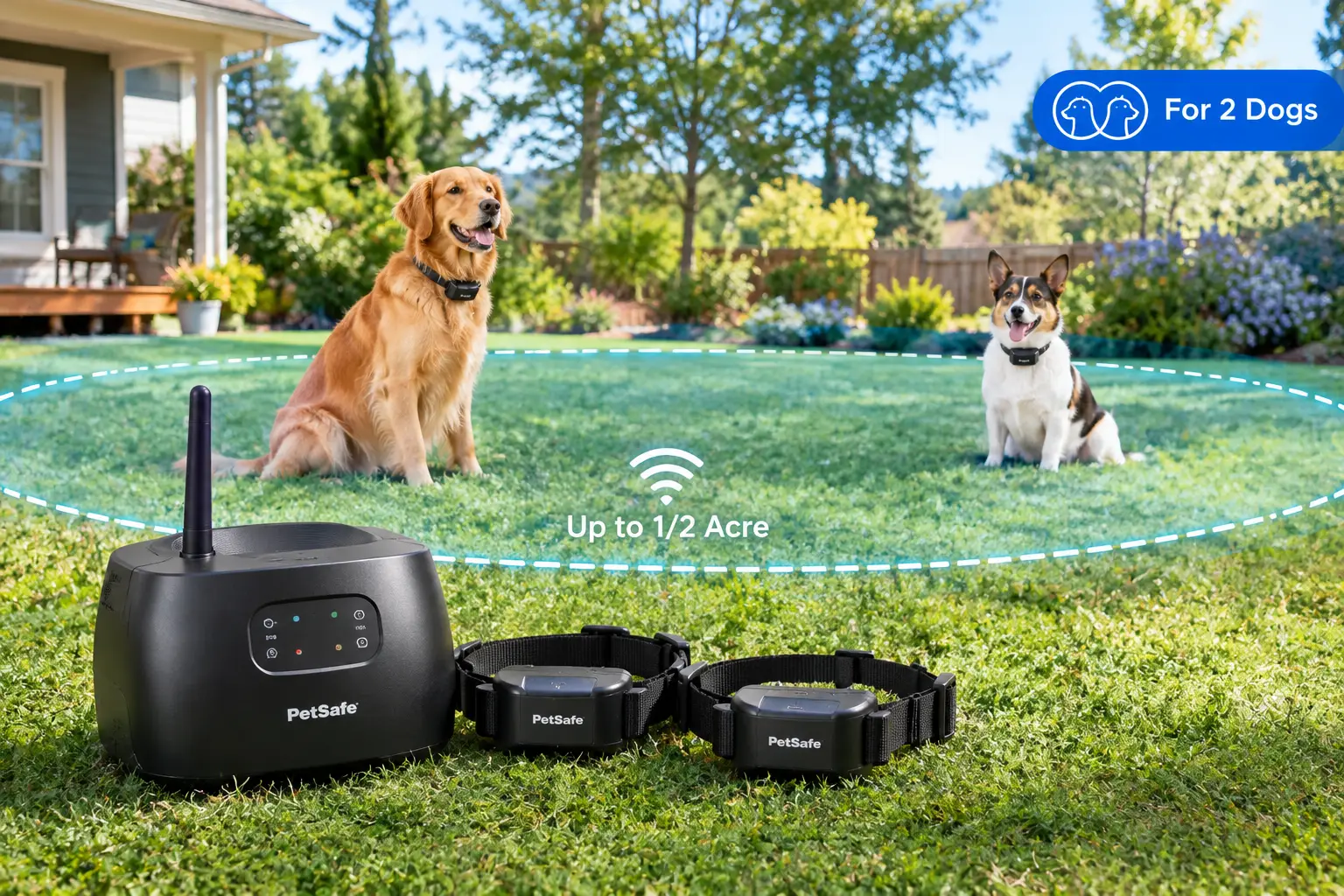
A wireless fence for 2 dogs is a pet containment system that keeps two dogs inside a set boundary without buried wire. Either an indoor transmitter broadcasts a circular radio boundary, or GPS collars enforce a virtual boundary you draw in an app. Each dog wears its own receiver collar that warns, then corrects, near the edge.
That’s the textbook answer. The more useful answer is that these systems are a category of pet fence that trades physical posts for signals—which means the quality of the signal, the fit of each collar, and the training you put in matter far more than the marketing on the box.
In this guide, you’ll find seven real systems available to US shoppers in 2026, ranging from budget two-collar kits to premium GPS collars. Rather than repeating spec sheets, each pick comes with honest analysis grounded in published specs and aggregated customer feedback: what the numbers mean for a two-dog household, who each system suits, and where it tends to fall short. You’ll also get a two-week training plan, real-world scenarios, cost-of-ownership math, and a frank look at the welfare questions every owner should weigh before strapping a correction collar on either dog.
Quick Comparison: Best Wireless Dog Fence for Two Dogs at a Glance
| Product | Technology | Boundary | Subscription | 2nd Collar | Best for |
|---|---|---|---|---|---|
| PetSafe Stay & Play Compact Wireless Fence | Radio (indoor transmitter) | Circle, up to ¾ acre | None | Sold separately | Best for typical suburban yards |
| PetSafe Wireless Pet Containment System (PIF-300) | Radio (indoor transmitter) | Circle, up to ½ acre | None | Sold separately | Best for smaller lots and RV trips |
| PetSafe Guardian GPS Dog Fence | GPS + motion sensing | Custom shape | None | Add-a-dog collar | Best for large, oddly shaped properties |
| Dogtra GPS Fence | Dual-band GPS | Custom or circle | None | Second collar | Best for no-fee GPS on a budget |
| Halo Collar 5 | Dual-frequency GPS | Custom, unlimited fences | Required | Second collar + plan | Best for tech-savvy owners who travel |
| SpotOn GPS Fence Nova Edition | Dual-band GPS | Custom, multiple zones | Optional | Second collar | Best for wooded or rural acreage |
| MIMOFPET Wireless Dog Fence System for 2 Dogs | Radio (portable transmitter) | Circle, adjustable | None | Included | Best for tight budgets |
Looking at the table, the first fork in the road is technology: radio systems like the PetSafe Stay & Play Compact Wireless Fence are cheaper and simpler but lock you into a circle, while GPS systems like the Dogtra GPS Fence or Halo Collar 5 follow your property lines at a much higher two-dog cost. Note that only the MIMOFPET Wireless Dog Fence System for 2 Dogs ships with both collars in the box—every other pick requires a second collar purchase, which changes the real price considerably.
💬 One click helps other shoppers make an informed choice too! 😊
Top 7 Wireless Fence for 2 Dogs Picks: Expert Analysis
1. PetSafe Stay & Play Compact Wireless Fence — the safest all-round starting point
The PetSafe Stay & Play Compact Wireless Fence is the default recommendation for a reason: it’s simple, proven, and scales to two dogs without drama. An indoor transmitter creates an adjustable circular boundary of up to ¾ acre (roughly a 105-foot radius), and PetSafe states there’s no limit to how many pets you can contain as long as each wears its own receiver collar.
In practice, the circle is both the strength and the catch. If your house sits roughly in the middle of a squarish lot, the circle covers most of it nicely; if your home sits near the street, part of that circle may land on pavement. The rechargeable collar is designed for dogs 5 lb and up, with five static levels plus a tone-only mode—handy when one of your two dogs is far more sensitive than the other, because each collar is set independently.
Based on the specs, this suits suburban households with two medium dogs who aren’t escape artists. Reviews consistently praise the quick setup (about an hour or two) and the small collar size; the most common complaint is boundary “wobble” near metal structures like garages or appliances.
Pros:
- ✅ Unlimited extra collars on one transmitter
- ✅ Independent correction levels for each dog
- ✅ Light, rechargeable collar suits smaller dogs
Cons:
- ❌ Circular boundary can’t follow property lines
- ❌ Signal can fluctuate near metal and siding
Expect a price in the $300 range for the kit plus roughly $100–$130 per extra collar—solid value for a no-subscription, no-dig two-dog setup.
2. PetSafe Wireless Pet Containment System (PIF-300) — the proven classic for smaller lots
The PetSafe PIF-300 is the system that made wireless containment mainstream, and it still earns a spot. It covers up to ½ acre with a maximum 90-foot radius, uses tone plus static correction, and offers static-free re-entry so a dog who wanders out isn’t corrected for coming home.
That re-entry detail matters more with two dogs than one: if both bolt after a deer, you want both to come back without hesitation. The collar is waterproof and fits dogs 8 lb and up, but it runs on replaceable batteries rather than a rechargeable cell—a lower upfront cost traded for an ongoing battery habit.
On paper, this is the pick for smaller properties, renters who can’t dig, and families who take the transmitter camping, since it plugs in anywhere. Aggregated customer feedback tends to describe it as dependable once dogs are trained, while recurring complaints mention a bulkier collar than newer models and battery replacements adding up across two dogs.
Pros:
- ✅ Static-free re-entry encourages dogs to return
- ✅ Portable transmitter works at campsites and cabins
- ✅ Compatible add-on collars are widely available
Cons:
- ❌ Smaller ½-acre maximum coverage
- ❌ Disposable batteries add recurring cost for two dogs
Typically found in the $250–$330 range for the kit, it remains a sensible value if your yard fits comfortably inside a 90-foot circle.
3. PetSafe Guardian GPS Dog Fence — custom shapes with no monthly bill
The PetSafe Guardian GPS Dog Fence solves the radio-fence circle problem by letting you draw a custom-shaped boundary in the My PetSafe app. PetSafe’s AccuGuard technology blends GPS satellite data with motion detection to steady the boundary, and the company advertises no subscription fees, ever.
Translated into real life: the boundary can trace a driveway, skip a pond, or hug an L-shaped lot—things no circle can do. The collar offers tone and vibration or 10 static levels and is rated for up to five days per charge, which is a genuine convenience when you’re charging two collars instead of one. Retail listings describe support for multiple dogs through a separate add-a-dog collar.
This is built for bigger properties. Owners note in reviews that it needs a sizeable yard—roughly ¾ acre or more—and a buffer from roads, so it’s a poor fit for compact suburban lots. Reviews generally praise the battery life and no-fee model; a recurring complaint involves the base unit dropping its Wi-Fi connection and occasional GPS drops under heavy tree cover.
Pros:
- ✅ Custom boundary follows real property lines
- ✅ Multi-day battery eases two-collar charging
- ✅ No subscription for core containment
Cons:
- ❌ Not suited to small or tight yards
- ❌ Some reports of base-station connectivity issues
Expect around $350–$400 for the starter kit before the second collar—strong value for large properties if you hate subscriptions.
4. Dogtra GPS Fence — the most affordable no-fee GPS option
The Dogtra GPS Fence brings GPS containment down to a price where a two-dog setup becomes realistic. You draw circular or custom boundaries in the free app, and once the fence is saved the collar works independently of your phone—no subscription required.
Dogtra’s layered approach is the standout: each fence has a main boundary plus two backup boundaries, so a dog who pushes through the first line meets a second correction sequence rather than simply running free. You can store up to 30 fences, and Dogtra says up to three dogs can share the same fence profile in the app, which keeps two-dog setup tidy. The collar carries an IPX9K waterproof rating and is designed for dogs 15 lb and up.
Based on comparing specs, this is ideal for owners with two medium-to-large dogs who want GPS flexibility without Halo-level pricing. Aggregated reviews are broadly positive about the no-fee model and easy adjustments, while battery life—commonly described as roughly a day to a day and a half—is the most frequent gripe, along with weaker performance under dense trees.
Pros:
- ✅ No subscription with layered backup boundaries
- ✅ Up to 30 saved fences for multiple locations
- ✅ Rugged IPX9K waterproof construction
Cons:
- ❌ Battery typically needs charging daily
- ❌ Not designed for dogs under 15 lb
At around $200 per collar, two dogs land near $400—arguably the best GPS value per dog right now.
5. Halo Collar 5 — premium smarts, premium running costs
The Halo Collar 5 is the most feature-rich collar here. It connects to six satellite constellations using dual-frequency L1 and L5 signals, and Halo claims accuracy within about 1.4 feet—an important number, because GPS “drift” is what causes false corrections.
Beyond containment, you get unlimited saved fences, live GPS tracking, activity data, and optional beacons for indoor no-go zones. Halo rates the battery at up to 48 hours, the collar is IP67 waterproof, and it fits dogs 10 lb and up with an adjustable 8–30-inch neck range—wide enough to fit very different dogs in the same household.
The catch for two-dog families is cost structure: a subscription is required for each collar to function. That makes the Halo Collar 5 best for owners who’d use tracking daily—frequent travelers, hikers, or households with an escape-prone dog. Reviews frequently highlight how well the app and training videos work; recurring complaints center on the collar’s bulk for small dogs and the ongoing fee.
Pros:
- ✅ Excellent accuracy claims with dual-frequency GPS
- ✅ Live tracking and unlimited fences included
- ✅ Wide neck range fits mismatched dogs
Cons:
- ❌ Mandatory subscription for each collar
- ❌ Bulky on small or narrow-necked dogs
Hardware runs in the $500–$600 range per collar; the value is strong only if you’ll use the tracking features.
6. SpotOn GPS Fence Nova Edition — built for trees, hills, and acreage
The SpotOn Nova targets the toughest GPS environment: wooded, rolling, rural land. SpotOn says it pairs a dual-band receiver with the largest GPS antenna it has fitted to a collar, plus its True Location technology that uses motion sensors to filter out bad readings.
Why that matters: under tree canopy, cheaper GPS collars can “see” a dog jump several feet in a second, triggering corrections the dog didn’t earn. A larger antenna and smarter filtering are designed to keep the boundary in the same place every day. The Nova also offers an Off-Grid mode for cabins with no cell service, and the core fence requires no subscription—an optional plan adds tracking and escape alerts.
This is the specialist’s pick for big rural properties, where the boundary might run hundreds of feet through woods. It’s manufactured in the US with a 90-day satisfaction guarantee and access to certified trainers. Customer feedback commonly praises boundary consistency; the most cited downsides are price and a battery that needs more frequent charging than Halo’s, according to comparisons.
Pros:
- ✅ Designed specifically for tree cover and terrain
- ✅ Off-Grid mode works without cell service
- ✅ No required subscription for containment
Cons:
- ❌ Highest per-collar price in this guide
- ❌ Plan on frequent charging for two collars
At around $1,000 per collar, it’s a big investment—worth it mainly on acreage where cheaper GPS struggles.
7. MIMOFPET Wireless Dog Fence System for 2 Dogs — two collars in one box for less
The MIMOFPET 2-Dog System is the budget play: a portable transmitter plus two rechargeable, waterproof collars in a single package. The listing advertises an adjustable range of up to 3,500 feet, and the collars double as training receivers.
Here’s the honest framing: budget radio systems from lesser-known brands typically publish optimistic range figures, and independent testing data is thin. Treat the maximum range as a best-case number in open space, and expect real-world boundaries to shift with terrain, walls, and interference. The upside is obvious—everything a two-dog household needs arrives in one box at a fraction of the name-brand cost.
Based on its feature set, this suits owners testing whether wireless containment works for their dogs, or those containing two easygoing dogs on a modest budget. Aggregated review sentiment generally reports easy setup and good value, while recurring complaints mention boundary inconsistency and collars that may not hold up as long as premium brands.
Pros:
- ✅ Both collars included out of the box
- ✅ Very low cost per dog
- ✅ Doubles as a basic training collar
Cons:
- ❌ Range claims are likely optimistic
- ❌ Less proven long-term durability and support
Usually found well under $150 for the full two-dog kit—excellent value if your expectations are realistic.
Side-by-Side: Top 7 Specs for Two-Dog Homes
| Product | Min. Dog Size | Battery | Waterproof | Approx. 2-Dog Hardware | Best for |
|---|---|---|---|---|---|
| PetSafe Stay & Play Compact Wireless Fence | 5 lb | Rechargeable | Yes | ~$400–$475 | Best for mixed-size pairs |
| PetSafe PIF-300 | 8 lb | Replaceable | Yes | ~$330–$420 | Best for small lots |
| PetSafe Guardian GPS Dog Fence | Medium+ | Up to 5 days | Yes | ~$550–$650 | Best for big custom yards |
| Dogtra GPS Fence | 15 lb | ~1 day | IPX9K | ~$400 | Best for no-fee GPS |
| Halo Collar 5 | 10 lb | Up to 48 hrs | IP67 | ~$1,050–$1,200 | Best for trackers |
| SpotOn Nova | Neck 10″+ | Daily-ish | Yes | ~$2,000 | Best for wooded acreage |
| MIMOFPET 2-Dog System | Small+ | Rechargeable | Yes | Under $150 | Best for budgets |
The pattern is clear: for two dogs, radio systems cluster around $350–$475 total, while GPS spans from about $400 with the Dogtra GPS Fence to roughly $2,000 for two SpotOn Nova collars. If one dog weighs under 15 lb, the PetSafe Stay & Play Compact Wireless Fence is the safest bet, since several GPS collars are simply too large for small necks. All prices are approximate at the time of writing—check current pricing before you buy.
✨ Don’t miss these smart two-dog setups!
🔍 Take your backyard freedom to the next level with this carefully curated lineup. Click a highlighted product to check current pricing and availability. These picks will help you give both dogs safe, happy outdoor time the whole family will enjoy!
Getting Started: Training Two Dogs on a Wireless Fence
The hardware is the easy part. Training is where a 2 dog wireless fence system succeeds or fails, and two dogs add a twist: they learn from each other—good habits and bad ones.
Week 1: one dog at a time. Train each dog separately on a leash for 10–15 minutes, two or three times a day. Place boundary flags where the warning tone starts, walk toward a flag, and let the collar beep. The moment the dog turns back, reward generously. Many manufacturers recommend tone-only mode for the first few days, and it’s wise advice: your goal is “beep means turn around,” not “the yard is scary.”
Week 2: introduce mild correction, still separately. Use the lowest level that gets a reaction—a head turn or ear flick, not a yelp. Sensitive dogs often never need more than level one or two.
Then train together. Once each dog reliably turns at the flags alone, repeat sessions with both dogs on leashes, then add distractions: a ball rolled toward the boundary, a family member walking past on the sidewalk.
First-30-day mistakes to avoid:
- ❌ Removing flags too early (wait at least a month)
- ❌ Leaving both dogs unsupervised in the first weeks
- ❌ Using one correction level for two different dogs
- ❌ Forgetting to charge or swap one collar’s battery
Maintenance schedule: check collar fit weekly (two fingers under the strap), clean contact points weekly to prevent skin irritation, and test each collar with its tester tool monthly. Also, remove collars after 8–12 hours of wear to protect each dog’s neck.
Real-World Scenarios: Matching the Right System to Your Household
Specs only become meaningful in context. Here are three common two-dog households and the reasoning behind the best match for each.
Scenario 1: The suburban family with a Lab and a Beagle. Picture a third-acre lot, house roughly centered, a moderate budget, and dogs outside a few hours a day. The PetSafe Stay & Play Compact Wireless Fence fits naturally: the circle covers most of the yard, there’s no subscription, and separate correction levels let you go gentle on the Beagle while giving the Lab a firmer boundary. The real two-dog total lands around $400–$475.
Scenario 2: The rural owners with two shepherd mixes on three wooded acres. Here, a radio circle can’t reach the property edges, and tree cover punishes cheap GPS. The SpotOn Nova is engineered for exactly this terrain, and its Off-Grid mode helps where cell service is weak. If roughly $2,000 is too steep, the PetSafe Guardian GPS Dog Fence is the next-best compromise for large lots, with the caveat that dense canopy may still cause occasional drops.
Scenario 3: The weekend travelers with two active retrievers. A couple who splits time between a house and a lake cabin needs boundaries that travel. The Halo Collar 5 stores unlimited fences and adds live tracking—useful if a dog ever does slip out at an unfamiliar property. If the subscription is a dealbreaker, the Dogtra GPS Fence stores up to 30 fences with no monthly fee, at the cost of tracking features.
Notice the common thread: yard shape and tree cover decide the technology, while your budget and appetite for subscriptions decide the brand.
Problem → Solution: Fixing the 5 Most Common Two-Dog Headaches
Problem 1: One dog respects the boundary; the other blows through it. This is the classic two-dog pattern. Solution: retrain the bold dog individually, and check fit first—a loose collar is the most common cause of “ignored” corrections. If fit is fine, raise that dog’s level by one step only.
Problem 2: The boundary seems to move day to day. On radio systems like the PetSafe PIF-300, move the transmitter away from metal appliances and exterior walls with aluminum siding. On GPS systems, avoid boundaries that run tight to tall trees or buildings, and give your fence a wider buffer than you’d like.
Problem 3: One collar always dies first. The more active dog drains GPS batteries faster. Solution: rotate charging on a fixed nightly schedule, or choose a longer-life collar like the PetSafe Guardian GPS Dog Fence to cut charging frequency.
Problem 4: The dogs chase each other right through the boundary. Play excitement overrides training. Solution: run “play near the boundary” sessions on leash and reward disengagement—and set boundaries well inside the true property line, so the warning zone absorbs momentum.
Problem 5: A nervous dog won’t leave the porch. This is a sign corrections were too strong or too early. Return to tone-only mode, play games well inside the safe zone, and rebuild confidence before reintroducing any correction.
How to Choose a Wireless Fence for 2 Dogs
Use these seven steps, in order, to narrow your options quickly:
- Measure your usable yard. Radio systems create circles (½ to ¾ acre); GPS needs larger lots and buffers from roads to work well.
- Map your obstacles. Heavy tree cover favors high-end GPS antennas; metal buildings can disrupt radio signals.
- Weigh both dogs. Minimum weights range from 5 lb to 15 lb—your smaller dog sets the limit for the whole system.
- Compare temperaments. A sensitive dog and a stubborn dog need collars with wide, independent correction ranges.
- Price two collars, not one. Add the second collar and any second subscription before comparing.
- Decide on tracking. If you’d never use live tracking, skip subscription systems.
- Plan the charging routine. Two daily-charge collars are a real chore; multi-day batteries reduce missed charges.
Veterinary guidance from VCA Animal Hospitals adds a useful reminder: invisible fences keep your dogs in, but they don’t keep stray dogs or wildlife out, and success depends on your dogs actually learning where the boundary is. Factor that into your choice—especially if coyotes or roaming dogs are common in your area.
Radio-Frequency vs. GPS: Which Invisible Fence for Two Dogs Works Better?
Both technologies can contain two dogs well, but they fail in different ways—and knowing those failure modes is the smartest shortcut to choosing an invisible fence for two dogs.
Radio-frequency systems (PetSafe Stay & Play Compact Wireless Fence, PetSafe PIF-300, MIMOFPET 2-Dog System) use an indoor transmitter that broadcasts a signal. Collars stay small because they only listen. One transmitter serves any number of collars, so adding the second dog is cheap. The downsides: a fixed circular boundary, and signal sensitivity to metal, walls, and terrain.
GPS systems (PetSafe Guardian GPS Dog Fence, Dogtra GPS Fence, Halo Collar 5, SpotOn Nova) put the intelligence in each collar. That means custom shapes and portability—but also bigger collars, more frequent charging, and a full collar purchase per dog. GPS accuracy also varies with conditions; the official GPS.gov accuracy overview notes that real-world performance depends on factors like atmospheric effects, sky blockage, and receiver quality. Under trees, those effects become very real for a dog collar.
The verdict: choose radio for small-to-mid yards with a central house and smaller dogs; choose GPS for larger, irregular, or multiple properties—and invest more in antenna quality as tree cover increases.
Wireless vs. In-Ground vs. Physical Fences for Two Dogs
| Factor | Wireless (Radio/GPS) | In-Ground Wire | Physical Fence |
|---|---|---|---|
| Installation | Hours, no digging | Trenching required | Days to weeks |
| Boundary shape | Circle (radio) / custom (GPS) | Fully custom | Fully custom |
| Keeps others out | No | No | Yes |
| Portable | Yes | No | No |
| Typical 2-dog cost | ~$150–$2,000 | Moderate + labor | Often thousands |
| Best for | Renters, travelers, large lots | Permanent custom yards | Maximum security |
The table shows why wireless systems win on flexibility: the PetSafe Stay & Play Compact Wireless Fence or Dogtra GPS Fence installs in an afternoon and moves with you. However, only a physical fence blocks stray animals and people from reaching your dogs, so if your neighborhood has coyotes or loose dogs, wireless containment works best as a supervised supplement rather than a full replacement.
Long-Term Cost and Maintenance: The Real Two-Dog Math
Sticker prices mislead with two dogs. Here’s a two-year view, using approximate figures at the time of writing.
| Product | 2-Dog Hardware | 2-Year Ongoing Costs | Approx. 2-Year Total | Best for |
|---|---|---|---|---|
| MIMOFPET 2-Dog System | Under $150 | Minimal | ~$150 | Best for lowest cost |
| Dogtra GPS Fence | ~$400 | None | ~$400 | Best for GPS value |
| PetSafe PIF-300 | ~$330–$420 | Batteries for 2 collars | ~$400–$500 | Best for small lots |
| Halo Collar 5 | ~$1,050–$1,200 | Two plans from ~$10/mo each | ~$1,500–$1,700 | Best for tracking |
The biggest surprise is the Halo Collar 5: subscriptions for two collars can add roughly $480 over two years at its entry plan, nearly half the hardware cost again. Meanwhile, the Dogtra GPS Fence delivers custom GPS boundaries for both dogs at a two-year total similar to a radio system, which makes it the value standout for owners who don’t need tracking.
Maintenance costs also hide in the details. Rechargeable lithium batteries degrade over a few years, so budget for eventual collar battery or collar replacements. Contact points and straps wear out, especially on dogs who swim. And the PetSafe PIF-300‘s disposable batteries are cheap individually but add up across two collars—set a calendar reminder so neither dog runs on a dead receiver.
🐾 Ready to give both dogs safe freedom?
💡 Compare the highlighted picks above, check current pricing and availability, and choose the system that fits your yard, your budget, and your dogs’ personalities—not just the one with the flashiest box!
Features That Actually Matter (and Ones That Don’t)
Marketing for any 2 dog wireless fence system piles on features. Here’s what truly changes daily life with two dogs.
Features that matter:
- ✅ Independent correction levels per collar. Two dogs rarely share a sensitivity level. Every system here supports this, but check the range—Guardian’s 10 static levels offer finer tuning than five-level systems.
- ✅ Tone-only or vibration modes. Essential for training and for sensitive dogs who may never need static.
- ✅ Static-free re-entry. Ensures an escaped dog isn’t punished for returning—a feature the PetSafe PIF-300 highlights.
- ✅ Backup boundaries. The Dogtra GPS Fence‘s layered zones add a safety net for determined runners.
- ✅ Battery life. With two collars, every extra day between charges reduces the odds of a dead collar.
Features that matter less than you’d think:
- ❌ Huge maximum range numbers. A 3,500-foot claim is meaningless if your yard is a quarter-acre—and optimistic ranges rarely hold in real terrain.
- ❌ Activity scores and step counts. Nice data, but they don’t contain your dogs.
- ❌ Unlimited saved fences. Valuable for travelers; irrelevant if you only ever use your backyard.
The rule of thumb: pay for accuracy, fit, and battery life first, then bonus features if the budget allows.
Common Mistakes to Avoid When Buying a Wireless Fence for 2 Dogs
Most disappointing two-dog experiences trace back to a handful of avoidable buying mistakes.
Mistake 1: Pricing one collar. The second collar—and possibly a second subscription—can double the cost. Always calculate the full two-dog total before comparing.
Mistake 2: Ignoring the smaller dog. If one dog weighs 12 lb, the Dogtra GPS Fence (15 lb minimum) is out, no matter how good it looks for your bigger dog. The smallest dog sets your shortlist.
Mistake 3: Choosing GPS for a small lot. GPS needs buffer space; on a compact suburban lot, a radio system like the PetSafe Stay & Play Compact Wireless Fence is usually more precise and predictable.
Mistake 4: Trusting the box’s range claim. Radio signals bend around metal and walls, and GPS weakens under trees. Plan for a smaller real-world boundary than advertised.
Mistake 5: Assuming both dogs suit electronic containment. Fearful, anxious, or highly prey-driven dogs may not be good candidates. Be honest about each dog’s personality before buying.
Mistake 6: Skipping identification. Wireless fences reduce escapes; they don’t eliminate them. Keep ID tags and microchip details current for both dogs.
Wireless Fence for 2 Dogs of Different Sizes and Temperaments
Mismatched pairs are the rule, not the exception: a Great Pyrenees with a Corgi, a calm senior with a manic adolescent. Choosing the best wireless dog fence for multiple dogs of different types takes a few extra considerations.
Big dog + small dog. Start from the small dog’s needs. The PetSafe Stay & Play Compact Wireless Fence accepts dogs from 5 lb with a compact collar, making it the most inclusive option. The Halo Collar 5 fits dogs 10 lb and up with a wide neck range, though reviews note it can feel bulky on small necks.
Sensitive dog + stubborn dog. Prioritize systems with wide correction ranges and non-static modes. Set the sensitive dog on tone or vibration and the stubborn dog one level above its minimum effective setting—never higher than needed.
Senior dog + young dog. Older dogs may have hearing loss, which weakens tone warnings; vibration modes help. Young dogs test boundaries constantly, so backup boundaries like the Dogtra GPS Fence‘s layered zones are especially useful.
Two high-drive dogs. Pairs that hunt or chase together egg each other on. For them, a GPS dog fence for 2 dogs with strong accuracy—or a physical fence in the highest-risk direction, such as a road side—may be the responsible choice.
Safety, Regulations, and Standards
Before you buy, understand the welfare debate and the rules around containment.
The welfare question. Static correction is an aversive stimulus, and veterinary behavior experts take that seriously. The American Veterinary Society of Animal Behavior’s position statement on humane dog training recommends reward-based methods and advises against tools that rely on pain, explicitly including electronic shock collars. If you choose a wireless fence, the responsible approach is to lean on tone and vibration modes, use the lowest effective static level, train patiently with rewards, and stop if either dog shows lasting fear.
Radio and electronics standards. Wireless transmitters and collars sold in the US fall under FCC rules for radio-frequency devices; legitimate products carry an FCC ID on the label. Waterproof claims usually reference IP ratings—IP67 means dust-tight and protected against temporary immersion, while IPX9K indicates resistance to high-pressure, high-temperature water jets.
Local laws and HOA rules. Many US municipalities have leash or “at large” ordinances, and some don’t consider an invisible boundary equivalent to physical restraint. Homeowners associations may also have rules about containment and signage. Check your city or county code and HOA covenants before relying on a wireless system.
Practical safety. Never leave correction collars on 24/7, check necks for irritation, and keep boundaries well clear of roads so a dog’s momentum ends inside your yard.
FAQ: Wireless Fence for 2 Dogs
❓ Can two dogs share one wireless fence transmitter?
❓ Is a GPS dog fence for 2 dogs worth the extra cost?
❓ Do I need two subscriptions for two GPS collars?
❓ What's the cheapest wireless fence for 2 dogs that works?
❓ How long does it take to train two dogs on a wireless fence?
Conclusion: Picking the Right Wireless Fence for 2 Dogs
The best wireless fence for 2 dogs isn’t the one with the biggest range or the slickest app—it’s the one that fits your yard, both of your dogs, and your tolerance for charging and subscriptions.
For most suburban households, the PetSafe Stay & Play Compact Wireless Fence remains the smartest all-round choice: simple, subscription-free, and kind to small dogs. If your lot is small or you camp often, the PetSafe PIF-300 still delivers. Need custom shapes without monthly fees? The Dogtra GPS Fence is the value champion, while the PetSafe Guardian GPS Dog Fence suits large properties that want longer battery life. Owners who’d genuinely use live tracking will appreciate the Halo Collar 5, and those with wooded acreage should look hard at the SpotOn Nova. On a tight budget, the MIMOFPET 2-Dog System is a reasonable trial run—with realistic expectations.
Whatever you choose, remember the bigger picture: price two collars, set each dog’s correction independently, lean on tone and rewards, and keep ID tags current. A wireless boundary is a training tool, and the training you invest in will matter more than the hardware.
✨ Find the perfect fit for your two pups!
🔍 Take your dogs’ backyard freedom to the next level with this carefully curated lineup. Click a highlighted product to check current pricing and availability. These picks will help you give both dogs safe, happy playtime the whole family will enjoy!
Recommended for You
- Dog Fence Designs: 7 Best Picks That Actually Work (2026)
- Halo Harness: 7 Best Picks for Blind Dogs (Honest 2026 Guide)
- Heavy Duty Dog Fence: 7 Best Escape-Proof Picks (2026 Guide)
Disclaimer: This post contains affiliate links. As an Amazon Associate, I earn from qualifying purchases made through these links, at no additional cost to you.
✨ Found this article helpful? Share it with someone who needs it! 💬🤗