
In This Article
Introduction: Why the Pawious Wireless Dog Fence Keeps Showing Up in Shopping Carts
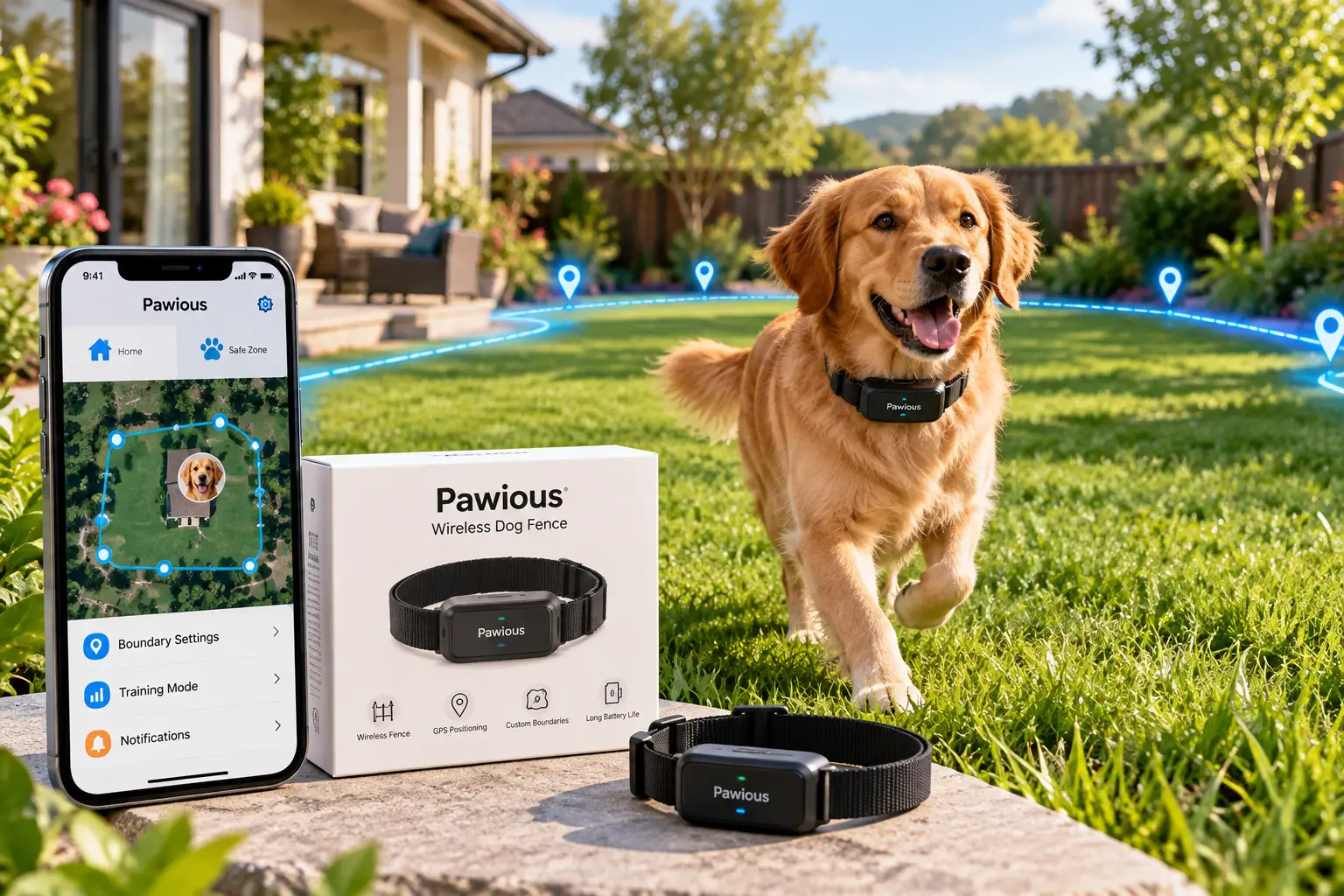
If you’ve ever sprinted barefoot down the driveway after a dog who spotted a squirrel, you already understand the appeal of a Pawious wireless dog fence. No trenching, no buried wire, no $5,000 quote from a fencing contractor. You set a boundary, strap on a collar, and spend the next week teaching your dog where “home” ends. That’s the promise, anyway. Whether a Pawious wireless dog fence actually delivers depends far more on your yard than on any marketing claim.
Here’s what most buyers don’t realize at first: Pawious sells two very different technologies under one brand. The Pawious XEdge GPS Dog Fence and Pawious XSentry GPS Dog Fence use satellites and work best on big, open land. The Pawious N5-F910, Pawious N5-F900Plus, and Pawious F900 use an indoor transmitter with what the company calls radar positioning, and they target ordinary suburban lots. Pick the wrong family and you’ll fight false alerts for weeks.
So this guide does the sorting for you. We compared spec sheets, aggregated customer review themes from US retailers and the brand’s own review platform, and set Pawious against the two PetSafe systems most shoppers cross-check: the PetSafe Stay & Play Compact Wireless Fence and the PetSafe Guardian GPS Dog Fence. You’ll get tables, real-world scenarios, a setup plan, and a frank look at the safety debate around static correction.
✅ Short on time? Jump to the quick comparison table below.
What Is a Pawious Wireless Dog Fence?
A Pawious wireless dog fence is a no-dig pet containment system that creates an invisible boundary around your yard. A receiver collar tracks your dog’s position, by GPS satellite or by distance from an indoor transmitter, and plays escalating tone, vibration, or optional static cues when your dog nears the edge.
That definition hides one big variable: accuracy. According to the U.S. government’s official GPS accuracy page, GPS-enabled smartphones are usually accurate to about 16 feet under open sky, and that accuracy worsens near buildings, bridges, and trees. Dog-collar GPS chips face the same physics. That’s why Pawious tells buyers its GPS models need roughly 3/4 to 1 acre or more, while its transmitter-based models handle radii as small as 10 to 20 feet.
In practice, this means the technology choice comes first and the model choice comes second. A GPS collar shines on a five-acre farm with few trees. A transmitter system makes more sense on a half-acre lot hemmed in by a house, a garage, and a neighbor’s fence. Every other feature, from forbidden zones to battery life, is secondary to that one decision.
Quick Comparison: 7 Wireless Dog Fences at a Glance
| Product | Technology | Boundary & Coverage | Collar Battery | Price Range | Best for |
|---|---|---|---|---|---|
| Pawious XEdge GPS Dog Fence | GPS + phone app | Custom polygon (up to 8 points) or circle; 3/4 acre+ | Up to ~18 hrs | $260–$325 | Pawious XEdge GPS Dog Fence: odd-shaped yards |
| Pawious XSentry GPS Dog Fence | GPS, no app | Circle, 33–1,000 yd radius; ~1–650 acres | 24–36 hrs | $140–$200 | Pawious XSentry GPS Dog Fence: big acreage on a budget |
| Pawious N5-F910 | Indoor transmitter (radar) | Circle, 20–280 ft radius; up to 5 acres | Up to 50 hrs | $270–$450 | Pawious N5-F910: suburban yards, multi-dog homes |
| Pawious N5-F900Plus | Indoor transmitter (radar) | Circle, 10–280 ft; forbidden zone | 24–36 hrs | $270–$380 | Pawious N5-F900Plus: yards plus indoor no-go zones |
| Pawious F900 | Indoor transmitter (radar) | Circle, 10–280 ft; up to 5 acres | 24–36 hrs | $220–$250 | Pawious F900: simplest entry point |
| PetSafe Stay & Play Compact Wireless Fence | Indoor radio transmitter | Circle, 22–105 ft; up to 3/4 acre | Rechargeable | $250–$370 | PetSafe Stay & Play Compact Wireless Fence: small dogs, small yards |
| PetSafe Guardian GPS Dog Fence | GPS + base station + app | App-drawn fence; 3/4 acre+ | Rechargeable | $370–$500 | PetSafe Guardian GPS Dog Fence: buyers who want a legacy brand |
Prices are approximate ranges seen across major US retailers at the time of writing; check the current price on Amazon before you buy.
Reading the table top to bottom, the split is obvious: the two GPS Pawious models trade small-yard precision for nearly unlimited acreage, while the three transmitter models cap out around 280 feet but work on lots where GPS would struggle. The Pawious XSentry GPS Dog Fence is the cheapest way into big-property containment, whereas the Pawious N5-F910 wins on battery life, which matters if you’d rather not charge collars every night. Meanwhile, the PetSafe Stay & Play Compact Wireless Fence is the only option here that officially fits dogs from 5 pounds, so tiny-breed owners should start there.
💬 One click helps other shoppers make an informed choice too! 😊
Top 7 Picks: Expert Analysis of Each Pawious Wireless Dog Fence (and Two Rivals)
1. Pawious XEdge GPS Dog Fence — draws around odd-shaped yards
The Pawious XEdge GPS Dog Fence is the one Pawious model that stops forcing your property into a circle. You draw a polygon with up to eight points on your phone’s map, or drop a quick circular radius if your land is simple.
What that means in practice: an L-shaped lot, a driveway you want to exclude, or a pond you want fenced off all become solvable. A roughly 9-foot pre-boundary buffer plays a beep and flashes the LED before any correction, and the collar offers 5 vibration levels, 5 static levels, and 3 sound cues, each tunable per dog. A built-in overcorrection limit runs one six-level cycle, pauses a minute, runs one more, then drops to sound only.
Based on the spec sheet, this is the pick for suburban or rural owners with 3/4 acre or more and a yard that a circle would butcher. The trade-off is battery life of roughly 18 hours, so nightly charging becomes routine.
Review sentiment on the brand’s own review platform (about 4.7 stars from 400+ ratings, so weigh it accordingly) consistently praises keep-away zones around pools and gardens and per-collar intensity. Common complaints mention an app learning curve, weaker signal near dense trees or metal buildings, and a stiff strap at first.
Pros:
- ✅ Custom polygon boundaries fit irregular properties
- ✅ Pre-boundary warning gives dogs time to turn back
- ✅ Separate keep-inside and keep-away zones in one app
Cons:
- ❌ Roughly 18-hour battery means charging every night
- ❌ Not reliable on lots under about 3/4 acre
💲 Typically in the $260–$325 range; strong value if your yard shape has defeated circle-only systems.
2. Pawious XSentry GPS Dog Fence — cheapest route to huge acreage
The Pawious XSentry GPS Dog Fence is the budget satellite option, built for owners whose land is measured in acres, not square feet.
Its circular radius runs from 33 to 1,000 yards, which Pawious translates to roughly 0.7 to 650 acres. There’s no app: you stand at the center, press two buttons, and the boundary saves. Auto mode ramps correction gradually, while Fixed mode lets you lock a level from L01 to L05, which helps with stubborn, prey-driven dogs. An indoor/outdoor recognition feature aims to cut false triggers, and the collar is IPX7 waterproof with a 24–36 hour battery.
Here’s what to weigh: the XSentry is explicitly not for small yards, indoor use, or dense woods, and it suits medium to large dogs with 9–23 inch necks. For a farm, ranch, or big open field, the price-to-coverage ratio is hard to beat.
On the brand’s review platform (600+ ratings, roughly 79% five-star), rural owners repeatedly highlight working without Wi-Fi or cell service and surviving daily swims. Recurring gripes: a bulky collar, a magnetic charger some find finicky, and a satellite lock that can take a few minutes after power-up.
Pros:
- ✅ Massive coverage for the lowest price in this lineup
- ✅ Fixed mode gives better control over stubborn dogs
- ✅ No subscription, Wi-Fi, or SIM card needed
Cons:
- ❌ Circle only, so oddly shaped land wastes space
- ❌ Collar is bulky for smaller medium breeds
💲 Usually $140–$200; outstanding value for open acreage, poor value for small lots.
3. Pawious N5-F910 — longest battery among the transmitter models
The Pawious N5-F910 is the flagship of Pawious’ transmitter family, aimed at suburban households that want reliable containment without GPS headaches.
An indoor transmitter sets a circular boundary from 20 to 280 feet, up to about 5 acres in ideal conditions, and one base controls up to three collars. The collar runs up to 50 hours per charge and the transmitter more than 65, so you can realistically charge every other day. A real-time distance readout shows how far each dog is from the base, and correction-free reentry lets a dog walk back in without being punished for returning.
Based on comparing the specs, the F910’s practical edge over its siblings is endurance plus adjustable warning strength. It also adds a small forbidden zone (5–15 feet around the transmitter) and a training mode.
Across roughly 400 brand-platform reviews (about 76% five-star), owners praise the no-dig setup and three-dog management. The most consistent caveat: transmitter placement matters, and metal sheds, carports, garage walls, or thick trees can create patchy alerts until you relocate the base.
Pros:
- ✅ Up to 50 hours of collar battery life
- ✅ One transmitter handles up to three dogs
- ✅ Dogs return inside without another correction
Cons:
- ❌ Circular boundary only, centered on your house
- ❌ Metal structures nearby can cause inconsistent alerts
💲 Roughly $270 for one dog up to about $450 for three; best overall value for typical suburban yards.
4. Pawious N5-F900Plus — yard fence plus indoor no-go zone
The Pawious N5-F900Plus pairs a standard yard boundary with a Forbidden Area mode, which is the whole reason many buyers choose it.
The circular yard boundary adjusts from roughly 10 to 280 feet, while Forbidden Area mode flips the logic and creates a small no-entry zone around the transmitter. Put the base near the kitchen trash, a nursery door, or the grill, and the collar warns your dog away. The collar lasts 24–36 hours, the transmitter about 65, and the box includes 25 training flags.
What the spec sheet doesn’t say, but reviews reveal: owners use the forbidden mode far more than they expected, often around fire pits, grills, and garden beds. If you need both containment and “stay out of here” rules, this is the logical pick; if you only need containment, the Pawious N5-F910 offers more battery for similar money.
Its brand-platform rating is strong (about 490 reviews, roughly 96% four or five stars). Complaints cluster around signal fluctuations near covered porches and metal outbuildings, a remote with many buttons, and at least one reviewer reporting trouble reaching support.
Pros:
- ✅ Forbidden Area mode handles indoor trouble spots
- ✅ Distance display makes early training easier
- ✅ Includes boundary flags for first-week training
Cons:
- ❌ Shorter collar battery than the F910
- ❌ Remote menu takes time to learn
💲 Typically $270–$380 depending on dog count; good value if you’ll actually use the no-go zone.
5. Pawious F900 — the no-frills radar starter
The Pawious F900 is the original radar-based model and the most affordable way into Pawious’ transmitter lineup.
It covers a circular area with a 10 to 280 foot radius from an indoor transmitter, supports up to three dogs, and shows real-time distance on the base. Setup takes minutes, with nothing to bury. In plain terms, you get the core containment experience of its pricier siblings without the extra modes.
Our honest take: the Pawious F900 makes sense for owners of one or two cooperative dogs on a fairly open lot who want to save money and don’t need a forbidden zone. If your dog is a determined escape artist, the adjustable warning strength on the Pawious N5-F910 is worth the step up.
Detailed review data for this base model is thinner than for the newer versions. On Walmart, the single-dog listing averages around 4.6 stars from a few hundred ratings, and the themes that do appear echo the Plus model: quick setup, good accuracy in open areas, and sensitivity to obstructions.
Pros:
- ✅ Lowest-priced Pawious transmitter system
- ✅ Same 280-foot maximum radius as pricier models
- ✅ Real-time distance readout on the base
Cons:
- ❌ No forbidden zone or extra training modes
- ❌ Fewer detailed reviews to judge long-term durability
💲 Generally $220–$250; a sensible entry point for simple, open yards.
6. PetSafe Stay & Play Compact Wireless Fence — best for small dogs
The PetSafe Stay & Play Compact Wireless Fence is the mainstream benchmark, and the safest bet if your dog is small.
Its compact indoor transmitter creates a circle from 22 to 105 feet in every direction, or up to 3/4 acre. The collar is rechargeable and waterproof, fits dogs from 5 pounds, and offers tone-only mode plus 5 static levels. With add-on collars, one base supports an unlimited number of pets, which matters for households with four or more dogs.
Compared with the Pawious N5-F910, you give up range and vibration cues but gain a far lighter dog-size floor and the reach of a national brand with in-store availability. It’s portable too, though the base needs an outlet.
On Tractor Supply, it averages about 4.3 stars across more than 1,200 reviews, with roughly 87% of reviewers recommending it. That big pool also contains a notable number of one-star reviews, so expect some variability depending on yard layout.
Pros:
- ✅ Fits dogs as small as 5 pounds
- ✅ Unlimited pets with additional collars
- ✅ Huge review base and wide retail availability
Cons:
- ❌ Maximum 105-foot radius limits larger yards
- ❌ No vibration-only warning mode
💲 Usually $250–$370; fair value for small lots and small breeds.
7. PetSafe Guardian GPS Dog Fence — legacy-brand GPS alternative
The PetSafe Guardian GPS Dog Fence is the closest big-brand rival to the Pawious XEdge GPS Dog Fence, built for yards of 3/4 acre or more.
You create the boundary through PetSafe’s app, there’s no subscription for the fence-only version, and a home base station anchors the system. PetSafe’s support library includes guidance on what happens if that base loses Wi-Fi or power, so plan for a reliable outlet and network. Unlike the subscription-based Guardian GPS 2.0, this version doesn’t offer live tracking or portability.
Based on the specs, it’s the choice for owners who value a long-established US brand and dealer network over price. You’ll pay noticeably more than the Pawious GPS options for similar containment.
Tractor Supply shows about 4.2 stars from roughly 170 reviews. Note that some reviews on other retailer pages are marked as written in exchange for a free product, which weakens their weight.
Pros:
- ✅ App-drawn fence from an established brand
- ✅ No subscription required for containment
- ✅ Broad US retail and support network
Cons:
- ❌ Priciest system in this comparison
- ❌ Base station ties it to one property
💲 Typically $370–$500; reasonable only if brand familiarity outweighs cost.
Getting Started: A 14-Day Setup and Training Plan
The box says “set up in minutes,” and technically that’s true. The fence is ready in minutes; your dog is not. Owners across every model above report the same thing: hardware takes an hour, training takes one to two weeks. Here’s a practical schedule.
Days 1–2: Set the boundary, then shrink it
- 🏠 For transmitter models (Pawious N5-F910, Pawious N5-F900Plus, Pawious F900), place the base near a window, away from metal appliances, brick walls, and garages. Reviews repeatedly show placement fixes most “weird boundary” complaints.
- 🛰️ For GPS models, power on outdoors and give the collar a few minutes to lock satellites before saving a fence.
- 🚩 Walk the edge with the collar in your hand and plant flags where it beeps. Then pull the boundary 10–20 feet farther from roads than feels necessary.
Days 3–7: Tone and vibration only
Keep static off. Walk your dog on a leash toward the flags, let the tone play, turn back together, and reward generously. Ten to fifteen minutes, two or three times a day, beats one marathon session.
Days 8–14: Add distractions, then supervised freedom
Toss a toy near the line or have a family member walk past outside it. Only now, if your dog ignores tone and vibration, try the lowest static level. Finally, allow off-leash time while you watch.
Ongoing maintenance
🔋 Charge collars overnight, wipe contact points weekly, and check the skin under the collar. Pawious’ XEdge guidance suggests limiting continuous wear to around 12 hours unless the skin looks healthy, and repositioning the collar every few hours. Pawious also recommends waiting until a dog is about 6 months old before starting.
Real-World Scenarios: Which Model Fits Which Household?
Specs only mean something once you attach them to a real property. Here are three common buyer profiles and the reasoning behind each match.
Scenario 1: The half-acre suburban family
Picture a 0.5-acre lot with a house in the middle, a detached metal shed, two kids, and a 55-pound Lab who chases delivery trucks. Budget: around $300. GPS would struggle here because the lot is small and buildings block the sky. The Pawious N5-F910 fits best: a 100–150 foot radius covers the yard, the 50-hour battery suits busy parents, and correction-free reentry keeps training fair. Just keep the transmitter away from that shed.
Scenario 2: The 8-acre rural property
Now imagine open pasture, a gravel road on one side, weak cell service, and a Border Collie mix. Budget: under $200. The Pawious XSentry GPS Dog Fence covers that acreage without Wi-Fi, and Fixed mode helps with a high-drive herding dog. If the property is long and narrow rather than round, stretch the budget to the Pawious XEdge GPS Dog Fence so the polygon tool can follow the real shape.
Scenario 3: The small-dog, small-yard home
A 12-pound terrier on a quarter-acre lot is a poor match for any collar rated for medium and large breeds. The PetSafe Stay & Play Compact Wireless Fence is the better call because it fits dogs from 5 pounds and its 22–105 foot radius suits compact yards.
✨ Found your match? Don’t wait for the next escape!
🔍 Take your yard’s safety to the next level with this carefully curated lineup. Click a highlighted product to check current pricing and availability on Amazon. These picks can help you get a calmer, safer backyard the whole family will enjoy!
Troubleshooting: 5 Common Problems and Practical Fixes
Even the best wireless dog fence for large dogs throws curveballs. These are the issues that surface most often in owner reviews, with fixes that actually work.
- Problem: Random alerts near the house or garage. Solution: For transmitter models, move the base toward a window and away from metal or brick, then reduce the radius slightly. For GPS models, take the collar off indoors or disable the fence in the app, as Pawious advises for the Pawious XEdge GPS Dog Fence.
- Problem: Boundary feels “jumpy” near trees. Solution: Pull the boundary out of wooded corners. GPS signals weaken under canopy, so a slightly smaller, cleaner circle beats a larger, unreliable one.
- Problem: Dog ignores the warning when wildlife appears. Solution: Revisit distraction training first. Then, on the Pawious XSentry GPS Dog Fence, switch to Fixed mode one level higher rather than maxing out.
- Problem: Collar shows full but dies early. Solution: Clean the charging contacts, seat the charger firmly, and contact support within the warranty window. Pawious lists a 1-year warranty and 30-day returns.
- Problem: Satellite lock takes too long in the morning. Solution: Power the GPS collar on outdoors a few minutes before letting your dog out; reviewers note it holds accurately once locked.
How to Choose a Pawious Wireless Dog Fence
Choosing well comes down to seven questions, asked in this order:
- Measure your usable yard. Under about 3/4 acre, skip GPS; transmitter models or the PetSafe Stay & Play Compact Wireless Fence handle tight lots better.
- Look up at the sky. Dense tree cover or metal outbuildings degrade both GPS and transmitter signals, so plan boundaries away from them.
- Map the shape. Round or square land works with circles; L-shaped or narrow land justifies the polygon tool on the Pawious XEdge GPS Dog Fence.
- Weigh your dog. Most Pawious collars target medium and large breeds with 9–23 inch necks; tiny dogs need a lighter collar.
- Count your dogs. Pawious transmitters support up to three collars; beyond that, a system with unlimited add-ons makes more sense.
- Decide on correction style. If you want tone and vibration only, confirm the model lets you disable static entirely.
- Check the total cost. A gps dog fence no subscription design saves money long term, but extra collars add up fast.
Review snapshot across the lineup
| Product | Review Source | Approx. Rating | Most Common Praise | Most Common Complaint | Best for |
|---|---|---|---|---|---|
| Pawious XEdge GPS Dog Fence | Brand review platform | ~4.7/5 (400+) | Polygon fit, keep-away zones | App learning curve | Pawious XEdge GPS Dog Fence: irregular lots |
| Pawious XSentry GPS Dog Fence | Brand review platform | ~79% 5-star (600+) | Works off-grid | Bulky collar | Pawious XSentry GPS Dog Fence: farms |
| Pawious N5-F910 | Brand review platform | ~76% 5-star (400+) | Multi-dog control | Placement sensitivity | Pawious N5-F910: suburbs |
| Pawious N5-F900Plus | Brand review platform | ~76% 5-star (490+) | Forbidden Area mode | Metal interference | Pawious N5-F900Plus: no-go zones |
| Pawious F900 | Walmart | ~4.6/5 (~290) | Easy setup | Limited detailed feedback | Pawious F900: budget buyers |
| PetSafe Stay & Play Compact Wireless Fence | Tractor Supply | ~4.3/5 (1,200+) | Small-dog fit | Mixed long-term results | PetSafe Stay & Play Compact Wireless Fence: small breeds |
| PetSafe Guardian GPS Dog Fence | Tractor Supply | ~4.2/5 (~170) | Brand trust | Price | PetSafe Guardian GPS Dog Fence: brand loyalists |
The pattern here is telling: every Pawious complaint is environmental, not mechanical, which suggests most bad experiences come from mismatched yards rather than defective hardware. Keep in mind that brand-hosted review platforms tend to skew positive, so the PetSafe numbers from a third-party retailer aren’t directly comparable. Treat this table as a map of common themes, not a definitive quality ranking.
GPS vs. Radar vs. In-Ground vs. Physical Fences
A wireless fence isn’t automatically better than the alternatives; it’s better at specific jobs. Traditional pet containment systems bury a wire around the perimeter, while wireless versions replace that wire with a transmitter radius or satellite coordinates.
| Factor | Pawious GPS (XEdge/XSentry) | Pawious Radar (F900 series) | Buried-Wire Fence | Physical Fence | Best for |
|---|---|---|---|---|---|
| Installation | Minutes, no digging | Minutes, indoor base | Trenching required | Contractor or major DIY | GPS or radar: renters, travelers |
| Boundary shape | Circle or polygon (XEdge) | Circle only | Any shape | Any shape | Buried wire or physical: complex lots |
| Small-yard accuracy | Weak under 3/4 acre | Good | Excellent | Excellent | Radar: suburban lots |
| Portability | Excellent | Good (base travels) | None | None | GPS: camping, cabins |
| Keeps other animals out | No | No | No | Yes | Physical: urban areas |
Looking at the table above, only a physical fence stops loose dogs and wildlife from coming in, which is a real safety gap for every electronic option. Wireless systems win decisively on installation and portability, though, and the Pawious XEdge GPS Dog Fence narrows the shape gap that used to favor buried wire. If your HOA bans front-yard fences, a wireless option may be your only practical route.
💬 One click helps other shoppers make an informed choice too! 😊
Safety, Standards, and the Static-Correction Debate
Any honest Pawious dog fence review has to address this: these collars can deliver static stimulation, and veterinary behavior experts are divided on it. The American Veterinary Society of Animal Behavior’s position statements favor reward-based training over aversive methods, and some cities and countries restrict or ban electronic collars outright. UK welfare groups have also cited a 2017 study in the Journal of the American Veterinary Medical Association that found dogs behind electronic fences escaped more often than dogs behind physical fences.
So what does that mean for you? Use the gentlest setting that works. Every Pawious model in this guide supports tone and vibration, and Pawious says static can be skipped entirely. Correction-free reentry on the transmitter models, plus automatic overcorrection limits on the Pawious XEdge GPS Dog Fence, reduce the risk of a confused dog being corrected repeatedly.
Practical safety checklist:
- ✅ Never use a wireless fence as unsupervised daycare near a busy road.
- ✅ Check under the collar daily for redness or pressure marks.
- ✅ Confirm the collar’s waterproof rating (IPX7 or IP67) before letting your dog swim.
- ✅ Look for FCC compliance information on any electronic transmitter you buy.
- ✅ Talk to your veterinarian if your dog is anxious, elderly, or has a heart condition.
Long-Term Cost and Maintenance
The sticker price is only part of the story. A gps dog fence no subscription model avoids monthly fees, but replacement collars, chargers, and add-on receivers shape the real cost of ownership.
| Product | Upfront Range | Subscription | Main Recurring Cost | Coverage per Dollar | Best for |
|---|---|---|---|---|---|
| Pawious XSentry GPS Dog Fence | $140–$200 | None | Collar replacement | Highest | Pawious XSentry GPS Dog Fence: maximum acreage |
| Pawious XEdge GPS Dog Fence | $260–$325 | None | Extra collars | High | Pawious XEdge GPS Dog Fence: shape flexibility |
| Pawious N5-F910 | $270–$450 | None | Add-on receivers | Moderate | Pawious N5-F910: multi-dog value |
| PetSafe Stay & Play Compact Wireless Fence | $250–$370 | None | Add-a-dog collars | Lower | PetSafe Stay & Play Compact Wireless Fence: 4+ dogs |
| PetSafe Guardian GPS Dog Fence | $370–$500 | None (fence-only) | Add-a-dog collars | Lowest | PetSafe Guardian GPS Dog Fence: brand preference |
Based on comparing these ranges, the Pawious XSentry GPS Dog Fence delivers the most land for the money by a wide margin, but only if you actually have that land. For multi-dog homes, the per-dog math favors buying a 2- or 3-dog Pawious set upfront rather than adding receivers later. And because all five skip subscriptions, a battery-killing habit like leaving collars on overnight is the biggest hidden cost; lithium cells degrade faster when constantly drained.
Common Mistakes to Avoid When Buying a Wireless Dog Fence
Most disappointing reviews trace back to a handful of avoidable decisions.
- ❌ Buying GPS for a small lot. Satellite accuracy simply isn’t tight enough for a quarter-acre yard; you’ll get alerts in the living room.
- ❌ Setting the boundary at the property line. Leave a generous buffer from roads, since a running dog carries momentum past the warning zone.
- ❌ Skipping the flags. Dogs learn faster when they can see where the tone happens.
- ❌ Starting with static. Begin with tone and vibration; jumping straight to correction can create fear of the yard itself.
- ❌ Ignoring collar fit. Contact points must touch skin without pinching; one to two fingers of space is the guideline Pawious gives.
- ❌ Assuming one setting fits every dog. Multi-dog homes should use per-collar settings where available, like the Pawious XEdge GPS Dog Fence offers.
- ❌ Forgetting the Pawious forbidden area feature. If your dog raids the trash or grill, the Pawious N5-F900Plus or Pawious N5-F910 solves that problem without a second device.
FAQ: Buying a Pawious Wireless Dog Fence
❓ Does a Pawious wireless dog fence require a monthly subscription?
❓ Can I add a second or third dog to a Pawious system later?
❓ Is the Pawious GPS dog fence worth it for a 1-acre yard?
❓ Where can I buy a Pawious wireless dog fence, and what warranty applies?
❓ Will a Pawious wireless dog fence work for a dog under 20 pounds?
Conclusion: The Right Pawious Wireless Dog Fence Depends on Your Yard
After digging through spec sheets and hundreds of review themes, one conclusion stands out: there’s no single best Pawious wireless dog fence, only the best match for your land.
If you own big, open acreage, the Pawious XSentry GPS Dog Fence gives you the most coverage for the least money. If your property is irregular, the Pawious XEdge GPS Dog Fence is worth the premium for its polygon boundaries and per-dog settings. For a typical suburban yard, the Pawious N5-F910 strikes the best balance of range, battery life, and multi-dog control, while the Pawious N5-F900Plus makes sense if a forbidden zone solves a daily headache. The Pawious F900 remains a solid starter system. Outside the Pawious family, the PetSafe Stay & Play Compact Wireless Fence is the smarter choice for small dogs, and the PetSafe Guardian GPS Dog Fence suits shoppers who prefer a legacy brand.
Whichever you choose, remember that the collar is only half the system. Two weeks of patient, reward-based training, a generous buffer from roads, and the gentlest effective setting matter as much as any spec. Get those right, and your dog trades the leash for a yard full of safe freedom.
🐾 Ready to give your dog safe freedom?
🔍 Take your backyard to the next level with this carefully curated lineup. Click a highlighted product to check current pricing and availability. These picks will help you get peace of mind the whole family will enjoy!
Recommended for You
- Pet Chip Network 2026: 7 Proven Tools to Bring Lost Pets Home
- Light Up Cat Collar: 7 Brilliant, Breakaway-Smart Picks for 2026
- Light Up Cat Collar Guide: 7 Best Picks to Keep Cats Safe (2026)
Disclaimer: This post contains affiliate links. As an Amazon Associate, I earn from qualifying purchases made through these links, at no additional cost to you.
✨ Found this article helpful? Share it with someone who needs it! 💬🤗