
In This Article
Introduction: Why the Right Off Leash K9 Training Collar Changes Everything
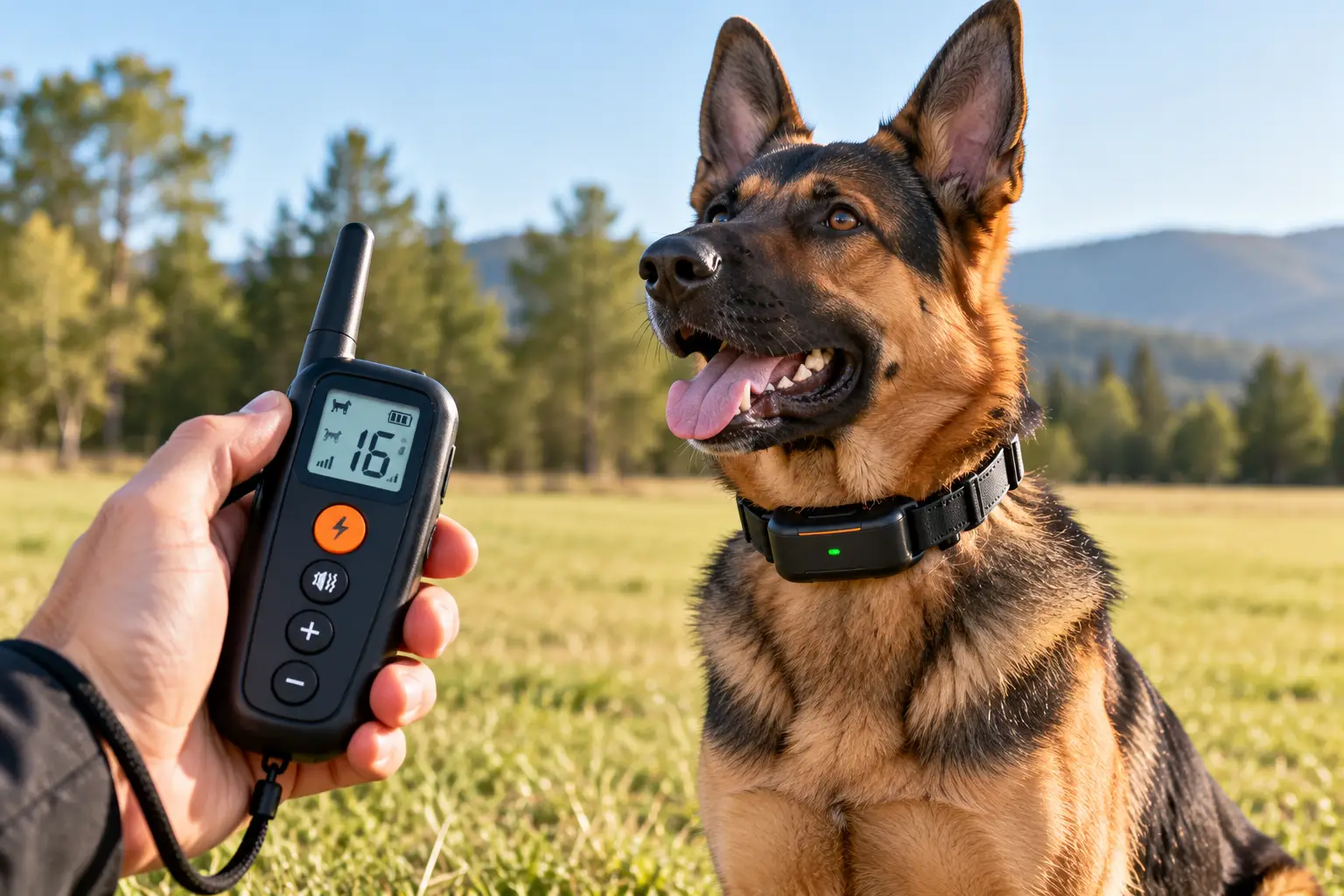
Picture this: you’re on a trail, your dog spots a deer, and in half a second you find out whether months of recall practice actually stuck. That moment is exactly why so many owners start shopping for an off leash k9 training collar. The goal isn’t to punish a dog into obedience — it’s to keep a clear line of communication open when your voice gets drowned out by squirrels, traffic, or pure doggy enthusiasm.
Here’s the catch: not every remote collar is built for that job. A cheap 3,300-foot “shock collar” with 99 coarse levels and an off leash k9 training collar with fine-grained, low-level stimulation are two very different tools, even if they look similar in a product photo. The difference shows up in how precisely you can find your dog’s working level — the lowest setting your dog notices — and how reliably the signal reaches the collar when it matters.
What Is an Off Leash K9 Training Collar?
An off leash k9 training collar is a remote electronic collar (e-collar) that lets a handler send a tone, vibration, or adjustable low-level static stimulation to a dog from a handheld transmitter. It’s used to reinforce commands like recall at a distance, after the dog has learned them with positive training.
If you want the broader background on how these devices evolved and why they remain debated, the Wikipedia overview of remote training collars is a solid neutral starting point. In this guide, we compare seven real collars from E-Collar Technologies (Educator), Dogtra, Garmin, and SportDOG — analyzing spec sheets and aggregated owner feedback, not inventing hands-on tests — so you can match the tool to your dog’s size, temperament, and lifestyle. We’ll also cover the e-collar for off leash training conditioning process, common mistakes, and the real long-term costs.
Quick Comparison: Off Leash K9 Training Collar Picks at a Glance
| Collar | Range | Stimulation levels | Min. dog size (mfr.) | Dogs per remote | Price range | Best for |
|---|---|---|---|---|---|---|
| E-Collar Technologies Mini Educator ET-300 | 1/2 mile | 100 + boost | 5 lb | 1 (2-dog version sold) | around $200–$220 | Mini Educator ET-300: most owners, all-around off-leash work |
| Educator ET-400 | 3/4 mile | 100 + boost (1–60) | 5 lb | Up to 2 | around $220–$240 | Educator ET-400: hikers and larger properties |
| Micro Educator ME-300 | 1/3 mile | 100 + boost | 5 lb | 1 (2-dog version sold) | around $200–$220 | Micro Educator ME-300: small or sensitive dogs |
| Dogtra 280C | 1/2 mile | 127 (rheostat) | 10 lb | 1 (282C for 2) | around $210–$235 | Dogtra 280C: compact, no-fuss obedience |
| Dogtra ARC | 3/4 mile | 127 (rheostat) | 15 lb | Expandable to 2 | around $235–$255 | Dogtra ARC: slim receiver, medium-to-large dogs |
| Garmin Sport PRO | 3/4 mile | 10 momentary / 10 continuous | See listing | Up to 3 | around $250–$300 | Garmin Sport PRO: multi-dog, no-look use |
| SportDOG FieldTrainer 425X | 500 yards | 21 | 8 lb | Up to 3 | around $125–$180 | SportDOG FieldTrainer 425X: tighter budgets |
Prices are approximate ranges at the time of writing; check the current price on Amazon, as prices vary.
Looking at the table above, the three Educator models dominate on fine control — 100 levels plus a separate boost gives you more room to find a whisper-quiet working level than the Garmin Sport PRO‘s 10 steps. The Dogtra ARC and Educator ET-400 tie on range at 3/4 mile, so the decision between them comes down to receiver shape versus remote style. Budget shoppers should note that the SportDOG FieldTrainer 425X halves the cost but trades away range and level granularity.
💬 One click helps other shoppers make an informed choice too! 😊
Top 7 Off Leash K9 Training Collar Picks: Expert Analysis
Each pick below is a real, currently sold model. The commentary is based on comparing manufacturer spec sheets and retailer listings, plus the review sentiment we could actually verify — where review data was thin, we say so.
1. E-Collar Technologies Mini Educator ET-300 — the off-leash trainer’s default
The Mini Educator ET-300 is the collar you’ll see on more off-leash training graduates than almost any other, and the spec sheet explains why. It pairs a half-mile range with 100 stimulation levels, a lock-and-set feature, tone or vibration, and a 2.4 oz receiver rated for dogs from 5 lb up.
In practice, 100 levels means you can creep up one notch at a time until your dog flicks an ear — that’s your working level, and it’s often surprisingly low. Lock-and-set matters more than it sounds: a bumped dial in your pocket can’t silently jump from 12 to 40. The remote-activated LED light is handy for dusk walks, too.
Based on the specs, this is the right off leash k9 training collar for most households: big enough output for a 90-pound Lab, fine enough control for a sensitive Border Collie. It’s less ideal if you need more than half a mile — think bird dogs ranging wide.
Retail listings we checked show generally positive ratings (around 4.2 out of 5 on one major US retailer, on a modest review count), and several 2026 roundups name it their top pick.
Pros:
- ✅ 100 fine-grained levels make low-level work easy
- ✅ Lock-and-set prevents accidental level jumps
- ✅ Light receiver suits dogs from small to large
Cons:
- ❌ Puck-style remote takes a few days to learn
- ❌ Half-mile range limits big-country use
💰 Expect roughly $200–$220; strong value given how long these systems typically stay in service.
2. Educator ET-400 — extra reach for trail lovers
The Educator ET-400 builds on the ET-300 foundation with a larger remote, an enhanced internal antenna, and a 3/4 mile range.
You still get 100 levels, a boost setting adjustable from 1 to 60, tone, vibration, and the remote LED light. The boost is the underrated feature: you preset a higher level for emergencies (deer, road) so you never fumble the dial mid-crisis. The kit includes two contact-point lengths — 5/8″ and 3/4″ — which helps on thick-coated dogs, where poor contact is the number-one cause of “my dog ignores it.”
This is the better pick for hikers, rural property owners, or anyone whose dog ranges past 800 yards. The stopwatch-style remote is also easier to read for people who dislike the ET-300’s compact puck. A 2-dog version, the ET-402, is available.
Aggregated retail feedback is generally favorable, with owners describing successful off-leash hiking; we also saw scattered durability complaints (one owner reported a failure after about 18 months), so register the warranty.
Pros:
- ✅ 3/4 mile range covers most trail scenarios
- ✅ Presettable boost for emergency recalls
- ✅ Two contact-point lengths for thick coats
Cons:
- ❌ Remote is bulkier than the ET-300’s puck
- ❌ Costs a bit more for range many owners won’t use
💰 Roughly $220–$240; worth the step up only if you’ll truly use the extra distance.
3. Micro Educator ME-300 — built for little and soft dogs
The Micro Educator ME-300 pairs the familiar ET-300 transmitter with the RX-070 micro receiver, which the maker describes as roughly 20% smaller, lighter, and gentler than the standard unit.
That receiver weighs about 1.9 oz — a meaningful difference on a 12-pound terrier, where a bulky box can shift around and break contact. Gentler output also means the lowest levels are genuinely subtle, which is exactly what soft-tempered dogs need. You keep 100 levels plus boost, tone, and vibration.
On paper, this is the most sensible off leash k9 training collar for small breeds and anxious dogs. The trade-off is a 1/3 mile range, which is still plenty for parks, beaches, and neighborhood greenways.
Review volume is smaller than for the ET-300; listings we found show favorable but modest-sample ratings, so we’d weight the spec sheet more heavily here.
Pros:
- ✅ Smallest, lightest receiver in this roundup
- ✅ Gentler output suits sensitive dogs
- ✅ Same proven transmitter as the ET-300
Cons:
- ❌ 1/3 mile range is the shortest here
- ❌ May feel underpowered for big, driven dogs
💰 Around $200–$220; good value if your dog is under about 25 lb.
4. Dogtra 280C — compact simplicity with a real dial
The Dogtra 280C is Dogtra’s most compact e-collar, built for dogs as small as 10 lb with low-to-medium output.
Its patented rheostat dial runs from 0 to 127 with no jumps between levels, and the LCD shows your exact setting — useful when you’re switching between calm house manners and an exciting park. You get nick (momentary), constant, and a non-stimulating pager vibration. Both units carry Dogtra’s IPX9K rating, which means they were tested against high-pressure, high-temperature water jets — overkill for most people, reassuring for duck-pond dogs.
This suits owners who want a traditional handheld remote with a screen rather than Educator’s puck. The low-to-medium output is a plus for calm-to-mild temperaments and a minus for very hard-headed large dogs.
We couldn’t verify a large, recent body of US customer reviews for this exact model, so this assessment leans on the specs and Dogtra’s long track record with trainers.
Pros:
- ✅ 127-level rheostat with a clear LCD
- ✅ IPX9K-rated waterproofing on both units
- ✅ 2-hour rapid charge batteries
Cons:
- ❌ No tone-only mode, only pager vibration
- ❌ Output may be light for strong large breeds
💰 Roughly $210–$235; fair value for a durable, screen-equipped system.
5. Dogtra ARC — slim receiver, serious range
The Dogtra ARC gives you 3/4 mile range in a slim, ergonomic receiver shaped to the dog’s neck.
That contoured shape matters in practice: a receiver that sits flush is less likely to rotate, which keeps the contact points where they belong. The ARC keeps the 0–127 rheostat dial, LCD, nick, constant, and pager vibration, plus 2-hour charging and expandability to a 2-dog system. It’s rated for dogs 15 lb and up and uses a 1″ strap.
Based on the specs, the Dogtra ARC is a strong choice for medium-to-large companion dogs whose owners want more range than the Dogtra 280C without stepping up to high-output hunting collars.
Independent roundups flag one honest limitation: its maximum output may be insufficient for very large, stubborn dogs. Retail review counts we found for the ARC were small, so treat that as a spec-based caution rather than a consensus.
Pros:
- ✅ Contoured receiver stays put and looks discreet
- ✅ 3/4 mile range with precise 127 levels
- ✅ Expandable later to a second dog
Cons:
- ❌ Not rated for dogs under 15 lb
- ❌ Top-end output may disappoint with very hard dogs
💰 Typically $235–$255; good value for a medium-to-large dog over many years.
6. Garmin Sport PRO — one-handed, multi-dog control
The Garmin Sport PRO is designed for “no-look” one-handed operation, with a multi-dog toggle and color-coded buttons for up to three dogs.
It offers 10 momentary and 10 continuous stimulation levels, tone, vibration, LED beacon lights visible up to about 100 yards, and a settable BarkLimiter built into the dog device. The fixed antenna removes a classic failure point, and the 3/4 mile range is generous. Only 10 levels, though, means bigger steps — less ideal for finding a very precise working level.
This fits multi-dog households and sporting owners who want to train by feel without looking down. Note that the dog device weighs about 3.5 oz, heavier than the Educator receivers.
Reviews consistently report satisfaction: on Chewy it averages about 4.5 out of 5 across roughly 100 ratings, with range, battery, and training modes most often praised. A recurring caution is to double-check the toggle so you signal the right dog.
Pros:
- ✅ True one-hand, no-look operation
- ✅ Controls up to three dogs from one remote
- ✅ Built-in BarkLimiter adds extra value
Cons:
- ❌ Only 10 levels per stimulation type
- ❌ Heaviest dog device in this lineup
💰 Around $250–$300; best value when you’re training two or three dogs.
7. SportDOG FieldTrainer 425X — the budget-friendly starter
The SportDOG FieldTrainer 425X is SportDOG’s smallest, lightest e-collar and the most affordable serious option here.
You get a 500-yard range, 21 static levels (low, medium, and high for each dial number), tone, and vibration. Lithium-ion batteries charge in 2 hours and last 50–70 hours, and the DryTek receiver is submersible to 25 feet. It fits dogs 8 lb and up with necks from 5″ to 22″, and expands to three dogs.
For a first-time owner working mostly in yards, parks, or a fenced field, 500 yards is plenty. Twenty-one levels is coarser than 100 or 127, so very sensitive dogs may find even neighboring steps a noticeable jump. A related 425XS version exists for higher-drive dogs.
Verified customer reviews on SportDOG’s site include owners reporting that running-off problems resolved quickly, and the model appears as a top pick in several 2026 roundups.
Pros:
- ✅ Lowest price among quality brands here
- ✅ Long 50–70 hour battery life
- ✅ Submersible receiver for water-loving dogs
Cons:
- ❌ 500-yard range is the shortest in absolute terms
- ❌ 21 levels give less fine-tuning
💰 Typically $125–$180; excellent value for yard and park training.
✨ Don’t miss these top-rated picks!
🔍 Take your dog’s off-leash freedom to the next level with this carefully curated lineup. Click a highlighted collar to check current pricing and availability — these picks can help you build the confident, reliable recall the whole family will enjoy!
Getting Started: Your First 30 Days With an Off Leash K9 Training Collar
The collar is only half the system; the conditioning plan is the other half. Most “it doesn’t work” stories trace back to skipping these steps, not to the hardware.
Week 1: Wear it, don’t use it
Put the collar on (switched off or unused) for walks, meals, and play. You want your dog to associate it with good things, not to become “collar-wise” — obedient only when wearing it. Fit it high on the neck, snug enough that you can slide one or two fingers under the strap, and rotate its position every couple of hours to avoid skin irritation.
Week 2: Find the working level
In a quiet room, start at 0 and raise the level one step at a time, pausing a few seconds between taps. Watch for the smallest sign of awareness: an ear flick, a head turn, a blink. That’s your working level — and on a 100-level Mini Educator ET-300, it’s often in the single digits or low teens. Write it down; it’ll shift with excitement and distance.
Weeks 2–3: Layer it onto known commands
Pair the stimulation with a command your dog already knows, on a long line. Say “come,” press as you guide gently with the leash, and release the button the instant your dog turns toward you. Then reward generously. The leash does the teaching; the collar becomes a tap on the shoulder.
Weeks 3–4: Add distance and distractions gradually
Increase one variable at a time: distance first, then mild distractions, then a new location. Keep the long line on until recall is reliable at least 9 times out of 10.
⚡ Common first-month mistakes: starting too high, using it as a punishment when you’re frustrated, and dropping food rewards too early.
Real-World Scenarios: Matching the Collar to Your Life
Specs only mean something once you map them to a real routine. Here are three common owner profiles and the reasoning behind each match.
🏙️ The suburban family with a 20-lb rescue
Profile: budget around $200, daily walks plus weekend trips to a beach and a big dog park, a dog that startles easily.
Best match: the Micro Educator ME-300. Its lighter, gentler receiver suits a small, soft dog, and 1/3 mile easily covers parks and beaches. The SportDOG FieldTrainer 425X is the budget alternative, but its 21 coarser steps may feel jumpy to a sensitive dog.
🥾 The weekend hiker with a 70-lb shepherd mix
Profile: budget up to $250, off-leash hikes on public land where allowed, strong prey drive around deer.
Best match: the Educator ET-400. The 3/4 mile range buys margin on winding trails, and the presettable boost means an emergency level is one button away when a deer bolts. If you prefer a screen and a contoured receiver, the Dogtra ARC is an equally sensible pick.
🏡 The rural owner with three dogs
Profile: budget flexible, acreage, daily chores with dogs loose, occasional barking issues.
Best match: the Garmin Sport PRO. One remote handles three dogs with color-coded control, and the built-in BarkLimiter handles nuisance barking without a separate device. Accept the trade-off: 10 levels give less fine-tuning than the Educator line.
Notice the pattern: the right off leash k9 training collar depends less on “best overall” and more on dog size, temperament, terrain, and how many dogs you manage.
Problem → Solution: Fixing the Most Common E-Collar Headaches
Most frustrations with a remote dog training collar fall into a handful of patterns. Here’s how to troubleshoot each one before blaming the device.
❌ Problem 1: “My dog doesn’t react at all.” ✅ Solution: check contact first. Long or double coats often need the longer contact points — the Educator ET-400 ships with both 5/8″ and 3/4″ sets for exactly this reason. Tighten the strap slightly and recheck with the test light before raising levels.
❌ Problem 2: “It works at home but not at the park.” ✅ Solution: your working level rises with arousal. Practice at the park at gradually higher levels, and use a preset boost (Educator models) for high-distraction moments instead of cranking the dial.
❌ Problem 3: “My dog only listens when wearing the collar.” ✅ Solution: you’re seeing collar-wise behavior. Have the dog wear the collar during ordinary, fun activities, and keep rewarding good choices with food and play so the behavior — not the device — becomes the habit.
❌ Problem 4: “The signal cuts out on hikes.” ✅ Solution: manufacturer ranges are line-of-sight figures. Hills, dense trees, and buildings shorten them. If you routinely lose contact, step up from 1/2 mile to a 3/4 mile model like the Dogtra ARC or Garmin Sport PRO.
❌ Problem 5: “Red spots on my dog’s neck.” ✅ Solution: that’s pressure irritation, not a burn. Rotate the receiver every few hours, never leave it on more than the maker recommends (often around 8–12 hours a day), and clean the skin and contact points regularly. See a vet if spots persist.
How to Choose an Off Leash K9 Training Collar
Choosing an off leash k9 training collar comes down to seven decisions, in roughly this order of importance:
- Level granularity. More, finer steps (100 or 127) make it easier to find a low working level; 10–21 steps mean bigger jumps between settings.
- Receiver size versus dog size. A receiver should sit flush without flopping. Under about 25 lb, favor micro or compact receivers like the Micro Educator ME-300 or Dogtra 280C.
- Output ceiling. Low-to-medium output units suit most companion dogs; very large, driven dogs may need more headroom.
- Realistic range. Pick a rated range roughly double the distance you actually expect, because terrain cuts it.
- Non-stimulation options. Tone and vibration let many dogs work with no static at all once conditioned.
- Waterproofing. Look for a stated rating, not just “water-resistant.” If you want to decode labels like IPX7 or IPX9K, this explainer on IP codes breaks down exactly what each digit tests.
- Multi-dog support and remote style. Puck, stopwatch, or classic handheld — choose what you can operate without looking.
E-Collar vs Traditional Alternatives for Off-Leash Work
| Tool | Works at distance | Precision | Learning curve | Best for |
|---|---|---|---|---|
| Remote e-collar (e.g., Mini Educator ET-300) | Yes, up to 1/3–3/4 mile | High (with 100+ levels) | Moderate | Reinforcing known commands off leash |
| Long line (15–50 ft) | Only to line length | High, physical | Low | Teaching recall foundations |
| Food/toy rewards only | Depends on dog’s focus | Variable around big distractions | Low–moderate | Building motivation and reliability |
| Whistle | Yes, by sound | Signal only, no feedback | Low | Gun dogs and consistent cues |
The table shows why most experienced trainers treat these as layers, not rivals: the long line and rewards teach the behavior, and the collar extends communication past the leash’s reach. An e-collar for off leash training is the only option here that delivers a private, consistent cue at half a mile — but it also carries the steepest responsibility, which is why the conditioning steps above aren’t optional.
Features That Actually Matter (and Ones That Don’t)
Matter: lock-and-set or a physical rheostat (prevents accidental jumps), a presettable boost, interchangeable contact points, honest waterproof ratings, and quick-charge batteries. A remote LED light on the receiver, like those on the Educator ET-400 and Garmin Sport PRO, is genuinely useful for dusk recalls.
Matter less: headline ranges of “4,500 feet” on bargain collars, because range means little if the stimulation steps are coarse or the receiver loses contact. Likewise, “99 levels” on a no-name unit isn’t the same as 100 well-calibrated levels — the useful question is how small the gap between neighboring steps feels to your dog.
Nice but niche: a built-in bark limiter (the Garmin Sport PRO) and tracking lights. Great if you need them, not worth paying extra for if you don’t.
🐾 Ready to give your dog safe, reliable freedom?
🔍 Compare the highlighted collars above and click your favorite to check current pricing and availability on Amazon — the right match makes every walk calmer for both of you!
Long-Term Cost and Maintenance
| Collar | Upfront range | Expandable? | Battery notes | Best for value |
|---|---|---|---|---|
| SportDOG FieldTrainer 425X | around $125–$180 | Up to 3 dogs | 50–70 hr per charge | SportDOG FieldTrainer 425X: lowest entry cost |
| Mini Educator ET-300 | around $200–$220 | 2-dog model sold separately | Quick-charge Li-polymer | Mini Educator ET-300: best all-round value |
| Dogtra ARC | around $235–$255 | Up to 2 dogs | 2-hour rapid charge | Dogtra ARC: long service on medium-large dogs |
| Garmin Sport PRO | around $250–$300 | Up to 3 dogs | Handheld up to ~60 hr | Garmin Sport PRO: lowest cost per dog in multi-dog homes |
Spread over several years, the price gap between these systems shrinks to a few dollars a month, so buy for fit, not just sticker price. The real hidden costs are replacement batteries (lithium cells typically fade after a few years of regular charging), spare straps, and add-on receivers. Multi-dog owners should note that the Garmin Sport PRO and SportDOG FieldTrainer 425X only need an extra dog device, not a second remote.
Maintenance routine: wipe contact points and the dog’s neck weekly, check that points are hand-tight, store the system partly charged rather than empty, and replace a cracked strap before it fails on a trail.
Safety, Regulations, and Standards
In most of the US, remote training collars are legal to buy and use, but rules on where dogs may be off leash are set locally — city, county, park, and land-agency regulations vary widely, so check before unclipping. Some retailers have chosen not to sell e-collars, and several countries, including parts of the UK, restrict or ban them.
It’s also worth knowing the professional debate. The American Veterinary Society of Animal Behavior’s position statement on humane dog training recommends reward-based methods and advises against aversive tools, including shock collars, citing research that found no effectiveness advantage over rewards for recall. Many balanced trainers disagree, arguing that low-level, well-conditioned use is a communication tool rather than punishment. Reading both sides helps you decide whether this tool fits your values and your dog.
Practical safety rules that apply either way: never use stimulation on a dog with heart conditions or implanted medical devices without veterinary advice, never leave a receiver on around the clock, and remove it before crating or unsupervised play. Since these remotes are radio transmitters, look for an FCC ID on the label as a basic sign of a legitimate, compliant product.
Common Mistakes to Avoid When Buying an Off Leash K9 Training Collar
- Buying on range alone. A huge range number says nothing about level precision.
- Ignoring receiver size. An oversized box on a small dog rotates and loses contact.
- Skipping a professional. One or two sessions with a qualified trainer can prevent months of confusion.
- Assuming more power is better. Most companion dogs work at low levels; headroom matters only for very driven dogs.
- Forgetting contact-point length. Thick coats need longer points — check what’s in the box.
- Treating the collar as a shortcut. Without groundwork on a long line, even the best off leash k9 training collar won’t deliver a reliable recall.
FAQ: Off Leash K9 Training Collar Questions Answered
❓ What collar do off leash k9 trainers typically use?
❓ Is the Mini Educator e-collar worth the price over cheaper collars?
❓ Can I buy an off leash k9 training collar for a small dog?
❓ Which e-collar is best for training two or three dogs at once?
❓ How long does e-collar recall training take before going off leash?
Conclusion: Choosing Your Off Leash K9 Training Collar With Confidence
The best off leash k9 training collar isn’t the one with the biggest range number on the box — it’s the one whose levels, receiver, and remote fit your actual dog and your actual life.
For most households, the Mini Educator ET-300 remains the benchmark: 100 fine levels, lock-and-set, and a light receiver at a fair price. Hikers and rural owners who need more reach should look at the Educator ET-400 or the Dogtra ARC, while small and sensitive dogs are best served by the Micro Educator ME-300 or Dogtra 280C. Multi-dog homes will appreciate the Garmin Sport PRO, and first-time buyers on a budget can start confidently with the SportDOG FieldTrainer 425X.
Whichever you pick, remember that the hardware is the easy part. The real results come from patient conditioning, low working levels, plenty of rewards, and a long line until recall is rock-solid. Consider a session with a qualified trainer, check your local leash rules, and weigh the professional debate so your choice fits your values.
Do that, and your collar becomes what it should be: a quiet tap on the shoulder that buys your dog more freedom, not less.
🚀 Give your dog the freedom they’ve been waiting for!
🔍 Click any highlighted collar in this guide to check current pricing and availability — and start building a recall you can truly trust this season!
Recommended for You
- Wallets with Tracking: 7 Best Picks You Won’t Lose in 2026
- Inside Fences for Dogs: 7 Best Picks That Actually Work (2026)
- Inside Electric Fence for Dogs: 7 Best Smart Picks for 2026
Disclaimer: This post contains affiliate links. As an Amazon Associate, I earn from qualifying purchases made through these links, at no additional cost to you.
✨ Found this article helpful? Share it with someone who needs it! 💬🤗