
In This Article
Inside Fences for Dogs: Why the Right Indoor Barrier Changes Everything
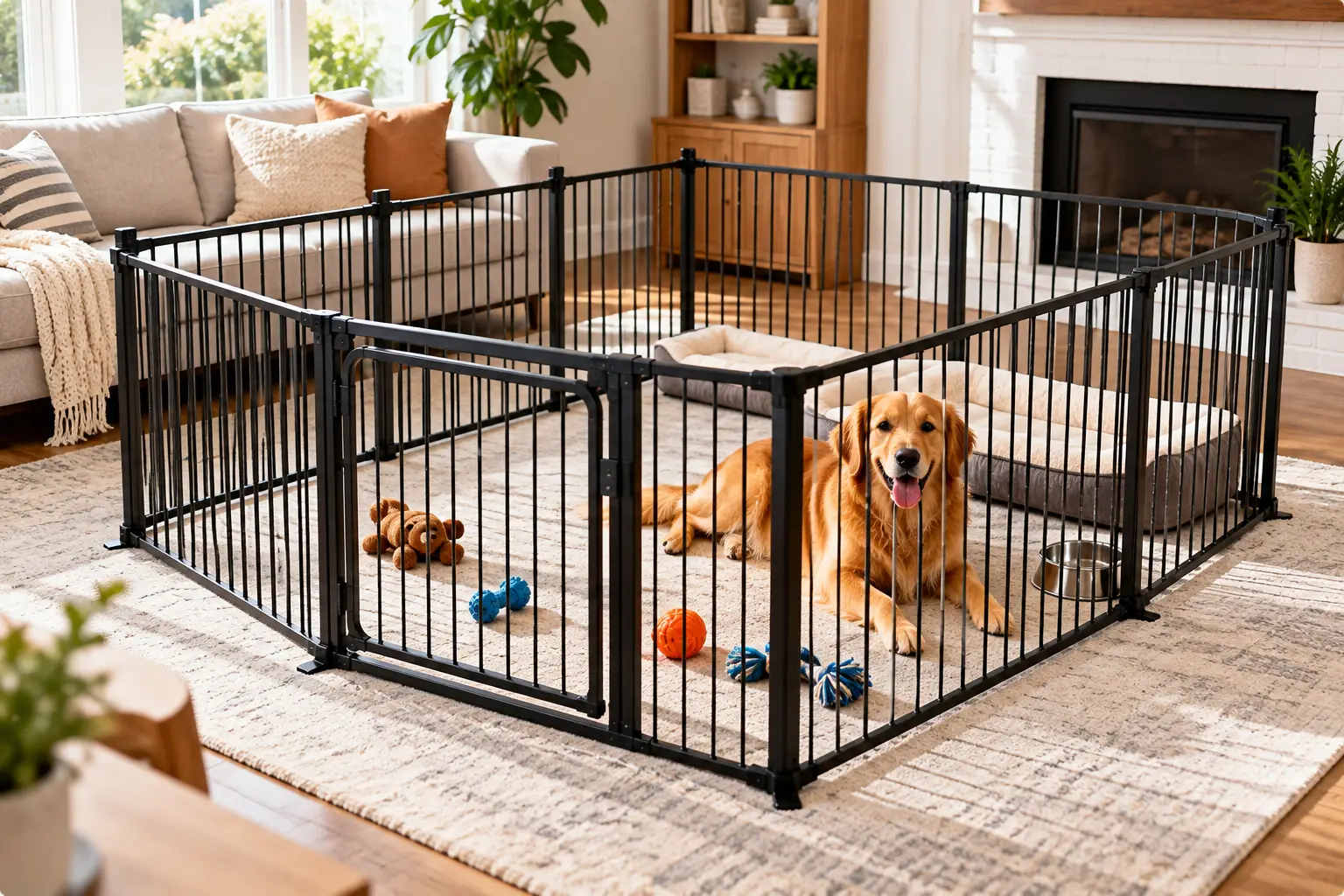
Picture this: you’re chopping onions, your Lab is “helping” by leaning on your knees, and the toddler just discovered the dog’s water bowl. Sound familiar? That everyday chaos is exactly why inside fences for dogs have quietly become one of the most useful pieces of gear in American homes. They’re not about locking your dog away. They’re about deciding where the fun happens, so everyone in the house — two-legged and four-legged — gets a little more peace.
The tricky part is that “indoor dog fence” covers a surprisingly wide range of products. A $30 pressure gate, a $180 hardwood freestanding gate, a metal exercise pen, and even a wireless collar-based barrier can all be marketed as inside fences for dogs. They solve different problems, and buying the wrong type is the number-one reason these products end up in the garage.
In this guide, we compare seven real products you can find on amazon.com, from budget doorway gates to configurable playpens. Rather than repeating listing copy, we translate spec sheets into what they mean on your floors, dig into the patterns that show up again and again in customer reviews, and flag the honest trade-offs. The American Kennel Club recommends using barricades like dog gates or exercise pens to keep puppies confined to safe areas — and the same logic applies to adult dogs, seniors, and multi-pet homes.
You’ll also get a 30-day setup plan, real-world scenarios, a problem-solving guide, and a no-nonsense breakdown of the features that actually matter. Let’s find the barrier that fits your dog, your doorways, and your sanity. 🐾
What Is an Inside Fence for Dogs?
An inside fence for dogs is any barrier designed to limit where a dog can go inside the home. It includes pressure- or hardware-mounted gates, freestanding gates, exercise pens (playpens), and wireless barriers that use a collar signal — each balancing security, flexibility, and convenience differently.
That definition matters because each category answers a different question:
- Gates answer “How do I block this doorway or hallway?”
- Freestanding gates answer “How do I block a wide or oddly shaped opening without drilling?”
- Exercise pens answer “How do I give my dog a safe zone in the middle of a room?”
- Wireless barriers answer “How do I keep my dog away from one specific spot, like a couch or trash can?”
Here’s what most first-time buyers overlook: the dog’s motivation matters as much as the barrier’s height. A mellow senior Beagle will respect a 23-inch gate forever. A young Border Collie who can see you eating dinner on the other side treats that same gate as a fitness challenge. So before you compare products, think about three things — your dog’s size and athleticism, the width and layout of the opening, and whether the barrier needs to be permanent or portable.
Keep those three in mind, and the table below will make a lot more sense. ⚡
Quick Comparison: Inside Fences for Dogs at a Glance
| Product | Type | Height | Width / Area | Best for |
|---|---|---|---|---|
| MyPet North States Paws Portable Pet Gate | Pressure-mounted gate | 23″ | 26″–40″ | Small, calm dogs on a budget |
| Carlson Extra Wide Walk-Thru Pet Gate | Pressure-mount walk-through gate | 30″ | 29″–36.5″ | Busy doorways, dog + cat homes |
| PAWLAND Wooden Freestanding Pet Gate | Freestanding folding gate | 24″ | Up to roughly 74″ (4 panels) | Renters, decor-focused homes |
| MidWest Exercise Pen with Door | Metal exercise pen | 24″–48″ options | 16 linear ft | Puppies, flexible play zones |
| North States MyPet Petyard Passage | Plastic play yard / barrier | 26″ | 18.5 sq ft (6 panels) | Multi-pet homes, open floor plans |
| Richell Freestanding Pet Gate HL | Hardwood freestanding gate | 27.6″ | 39.4″–70.9″ (large) | Wide openings, premium look |
| PetSafe Pawz Away Indoor Pet Barrier | Wireless collar barrier | N/A | 2–12 ft radius | Guarding a single spot |
Looking at the table, the biggest split isn’t price — it’s how each product stops your dog. The MyPet North States Paws Portable Pet Gate and Carlson Extra Wide Walk-Thru Pet Gate rely on wall pressure, so they need two solid sides. The PAWLAND Wooden Freestanding Pet Gate and Richell Freestanding Pet Gate HL rely on their own footprint, which frees you from walls but means a determined large dog can sometimes push them. The PetSafe Pawz Away Indoor Pet Barrier is the outlier: there’s no physical wall at all, which brings its own set of considerations covered below.
💬 One click helps other shoppers make an informed choice too! 😊
Top 7 Inside Fences for Dogs: Expert Analysis
1. MyPet North States Paws Portable Pet Gate — cheapest way to block a doorway
If you just need to keep a small dog out of the kitchen, this is the least complicated answer on the market. The MyPet North States Paws Portable Pet Gate stands 23 inches tall and slides along a track to fit openings from 26 to 40 inches wide; you expand it, then engage the pressure handle. No tools, no drilling. Its rubber bumpers sit higher than on many gates, which North States says accommodates baseboard molding up to about 4 inches — a small detail that solves a common fit problem in older homes.
On paper, 23 inches is the dealbreaker for bigger dogs. Based on comparing the specs, this gate suits toy breeds, small terriers, Dachshunds, and calm medium dogs that don’t test boundaries. It’s also made in the USA, which some buyers value. Reviews consistently report that it’s light, quick to move between rooms, and effective for keeping pets away from food bowls or kitchens. The most common complaints are about height (athletic dogs can hop it) and durability of the latch handle over heavy use.
Pros:
- ✅ Sets up in seconds with zero tools
- ✅ Bumpers clear thick baseboard molding
- ✅ Very light and easy to relocate
Cons:
- ❌ Too short for jumpers or large breeds
- ❌ You step over it — no walk-through door
Usually in the $25–$40 range at the time of writing, it’s outstanding value as long as your dog is genuinely small and polite.
2. Carlson Extra Wide Walk-Thru Pet Gate — best walk-through for dog-and-cat homes
The headline feature here is the built-in small pet door, roughly 8 by 8 inches, which lets a cat slip through while your dog stays put. The Carlson Extra Wide Walk-Thru Pet Gate is all-steel, stands 30 inches tall, and fits openings from 29 to 36.5 inches using the included 4-inch extension. It’s pressure-mounted for quick setup, but wall-mount hardware is included for spots where you want extra security.
What this means in practice: you get a real walk-through door, so you’re not high-stepping over a gate with a laundry basket. The steel frame resists chewing, which matters with teething puppies. Here’s what to weigh, though — the small pet door also admits small dogs, so if you have a Chihuahua you’re trying to contain, keep the pet door locked.
Customer reviews consistently praise its sturdiness and the cat door for separating litter boxes and food from dogs. Recurring complaints involve fiddly width adjustment during installation and a latch that takes some getting used to; a few buyers mention variation in fit.
Pros:
- ✅ Lockable small pet door for cats
- ✅ Chew-resistant all-steel construction
- ✅ Walk-through door saves stepping over
Cons:
- ❌ Installation adjustment can take patience
- ❌ Narrower range than “extra wide” implies
Typically between $35 and $55, it’s one of the best values in this lineup for mixed-pet households.
3. PAWLAND Wooden Freestanding Pet Gate — no-drill pick for renters
This gate solves the wall-damage problem by not touching walls at all. The PAWLAND Wooden Freestanding Pet Gate uses four hinged wooden panels you can arrange in a straight line, a zigzag, or an angled shape, covering openings up to roughly 74 inches in the 24-inch-tall version. Because it’s freestanding, it works across open-concept gaps where a pressure gate has nothing to push against.
The trade-off is physics. A freestanding gate stays upright through its own weight and angles, so a strong dog leaning or jumping on it can shift it. Based on comparing the specs, the 24-inch model fits small-to-medium dogs that respect visual boundaries — think Corgis, Cavaliers, or older dogs. Zigzagging the panels increases stability but shortens the span, so measure with that in mind.
Reviews consistently highlight its furniture-like look and easy setup, which is why it appears on several best-of lists. The main criticisms: it’s heavier than plastic gates (one roundup cites about 20 pounds), and there’s no walk-through door, so you step over or move it.
Pros:
- ✅ Zero wall contact or drilling required
- ✅ Looks like furniture, not baby gear
- ✅ Folds flat for storage between uses
Cons:
- ❌ Pushable by large or excited dogs
- ❌ No door — you must step over
Generally in the $60–$110 range depending on height and panel count, it’s a strong value for renters who prize aesthetics.
4. MidWest Exercise Pen with Door — most versatile puppy zone
An exercise pen is less a fence and more a portable room. The MidWest Exercise Pen with Door uses eight hinged 24-inch-wide metal panels — 16 linear feet in total — that unfold into a square, octagon, or long barrier. It comes in heights from 24 to 48 inches, so you can match the pen to the breed, and the black e-coat finish resists rust. The door uses a double-latch design, and four ground stakes come with it for outdoor use.
In practice, this is the puppy-raising workhorse. Clip it to a crate door and you’ve built a combined den-and-play area with a potty pad — a setup many owners describe in reviews. The pen also stretches across a wide opening as a makeshift barrier. Choose the height carefully: a 30-inch pen often suits beagle-size pups, while large breeds need 42 or 48 inches.
Reviews consistently praise versatility and value. Common complaints include a door some find flimsy, occasional sharp burrs on the wire that owners filed down, and pens that get “walked” across the floor by pushy dogs when left in a round shape.
Pros:
- ✅ Five heights fit almost any breed
- ✅ Converts from pen to wide barrier
- ✅ Folds flat and travels easily
Cons:
- ❌ Door latch feels lightweight to some
- ❌ Can shift if a dog pushes it
Expect roughly $35–$100 depending on height — outstanding versatility per dollar.
5. North States MyPet Petyard Passage — best for multi-pet open floor plans
The North States MyPet Petyard Passage is a plastic play yard with a twist: one panel has a 9.5-by-8-inch swinging pet door that can lock. The six-panel version stands 26 inches high and encloses about 18.5 square feet; adding a two-panel extension grows it to 34.4 square feet. With the optional wall mount kit, it stretches into an extra-wide barrier that North States says fits openings from 38.5 inches to over 16 feet.
What sets it apart is that dual personality. Open-plan homes are notoriously hard to gate — there’s no doorway, just a wide gap between living room and kitchen. This product handles that, then folds up with a carry strap for travel. The swinging door lets a cat or small dog come and go while bigger dogs stay contained. It’s made in the USA and weather resistant.
We couldn’t verify a large, consistent pool of aggregated customer reviews for this exact model across retailers, so we’ll stick to what’s documented: North States’ own FAQ notes the panels are made tight for strength, which makes folding stiff at first. On paper, 26 inches limits it to small and medium dogs.
Pros:
- ✅ Pen and wide barrier in one
- ✅ Swinging, lockable pet door
- ✅ Lightweight and easy to transport
Cons:
- ❌ Too low for large or jumpy dogs
- ❌ Panels feel stiff to fold initially
Usually between $75 and $170 depending on panel count and kit — fair value for open layouts.
6. Richell Freestanding Pet Gate HL — premium hardwood for wide openings
If your gate lives in the living room permanently, looks matter. The Richell Freestanding Pet Gate HL is the taller version of Richell’s classic freestanding gate — about 7.5 inches taller than the original, at roughly 27.6 inches high. The large size spans 39.4 to 70.9 inches, while the small size covers about 28.3 to 47.2 inches. Side panels keep it from tipping, and rubber feet reduce sliding on hardwood floors.
Richell builds it from rubberwood, a dense, tight-grained timber harvested after trees finish their latex-producing life. In practice, that means a gate that looks like part of your furniture rather than nursery equipment, and it resists the warping cheaper wood gates sometimes show. Based on the specs, it suits small to medium dogs — Richell lists extra-small through medium breeds — and the extra height helps with mild jumpers.
Retail reviews and expert roundups consistently rank Richell freestanding gates highly for appearance and stability. The honest caveat: no freestanding gate is a fortress, and the warranty is a fairly short 90 days.
Pros:
- ✅ Beautiful, durable rubberwood construction
- ✅ Side panels resist tipping
- ✅ Spans wide openings without hardware
Cons:
- ❌ Premium price for a gate
- ❌ Not built for large, strong breeds
Typically in the $120–$200 range at the time of writing, it’s worth it if aesthetics and wide spans are priorities.
7. PetSafe Pawz Away Indoor Pet Barrier — invisible option for one off-limits spot
This is the only product here without a physical wall. The PetSafe Pawz Away Indoor Pet Barrier is a battery-powered transmitter that creates a circular zone adjustable from 2 to 12 feet. When a dog wearing the receiver collar enters it, the collar sounds a warning tone followed by a progressive static correction, which shuts off automatically after 15 seconds. It’s for dogs and cats over 5 pounds with neck sizes from 6 to 28 inches, and you can add unlimited barriers and collars.
What it does well: protecting a single spot you can’t gate, like a couch, a trash can, or a Christmas tree. What it doesn’t do: replace a gate for real containment. It’s also an aversive tool. The American Veterinary Society of Animal Behavior’s humane dog training position statement recommends reward-based methods and advises against aversive ones, so treat this as a last resort after physical barriers and positive training.
Customer sentiment is genuinely mixed. Some owners report quick results; others say the range is inconsistent, pets ignore it, or battery life disappoints.
Pros:
- ✅ Protects spots no gate can block
- ✅ Adjustable range from 2 to 12 feet
- ✅ Expandable for multiple areas and pets
Cons:
- ❌ Uses static correction, an aversive method
- ❌ Range and reliability vary in reviews
Usually around $75–$90, its value depends entirely on whether a physical barrier is truly impossible.
Detailed Specs: How the Top 7 Inside Fences for Dogs Compare
| Product | Mounting | Door | Material | Price range | Best for |
|---|---|---|---|---|---|
| MyPet North States Paws Portable Pet Gate | Pressure | None | Plastic | $25–$40 | MyPet North States Paws Portable Pet Gate: small dogs, tight budgets |
| Carlson Extra Wide Walk-Thru Pet Gate | Pressure (wall mounts incl.) | Walk-through + pet door | Steel | $35–$55 | Carlson Extra Wide Walk-Thru Pet Gate: dogs + cats |
| PAWLAND Wooden Freestanding Pet Gate | Freestanding | None | Wood | $60–$110 | PAWLAND Wooden Freestanding Pet Gate: renters |
| MidWest Exercise Pen with Door | Freestanding pen | Double-latch | E-coat steel wire | $35–$100 | MidWest Exercise Pen with Door: puppies |
| North States MyPet Petyard Passage | Freestanding / wall kit | Swinging pet door | Plastic | $75–$170 | North States MyPet Petyard Passage: open plans |
| Richell Freestanding Pet Gate HL | Freestanding | None | Rubberwood | $120–$200 | Richell Freestanding Pet Gate HL: wide, stylish spans |
| PetSafe Pawz Away Indoor Pet Barrier | Wireless | N/A | Electronic | $75–$90 | PetSafe Pawz Away Indoor Pet Barrier: single spots |
Reading across the “Door” column tells you a lot about daily life: only the Carlson Extra Wide Walk-Thru Pet Gate and MidWest Exercise Pen with Door let humans pass without stepping over or moving the barrier. For multi-pet homes, the pet doors on the Carlson Extra Wide Walk-Thru Pet Gate and North States MyPet Petyard Passage are the standout features. And notice that price tracks with material and span more than with security — the most expensive option here isn’t the most escape-proof.
✨ Don’t miss the right fit for your home!
🔍 Take your dog’s indoor setup to the next level with this carefully curated lineup. Click a highlighted item to check current pricing and availability. These picks will help you get calmer, safer days the whole family will enjoy!
Getting Started: Your First 30 Days With an Indoor Dog Fence
Buying the gate is the easy part. Teaching your dog that it’s a boundary — not a puzzle — is where most success or failure happens. Here’s a practical plan that listings never include.
Days 1–3: Introduce it with zero pressure
Set the barrier up, then leave it open or partly folded. Toss treats near it and let your dog sniff it. You want the first association to be “this thing comes with snacks,” not “this thing trapped me.”
Days 4–10: Short, happy separations
Close the gate for 5–10 minutes while you’re in sight on the other side. Give a stuffed food toy or chew. Open it before your dog starts whining, so calm behavior — not noise — is what earns freedom. Gradually extend to 30 minutes.
Days 11–20: Out-of-sight practice
Step out of view for short periods. If your dog jumps at the barrier, you’ve progressed too fast; drop back a step. This is also the moment to check for weak points: does the pressure gate creep loose? Does the pen shift when your dog leans on it?
Days 21–30: Make it routine
Use the barrier at predictable times — meals, cleaning, guests arriving. Predictability lowers stress.
Common first-month mistakes:
- ✅ Do re-tighten pressure gates weekly; they loosen with use.
- ❌ Don’t use the barrier only as punishment — dogs learn to resent it.
- ❌ Don’t leave a new puppy unsupervised behind a gate it hasn’t tested yet.
Maintenance is simple: wipe plastic and metal with mild soap, check wood for chew marks, and inspect hinges and latches monthly.
Real-World Scenarios: Matching Inside Fences for Dogs to Your Home
Specs only mean something when they meet a real house. Here are three common US household profiles and the picks that fit them best.
🏙️ Scenario 1: The apartment renter with a small dog
Budget: under $60. Use: daily, kitchen and bedroom doorways. A renter with a 12-pound Shih Tzu can’t drill into walls and probably has standard 30–36-inch interior doorways. The MyPet North States Paws Portable Pet Gate handles this for very little money, and moving it between rooms takes seconds. If the dog shares the home with a cat, upgrading to the Carlson Extra Wide Walk-Thru Pet Gate makes sense because the small pet door keeps the litter box cat-only.
🏡 Scenario 2: The new-puppy family in an open-concept house
Budget: $80–$170. Use: all day, every day for 6+ months. A family bringing home a 10-week-old Golden Retriever needs a safe zone, not just a blocked doorway. The MidWest Exercise Pen with Door in a 36- or 42-inch height gives the puppy room to grow, and it can attach to a crate. For blocking the wide kitchen gap at the same time, the North States MyPet Petyard Passage with its wall mount kit covers spans regular gates can’t — though a growing large breed will outgrow its 26-inch height.
🛋️ Scenario 3: The design-minded homeowner with a senior dog
Budget: $120–$200. Use: permanent, living room. An older Cocker Spaniel who shouldn’t roam upstairs at night needs a gentle, attractive barrier. The Richell Freestanding Pet Gate HL looks like furniture, spans wide openings, and won’t mark walls. Since seniors rarely test boundaries aggressively, a freestanding design is a perfectly reasonable fit here.
Problem → Solution: Fixing the Most Common Indoor Fence Headaches
Even good inside fences for dogs run into trouble. Here are five issues that come up repeatedly in customer reviews, with practical fixes.
Problem 1: “My dog jumps right over it.”
Solution: Height should generally exceed what your dog can comfortably clear from a standstill. Move up to a taller option such as a 42- or 48-inch MidWest Exercise Pen with Door, and work on rewarding calm behavior near the barrier. Never stack gates in a way that creates a climbing ladder.
Problem 2: “The pressure gate keeps sliding out.”
Solution: Pressure gates loosen as walls flex and dogs push. Re-tighten weekly, use wall cups where included (the Carlson Extra Wide Walk-Thru Pet Gate ships with wall mounts), and avoid installing against baseboards or door trim that compress.
Problem 3: “My freestanding gate gets pushed across the floor.”
Solution: Angle the panels into a zigzag or “U” shape for a wider base, place it on rugs rather than slick floors, or set it against furniture. If your dog is large and pushy, a freestanding gate like the PAWLAND Wooden Freestanding Pet Gate may simply be the wrong tool.
Problem 4: “The cat can’t get to her litter box anymore.”
Solution: Choose a gate with a pet door — the Carlson Extra Wide Walk-Thru Pet Gate or North States MyPet Petyard Passage — and confirm your dog is too big to fit through it.
Problem 5: “My dog barks and scratches behind the gate.”
Solution: That’s usually a training gap, not a product flaw. Go back to short, rewarded sessions (see the 30-day plan above), add enrichment toys, and make sure exercise needs are met before confinement.
How to Choose Inside Fences for Dogs
Choosing well comes down to a quick, honest assessment. Follow these steps in order:
- Measure the opening precisely. Measure at the top and bottom of the doorway; baseboards often make the bottom narrower. Many gates list gaps they can’t fit.
- Match height to your dog’s athleticism, not just size. A small terrier can out-jump a lazy Great Dane. Choose generously if your dog has ever hopped furniture.
- Pick a mounting style for your walls. Pressure-mounted for renters and doorways, hardware-mounted for stairs, freestanding for wide or wall-free spaces.
- Decide how often humans pass through. High-traffic doorways need a walk-through door; stepping over a gate 30 times a day gets old — and can be a trip hazard.
- Account for other pets and kids. Cats benefit from pet doors; toddlers need gates certified for children (see the safety section below).
- Consider chewing. Teething puppies make short work of soft wood and plastic; steel holds up better.
- Think about the long game. A puppy pen today may become a wide barrier tomorrow. Versatile products often save money over time.
Each of these steps rules out entire categories, which is why the right choice usually becomes obvious after step three.
Dog Gates for the House vs. Indoor Dog Playpens: Which Do You Need?
These two categories look similar on Amazon, but they solve opposite problems. Dog gates for the house divide spaces: they sit in a doorway or hallway and keep your dog on one side. An indoor dog playpen creates a space: it builds a contained area anywhere you set it down, even in the middle of a room.
Here’s the practical difference. A gate gives your dog the run of an entire room or floor, which suits housetrained adult dogs. A playpen limits a dog to a few square feet, which suits puppies who are still learning potty habits, dogs recovering from surgery, or dogs who need a calm retreat away from visiting kids. Many owners end up with one of each — a playpen for the puppy months, then gates once the dog earns more freedom.
There are crossover products. The MidWest Exercise Pen with Door and North States MyPet Petyard Passage can both stretch into barriers, while the PAWLAND Wooden Freestanding Pet Gate can fold into a partial corner enclosure. If you’re unsure which you need, crossovers are the safest bet.
| Approach | Strengths | Weaknesses | Best for |
|---|---|---|---|
| Inside fences for dogs (gates/pens) | Visible boundary, flexible, no aversive tools | Takes floor space; some can be jumped | Most homes |
| Closing interior doors | Free, totally secure | Isolates the dog; causes door scratching | Short absences |
| Crate only | Safe, compact den | Too confining for long periods | Sleep, travel |
| Wireless collar barrier | No physical obstacle | Aversive; inconsistent results | PetSafe Pawz Away Indoor Pet Barrier: single spots |
The table shows why physical inside fences for dogs win for most families: they keep dogs included in household life — they can see and hear you — without the isolation of a closed door or the long confinement of a crate. The wireless option fills a narrow niche rather than replacing a barrier.
Features That Actually Matter (and Ones That Don’t)
Marketing copy on dog barriers loves big claims. Here’s an honest cut.
✅ Features that genuinely matter
- True opening range. The difference between “fits 29–36.5 inches” and “fits up to 44 inches with extensions” decides whether it works at all. Check whether extensions are included.
- Height relative to your dog. This is the single biggest predictor of escapes.
- Walk-through door with one-handed operation. It affects you dozens of times a day.
- Pet door that locks. An unlockable pet door is a liability if a small dog joins the household later.
- Material for chewers. Steel beats wood and plastic for teething puppies.
❌ Features that matter less than you think
- Decorative patterns. Paw-print cutouts are cute but don’t improve security.
- “Heavy-duty” labels without specs. Look for material and wire thickness, not adjectives.
- Ultra-wide spans you don’t need. Extra panels add cost and weight; buy for your actual opening.
A note on the freestanding dog gate category
A freestanding dog gate is brilliant for renters and wide openings, but its feature list often hides one fact: stability depends on panel angles and floor surface. Rubber feet, side support panels (as on the Richell Freestanding Pet Gate HL), and real weight matter more than finish color. If your dog is over about 50 pounds and pushy, prioritize a mounted gate instead.
Common Mistakes to Avoid When Buying an Indoor Dog Fence
Most returns in this category trace back to a handful of predictable errors.
1. Measuring only once, at the wrong height. Doorways with thick baseboards or uneven walls can be an inch or two narrower at floor level. Measure top, middle, and bottom.
2. Buying for the puppy you have, not the dog you’ll have. A 24-inch barrier that contains a 10-week-old Labrador will be cleared easily by month six. If you’re raising a large breed, buy for adult height or choose something you can upgrade.
3. Using a pressure-mounted gate at the top of stairs. This is the most dangerous mistake. North States itself notes that only hardware-mounted gates are approved for top-of-stairway use, because a pressure gate can dislodge, and the bottom bar is a trip hazard.
4. Assuming every pet door is “dog-proof.” Small pet doors admit small dogs. If you have a toy breed you’re trying to contain, lock the door or choose a gate without one.
5. Expecting a wireless barrier to work like a fence. The PetSafe Pawz Away Indoor Pet Barrier guards a spot; it doesn’t contain a dog, and reviews show results vary widely.
6. Skipping training. Even the best inside fences for dogs fail with a dog who’s anxious about confinement. Pair the product with the gradual introduction plan earlier in this guide.
🐶 Ready to set up a calmer home?
👉 Check the highlighted picks above for current pricing and availability, and match the barrier to your dog’s size, energy, and your floor plan before you buy.
Safety, Regulations, and Standards
Here’s something many pet owners don’t realize: there isn’t a dedicated federal safety standard specifically for pet gates in the US. The standard that exists applies to children’s gates. The Consumer Product Safety Commission’s rules for gates and enclosures incorporate the ASTM F1004 standard and apply to products intended for children aged 6 to 24 months, with requirements covering things like pressure-mounted gates and their mounting hardware, and third-party testing.
Why does this matter for dog owners? If your home also has a baby or toddler, a “pet gate” may not have been tested to the children’s standard. Look for gates that explicitly state they meet ASTM/CPSC requirements or are JPMA certified if a child will be on either side. A pet-only gate with wide bar spacing or a small pet door can create entrapment or escape risks for little ones.
A few other practical safety points:
- Stairs: Use hardware-mounted gates at the top of stairs, mounted so they swing away from the steps.
- Bar spacing: Gaps wide enough for a small dog’s head can trap it; this matters most for toy breeds and puppies.
- Electronic barriers: Products like the PetSafe Pawz Away Indoor Pet Barrier are battery-powered devices; follow the manufacturer’s fit instructions closely, check the dog’s neck for irritation where contact points touch, and remember that veterinary behavior experts favor reward-based approaches.
- Materials: Look for non-toxic, lead-free finishes, especially with chewers. Carlson, for example, markets its steel gates as non-toxic.
Safety isn’t a single feature — it’s the right product, installed the right way, in the right spot.
Long-Term Cost and Maintenance
Sticker price is only part of the cost. Here’s how ownership plays out over a few years.
| Product | Upfront range | Ongoing costs | Expected lifespan factors | Best for |
|---|---|---|---|---|
| MyPet North States Paws Portable Pet Gate | $25–$40 | Replacement parts if worn | Plastic latch wear | MyPet North States Paws Portable Pet Gate: low-cost short term |
| Carlson Extra Wide Walk-Thru Pet Gate | $35–$55 | Optional extensions | Steel resists chewing | Carlson Extra Wide Walk-Thru Pet Gate: long-term value |
| MidWest Exercise Pen with Door | $35–$100 | Optional top cover | Rust-resistant coating | MidWest Exercise Pen with Door: multi-stage use |
| PetSafe Pawz Away Indoor Pet Barrier | $75–$90 | Batteries, extra barriers/collars | Electronics, battery life | PetSafe Pawz Away Indoor Pet Barrier: niche use |
The cheapest upfront option isn’t always cheapest over time: a plastic gate that cracks after a year may cost more than a steel gate that lasts five. Electronic barriers carry the most hidden costs, because batteries and add-on transmitters add up. For most households, a mid-priced steel gate or a versatile pen delivers the best total cost of ownership.
Maintenance tips that extend lifespan:
- Re-tighten pressure gates every week or two.
- Wipe metal pens dry after outdoor use to protect the coating.
- Sand down any chewed wood edges before splinters form.
- Store pens folded flat and dry when not in use.
- Order manufacturer replacement parts — North States, for instance, sells them by model number — rather than replacing the whole gate.
Pet Gate With Door Options for Puppies, Seniors, and Multi-Pet Homes
Different life stages need different barriers. Here’s tailored advice.
🐕 Puppies
Puppies need contained space, not just a blocked doorway. Start with an exercise pen like the MidWest Exercise Pen with Door, sized for the adult dog’s height. Add puppy pads, a bed, and chew toys inside. Steel resists teething far better than wood. Once house training is solid, move to doorway gates to grant gradual freedom.
🦮 Senior dogs
Older dogs mainly need protection from stairs and slippery areas. Gentle, attractive freestanding options like the Richell Freestanding Pet Gate HL work well for blocking living areas, while stairs still call for a hardware-mounted gate. Avoid barriers that require your senior to squeeze through tight pet doors.
🐈 Multi-pet homes
A pet gate with door features is the secret weapon in dog-and-cat households. The Carlson Extra Wide Walk-Thru Pet Gate keeps the cat’s food and litter box dog-free, while the North States MyPet Petyard Passage offers a swinging pet door in a larger enclosure. If you have two dogs of different sizes, a small pet door can let the little one roam while the bigger one stays put — a setup many owners describe in reviews.
👶 Homes with babies and dogs
Choose a gate certified for children (see the safety section), with a walk-through door you can operate one-handed. That combination protects both species — and your back.
For extra puppy-proofing ideas beyond barriers, the AKC’s puppy-proofing checklist for your home and yard is a useful companion to this guide.
FAQ: Inside Fences for Dogs
❓ What is the best inside fence for a large dog that jumps?
❓ Are inside fences for dogs worth it for apartments?
❓ Can I use a pet gate for my baby too?
❓ How tall should an indoor dog fence be?
❓ Do wireless indoor dog barriers really work?
Conclusion: Choosing the Right Inside Fences for Dogs
The best indoor barrier isn’t the most expensive one — it’s the one that matches your dog’s athleticism, your doorway’s width, and how your household actually moves through the day. For small dogs on a budget, the MyPet North States Paws Portable Pet Gate is hard to beat. For dog-and-cat households, the Carlson Extra Wide Walk-Thru Pet Gate delivers a walk-through door and a smart pet door for very reasonable money. Renters and design lovers will appreciate the PAWLAND Wooden Freestanding Pet Gate and the premium Richell Freestanding Pet Gate HL.
Raising a puppy? The MidWest Exercise Pen with Door is the most versatile tool here, while the North States MyPet Petyard Passage solves the open-floor-plan puzzle that stumps most gates. And if there’s a single spot no gate can protect, the PetSafe Pawz Away Indoor Pet Barrier exists — just treat it as a last resort and pair any barrier with patient, reward-based training.
Measure carefully, buy for your dog’s adult size, and introduce the barrier gradually. Do those three things, and inside fences for dogs stop being “the thing the dog tries to escape” and become the quiet backbone of a calmer home.
🏆 Find your perfect fit today!
🔍 Click any highlighted product to check current pricing and availability on Amazon. The right barrier means safer days for your dog and more peace for everyone at home! 🐾
Recommended for You
- Indoor Invisible Dog Fence: 7 Best Picks That Actually Work (2026)
- Hunting Collars 2026: 7 Best Picks That Keep Your Dog Close
- How Does Fahlo Work? 7 Best Tracking Bracelets Explained (2026)
Disclaimer: This post contains affiliate links. As an Amazon Associate, I earn from qualifying purchases made through these links, at no additional cost to you.
✨ Found this article helpful? Share it with someone who needs it! 💬🤗