
In This Article
Why Hunting Collars Matter More Than Ever in 2026
There’s a specific kind of silence that every bird hunter dreads. Your pointer was quartering beautifully thirty seconds ago, and now the cover has swallowed her whole. No bell, no movement, no idea whether she’s locked on point 200 yards out or chasing a deer toward the county line. That moment is exactly why hunting collars have gone from “nice upgrade” to standard field gear.
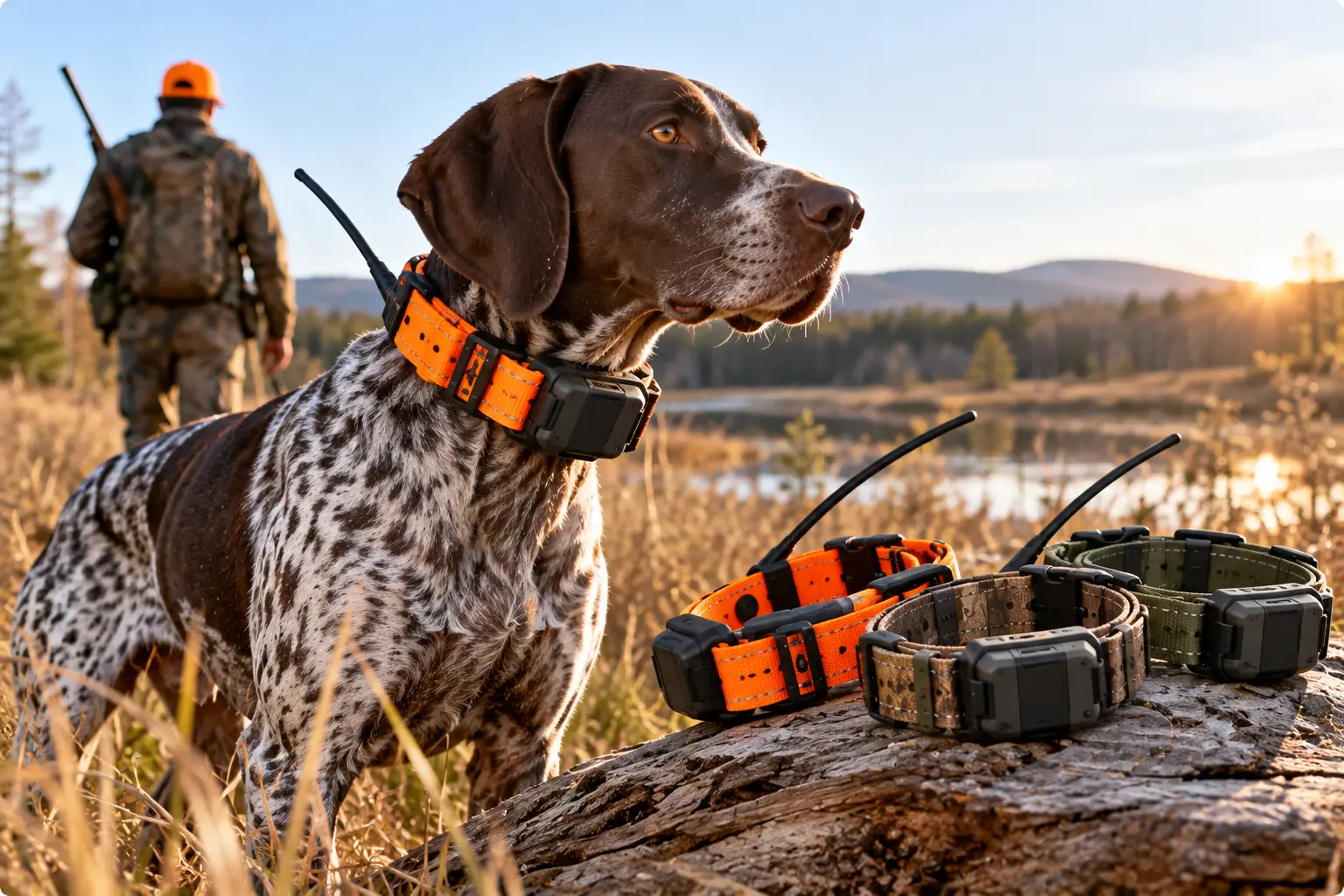
Today’s hunting collars do far more than hold an ID tag. The best of them pin your dog’s position on a topo map every two or three seconds, tell you when she’s on point or treed, let you correct a bad habit from half a mile away, and even light up so you can find her after sunset. The trick is that “hunting collar” covers several very different tools — GPS trackers, remote training e-collars, and combination systems — and buying the wrong category is the most expensive mistake you can make.
This guide cuts through that confusion. We compared spec sheets, manufacturer documentation, independent field reviews, and aggregated customer sentiment for seven real systems you can find on amazon.com, from a budget-friendly half-mile trainer to a satellite-connected flagship. You’ll also find practical setup advice, real-world scenarios, a cost-of-ownership breakdown, and the safety and radio rules that most listings never mention.
Whether you run a single Brittany on weekend grouse hunts or a string of coonhounds through river bottoms, you’ll leave knowing which of these hunting collars fits your dog, your terrain, and your budget — and why. Let’s get your dog back in sight. 🐕
What Is a Hunting Collar?
A hunting collar is a rugged, waterproof dog collar built for field work that does one or more of three jobs: tracks your dog’s location (GPS or radio), lets you communicate with your dog remotely through tone, vibration, or static stimulation, and makes the dog easier to find with lights or beepers.
Most premium GPS hunting dog collars in the US send location data from the collar to a handheld over VHF radio rather than through cell towers. Many use frequencies in the Multi-Use Radio Service (MURS), a license-by-rule band the FCC allows the public to use — which is why these systems keep working deep in backcountry where your phone shows zero bars. The tradeoff is that VHF is a line-of-sight technology: hills, ridges, and even the curvature of the Earth shorten real-world range compared to the “up to 9 miles” printed on the box.
Training-only e-collars, by contrast, have no GPS at all. They’re simpler, lighter, and cheaper, and they’re designed for dogs that work within sight or earshot. Understanding which job you actually need done is the foundation of every recommendation below.
Quick Comparison: Hunting Collars at a Glance
| Product | Type | Rated Range | Dogs Supported | Approx. Price Range | Best for |
|---|---|---|---|---|---|
| Garmin Alpha 300i + Alpha TT 25 | GPS + training + satellite SOS | Up to 9 miles | Up to 20 | Around $1,200–$1,250 | Garmin Alpha 300i + Alpha TT 25: serious multi-dog handlers in remote country |
| SportDOG TEK Series 2.0 GPS + E-Collar | GPS + training | Up to 10 miles | Up to 21 | High-hundreds (check current price) | SportDOG TEK Series 2.0 GPS + E-Collar: long-range upland and big-game dogs |
| Dogtra Pathfinder2 | GPS + training via phone app | Up to 9 miles | Up to 21 | Around $400–$450 | Dogtra Pathfinder2: smartphone users who hate subscriptions |
| Garmin Alpha T 20 | GPS tracking only (add-on collar) | Up to 9 miles | Depends on handheld | Around $300 | Garmin Alpha T 20: hound hunters already on Garmin |
| Dogtra Pathfinder2 Mini Compass | Compact GPS + training w/ handheld | Up to 4 miles | Expandable | Mid-hundreds (check current price) | Dogtra Pathfinder2 Mini Compass: smaller hunting breeds |
| SportDOG SportHunter 825X | Training e-collar | Up to ½ mile | Up to 3 | In the $200 range | SportDOG SportHunter 825X: medium-range training and hunting |
| SportDOG FieldTrainer 425XS | Training e-collar | Up to 500 yards | Up to 3 | Around $160 | SportDOG FieldTrainer 425XS: close-working, stubborn dogs |
Looking at the table, the real dividing line isn’t brand — it’s whether you need to find your dog or just talk to her. The SportDOG FieldTrainer 425XS and SportDOG SportHunter 825X cost a fraction of any GPS system because they skip tracking entirely, which makes them smart buys for flushing dogs and retrievers that rarely leave sight. Once your dog ranges past a few hundred yards, the jump to the Dogtra Pathfinder2 delivers the most tracking capability per dollar, while the Garmin Alpha 300i + Alpha TT 25 justifies its premium only if you’ll actually use satellite messaging and multi-dog management.
💬 One click helps other shoppers make an informed choice too! Tap any highlighted product to check current pricing and availability. 😊
Top 7 Hunting Collars: Expert Analysis
1. Garmin Alpha 300i + Alpha TT 25 — best all-in-one for remote country
The Garmin Alpha 300i + Alpha TT 25 bundle is the most complete tracking-and-training package in this lineup, and it’s built for hunters who regularly lose cell service.
Retailer spec sheets list tracking for up to 20 dogs at up to 9 miles, with an update rate as fast as 2.5 seconds on a sunlight-readable 3.5-inch touchscreen. In practice, that refresh rate means you see a dog swing toward a bird in near real time instead of reading a stale dot. The TT 25 collar offers 18 stimulation levels in momentary and continuous modes plus tone and vibration, and the “i” in 300i adds inReach satellite messaging and SOS — requiring a separate satellite subscription. As Gun Dog Magazine reported at launch, the new TT 25 and T 20 collars are slimmer and lighter than earlier Garmin collars, with up to 68 hours of runtime on a standard battery pack.
This is for western bird hunters, solo houndsmen, and anyone running multiple dogs where a twisted ankle 10 miles from the truck is a genuine risk. If you never leave cell coverage, the non-“i” Alpha 300 version saves real money with the same tracking core.
Aggregated sentiment across retailer and editorial reviews is strongly positive on screen clarity and Garmin’s mapping; Outdoor Life named the TT 25 paired with an Alpha handheld its top pick for hunting. The most common complaint is total cost, especially once subscriptions are added.
Pros:
- ✅ Satellite SOS works far beyond cell coverage
- ✅ Fast 2.5-second updates for up to 20 dogs
- ✅ Compatible with many older Garmin collars
Cons:
- ❌ Highest upfront cost in this lineup
- ❌ Satellite features require a paid subscription
Expect around $1,200–$1,250 for the bundle at the time of writing — premium pricing that pays off only if you’ll use the satellite and multi-dog features.
2. SportDOG TEK Series 2.0 GPS + E-Collar — longest rated range on the market
The SportDOG TEK Series 2.0 GPS + E-Collar stands out on one number: SportDOG rates it at up to 10 miles using its HopTek technology, a mile beyond Garmin and Dogtra’s flagships.
The collar combines GPS and GLONASS satellite tracking with 99 levels each of continuous, momentary, and rising static stimulation, plus tone and vibration. Ninety-nine levels sounds like overkill, but it matters for sensitive dogs: smaller steps let you find the lowest level your dog notices instead of jumping past it. The DryTek collar is submersible to 25 feet, lasts about 24 hours per charge at a 3-second update rate, and fits dogs 8 pounds and up with 10.75- to 23-inch necks. The handheld ships with preloaded 1:100,000 topo maps and expands to 21 collars.
Based on comparing the specs, this is the system for houndsmen and pointing-dog hunters in big, open country who want deep training control without a smartphone in the loop. The weak point is the handheld itself — about 12 hours per charge is noticeably shorter than the Garmin units, so plan on a spare power bank for multi-day trips.
Field & Stream picked the TEK 2.0 as its best long-range dog GPS tracker, and buyers consistently praise range and reliability; the recurring gripe is a handheld interface that feels dated next to a touchscreen.
Pros:
- ✅ Longest rated range at up to 10 miles
- ✅ 99 stimulation levels allow very fine adjustments
- ✅ Collar submersible to 25 feet for water dogs
Cons:
- ❌ Handheld battery lasts about 12 hours
- ❌ Interface feels older than touchscreen competitors
Pricing typically sits in the high-hundreds — check the current price — making it solid value for pure range.
3. Dogtra Pathfinder2 — best value with no subscription
The Dogtra Pathfinder2 turns your smartphone into the handheld, which is exactly why it costs less than half of a comparable Garmin bundle.
A small GPS Connector clips to your gear and relays collar data to Dogtra’s free app over Bluetooth, while the collar talks to the connector over radio, so it still works off-grid. Dogtra lists up to 9 miles of range, 21 dogs, and a 2-second update rate — the quickest refresh in this roundup. The redesigned collar adds an LED locate light and pager vibration, and the connector now has a physical e-collar button so you’re not fumbling with a touchscreen at the critical moment. The app supports offline maps and geofencing with no monthly fee.
Here’s what to weigh: your phone becomes mission-critical. In cold weather, phone batteries drain fast, so this suits hunters who already carry a power bank and like modern app design. The 6.6-ounce collar is reasonably light for a full GPS unit.
Reviews consistently report strong accuracy and value; one detailed retailer review noted field accuracy within a few yards. The most frequent complaint is that the Pathfinder2 isn’t backward-compatible with original Pathfinder collars, frustrating upgraders.
Pros:
- ✅ Fastest 2-second update rate in this lineup
- ✅ No subscription for maps or tracking
- ✅ Physical e-collar button on the connector
Cons:
- ❌ Depends on your phone’s battery and screen
- ❌ Not compatible with original Pathfinder collars
At around $400–$450, it delivers the most GPS capability per dollar on this list.
4. Garmin Alpha T 20 — tracking-only workhorse for houndsmen
The Garmin Alpha T 20 is a tracking-only GPS collar, which makes it the ideal add-on for hunters who already own a Garmin handheld and don’t want training stimulation on every dog.
It uses multi-GNSS reception (GPS plus Galileo), offers up to 9 miles of range, and runs up to 68 hours on its user-replaceable battery when set to dynamic tracking. That “dynamic” setting is the hidden value: the collar updates quickly when the dog moves fast and slows down when she’s lying still, stretching battery through long nights on the track. LED beacon lights in several colors help you identify dogs after dark, and the receiver is waterproof to 10 meters. Total weight with strap is about 8.4 ounces.
On paper, this is the coon hunter’s and bear hunter’s collar: long run times, no risk of accidental stimulation, and multiple light colors to tell dogs apart at the tree. Remember it’s useless alone — it must pair with a compatible handheld like the Alpha 10, 200, or 300 series.
Treeline Review’s hands-on test found it heavy and bulky for smaller breeds and noted battery life depends heavily on update-rate settings, while praising its backcountry reliability.
Pros:
- ✅ Up to 68 hours with dynamic tracking
- ✅ Colored LED beacons simplify night identification
- ✅ No training module means no accidental corrections
Cons:
- ❌ Requires a separately purchased Garmin handheld
- ❌ Bulky for small and mid-size dogs
Around $300 for the collar alone — fair value if you’re already invested in Garmin.
5. Dogtra Pathfinder2 Mini Compass — compact pick for smaller hunting breeds
The Dogtra Pathfinder2 Mini Compass packs GPS tracking and e-collar training into a smaller collar paired with a dedicated handheld, so you’re not relying on your phone.
The Mini collar is designed for dogs roughly 15 to 100+ pounds and is rated to 4 miles of range. The handheld uses a MURS-band antenna plus GPS, which means it tracks fully offline with no ongoing costs. Four miles sounds modest next to 9-mile flagships, but here’s the reality: in timbered or hilly terrain, line-of-sight radio rarely reaches its rated maximum anyway, and most flushing and close-working pointing dogs never get close to four miles out.
This is the sweet spot for owners of springers, cockers, smaller Brittanys, and Boykins who found full-size GPS collars too heavy. It also suits hunters who want a physical handheld without paying flagship prices. If you run big-running setters across open prairie, step up to a 9-mile system instead.
Verified customer review volume for this specific Compass bundle is still limited compared with older models, so we can’t summarize broad owner sentiment with confidence. What’s verifiable is Dogtra’s reputation for durable e-collars and the strong reception of the Pathfinder2 platform it’s built on.
Pros:
- ✅ Smaller collar suits lighter hunting breeds
- ✅ Dedicated handheld works without a smartphone
- ✅ No subscription or ongoing fees
Cons:
- ❌ 4-mile range limits big-running dogs
- ❌ Limited long-term owner reviews so far
Expect mid-hundreds pricing — check the current price — strong value for small-dog handlers.
6. SportDOG SportHunter 825X — half-mile training with beeper add-on option
The SportDOG SportHunter 825X is SportDOG’s entry into its long-range training family, giving you half a mile of reliable communication without the cost of GPS.
You get tone, vibration, and 21 static levels, with the remote offering low, medium, and high options per dial setting. The remote is designed for no-look operation — a slight dial roll and a button press — so your eyes stay on the dog, not the device. It expands to 3 dogs with Add-A-Dog collars, fits dogs 8 pounds and up, and its lithium-ion batteries charge in 2 hours and last 50–70 hours. Critically for hunters, the system supports SportDOG’s optional remote beeper locator, letting you trigger an audible signal to find a dog on point in heavy cover.
This collar fits upland hunters and waterfowlers whose dogs work within a quarter to half mile, and trainers who want one tool for yard and field. Retailer analysis notes the low, gradual stimulation steps work well for sensitive breeds.
Owner sentiment across major US retailers is generally positive on ease of use and battery life; we couldn’t verify a large, consistent body of complaints, though some buyers wish the beeper module were included rather than sold separately.
Pros:
- ✅ Half-mile range covers most upland work
- ✅ 50–70 hours of battery per charge
- ✅ Supports optional beeper for dogs on point
Cons:
- ❌ No GPS — you can’t see location
- ❌ Beeper module costs extra
In the $200 range, it’s excellent value for hunters who need control more than tracking.
7. SportDOG FieldTrainer 425XS — budget trainer for stubborn close-workers
The SportDOG FieldTrainer 425XS is SportDOG’s smallest, lightest e-collar, and the “S” stands for higher static range aimed at high-drive, hardheaded dogs.
It delivers tone, vibration, and 21 static levels out to 500 yards, expands to 3 dogs, and is waterproof and submersible to 25 feet. The batteries charge in about two hours and last 50 to 70 hours, meaning a full season weekend on one charge isn’t unrealistic. That higher static ceiling matters in a specific situation: a hard-charging Lab locked onto a crippled bird across a cattail slough may ignore levels that would stop a softer dog. The trade-off is that sensitive dogs may not need that headroom at all.
This is the right pick for duck dogs, pheasant flushers, and young dogs in their first real season — anything that works inside 500 yards. If your dog regularly disappears over the horizon, no amount of stimulation helps; you need GPS.
Dogster named the 425XS its best overall hunting dog collar, and verified buyers on SportDOG’s own site appreciate the included training manual and supporting video library. Reviews often note it’s simple enough to use without looking.
Pros:
- ✅ Lowest price in this lineup
- ✅ Higher stimulation range suits stubborn dogs
- ✅ Light, compact receiver for long days
Cons:
- ❌ 500-yard range only suits close workers
- ❌ May be too strong for soft-tempered dogs
Around $160 at the time of writing — the best entry point into quality hunting dog training collars.
Side-by-Side Spec Comparison of All 7
| Product | Update Rate / Response | Collar Battery Life | Waterproofing | Stimulation | Best for |
|---|---|---|---|---|---|
| Garmin Alpha 300i + Alpha TT 25 | Up to 2.5 sec | Up to 68 hrs | Waterproof | 18 levels + tone/vibe | Garmin Alpha 300i + Alpha TT 25: remote multi-dog hunts |
| SportDOG TEK Series 2.0 GPS + E-Collar | 3 sec | ~24 hrs | Submersible to 25 ft | 99 levels + tone/vibe | SportDOG TEK Series 2.0 GPS + E-Collar: maximum range |
| Dogtra Pathfinder2 | 2 sec | About a full day | Waterproof | E-collar + pager | Dogtra Pathfinder2: app-first hunters |
| Garmin Alpha T 20 | 2.5 sec to 2 min | Up to 68 hrs | 10 m (1 ATM) | None | Garmin Alpha T 20: long hound runs |
| Dogtra Pathfinder2 Mini Compass | Live GPS | Full-day class | Waterproof | E-collar | Dogtra Pathfinder2 Mini Compass: smaller breeds |
| SportDOG SportHunter 825X | Instant (no GPS) | 50–70 hrs | Submersible to 25 ft | 21 levels + tone/vibe | SportDOG SportHunter 825X: half-mile control |
| SportDOG FieldTrainer 425XS | Instant (no GPS) | 50–70 hrs | Submersible to 25 ft | 21 levels + tone/vibe | SportDOG FieldTrainer 425XS: stubborn close-workers |
The pattern here is that battery life and GPS refresh rate pull in opposite directions. The SportDOG TEK Series 2.0 GPS + E-Collar runs its fast 3-second updates for about a day, while the Garmin Alpha T 20 stretches to 68 hours largely by slowing updates when the dog isn’t moving. Training-only units like the SportDOG FieldTrainer 425XS last two to three times longer simply because they aren’t powering a GPS chip and radio transmitter.
🎯 Ready to Stop Guessing Where Your Dog Is?
🔍 Every system above solves a different problem — pick the one that matches how far your dog actually ranges. Click a highlighted product name to check current pricing and availability on Amazon, and get back to hunting instead of searching!
Getting Started: Your First 30 Days With a New Hunting Collar
A new collar can feel like a cockpit full of switches. Here’s a practical sequence that avoids the most common early stumbles.
Days 1–3: Charge, update, and pair at home. Fully charge both collar and handheld before anything else, then install firmware updates. Garmin’s newest collars can update automatically over Wi-Fi while charging, which saves a desk session. Pair every collar indoors, name each dog, and assign distinct colors so you’re not guessing in the field.
Days 4–7: Fit it right. Contact points must touch skin, not float on fur. The classic rule is that you can slide one or two fingers between strap and neck. Long-coated setters and Gordons often need the longer contact points included with most SportDOG systems. Never leave a training collar in the same spot on the neck for more than several hours — rotate position to prevent pressure sores.
Week 2: Introduce the collar as “furniture.” Let your dog wear it during fun activities — walks, retrieves, meals — with the stimulation off. You want the collar to predict good things, not corrections.
Week 3: Find the working level. Start at the lowest stimulation setting and step up one level at a time until you see a subtle response like an ear twitch or head turn. That’s your dog’s working level, and it’s usually far lower than owners expect. Many experienced trainers pair a tone or vibration cue first so the dog learns to respond before static is ever needed.
Week 4: Test tracking in safe terrain. Before opening day, take the GPS system to a familiar field. Walk away from your dog (with a helper) and watch how accurately the map matches reality, how quickly updates arrive, and where hills block the signal. That rehearsal is worth more than any spec sheet.
Matching the Collar to the Hunter: Three Real-World Scenarios
Scenario 1: The weekend pheasant hunter with one Lab. Budget around $200, hunts public land in the Midwest maybe 12 days a season, and the dog flushes within 40 yards. GPS is unnecessary here. The SportDOG FieldTrainer 425XS handles steadiness work and recall at a price that leaves room for shells and a blaze-orange vest. If the dog also retrieves across big water or wide marshes, the half-mile SportDOG SportHunter 825X adds comfortable headroom.
Scenario 2: The western chukar hunter running two pointing dogs. Budget is $1,000-plus, dogs range a half mile or more across steep canyons, and cell coverage disappears after the trailhead. This hunter benefits from every premium feature: fast updates to catch points, topo maps for navigating ridges, and satellite SOS for personal safety. The Garmin Alpha 300i + Alpha TT 25 is the logical fit, with a second TT 25 collar added for dog number two. A hunter willing to trade satellite messaging for extra range could choose the SportDOG TEK Series 2.0 GPS + E-Collar instead.
Scenario 3: The tech-savvy grouse hunter on a budget. Budget is roughly $450, hunts thick Appalachian or Great Lakes cover where a dog vanishes at 60 yards, and already lives in phone apps. The Dogtra Pathfinder2 gives full GPS tracking, a locate light, and pager vibration for a fraction of flagship cost. If the dog is a smaller springer or cocker, the lighter Dogtra Pathfinder2 Mini Compass is the more comfortable choice.
Notice the common thread: the right purchase is driven by range, terrain, and dog size — not by which collar has the longest feature list.
Problem → Solution: Fixing the Most Common Collar Headaches
Problem 1: The GPS dot “jumps” or lags. Usually this is terrain, not hardware. VHF signals between collar and handheld weaken behind ridges and in deep draws. Solution: move to higher ground, hold the handheld antenna vertical, and if your system offers adjustable update rates, use the faster setting during active hunting.
Problem 2: The battery dies before the hunt ends. Solution: use dynamic or slower update modes during long hound runs — the Garmin Alpha T 20 is built around this — and enable rescue or low-power modes when a dog is lost. Dogtra says the Dogtra Pathfinder2‘s Rescue Mode can add almost six hours of collar life. Carry a USB power bank for phone-based systems.
Problem 3: The dog ignores stimulation. Nine times out of ten, contact points aren’t touching skin. Solution: switch to longer contact points, tighten the strap one notch, and recheck after the dog gets wet, since soaked coats shift. Only then consider raising the level.
Problem 4: The dog becomes “collar-wise.” He behaves only when wearing the collar. Solution: have him wear it (or a dummy collar) during many sessions with no corrections at all, so it never signals “work mode.”
Problem 5: You can’t tell dogs apart at night. Solution: assign different LED colors or collar strap colors per dog. Garmin’s collars offer multiple beacon colors, and SportDOG includes color ID bands with add-a-dog collars.
How to Choose Hunting Collars
Use these seven steps in order — each one narrows the field.
- Measure how far your dog actually ranges. Under 500 yards points to a training e-collar; beyond a half mile, you need GPS.
- Decide between tracking, training, or both. Tracking-only collars avoid accidental corrections; combo units save carrying two systems.
- Match collar weight to your dog’s size. A collar over 8 ounces can tire a 30-pound dog over a long day.
- Check the update rate. Two to three seconds lets you see a point develop; slower rates conserve battery for hounds.
- Count total battery hours you need. Overnight hound hunts demand 24+ hours; morning upland hunts need far less.
- Confirm waterproofing for your hunting style. Duck dogs need full submersion ratings, not just “water-resistant.”
- Calculate total cost, not sticker price. Include extra collars, subscriptions, and replacement batteries over five years.
Following this order prevents the most expensive trap: buying a 9-mile GPS flagship for a dog that never leaves the 40-yard flushing zone, or a budget trainer for a dog you can’t even see.
GPS Hunting Dog Collars vs Beeper and Training-Only Collars
Before GPS hunting dog collars became common, upland hunters relied on bells and beeper collars, and houndsmen used VHF telemetry with directional antennas. Those tools still have a place, but they answer a narrower question.
A beeper collar tells you, by ear, roughly where your dog is and whether she’s running or pointed — usually by changing its beep pattern when the dog stops. That’s genuinely useful in thick grouse cover within a couple hundred yards. Beyond earshot, though, it falls silent as a source of information. Training e-collars like the SportDOG SportHunter 825X add remote communication, and its optional beeper module blends both jobs at a modest price.
GPS changes the question from “Where did that sound come from?” to “There she is, 640 yards northeast, on point for 45 seconds.” It also records tracks, so you can see where a dog worked cover and where she skipped it — valuable information for training young dogs.
| Feature | GPS Hunting Collar | Beeper Collar | Training-Only E-Collar | Best for |
|---|---|---|---|---|
| Shows exact location | ✅ Yes, on a map | ❌ Sound only | ❌ No | GPS: big-running dogs |
| Works beyond earshot | ✅ Miles | ❌ Limited | ⚠️ Commands only | GPS: open country |
| Point / treed alerts | ✅ On many models | ✅ Beep pattern | ❌ No | Beeper: tight grouse cover |
| Remote correction | ✅ On combo models | ❌ No | ✅ Yes | E-collar: steadiness training |
| Typical cost | Highest | Lowest | Low to mid | E-collar: budget training |
The table makes the tradeoff clear: GPS hunting collars win on information, while beepers and training-only collars win on simplicity, weight, and cost. For many grouse and woodcock hunters, a beeper-ready trainer such as the SportDOG SportHunter 825X remains the most practical answer, but once dogs range beyond hearing, GPS isn’t a luxury — it’s how you get your dog home.
Features That Actually Matter (and Ones That Don’t)
Features that matter:
⚡ Update rate. The difference between 2.5 seconds and 30 seconds is the difference between watching a point happen and finding out about it after the bird flushes.
🔋 User-replaceable batteries. Lithium-ion cells degrade over several seasons. Systems like the Garmin Alpha T 20 with swappable battery packs avoid buying a whole new collar when capacity fades.
📡 Antenna design. A flexible, replaceable antenna survives briar patches and fence crossings far better than a fixed one.
💡 Locate lights and pager vibration. The Dogtra Pathfinder2‘s LED light and pager function offer non-aversive ways to call a dog in or find it at dusk.
🐾 Point and treed detection. Knowing the dog has stopped is often more useful than knowing exactly where it is.
Features that matter less than marketing suggests:
❌ Maximum rated range. “Up to 10 miles” assumes ideal line of sight. In real hunting terrain, every system on this list performs closer together than the box numbers suggest.
❌ Dog capacity beyond your needs. Tracking 20 or 21 dogs is impressive, but if you’ll never run more than two, don’t let that number drive your purchase.
❌ Huge stimulation level counts. Ninety-nine levels on the SportDOG TEK Series 2.0 GPS + E-Collar offer finer steps, but the 21 levels on the SportDOG FieldTrainer 425XS are plenty for most dogs. Consistent timing matters far more than level count.
Long-Term Cost and Maintenance
Sticker price is only the opening bid. Over a typical five-year ownership period, add-on collars, subscriptions, and battery replacement can reshape which system is really the bargain.
| Product | Upfront Cost Range | Recurring Costs | Expansion Cost | 5-Year Value Verdict | Best for |
|---|---|---|---|---|---|
| Garmin Alpha 300i + Alpha TT 25 | Around $1,200–$1,250 | Optional inReach plan; optional map subscription | Additional TT 25 or T 20 collars | Strong if satellite features are used | Garmin Alpha 300i + Alpha TT 25: safety-first remote hunters |
| SportDOG TEK Series 2.0 GPS + E-Collar | High-hundreds | None required; lifetime map updates | Add-A-Dog collars | Good long-range value | SportDOG TEK Series 2.0 GPS + E-Collar: no-subscription range |
| Dogtra Pathfinder2 | Around $400–$450 | None; free app | Extra Pathfinder2 collars | Best GPS value | Dogtra Pathfinder2: cost-conscious trackers |
| SportDOG FieldTrainer 425XS | Around $160 | None | Add-A-Dog (up to 3) | Excellent for close workers | SportDOG FieldTrainer 425XS: budget training |
The takeaway is that no-subscription systems like the Dogtra Pathfinder2 and SportDOG TEK Series 2.0 GPS + E-Collar keep their cost advantage over time, while the Garmin Alpha 300i + Alpha TT 25 only earns its higher lifetime cost if you value satellite communication. For multi-dog households, check the price of each extra collar — that, not the starter bundle, often drives total spending.
Maintenance habits that extend collar life:
- ✅ Rinse collars with fresh water after saltwater or muddy hunts.
- ✅ Store lithium-ion batteries partially charged during the off-season, not empty.
- ✅ Inspect straps and contact points for wear before each season.
- ✅ Keep firmware current — updates often improve battery management and tracking.
Hunting Dog Training Collar Safety, Regulations, and Standards
Responsible use of any hunting dog training collar starts with understanding both your dog’s welfare and the rules that govern the equipment.
Radio rules. Many US GPS dog trackers transmit on MURS frequencies, which are licensed by rule under the FCC’s Part 95 — meaning you don’t need an individual license, but the devices themselves must be certified and labeled. Practically, this means buying genuine, FCC-certified hardware from reputable brands and avoiding gray-market imports built for other countries’ frequencies, which may be illegal to operate here.
Hunting regulations. Rules on electronic tracking and training devices are set by state wildlife agencies and vary by species, season, and location. Some states limit electronic devices during certain seasons or on specific public lands, and field trials often have their own rules. Always check your state’s current hunting regulations before opening day.
Welfare and fit. Use the lowest effective stimulation level, pair corrections with clear cues, and never use static stimulation as punishment for a dog that doesn’t yet understand the command. Check for skin irritation under contact points after each outing, and don’t leave training collars on unsupervised dogs for extended periods.
Battery safety. Lithium-ion batteries should be charged with the manufacturer’s charger, kept away from heat, and replaced if swollen or damaged.
Following these guidelines protects your dog, keeps you legal, and preserves public trust in electronic training tools — something every hunter benefits from.
Common Mistakes to Avoid When Buying Hunting Collars
1. Buying range you’ll never use. A 9- or 10-mile rated system is wasted on a dog working 50 yards ahead in grouse cover. Spend that money on training instead.
2. Ignoring collar weight. A heavy GPS unit on a small dog causes fatigue and chafing. This is why the Dogtra Pathfinder2 Mini Compass exists — match the hardware to the dog.
3. Forgetting compatibility. Not every collar works with every handheld. The Dogtra Pathfinder2 won’t pair with original Pathfinder collars, while Garmin’s newer collars work across many Alpha handhelds. Check before you buy add-ons.
4. Overlooking cold-weather battery drain. Phone-dependent systems lose power fast in late-season cold. Carry a power bank or choose a dedicated handheld.
5. Treating the collar as a training shortcut. No e-collar replaces foundational obedience. The collar reinforces commands a dog already understands.
6. Choosing on brand loyalty alone. If your hunting partners run Garmin, sharing compatible collars can be useful — but don’t buy a flagship just to match. Buy what fits your dog and terrain.
7. Skipping the waterproof rating. “Water-resistant” isn’t enough for retrievers. Look for explicit submersion ratings like the 25-foot DryTek rating on SportDOG collars.
FAQ About Hunting Collars
❓ Do GPS hunting collars require a monthly subscription?
❓ What's the best hunting dog tracking collar for a small dog?
❓ Can I use an e-collar for hunting dogs that also tracks location?
❓ How long do hunting collar batteries last in the field?
❓ Is a beeper collar for hunting dogs still worth buying?
Conclusion: Choosing the Right Hunting Collar for Your Dog
The best hunting collars aren’t the ones with the biggest numbers on the box — they’re the ones that match how your dog actually hunts. If your dog flushes birds within shotgun range, a dependable trainer like the SportDOG FieldTrainer 425XS or the half-mile SportDOG SportHunter 825X gives you control without paying for satellites you’ll never use.
Once your dog ranges beyond sight and sound, GPS becomes essential. The Dogtra Pathfinder2 delivers remarkable capability for the money, and the Dogtra Pathfinder2 Mini Compass brings that technology to smaller breeds. Hound hunters already on Garmin will appreciate the long battery life of the Garmin Alpha T 20, while the SportDOG TEK Series 2.0 GPS + E-Collar stretches range further than anything else here. And for remote, multi-dog adventures where your own safety matters as much as your dog’s, the Garmin Alpha 300i + Alpha TT 25 is worth its premium.
Whatever you choose, give yourself a few weeks to learn the system before the season opens. Fit it properly, find your dog’s working level, and test your tracking in familiar terrain. For more field-tested perspectives, Outdoor Life’s GPS dog collar testing is a useful second opinion. The collar is a tool — the bond and training behind it are what bring your dog back every time. 🐾
🏆 Gear Up Before Opening Day!
✨ The right collar turns anxious searching into confident hunting. Click any highlighted product above to check current pricing and availability, and spend this season watching points instead of looking for your dog!
Recommended for You
- GPS Tracking Necklace for Child: 7 Smart, Safe Picks (2026 Guide)
- Perimeter Dog Collars: 7 Best Picks That Actually Work in 2026
- Best GPS Tracker for Equipment: 7 Proven Picks for 2026
Disclaimer: This post contains affiliate links. As an Amazon Associate, I earn from qualifying purchases made through these links, at no additional cost to you.
✨ Found this article helpful? Share it with someone who needs it! 💬🤗