
In This Article
Keeping Little Explorers Found: An Honest Introduction
Quick note: this post contains affiliate links. If you buy through them, we may earn a small commission at no extra cost to you.
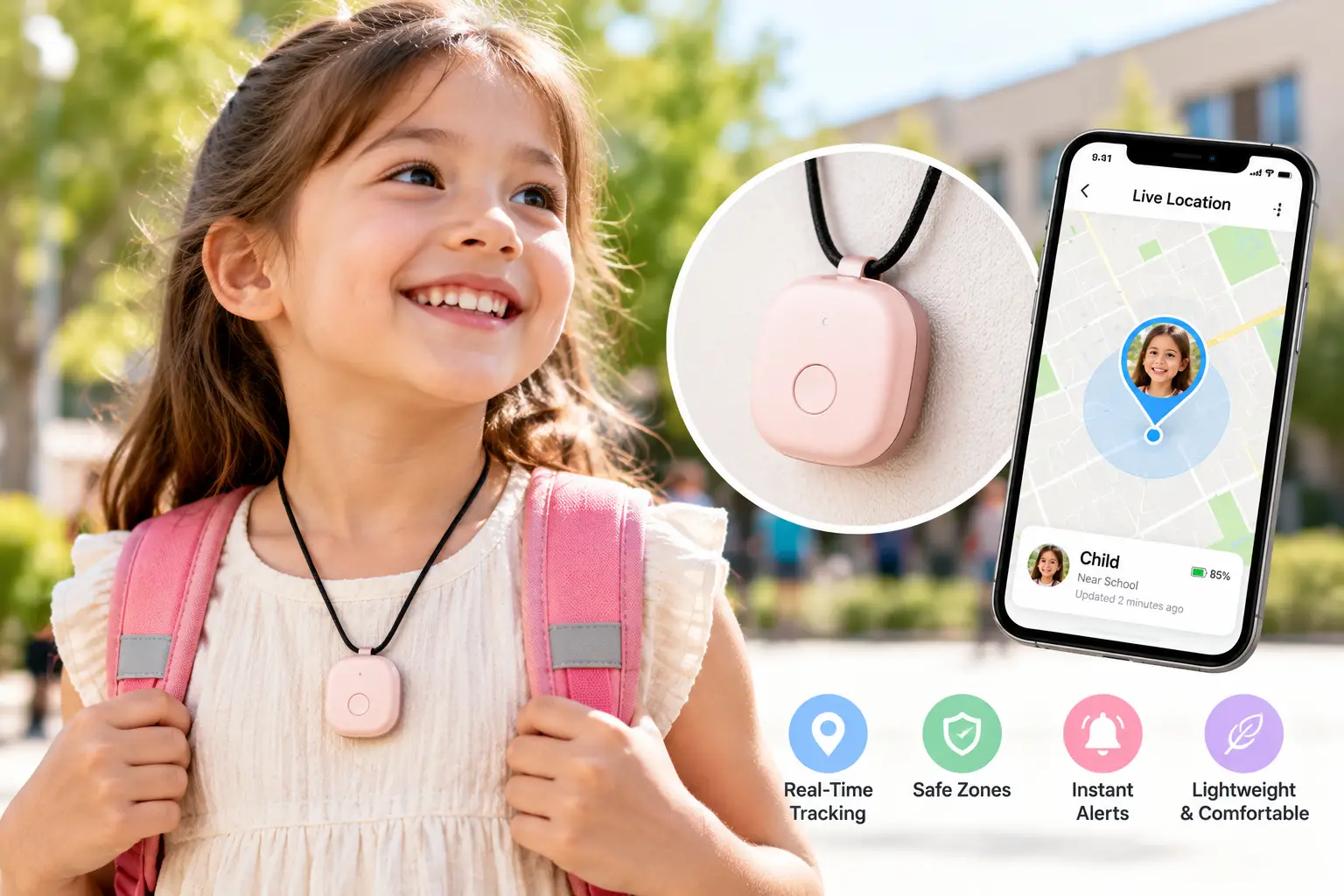
Every parent knows the feeling. You glance down at the cereal aisle, look back up, and your five-year-old has simply evaporated. It usually lasts ten seconds. Sometimes it lasts ten minutes. And those ten minutes are exactly why searches for a gps tracking necklace for child keep climbing in 2026.
Here’s the thing most product pages won’t tell you upfront: there’s almost no such thing as a purpose-built “GPS necklace” with a tracker baked into the chain. What families actually buy is a small tracker paired with a lanyard, pendant holder, or breakaway cord. That distinction matters, because the tracker decides how accurately you find your kid, and the cord decides whether wearing it is safe.
So this guide does two jobs at once. First, it compares seven real trackers you can order on amazon.com — from true cellular GPS devices to cheaper Bluetooth tags — and explains, honestly, which ones genuinely locate a child across town and which ones only work when other phones happen to be nearby. Second, it walks you through the safety side: breakaway cords, age limits, button batteries, and the subscription math that quietly doubles the price of most trackers over two years.
To build this guide, we compared manufacturer spec sheets, independent reviews from outlets like SafeWise’s hands-on kids GPS tracker testing, and the aggregated themes in real customer feedback. We haven’t personally field-tested every model, so we’ll always tell you where a claim comes from. No fake testimonials, no invented star ratings — just the analysis you’d want from a well-read friend who happens to obsess over spec sheets.
Ready? Let’s find your kid’s new favorite (and least-noticed) accessory.
What Is a gps tracking necklace for child?
A gps tracking necklace for child is a small location tracker worn around a child’s neck on a lanyard or pendant holder, letting parents see the child’s position in a phone app. True GPS models use satellites plus a cellular connection for real-time, unlimited-range tracking; cheaper Bluetooth tags only update when compatible phones pass nearby.
That one-sentence split — cellular GPS versus Bluetooth “crowd-finding” — is the single most important thing to understand before you spend a dollar. A cellular tracker carries its own SIM card and reports its location on its own, which is why nearly all of them need a monthly plan. A Bluetooth tag like an AirTag costs nothing per month, but it’s essentially a beacon whispering to strangers’ phones; on an empty trail or in a quiet suburb, it may go silent for long stretches.
Under the hood, a GPS tracker calculates its position from satellite signals, then sends that position to a server over a cellular network so your app can display it. For parents, though, the practical translation is simple: if you need to find a child anywhere, you need cellular GPS. If you mostly need a backup for crowded places full of iPhones or Galaxy phones, a Bluetooth tag can be a reasonable budget layer.
Quick Comparison: 7 Child Trackers at a Glance
| Tracker | Technology | Battery (typical) | Ongoing cost | Best for |
|---|---|---|---|---|
| Greenlight Safe Kids GPS Tracker | Cellular GPS + Wi-Fi | Up to ~30 days | Low monthly plan | Greenlight Safe Kids — best all-round value |
| Tracki 4G LTE GPS Tracker | Cellular GPS + Wi-Fi | 2-5 days live | Monthly plan | Tracki — budget hardware, lanyard included |
| AngelSense Personal GPS Tracker | Cellular GPS + Wi-Fi + voice | About 1 day heavy use | Premium monthly plan | AngelSense — kids who wander |
| Invoxia Cellular GPS Tracker | LTE-M GPS + Wi-Fi | Weeks | Low annual plan | Invoxia — longest-lasting cellular option |
| Spytec Atlas GPS Tracker | 4G LTE GPS | Up to ~14 days | Monthly plan | Spytec Atlas — older kids, rugged use |
| Apple AirTag (2nd generation) | Bluetooth + UWB (Find My) | 1+ year | None | AirTag (2nd gen) — iPhone families, crowds |
| Samsung Galaxy SmartTag2 | Bluetooth + UWB (SmartThings Find) | Many months | None | Galaxy SmartTag2 — Android families |
Looking at the table, the first five rows are true GPS trackers and the last two are Bluetooth tags — and that split matters more than any battery number. Greenlight Safe Kids stands out because it pairs genuine cellular GPS with a month-long battery and one of the lowest plans in the category, while Invoxia wins on endurance but trades away update speed. The two Bluetooth tags are the only true “no monthly fee” picks, but they’re backups, not primary safety devices.
💬 One click helps other shoppers make an informed choice too! 😊
Top 7 GPS Tracking Necklace Picks for Kids: Expert Analysis
1. Greenlight Safe Kids GPS Tracker — best everyday value for families
Greenlight Safe Kids GPS Tracker earns the top spot because it nails the three things parents use daily: a reliable location, long battery life, and a simple SOS button. Greenlight launched this screen-free device in March 2026, and it’s sold on amazon.com and Greenlight’s own store.
On paper, it combines GPS, Wi-Fi, and IoT cellular networks, and Greenlight rates outdoor accuracy at roughly 10-16 feet. In practice, that’s precise enough to tell whether your child is on the playground or in the parking lot. The up-to-30-day battery rating is the real headline: you could realistically charge it on the first of the month and forget about it, which matters because a dead tracker is a useless tracker.
Who’s it for? Elementary-age kids heading to the bus, soccer practice, or sleepovers — children old enough to press an SOS button deliberately but not ready for a phone. Because the tracker is small and clip-friendly, it sits comfortably in a breakaway lanyard pouch.
Honest caveat on reviews: because the device is new in 2026, there’s no large, long-term pool of verified customer reviews yet. Greenlight’s broader app is highly rated, but that reflects the money app, not this hardware specifically.
Pros:
- ✅ Month-long battery rating means far fewer charging chores
- ✅ One-tap SOS alerts reach parents anywhere with coverage
- ✅ Very low monthly plan compared with most GPS rivals
Cons:
- ❌ Limited long-term review history since its 2026 launch
- ❌ No voice calling, so kids can’t talk back
Expect the device in the $40-$80 range, with plans around $5-$6 a month — excellent value for a true cellular GPS tracker.
2. Tracki 4G LTE GPS Tracker — cheapest way into real GPS
Tracki 4G LTE GPS Tracker is the budget-friendly entry ticket to genuine cellular tracking, and it’s one of the few that ships with a lanyard in the box. SafeWise even named it its best-value pick in its Kids Safety Awards.
The spec sheet lists 4G LTE with older-network fallback, Wi-Fi positioning when GPS is blocked indoors, an SOS button, and geofence alerts by push, text, or email. Translation: you’ll get a usable location inside a mall or school building, not just outdoors. Tracki also bundles a silicone cover, belt clip, key ring, and lanyard, so turning it into a kids gps tracker necklace takes about thirty seconds.
The trade-off is battery. In live mode (updates every 1-5 minutes), Tracki’s own rating is just 2-5 days. Switch to battery-saver and it stretches to weeks, but then you lose the near-real-time view you probably bought it for. That makes it best for planned outings — field trips, theme parks, travel days — rather than set-and-forget daily wear.
Aggregated review sentiment is mixed on exactly this point: reviewers consistently praise easy setup and global coverage, while a recurring complaint is that the battery drains faster than expected, along with frustration that plan details sit inside the app.
Pros:
- ✅ Very low hardware cost for true cellular GPS
- ✅ Lanyard, clip, and silicone case included out of box
- ✅ Wi-Fi positioning helps indoors where GPS struggles
Cons:
- ❌ Live-tracking battery often lasts only a few days
- ❌ Subscription pricing is buried inside the app
Hardware often sells in the $20-$60 range, with plans roughly $10-$20 monthly — strong value if you’ll charge it often.
3. AngelSense Personal GPS Tracker — built for children who wander
AngelSense Personal GPS Tracker is the specialist on this list, designed specifically for kids with autism and other special needs who are prone to wandering. SafeWise named it best overall in its 2026 Kids Safety Awards.
Its standout features go well beyond a dot on a map: a two-way auto-answer speakerphone, so you can talk to your child without them pressing anything, plus an SOS button and Wi-Fi-assisted searching for large indoor spaces. Practically, that auto-answer voice feature is huge — a frightened or nonverbal child doesn’t have to operate the device for you to reassure them or hear what’s around them.
One important honesty point: AngelSense is designed to fasten securely to clothing with non-removable fasteners and a parent key, not to hang loosely on a cord. That’s intentional — a child who pulls off necklaces can’t easily ditch it. If you specifically want a necklace format, this isn’t it; if you want a tracker your child can’t remove, it may be the better answer.
Reviews consistently describe it as a “game changer” for families managing wandering, while the most common complaint is cost — some parents report switching to cheaper brands at renewal — and occasional GPS inaccuracy or delayed alerts.
Pros:
- ✅ Auto-answer speakerphone works without child’s help
- ✅ Tamper-resistant fasteners stop kids removing it
- ✅ Purpose-built features for special-needs families
Cons:
- ❌ Highest monthly cost on this list by far
- ❌ Battery may need daily charging with heavy use
Device promotions vary widely; plans run roughly $40-$50 monthly — worth it mainly where wandering risk is real.
4. Invoxia Cellular GPS Tracker — longest battery among true GPS picks
Invoxia Cellular GPS Tracker is the endurance champion of the cellular group, built by a French company and sold in a US version that runs on the AT&T LTE-M network.
Here’s what the specs mean in real life. LTE-M is a low-power cellular network that’s good at reaching indoors, which is why the battery stretches from about 15 days to 7 weeks depending on update frequency. At roughly 1 ounce and under half an inch thick, it’s slim enough for a pendant pouch without bouncing around. The first year of service is typically included, with a modest annual fee afterward.
The catch? Update intervals. Invoxia’s tracker reports every 5, 10, or 30 minutes while moving — fine for confirming your child reached school, too slow for chasing a toddler through a festival crowd. It’s also marketed heavily as an anti-theft device for bikes and cars, so the app leans toward “where is my stuff” rather than kid-specific features like an SOS button.
Aggregated review themes are positive on battery life, small size, and accuracy, while reviewers note the device simply won’t function without the subscription.
Pros:
- ✅ Weeks of battery between charges in normal use
- ✅ Low annual plan after the included first year
- ✅ Slim, light body suits a pendant holder
Cons:
- ❌ Slower 5-30 minute updates limit emergency use
- ❌ No dedicated SOS button for kids
Expect around $100-$130 including the first year — outstanding long-term value for routine check-ins.
5. Spytec Atlas GPS Tracker — rugged pick for tweens and teens
Spytec Atlas GPS Tracker comes from the brand behind the long-running GL300, a tracker that’s earned a reputation for accurate positioning — Tom’s Guide found it often zeroed in within a few yards, even indoors.
The Atlas offers 4G LTE coverage across North America, geofence alerts, and up to roughly 14 days of battery life, with a weatherproof magnetic case included. In practice, that two-week battery is a sweet spot: long enough that a busy family won’t forget charging, short enough to keep updates reasonably frequent. It’s marketed for vehicles, kids, and seniors alike.
Who’s it for? Honestly, older kids. The GL300-style body measures about 3 inches long — noticeably chunkier than Greenlight Safe Kids or Invoxia — so it’s awkward on a young child’s neck. For a 10-to-14-year-old who’ll keep it on a backpack strap or lanyard while biking around the neighborhood, the ruggedness and accuracy make more sense.
Customer feedback themes consistently praise location accuracy and battery life; common complaints focus on subscription costs, a mobile app with fewer features than the desktop version, and occasional delays in low-signal spots.
Pros:
- ✅ Well-documented location accuracy, even indoors
- ✅ Two-week battery suits busy households
- ✅ Weatherproof case handles outdoor kids
Cons:
- ❌ Too bulky for a young child’s necklace
- ❌ Plans historically pricier than kid-focused rivals
The device typically sits under $100, with monthly plans that vary — a fair value for older, active kids.
6. Apple AirTag (2nd generation) — best no-fee backup for iPhone families
Apple AirTag (2nd generation) launched in January 2026 with a second-generation Ultra Wideband chip, a stronger Bluetooth radio, and a speaker Apple says is 50% louder.
What does that mean for a parent? Precision Finding — the arrow that points you to the tag — now works roughly 50% farther away, and you can use it from an Apple Watch for the first time. In a packed stadium or theme park full of iPhones, that’s genuinely useful: the tag gets relayed through Apple’s huge Find My network, and the louder chime helps you home in. The battery lasts over a year, and there’s no subscription at all.
But let’s be blunt. This is not GPS. It has no SIM and can’t report its own location — it depends on nearby Apple devices. Apple designs AirTag for items, not people, and its anti-stalking alerts may notify other people’s phones that an unknown AirTag is traveling with them. AirTag also uses a replaceable coin battery, which means any necklace holder must be truly tamper-proof (more on that in the safety section).
Reviews are overwhelmingly positive for finding keys and luggage; parent-specific feedback mainly highlights its value as a crowd backup and its weakness in low-traffic areas.
Pros:
- ✅ Zero monthly fees and year-plus battery
- ✅ Precision Finding now works from Apple Watch
- ✅ Huge Find My network in busy places
Cons:
- ❌ Not real GPS — unreliable away from crowds
- ❌ Coin battery demands a secure, child-proof holder
Single tags run around $29, multi-packs offer better per-tag value — a smart secondary layer, never your only one.
7. Samsung Galaxy SmartTag2 — the Android household’s answer
Samsung Galaxy SmartTag2 is the Android counterpart to the AirTag, relying on Samsung’s SmartThings Find network of nearby Galaxy devices to report location.
Its practical perks include an IP67 water and dust rating — so playground puddles aren’t a worry — a built-in ring-style loop that threads easily onto a breakaway lanyard, and a long battery life that Samsung rates at many months (up to roughly 500 days in power-saving mode, by Samsung’s figures). Galaxy phones with UWB support also get a directional search view similar to Apple’s Precision Finding.
The limits are the same as any Bluetooth tag, plus one more: it only works with Samsung Galaxy phones. If your family is mixed Android and iPhone, or uses a non-Samsung Android, this one’s out. And like AirTag, it’s not real GPS — it’s a crowd-sourced beacon that excels in busy places and struggles in quiet ones.
Aggregated review sentiment is positive on build quality, battery life, and the integrated loop; the recurring frustration is ecosystem lock-in and spotty updates in less populated areas.
Pros:
- ✅ No subscription and a very long battery life
- ✅ IP67 rating shrugs off rain and splashes
- ✅ Built-in loop makes lanyard attachment easy
Cons:
- ❌ Works only with Samsung Galaxy phones
- ❌ Bluetooth-only, so coverage gaps are common
Usually found around $25-$30 — an inexpensive backup for Galaxy-loyal families.
✨ Don’t miss these smart safety picks!
🔍 Take your family’s peace of mind to the next level with this carefully curated lineup. Click a highlighted tracker to check current pricing and availability. These picks will help you get calmer outings and quicker reunions the whole family will appreciate!
What happened to Jiobit?
If you’ve read older roundups, you’ve probably seen Jiobit crowned the best kids tracker — it was tiny, light, and easy to loop onto a necklace. As of 2026, though, Life360 (which bought Jiobit) states in its Jiobit replacement support notice that the current Jiobit line remains out of stock, while existing subscriptions continue to be serviced. That’s why it isn’t on our list. If you spot a “new” Jiobit from a third-party seller, verify activation and support before you pay.
Full Spec Comparison of the Top 7
| Tracker | Real-time GPS? | SOS button | Voice | Size/weight notes | Price range (device) | Best for |
|---|---|---|---|---|---|---|
| Greenlight Safe Kids GPS Tracker | Yes | Yes | No | Small, clip-friendly | $40-$80 | Greenlight Safe Kids — ages 5-12 daily use |
| Tracki 4G LTE GPS Tracker | Yes | Yes | No | Under 2 oz | $20-$60 | Tracki — outings, travel |
| AngelSense Personal GPS Tracker | Yes | Yes | Two-way | Clothing-mounted | Varies by promo | AngelSense — wandering risk |
| Invoxia Cellular GPS Tracker | Near real-time | No | No | ~1 oz, very slim | $100-$130 incl. 1st year | Invoxia — routine check-ins |
| Spytec Atlas GPS Tracker | Yes | Varies by model | No | ~3 in long, chunky | Under $100 | Spytec Atlas — tweens/teens |
| Apple AirTag (2nd generation) | No (Bluetooth) | No | No | Coin-sized | Around $29 | AirTag (2nd gen) — iPhone crowd backup |
| Samsung Galaxy SmartTag2 | No (Bluetooth) | No | No | Small, built-in loop | $25-$30 | Galaxy SmartTag2 — Galaxy crowd backup |
Reading across the “SOS” and “Voice” columns tells you a lot: only AngelSense lets you talk to your child, and only three trackers give a child a panic button that reaches you anywhere. For a young child on a necklace, size is the hidden deciding factor, which is why Greenlight Safe Kids and Invoxia fit better than the bulkier Spytec Atlas. If budget forces a choice between hardware price and monthly cost, remember that Tracki‘s cheap device can cost more than Invoxia after two years.
How to Set Up a Kids GPS Tracker Necklace Safely: Your First 30 Days
Buying the tracker is the easy part. Turning it into a reliable kids gps tracker necklace takes a little setup — and the first month is when most families either build good habits or quietly give up.
Day 1: Activate before you attach. Charge the device fully, install the app, activate the plan, and walk around the block with it in your own pocket. Confirm the map updates and that alerts reach every caregiver’s phone. Discovering a pairing problem during an outing is the worst possible timing.
Days 2-3: Choose the right cord. Use only a breakaway lanyard — one that snaps apart under a modest pull — never a standard chain, ribbon, or shoelace. Place the tracker in a snug silicone pouch so it doesn’t swing, and keep the cord length short enough that it sits at chest level rather than dangling near the waist.
Days 4-7: Set geofences that match real life. Add home, school, grandma’s house, and the after-school program. Give each zone a generous radius at first (a few hundred feet), then tighten it once you see how accurate the device is in each spot. Too-tight zones create false alarms, and false alarms train you to ignore real ones.
Week 2: Practice the SOS drill. If your tracker has a panic button, rehearse it like a fire drill: “If you can’t see a grown-up you know, press and hold this.” Kids remember what they’ve practiced, not what they’ve been told once.
Weeks 3-4: Build a charging ritual. Tie charging to an existing habit — Sunday dinner, bath night, or the first of the month for long-battery models like Greenlight Safe Kids or Invoxia. Set the app’s low-battery alert so you’re warned well before it dies.
Three Real-World Family Scenarios
Specs only become meaningful when they meet an actual household. Here’s how three common family situations map to the products above.
Scenario 1: The six-year-old bus rider. Maya rides the school bus five days a week and does aftercare twice. Her parents want arrival alerts and an emergency button, with a budget under $100 for the device and minimal monthly fees. Greenlight Safe Kids GPS Tracker is the clear fit: geofence alerts for school and aftercare, an SOS button she can press, and a battery that only needs charging monthly. Total first-year cost lands in the low hundreds, and nobody has to remember daily charging.
Scenario 2: The nine-year-old with autism who wanders. Leo has bolted from the house twice, doesn’t always respond to his name, and pulls off anything loose around his neck. His family’s priority is speed and recovery, not budget. Here, a necklace is actually the wrong format. AngelSense Personal GPS Tracker, fastened to his clothing with tamper-resistant fasteners, plus the auto-answer speakerphone, gives them a way to locate and calm him without his cooperation. It’s the priciest option, but in this scenario the cost reflects the stakes.
Scenario 3: The theme-park family vacation. The Garcias are taking three kids, ages 4, 7, and 10, to a crowded park for four days. They want something cheap, temporary, and effective in dense crowds. Bluetooth tags shine here: an Apple AirTag (2nd generation) on each child’s breakaway lanyard (in a screw-locked holder) uses the thousands of iPhones around them, and Precision Finding helps close the final distance. For extra cover, adding one Tracki 4G LTE GPS Tracker to the youngest child provides a true GPS fallback for the trip.
Problem → Solution: Fixing the 5 Most Common Tracker Headaches
Even good trackers misbehave. These are the problems that come up most often in customer reviews, with practical fixes.
1. “The battery dies way faster than advertised.” Battery ratings assume ideal conditions. Frequent updates, weak cellular signal, and cold weather all drain power. Solution: lower the update frequency during predictable hours (school days), and reserve live mode for outings. With Tracki 4G LTE GPS Tracker, this single change can multiply runtime.
2. “The location jumps around indoors.” GPS signals struggle through roofs and walls. Solution: pick a tracker with Wi-Fi positioning — Greenlight Safe Kids, Tracki, and AngelSense all use it — and widen indoor geofences to avoid false exit alerts.
3. “My child keeps taking it off.” Discomfort and boredom are the usual culprits. Solution: let your child choose the lanyard color or a fun silicone sleeve, keep the pouch soft, and frame it as “your adventure badge.” If removal is a safety issue, switch to a clothing-mounted design like AngelSense.
4. “Strangers got an alert about my kid’s AirTag.” That’s Apple’s anti-stalking system working as designed. Solution: expect it, and don’t rely on an Apple AirTag (2nd generation) as a primary child tracker. Use it as a secondary layer in crowded venues.
5. “Alerts arrive late.” Slow alerts usually trace back to long update intervals. Solution: check the setting first; Invoxia Cellular GPS Tracker‘s 5-30 minute cycle is by design, so pair it with a faster device if you need real-time chase capability.
How to Choose a gps tracking necklace for child
Choosing a gps tracking necklace for child comes down to matching the device to your actual risk, not to the longest feature list. Follow these steps in order.
- Decide: true GPS or Bluetooth? If you need to find your child anywhere — parks, rural roads, quiet neighborhoods — choose cellular GPS. Bluetooth tags only help in crowded places.
- Match update speed to the risk. For toddlers and wanderers, you want updates every minute or two. For school arrival confirmation, every 10-15 minutes is fine and saves battery.
- Check battery against your habits. Be honest: if you won’t charge something every other day, skip 2-day-battery devices and choose a weeks-long model.
- Weigh size and weight for the neck. Lighter, flatter devices sit better on a cord. Anything over about 2 ounces starts to feel heavy and swing on small children.
- Calculate two-year cost, not sticker price. Add the device price to 24 months of plan fees. Cheap hardware with pricey plans often loses to mid-priced hardware with cheap plans.
- Confirm the essentials: SOS, geofences, multiple caregivers. An SOS button and co-parent access matter more than fancy extras like step counting.
- Verify US coverage and compatibility. Make sure the tracker supports US networks (not just European 2G) and works with every caregiver’s phone.
GPS Tracker Necklace vs Kids Smartwatch vs AirTag
Parents often treat these three as interchangeable. They’re not, and choosing the wrong category is the most expensive mistake in this space.
| Option | Finds child anywhere? | Child can call you? | Monthly fee | Distraction level | Best for |
|---|---|---|---|---|---|
| GPS tracker on a necklace (e.g., Greenlight Safe Kids) | Yes | Usually SOS only | Low-moderate | None | Ages 4-10, screen-free safety |
| Kids smartwatch with GPS | Yes | Yes, calls/texts | Moderate | Moderate | Ages 8-12, needs communication |
| Bluetooth tag (e.g., AirTag (2nd gen)) | Only near phones | No | None | None | Crowds, backup layer |
The table shows a clear progression: a GPS necklace is the screen-free middle ground, smartwatches add communication (and distraction), and Bluetooth tags are cheap but conditional. For a young child, the necklace format wins because it avoids screens entirely and is easy to hide under a shirt. Once a child is old enough to need to call you independently, a smartwatch starts to justify its higher plan.
The deeper distinction is who controls the device. A smartwatch invites kids to tap, play, and occasionally lose it on the bus. A screen-free tracker like Greenlight Safe Kids GPS Tracker or Tracki 4G LTE GPS Tracker does one job quietly — which, for a five-year-old, is exactly the point. Many schools also restrict smartwatches during class, while a small tracker tucked under a shirt rarely draws attention.
Safety, Regulations, and Standards
This is the section most “best of” lists skip, and it’s the one we’d ask you not to skim. Anything worn around a child’s neck carries a strangulation risk, and that’s the core reason a wearable gps tracker for toddlers needs extra care.
Strangulation and cords. The U.S. Consumer Product Safety Commission warns that necklaces, cords, and ribbons wrapped around a child’s neck have caused strangulation deaths, and its guidance on strings and straps that can strangle young children notes that only a few pounds of force on the neck can be dangerous and that most young children cannot untwist a cord. Our practical rules:
- ✅ Never put any necklace-style tracker on a child under 3, or on any child while sleeping.
- ✅ Use a breakaway lanyard designed to separate under light force; children’s jewelry standards (such as ASTM F2923) include breakaway testing for exactly this reason.
- ✅ Remove the necklace for playground climbing structures, car seats, and naps.
- ❌ Don’t use metal chains, ribbons, or shoelaces as substitutes.
Button and coin batteries. Bluetooth tags like the Apple AirTag (2nd generation) and Samsung Galaxy SmartTag2 run on coin cells. Ingested coin batteries can cause severe internal burns, which is why Congress passed Reese’s Law and the CPSC adopted a mandatory safety standard (ANSI/UL 4200A) for products containing them — you can read the original Federal Register rulemaking for Reese’s Law. For parents, that means choosing a holder with a screw-locked or fully enclosed case, never a snap-in sleeve a child can pry open.
Privacy and data. Location data about children is sensitive. Favor brands that publish clear privacy policies, use encryption, and let you delete location history. The FTC’s COPPA rule governs how online services collect data from children under 13, so read the app’s terms before activating.
Long-Term Cost and Maintenance
Sticker prices are misleading in this category. A tracker that costs $20 can easily cost more over two years than one priced at $120. Here’s an approximate two-year cost of ownership using the ranges above (always check current pricing).
| Tracker | Device (approx.) | Plan for 24 months (approx.) | Two-year total (approx.) | Best for |
|---|---|---|---|---|
| Greenlight Safe Kids GPS Tracker | $40-$80 | ~$120-$145 | ~$160-$225 | Greenlight Safe Kids — lowest GPS total |
| Invoxia Cellular GPS Tracker | $100-$130 | ~$30-$40 (yr 2 only) | ~$130-$170 | Invoxia — cheapest long-run GPS |
| Tracki 4G LTE GPS Tracker | $20-$60 | ~$240-$480 | ~$260-$540 | Tracki — short-term use |
| AngelSense Personal GPS Tracker | Varies | ~$960-$1,200 | ~$1,000+ | AngelSense — highest-stakes needs |
| Apple AirTag (2nd generation) | Around $29 | $0 (+ battery swap) | ~$30-$35 | AirTag (2nd gen) — backup only |
The pattern is striking: Invoxia and Greenlight Safe Kids are the two cheapest ways to own real GPS over two years, while Tracki‘s bargain hardware gets overtaken by its plan fees. AngelSense costs several times more than anything else, which only makes sense when its voice and anti-removal features are genuinely needed.
Maintenance basics: wipe the device and silicone pouch weekly (kids are sticky), inspect the breakaway clasp monthly for wear, keep firmware and the app updated, and replace any lanyard that no longer separates cleanly. For coin-cell tags, swap the battery as soon as the app warns you, and store spares where children can’t reach them.
Features That Actually Matter (and Ones That Don’t)
Marketing copy for child trackers is packed with buzzwords. Here’s an honest cut through the noise.
Features that genuinely matter:
- ✅ Real cellular GPS — the foundation; without it, “unlimited range” claims are fiction.
- ✅ Wi-Fi positioning — fixes the indoor blind spot where satellites can’t reach.
- ✅ Adjustable update frequency — lets you trade battery for precision based on the day.
- ✅ SOS button — gives your child agency in a scary moment.
- ✅ Multiple caregiver access — so grandparents, co-parents, and sitters all see alerts.
Features that matter less than you’d think:
- ❌ Step counting and “activity” stats — nice trivia, zero safety value.
- ❌ Speed alerts — useful for teen drivers, irrelevant for a seven-year-old on foot.
- ❌ “Military-grade” or “AI-powered” labels — vague marketing unless backed by specifics.
- ❌ Global roaming — only worth paying for if you actually travel abroad with the kids.
The takeaway: a no-frills tracker like Greenlight Safe Kids GPS Tracker that nails the first list will serve you better than a feature-stuffed device that fumbles battery life or update speed.
Common Mistakes to Avoid When Buying a Child Tracker
After comparing hundreds of review themes, the same buyer regrets keep surfacing. Avoid these and you’ll be ahead of most shoppers.
Mistake 1: Treating an AirTag as a GPS tracker. It’s the most common misunderstanding of all. Bluetooth tags are useful backups, but in a quiet neighborhood they may not update for a long time. If you need reliable tracking, budget for a cellular device.
Mistake 2: Ignoring the subscription. Many buyers grab a cheap device, then balk at the plan. Always total 24 months of fees before deciding, as the cost table above shows.
Mistake 3: Using an ordinary necklace or chain. A regular cord that doesn’t break away creates real strangulation risk. Use breakaway lanyards only, and skip necklaces entirely for children under 3.
Mistake 4: Buying a European-only device. Some kids’ trackers sold internationally rely on 2G networks that are no longer available in much of the US. Confirm US LTE or LTE-M support on the listing.
Mistake 5: Skipping the setup test. Activating the tracker the morning of a big trip is a recipe for panic. Test it for a few days at home first.
Mistake 6: Forgetting the conversation. Kids handle trackers better when they understand why. Explain that it’s a safety tool, not surveillance — and, for older kids, agree on when you’ll check it. Trust built now pays off in the teen years.
Child GPS Locator Options for Kids with Autism or Wandering Risk
For families of children who wander — common among kids with autism — a child gps locator isn’t a convenience, it’s a core part of the safety plan. The selection criteria shift noticeably.
Speed beats battery. When a child bolts, minutes matter. Prioritize devices with frequent live updates and Wi-Fi-assisted indoor search, even if that means daily charging. AngelSense Personal GPS Tracker is built around this trade-off, while slower-reporting devices like Invoxia are better left for routine check-ins.
Removal resistance beats convenience. Many children with sensory sensitivities pull off necklaces, bracelets, or anything that dangles. A tracker locked onto clothing, sewn into a pocket, or tucked inside a compression shirt is often more reliable than a necklace in this situation.
Communication without cooperation. A nonverbal or panicked child may not press an SOS button. Auto-answer voice, like AngelSense offers, lets you speak to your child and hear surroundings, which can help both you and first responders.
Layer your plan. No device replaces supervision, door alarms, and a written safety plan shared with school staff and neighbors. Many families combine a primary GPS tracker with a Bluetooth tag as a cheap backup, and keep a recent photo and description ready on their phone. Some local police departments also run voluntary registries for children at risk of wandering — worth asking about in your area.
FAQs
❓ Is a gps tracking necklace for child safe for toddlers?
❓ Can I get a gps tracker necklace for kids no monthly fee?
❓ Which kids GPS tracker has the longest battery life?
❓ Will a kids GPS tracker work inside school buildings?
❓ Is it worth buying a used Jiobit for my child?
Conclusion
Finding the right gps tracking necklace for child isn’t about buying the flashiest gadget — it’s about matching real technology to your real risks, then wearing it safely.
For most families with kids ages 4 to 12, Greenlight Safe Kids GPS Tracker offers the best balance of genuine GPS, a month-long battery, an SOS button, and low monthly costs. If you want the longest-lasting cellular option for routine check-ins, Invoxia Cellular GPS Tracker is hard to beat over two years. Budget-minded families heading out on trips will appreciate Tracki 4G LTE GPS Tracker, while tweens and teens are better suited to the rugged Spytec Atlas GPS Tracker. For children who wander, AngelSense Personal GPS Tracker costs more for good reason. And Apple AirTag (2nd generation) or Samsung Galaxy SmartTag2 make excellent no-fee backups in crowded places — just never your only line of defense.
Whatever you choose, follow three non-negotiables: use a breakaway lanyard, skip necklaces for kids under 3, and test the tracker at home before you rely on it. Pair the device with an honest conversation, a practiced SOS drill, and a simple charging routine, and you’ll have something far more valuable than a dot on a map: calm.
🛡️ Ready to give your family real peace of mind?
👉 Click any highlighted tracker above to check current pricing and availability on Amazon — and start your next outing knowing exactly where your little explorer is!
Recommended for You
- Best GPS Tracker for Equipment: 7 Proven Picks for 2026
- Best Indoor Cat Barrier: 7 Options for Every Home
- Wireless Fence for 2 Dogs: 7 Best Heavy-Duty Containment Systems
Disclaimer: This post contains affiliate links. As an Amazon Associate, I earn from qualifying purchases made through these links, at no additional cost to you.
✨ Found this article helpful? Share it with someone who needs it! 💬🤗