
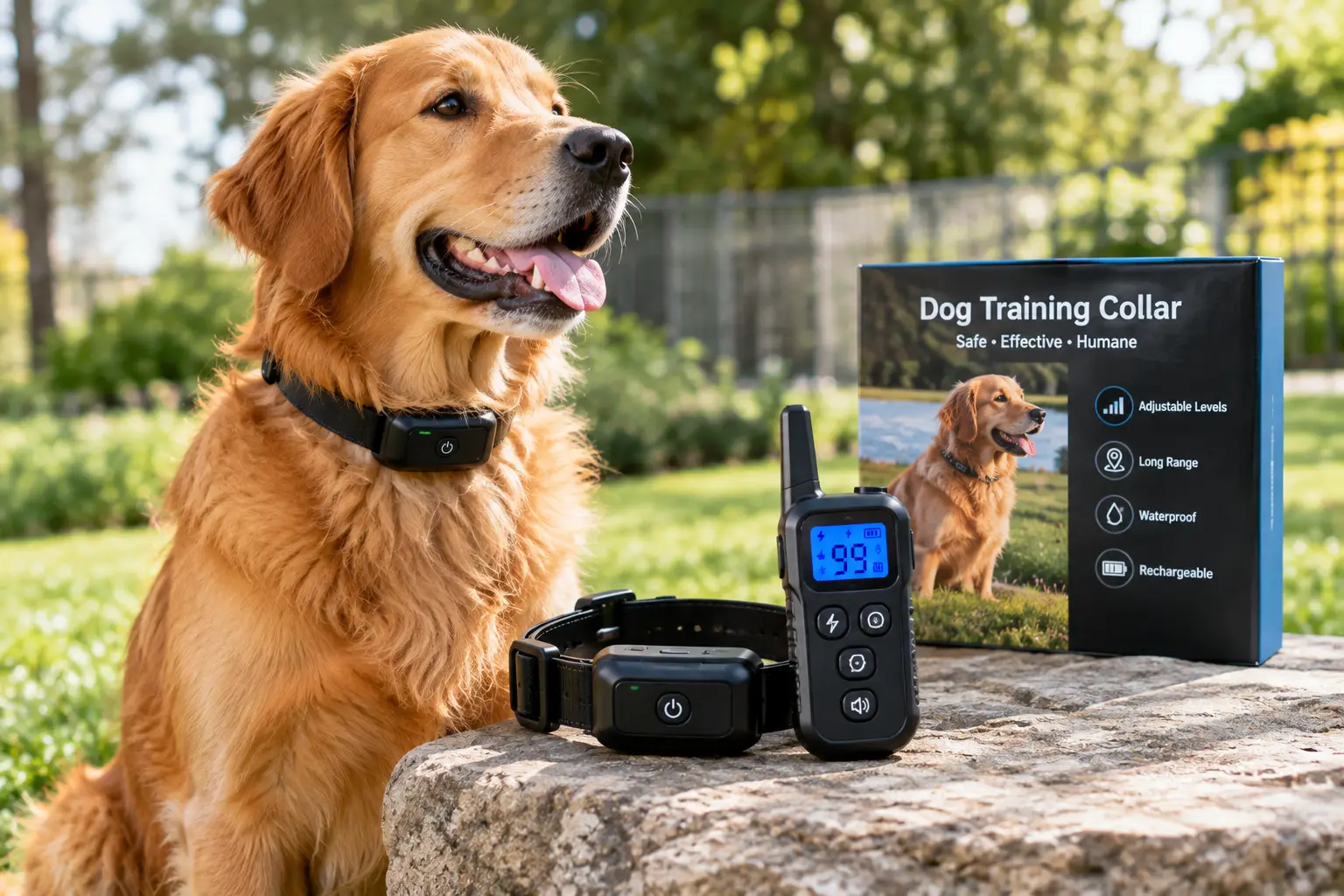
In This Article
Introduction: Why Stubborn Dogs Need Precision, Not Power
If you’re searching for the best shock collar for stubborn dogs, you’ve probably already tried the treat pouch, the long line, the squeaky toy, and the “come here, please, I’m begging you” voice. Your dog heard every word. The squirrel was simply more interesting. 🐿️
Here’s the twist most buyers miss: the best shock collar for stubborn dogs is rarely the one with the biggest jolt. “Stubborn” usually means a dog facing high distraction, low motivation, and inconsistent rules, not a dog that can’t feel anything. What actually helps is precision. That means dozens of finely spaced levels, a lock that keeps you from bumping the dial, tone and vibration modes you can lean on first, and a receiver that fits your dog’s neck properly. A collar with 10 coarse steps can force you to choose between “he ignored it” and “that was too much.” A collar with 100 or 127 levels, by contrast, lets you find the faint tap your dog notices and stop right there.
Today’s units are more accurately called remote training collars or e-collars, and the history and ongoing debate around shock collars is worth a quick read before you buy. This is a tool with real welfare trade-offs, not a magic off switch.
In this guide, we compare seven real models you can find on amazon.com, from a budget option in the $40 to $60 range to professional systems in the $230 to $320 range. You’ll get spec-by-spec analysis, honest summaries of real owner feedback, a 30-day introduction plan, problem-solving tips, and a frank look at what veterinary behaviorists say. No invented test stories, just research you can check for yourself. ⚡
What Is the Best Shock Collar for Stubborn Dogs?
The best shock collar for stubborn dogs is a remote e-collar that offers many finely spaced static levels, tone and vibration alternatives, a level lock, and a waterproof receiver sized for your dog. Together, these let you use the lowest noticeable stimulation consistently, instead of relying on raw power to get attention.
So how does it work? A handheld transmitter sends a radio signal to a receiver on the collar. Two contact points touch your dog’s skin and deliver an electrical stimulation, which manufacturers usually call “static” or “stim.” Most trainers who use these tools work at the recognition level, meaning the lowest setting where your dog shows a small sign of noticing, like an ear flick, a head turn, or a pause. That level changes with excitement: a dog chasing a deer needs a stronger signal to notice than the same dog lying on the couch.
That’s exactly why stubborn dogs benefit from more levels, not more power. With fine steps, you can move up gradually as distractions rise, instead of jumping straight to a level that frightens your dog. Additionally, tone and vibration modes give you a non-static cue that many dogs learn to respond to on their own over time.
One quick distinction: these remote trainers differ from automatic bark collars, which trigger themselves. Only one pick here, the Garmin Sport PRO, combines both functions.
Quick Comparison: The 7 Best E-Collars at a Glance
| Model | Range | Static levels | Other modes | Approx. price | Best for |
|---|---|---|---|---|---|
| Educator ET-300 Mini Educator | 1/2 mile | 1–100 + boost 1–60 | Tone, vibration | $190–$230 | Educator ET-300 Mini Educator: most stubborn dogs, first-timers |
| Educator ET-400 Educator | 3/4 mile | 1–100 + boost 1–60 | Tone, vibration, LED | $230–$260 | Educator ET-400 Educator: dogs that roam far |
| Dogtra 1900S | 3/4 mile | 0–127 (rheostat dial) | Pager vibration | $230–$270 | Dogtra 1900S: large, high-drive dogs (35 lb+) |
| SportDOG FieldTrainer 425X | 500 yards | 21 | Tone, vibration | $140–$170 | SportDOG FieldTrainer 425X: hunters, close-working dogs |
| Garmin Sport PRO | 3/4 mile | 10 | Tone, vibration, BarkLimiter | $250–$320 | Garmin Sport PRO: rugged multi-dog use |
| PetSafe 300 Yard Remote Trainer | 300 yards | 15 (8–15 locked) | Tone, vibration | $90–$150 | PetSafe 300 Yard Remote Trainer: backyard beginners |
| Bousnic Dog Shock Collar | 3,300 ft | 1–99 | Beep, vibration | $40–$60 | Bousnic Dog Shock Collar: tight budgets, backup unit |
Looking at the table above, the Educator ET-300 Mini Educator offers the best balance of precision and price, because 100 lockable levels plus a separate boost cover almost any temperament. If your dog regularly disappears over the horizon, the Educator ET-400 Educator or Dogtra 1900S justify their higher price with 3/4-mile range. Meanwhile, budget-conscious buyers should note that the Bousnic Dog Shock Collar trades proven reliability for a much lower entry price.
💬 One click helps other shoppers make an informed choice too! 😊
Top 7 Picks for the Best Shock Collar for Stubborn Dogs: Expert Analysis
Each pick below was chosen from real, currently sold models, with specs taken from manufacturer and authorized retailer listings. Prices are ranges at the time of writing, so always check the current price before buying.
1. Educator ET-300 Mini Educator — finest control for most stubborn dogs
If you want one collar that can whisper to a soft dog and still get through to a hard-headed one, the Educator ET-300 Mini Educator is the benchmark the others get measured against.
Its “lock and set” levels run from 1 to 100, plus a separately programmable boost from 1 to 60. In practice, that boost lets you preset a slightly stronger tap for high-distraction moments without fumbling the dial, while the lock keeps a bump in your pocket from jumping your dog from level 12 to level 40. The 2.4-ounce receiver is waterproof to 500 feet, the transmitter floats, and the half-mile range covers parks, trails, and most rural lots. E-Collar Technologies describes its output as proprietary “blunt” stimulation, which it says feels less sharp than typical static; treat that as a manufacturer claim, though it matches how owners describe it.
Based on comparing the specs, this is the smartest starting point for dogs from about 5 pounds up to big, distracted retrievers. A hundred small steps make finding a low working level far easier than 10 or 15 big ones.
Owner reviews consistently praise how low you can start and how wide the settings range is. A recurring theme is that results improve dramatically when owners learn the method from a trainer first.
Pros:
- ✅ Exceptionally fine control across 100 lockable levels
- ✅ Light 2.4-ounce receiver suits small and large dogs
- ✅ Floating, waterproof remote with a handy night light
Cons:
- ❌ Button layout takes some practice to master
- ❌ Half-mile range may fall short for hounds
Typically in the $190 to $230 range, it delivers excellent value for the precision you get.
2. Educator ET-400 Educator — more range for big roamers
The Educator ET-400 Educator keeps everything that makes the ET-300 great and simply stretches the leash, figuratively speaking, to 3/4 mile.
You get the same 1–100 lock-and-set levels, the same 1–60 boost, tone, vibration, and the same 2.4-ounce receiver. The real differences are a larger stopwatch-style remote and an enhanced internal antenna. What that means in practice: the bigger remote is easier to work with gloves or cold hands, and the extra range matters when your dog can cover a quarter mile before you’ve finished saying “come.” The receiver’s LED light can strobe or stay solid, which helps you spot your dog at dusk. There’s also a two-dog version, the ET-402, with independent settings per dog.
Who should pay more for it? Owners of huskies, hounds, and farm dogs with real bolting habits. If your dog stays within a few hundred yards, though, the ET-300 is the more sensible buy.
Reviews repeatedly highlight the floating remote and the no-look button layout. Several owners also stress learning proper use with a qualified trainer before working off leash.
Pros:
- ✅ 3/4-mile range with an improved internal antenna
- ✅ Same precise 100-level control as the ET-300
- ✅ Remote-activated LED light for low-light visibility
Cons:
- ❌ Bulkier remote than the Mini Educator
- ❌ Costs more than most backyard users need
Usually around $230 to $260, it’s worth it if range is your real bottleneck.
3. Dogtra 1900S — smoothest dial for large, driven dogs
The Dogtra 1900S is the heavy-duty choice for big, high-drive dogs, where you want a wide output range and a dial that never jumps.
Its 127 levels sit on a rheostat dial, so you roll smoothly upward instead of clicking in big steps, and the LCD screen shows your exact level and battery life. It offers “nick” (momentary) and constant stimulation, plus a non-stimulating High Performance Pager vibration. The transmitter and receiver carry an IPX9K waterproof rating, range reaches 3/4 mile, and lithium-polymer batteries recharge in about two hours. However, the receiver rides on a 1-inch strap and is intended for dogs 35 pounds and up, so it’s not a small-dog collar.
Here’s what to weigh: Dogtra markets this as a high-output unit, which suits large working breeds with thick coats and serious prey drive. That extra headroom is a safety margin, not a target; most dogs should never need the top of the dial.
Feedback on retailer pages centers on the smooth dial, dependable range, and rugged build. Note that it isn’t compatible with Dogtra’s Handsfree Square accessory.
Pros:
- ✅ Gradual 127-level rheostat dial with no jumps
- ✅ IPX9K waterproofing for brutal field conditions
- ✅ Clear LCD shows exact level and battery
Cons:
- ❌ Only suitable for dogs 35 pounds and up
- ❌ Heavier, larger receiver than the Educator models
Expect roughly $230 to $270, fair value for big-dog owners who need durability.
4. SportDOG FieldTrainer 425X — simplest no-look remote
The SportDOG FieldTrainer 425X is the brand’s smallest, lightest e-collar, built around one idea: you should be able to operate it without looking down.
It offers 21 levels of static stimulation across low and medium ranges, plus tone and vibration. A small dial and push button handle everything, so your eyes stay on your dog, which matters because timing is everything in e-collar training. Range is 500 yards, the system expands to three dogs with add-on collars, and DryTek waterproofing makes both pieces submersible to 25 feet. It fits dogs 8 pounds and up with 5- to 22-inch necks, charges in two hours, and runs 50 to 70 hours per charge.
On paper, 21 levels means each step is a bigger jump than on a 100-level unit. Consequently, it suits close-working sporting dogs and owners who value simplicity over fine-tuning. For a very large, very driven dog, the low/medium output may not offer much headroom.
We couldn’t verify a large, consistent body of owner reviews specific to this X-series version, so weigh the spec sheet and SportDOG’s long track record with hunters instead.
Pros:
- ✅ Genuinely intuitive no-look dial and button
- ✅ Excellent 50- to 70-hour battery life
- ✅ Expands to three dogs with add-on collars
Cons:
- ❌ Only 21 levels limits fine adjustment
- ❌ 500-yard range is shortest among field units
At about $140 to $170, it’s strong value for a name-brand field collar.
5. Garmin Sport PRO — tough build with bark control built in
The Garmin Sport PRO is built like field gear first and a training gadget second, which is exactly why hunters and multi-dog households like it.
It delivers 10 levels of momentary and continuous stimulation, plus tone and vibration, through a quick-turn dial with positive clicks. A fixed antenna gives up to 3/4-mile range with nothing to snap off, the handheld is IPX7-rated and floats, and the 3.5-ounce dog device is water-rated to 10 meters. It also adds a beacon light, up to 60 hours of collar battery, support for up to three dogs, and a built-in BarkLimiter with adjustable levels.
What most buyers overlook: only 10 levels means coarse steps, so this isn’t the tool for delicate low-level work with a sensitive dog. Conversely, if you need durability, multi-dog toggling, and bark management in one package, nothing else here combines all three.
Real owner feedback is mixed. Chewy reviewers praise the sturdy strap that stays adjusted, yet at least one reported the remote failing within a year, so register your warranty promptly.
Pros:
- ✅ Fixed antenna and rugged, floating handheld
- ✅ Built-in BarkLimiter adds a second use
- ✅ Color-coded multi-dog control for up to three
Cons:
- ❌ Only 10 stimulation levels
- ❌ Priciest pick in this roundup
Typically $250 to $320, it’s best value when you’ll use the bark and multi-dog features.
6. PetSafe 300 Yard Remote Trainer — beginner-friendly safety lock
The PetSafe 300 Yard Remote Trainer is designed for home and backyard training, with guardrails that help nervous first-timers avoid over-correcting.
You choose between tone, vibration, and 15 static levels, and levels 8 through 15 stay locked until you intentionally unlock them. That lock is the headline feature: your first weeks happen in the gentle half of the range by default. The remote and collar charge in two hours and last up to 40 hours, the backlit display is easy to read, and you can add a second dog’s collar. It fits dogs 8 pounds and up, isn’t intended for puppies under six months, and PetSafe advises not leaving it on for more than 12 hours a day. A Lite version offers milder stimulation for small or sensitive dogs.
In short, it’s a sensible choice for suburban owners working on door-dashing, jumping, or backyard recall. However, 300 yards won’t cover trail or field work.
We couldn’t verify a consistent set of aggregated reviews for the current version, but PetSafe’s support library (fit guides, recognition-level walkthroughs, and range troubleshooting) is genuinely useful.
Pros:
- ✅ Upper levels locked by default for safety
- ✅ Standard and Lite versions for different dogs
- ✅ Strong online support and how-to guides
Cons:
- ❌ 300-yard range limits outdoor adventures
- ❌ 15 levels feel coarse for sensitive dogs
Usually $90 to $150, it’s a solid value for backyard training.
7. Bousnic Dog Shock Collar — budget pick with granular levels
The Bousnic Dog Shock Collar is the option for owners who want to try remote training without spending $200 first.
On paper, it’s surprisingly feature-rich: beep levels 1–8, vibration 1–16, and static 1–99, with a claimed range of 3,300 feet and sizing for dogs from 5 to 120 pounds. The receiver is IP67 waterproof, but the remote is not, so keep it out of the rain. There’s also an on/off safety switch to prevent accidental presses, and the strap adjusts to 24 inches.
Here’s the honest analysis: 99 levels sound comparable to the Educator, but budget imports rarely publish how consistent their output is from one level, or one unit, to the next. In practice, it’s best as a starter, a backup, or a vibration-focused trainer.
Chewy reviewers like the material quality and the many beep and vibration levels. That said, at least one owner reported the static working inconsistently, which is a pattern worth testing for during your return window.
Pros:
- ✅ Very low entry price for a full-featured unit
- ✅ Wide beep and vibration ranges for non-static cues
- ✅ Safety switch prevents accidental activation
Cons:
- ❌ Remote is not waterproof
- ❌ Output consistency is less proven than name brands
At roughly $40 to $60, it’s good value as long as you test it carefully.
✨ Don’t miss these top-rated training tools!
🔍 Take your dog’s recall to the next level with this carefully curated lineup. Click a highlighted product to check current pricing and availability. These picks will help you build reliable off-leash manners the whole family will enjoy! 🐕
Head-to-Head Spec Breakdown
| Model | Level lock / boost | Waterproofing | Minimum dog size | Dogs supported | Battery | Best for |
|---|---|---|---|---|---|---|
| Educator ET-300 Mini Educator | Lock + boost 1–60 | Receiver to 500 ft; remote floats | About 5 lb | 1 (2 with ET-302) | Rechargeable | Educator ET-300 Mini Educator: precision |
| Educator ET-400 Educator | Lock + boost 1–60 | Receiver to 500 ft; remote floats | About 5 lb | 1 (2 with ET-402) | Rechargeable | Educator ET-400 Educator: range plus precision |
| Dogtra 1900S | Rheostat dial | IPX9K both units | 35 lb | 1 (2 with 1902S) | 2-hr rapid charge | Dogtra 1900S: big working dogs |
| SportDOG FieldTrainer 425X | Dial | Submersible to 25 ft | 8 lb | Up to 3 | 50–70 hr | SportDOG FieldTrainer 425X: simplicity |
| Garmin Sport PRO | Dial | Handheld IPX7; collar 10 m | Not specified in our sources | Up to 3 | Up to 60 hr (collar) | Garmin Sport PRO: durability |
| PetSafe 300 Yard Remote Trainer | Levels 8–15 locked | Waterproof | 8 lb | Up to 2 | Up to 40 hr | PetSafe 300 Yard Remote Trainer: cautious beginners |
| Bousnic Dog Shock Collar | On/off switch | Receiver IP67 only | 5 lb | 1 (2-dog kit sold) | Rechargeable | Bousnic Dog Shock Collar: budget |
This table reveals the real dividing line: safety controls. The Educator ET-300 Mini Educator and Educator ET-400 Educator pair a lock with a programmable boost, while the PetSafe 300 Yard Remote Trainer protects beginners by locking its upper half. If you’ll train in rain, lakes, or marshes, the Dogtra 1900S and SportDOG FieldTrainer 425X are the toughest bets, whereas the Bousnic Dog Shock Collar needs a dry pocket for its remote.
How to Introduce an E Collar for Stubborn Dogs: Your First 30 Days
Buying the gear is the easy part. Here’s a practical plan for using an e collar for stubborn dogs that Amazon listings don’t give you. 🗓️
Days 1–3: Fit and “collar conditioning”
Fit the receiver high on the neck, snug enough that both contact points touch skin, yet loose enough to slide one finger under the strap. Then have your dog wear it, switched off, during walks, meals, and play. That way, the collar predicts nothing but normal life, which prevents the “collar-wise” dog who only behaves when it’s on.
Days 4–7: Find the recognition level
In a quiet room, start at the lowest level and tap once, raising one level at a time until you see a subtle sign: an ear flick, a head turn, a neck scratch. Write that number down. It’s your baseline, not a fixed setting.
Weeks 2–3: Pair stim with commands your dog already knows
On a leash or long line, give your “come” cue, apply continuous stim at the recognition level while gently guiding your dog in, and release the button the instant they turn toward you. Then reward generously. Your dog is learning that turning off the sensation is easy and that coming to you pays.
Week 4: Add distractions gradually
Move to a park while dragging a long line. Raise the level only slightly when distractions spike, and use tone or vibration first whenever possible.
✅ Common first-month mistakes: skipping conditioning, using stim for commands the dog was never taught, and leaving the collar on all day, which risks skin sores.
Real-World Scenarios: Matching the Right Collar to Your Dog
Specs only matter in context, so here are three common profiles and the reasoning behind each match.
Scenario 1: The suburban Lab who ignores recall at the park
Picture a 75-pound Lab mix, walked daily, with a budget around $200. He knows “come” at home but goes deaf near ducks. The Educator ET-300 Mini Educator fits best, because its fine levels let you find a low working level, and the boost covers sudden high-distraction moments. Half a mile is far more range than a park requires.
Scenario 2: Two huskies on a rural property
Now imagine two escape-artist huskies on five open acres, with an owner who hikes most weekends. Here, range and multi-dog control matter most. The two-dog ET-402 version of the Educator ET-400 Educator gives independent settings per dog, while the Dogtra 1900S (or its two-dog 1902S) suits owners who want a smooth rheostat dial and rugged waterproofing for big, thick-coated dogs.
Scenario 3: A first-time owner with a 25-pound terrier mix
Finally, consider an apartment dweller with a reactive, dash-out-the-door terrier and real nerves about “shocking” their dog. The PetSafe 300 Yard Remote Trainer (or its Lite version) locks the upper levels and offers tone and vibration first. Even better: book two or three sessions with a qualified trainer before using static at all, because reactivity often has fear underneath it.
In every scenario, the collar supports training rather than replacing it.
Problem → Solution: When Your Remote Training Collar “Doesn’t Work”
Most complaints that a remote training collar “doesn’t work” trace back to a handful of fixable problems. 🔧
Problem 1: Your dog doesn’t react, even at higher levels. Solution: Check fit first. On thick or long coats, contact points often sit on fur, not skin. Swap to the longer contact points included with the SportDOG FieldTrainer 425X, Educator ET-300 Mini Educator, and similar kits, and tighten the strap slightly.
Problem 2: Your dog behaves only when wearing the collar. Solution: That’s a “collar-wise” dog. Go back to collar conditioning: have your dog wear the receiver (or a dummy) during everyday life for several weeks so it stops predicting training.
Problem 3: Your dog yelps, freezes, or panics. Solution: Stop immediately. The level was far too high, or the stim was poorly timed. Drop back below the recognition level, rebuild with tone and vibration, and seek a qualified trainer or veterinary behaviorist before continuing.
Problem 4: The range seems much shorter than advertised. Solution: Rated ranges assume open terrain. Hills, trees, walls, and appliances all reduce signal, and low batteries make it worse. Garmin itself notes reduced range indoors for the Garmin Sport PRO.
Problem 5: Red marks appear under the contact points. Solution: Remove the collar, rotate its position every few hours, and respect wear-time limits, such as PetSafe’s 12-hour daily cap. Ask your vet if irritation persists.
How to Choose the Best Shock Collar for Stubborn Dogs
Use these seven steps to narrow the field quickly:
- Rule out medical causes first. Hearing loss, joint pain, or thyroid issues can look like stubbornness, so a vet check comes before any training tool.
- Prioritize level count and spacing. For sensitive or medium dogs, 100+ levels (like the Educator ET-300 Mini Educator or Dogtra 1900S) make low-level work far easier than 10 to 21.
- Insist on a lock or safety feature. A lock-and-set system or locked upper levels prevents accidental over-correction.
- Match range to reality. Backyards need 300 yards at most, whereas trails and farms benefit from a half mile or more.
- Check the minimum dog size. A receiver built for 35-pound dogs is too bulky for a beagle.
- Confirm waterproofing on both pieces. Many budget units waterproof only the collar.
- Choose tone and vibration you’ll actually use. The goal is to fade static over time, so non-static cues matter.
Work through these in order, and the right collar usually becomes obvious.
Best E Collar for Large Stubborn Dogs: What Changes Over 60 Pounds
Shopping for the best e collar for large stubborn dogs isn’t just about more power. Big dogs bring three practical differences.
First, coat and neck size. Malamutes, Newfoundlands, and German shepherds often have dense ruffs, so contact length matters more than raw output. A collar that ships with long contact points, or sells them cheaply, will save you frustration.
Second, momentum and distance. A 90-pound dog in full sprint covers ground fast, so range and quick, no-look operation become more valuable. That’s where the Educator ET-400 Educator and Dogtra 1900S earn their price, with 3/4-mile range and controls you can work by feel.
Third, safety margin. A high-output unit like the Dogtra 1900S gives headroom for rare, high-arousal moments, such as a deer bolting across the trail. But headroom is insurance, not a working level. Most large dogs still respond at surprisingly low settings once they understand the game.
Finally, avoid assuming size equals toughness. Plenty of 100-pound dogs are emotionally soft, and over-correcting them can create anxiety or avoidance. So whichever best e collar for large stubborn dogs you choose, start low and let your dog’s body language, not their weight, set the level.
Features That Actually Matter (and Ones That Don’t)
Marketing pages love big numbers. Here’s how to separate signal from noise.
✅ Features that matter
- Fine level spacing. One hundred or more levels let you make tiny adjustments, which is the single biggest driver of humane, effective use.
- Lock and boost controls. The Educator lock-and-set and the PetSafe upper-level lock both prevent mistakes when you’re stressed.
- No-look operation. Timing beats intensity. A remote you can work by feel, like the SportDOG FieldTrainer 425X, helps you respond the instant a behavior starts.
- True waterproofing on both units. Dogs find water; remotes get dropped in it.
- Distinct tone and vibration. These become your long-term communication once static fades out.
❌ Features that matter less than you’d think
- Huge range claims. A 3,300-foot rating means little if your dog is out of sight, because you can’t time a cue you can’t see.
- “Safe shock” branding. Safety comes from fit, level, and timing, not a label.
- Maximum output. If you need the top level regularly, the problem is the training plan, not the hardware.
In other words, pay for control, not for headline power.
Remote Training Collar vs Other Training Approaches
A remote training collar isn’t your only option, so it’s worth comparing it honestly with the alternatives.
| Approach | Off-leash distance control | Precision | Welfare risk if misused | Learning curve | Best for |
|---|---|---|---|---|---|
| Remote e-collar (e.g., Educator ET-300 Mini Educator) | High | High with many levels | High | Moderate to steep | Off-leash recall with guidance |
| Long line + rewards | Moderate (line length) | High | Low | Low | Building recall foundations |
| Reward-only training with a professional | Grows over time | High | Very low | Moderate | Fearful or reactive dogs |
| Prong or choke collar | None (on leash only) | Low | High | Moderate | Not recommended by most behaviorists |
| GPS or containment collar | Boundary only | Low for commands | Moderate | Low | Property boundaries, not obedience |
The table shows the trade-off clearly: an e-collar offers unmatched distance control, but it also carries the highest risk if you get the level or timing wrong. Meanwhile, a long line with rewards is the cheapest, lowest-risk way to build recall first, and many trainers recommend it as the foundation even if you add a collar later. For reactive or fearful dogs, reward-based work with a professional is the safer route.
Common Mistakes to Avoid When Buying a Dog Training Collar with Remote
Even smart shoppers trip over these when picking a dog training collar with remote. ⚠️
Mistake 1: Buying the most powerful model “just in case.” A higher ceiling doesn’t fix a dog that doesn’t understand the cue. Instead, buy the most precise model your budget allows.
Mistake 2: Ignoring the minimum dog size. The Dogtra 1900S is rated for dogs 35 pounds and up, so it’s the wrong tool for a 15-pound terrier, no matter how stubborn.
Mistake 3: Trusting glowing reviews blindly. Budget listings sometimes attract incentivized or unverified feedback. The FTC’s endorsement guidance explains how honest reviews and endorsements should be disclosed, which helps you spot red flags.
Mistake 4: Forgetting the remote’s waterproofing. The Bousnic Dog Shock Collar has an IP67 receiver, but its remote isn’t waterproof.
Mistake 5: Skipping the return-window test. Within the first week, check range, every mode, and level consistency, using the included test light where one is provided.
Mistake 6: Buying a collar instead of a plan. Budget for a few sessions with a qualified trainer, because the right technique matters more than the brand of dog training collar with remote you choose.
Safety, Welfare, and What the Science Says
An honest guide has to cover this part, even though it’s uncomfortable. 🩺
In 2021, the American Veterinary Society of Animal Behavior published its Humane Dog Training Position Statement, which recommends reward-based methods for all dog training, including behavior problems, and advises against aversive tools such as electronic collars. The statement argues there’s no evidence aversive training is necessary and that it can harm welfare and the dog-human bond. Purdue University’s Center for Canine Welfare also lists the statement among its canine welfare resources.
On the other side, many hunting, K9, and “balanced” trainers use low-level e-collar methods and report good results. You’ll need to weigh both views for your own dog.
Legally, there’s currently no federal ban on remote training collars in the US, but rules differ abroad; Wales banned them in 2010 and England followed in 2024. Check local regulations if you travel with your dog.
If you do use one, follow these safety basics:
- Never use static on a fearful or aggressive dog without professional guidance, since pain can intensify fear.
- Limit wear time and rotate the receiver to prevent pressure sores.
- Never let children operate the remote.
- Charge lithium batteries with the supplied charger, and stop using any damaged unit.
Used carelessly, any e-collar can do real harm. Used thoughtfully, with a plan, it’s a communication tool, not a punishment button.
Long-Term Cost and Maintenance
The sticker price is only part of the story, so here’s how total cost of ownership typically shakes out.
| Model | Upfront range | Ongoing costs | Expected value | Best for |
|---|---|---|---|---|
| Bousnic Dog Shock Collar | $40–$60 | Higher replacement risk | Good short-term | Bousnic Dog Shock Collar: trial or backup |
| PetSafe 300 Yard Remote Trainer | $90–$150 | Add-a-dog collar, straps | Good for backyard | PetSafe 300 Yard Remote Trainer: home use |
| SportDOG FieldTrainer 425X | $140–$170 | Add-a-dog collars, contact points | Strong | SportDOG FieldTrainer 425X: hunters on a budget |
| Educator ET-300 Mini Educator | $190–$230 | Straps, comfort pads | Excellent | Educator ET-300 Mini Educator: long-term owners |
Reading the numbers, a cheap collar can cost more over time if you replace it after a season. By contrast, the Educator ET-300 Mini Educator or SportDOG FieldTrainer 425X spread their higher upfront cost over years of use, with replaceable parts. Warranty terms vary by model and seller, so confirm coverage at purchase.
For maintenance, wipe the contact points and your dog’s neck area weekly, inspect straps for cracking, keep batteries topped up rather than fully drained, and store units away from extreme heat. These simple habits extend battery life and help prevent skin irritation.
FAQs
❓ Is a shock collar safe for a stubborn dog?
❓ What level should I set an e collar for stubborn dogs?
❓ Which is better, Educator or Dogtra, for a stubborn dog?
❓ How long does it take to train a stubborn dog with a remote collar?
❓ Can I buy a cheap shock collar for a stubborn dog?
Conclusion: Train Smarter, Not Harder
Choosing the best shock collar for stubborn dogs comes down to one principle: buy control, not power. Stubborn dogs rarely need stronger stimulation. Instead, they need clearer communication, delivered at the right moment and at the lowest level that works.
For most owners, the Educator ET-300 Mini Educator is the standout pick, with 100 lockable levels, a programmable boost, and a featherweight receiver. If your dog roams far, step up to the Educator ET-400 Educator, while big, high-drive dogs over 35 pounds are well served by the Dogtra 1900S. Hunters who value simplicity should look at the SportDOG FieldTrainer 425X, and multi-dog households that also need bark control will appreciate the Garmin Sport PRO. Nervous beginners can start with the PetSafe 300 Yard Remote Trainer, and tight budgets can try the Bousnic Dog Shock Collar with careful testing.
Whichever you choose, remember the bigger picture. Pair the collar with rewards, start with tone and vibration, respect wear-time limits, and get professional help for fear or aggression. Above all, aim to need the collar less every month. That’s the clearest sign you picked the right tool and used it well. 🐾
🚀 Ready to finally nail that recall?
🔍 Compare the picks above, click a highlighted product to check current pricing and availability, and start your 30-day plan this week. Your calmer, more responsive walks are closer than you think! 🐕✨
Recommended for You
- Dog Fence Designs: 7 Best Picks That Actually Work (2026)
- Halo Harness: 7 Best Picks for Blind Dogs (Honest 2026 Guide)
- Heavy Duty Dog Fence: 7 Best Escape-Proof Picks (2026 Guide)
Disclaimer: This post contains affiliate links. As an Amazon Associate, I earn from qualifying purchases made through these links, at no additional cost to you.
✨ Found this article helpful? Share it with someone who needs it! 💬🤗