
In This Article
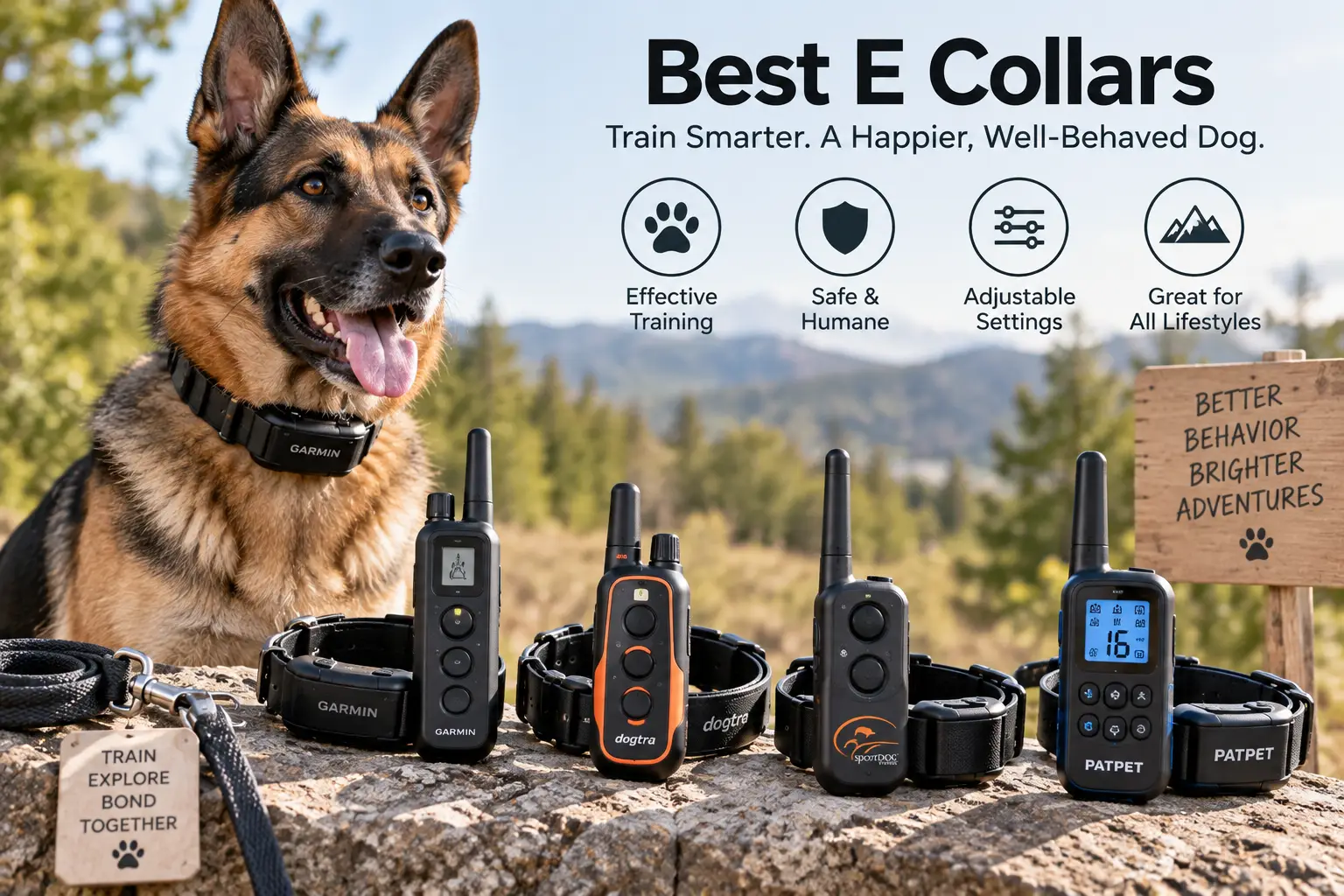
Searching for the best e collars usually starts the same way: you’ve got a dog who won’t come back when called, a yard that isn’t fenced, or a trainer who recommended “getting a collar” without telling you which one. What is an e collar? It’s a remote-controlled training device — a receiver worn on the dog’s collar and a handheld transmitter — that delivers a tone, a vibration, or a mild static correction to reinforce commands at a distance. The best e collars aren’t the ones with the flashiest marketing; they’re the ones matched to your dog’s size, temperament, and the specific problem you’re solving.
This guide breaks down seven real, currently available models — from a sub-$70 entry-level option to a professional-grade unit trusted by hunting dog trainers — based on published spec sheets and aggregated owner reviews from retailers like Chewy and Amazon. We’ll walk through range, stimulation levels, waterproofing, and honest pros and cons for each, then get into how to choose, how to introduce the collar without stressing your dog, and where these tools fit (and don’t fit) next to positive-reinforcement methods. Veterinary behaviorists have raised real welfare concerns about aversive training tools, and we’ll address that directly rather than pretend it doesn’t exist — you deserve the full picture before you buy, not just a product list.
Quick Comparison: Best E Collars at a Glance
Before the deep dive, here’s how the seven models stack up by use case.
| Category | Pick | Why It Wins |
|---|---|---|
| Best Overall | Dogtra 1900S | 127 stimulation levels, ¾-mile range, built for tough conditions |
| Best for Small Dogs | Dogtra iQ Plus | Lightweight receiver for dogs as small as 10 lbs |
| Best Budget Pick | PetSpy M686 | Longest range for the price, though quality control is mixed |
| Best for Multiple Dogs | Garmin Sport PRO | One-handed toggle trains up to 3 dogs on one remote |
| Best Precision/Sensitive Dogs | Educator ET-300 Mini Educator | 100 finely graduated levels for soft temperaments |
Looking at this table, a clear pattern emerges: price roughly tracks precision, not raw power. The PetSpy M686 and the Dogtra 1900S both deliver static correction, but the gap between 8 adjustable levels and 127 is the difference between a blunt instrument and a scalpel. If your dog is sensitive, anxious, or new to remote training, that granularity is worth paying for — it’s genuinely hard to find the “your dog barely notices this” setting on an 8-level collar.
💬 Bookmark this comparison — you’ll want to reference it again once you’ve read the full breakdown below! 😊
Top 7 Best E Collars for Dogs: In-Depth Reviews
1. Dogtra 1900S — best long-range for hunting and hiking
The 1900S is Dogtra’s workhorse, and the distinguishing feature is control granularity paired with genuine outdoor durability. Its 127-level rheostat dial means you can dial in a correction so subtle your dog barely flinches, or scale up for a stubborn 90-pound retriever chasing a rabbit into the next county — the nick mode delivers a quick half-second pulse while continuous mode can run up to 12 seconds for extended corrections. The ¾-mile range and full waterproof rating (both the collar and the handheld are submersible) make this the model trainers reach for when dogs are working off-leash in fields, marshes, or thick brush where a shorter-range collar would lose contact.
This is a collar built for working and sporting dogs, not first-time owners with a couch-potato Chihuahua. Based on comparing the spec sheet against competitors, the LCD display and rapid 2-hour recharge cycle are what separate it from cheaper long-range collars that rely on guesswork dials and overnight charging. Reviewers on manufacturer and retailer sites consistently describe the build quality as “professional-grade,” specifically praising the rubberized grip and the fact that the batteries hold a charge far longer than budget alternatives — a common complaint about lower-tier collars is that batteries degrade within a year, and that theme is notably absent from Dogtra 1900S feedback.
Pros:
- ✅ 127 stimulation levels for precise correction
- ✅ ¾-mile range holds up in open terrain
- ✅ Fully waterproof collar and remote
Cons:
- ❌ Not designed for dogs under 35 lbs
- ❌ Premium price compared to entry-level collars
Expect to pay in the $250 to $280 range at the time of writing, and given the extended battery life and durability trainers report, it’s a legitimately strong value for anyone training a working or high-energy dog — just not the right pick for a 12-pound lapdog.
2. Educator ET-300 Mini Educator — most precise stimulation control
The Mini Educator’s claim to fame is its 100-level “medical-grade” static stimulation scale, often compared to a TENS unit rather than a jolt. That granularity means you can find your dog’s true “working level” — the lowest setting where they show a subtle ear-flick or head-turn — instead of jumping from “nothing” to “too much” the way cheaper 8-level collars force you to. The proprietary boost feature (1–60) lets you temporarily raise intensity for high-distraction moments without resetting your dog’s baseline level, and the lock-and-set function prevents accidental dial bumps mid-session.
What most buyers overlook with this model is how much the receiver’s size matters for small or sensitive dogs: at 2.4 ounces, it’s genuinely comfortable on dogs as light as 5 pounds, which most remote trainers simply can’t accommodate. Reviews consistently report that professional trainers favor E-Collar Technologies collars specifically because the stimulation feels smoother and less “jerky” than competing static outputs — several independent trainer write-ups describe it as the brand roughly three-quarters of e-collar-using trainers in online discussion groups say they rely on. A recurring theme in customer feedback is a modest learning curve with the remote’s button layout in the first week, which tapers off quickly.
Pros:
- ✅ 100 finely graduated stimulation levels
- ✅ Comfortable receiver for dogs as small as 5 lbs
- ✅ Two-year warranty with US-based support
Cons:
- ❌ Half-mile range is shorter than the Dogtra 1900S
- ❌ Slight learning curve on remote layout
Pricing typically runs around $180 to $220 for the single-receiver Mini system, and for buyers training a sensitive or first-time e-collar dog, the precision genuinely justifies the cost over a bargain 8-level unit.
3. Garmin Sport PRO — easiest one-handed multi-dog operation
Garmin built the Sport PRO around a quick-turn dial with audible “clicks” between its 10 stimulation levels, which sounds like a small thing until you’re standing in a field trying to adjust intensity without looking down and losing sight of your dog. The four-button layout separates continuous stimulation, momentary “nick,” vibration, and tone, and a toggle switch lets one transmitter control up to three dogs — genuinely useful for multi-dog households where buying three separate systems would be overkill.
Here’s what the spec sheet doesn’t fully convey: the built-in BarkLimiter with AutoRise technology automatically escalates correction if a dog keeps barking, then resets on its own, meaning you’re not standing there manually adjusting settings every time. Based on comparing this to the SportDOG and PetSafe multi-dog options, Garmin’s toggle-and-dial interface is noticeably faster to operate mid-session, which matters if you’re actively training rather than just containing barking. Retailer listings describe it as their single best-selling remote trainer, largely because it hits a sweet spot between the simplicity newer owners want and the durability serious trainers expect — both the collar (rated to 10 meters submersion) and the floating IPX7 handheld are built for wet, muddy field conditions.
Pros:
- ✅ One-handed dial control across 10 levels
- ✅ Expands to train up to 3 dogs on one remote
- ✅ Fully waterproof, floating transmitter
Cons:
- ❌ Only 10 stimulation levels, fewer than Dogtra or Educator models
- ❌ Additional dog collars sold separately, raising multi-dog cost
At the time of writing, the bundle typically runs around $280 to $330. For a household managing multiple dogs or anyone who wants dead-simple field operation without fumbling a menu, that price reflects genuine convenience — sensitive dogs needing finer-grain correction may be better served by the Educator’s 100-level scale instead.
4. SportDOG FieldTrainer 425X — three-mode reliability for active dogs
The 425X earns its reputation from a straightforward three-mode setup — tone, vibration, and 21 levels of momentary or continuous static stimulation — paired with SportDOG’s DryTek waterproofing, rated for full submersion up to 25 feet. That combination of range and modest but usable stimulation granularity makes it a natural fit for active family dogs doing yard work, hiking, or basic recall training, without the price tag of a professional field-trial system.
What sets this collar apart in practice is durability under repeated abuse: reviewers and independent testers repeatedly single out the housing and strap hardware as noticeably tougher than budget alternatives in the same price bracket, which matters if your dog swims, rolls in mud, or generally treats gear like a chew toy. On paper, this means fewer replacement purchases over a multi-year ownership span, even though the sticker price is higher than entry-level competitors. The three-mode structure (tone before vibration before static) also supports a lower-escalation training approach, letting you start with the least intrusive signal and only increase intensity if your dog genuinely isn’t responding.
Pros:
- ✅ Three training modes for graduated corrections
- ✅ Submersible up to 25 feet
- ✅ Reputation for rugged, long-term durability
Cons:
- ❌ 21 levels is less precise than Educator or Dogtra units
- ❌ Pricier than comparable single-mode budget collars
Expect a price in the $180 to $230 range. It’s a strong middle-ground pick: not the cheapest, not the most granular, but a genuinely durable all-rounder for active dogs that spend real time outdoors.
5. PetSafe 900 Yard Remote Trainer — best value for suburban yards
PetSafe’s 900-yard model sits at the top of the brand’s remote trainer lineup, offering tone, vibration, or 15 levels of static stimulation with a safety lock that keeps the top levels (8–15) from being triggered by accident — a genuinely useful feature for households where more than one family member operates the remote. Backed by roughly 25 years in the pet-product space and the same parent company behind Invisible Fence, PetSafe leans on brand trust and straightforward usability rather than professional-grade granularity.
The practical upside here is range for the money: 900 yards (about half a mile) comfortably covers most suburban yards, local parks, and hiking trails, and both the collar and remote are rechargeable and waterproof. What the spec sheet doesn’t say outright is that PetSafe’s static output tends to run gentler at comparable dial positions than Dogtra or SportDOG units, which some owners read as a pro (better for soft-tempered dogs) and others read as a con (less headroom for genuinely stubborn dogs). Either way, the 15-level range and safety lock make it a sensible choice for owners who want remote range without professional-trainer complexity.
Pros:
- ✅ 900-yard range covers most suburban and trail use
- ✅ Safety lock prevents accidental high-level stimulation
- ✅ Backed by a well-established, veterinarian-referenced brand
Cons:
- ❌ Gentler static output may underwhelm very stubborn dogs
- ❌ Fewer stimulation levels than premium competitors
Pricing generally runs around $150 to $200 for the 900-yard tier at the time of writing, making it a solid mid-tier pick for owners who want name-brand reliability without stepping up to a $250+ system.
6. Dogtra iQ Plus — best pick for small and toy breeds
Where most remote trainers assume a 35-pound-plus dog, the iQ Plus is purpose-built for the other end of the scale — a compact, IPX9K-rated receiver suitable for dogs as small as 10 pounds, with 100 levels of low-to-medium power stimulation plus a non-stimulating “pager” vibration mode. The simple three-button transmitter (nick, constant, page) trades some of the professional-grade complexity found in the Dogtra 1900S for something a first-time small-dog owner can pick up in minutes.
Reviews consistently report a common use case: teaching a small or toy breed to come in from the yard reliably, something owners often struggle with because standard-size receivers are simply too heavy or bulky for a 12-pound dog’s neck. What most buyers overlook is that low-medium power doesn’t mean low precision — the 100-level scale is identical in granularity to the larger Mini Educator, just tuned for smaller, typically more sensitive dogs. The 400-yard range is shorter than the field-trial-oriented Dogtra 1900S, which makes sense given this collar’s target use case is backyard and neighborhood training, not open-field work.
Pros:
- ✅ Purpose-built receiver for dogs as small as 10 lbs
- ✅ 100 stimulation levels for fine-tuned corrections
- ✅ Fully waterproof to 25 feet
Cons:
- ❌ 400-yard range is short next to full-size field units
- ❌ Not rated for dogs under 10 lbs or with thick, long coats
At around $175 to $200, it costs about the same as some full-size collars — buyers are paying for the small-dog-specific engineering, not extra range or power, so it’s worth skipping if your dog is over 20 pounds and a standard receiver would fit fine.
7. PetSpy M686 — most affordable entry point
The M686 undercuts nearly everything else on this list on price while still offering four training modes (continuous shock, one-second shock, vibration, and beep) across 8 adjustable levels and a genuinely long advertised range of up to 1,100 yards. For owners who aren’t sure e-collar training is right for their dog and don’t want to commit $200+ before finding out, it’s the lowest-friction way to test the waters.
Here’s where honesty matters most: real Chewy customer reviews put the M686 at roughly 3.5 to 3.7 out of 5 stars across several hundred ratings, with about three-quarters of buyers saying they’d recommend it. Positive reviews highlight ease of setup and genuinely long range for the price, with several owners specifically praising the two-dog toggle feature. But the aggregated data also surfaces a real concern worth flagging honestly: a meaningful minority of reviewers report inconsistent stimulation — either no response from the collar or, more seriously, static triggering without an intentional remote press. That’s a quality-control theme not present in the Dogtra, Educator, or Garmin feedback, and it’s the trade-off that comes with the lower price point.
Pros:
- ✅ Lowest price point on this list
- ✅ 1,100-yard advertised range
- ✅ Two-dog toggle switch included
Cons:
- ❌ Only 8 stimulation levels, limiting fine-tuning
- ❌ Some verified reviewers report inconsistent or unprompted stimulation
At well under $70, it’s genuinely tempting for budget-conscious buyers, but given the reliability complaints in real customer reviews, this is a collar to test cautiously on a low setting before trusting it for off-leash recall in a high-risk area like near a road.
How to Introduce Your Dog to an E-Collar the Right Way
Getting this wrong in the first 30 days is the single biggest reason e-collar training fails or backfires. Start with a behavior your dog already knows reliably on a leash — sit, come, or heel — before ever activating stimulation, so the collar never becomes their first exposure to a new command. For the first several sessions, let your dog simply wear the powered-off collar during normal activities like meals and walks, so it stops registering as anything unusual.
Once your dog is comfortable wearing it, find the “working level” in a quiet, low-distraction space: start at the lowest static setting and increase one level at a time until you see the smallest possible reaction — an ear flick or head turn, nothing more. That minimal-response level is where real training happens; a yelp or flinch means you’ve gone too high and should immediately drop back down. Pair every activation with the verbal cue and a reward the instant your dog responds, so the collar reinforces a command rather than replacing one. Keep sessions to 10–15 minutes and end on a success, not when your dog gets frustrated or tired — long, repetitive sessions are where most of the common first-month mistakes happen.
Which E-Collar Fits Your Dog? 3 Real-World Scenarios
The suburban recall dog. A family with a 3-year-old Labrador who bolts after squirrels in an unfenced yard needs range more than raw power — the PetSafe 900 Yard Remote Trainer or SportDOG FieldTrainer 425X covers typical yard-to-park distances with enough static headroom for a moderately stubborn dog, without the field-trial price tag of a Dogtra system.
The anxious toy breed. A 9-pound rescue terrier who startles easily and is new to any kind of remote training is a poor match for a high-power collar. The Dogtra iQ Plus or Educator ET-300 Mini Educator, both offering finely graduated low-power stimulation and lightweight receivers, let an owner work at a barely perceptible level — often just vibration alone for weeks before static is ever introduced.
The weekend hunting or trail dog. An owner running a high-drive pointer or retriever across open terrain needs the ¾-mile range and waterproofing of the Dogtra 1900S or the multi-dog flexibility of the Garmin Sport PRO — shorter-range budget collars like the PetSpy M686 simply can’t maintain a reliable signal at field-trial distances.
✨ Ready to find your dog’s match? 🐾 Compare the range, stimulation levels, and price of each pick above, click through to check current availability, and start training smarter this week.
Common Problems E-Collar Owners Run Into (and How to Fix Them)
Problem: the dog seems to ignore vibration mode entirely. This usually means the collar fit is too loose for the contact points to maintain skin contact — check that two fingers fit snugly under the strap, not more, and rotate long or short contact points based on your dog’s coat length.
Problem: training stalls after the first week. This is almost always caused by skipping foundational obedience — the collar clarifies a command your dog already knows, it doesn’t teach a brand-new one. Go back to leash-based repetition before reintroducing the collar.
Problem: the dog seems stressed or avoidant around the collar. Stop sessions immediately and reassess the working level; this is a sign stimulation is set too high or being used punitively rather than as a cue. Pair every future session with treats and calm reintroduction.
Problem: inconsistent stimulation on a budget collar. As the PetSpy M686 reviews illustrate, cheaper units are more prone to intermittent malfunction. Test thoroughly on a low setting in a controlled environment before ever relying on the collar near traffic or other real hazards.
How to Choose a Dog Training Collar
- Match the range to your actual use case. A backyard needs 100–300 yards; open trails or hunting fields need ¾ mile or more, like the Dogtra 1900S.
- Prioritize stimulation-level count for sensitive dogs. Collars with 100+ levels, like the Educator ET-300 Mini Educator or Dogtra iQ Plus, allow far finer control than 8–15-level budget units.
- Check the minimum dog weight. Small-breed-specific receivers, such as the Dogtra iQ Plus, are lighter and more comfortable than standard units scaled down.
- Confirm waterproof ratings if your dog swims or trains in rain. Full submersion ratings (SportDOG’s DryTek, Dogtra’s IPX9K) matter more than “water-resistant” claims.
- Factor in multi-dog households early. Systems like the Garmin Sport PRO expand to three dogs on one remote, which is cheaper than buying separate systems later.
- Read aggregated reviews for reliability complaints, not just star ratings. A 3.5-star average with reports of unprompted stimulation (as with some PetSpy M686 units) is a meaningfully different risk profile than a 4.5-star collar with a learning-curve complaint.
- Budget for the whole system, not just the sticker price. Replacement contact points, extra receivers for multi-dog use, and battery longevity all affect real cost of ownership over several years.
Common Mistakes to Avoid When Buying an E Collar for Dogs
The most frequent mistake is buying based on maximum range alone. A 4,000-foot advertised range sounds impressive, but if your training happens entirely in a fenced backyard, that spec is irrelevant and you’re likely overpaying for hardware you won’t use — a shorter-range, higher-precision collar like the Educator ET-300 Mini Educator often serves suburban owners better than a long-range unit built for open fields.
A second common error is choosing a collar based on stimulation level count without checking whether it’s rated for your dog’s actual weight and coat type. Reviews consistently report frustration when owners buy a standard-size receiver for a small or toy breed, only to find it’s uncomfortably heavy — that’s exactly the gap the Dogtra iQ Plus exists to close. Finally, many first-time buyers skip reading real owner reviews for reliability issues, focusing only on the feature list. As the PetSpy M686‘s mixed Chewy feedback shows, a lower price sometimes comes with a higher rate of quality-control complaints, and that’s worth weighing against the upfront savings.
E-Collars vs. Traditional Training Methods
| Method | Off-Leash Range | Upfront Cost | Learning Curve | Best For |
|---|---|---|---|---|
| E-collar (e.g., Dogtra 1900S) | Up to ¾ mile+ | $70–$280 | Moderate | Distance recall, high-distraction environments |
| Prong or choke collar | None (leash-dependent) | Under $30 | Low | Close-range leash corrections only |
| Invisible/underground fence | Property boundary only | $150–$400+ installed | Moderate | Yard containment, not active training |
| Verbal/reward-only training | Unlimited (with reliable recall) | Free–$50 (treats, clicker) | High (requires consistency) | All dogs, foundational obedience |
The table above makes the trade-offs clear: e-collars extend a handler’s reach well beyond what a leash or fence can offer, but they require more upfront investment in both money and technique than verbal-only training. Reward-based methods carry no equipment cost and, per veterinary behaviorists, no welfare risk, but they demand more consistency and don’t solve the specific problem of communicating with a dog that’s 200 yards away and not looking at you. In practice, most experienced trainers use e-collars as one tool inside a broader positive-reinforcement framework rather than a replacement for it.
What to Expect: Everyday Performance
On paper, spec sheets list stimulation levels and mile ranges, but the real-world experience is quieter than the marketing suggests. Most dogs at a properly calibrated working level show a barely visible response — an ear twitch, a brief pause — not a yelp or jump, which is the entire point of finding that level correctly in the first place. Battery life across the models here generally runs from several hours to a full weekend of intermittent use between charges, and rapid-charge batteries (2 hours on the Dogtra 1900S and Dogtra iQ Plus) mean less downtime than older nickel-cadmium systems that required overnight charging.
Range specs are measured in open, unobstructed conditions; expect meaningfully less reliable signal in wooded areas, around buildings, or through hills. A collar advertised for ¾ mile might realistically hold a clean signal for a few hundred yards in a suburban neighborhood full of houses and trees — which is exactly why matching the collar to your actual environment (see the how-to-choose section above) matters more than chasing the biggest number on the box.
Long-Term Cost and Maintenance
The sticker price is only part of the total cost of a remote training collar. Contact points wear down or corrode over a year or two of regular use and typically need replacing at $10–$20 per set; premium brands like Dogtra and Educator sell these individually, while budget collars sometimes require buying a whole new receiver. Rechargeable lithium batteries in quality units (Dogtra, Garmin, Educator) are generally rated for hundreds of charge cycles and multiple years of daily use, while cheaper batteries in budget collars, per aggregated review patterns, tend to degrade faster and lose charge capacity within 12–18 months.
Multi-dog households should factor in additional receiver collars early rather than as an afterthought — a second Garmin Sport PRO or Dogtra 1900S collar typically costs less than buying a second complete system, since the transmitter is reusable. Warranty coverage also affects long-term cost: Educator’s two-year warranty with US-based support meaningfully reduces the odds of an out-of-pocket replacement compared to collars with shorter or no coverage, which is worth weighing against a lower sticker price on budget alternatives.
Safety, Regulations, and Standards
E-collars themselves aren’t subject to FDA medical-device regulation the way TENS units are, but reputable manufacturers voluntarily test for waterproof (IPX) ratings and battery safety standards, which is why checking a collar’s IPX rating before buying matters more than trusting marketing copy alone. It’s also worth being transparent about where the veterinary and animal-behavior community currently stands: the American Veterinary Society of Animal Behavior recommends reward-based methods for all dog training and cites welfare risks associated with aversive tools, a position echoed by the American Veterinary Medical Association. That doesn’t mean every e-collar use is harmful — the risk profile changes significantly based on stimulation level, timing, and whether the tool is paired with rewards, as outlined in the introduction section above — but it does mean owners should go in with realistic expectations and start at the lowest effective setting, ideally alongside guidance from a certified trainer.
On the purchasing side, always verify a product listing’s stated dog-weight range and safety-lock features before buying, and keep the collar’s charging port dry between uses even on “waterproof” models, since repeated full submersion accelerates seal wear over several years.
Frequently Asked Questions
❓ Are e-collars safe for dogs?
❓ What's the difference between a shock collar and an e-collar?
❓ How many stimulation levels does a dog training collar need?
❓ What is the best e collar for small dogs?
❓ Do e-collars work for recall training with distracted dogs?
Conclusion
There’s no single best e collars pick that fits every dog — the right choice depends on your dog’s size, temperament, and how far away you actually need to communicate with them. The Dogtra 1900S earns its spot as the strongest all-around option for active, larger dogs who need real range and precision, while the Dogtra iQ Plus and Educator ET-300 Mini Educator better serve small or sensitive dogs who need a gentler touch. Budget-conscious owners can start with the PetSpy M686, keeping the reliability trade-offs in mind, and multi-dog households will likely find the Garmin Sport PRO‘s expandable system the most cost-effective long-term.
Whichever model you choose, the collar itself is only half the equation — proper introduction, finding the true working level, and pairing every correction with a reward are what determine whether the tool actually improves your relationship with your dog or just adds noise. Start slow, read the aggregated reviews honestly, and match the spec sheet to your real-world training environment rather than the biggest number on the box.
Recommended for You
- Dog Training Collars That Vibrate: 7 Best Picks for Smarter Dog Training
- 7 Best Waterproof Dog Training Collars of 2026 (Tested Picks)
- 7 Backyard Dog Fence Ideas for a Safe and Stylish Yard
Disclaimer: This post contains affiliate links. As an Amazon Associate, I earn from qualifying purchases made through these links, at no additional cost to you.
✨ Found this guide helpful? Share it with another dog owner still deciding! 💬🐕