
In This Article
Introduction: Freedom for Your Dog Without Digging a Single Trench
Your dog wants to sniff every corner of the yard. You want to stop sprinting after them every time a squirrel crosses the street. Somewhere between those two wishes sits the best wireless electric dog fence for your property — and in 2026, choosing one is more complicated (and more interesting) than it used to be.
A few years ago, “wireless fence” meant one thing: a plug-in transmitter that broadcast a circle around your house. Today you’ll also find GPS collars that let you draw boundaries on your phone, follow your dog across 100 acres, and coach them with tones and vibration before static ever enters the picture. Prices now range from under $200 to roughly $1,000, and some systems quietly add a monthly subscription on top.
This guide cuts through that noise. We compared spec sheets, manufacturer documentation, and aggregated owner reviews for seven real systems sold on amazon.com, then translated the numbers into plain-English advice: which yard shapes each fence handles, what the true three-year cost looks like, and which dogs are (and aren’t) good candidates. No invented test drives — just careful analysis you can verify.
What Is a Wireless Electric Dog Fence?
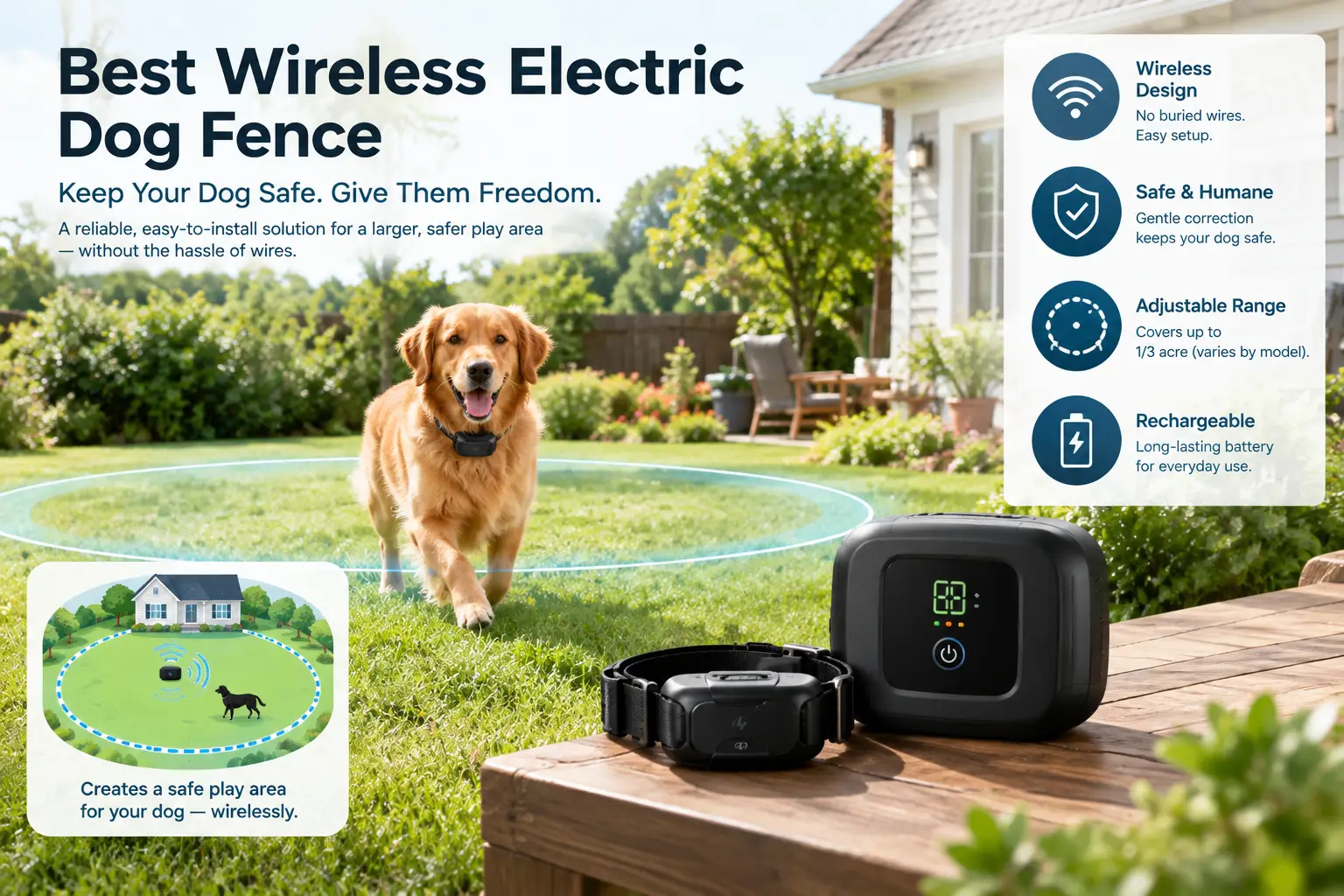
A wireless electric dog fence is a containment system that keeps a dog inside a set boundary without buried wire. A collar receiver detects when your dog nears the edge — via a radio signal from a home transmitter or via GPS — and gives a warning tone, then vibration or a mild static correction, until the dog turns back.
If you want the bigger historical picture, the electronic pet fence concept dates back to the 1970s; what’s new is how precise and portable it has become.
Quick Comparison: The Best Wireless Electric Dog Fence Options at a Glance
| Product | Technology | Coverage | Collar Power | Subscription | Best for |
|---|---|---|---|---|---|
| PetSafe Stay & Play Wireless Fence | Radio (circular) | Up to 3/4 acre | Rechargeable | None | PetSafe Stay & Play Wireless Fence: flat suburban yards |
| PetSafe Stay & Play Wireless Fence for Stubborn Dogs | Radio (circular) | Up to 3/4 acre | Rechargeable | None | PetSafe Stay & Play Wireless Fence for Stubborn Dogs: persistent escape artists |
| PetSafe Wireless Pet Containment System (PIF-300) | Radio (circular) | Up to 1/2 acre | Replaceable battery | None | PetSafe Wireless Pet Containment System (PIF-300): small yards, tight budgets |
| WIEZ GPS Wireless Dog Fence | GPS (circular) | 65–3,281 ft radius | Rechargeable | None | WIEZ GPS Wireless Dog Fence: open fields on a budget |
| PetSafe Guardian GPS 2.0 Dog Fence + Tracking | GPS (custom shapes) | 1/2 acre or more | Rechargeable | Required | PetSafe Guardian GPS 2.0 Dog Fence + Tracking: battery life + tracking |
| Halo Collar 5 | GPS (custom shapes) | Min. 30 x 30 ft | Rechargeable | Required | Halo Collar 5: guided training, multiple locations |
| SpotOn GPS Fence Nova Edition | GPS (custom shapes) | 1/3 acre and up | Rechargeable | Optional | SpotOn GPS Fence Nova Edition: rural acreage, no forced fees |
Looking at the table, the split is obvious: radio systems (the three PetSafe circles) are cheap to own and simple, but they force your dog’s play area into a circle centered on your house. GPS systems free you from that shape and from the house itself, yet they demand daily charging and — in two cases — a subscription. Your yard’s shape and size should decide which half of this table you shop from before brand or price does.
💬 One click helps other shoppers make an informed choice too! 😊
Top 7 Wireless Electric Dog Fence Picks: Expert Analysis
1. PetSafe Stay & Play Wireless Fence — best all-round circular coverage
This is the system most people picture when they hear “wireless dog fence,” and it earns that status with a genuinely flexible circle. The indoor transmitter creates an adjustable boundary from 22 to 105 feet in every direction — up to 3/4 acre, or 210 feet across. In practice, that’s enough for a typical quarter- to half-acre suburban lot with room left for the transmitter to sit centrally in the house.
The collar is waterproof and rechargeable, fits dogs from 5 lbs with neck sizes 6–28 inches, and offers five static levels plus a tone-only mode. That tone-only mode matters more than it sounds: many dogs learn the boundary on beeps alone, and you may never need to go above level one or two.
Based on the specs, this is the safest default for flat yards with few metal obstacles. Retailer materials note it isn’t recommended for sloped yards, because terrain bends the radio signal. Reviews consistently report that most dogs learn the boundary within days to a few weeks of flag training, and owners frequently praise not buying batteries.
Pros:
- ✅ Rechargeable collar eliminates ongoing battery costs
- ✅ Adjustable 22–105 ft radius suits many lot sizes
- ✅ Add unlimited dogs with extra collars, no fees
Cons:
- ❌ Boundary is always a circle around the transmitter
- ❌ Slopes and metal siding can distort the signal
Expect to pay in the $250–$350 range; for flat yards, it’s the strongest value-per-acre in this roundup.
2. PetSafe Stay & Play Wireless Fence for Stubborn Dogs — built for determined chasers
Some dogs treat a beep as a polite suggestion. This variant pairs the same 3/4-acre circular system with a collar PetSafe designs specifically for persistent, high-drive dogs. Its adjustable range runs from as little as 5 feet up to 105 feet from the transmitter, which gives you finer control if you want a small, tight zone near the house.
What the spec sheet doesn’t spell out is the trade-off: a “stubborn dog” collar is a tool for the dog that has already proven it will push through a standard correction, not a starting point. If you have a mellow Lab who simply wanders, the standard PetSafe Stay & Play Wireless Fence is the gentler, more appropriate choice. If you own a beagle who loses all reason at the scent of a rabbit, this version makes sense — paired with serious training.
The rechargeable collar uses a non-replaceable lithium-ion battery, so the collar’s lifespan is tied to the battery’s. Aggregated reviews for this variant mirror the standard model: easy setup and reliable containment on flat ground, with occasional complaints about the circular shape not matching rectangular lots.
Pros:
- ✅ Designed for dogs that ignore standard corrections
- ✅ Very small minimum radius for tight zones
- ✅ Works with the same 3/4-acre transmitter
Cons:
- ❌ Overkill for calm or sensitive dogs
- ❌ Collar battery cannot be swapped when it ages
Typically priced in the $280–$380 range — worth it only if your dog genuinely needs it.
3. PetSafe Wireless Pet Containment System (PIF-300) — the budget-friendly original
The PIF-300 is the system that launched the wireless category, and it remains a sensible pick for smaller yards. Its transmitter projects a circle up to 90 feet in radius — 180 feet across, roughly 1/2 acre. That’s plenty for a modest backyard, and like the newer models, you can overlap a second transmitter to stretch coverage.
The big difference is power. The collar runs on a replaceable RFA-67 battery rather than a built-in rechargeable cell. Manufacturer and retailer documentation suggests about one to two months per battery, and the collar’s indicator light flashes every 4–5 seconds when it’s time for a swap. That’s a small recurring cost, but there’s an upside: when a rechargeable battery dies after years of use, the whole collar often goes; here, you just buy a new battery.
Based on comparing the specs, the PIF-300 suits dogs 8 lbs and up in flat, compact yards where the 1/2-acre limit isn’t a constraint. Owner reviews have historically been positive overall, with the most common complaint being the cost and hassle of proprietary batteries.
Pros:
- ✅ Proven, widely supported system with easy parts
- ✅ Replaceable battery extends collar lifespan
- ✅ Includes long contact points for thick coats
Cons:
- ❌ Smaller 1/2-acre maximum than Stay & Play
- ❌ Ongoing proprietary battery purchases add up
Usually found around $230–$300; solid value for small yards, though the Stay & Play often justifies the small premium.
4. WIEZ GPS Wireless Dog Fence — the low-cost entry into GPS
This collar-only system skips the base station entirely: you stand where you want the center of the zone, set a radius, and GPS does the rest. The advertised range runs from 65 to 3,281 feet in radius — up to a claimed 776 acres — which makes it interesting for farms and open fields where no radio transmitter could reach.
But read that minimum carefully. A 65-foot minimum radius means a 130-foot-wide circle, so the manufacturer itself notes the device is suited to open fields and farms, not very small yards. The boundary is still circular, and the product page specifies outdoor use only. If the dog exits the zone, the warning runs for 16 seconds followed by a 30-second pause — a safety cycle that prevents nonstop correction but also means a determined dog can push through.
Here’s what to weigh: this is a containment collar, not a tracker. There’s no app showing where your dog went if it escapes, a limitation some reviewers flag as significant. Aggregated owner sentiment is mixed — appreciated for price and setup simplicity, criticized for battery life and inconsistent accuracy.
Pros:
- ✅ No base station or subscription required
- ✅ Huge adjustable radius for open acreage
- ✅ Far cheaper than premium GPS collars
Cons:
- ❌ No live tracking if your dog escapes
- ❌ Unsuitable for small or crowded suburban yards
Generally under $200 (two-collar bundles cost more); fair value for rural owners who accept its limits.
5. PetSafe Guardian GPS 2.0 Dog Fence + Tracking — the battery-life champion
PetSafe’s GPS 2.0 collar brings custom-shaped boundaries and live tracking from a brand most owners already know. You draw up to 50 virtual fences in the My PetSafe app, and dual-frequency GPS improves reliability around trees and buildings. The spec that stands out is battery life: up to 70 hours per charge, versus roughly a day and a half for most GPS rivals.
In practice, that means you can skip a night of charging without anxiety — a real safety advantage, since a dead GPS collar is just a strap. The collar is waterproof, fits dogs 10 lbs and up with 8–28 inch necks, and offers tone, vibration, and static.
The catch is the subscription. PetSafe lists monthly plans around $9.99 or annual plans in the $89–$99 range, and Chewy’s product page notes that without one, you’re limited to a single Bluetooth-based fence and cannot change the static level. Each dog needs its own collar and plan. Reviews are split on battery claims: some owners report several days, while others report under 24 hours, likely depending on tracking settings and signal conditions.
Pros:
- ✅ Up to 70-hour battery outlasts most GPS collars
- ✅ Up to 50 custom-shaped fences in the app
- ✅ Real-time tracking if your dog gets out
Cons:
- ❌ Subscription required for meaningful functionality
- ❌ Real-world battery results vary widely between owners
Hardware runs in the $350–$400 range plus the plan — strong value for half-acre-plus properties.
6. Halo Collar 5 — best for guided training and on-the-go fences
The Halo Collar 5 is built around the idea that a fence should travel with you. You drop a pin or enter an address, and the app creates boundaries for your yard, a cabin, or a trailhead. Halo states it processes 20 location updates per second and uses dual-frequency L1/L5 satellites with ground-station corrections, claiming accuracy within about 2 feet.
What most buyers overlook is the training philosophy. Halo’s program, developed with Cesar Millan, leans on sound and vibration cues first, with static optional rather than central. For owners uneasy about static correction, that design choice matters more than any spec. The minimum fence is about 30 x 30 feet, making it more small-yard friendly than most GPS options, while battery life is rated up to 48 hours.
Halo states a Pack Membership is required to activate GPS, cellular data, and fence features, with plans starting at $9.99 a month. Reviews consistently praise the app and setup ease; the most common complaint is the ongoing subscription, which some owners note can climb toward $20 a month on higher tiers. Halo estimates a collar lifespan of three to five years.
Pros:
- ✅ Static is optional; strong tone and vibration training
- ✅ Unlimited fences anywhere you travel
- ✅ Fast 20-per-second location updates for responsiveness
Cons:
- ❌ Collar does nothing without an active membership
- ❌ Subscription costs grow with each added dog
List price is around $500–$600 with frequent discounts; excellent if you value training support and travel.
7. SpotOn GPS Fence Nova Edition — the premium pick for serious acreage
The SpotOn GPS Fence Nova Edition is the most expensive system here and the one aimed squarely at rural owners. Its headline feature is philosophical as much as technical: containment works out of the box with no subscription. A paid plan is optional and only adds live tracking, escape alerts, and remote cues.
The Nova uses a multi-constellation receiver (GPS, GLONASS, Galileo, BeiDou) and a larger dual-feed antenna, which SpotOn says reduces drift around trees and metal buildings. It supports properties from about 1/3 acre upward, lets you walk or draw fences, and allows overlapping fences and keep-out zones — perfect for fencing off a pond or a barn. SpotOn rates battery life at 33+ hours with tracking and 40+ in Extended Battery Life Mode, and the collar charges in about an hour.
Reviews from rural owners are strongly positive about containment on large, wooded properties. The recurring complaint is battery: several owners report needing to charge nightly, and some feel real-world runtime falls short of the marketing.
Pros:
- ✅ No subscription required for containment
- ✅ Keep-out zones and overlapping fences supported
- ✅ Designed to handle tree cover and remote land
Cons:
- ❌ Highest upfront cost in this roundup
- ❌ Most owners end up charging every night
Priced around $1,000 — expensive upfront, but often the cheapest GPS option after two to three years.
Top 7 Head-to-Head Comparison
| Product | Approx. Price Range | Battery | Min. Dog Size | Boundary Shape | Best for |
|---|---|---|---|---|---|
| PetSafe Stay & Play Wireless Fence | $250–$350 | Rechargeable (weeks) | 5 lbs | Circle | PetSafe Stay & Play Wireless Fence: best overall value |
| PetSafe Stay & Play Wireless Fence for Stubborn Dogs | $280–$380 | Rechargeable (weeks) | 5 lbs | Circle | PetSafe Stay & Play Wireless Fence for Stubborn Dogs: high prey drive |
| PetSafe Wireless Pet Containment System (PIF-300) | $230–$300 | Replaceable (1–2 months) | 8 lbs | Circle | PetSafe Wireless Pet Containment System (PIF-300): small yards |
| WIEZ GPS Wireless Dog Fence | Under $200 | Rechargeable (daily-ish) | Medium/large dogs | Circle | WIEZ GPS Wireless Dog Fence: open farmland |
| PetSafe Guardian GPS 2.0 Dog Fence + Tracking | $350–$400 + plan | Up to 70 hrs | 10 lbs | Custom | PetSafe Guardian GPS 2.0 Dog Fence + Tracking: long battery |
| Halo Collar 5 | $500–$600 + plan | Up to 48 hrs | Most breeds | Custom | Halo Collar 5: training + travel |
| SpotOn GPS Fence Nova Edition | Around $1,000 | 33–40+ hrs | ~15 lbs | Custom | SpotOn GPS Fence Nova Edition: rural acreage |
Reading across, the radio systems win decisively on battery convenience — weeks per charge versus a day or two — which is easy to underestimate until you’ve forgotten to charge a GPS collar once. Among GPS options, the PetSafe Guardian GPS 2.0 Dog Fence + Tracking wins on runtime, the Halo Collar 5 on training support, and the SpotOn GPS Fence Nova Edition on long-term cost and terrain handling. The WIEZ GPS Wireless Dog Fence is the outlier: cheap and capable in open space, but missing the tracking safety net.
🐾 Ready to Give Your Dog Safe Freedom?
🔍 Take your backyard setup to the next level with this carefully curated lineup. Click a highlighted product to check current pricing and availability. The right fence means more off-leash playtime and fewer heart-stopping escapes!
Getting Started: Your First 30 Days With a Wireless Dog Fence
Buying the fence is the easy part. The first month decides whether it works. Every manufacturer here stresses training, and for good reason: a collar alone teaches nothing.
Days 1–3: Set up without the dog. For radio systems, place the transmitter centrally, at least a few feet off the floor and away from large metal appliances, then walk the boundary with the test light or collar to find where it actually triggers. Mark it with the included flags every 10 feet or so. For GPS systems, walk or draw your fence, then walk the line yourself with the collar to confirm where alerts fire — expect a few feet of variance.
Days 4–14: Teach with sound only. Use tone-only or vibration mode. Walk your dog on a leash toward the flags; when the collar beeps, cheerfully guide them back and reward with a treat. Keep sessions to 10–15 minutes, two or three times a day. You’re teaching “flags plus beep means turn around,” not punishing.
Days 15–21: Introduce the lowest static level, if needed. Many dogs never need it. If yours does, start at level one and only go up if the dog genuinely doesn’t notice. Keep the leash on.
Days 22–30: Add distractions, then supervised off-leash time. Toss a toy near the boundary, have a neighbor walk by. Once your dog reliably turns back, try short off-leash sessions while you watch.
Common first-month mistakes: removing flags too early (wait at least a few weeks), leaving the collar on 24/7 (contact points can irritate skin — rotate position and remove it indoors), and skipping the fit check (contact points must touch skin, not float on fur).
Real-World Scenarios: Matching the Right Fence to Your Life
Specs only mean something when they meet a real yard. Here are three common profiles and the reasoning behind each match.
The Suburban Family: Quarter-Acre Lot, One Friendly Golden
Budget around $300, dog outside a few hours a day, house sits roughly in the middle of the lot. The PetSafe Stay & Play Wireless Fence fits perfectly. The circular boundary covers the backyard and side yards, the rechargeable collar lasts weeks, and there’s no subscription. A GPS collar would be overkill here — and on a lot this small, GPS drift of even a few feet could put the boundary uncomfortably close to the sidewalk.
The Weekend Adventurer: Townhouse Yard Plus a Lake Cabin
Budget around $600 plus a monthly fee, dog travels most weekends. The Halo Collar 5 is the logical match. Its small minimum fence size handles the compact home yard, and creating a new fence at the cabin takes minutes. The tone-and-vibration-first training also suits a sociable dog that needs guidance more than correction. Factor in the membership cost before committing.
The Rural Homeowner: Five Wooded Acres, a Pond, and a Wandering Hound
Budget up to $1,000, no appetite for monthly bills, dog outdoors all day. The SpotOn GPS Fence Nova Edition is built for exactly this. Irregular property lines, keep-out zones around the pond, and tree cover are where it reportedly shines. If $1,000 is too much, the PetSafe Guardian GPS 2.0 Dog Fence + Tracking is the middle path — lower upfront cost and longer battery, but with an ongoing plan.
Troubleshooting: 5 Common Problems and How to Fix Them
1. The boundary seems to “move” day to day (radio systems). Signal fluctuation usually comes from metal: appliances, a parked car, aluminum siding, or a metal roof. Move the transmitter away from large metal objects and re-walk the boundary. If your yard slopes, expect inconsistency — the PetSafe Stay & Play Wireless Fence is designed for flat ground.
2. The GPS fence triggers too early or too late. Some drift is inherent to GPS. Avoid placing fence lines right against your house or under dense trees, and leave a buffer of several feet between the virtual boundary and any real danger, like a road. Collars with dual-frequency GPS, such as the Halo Collar 5 and the PetSafe Guardian GPS 2.0 Dog Fence + Tracking, are designed to reduce this.
3. The dog ignores the collar. Check the fit first: you should be able to slide one finger between the contact points and the skin. Long-coated dogs often need longer contact points — the PetSafe Wireless Pet Containment System (PIF-300) includes a set. Then go back a step in training before raising the correction level.
4. The dog escaped and won’t come back in. Most systems include a safety timeout (the PetSafe radio collars stop correcting after 30 seconds) so the dog isn’t corrected endlessly. But a dog outside the line may hesitate to recross. Walk them back in on a leash with lots of praise, and revisit training around whatever triggered the breakout.
5. The GPS collar keeps dying. Build charging into a routine — collar off at bedtime, on the charger, back on at breakfast. Real-world runtime often falls short of maximum ratings, especially with live tracking enabled.
How to Choose the Best Wireless Electric Dog Fence
Choosing well comes down to matching technology to terrain. Here are the criteria, in the order that matters most.
- Measure your usable yard and its shape. A rectangular lot with the house at one end wastes much of a radio circle. If your property is long, narrow, or irregular, GPS’s custom shapes are worth the premium.
- Check your terrain. Radio signals dislike slopes and metal; GPS dislikes dense tree canopy and tall buildings. Pick the system whose weakness your yard doesn’t trigger.
- Decide how you feel about subscriptions. The Halo Collar 5 and PetSafe Guardian GPS 2.0 Dog Fence + Tracking need plans for full function; the SpotOn GPS Fence Nova Edition and all radio systems don’t.
- Be honest about charging discipline. Radio collars go weeks between charges; GPS collars need near-daily attention. A dead collar is no fence at all.
- Match the collar to your dog’s size. Minimum weights range from 5 lbs (Stay & Play) to around 15 lbs (SpotOn). Small dogs need small collars.
- Look at correction options. Tone-only and vibration modes give you a gentler training path. More options equal more flexibility.
- Think about escapes. If losing your dog would be catastrophic — near a highway, for example — live GPS tracking is a meaningful safety net.
On accuracy, it helps to know that consumer GPS has real-world limits. The U.S. government’s GPS accuracy overview explains how signal blockage, reflections, and receiver quality all affect precision — which is exactly why GPS fences recommend buffers and minimum property sizes.
Wireless GPS vs Radio Fences vs Traditional Fencing
Every wireless option competes with two alternatives: in-ground wired systems and physical fences. Here’s how they stack up.
| Factor | Radio Wireless | GPS Wireless | In-Ground Wired | Physical Fence |
|---|---|---|---|---|
| Installation | Plug in, 1–2 hrs | App setup, minutes–hours | Trenching required | Professional, days |
| Boundary shape | Circle only | Any shape | Any shape | Any shape |
| Portability | Yes (outlet needed) | Fully portable | No | No |
| Keeps others out | No | No | No | Yes |
| Typical cost | $230–$380 | $200–$1,000+ | Varies widely | Often thousands |
| Best for | PetSafe Stay & Play Wireless Fence buyers with flat yards | SpotOn GPS Fence Nova Edition buyers with acreage | Permanent custom layouts | Maximum security |
The table makes one limitation unavoidable: no electronic fence keeps coyotes, loose dogs, or strangers out. A physical fence remains the most secure option where budget and HOA rules allow. Where they don’t, radio systems offer the simplest setup and GPS the most freedom — and both beat a buried-wire install for anyone who rents or moves frequently.
Long-Term Cost and Maintenance: The Three-Year Reality
Sticker price tells only half the story. Here’s an approximate three-year cost of ownership, using price ranges and published plan rates at the time of writing (check current pricing, as both change).
| System | Upfront (approx.) | Ongoing | Est. 3-Year Total | Best for |
|---|---|---|---|---|
| PetSafe Wireless Pet Containment System (PIF-300) | $230–$300 | Replacement batteries | ~$300–$450 | Lowest small-yard cost |
| PetSafe Stay & Play Wireless Fence | $250–$350 | None | ~$250–$350 | Best radio value |
| PetSafe Guardian GPS 2.0 Dog Fence + Tracking | $350–$400 | ~$89–$120/yr | ~$620–$760 | Mid-priced GPS |
| Halo Collar 5 | $470–$600 | From ~$120/yr | ~$830–$960+ | Feature-rich GPS |
| SpotOn GPS Fence Nova Edition | Around $1,000 | Optional | ~$1,000 | No-fee GPS |
The surprise here is how quickly the gap closes. Over three years, the Halo Collar 5 on a base plan approaches the SpotOn GPS Fence Nova Edition‘s one-time price, and higher Halo tiers or additional dogs push it past. Meanwhile, the PetSafe Stay & Play Wireless Fence remains the cheapest by far — if your yard suits a circle.
Maintenance is light across the board: clean contact points weekly, check the collar strap for wear, and avoid letting lithium batteries sit fully drained for long periods. Rechargeable collars eventually lose capacity; since the Stay & Play battery isn’t replaceable, budget for a new collar after several years.
Features That Actually Matter (and Ones That Don’t)
Marketing pages for wireless fences are crowded with claims. Here’s how to sort signal from noise.
Features that matter:
- Tone-only and vibration modes — They let you train with the gentlest effective cue and may mean static is rarely or never used.
- Safety timeout — A cap on how long corrections run (30 seconds on PetSafe radio collars) protects a dog that has bolted past the line.
- Real battery life with tracking on — Look for owner-reported runtime, not just the maximum rating.
- Minimum fence size — It quietly decides whether a GPS collar even works on your lot: about 30 x 30 feet for the Halo Collar 5, about 1/3 acre for the SpotOn GPS Fence Nova Edition, 65 feet of radius for the WIEZ GPS Wireless Dog Fence.
- Escape tracking — If the dog does get out, knowing where it went is worth more than any other feature.
Features that matter less than advertised:
- Huge maximum ranges — “Up to 776 acres” sounds impressive, but most owners will never need more than a few.
- Activity stats and step counts — Nice extras, but they don’t keep your dog safer.
- Number of stored fences beyond a handful — Fifty fences rarely beats five for most households.
Safety, Welfare, and Standards: What Every Owner Should Know
Electronic containment is a training tool that relies on an unpleasant stimulus, and responsible use starts with acknowledging that. Veterinary sources such as VCA Animal Hospitals’ overview of invisible fences lay out both sides: these systems are affordable, flexible, and can contain dogs that dig or climb, yet a sufficiently motivated dog may break through — and then hesitate to come back in.
A balanced, vet-reviewed perspective from Dogster on whether electric fences work for dogs notes that these fences are considered an aversive method, and that dogs with strong prey drive or intact males chasing a female in heat may override boundaries.
Practical safety rules:
- Avoid electronic fences for fearful, anxious, or reactive dogs. Stress around the boundary can worsen behavior.
- Don’t use them for puppies too young to train, and follow each manufacturer’s minimum weight.
- Never leave a dog unsupervised for long periods behind an invisible boundary — it doesn’t stop other animals or people.
- Check local rules. Some municipalities and HOAs have leash or containment ordinances, and an electronic fence may not satisfy “secure enclosure” requirements.
- Inspect the neck regularly for redness or pressure sores.
From a product-safety standpoint, buy from established sellers, follow charging instructions for lithium-ion collars, and use only the supplied adapters.
Common Mistakes to Avoid When Buying a Wireless Dog Fence
Even good systems fail when they’re mismatched to the buyer. These are the most frequent pitfalls.
Buying a circle for a rectangle. If your house sits at the front of a long lot, a radio circle wastes much of the backyard while spilling into the front yard. Map your property first.
Underestimating subscriptions. A collar that’s $400 cheaper upfront can cost more within two or three years. Always multiply the monthly fee by 36 before comparing.
Choosing GPS for a tiny yard. GPS has inherent drift. On small lots, that drift can be a meaningful share of your total space, which is why several brands set minimum fence sizes.
Ignoring your dog’s personality. A confident, food-motivated dog often learns quickly; a timid or highly reactive dog may become stressed. The fence should fit the dog, not the other way around.
Skipping training. Every system here ships with flags and training guidance for a reason. Rushing straight to off-leash time is the fastest way to a failed fence and a confused dog.
Forgetting multi-dog costs. Radio systems add dogs for the price of a collar. Subscription GPS systems typically add a monthly fee per dog on top of each collar.
FAQ: Wireless Electric Dog Fence Questions Answered
❓ Do wireless dog fences work through walls and trees?
❓ Can I use a wireless electric dog fence for two dogs?
❓ Which wireless dog fence works without a subscription?
❓ How long does it take a dog to learn a wireless fence?
❓ Is a GPS dog fence accurate enough for a small yard?
Conclusion: Finding the Best Wireless Electric Dog Fence for Your Dog
The best wireless electric dog fence isn’t the one with the biggest range or the flashiest app — it’s the one that matches your yard, your dog, and your tolerance for charging and monthly bills.
For most flat suburban yards, the PetSafe Stay & Play Wireless Fence delivers the best value: reliable circular coverage, a rechargeable collar, and zero fees. If your dog treats boundaries as a dare, the PetSafe Stay & Play Wireless Fence for Stubborn Dogs adds the backup you need, while the PetSafe Wireless Pet Containment System (PIF-300) keeps costs low on smaller lots.
If your property is oddly shaped, wooded, or measured in acres, GPS is worth it. The SpotOn GPS Fence Nova Edition is the long-term value leader with no forced subscription, the Halo Collar 5 excels at gentle guided training and travel, and the PetSafe Guardian GPS 2.0 Dog Fence + Tracking offers the longest battery life in its class. Rural owners on a tight budget can consider the WIEZ GPS Wireless Dog Fence, as long as they accept it has no tracking.
Whatever you choose, commit to the first 30 days of training, keep a buffer from real hazards, and remember that no invisible boundary replaces your supervision.
✨ Don’t Miss These Top-Rated Picks!
🔍 Give your dog the freedom to explore safely with this carefully curated lineup. Click a highlighted product to check current pricing and availability — and enjoy more relaxed afternoons with your best friend!
Recommended for You
- GPS Tracking Device for ATV: 7 Best Picks That Beat Thieves (2026)
- airtag collar holder: 7 Best Secure Picks for Dogs (2026)
- No Climb Dog Fence: 7 Proven Picks That Stop Escapes (2026)
Disclaimer: This post contains affiliate links. As an Amazon Associate, I earn from qualifying purchases made through these links, at no additional cost to you.
✨ Found this article helpful? Share it with someone who needs it! 💬🤗