
In This Article
Why a GPS ATV Tracker Belongs on Your Quad in 2026
Here’s an uncomfortable truth about four-wheelers: they’re built to go anywhere, and that includes the back of a stranger’s trailer. Most ATVs have no steering lock, no immobilizer worth mentioning, and enough resale value to make them a tempting midnight target. A GPS ATV tracker won’t stop a thief from loading your machine, but it changes what happens next — instead of filing a cold report the next morning, you hand police a live location.
The numbers back up the worry. According to the National Insurance Crime Bureau’s ATV theft report, an average of more than 20,000 ATVs were reported stolen each year between 2016 and 2018, with thefts peaking in July and August. More recent NICB figures for 2025, reported in August 2026, put ATVs at the bottom of the recovery table for recreational vehicles — roughly one in four stolen ATVs ever made it home.
So which GPS ATV tracker actually earns a spot under your seat? That depends on where you ride, how long your machine sits between rides, and whether you can stomach a monthly bill. In this guide, I’ve compared seven real trackers sold on amazon.com — cellular, LTE-M, and satellite — using manufacturer spec sheets, published plan pricing, and aggregated owner feedback. You’ll get honest trade-offs, a three-year cost breakdown, an install walkthrough, and a decision framework, so you can pick once and stop worrying every time the barn door creaks. ⚡
What Is a GPS ATV Tracker?
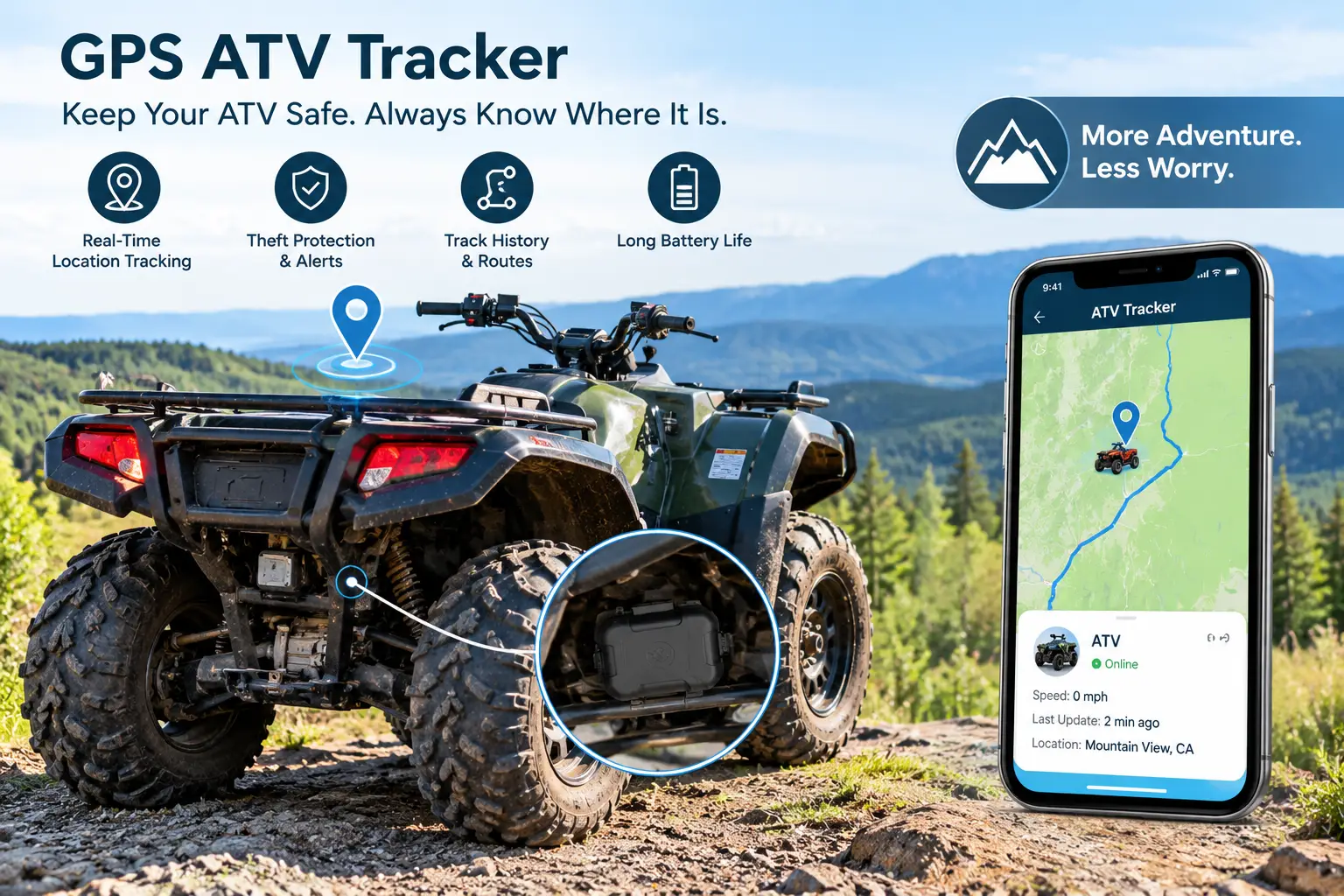
A GPS ATV tracker is a small, weatherproof device hidden on an all-terrain vehicle that determines its position via satellites and reports it to your phone over a cellular or satellite network, usually with motion alerts, geofences, and trip history to help you detect and recover a stolen machine quickly.
That definition hides an important split. Search “atv gps tracker” and you’ll see two very different product types: trail-navigation units with big screens (think dash-mounted map devices) and anti-theft trackers that hide out of sight. This guide covers the second kind. Within that category, you’ll find three families:
- ✅ Battery-powered cellular trackers — magnet-mount, no wiring, fast updates where there’s cell coverage.
- ✅ Hardwired trackers — pull power from the ATV’s 12V battery, so you never charge them.
- ✅ Satellite trackers — work with zero bars, but report every few minutes instead of every few seconds.
Knowing which family fits your riding is half the buying decision — we’ll get to the other half below.
Quick Comparison: The 7 Best GPS ATV Tracker Picks at a Glance
| Tracker | Network | Fastest updates | Rated battery life | Water rating | Best for |
|---|---|---|---|---|---|
| LandAirSea 54 | 4G LTE | Every 3 seconds (plan-dependent) | 1–3 weeks; up to 6 months in low-power mode | IP67 | LandAirSea 54: cheapest way into real-time tracking |
| Tracki Pro | 4G LTE + Wi-Fi | Every 15 seconds (plan-dependent) | 2–12 months (10,000 mAh) | Waterproof case | Tracki Pro: long battery on a budget |
| Optimus 3.0 | 4G LTE | Every 10 seconds (free upgrade) | About 1 month at 1-minute updates | Waterproof twin-magnet case | Optimus 3.0: simple, no-contract monitoring |
| Trak-4 | 4G LTE + Wi-Fi/cell fallback | Every 1 minute (top tier) | 12–18 months on daily reports | Waterproof | Trak-4: set-and-forget storage and hardwiring |
| Monimoto 9 | LTE-M | Calls you within ~1 minute of movement | Up to 12 months | IP68 | Monimoto 9: hands-free alarm with key fob |
| Invoxia GPS Tracker Pro Max | LTE-M | 1 position per second after an alert | Up to 6 months | IP67 | Invoxia GPS Tracker Pro Max: low long-term cost with live chase mode |
| SPOT Trace | Globalstar satellite | Every 2.5 minutes (add-on plan) | Weeks to months on AAA cells (interval-dependent) | Waterproof | SPOT Trace: zero-bar backcountry |
Looking at the table, the split is obvious: the LandAirSea 54, Tracki Pro, and Optimus 3.0 chase speed, while the Trak-4, Monimoto 9, and Invoxia GPS Tracker Pro Max chase endurance — and the endurance crowd mostly gets there by sleeping until something moves. The SPOT Trace is the outlier; it’s the only one that keeps reporting when your phone shows “No Service.” If your ATV sits for weeks between rides, prioritize the battery column over the speed column.
💬 One click helps other shoppers make an informed choice too! Tap a highlighted tracker to check current pricing and availability. 😊
Top 7 GPS Trackers for ATV Owners: Expert Analysis
1. LandAirSea 54 — fastest updates for the money
If you want to watch a stolen quad move across a map almost in real time, the LandAirSea 54 is the cheapest serious ticket in. It’s a puck about 2.3 inches across with a powerful built-in magnet, IP67 waterproofing, a 1,500 mAh battery, and 4G LTE reporting as often as every three seconds on the top plan. In practice, IP67 means it can survive a dunk to about one meter for 30 minutes — handy when your ride includes creek crossings and a pressure-washer finale. The motion sensor puts it to sleep when the ATV is parked, which is how LandAirSea quotes one to three weeks of runtime, stretching to about six months in low-power mode.
Based on comparing the specs, this is a tracker for owners who’ll actually recharge it — weekend riders who park in a garage with an outlet nearby. The catch is that update speed and battery life pull in opposite directions: three-second tracking is thrilling during a theft, but it drains the pack fast. Reviews consistently praise the build quality and magnet strength, while the most common complaint is how quickly the subscription cost overtakes the low device price.
Pros:
- ✅ Updates as fast as every three seconds on top plans
- ✅ IP67 shell shrugs off mud, rain, and hose-downs
- ✅ Strong internal magnet means zero-tool mounting
Cons:
- ❌ Monthly plans run roughly $20 to $50
- ❌ Sealed battery needs frequent charging at fast settings
Price: the device usually sits in the $30–$40 range — check the current price; great value if you need speed, less so if your ATV sits idle for months.
2. Tracki Pro — biggest battery in the budget tier
The Tracki Pro answers the most common ATV-owner complaint — “I forgot to charge it” — with brute force. Inside its waterproof magnetic housing sits a 10,000 mAh lithium-ion battery, which Tracki rates for two to twelve months per charge depending on update mode and signal strength. It reports over 4G LTE and can fall back on Wi-Fi positioning, so you’ll often get a usable fix even when the ATV is tucked inside a pole barn.
What most buyers overlook is that Tracki’s speed lives in the subscription, not the hardware: one-minute updates are the baseline, while 30- and 15-second plans cost more and burn more battery. That makes the Pro a smart fit for farm and ranch owners who want slow, steady check-ins most of the year and faster tracking only when it matters. It’s bulkier than the standard Tracki, though, so plan your hiding spot before you buy.
Customer feedback is genuinely mixed. Reviewers like the low entry price and multi-device app, but SafeWise’s review flagged inconsistent battery life as a recurring theme in owner reports — set your expectations by your update interval, not the headline number.
Pros:
- ✅ Huge 10,000 mAh battery outlasts most rivals
- ✅ Wi-Fi fallback helps inside sheds and barns
- ✅ One account can manage many trackers
Cons:
- ❌ Larger housing is harder to conceal
- ❌ Owner reports on battery life vary widely
Price: typically in the $25–$40 range for the device (check the current price), with plans from roughly $10 to $20 a month — strong value for long-interval tracking.
3. Optimus 3.0 — simplest no-contract setup
The Optimus 3.0 is the “buy it, stick it, forget the fine print” option. The bundle pairs a 4G LTE tracker with a heavy-duty waterproof case and twin magnets, and the company lists it as FCC and PTCRB certified. It reports every 60 seconds by default, with a free upgrade to 10-second reporting, and the battery is rated for about a month at the default setting thanks to a motion sensor that idles the unit when the ATV is parked.
On paper, that month of runtime is the sweet spot for seasonal riders: long enough to cover a typical gap between rides, short enough that you won’t forget it exists. The single flat plan — about $19.95 a month, cancel anytime — includes speed, geofence, and low-battery alerts plus a year of history, so there’s no tier-shopping. Here’s what to weigh: that flat price adds up over three years, and the twin-magnet case is chunky.
Aggregated review sentiment centers on ease of use — owners frequently describe downloading the app, paying the plan, and being up and running in minutes — while the main recurring gripe is simply the mandatory subscription.
Pros:
- ✅ One flat plan with every feature included
- ✅ Free upgrade to 10-second reporting
- ✅ Waterproof twin-magnet case grips steel frames
Cons:
- ❌ Bulky case limits hiding spots on small quads
- ❌ No discount tier for slower updates
Price: generally a budget-to-midrange device purchase (check the current price); fair value if you prefer simplicity over plan optimization.
4. Trak-4 — set-and-forget battery, optional hardwire
The Trak-4 is the tortoise of this list, and on an ATV that sits through winter, the tortoise wins. Its rechargeable model is rated for 12 to 18 months per charge on daily reports, and a 12V hardwired version uses a two-wire harness to trickle-charge the internal battery — if a thief cuts power, the backup battery keeps reporting. When GPS is blocked, it switches to Wi-Fi and cellular positioning for an approximate fix.
The practical meaning: you can mount it in October and not think about it until spring. Plans scale by reporting speed — roughly $7 a month (paid annually) for hourly pings, rising to about $15 for one-minute tracking — which is the lowest entry price in this roundup. The trade-off is that hourly pings won’t let you chase a trailer down the highway; you’ll want to bump the plan before riding season or after a theft alert.
Reviews consistently put battery life at the top of the praise list, and owners describe it as a no-frills, reliable tracker. The usual criticism is the basic app and US-centric coverage.
Pros:
- ✅ 12–18 months per charge on daily reporting
- ✅ Hardwired option never needs a charger
- ✅ Cheapest plans in this comparison
Cons:
- ❌ Hourly pings are too slow for live pursuit
- ❌ App is functional rather than polished
Price: the device often lands in the $15–$50 range depending on the model (check the current price); outstanding value for storage-heavy owners.
5. Monimoto 9 — alarm that phones you, no app tapping
The Monimoto 9 thinks like an alarm first and a tracker second. Pair it with the included key fob, and it arms itself when you walk away and disarms when you return — no app toggling before every ride. If the ATV moves without the fob nearby, the tracker calls your phone, typically within about a minute, then shares its location over LTE-M.
That phone call matters more than it sounds: push notifications are easy to sleep through, a ringing phone isn’t. The 900 mAh battery is rated for up to 12 months because the device sleeps until disturbed, and the IP68 rating means it’s dust- and waterproof. It’s 3.65 inches long and about half an inch thick, so it slips behind a fender panel easily. Based on comparing the specs, it suits owners who store machines at hunting camps or remote properties and want an alert without babysitting an app.
The spec sheet doesn’t state a live-tracking refresh rate after an alarm, which reviewers and competitors have pointed out. Owner feedback published by motorcycle outlets highlights the auto-arming fob as the standout convenience.
Pros:
- ✅ Key fob auto-arms and disarms the system
- ✅ Phone-call alerts are hard to miss
- ✅ IP68 rating and up to 12-month battery
Cons:
- ❌ Post-theft update frequency isn’t published
- ❌ Higher upfront cost than cellular pucks
Price: usually in the $170–$180 range with a roughly $49-a-year plan after two free months — excellent long-term value.
6. Invoxia GPS Tracker Pro Max — live chase mode with low running costs
The Invoxia GPS Tracker Pro Max tries to solve the battery-versus-speed dilemma by switching gears automatically. Day to day, it conserves power over LTE-M and is rated for up to six months per charge; when a motion alert fires, it jumps into live tracking at up to one position per second. It’s IP67-rated, includes a SIM, and covers the US plus 35-plus countries.
What this means in practice is that you get the endurance of a sleeper tracker and the pursuit speed of a premium one, without picking a plan tier. The first year of service is bundled, with renewal listed at about $67 a year — cheaper over three years than most monthly cellular plans. Here’s what to weigh: LTE-M coverage is strong in most of the lower 48 but can be thinner in some rural pockets, so check your carrier map for your trails.
Verified US owner reviews of the Pro Max are still limited because it’s a newer model; earlier Invoxia trackers earned praise from moto reviewers for running months between charges.
Pros:
- ✅ Automatic one-second live tracking after an alert
- ✅ Up to six months per charge
- ✅ First year of service included
Cons:
- ❌ Limited US review history for this model
- ❌ LTE-M coverage gaps in some rural areas
Price: typically under $200 with a year of service included (check the current price); strong three-year value.
7. SPOT Trace — the only pick that works with zero bars
The SPOT Trace is the one tracker here that ignores cell towers entirely. It reports over the Globalstar satellite network at 5-, 10-, 30-, or 60-minute intervals on the basic plan, with 2.5-minute “Extreme Tracking” as a paid add-on. It sends movement, power-off, and low-battery messages, runs on AAA batteries or line power, and mounts with brackets, tape, or Velcro.
In practice, it’s built for riders whose ATVs live where phones don’t — mountain cabins, canyon country, big ranches. A 2.5-minute interval won’t show a smooth breadcrumb trail, but it will tell you which road the thief took, which is everything when there’s no other signal. The costs are steeper: a basic plan around $12 a month on a 12-month term, plus an activation fee.
REI shoppers give it a middling average of 3.7 out of 5 across a couple dozen reviews. The critical theme is the annual commitment and slow updates; the positive theme includes at least one owner crediting it with a stolen-vehicle recovery alongside police.
Pros:
- ✅ Works anywhere with a view of the sky
- ✅ Power-off and low-battery alerts included
- ✅ Replaceable AAA batteries or line power
Cons:
- ❌ Minutes between updates, not seconds
- ❌ 12-month service commitment required
Price: usually in the $100–$130 range for the device (check the current price); worth it only if you truly ride beyond cell coverage.
Head-to-Head: Specs That Decide the Winner
| Tracker | Power source | Mounting | Theft alert style | Coverage | Best for |
|---|---|---|---|---|---|
| LandAirSea 54 | 1,500 mAh rechargeable | Built-in magnet | App/text/email | US + 155+ countries | LandAirSea 54: live pursuit |
| Tracki Pro | 10,000 mAh rechargeable | Magnetic waterproof case | App/text/email | 4G worldwide | Tracki Pro: long intervals |
| Optimus 3.0 | Rechargeable, hardwire kit optional | Twin-magnet case | Text/email | USA | Optimus 3.0: easy setup |
| Trak-4 | Rechargeable or 12V hardwired | Brackets/zip ties | Text/email | USA | Trak-4: winter storage |
| Monimoto 9 | 900 mAh rechargeable | Hidden, fob-paired | Phone call | US + Europe (LTE-M) | Monimoto 9: remote sheds |
| Invoxia GPS Tracker Pro Max | Rechargeable | Hidden/strap | Critical alerts + live mode | US + 35+ countries | Invoxia GPS Tracker Pro Max: balance |
| SPOT Trace | AAA or line power | Bracket/tape/Velcro | Text/email | Satellite | SPOT Trace: off-grid |
The power-source column is the sleeper insight here: only the Trak-4 and Optimus 3.0 offer an obvious path to hardwiring, and only the SPOT Trace uses swappable cells you can replace on a trail. Meanwhile, the Monimoto 9 is the lone unit that phones you, which changes how fast you react at 2 a.m. Pick the alert style you’ll actually notice before you obsess over refresh rates.
✨ Don’t let your quad become a statistic!
🔍 Take your ATV security to the next level with this carefully curated lineup. Click a highlighted tracker to check current pricing and availability — these picks will help you sleep soundly while your machine stays exactly where you parked it! 🚜
How to Install a Hidden GPS Tracker for ATV Security (Step by Step)
A great tracker in a bad spot is just an expensive paperweight. Here’s a practical install routine that works for every pick above, plus the first-30-days habits that keep it working.
Before you mount anything
- Activate and charge on the bench. Fully charge the unit, activate the plan, and confirm it shows up on the map in your driveway. Troubleshooting is far easier with the tracker in your hand than wedged behind a fender.
- Pick a spot away from bare, enclosing metal. A tracker sealed inside a steel box can lose both GPS and cell signal. Plastic body panels, under-seat storage, and enclosed rack boxes work better.
- Think like a thief with a flashlight. The first places they check are under the seat and the obvious toolbox. Behind a front fender panel or tucked inside the air-box area (away from heat and intake) are harder to find in a hurry.
Securing it for the trail
- ✅ Magnet units (LandAirSea 54, Optimus 3.0, Tracki Pro): add a zip tie as a backup; washboard trails can shake loose even strong magnets.
- ✅ Hardwired units (Trak-4 12V): route the two-wire harness along the frame, away from the exhaust and moving suspension, and fuse it properly.
- ✅ Fob-armed units (Monimoto 9): keep the fob on your keychain, not in the ATV’s storage box — otherwise the tracker thinks you’re always nearby.
Your first 30 days
Set one geofence around your storage spot and another around your home, then trigger both on purpose. Check that alerts land as texts, calls, or push notifications you’ll actually notice at night. Finally, log your real battery drain after two weeks of normal riding; that number, not the box claim, tells you how often to recharge. Calendar a recurring reminder accordingly — a dead tracker protects nothing.
Real-World Scenarios: Matching the Right ATV Tracking Device to Your Life
Specs only matter in context, so here are three common owner profiles and the reasoning behind each match.
Scenario 1: The weekend trail rider in the suburbs
You ride two weekends a month, store the quad in an attached garage, and trailer it to state trail systems with solid cell coverage. Your budget for monitoring is roughly $15–$20 a month. The match: the LandAirSea 54 or Optimus 3.0. Your riding frequency means you’ll naturally recharge every couple of weeks, and fast updates matter because trailheads are where machines vanish while you grab lunch. If you’d rather not touch a charger at all, step up to the Invoxia GPS Tracker Pro Max for its six-month rating and live mode.
Scenario 2: The hunting-camp owner
Your ATV sits at a remote cabin from December to September, checked once a month at best. Cell coverage exists but is patchy. The match: the Monimoto 9 or a hardwired Trak-4. Both are built to survive long idle stretches, and the Monimoto 9‘s phone call gets your attention even when you’re 200 miles away. If the cabin’s coverage is truly zero, the SPOT Trace is the only honest answer.
Scenario 3: The farm with three utility quads
You run machines daily across 400 acres, plus a side-by-side for fencing. You need a fleet view, not three apps. The match: Tracki Pro units on one account for long-interval monitoring, or Trak-4 units hardwired into each machine. Both keep per-unit plan costs manageable when you multiply by three.
Problem → Solution: Fixing Common ATV Anti-Theft Tracker Headaches
Even good trackers misbehave. Here are the five issues owners report most often, with fixes that actually work.
- “It shows the wrong location inside my barn.” Metal roofs block GPS. Trackers with Wi-Fi fallback (Tracki Pro, Trak-4) handle this better; otherwise, move the unit toward a plastic panel or window side of the machine.
- “The battery dies in days, not weeks.” You’re probably on a fast reporting interval. Drop to one-minute or ten-minute reporting during storage and only speed up after a movement alert — or switch to a sleeper design like the Monimoto 9 or Invoxia GPS Tracker Pro Max.
- “I get false alerts from wind and rain.” Lower motion sensitivity in the app, or rely on fob-based arming so your own movement never triggers alarms.
- “It fell off on the trail.” Magnets alone aren’t enough on rutted terrain. Add a zip tie or use the hardwired mounting kit.
- “No updates when I’m deep in the backcountry.” Cellular trackers store points and upload them later, but they can’t report live with zero bars. For true off-grid riding, the SPOT Trace is the tool for the job.
How to Choose a GPS ATV Tracker
Use these seven criteria in order — each one narrows the field faster than browsing listings.
- Map your coverage first. Check carrier maps for your storage spot and favorite trails. Solid bars mean cellular or LTE-M; frequent dead zones mean satellite.
- Match battery life to your storage gaps. If the ATV sits six weeks between rides, a two-week battery is a liability. Long idle periods favor the Trak-4, Monimoto 9, or Invoxia GPS Tracker Pro Max.
- Demand real waterproofing. Look for IP67 or IP68 on the device or its case. The IP code system explains the difference: IP67 handles temporary immersion, while IP68 is rated for longer submersion under manufacturer-specified conditions.
- Choose your alert style. Push notifications are easy to miss overnight; a phone call (as on the Monimoto 9) or a loud critical alert is harder to ignore.
- Decide on power: battery or hardwire. Battery units hide anywhere; hardwired units never need charging but take an hour of careful wiring.
- Price the subscription for three years, not one month. The device is the cheap part. A $30 tracker on a $20 plan costs far more over time than a $180 tracker on a $49 yearly plan.
- Check the app before you buy. Geofences, trip history, and multi-device views matter more than flashy maps if you own more than one machine.
Follow that order, and you’ll usually end up with two finalists — then let price break the tie.
Cellular vs. Satellite vs. Traditional ATV Theft Protection
The biggest decision isn’t brand; it’s how your tracker talks to the world. Cellular trackers use standard 4G LTE, which is fast and cheap but needs towers. Newer units like the Monimoto 9 and Invoxia GPS Tracker Pro Max use LTE-M, a low-power cellular standard designed for IoT devices — it sips battery and often penetrates buildings better, at the cost of lower data speeds that don’t matter for location pings. Satellite trackers like the SPOT Trace skip towers entirely.
| Protection method | Works with no cell signal? | Locates a stolen ATV? | Ongoing cost | Best for |
|---|---|---|---|---|
| Cellular GPS tracker (LandAirSea 54, Optimus 3.0) | No (stores and uploads later) | Yes, in near real time | Monthly plan | Trailheads, garages, suburbs |
| LTE-M tracker (Monimoto 9, Invoxia GPS Tracker Pro Max) | No | Yes, with long standby | Low yearly plan | Long storage with coverage |
| Satellite tracker (SPOT Trace) | Yes | Yes, every few minutes | Higher yearly contract | Backcountry and remote cabins |
| Bluetooth tag (AirTag-style) | Depends on nearby phones | Sometimes | None | Backup layer only |
| Disc lock or chain | N/A | No | None | Slowing thieves down |
Reading across the rows, no single method covers everything: locks deter but can’t locate, Bluetooth tags rely on strangers’ phones passing by, and trackers can’t physically stop a trailer. The smartest setup layers a mechanical lock with a hidden tracker. If your ATV ever leaves coverage, satellite is the only row that keeps a “Yes” in the second column.
Long-Term Cost: What a GPS Tracker for ATV Really Costs Over 3 Years
Sticker price is a trap. Here’s an approximate three-year service cost using each maker’s published plan pricing at the time of writing (device cost excluded; plans change, so verify before buying).
| Tracker | Plan structure | Approx. 3-year service cost | Best for |
|---|---|---|---|
| Invoxia GPS Tracker Pro Max | Year 1 included, then ~$67/year | ~$130–$140 | Invoxia GPS Tracker Pro Max: lowest running cost |
| Monimoto 9 | 2 months free, then ~$49/year | ~$140–$150 | Monimoto 9: cheap alarm-style coverage |
| Trak-4 | ~$7–$15/month (annual billing) | ~$250–$540 | Trak-4: pay only for the speed you need |
| Tracki Pro | ~$10–$20/month | ~$360–$720 | Tracki Pro: long-term prepay savings |
| SPOT Trace | ~$12/month, 12-month term, plus activation | ~$460–$610 | SPOT Trace: off-grid only |
| LandAirSea 54 | ~$10–$50/month by speed | ~$360–$1,800 | LandAirSea 54: speed when it counts |
| Optimus 3.0 | ~$20/month flat | ~$720 | Optimus 3.0: simplicity |
The table flips the usual “cheap device” logic on its head: the two most expensive gadgets up front, the Invoxia GPS Tracker Pro Max and Monimoto 9, are the cheapest to own over three years. The LandAirSea 54 has the widest spread because its fastest plans are premium. If you only need fast tracking after an alert, sleeper designs deliver the best return on investment.
Features That Actually Matter (and Ones That Don’t)
Marketing pages love long feature lists. Here’s how to separate signal from noise.
Features that matter ✅
- Motion-triggered wake-up. It’s the single biggest factor in real-world battery life, because your ATV spends 95% of its life parked.
- Power-cut or tamper alerts. On hardwired units, knowing the instant someone disconnects the battery buys precious minutes.
- Fallback positioning. Wi-Fi or cell-tower location (Tracki Pro, Trak-4) keeps you from losing the trail inside metal buildings.
- Trip history of a year or more. Useful for police reports and for spotting unauthorized joyrides by family members.
Features that don’t matter much ❌
- Speeding alerts. Great for teen drivers in cars; mostly noise on a farm quad.
- “Unlimited distance” claims. Every tracker is limited by its network, not by distance.
- Two-second versus five-second updates. During a theft, either is plenty. Battery life matters far more than shaving three seconds.
Common Mistakes to Avoid When Buying an ATV Tracking Device
Most tracker disappointments trace back to a handful of avoidable errors.
- ❌ Buying on device price alone. As the cost table shows, a $30 puck can cost more than $700 to run.
- ❌ Ignoring storage habits. A fast-update tracker on an ATV parked for three months will be dead when thieves arrive.
- ❌ Hiding it in a metal box. That cozy steel toolbox can block the very signals you’re paying for.
- ❌ Skipping the test run. Always trigger a geofence and a motion alert before you trust it.
- ❌ Assuming a tracker replaces a lock. It doesn’t. Thieves still need to be slowed down, and insurers may ask about locks.
- ❌ Forgetting the subscription renewal date. A lapsed plan is a silent tracker. Put renewal on your calendar.
Avoid these six, and even a modest tracker will outperform an expensive one that’s set up poorly.
Safety, Regulations, and Legal Use of an ATV Anti-Theft Tracker
Tracking an ATV you own is broadly legal across the US. The laws that restrict GPS tracking mainly target placing a device on a vehicle you don’t own, or tracking another person without consent — so if you share a machine with a spouse or a ranch hand, tell them it’s there. Trackers sold in the US should carry FCC authorization; the Optimus 3.0 listing, for example, states FCC and PTCRB certification. For hardwired installs, follow the maker’s fusing instructions to avoid electrical faults.
A tracker can also double as a safety tool. If a family member rides alone, live location helps you find them after a breakdown or crash. That matters, because the CPSC’s ATV Safety Information Center reports an annual average of more than 800 deaths and roughly 100,000 emergency-department-treated injuries involving off-highway vehicles. The CPSC also recommends hands-on rider training, helmets, and keeping kids off adult-size ATVs.
One firm rule: if your ATV is stolen, give the tracker’s location to police and let them recover it. Never confront thieves yourself, no matter how close the map dot looks.
GPS ATV Tracker FAQs
❓ Is there a GPS ATV tracker with no monthly fee?
❓ Will a GPS tracker drain my ATV battery?
❓ Can I use the same tracker on a UTV or side-by-side?
❓ Do insurance companies give discounts for an ATV tracker?
❓ What's the best GPS tracker for an ATV with no cell service?
Conclusion: Pick the GPS ATV Tracker That Fits How You Ride
There’s no single “best” GPS ATV tracker — there’s the best one for your coverage, your storage habits, and your tolerance for monthly bills. If you ride often and want to watch a thief’s route in near real time, the LandAirSea 54 and Optimus 3.0 deliver speed at a modest entry price. If your quad hibernates for months, the Trak-4 and Tracki Pro keep reporting long after faster trackers go dark.
For most owners who want low running costs without giving up a live chase, the Invoxia GPS Tracker Pro Max and Monimoto 9 are the standouts; their three-year costs undercut nearly everything else here. And if your machine lives where phones go silent, the SPOT Trace remains the honest choice, slower updates and all.
Whatever you choose, the setup matters as much as the hardware: hide it away from enclosing metal, test your alerts, calendar your recharges and renewals, and pair it with a solid lock. Do that, and you’ll have turned your four-wheeler from an easy target into a machine that tells you exactly where it is. 🔋🏍️
🚀 Ready to protect your ride?
🔍 Lock in peace of mind with one of these hand-picked trackers. Click a highlighted name to check current pricing and availability — your ATV (and your weekend plans) will thank you!
Recommended for You
- GPS Tracking Device for ATV: 7 Best Picks That Beat Thieves (2026)
- airtag collar holder: 7 Best Secure Picks for Dogs (2026)
- No Climb Dog Fence: 7 Proven Picks That Stop Escapes (2026)
Disclaimer: This post contains affiliate links. As an Amazon Associate, I earn from qualifying purchases made through these links, at no additional cost to you.
✨ Found this article helpful? Share it with someone who needs it! 💬🤗