
In This Article
Introduction: Why Track and Train Dog Collars Changed the Game
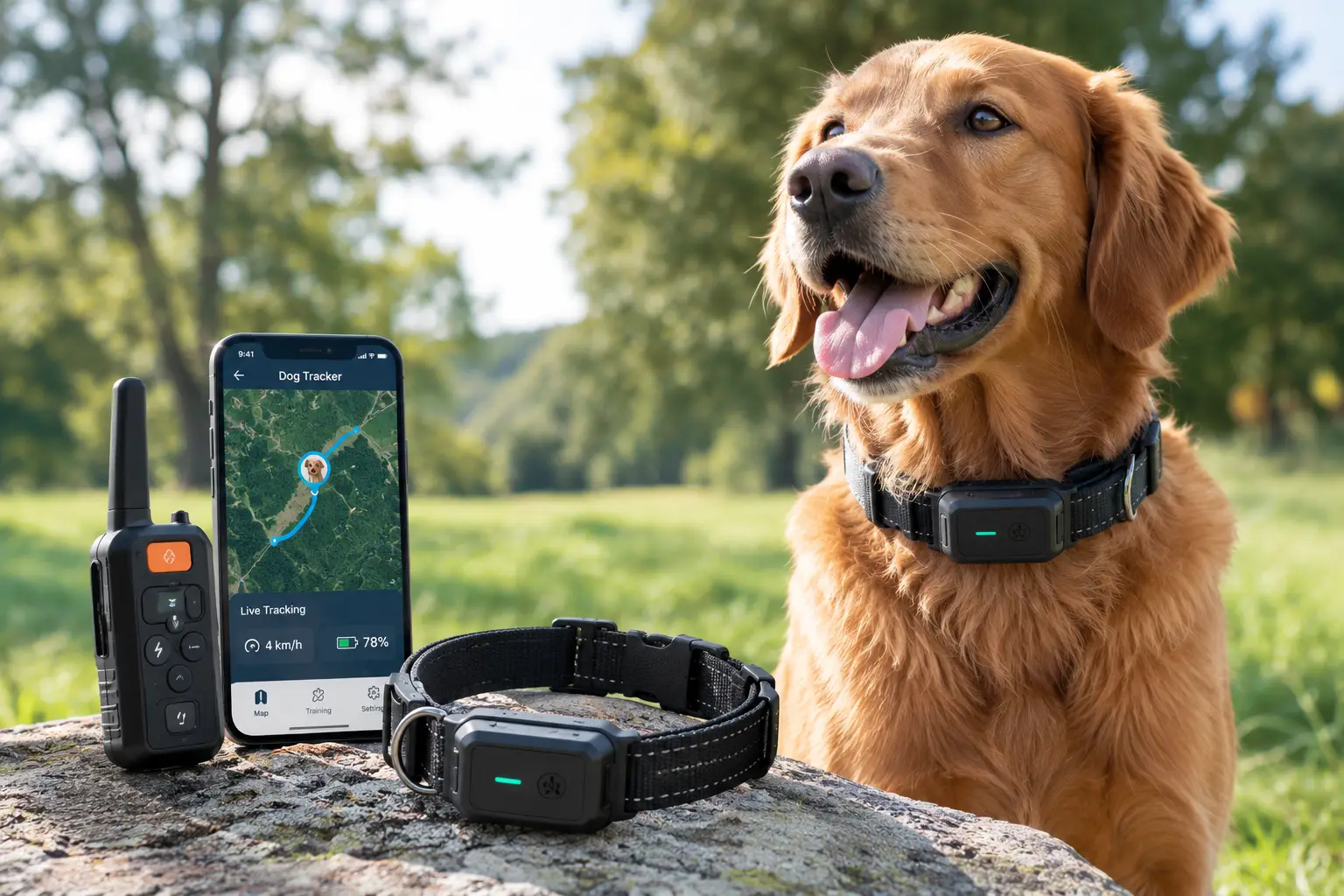
Track and train dog collars combine a GPS tracker and a remote training collar in a single unit, so you can see exactly where your dog is on a map and send a tone, vibration, or stimulation cue from the same handheld or phone. They’re built mainly for hunting, field, and off-leash working dogs that range far beyond sight.
Here’s the problem they solve. Your pointer locks up on birds 600 yards away, just over a ridge. A regular e-collar lets you correct a dog you can see. A plain GPS tracker tells you where the dog is, but can’t do a thing about it. Track and train dog collars close that gap—you know the dog is on point, you know which direction it’s facing, and you can cue a “whoa” or a recall without shouting every bird in the county into the next zip code.
The category has matured fast. Garmin replaced its long-running TT 15 collar with the redesigned TT 25, SportDOG pushed range to 10 miles with frequency-hopping radio, and Dogtra moved the whole control center onto your smartphone. Meanwhile, “everyday” smart collars like Halo have blurred the line by adding GPS fences and feedback cues for backyard dogs.
That’s a lot of choice—and these systems aren’t cheap. So instead of reprinting spec sheets, this guide compares seven real systems available to US buyers, translates each spec into what it means in the field, summarizes what owners and independent testers actually report, and flags the trade-offs marketing copy glosses over. If you’re newer to the underlying tech, the background on the electronic training collar is worth a skim first, since the “train” half of these systems is built on it.
Quick Comparison: Track and Train Dog Collars at a Glance
| Product | Max range | Control | Training cues | Best for |
|---|---|---|---|---|
| Garmin Alpha 300i + TT 25 Bundle | Up to 9 mi | Dedicated handheld + inReach | 18 stim levels, tone, vibe | Serious hunters in remote country |
| SportDOG TEK Series 2.0 GPS + E-Collar | Up to 10 mi | Dedicated handheld | 99 stim levels, tone, vibe | Big packs, upland hunters |
| Garmin Alpha 200 + TT 15X Bundle | Up to 9 mi | Dedicated handheld | 18 stim levels, tone, vibe | Garmin ecosystem on a tighter budget |
| Dogtra Pathfinder 2 | Up to 9 mi | Smartphone app + connector | Stim, tone, pager vibration | Best value, no subscription |
| Garmin Alpha 10 + TT 15X Bundle | Up to 9 mi | Compact handheld + phone | 18 stim levels, tone, vibe | Minimalists, long trips |
| Dogtra Pathfinder 2 Mini | Up to 4 mi | Smartphone app + connector | Stim, tone, vibration | Small and mid-size dogs |
| Halo Collar 5 | Cellular (no radio limit) | Smartphone app | Sound, vibe, optional static | Everyday pets, GPS fencing |
Reading the table, the first split isn’t range—it’s how you control the system. The Garmin Alpha 300i + TT 25 Bundle, SportDOG TEK Series 2.0 GPS + E-Collar, and Garmin Alpha 200 + TT 15X Bundle use dedicated handhelds that keep working when your phone dies, while the Dogtra Pathfinder 2 trades that redundancy for a much lower price. The Halo Collar 5 is the outlier: it runs on cell service, which gives it “unlimited” range in town but makes it unreliable in the backcountry dead zones where hunting dogs actually disappear.
💬 One click helps other shoppers make an informed choice too! 😊
Top 7 Track and Train Dog Collars: Expert Analysis
Every pick below is a real system sold to US buyers, with specs drawn from manufacturer data and independent field reviews. Price ranges are approximate at the time of writing—always check the current price.
1. Garmin Alpha 300i + TT 25 Bundle — the backcountry gold standard
If your dogs run where cell towers don’t, this is the most complete safety net in the category. The TT 25 collar tracks up to 9 miles and refreshes as often as every 2.5 seconds, so a dog moving at full speed shows up where it is, not where it was half a minute ago. It offers 18 stimulation levels plus tone and vibration, and multicolor LED beacon lights that Garmin rates as visible up to about 100 yards—handy for finding a black Lab at dusk. The Alpha 300i handheld adds inReach two-way satellite messaging and interactive SOS, tracks up to 20 dogs, and carries preloaded topo maps.
Based on comparing specs, the real upgrade over older Garmins is battery flexibility: retailers list the TT 25 at up to 68 hours on the standard battery and up to 136 hours with the optional extended pack, and both the battery and GPS flex band are user-replaceable. That’s a big deal for coon and bear hunters running multi-day hunts.
Owner feedback is strongly positive on durability—one veterinarian-hunter’s long-term review praised its ability to survive heavy abuse—while forum complaints center on a finicky charging clip and a collar that’s hard to snug down on very small dogs.
Pros:
- ✅ inReach SOS works far beyond cell coverage
- ✅ Replaceable battery and flex band extend service life
- ✅ LED beacon helps you spot dogs in low light
Cons:
- ❌ inReach features require a paid satellite subscription
- ❌ No mini version for small-necked dogs
💰 Typically starts around $1,000 and climbs with multi-collar bundles—expensive, but unmatched for remote-country safety.
2. SportDOG TEK Series 2.0 GPS + E-Collar — biggest pack, longest range
The SportDOG TEK Series 2.0 GPS + E-Collar (model TEK-V2LT) is built for handlers running a crowd. Its HopTek radio uses frequency hopping to dodge interference and is rated up to 10 miles, and a single handheld can manage up to 21 dogs. On the training side you get 99 static levels in continuous, momentary, and rising modes, plus tone and vibration.
What 99 levels means in practice: you can find a dog’s “working level” in very fine steps, which suits soft-tempered pointers that shut down if a cue is even slightly too strong. The collar is submersible to 25 feet (the handheld to 5 feet), and preloaded 1:100,000 topo maps come standard with no mapping subscription. Bluetooth voice updates through an earpiece let you keep your eyes on cover instead of a screen.
This is a strong fit for upland hunters with three or more dogs who want maps included and no monthly fees. A multi-month independent test found tracking accurate across its range but noted it’s overkill for casual hikers.
Aggregated reviews praise reliability in mountainous terrain; the most repeated drawback is collar battery life of roughly 24 hours, well short of current Garmins.
Pros:
- ✅ Up to 10-mile rated range with interference-resistant radio
- ✅ 99 stimulation levels allow very precise cues
- ✅ Topo maps included with no subscription
Cons:
- ❌ About 24-hour collar battery limits multi-day hunts
- ❌ Handheld is bulkier than smartphone-based systems
💰 Generally in the $700–$900 range at the time of writing—excellent value per dog if you run a big string.
3. Garmin Alpha 200 + TT 15X Bundle — proven Garmin power for less
The Garmin Alpha 200 + TT 15X Bundle gives you most of Garmin’s field-proven platform without the inReach premium. The Alpha 200 handheld has a 3.5-inch sunlight-readable touchscreen, a 2.5-second update rate, and tracks up to 20 dogs up to 9 miles away. The TT 15X collar delivers 18 stimulation levels plus tone and vibration, and retailers list its battery at roughly 60 to 80 hours—about double the original TT 15—thanks to an added sleep mode.
Here’s what to weigh: the TT 15X is the previous-generation collar, but it’s fully compatible with the newer Alpha 300 handhelds, so you’re not buying into a dead end. If you hunt within areas where you’d have cell coverage for emergencies, or already carry a separate satellite messenger, skipping the “i” saves real money.
This is the pick for Garmin loyalists and upland hunters who want button-driven training (no fumbling a phone with gloves) at a lower buy-in. Reviews consistently describe the TT 15X’s battery life as a genuine multi-day improvement; common gripes are the older charging cable style and the fact that newer TT 25 features—like Wi-Fi collar updates and a replaceable flex band—aren’t included.
Pros:
- ✅ Multi-day battery with sleep mode
- ✅ Physical buttons work well with gloves
- ✅ Compatible with newer Garmin handhelds later
Cons:
- ❌ No satellite SOS or messaging
- ❌ Previous-generation collar hardware
💰 Usually in the $650–$800 range—the smart middle ground for Garmin users.
4. Dogtra Pathfinder 2 — best value, zero subscription
The Dogtra Pathfinder 2 is the reason many hunters no longer assume “GPS e-collar” means four figures. Instead of a handheld, it uses a small GPS connector that talks to the collar over radio and to your phone over Bluetooth; the free app handles maps (including offline maps), tracking, and training. Rated range is up to 9 miles with a 2-second refresh, it manages up to 21 dogs, and the collar is IPX9K rated.
In practice, a phone-based system means a bigger, sharper map than any handheld—and smartwatch support (Apple Watch or Galaxy Watch) for quick cues without pulling the phone. The connector also carries a dedicated e-collar button for faster response. One independent tester noted you can switch to tracking-only mode for field trials that prohibit stimulation.
The trade-off is redundancy: if your phone dies, so does your map. Reviews repeatedly flag phone battery drain and collar runtime that suits single-day hunts better than multi-day trips. Several testers report real-world range of roughly 4–6 miles in heavy timber versus the 9-mile rating.
Pros:
- ✅ No subscription and free lifetime app
- ✅ Large phone map with offline support
- ✅ Smartwatch control for quick cues
Cons:
- ❌ Heavy phone battery drain on long hunts
- ❌ Collar sized for dogs about 25 pounds and up
💰 Typically $400–$500—roughly half of comparable handheld systems, making it the value champion.
5. Garmin Alpha 10 + TT 15X Bundle — compact control, week-long battery
The Garmin Alpha 10 + TT 15X Bundle is for handlers who find full-size handhelds clunky. The Alpha 10 is a compact, button-driven unit with at-a-glance tracking (distance, direction, dog status) and the same 18 stimulation levels, tone, and vibration. Garmin rates its battery at up to a full week.
What most buyers overlook: the Alpha 10 isn’t meant to be a map device on its own. It shines as part of a system—pair it with the Garmin Explore app for a full map on your phone, with select Garmin watches (fēnix, Instinct, tactix) for wrist tracking, or with a DriveTrack navigator so you can monitor dogs from the truck. Think of it as a rugged remote with a compass screen, not a mini-GPS.
That makes it ideal for road hunters, houndsmen who spend time in vehicles, and minimalists who already own a Garmin watch. Owner and retailer feedback praises the battery life and pocket-friendly size; the recurring complaint is that the small screen feels limited if you expected on-device topo maps.
Note that some retailers now also sell Alpha 10 bundles with the newer TT 25 collar—check which collar you’re getting.
Pros:
- ✅ Up to a week of handheld battery life
- ✅ Wrist tracking with compatible Garmin watches
- ✅ Small enough for a chest rig or pocket
Cons:
- ❌ No full map display on the handheld
- ❌ Best experience depends on extra devices
💰 Usually in the $550–$700 range—fair value if you already live in the Garmin ecosystem.
6. Dogtra Pathfinder 2 Mini — built for smaller dogs
The Dogtra Pathfinder 2 Mini solves a problem Garmin currently doesn’t: a lighter, smaller track-and-train collar for dogs under about 25 pounds. It runs on the same free app and connector concept as the Dogtra Pathfinder 2, tracks and trains up to 21 dogs, supports offline maps, and charges no subscription.
The honest trade-off is range: the Mini is rated up to 4 miles, less than half the full-size model. For a beagle on rabbits, a small spaniel, or a terrier-sized hiking buddy, that’s usually plenty—small dogs rarely cover the ground a big-running pointer does. Sleep mode slows the refresh rate and LED flash to stretch battery life on long outings.
Based on the spec sheet, this is the logical choice for rabbit hunters and owners of compact breeds who’ve struggled to fit full-size GPS collars. Forum threads show beagle owners frustrated that Garmin’s TT 25 has no mini version, which is exactly the gap this collar fills. Dogtra’s product page highlights easy setup and affordability as the themes customers mention most, though independent long-term reviews are thinner than for the full-size model—so weigh that uncertainty.
Pros:
- ✅ Sized for small and mid-size dogs
- ✅ Same subscription-free app as full-size model
- ✅ Sleep mode stretches battery life
Cons:
- ❌ 4-mile range limits big-country use
- ❌ Fewer independent long-term reviews available
💰 Generally priced below the full-size Pathfinder 2, often in the $300s—strong value for small-breed owners.
7. Halo Collar 5 — everyday tracking with GPS fences
The Halo Collar 5 isn’t a hunting rig, and that’s the point. It’s a cellular GPS collar built for pets who live at home: you draw virtual fences in the app, and the collar uses sound, vibration, or optional static feedback to keep your dog inside. Halo lists up to 48 hours of battery, a roughly one-hour recharge, and 20 location updates per second, with fences ranging from about 900 square feet up to very large properties.
What that means day to day: no buried wire, fences that travel with you to the cabin, and live location if your dog does bolt. Halo also offers in-app training content co-developed with Cesar Millan and remote “beacons” for recall cues.
The big caveat is cell dependency. In a suburban yard, it’s excellent; in a roadless valley, it’s guessing. It also requires a paid subscription. Independent reviewers consistently praise the easy fence setup and big battery gains over the Halo 4, while noting that a GPS fence still demands real training time and can’t keep other animals out.
Pros:
- ✅ Portable GPS fences with no wires
- ✅ Up to 48-hour battery with fast charging
- ✅ Friendly app with built-in training content
Cons:
- ❌ Subscription required for core features
- ❌ Weak where cell coverage is poor
💰 Around $500–$600 plus a monthly plan—worth it for rural homeowners without a physical fence.
Side-by-Side: The Top 7 Compared
| Product | Collar battery (rated) | Dogs per system | Subscription? | Best for |
|---|---|---|---|---|
| Garmin Alpha 300i + TT 25 Bundle | Up to 68 hr (136 extended) | Up to 20 | Optional (inReach) | Multi-day remote hunts |
| SportDOG TEK Series 2.0 GPS + E-Collar | About 24 hr | Up to 21 | No | Large upland packs |
| Garmin Alpha 200 + TT 15X Bundle | About 60–80 hr | Up to 20 | No | Garmin users on a budget |
| Dogtra Pathfinder 2 | Single long day | Up to 21 | No | Best overall value |
| Garmin Alpha 10 + TT 15X Bundle | About 60–80 hr | Up to 20 | No | Truck and wrist tracking |
| Dogtra Pathfinder 2 Mini | Single long day | Up to 21 | No | Small breeds |
| Halo Collar 5 | Up to 48 hr | 1 per collar | Yes | Home and yard dogs |
The battery column tells a story the range column hides: Garmin’s collars are built for hunts measured in days, while the SportDOG TEK Series 2.0 GPS + E-Collar and both Dogtra models assume you’ll charge nightly. Notice too that only the Halo Collar 5 makes a subscription mandatory, whereas on the Garmin Alpha 300i + TT 25 Bundle it’s optional and only unlocks satellite messaging. If you run dogs for more than a day at a time, battery should outrank nearly every other spec.
✨ Don’t miss these top-rated picks!
🔍 Take your dog’s field training to the next level with this carefully curated lineup. Click a highlighted system to check current pricing and availability—these picks will help you get a safer, more responsive dog you can trust off leash!
Getting Started: Your First 30 Days With a GPS Dog Training Collar
A GPS dog training collar is only as good as the routine around it. Here’s a practical first-month plan.
Week 1 — Charge, pair, and fit. Fully charge collar and handheld before first use, update firmware (the TT 25 can update over Wi-Fi while charging), and pair the collar. Fit it snugly high on the neck with the GPS antenna pointing up—a rotated collar is the number one cause of “bad GPS.” You should fit one finger between contact points and skin.
Week 2 — Tone and vibration first. Before any stimulation, pair tone or vibration with a command your dog already knows, then reward compliance. Veterinary behavior groups such as the American Veterinary Society of Animal Behavior recommend reward-based methods only, and many handlers find their dogs respond to tone and vibe alone. If you do use stimulation, start at the lowest level and find the point where your dog barely notices—an ear twitch or head turn.
Week 3 — Short tracking sessions. Let the dog range in a familiar field while you watch the map. Set a geofence and test the alert. Learn what “on point” or “treed” looks like on your screen.
Week 4 — Real conditions. Try timber, creek bottoms, and hills to learn your system’s real-world range. Practice rescue or sleep mode so you know how to stretch battery if a dog goes missing.
⚡ Maintenance tip: Rinse contact points after muddy or saltwater days, check the antenna for cracks monthly, and store collars partly charged rather than fully drained over the off-season.
Real-World Scenarios: Matching the Right Dog Tracking Collar With Remote Trainer
Specs make more sense attached to real people. Here are four common profiles.
🐦 The weekend upland hunter (1–2 pointers, $500 budget). Hunts public land in the Midwest, day trips only, always carries a phone. The Dogtra Pathfinder 2 fits best: 9-mile rated range covers big-running pointers, the phone map is excellent, and nightly charging is no burden on day trips. A cheap power bank solves the phone-drain issue.
🏔️ The Western chukar or grouse hunter (2–3 dogs, remote country). Hikes steep canyons with patchy or zero cell service, sometimes overnight. The Garmin Alpha 300i + TT 25 Bundle earns its price here: satellite SOS covers the human, multi-day battery covers the dogs, and physical buttons work with frozen fingers.
🐕 The beagle or small-breed rabbit hunter (3–4 dogs, $400–$1,200 total). Needs light collars that actually fit. The Dogtra Pathfinder 2 Mini is the realistic choice, since its 4-mile range suits the tight circles rabbits run.
🏡 The rural pet owner (1 dog, no fence, 5 acres). Doesn’t hunt, wants the dog to stay home. Skip the hunting rigs entirely—the Halo Collar 5 GPS fence and cellular tracking match the use case, and the subscription replaces the cost of a physical fence.
The pattern: match the system to where you’ll use it and how long you’ll be out, not just to the longest range number.
Problem → Solution: Fixing the Most Common Track-and-Train Headaches
Problem 1: The dog’s position jumps around or lags. Usually the collar has rotated so the antenna points sideways or down. Tighten the strap and re-center the GPS module on top of the neck. On Garmin handhelds, confirm you haven’t left the collar in a slower update or rescue mode.
Problem 2: Range is far below the advertised number. Rated ranges assume line of sight. Hills, dense timber, and deep ravines block radio signals, so expect less in rough country. Climb to high ground, raise the handheld, and use the extended antenna if your system includes one.
Problem 3: The dog ignores the cue. Either the level is too low for the dog’s excitement level, or the dog was never taught what the cue means. Go back to Week 2 above and pair the cue with a known command in a low-distraction setting.
Problem 4: Battery dies mid-hunt. Switch to sleep or rescue mode early, not when the battery is already at 10%. With the Dogtra Pathfinder 2, carry a power bank for your phone; with the SportDOG TEK Series 2.0 GPS + E-Collar, plan around its roughly 24-hour collar runtime.
Problem 5: The collar won’t fit a small dog. Full-size Garmin TT 25 collars have no mini version, so consider the Dogtra Pathfinder 2 Mini instead of forcing a heavy collar onto a small neck.
How to Choose Track and Train Dog Collars
Use these seven steps to narrow the field quickly:
- Define your terrain. Open prairie rewards range; timber and canyons reward accuracy and battery life more than headline miles.
- Decide handheld vs. smartphone. Handhelds add redundancy and glove-friendly buttons; smartphone systems cut cost and give bigger maps.
- Count your dogs—now and later. Most systems handle 20–21 dogs, but add-on collar prices add up fast.
- Match battery to trip length. Day hunters can live with ~24 hours; multi-day hunters should look at 60+ hours.
- Check collar size and weight. Small breeds need smaller collars; don’t overload a 20-pound dog.
- Look at training flexibility. More stimulation levels allow finer adjustments; tone and vibration options matter for sensitive dogs.
- Add up the real cost. Include extra collars, replacement batteries, and any subscriptions.
Following these steps, most buyers land in one of three camps: remote-country hunters (Garmin Alpha 300i), budget-minded day hunters (Dogtra), or big-pack upland handlers (SportDOG). For independent field-testing context, Outdoor Life’s hands-on GPS dog collar tests are a useful second opinion on range and battery claims.
GPS E-Collar vs. a Separate Tracker and E-Collar
Plenty of hunters still run two devices: a standalone GPS tracker plus a separate remote trainer. Is a combined GPS e-collar actually better?
| Factor | Combined track-and-train collar | Separate tracker + e-collar | Best for |
|---|---|---|---|
| Weight on dog | One unit | Two units | Combined |
| Training range | Up to 9–10 mi | Usually ½–1 mi remote | Combined |
| Upfront cost | Higher single purchase | Can spread over time | Separate |
| Redundancy | One failure point | One device can fail independently | Separate |
| Knowing when to cue | See position and status before cueing | Cue blind beyond sight | Combined |
The deciding factor is the last row. A standalone e-collar can reach far, but you’re cueing blind once the dog is out of sight—and a correction delivered while the dog is on point, rather than chasing, is a training mistake that’s hard to undo. Combined systems like the Garmin Alpha 300i + TT 25 Bundle let you confirm status first. The separate-device route mainly makes sense if you already own a good trainer and want to add tracking gradually.
Handheld vs. Smartphone: Which GPS Dog Training Collar Control Style Wins?
This is the most practical fork in the road.
Dedicated handhelds (Garmin Alpha series, SportDOG TEK 2.0) are purpose-built: sunlight-readable screens, physical buttons you can find by feel, water resistance, and batteries that don’t compete with your texts and camera. The Garmin Alpha 200 + TT 15X Bundle is a good example—button training works even when your hands are cold and wet. The downside is cost and a smaller map.
Smartphone systems (Dogtra Pathfinder 2 and Mini, Halo Collar 5) use hardware you already own and update constantly. Your phone’s larger screen makes maps easier to read, and smartwatch support adds quick access. The trade-off is fragility: phones crack, freeze, and die, and one dead battery can take your whole system down.
A middle path exists: the Garmin Alpha 10 + TT 15X Bundle gives you a physical remote for training plus phone-based mapping via the Garmin Explore app. If you hate choosing, that hybrid is worth a look.
Rule of thumb: if losing contact with your dog could put it in real danger—roads, cliffs, predators, extreme cold—pay for the redundancy of a dedicated handheld.
Features That Actually Matter (and Ones That Don’t)
Matters a lot:
- ✅ Update rate. A 2–2.5-second refresh shows fast dogs accurately; slower rates can leave a dog “on the map” 100 yards from where it actually is.
- ✅ Battery life and replaceability. Replaceable batteries, like the TT 25’s, add years of service.
- ✅ Training granularity. Fine steps let you use the lowest effective level.
- ✅ Collar fit and weight. An ill-fitting collar hurts accuracy and comfort.
- ✅ Dog status reporting. Knowing a dog is on point or treed changes how you respond.
Matters less than marketing suggests:
- ❌ Maximum rated range. Few hunts need 10 miles; terrain matters more than the spec.
- ❌ Number of dogs supported. Twenty dogs sounds impressive, but most owners run one to four.
- ❌ Excessive stimulation levels for their own sake. Ninety-nine levels are great for fine-tuning, but only if you actually take time to find your dog’s working level.
In short, invest in battery, accuracy, and fit first. Everything else is a bonus.
Safety, Regulations, and Standards
A few rules and realities to know before you buy:
Radio regulations. Most handheld systems use VHF radio links in the 150 MHz range rather than cell service. Several systems, including Dogtra’s, operate on the FCC’s Multi-Use Radio Service (MURS), which the FCC “licenses by rule,” so ordinary users don’t need an individual license—but devices must be FCC-certified, and MURS channels are shared rather than exclusive. That’s one reason interference-resistant radios like SportDOG’s frequency hopping matter.
Hunting regulations vary by state. Rules on GPS collars for hunting dogs are not uniform. California has historically restricted GPS collar equipment on dogs used to pursue mammals, and those rules have been under review, while some states and agencies have considered requiring GPS collars for hound hunting. Always confirm current regulations with your state wildlife agency before the season.
E-collar use. There’s no federal ban on e-collars in the US, but some local ordinances and many professional organizations discourage aversive training. Using tone and vibration first is both kinder and legally safer.
Physical safety. Check contact points daily for skin irritation, remove the collar for several hours each day on long trips, and never leave a collar on a dog in a crate where straps can snag.
Long-Term Cost and Maintenance
The sticker price is just the start. Here’s a realistic ownership picture, using approximate ranges at the time of writing:
| System | Upfront (approx.) | Extra ongoing costs | Best for |
|---|---|---|---|
| Garmin Alpha 300i + TT 25 Bundle | ~$1,000+ | Optional inReach plan, extra collars, replacement batteries | Remote hunters wanting safety |
| Dogtra Pathfinder 2 | ~$400–$500 | Add-on collars, phone power bank | Value-minded day hunters |
| Halo Collar 5 | ~$500–$600 | Mandatory monthly plan | Pet owners without fences |
Over five years, the math can flip. A subscription-free system like the Dogtra Pathfinder 2 has almost no running costs beyond extra collars, while a Halo Collar 5 subscription can eventually add up to more than the collar itself. The Garmin Alpha 300i + TT 25 Bundle costs the most upfront, but its replaceable battery and flex antenna help it avoid early replacement—the most expensive “maintenance” of all.
Stretch your investment:
- 🔋 Store lithium batteries partly charged in the off-season.
- 🧽 Clean contact points and charging contacts after every muddy hunt.
- 🔧 Replace cracked antennas immediately; damaged antennas kill range.
- 📲 Keep firmware updated for bug fixes and battery optimizations.
Common Mistakes to Avoid When Buying a Track and Train Collar for Hunting Dogs
- Buying for maximum range instead of real terrain. A 10-mile rating means little in thick Appalachian timber.
- Ignoring collar size. Forcing a full-size collar onto a 20-pound beagle hurts fit and GPS accuracy.
- Forgetting add-on costs. Each extra dog means another collar, often a few hundred dollars.
- Skipping the introduction phase. Putting the collar on and immediately using stimulation creates a collar-wise, anxious dog.
- Relying on a phone without backup power. Smartphone systems need a power bank on every hunt.
- Overlooking the subscription fine print. Know which features stop working without a plan.
- Not checking state hunting rules. GPS and e-collar rules differ across state lines.
Avoid these, and even a mid-priced system will outperform an expensive one that’s poorly matched.
Garmin Track and Train Collar Options for Specific Dogs
Garmin dominates the premium tier, but the lineup confuses newcomers. Here’s how it breaks down by dog.
Big-running bird dogs and hounds: The TT 25 collar paired with an Alpha 300 or 300i handheld is Garmin’s current flagship, with the longest battery and replaceable parts. Hounds on multi-day chases benefit most from its extended battery option.
Budget-minded Garmin users: The TT 15X remains a capable collar and pairs with both older and newer handhelds, which is why the Garmin Alpha 200 + TT 15X Bundle is still widely sold.
Handlers who hunt from a truck or wear a Garmin watch: The Garmin Alpha 10 + TT 15X Bundle puts tracking on your wrist or dashboard.
Small dogs: This is Garmin’s gap. The older TT 15 Mini has been discontinued, and owners on hunting forums report the TT 25 doesn’t fit very small necks well. Small-breed owners are usually better served by the Dogtra Pathfinder 2 Mini.
Tip: before buying extra collars, confirm compatibility—Garmin’s newer handhelds support older T and TT collars, but charging cables differ between generations.
Frequently Asked Questions About Track and Train Dog Collars
❓ Are track and train dog collars worth the money?
❓ Do GPS dog training collars need a monthly subscription?
❓ Can I use a track and train collar without stimulation?
❓ What size dog can wear a GPS e-collar?
❓ Which track and train collar has the best battery life?
Conclusion: Picking Your Track and Train Dog Collar
The best track and train dog collars don’t just show dots on a map—they give you enough information to make the right call at the right moment. The key is matching the system to your terrain, trip length, and dogs.
If you hunt remote, rugged country—especially for multiple days—the Garmin Alpha 300i + TT 25 Bundle is worth its premium for satellite SOS, long battery life, and replaceable parts. If you run a big string of upland dogs, the SportDOG TEK Series 2.0 GPS + E-Collar brings 10-mile rated range, 21-dog capacity, and maps included. Want Garmin reliability for less? The Garmin Alpha 200 + TT 15X Bundle remains a proven workhorse, while the Garmin Alpha 10 + TT 15X Bundle suits truck-and-wrist trackers.
For most day hunters, the Dogtra Pathfinder 2 is the value pick—no subscription and excellent phone maps—with the Dogtra Pathfinder 2 Mini covering smaller breeds. And if your dog is a homebody who needs boundaries more than backcountry tracking, the Halo Collar 5 fits that life better than any hunting rig.
Whichever you choose, invest the first month in slow, reward-based introduction. The collar is a communication tool—your consistency is what turns it into a reliable dog.
🐾 Ready to find your dog’s perfect match?
🔍 Take the guesswork out of every hunt with a system built for your terrain and your pack. Click any highlighted pick above to check current pricing and availability—your safest, most confident season starts here!
Recommended for You
- Sticker GPS System: 7 Best Trackers That Actually Work (2026)
- Electric Fence Control: 7 Best Energizers That Actually Work (2026)
- Best Dog Training Collar for Small Dogs: 7 Gentle Picks (2026)
Disclaimer: This post contains affiliate links. As an Amazon Associate, I earn from qualifying purchases made through these links, at no additional cost to you.
✨ Found this article helpful? Share it with someone who needs it! 💬🤗