
In This Article
Electric Fence Control in 2026: Why the Box on the Post Runs the Whole Show
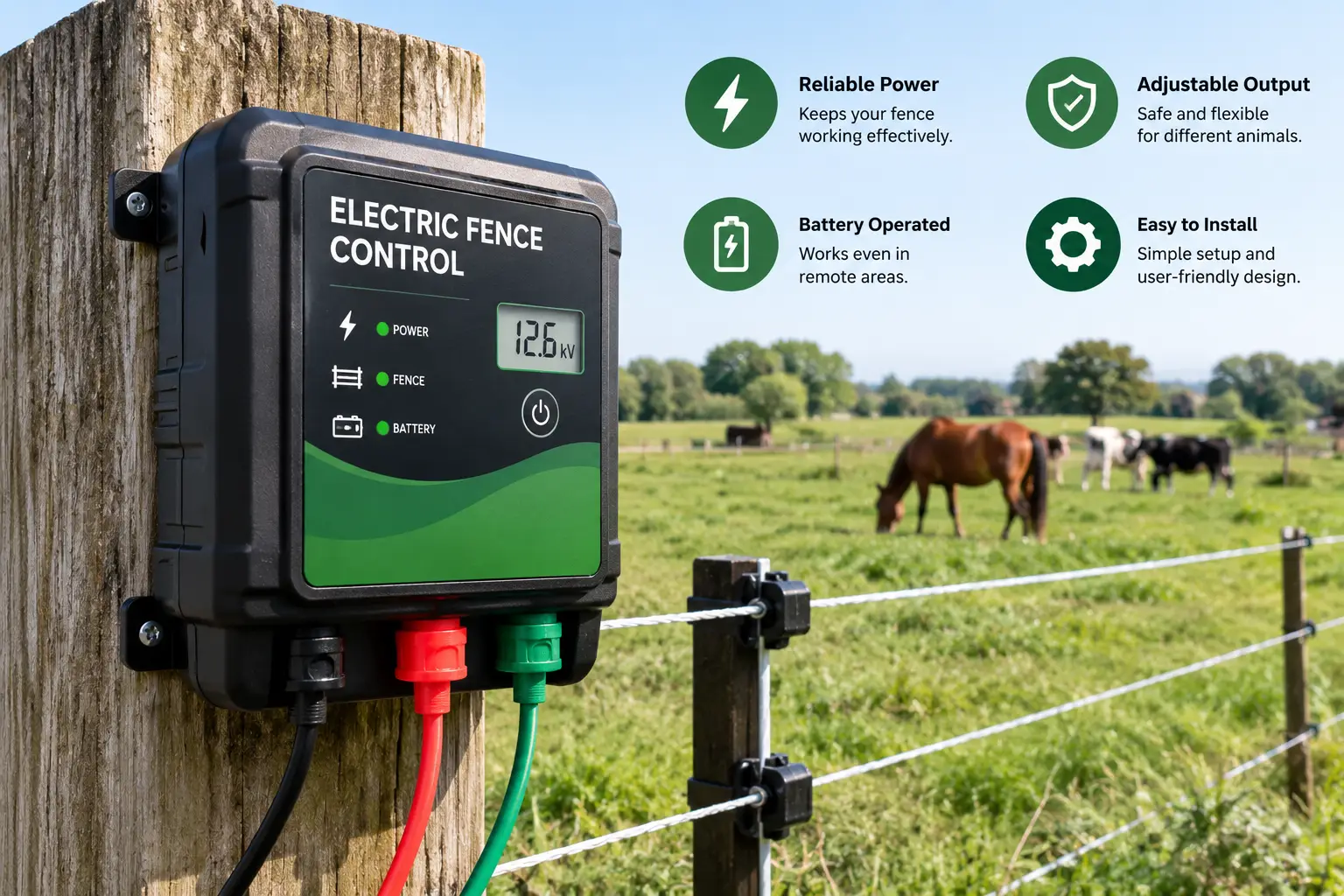
Electric fence control is the system that powers and manages an electric fence: an energizer (also called a charger or controller) converts AC, battery, or solar power into short, high-voltage pulses, about one per second, that travel along the wire and return through ground rods to deliver a safe but very memorable shock.
Here’s the thing most people learn the hard way. You can string the prettiest high-tensile wire in the county, but if the unit feeding it is undersized, badly grounded, or quietly dying, your fence becomes a polite suggestion. Cows figure that out fast. So do raccoons, goats, and that one neighbor’s dog with a talent for escape.
That’s why good electric fence control starts with the box, not the wire. The right electric fence controller has to match three things: how much fence you’re running, how much vegetation touches it, and what you’re trying to keep in (or out). As a useful starting point, Virginia Cooperative Extension’s energizer guide suggests planning around roughly one output joule per mile of fence and comparing units by output joules rather than stored joules, since stored ratings don’t translate evenly across brands.
In this guide, we compare seven real units you can find on amazon.com, from a tiny plug-in garden charger to a solar electric fence charger that can run a large off-grid pasture. To be upfront about our method: we didn’t bench-test these units ourselves. Instead, we worked from manufacturer spec sheets, published load-voltage data, university extension guidance, and real customer review sentiment where we could verify it. You’ll also get a setup plan for your first 30 days, a troubleshooting guide, and a straight answer on which electric fence energizer fits your property.
Quick Comparison: Top Electric Fence Control Units at a Glance
| Product | Power Source | Rated Energy | Rated Range | Best For |
|---|---|---|---|---|
| Patriot PE2 | 110V AC plug-in | 0.10 J output | 2 miles / 8 acres | Patriot PE2: pets, gardens, small nuisance animals |
| Zareba ESP10M-Z | Solar + 6V battery | 0.15 J output | Up to 10 miles (clean steel wire) | Zareba ESP10M-Z: small remote paddocks |
| Gallagher S30 Lithium | Solar + lithium battery | 0.21 J output (0.3 stored) | 4 miles typical / 20 clean | Gallagher S30 Lithium: portable strip grazing |
| Gallagher M160 | 110V AC plug-in | 0.86 J output (1.6 stored) | 11 miles typical / 30 clean | Gallagher M160: small-to-mid pastures |
| Zareba EAC50M-Z | 110V AC plug-in | 2.0 J output | Up to 50 miles | Zareba EAC50M-Z: weedy fence lines |
| Parmak Mark 8 | 110–120V AC plug-in | 1.1–4.9+ J (adjustable) | Up to 30 miles | Parmak Mark 8: medium pastures, predators |
| Parmak Magnum Solar-Pak 12 | Solar + 12V battery | 1.1–3.1+ J | Up to 30 miles | Parmak Magnum Solar-Pak 12: large off-grid pastures |
Looking at the table, the first thing to notice is that brands don’t report energy the same way. Gallagher lists both stored and output joules, Zareba and Patriot highlight output joules, and Parmak publishes low/high joule ratings, so a straight number-to-number comparison can mislead you. The practical takeaway: the Zareba EAC50M-Z and Parmak Mark 8 are the heavy hitters for weedy, grid-powered fence, the Parmak Magnum Solar-Pak 12 is the only true high-power off-grid option here, and the Patriot PE2 is strictly a small-job specialist.
👉 Tap any highlighted product name to check current pricing and availability — and share this table with a neighbor who’s still chasing escaped heifers! 😊
Top 7 Electric Fence Control Picks: Expert Analysis
1. Patriot PE2 — budget pick for gardens and pets
The Patriot PE2 exists for one job: keeping small critters honest on a small footprint without spending much.
It’s a 110-volt plug-in unit rated at 0.10 joules of output (0.16 stored) and covers up to 2 miles or 8 acres. In practice, that’s plenty of sting for a raccoon eyeing your sweet corn or a dog that treats the yard line as optional, but it’s nowhere near enough to hold a cow leaning through wet grass. Its low-impedance design helps push that small pulse past light foliage, and an LED pulses when the unit is working. Remember, though, that the light confirms the box is alive, not that the far end of your fence is hot. Patriot also specifies keeping it under shelter, so plan on mounting it on a garage or shed wall and running a lead-out wire to the fence.
Who should buy it? Gardeners, backyard poultry keepers dealing with small predators, and pet owners with a compact yard. If your plan involves anything with hooves and a grudge, skip ahead.
On reviews: the Patriot PE2 is widely stocked (Amazon, Walmart, Lowe’s), and Walmart’s listing alone shows more than a hundred customer reviews. However, we couldn’t verify a consistent sentiment pattern we’d feel comfortable summarizing, so we’re leaning on the spec sheet here.
Pros:
- ✅ Very low entry cost for small fencing jobs
- ✅ Simple plug-in setup with a pulse indicator LED
- ✅ Low-impedance circuit handles light foliage contact
Cons:
- ❌ Far too weak for cattle, horses, or large predators
- ❌ Must be installed indoors or under shelter
Typically found in the $40–$60 range at the time of writing, it’s excellent value as long as you respect its narrow job description.
2. Zareba ESP10M-Z — go-anywhere solar starter
The Zareba ESP10M-Z puts a working fence where no extension cord will ever reach, which is the whole point of a solar electric fence charger.
It delivers 0.15 output joules (0.18 stored) and ships with a 6-volt rechargeable battery that, once fully charged, can run the unit up to two weeks without sun. Zareba tells you to charge it in full sun for 72 hours before first use, and skipping that step is a classic reason new owners think their unit is “dead.” Pay close attention to the fine print on range: 10 miles applies to clean steel wire, dropping to 5 miles with light weeds, while polywire is rated at 5 miles clean and 2.5 miles with light weeds. That 2.5-mile figure is the realistic planning number for most temporary setups.
Based on the specs, this is a smart fit for a small remote paddock, short-haired livestock, or a hobby farm testing electric fence for the first time. Zareba rates it for moderate, dry weed conditions, so it’s not a brush-burner.
Customer sentiment is genuinely mixed. On Zareba’s own site, the unit averaged around 3.3 out of 5 across roughly 30 reviews at the time of writing, with praise from sheep owners using it for rotational grazing, while owner feedback on Zareba’s replacement-battery page shows that battery wear is a recurring maintenance item.
Pros:
- ✅ No outlet needed anywhere on your property
- ✅ Battery included and rated for two sunless weeks
- ✅ Integrated mount fits T-posts and wood posts
Cons:
- ❌ Low output struggles with heavy vegetation
- ❌ Mixed reviews, with batteries needing periodic replacement
Usually priced roughly between $150 and $230, it’s fair value if you keep your fence lines clean and short.
3. Gallagher S30 Lithium — lightest lift for moving paddocks
The Gallagher S30 Lithium is built for people who move fence every day or two and are tired of hauling heavy batteries.
It pairs an internal lithium iron phosphate battery with a 3.8-watt solar panel, delivering 0.3 stored and 0.21 output joules with a maximum output of 9.3 kV. Gallagher rates it at 4 miles (20 acres) of typical fence and 20 miles (60 acres) of perfectly clean wire. The clever part is its adaptive energy control: once the battery drops below 30%, it slows the pulse and trims voltage to stay on longer. What that means in the field is that during a long cloudy stretch, your fence gets softer rather than dying outright, which beats a dead fence, but animals may start testing it. LED lights warn you when fence voltage is too low or the battery is running down, and it’s backed by a 3-year warranty.
Our read: this is the rotational grazer’s tool. Moving polywire for strip grazing is where its portability pays off. Note that Gallagher itself steers wildlife-exclusion buyers toward its larger S60 and S80 models, so don’t expect it to stop deer.
We couldn’t verify a large pool of consistent US customer reviews for this specific model, so treat our assessment as spec-based analysis rather than crowd consensus.
Pros:
- ✅ Lithium battery keeps the unit light and portable
- ✅ Adaptive output stretches runtime in poor weather
- ✅ Warning LEDs flag low fence voltage quickly
Cons:
- ❌ Modest output limits it to clean, short fences
- ❌ Not recommended by Gallagher for wildlife exclusion
Expect it roughly in the $250–$400 range depending on the seller; check the current price. You’re paying for portability, not raw power.
4. Gallagher M160 — set-and-forget plug-in for small pastures
The Gallagher M160 is the kind of electric fence controller you install once, then mostly forget about, which is exactly what you want.
It stores 1.6 joules and delivers 0.86 output joules, with Gallagher rating it at 30 miles/100 acres of clean fence and 11 miles/60 acres of typical fence. That “typical” number is the honest one to plan around. The low-impedance design is meant to hold voltage under heavy fence load, and a built-in lightning diverter plus stainless steel terminals address the two things that kill chargers early: storms and corrosion. It’s UL listed and carries a 3-year warranty.
Here’s a useful data point from a seller Q&A: a buyer asked why their tester read only 2,000 volts, and the answer was that Gallagher chargers should read roughly 5,000–7,000 volts on the fence. Translation: if your reading is way below that, the problem is almost always your fence or grounding, not the box.
Who’s it for? Horse owners, small cattle herds, and anyone with barn power within reach of the fence. Keep in mind that extension guidance (about one output joule per mile) is far more conservative than the manufacturer’s ratings, so if your lines are weedy, size up.
Pros:
- ✅ Integrated lightning diverter protects the circuitry
- ✅ Realistic “typical fence” rating helps honest planning
- ✅ Plug-in power costs very little to run
Cons:
- ❌ No built-in voltage meter; buy a tester separately
- ❌ No battery or solar backup during power outages
Generally found around $180–$220, it’s one of the best-value AC units for small pastures.
5. Zareba EAC50M-Z — muscle for weedy summer fence lines
The Zareba EAC50M-Z is what you buy when July grass grows into your bottom wire faster than you can mow it.
It delivers 2.0 output joules, more than double the Gallagher M160‘s output, and is rated for up to 50 miles with a low-impedance design meant for heavy weed conditions. It’s fuseless (no blown fuse taking your fence down at 2 a.m.), uses digital timing, works with high-tensile wire, polywire, and polytape, and is UL listed and assembled in Tennessee. The warranty is 2 years, including lightning damage, extendable to 3 years when you register online, so register it the day it arrives.
Customer reviews on Home Depot frequently praise the strength of the shock, with some owners saying it hits harder than other 2-joule units they’ve used. The most instructive complaint: one owner discovered the “Fence OK” light stayed lit even with the fence shorted to the ground, and Zareba’s response was to recommend testing the fence directly. Lesson learned: that light reports the charger’s status, not your fence’s health. On Zareba’s site, the unit averaged about 4.8 out of 5 across roughly 15 reviews at the time of writing.
Based on the specs, it’s our pick for mixed livestock on long, weedy perimeters with grid power available.
Pros:
- ✅ Strong 2-joule output powers through heavy weeds
- ✅ Fuseless design avoids surprise downtime
- ✅ Lightning damage covered under the warranty
Cons:
- ❌ Indicator light can’t detect a shorted fence
- ❌ Needs sheltered mounting near an AC outlet
Typically priced in the $200–$300 range, it delivers excellent value per output joule.
6. Parmak Mark 8 — adjustable power with a built-in meter
The Parmak Mark 8 gives you something the others on this list don’t: adjustable power plus a digital readout of what your fence is actually doing.
Its output ranges from 1.1 to 4.9+ joules and it’s rated for up to 30 miles. That adjustability means you can run lower on clean lines during spring and crank it up for brushy fall fences or predator season. The built-in digital performance meter displays fence voltage right at the charger, which catches grounding failures and major shorts before your animals do. Just remember it reads at the box, so a break halfway down the line still needs a handheld tester. It adds fuse protection, built-in lightning arresters, UL listing, a UV-stabilized housing, and a 3-year warranty that covers lightning damage.
Parmak claims it runs for under 7 cents a month at 7 cents per kWh, which works out to roughly 1 kWh per month. Even if your utility charges several times that rate, you’re talking well under a dollar a month.
Review sentiment is notably polarized. On Jeffers, one owner called it the worst charger their farm had ever used, while another runs cows, hogs, goats, and a pony on it and reports every animal respects the fence. With a small sample like that, treat reviews cautiously and lean on the warranty.
Pros:
- ✅ Adjustable output adapts to seasons and weed load
- ✅ Digital voltage meter simplifies daily checks
- ✅ Lightning damage covered for three years
Cons:
- ❌ Polarized owner reviews suggest inconsistent unit quality
- ❌ AC-only, so outages take your fence down
Usually found roughly between $220 and $320, it’s strong value for medium pastures with predator pressure.
7. Parmak Magnum Solar-Pak 12 — off-grid power for big pastures
The Parmak Magnum Solar-Pak 12 is the answer when your pasture is big, your fence is long, and the nearest outlet is a mile away.
It combines a solar panel with an included sealed 12-volt battery, delivering 1.1 to 3.1+ joules across up to 30 miles, with Parmak’s built-in performance meter. What makes this unit unusually transparent is the published load data: about 11,000 volts open-circuit, 6,100 volts at a 500-ohm load, and 3,100 volts at a 100-ohm load. Here’s what that means: under moderate load, it stays in the zone Gallagher suggests for a healthy fence (5–7 kV), but under a heavy load (think wet weeds touching several wires), voltage drops substantially. That’s exactly why weed control still matters, even with a big solar box.
It’s UL listed and made in the USA, with a 3-year warranty (including lightning) on the unit and 1 year on the battery.
Reviews that we could verify are limited but positive: one owner on The Cheshire Horse reported using it year-round without charging problems and trusting it more than their hardwired units. It’s a single voice, but it matches the spec story.
Our analysis: this is the pick for large cattle pastures, remote hayfields, and predator-prone areas without grid power.
Pros:
- ✅ Highest off-grid output in this lineup
- ✅ Published load-voltage data aids honest planning
- ✅ Built-in meter shows fence condition at a glance
Cons:
- ❌ Highest price of the seven picks
- ❌ Battery warranty is shorter than the unit’s
Expect roughly $400–$600 at the time of writing; for off-grid acreage, it’s worth every dollar.
Side-by-Side: Monitoring, Mounting, and Weed Tolerance
| Product | Built-in Monitoring | Mounting | Weed Conditions (per maker) | Best For |
|---|---|---|---|---|
| Patriot PE2 | Pulse LED | Sheltered/indoor | Light foliage | Patriot PE2: backyard gardens |
| Zareba ESP10M-Z | Fence OK light | Outdoor post | Moderate, dry weeds | Zareba ESP10M-Z: small remote paddocks |
| Gallagher S30 Lithium | Low-voltage + battery LEDs | Outdoor post | Clean lines | Gallagher S30 Lithium: rotational grazing |
| Gallagher M160 | Power indicator | Sheltered near outlet | Heavy load (low impedance) | Gallagher M160: horse properties |
| Zareba EAC50M-Z | Fence OK light | Sheltered near outlet | Heavy weeds | Zareba EAC50M-Z: weedy perimeters |
| Parmak Mark 8 | Digital voltage meter | Sheltered near outlet | Wet weeds and brush | Parmak Mark 8: predator pressure |
| Parmak Magnum Solar-Pak 12 | Analog performance meter | Outdoor | Large pastures | Parmak Magnum Solar-Pak 12: off-grid acreage |
This table highlights the most underrated buying factor: monitoring. Only the two Parmak units show fence voltage on the box, which is why they suit owners who can’t walk the fence daily. If you choose the Zareba EAC50M-Z or Gallagher M160, budget for a digital fence tester on day one.
✨ Found your match? Don’t let another fence season slip by!
🔍 Take control of your pasture with this carefully curated lineup. Click a highlighted product to check current pricing and availability, and get your fence working the way it should, for animals that stay exactly where you want them.
Getting Started: Your First 30 Days With a New Electric Fence Controller
A new electric fence controller performs only as well as the first week of setup. Here’s a practical schedule.
Days 1–2: Build the Ground Before You Plug Anything In
Grounding is half the circuit. Michigan State University Extension’s charger guide recommends at least 3 feet of ground rod per joule of output, rods spaced at least 10 feet apart, and connecting wire made of the same metal as the rods to avoid corrosion. Keep your fence ground well away from your house’s electrical ground.
Days 3–4: Mount and Connect
Mount AC units under cover and solar units on a post facing the sun (south, for US readers). Charge solar models fully first; the Zareba ESP10M-Z, for example, needs 72 hours in the sun before use.
Days 5–7: Test, Then Train
Take readings at the charger, midway, and at the far end with a digital tester. A big drop from box to end points to shorts or breaks. Then let animals meet the fence in a small, well-built training area before turning them loose on a big pasture.
Weeks 2–4: Set a Maintenance Rhythm
- ✅ Check voltage at the far end at least weekly
- ✅ Walk the line after storms for broken insulators or fallen branches
- ✅ Trim vegetation before it touches the bottom wire
- ✅ Register your warranty (Zareba extends coverage when you do)
A common first-month mistake is trusting the indicator light instead of a tester. Another is using too few ground rods in dry summer soil. Fix both early and you’ll skip most of the troubleshooting later.
Real-World Scenarios: Matching the Right Electric Fence Energizer to Your Operation
Specs only make sense in context, so here are three realistic profiles and the electric fence energizer we’d point each toward, with the reasoning behind it.
Profile 1: The Suburban Gardener vs. the Raccoon Night Shift
Budget: under $100 total. Situation: a 60-by-40-foot vegetable garden, an outlet in the garage, and raccoons raiding the corn every night. The Patriot PE2 fits because the fence is tiny, power is close, and the target animals are small. Two strands of polywire, one low near the ground and one at about raccoon nose height, plus a ground rod, and the problem usually solves itself within days. Spending more here buys nothing but bragging rights.
Profile 2: The 12-Acre Horse Property
Budget: $250–$400 including a tester. Situation: three horses, permanent polytape fencing, and barn power 50 feet from the fence. The Gallagher M160 is the logical pick: its realistic 11-mile “typical fence” rating covers this with room to spare, and its lightning diverter protects the investment. Add a digital tester, since the M160 has no built-in meter. Horses are expensive to patch up after a fence failure, so reliability beats raw power here.
Profile 3: The Off-Grid Cow-Calf Operation
Budget: $500–$800 including grounding. Situation: 30 cow-calf pairs on 80 acres of permanent high-tensile fence, no power nearby, and coyotes in the area. The Parmak Magnum Solar-Pak 12 is the only unit on this list with the off-grid output to handle it, and the built-in meter matters because nobody checks a far pasture daily. If the operator also strip-grazes, a Gallagher S30 Lithium makes a smart second unit for the moving polywire.
The common thread? Match output to fence length and weed load first, then pick power source, then consider monitoring.
Problem → Solution: Fixing a Weak or Dead Fence
Most fence failures follow predictable patterns. Here are the big five, with fixes.
Problem 1: Low voltage everywhere, even near the charger. ✅ Solution: Suspect grounding first. Add ground rods, drive them deeper, and check clamps for corrosion. Dry soil is the usual culprit in late summer.
Problem 2: Good voltage at the box, weak at the far end. ✅ Solution: Walk the line. Look for weeds touching wire, cracked insulators, or a wire resting on a metal post. This is where a digital tester with a direction indicator earns its price.
Problem 3: The indicator light says “OK,” but animals are getting out. ✅ Solution: Don’t trust the light alone. As Zareba EAC50M-Z owners discovered, the light can stay on even when the fence is shorted. Test at the fence itself.
Problem 4: The solar unit dies every winter. ✅ Solution: Shorter days and a low sun angle reduce charging. Face the panel toward the equator (Gallagher’s own instructions say so), clean it, and consider stepping up to a larger unit such as the Parmak Magnum Solar-Pak 12 if winter outages are routine.
Problem 5: The charger died after a thunderstorm. ✅ Solution: Install a lightning diverter and a separate ground for it, then check whether your warranty covers lightning damage. The Zareba EAC50M-Z, Parmak Mark 8, and Parmak Magnum Solar-Pak 12 all advertise lightning coverage, so file that claim before buying a replacement.
How to Choose Electric Fence Control Equipment: 7 Steps
Choosing electric fence control gear gets easy once you work through it in order.
- Measure total fence length. Walk or map every electrified run. The University of Maine’s fence design lesson multiplies perimeter by the number of hot strands, while Virginia Tech notes that connected multi-wire runs don’t require more joules; when experts disagree, size up to be safe.
- Identify your animals. Pets and poultry need little energy; cattle, horses, and predators need far more.
- Rate your weed load. Clean, mowed lines can use a small unit; weedy lines demand low-impedance power like the Zareba EAC50M-Z.
- Pick your power source. AC is cheapest per joule; solar wins wherever running power is impractical.
- Compare output joules, not stored joules. Output is what reaches your fence; stored numbers vary by brand.
- Plan grounding with the charger. Maine’s extension team notes that poor grounding causes the large majority of fence problems, so budget for rods and clamps.
- Decide how you’ll monitor. A built-in meter, like the one on the Parmak Mark 8, saves daily walks; otherwise, buy a tester.
Features That Actually Matter (and Ones That Don’t)
What matters: low-impedance circuitry, published load voltages, lightning protection, and warranty terms. What matters less: huge “miles” claims measured on perfectly clean wire. A 50-mile rating is a best-case lab figure, not a promise for your brushy creek bottom. Treat manufacturer range as a ceiling, and trust “typical fence” ratings, like Gallagher’s, as the more honest planning figure.
Solar Electric Fence Charger vs. AC Plug-In Energizer
This is the biggest fork in the road, so let’s look at it without the marketing gloss.
When AC Wins
AC plug-in units deliver the most output per dollar. Virginia Tech’s extension guide notes that mains energizers are the most cost-effective option based on price per output joule, and the numbers in our lineup show it: the Zareba EAC50M-Z delivers 2.0 output joules for well under the price of any solar unit with similar reach. Operating costs are tiny too; Parmak estimates the Parmak Mark 8 uses about 1 kWh per month. The downside is obvious: no power, no fence. A tripped breaker or a storm outage turns your fence off without warning.
When a Solar Electric Fence Charger Wins
A solar electric fence charger shines when your fence is far from any outlet, when you move fence often, or when you’d otherwise pay an electrician to trench a line. Units like the Gallagher S30 Lithium and Zareba ESP10M-Z trade raw power for freedom. The honest caveats: solar units cost more per joule, their batteries wear out (Zareba’s support team puts typical battery life at around 3–5 years), and output depends on sunlight. The Parmak Magnum Solar-Pak 12 narrows the power gap, but at a premium price.
The Hybrid Approach
Many farms run both: an AC unit on the permanent perimeter near the barn, plus a portable solar electric fence charger for rotational paddocks. This split usually costs less than trying to make one unit do everything, and it adds redundancy if one fails.
Electric Fence Control vs. Traditional Fencing
Why go electric at all? Because a well-built electric fence is typically cheaper and easier on animals than physical barriers.
| Fence Type | Relative Cost (MSU Extension, 2017) | Animal Safety | Best For |
|---|---|---|---|
| 4-wire high-tensile electric | About $0.95–$1.25 per foot (no energizer) | Low injury risk | Permanent cattle and horse pastures |
| 5-strand barbed wire | About $1.55–$2.25 per foot | Cuts and hide damage possible | Traditional cattle boundaries |
| Woven wire | About $2.00–$4.50 per foot | Moderate | Sheep, goats, small livestock |
| 4-rail board | About $9.00–$10.00 per foot | Low injury risk, but chewable | Showcase horse properties |
These figures come from a 2017 Michigan State University Extension presentation, so today’s material prices will be higher across the board, but the relative gap is what matters. High-tensile electric fence costs a fraction of board fencing and noticeably less than barbed wire, even after you add a mid-range unit like the Gallagher M160. The trade-off is that electric fences depend on a working energizer and good grounding, so the savings only hold if you maintain them.
Electric Fence Charger for Cattle (Plus Horses, Goats, and Predators)
Choosing an electric fence charger for cattle is different from choosing one for goats or a garden, so here’s tailored advice by animal.
Cattle
Cattle respect a well-powered fence, but a weak one invites testing. For permanent pastures, an electric fence charger for cattle should deliver comfortably more than your extension-based minimum. That puts the Gallagher M160 in play for small herds on clean lines, and the Zareba EAC50M-Z or Parmak Mark 8 for longer or weedier fences. Off-grid herds belong on the Parmak Magnum Solar-Pak 12. According to Mississippi State University Extension, cattle can be trained to respect electric wire within a few days, and in shallow, rocky soils a two-wire setup with one hot and one grounded wire can improve control.
Horses
Horses are flighty and valuable, so visibility and reliability matter more than raw power. Wide polytape plus a steady unit like the Gallagher M160 is a common, sensible pairing.
Goats and Sheep
Thick coats insulate these animals, so they need solid voltage and good grounding. Michigan State’s extension team notes that sheep and goats often respond better to earth-return grounding designs, making the grounding plan just as important as the charger itself.
Predators
Coyotes and dogs test fences low and at night. The adjustable Parmak Mark 8 lets you raise output during predator season, while the Gallagher S30 Lithium is not the right tool here, per Gallagher’s own recommendation.
Long-Term Cost and Maintenance
The purchase price is only the first check you write. Here’s what ownership really looks like.
| Product | Approx. Price Range | Recurring Costs | Warranty | Long-Term Value |
|---|---|---|---|---|
| Patriot PE2 | $40–$60 | Minimal electricity | Check listing | Patriot PE2: best for tiny budgets |
| Zareba ESP10M-Z | $150–$230 | Battery replacement every few years | 3 years (Zareba chargers) | Zareba ESP10M-Z: fair, with upkeep |
| Gallagher M160 | $180–$220 | Minimal electricity | 3 years | Gallagher M160: excellent |
| Zareba EAC50M-Z | $200–$300 | Minimal electricity | 2 years + 1 with registration | Zareba EAC50M-Z: best per joule |
| Parmak Magnum Solar-Pak 12 | $400–$600 | Battery replacement (1-year battery warranty) | 3 years incl. lightning | Parmak Magnum Solar-Pak 12: best off-grid |
Prices are approximate ranges at the time of writing and can change, so check current pricing before buying. The key insight: AC units have nearly zero running costs, while solar units carry a hidden battery bill every few years. Over a decade, that can close a good part of the price gap between an AC unit plus a trenched power line and a solar model.
Your Annual Maintenance Checklist
- ✅ Spring: test ground rods, tighten clamps, replace cracked insulators
- ✅ Summer: mow or spray under the bottom wire monthly
- ✅ Fall: inspect for storm damage and check solar batteries
- ✅ Winter: clean solar panels and adjust panel angle toward the low sun
Skipping maintenance is what makes an electric fence expensive. A $15 insulator ignored for a season can cost you a vet bill or a highway call.
Safety, Regulations, and Standards
Electric fence control is safe when done right, and genuinely risky when done wrong. Here’s what US buyers should know.
Buy UL-Listed Units
In the US, electric fence controllers are evaluated to UL 69, the safety standard for electric-fence controllers. Several of our picks, including the Gallagher M160, Zareba EAC50M-Z, Parmak Mark 8, and Parmak Magnum Solar-Pak 12, are advertised as UL listed; verify the listing on any unit you buy, and avoid homemade or unbranded chargers that deliver unregulated current.
Follow the Basic Safety Rules
- ✅ Use only one energizer per fence; never connect two chargers to the same wire
- ✅ Never electrify barbed wire; animals and people can get tangled and shocked repeatedly
- ✅ Post “Electric Fence” warning signs where people, especially children, might touch the fence
- ✅ Never attach fence wire to utility poles
- ✅ Keep fence grounds separate from building and utility grounds to reduce lightning damage risk
Check Local Rules
State and local rules on electric fences vary, especially in residential and suburban areas. Some towns restrict electric fencing near sidewalks or property lines, and HOAs may have their own rules. Before installing a fence around a front yard or a shared boundary, call your city or county planning office. It’s a five-minute call that can save a fine and an awkward conversation with a neighbor.
Frequently Asked Questions About Electric Fence Control
❓ Can one electric fence controller power two separate pastures?
❓ Will an electric fence charger for cattle also keep deer out?
❓ How long does an electric fence energizer usually last?
❓ Is it legal to put an electric fence around my yard?
❓ Is a low-impedance energizer worth paying extra for?
Final Thoughts on Electric Fence Control
Good electric fence control comes down to a simple truth: the charger is the heart of the system, but grounding and maintenance keep it beating. Choose the wrong unit and you’ll spend your weekends chasing animals. Choose the right one, ground it properly, and test it regularly, and your fence practically runs itself.
Here’s the quick recap. For a garden or small pets, the Patriot PE2 does the job cheaply. For portable, off-grid paddocks, the Zareba ESP10M-Z is the budget solar option, while the Gallagher S30 Lithium is the lighter, smarter one for rotational grazers. For small pastures with power nearby, the Gallagher M160 is our value pick. Weedy perimeters call for the Zareba EAC50M-Z, predator pressure favors the adjustable Parmak Mark 8, and large off-grid pastures belong to the Parmak Magnum Solar-Pak 12.
Whatever you choose, remember the three rules that matter most: compare output joules, not marketing miles; install at least as much grounding as your charger needs; and trust a fence tester over any indicator light. Size up when in doubt, since a charger with extra headroom handles wet weeds, long summers, and curious animals far better than one working at its limit.
⚡ Ready to take back control of your fence line?
🔍 Take your pasture management to the next level with this carefully curated lineup. Click a highlighted product to check current pricing and availability. These picks will help you keep animals safely in, predators out, and your weekends free for something better than chasing cattle!
Recommended for You
- Best Dog Training Collar for Small Dogs: 7 Gentle Picks (2026)
- E Collars for Small Dogs: 7 Best Gentle Picks for 2026
- Vibration Collar for Small Dogs: 7 Best Gentle Picks for Safer Training (2026)
Disclaimer: This post contains affiliate links. As an Amazon Associate, I earn from qualifying purchases made through these links, at no additional cost to you.
✨ Found this article helpful? Share it with someone who needs it! 💬🤗