
In This Article
E Collars for Small Dogs: Why Tiny Necks Need a Different Tool
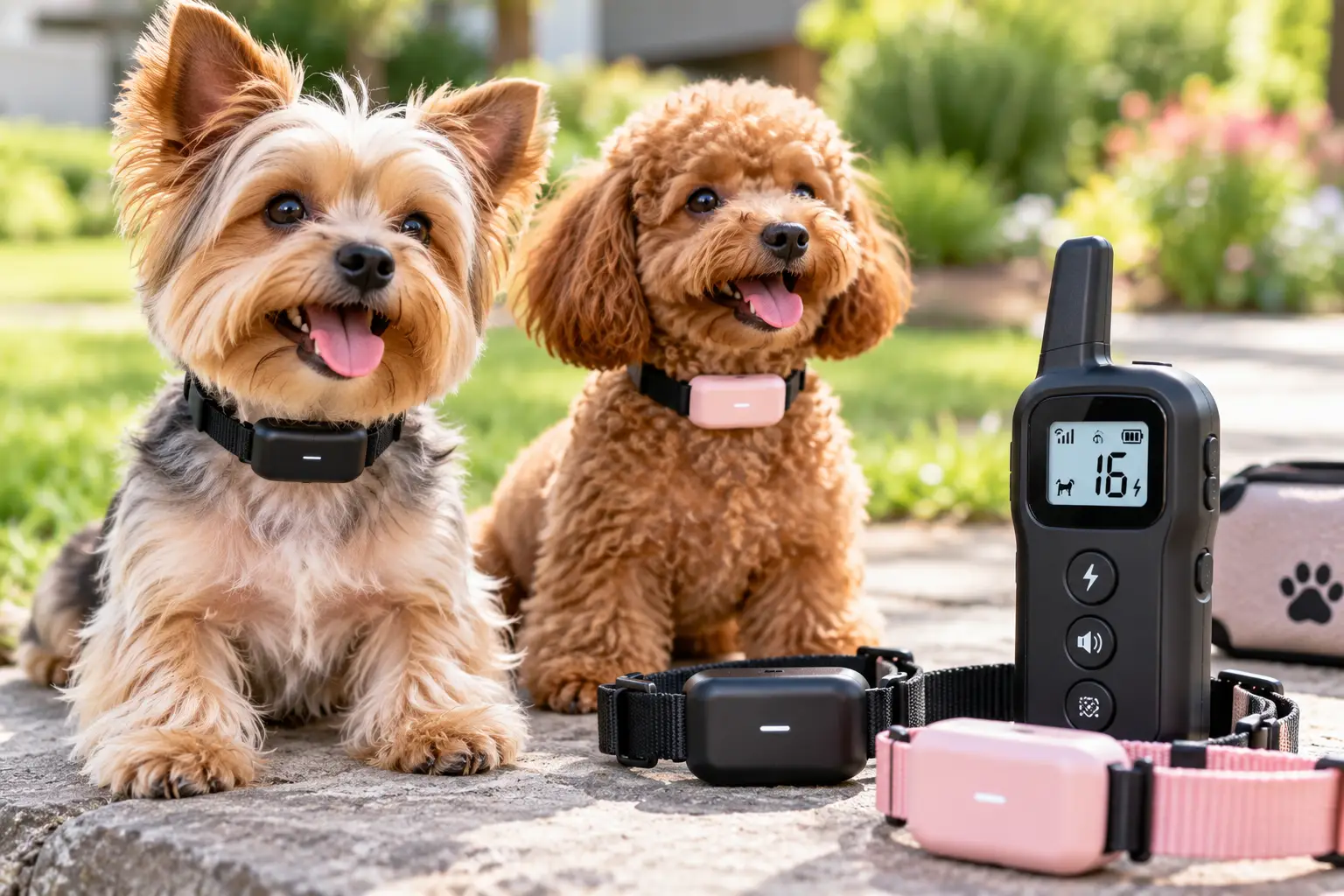
Picture a 9-pound terrier who has perfect manners in the kitchen and absolutely none once the front door opens. That’s the moment many owners start searching for e collars for small dogs — and it’s also the moment most of them discover that the majority of remote trainers on the market were designed around Labradors, not Yorkies.
That mismatch matters more than it sounds. A receiver that feels like nothing on a 70-pound retriever can hang like a padlock on a Chihuahua’s neck. And a stimulation scale that jumps in big steps leaves no room to find the faint, “hey, listen” level a small, sensitive dog actually needs. So this guide focuses only on e collars for small dogs: models built with compact receivers and fine control at the very bottom of the range.
What Are E Collars for Small Dogs?
E collars for small dogs are remote training collars with a lightweight receiver (roughly 1.4 to 2.4 ounces) and fine low-end control, rated for dogs as small as 5 to 10 pounds. A handheld remote triggers a tone, a vibration, or a low-level static pulse so you can cue or interrupt behavior at a distance.
A quick bit of honest context before we dive in: remote training collars date back to the 1960s, when they were built for hunting dogs, and they remain controversial — some countries restrict them, and major veterinary behavior groups favor reward-based training. We’ll cover that debate openly in the safety section. Everything below is based on manufacturer spec sheets, retailer data, and independent sources — not invented hands-on testing — so you can make a clear-eyed decision for your own dog.
Quick Comparison: The Best E Collar for Small Dogs at a Glance
Here’s the fast version. Every model below is rated by its maker for dogs 10 pounds or lighter, and every one includes a non-static option (tone and/or vibration).
| Collar | Min. dog weight | Max range | Modes | Best for |
|---|---|---|---|---|
| Educator ME-300 Micro | 5 lb | ⅓ mile | Tone, vibration, 100 static levels | Toy breeds with soft temperaments |
| Educator ET-300 Mini | 5 lb | ½ mile | Tone, vibration, 100 static levels + boost | Best all-around small dog e collar |
| Dogtra 280X | 10 lb | ½ mile | Tone, XPP vibration, 100 levels + BOOST | Active terriers, multi-dog homes |
| Dogtra CUE | 10 lb | 400 yards | Pager vibration, nick, continuous, boost | First-time e-collar owners |
| PetSafe 100 Yard Lite Remote Trainer | 8 lb | 100 yards | Tone, vibration, 15 static levels | Budget indoor/backyard manners |
| SportDOG FieldTrainer 425X | 8 lb | 500 yards | Tone, vibration, 21 static levels | Hikers who want no-look control |
| Garmin Delta Sport XC | 8 lb | ¾ mile | Tone, vibration, 36 levels + BarkLimiter | Owners who also need bark control |
Looking at the table, the two Educator models stand out simply because they’re the only ones rated down to 5 pounds, which makes them the default shortlist for Chihuahuas, toy Poodles, and Pomeranians. If your dog is 10 pounds or more, the Dogtra 280X and Garmin Delta Sport XC open up longer range and extra features, while the PetSafe 100 Yard Lite Remote Trainer covers the “I just need manners in the house and yard” crowd for far less money.
Notice, too, that we left star ratings out of this table on purpose. Ratings shift daily and can’t be verified reliably at the time of writing, so you’ll find spec-based analysis here instead of numbers that may already be stale.
💬 One click helps other shoppers make an informed choice too! 😊
Top 7 E Collars for Small Dogs: Expert Analysis
Each pick below follows the same format: what the specs mean in practice, who the collar suits, what verifiable owner feedback says (and where we couldn’t verify it), plus pros, cons, and a price range. Prices move constantly, so treat every figure as a ballpark and check the current price before buying.
1. Educator ME-300 Micro — lightest option for toy breeds
If your dog barely tips the scale at 5 or 6 pounds, this is the collar built with that dog in mind. E-Collar Technologies positions the Educator ME-300 Micro as its smallest receiver — about 2 ounces — rated for dogs from 5 pounds with very soft temperaments.
What that means in practice: the receiver is roughly 20% smaller and lighter than the popular ET-300 receiver and delivers about 20% less stimulation at each level. For a tiny dog, that reduced output is a feature, not a limitation — it spreads the gentle end of the scale across more usable steps. It shares the same “Mini” stopwatch-style remote as its bigger sibling, with tone, vibration, 100 levels, and lock-and-set to prevent accidental level jumps.
Based on comparing the specs, this is the pick for toy breeds and timid dogs whose owners mostly train within sight — the ⅓-mile range is plenty for yards, parks, and trails. It’s less suited to a stubborn 14-pound terrier, which may outgrow its lower output.
Because the Micro is a niche model, we couldn’t verify a large pool of aggregated customer reviews; what is verifiable is the manufacturer’s clear positioning for soft-tempered small dogs and its US assembly in Indiana.
Pros:
- ✅ Smallest, lightest receiver among our seven picks
- ✅ Reduced output suits very sensitive toy breeds
- ✅ Assembled in the USA, expandable to two dogs
Cons:
- ❌ Shorter ⅓-mile range than most competitors
- ❌ Limited independent review data to lean on
Expect to pay around $200, give or take — fair value if your dog truly sits at the 5-to-8-pound end of the scale.
2. Educator ET-300 Mini — best all-around small-dog system
This is the collar most small-dog owners end up comparing everything else against. The Educator ET-300 Mini pairs a 2.4-ounce receiver (about 2.0 × 1.5 × 1.1 inches) with a ½-mile range and a rating for dogs from 5 pounds up.
The headline feature is granularity: 100 static levels plus an adjustable boost from 1 to 60. On paper, that means you can find a working level in the low single digits and still have headroom if your dog is distracted by a squirrel. Sellers of the collar note that smaller dogs typically need boost settings between 1 and 20, so most small-dog owners will live in the bottom fifth of the dial. Separate tone and vibration (Educator calls it a “tapping sensation”) give you non-static cues, and a remote-controlled night light helps on evening walks.
Who it’s for: dogs roughly 8 to 20 pounds with normal temperaments, and owners who want one collar that can also move to a second, larger dog later. The waterproof remote even floats.
An independent review we examined praised the fine level control and cautioned, fairly, that the half-mile rating is a best-case line-of-sight figure that trees, houses, and garages will shrink.
Pros:
- ✅ Fine 100-level control with adjustable boost
- ✅ Light receiver suits dogs from 5 pounds
- ✅ Waterproof, floating remote with night tracking light
Cons:
- ❌ Stopwatch-style remote takes a few sessions to learn
- ❌ Rated range drops noticeably in wooded areas
Typically in the $200–$230 range — strong value given how many dog sizes it covers.
3. Dogtra 280X — toughest build for active terriers
If your small dog swims, digs, and sprints through brush, the Dogtra 280X is built to survive that lifestyle. It’s the new generation of the long-running 280C, with a receiver weighing about 2.4 ounces and a 10-pound minimum dog weight.
Key specs translate well into real life. The IPX9K waterproof rating means the receiver tolerates high-pressure water, not just a rainy walk. The 100 low-to-medium output levels give smooth control, and continuous stimulation has an automatic 12-second safety shutoff. Tone, XPP vibration, a BOOST button, a level lock, and a bright 1000-lux LED locate light round it out. One detail most buyers overlook: if you’re upgrading from a 280C, the scales don’t match — level 127 on the old collar is roughly level 80 on the 280X — so find your dog’s new level before the first real session.
Who it’s for: 10-to-25-pound terriers, Dachshunds, and Shih Tzus with plenty of drive, and households with up to three dogs, since the system is expandable and X-Series receivers are cross-compatible.
Owner comments on Dogtra’s product pages highlight the small, light receivers and the convenience of one remote for two dogs — useful signals, though manufacturer-hosted reviews deserve some healthy skepticism.
Pros:
- ✅ IPX9K waterproofing handles mud, swims, and hose-downs
- ✅ Bright locate light for dusk and early mornings
- ✅ Expandable to three dogs on one remote
Cons:
- ❌ Not rated for dogs under 10 pounds
- ❌ Priced above basic small-dog systems
Usually in the $220–$250 range — worth it if durability and multi-dog use matter to you.
4. Dogtra CUE — simplest remote for first-timers
The Dogtra CUE is designed around one idea: make the remote so obvious that a nervous first-time owner can’t fumble it. Its oversized main button and large LCD screen do exactly that.
The Gen2 version offers 0–99 levels, nick and continuous stimulation, a non-stimulating pager vibration, and a customizable boost. In practice, the big button reduces the most common beginner error — pressing the wrong thing at the wrong moment — which matters because timing is everything in training. The nickel-free plastic contact points are gentler on sensitive skin, and the receiver can be worn vertically or horizontally to suit different neck shapes. A built-in carabiner lets you clip the remote to a leash or belt loop so it’s always within reach.
Who it’s for: families with a 10-pound-plus dog who want basic obedience help at home and in the yard. The 400-yard range is modest but realistic for suburban life. Note that the CUE has no separate tone function; vibration is the non-static cue.
We couldn’t verify a representative set of aggregated customer reviews for the current generation, so weigh this pick mainly on its specs and Dogtra’s established reputation.
Pros:
- ✅ Big button and screen minimize beginner mistakes
- ✅ Nickel-free plastic contacts suit sensitive skin
- ✅ Carabiner remote clips anywhere for quick access
Cons:
- ❌ No dedicated tone mode, only vibration
- ❌ Shorter 400-yard range than premium models
Generally under $200 at the time of writing — good value for straightforward home obedience.
5. PetSafe 100 Yard Lite Remote Trainer — budget pick for indoor manners
For owners whose problems happen within shouting distance — counter-surfing, door-dashing, jumping on guests — the PetSafe 100 Yard Lite Remote Trainer covers the basics at a fraction of premium prices.
PetSafe’s “Lite” collars use a lighter static range designed for shy or sensitive dogs. You get tone, vibration, and 15 static levels, with levels 8 to 15 locked behind a safety feature. PetSafe’s own manual says levels 1 to 7 are adequate in most cases and stresses that your dog should never vocalize or panic — sensible guidance that more manufacturers should print in bold. The Lite receiver weighs about 1.4 ounces, fits necks from 6 to 23 inches, and is rated for dogs 8 pounds and up. Battery life runs up to 40 hours with a 2-hour charge.
Who it’s for: budget-minded owners training indoors or in a fenced yard. It’s not for dogs under 6 months, and the 100-yard version can’t be expanded to a second dog.
Owner reviews posted on a retailer page for the same Lite family (the 600-yard version) praise straightforward setup, waterproofing, and the level lock — consistent with its beginner-friendly design.
Pros:
- ✅ Very light 1.4-ounce receiver for small necks
- ✅ Higher levels locked to prevent accidental use
- ✅ Lowest price among our seven picks
Cons:
- ❌ Only 100 yards of range
- ❌ Coarser 15-level scale than premium collars
Usually in the $60–$90 range — excellent value if your training stays close to home.
6. SportDOG FieldTrainer 425X — no-look dial for outdoorsy small dogs
If you hike or hunt with a compact dog, the SportDOG FieldTrainer 425X brings sporting-dog ergonomics down to an 8-pound minimum. SportDOG describes it as its smallest, lightest e-collar.
The standout is the dial: you can roll it to the top for tone or vibration and feel it click down through static levels without looking, so your eyes stay on your dog. It offers 21 levels, selectable in low and medium ranges — and that detail matters. The similar 425XS runs medium and high ranges for stubborn, high-drive dogs, which is the wrong choice for most small breeds. Both the remote and collar use DryTek waterproofing, submersible to 25 feet, and the system expands to three dogs.
Who it’s for: active owners of Jack Russells, Beagles, or small spaniel mixes who train on trails and want 500 yards of range. The receiver (about 2.6 × 1.3 × 1.2 inches) is chunkier than the Educators, so it’s better for 12-pound-plus dogs.
Owner reviews for the 425 family on a retailer site include reports of dogs responding to vibration alone, without static — an encouraging sign for gentle use.
Pros:
- ✅ True no-look dial keeps eyes on your dog
- ✅ Submersible to 25 feet for water-loving dogs
- ✅ Expandable to three dogs with add-on collars
Cons:
- ❌ Bulkier receiver than Educator or PetSafe Lite
- ❌ Easy to buy the stronger 425XS by mistake
Usually around $170–$220 — solid value for outdoor-focused owners.
7. Garmin Delta Sport XC — built-in bark control with long battery
The Garmin Delta Sport XC is the only pick here that doubles as a bark-control collar, which makes it appealing if your small dog’s biggest issue is noise rather than recall.
It offers 36 levels of momentary and continuous stimulation plus tone and vibration, a ¾-mile range, and five correction configurations. The built-in BarkLimiter is designed to distinguish your dog’s barks from scratching or other dogs, and you can adjust or control it from the handheld. Garmin lists up to 80 hours of battery life per charge and IPX7 water resistance, and the dog device comes with long and short contact points for different coats. Specialist retailers list the receiver for dogs 8 pounds and up.
Who it’s for: owners of vocal small breeds who want one device for both training and barking, and people training up to three dogs. The trade-off: automatic bark correction means stimulation happens without you present, so it demands careful, conservative setup — start with the lowest settings and supervise early use.
We couldn’t verify a current aggregated review set, and at least one specialist retailer showed it out of stock during our research, so availability may fluctuate.
Pros:
- ✅ Integrated BarkLimiter adds a second use
- ✅ Up to 80 hours of battery per charge
- ✅ Changeable contact points for short or long coats
Cons:
- ❌ Automatic bark correction requires careful supervision
- ❌ Coarser 36-level scale than Educator or Dogtra
Typically in the $220–$250 range — worth it only if you’ll actually use the bark feature.
The Top 7 Side by Side: Price, Precision, and Extras
| Collar | Price range* | Static levels | Receiver weight | Multi-dog | Best for |
|---|---|---|---|---|---|
| Educator ME-300 Micro | ~$200 | 100 | ~2 oz | Up to 2 | Dogs 5–8 lb |
| Educator ET-300 Mini | $200–$230 | 100 + boost | 2.4 oz | Up to 2 | Most small dogs |
| Dogtra 280X | $220–$250 | 100 + BOOST | 2.4 oz | Up to 3 | Active terriers |
| Dogtra CUE | Under $200 | 0–99 + boost | Not verified | Expandable | First-time owners |
| PetSafe 100 Yard Lite Remote Trainer | $60–$90 | 15 | 1.4 oz | No | Tight budgets |
| SportDOG FieldTrainer 425X | $170–$220 | 21 | Not verified | Up to 3 | Trail dogs |
| Garmin Delta Sport XC | $220–$250 | 36 | Not verified | Up to 3 | Barking + training |
*Prices are approximate at the time of writing and change frequently — always check the current price.
Reading across the table, the real divide isn’t price — it’s precision. The Educator ET-300 Mini, Educator ME-300 Micro, Dogtra 280X, and Dogtra CUE all offer roughly 100 steps, which gives small, sensitive dogs a much softer landing than the 15-level PetSafe 100 Yard Lite Remote Trainer. That said, the PetSafe 100 Yard Lite Remote Trainer delivers the lightest receiver for the lowest cost, which is exactly right for close-range manners work.
✨ Don’t miss the right fit for your little one!
🔍 Take your small-dog training to the next level with this carefully curated lineup. Click a highlighted collar to check current pricing and availability — these picks will help you build calmer walks and a more reliable recall the whole family will enjoy! 🐾
How to Introduce a Small Dog E Collar: Your First 30 Days
Buying the collar is the easy part. How you introduce it decides whether it becomes a gentle communication tool or a source of stress. Here’s a practical roadmap.
Days 1–3: Wear it, don’t use it. Put the collar on (switched off) during meals, play, and walks. You want your dog to associate the receiver with good things, not with being corrected. Remove it after a few hours.
Days 4–7: Fit and find the recognition level. The contact points should touch skin snugly — you should be able to slide one finger, not two, under the strap. Then, in a quiet room, start at level 0 and step up one level at a time until you see a tiny sign of awareness: an ear flick, a head turn, a curious look. PetSafe’s manual calls this the “recognition level,” and it stresses the dog should never vocalize or panic. For most small dogs, that level sits near the bottom of the scale.
Weeks 2–3: Pair cues with rewards. Use tone or vibration as a “come here” signal, then pay generously with treats or a toy. Many owners find their dog starts responding to the non-static cue alone — which is the goal.
Week 4: Add distractions slowly. Move to the backyard, then a quiet park, still on a long line.
⚠️ Common first-month mistakes: skipping the long line, using the collar when you’re angry, raising the level instead of lowering distractions, and leaving the receiver in one spot for hours. Rotate its position and check your dog’s skin daily.
Real-World Scenarios: Matching the Right Collar to Your Dog
Specs only mean something when they meet a real routine. Here are three common small-dog profiles and the reasoning behind each match.
🐕 The apartment Chihuahua (6 lb, anxious, city walks)
Budget is flexible, but comfort is non-negotiable. With a dog this light, only two picks are rated for the weight: the Educator ME-300 Micro and the Educator ET-300 Mini. The Micro’s reduced output and smaller receiver make it the better fit for a timid dog, and its ⅓-mile range is irrelevant on city sidewalks anyway. Frequency of use: short daily sessions focused on a vibration-based “look at me” cue. Honestly, for an anxious dog, talk to your vet or a certified behavior consultant first — anxiety rarely improves with any kind of correction.
🏡 The suburban family with a 12-lb Shih Tzu mix (backyard, kids)
Budget: under $100. Problems: door-dashing and jumping on visitors. The PetSafe 100 Yard Lite Remote Trainer fits well here. Everything happens within 100 yards, the receiver is featherweight, and the locked upper levels add a safety buffer if a child grabs the remote. Use tone and vibration for most of the work.
🥾 The weekend hiker with a 16-lb Jack Russell (trails, high prey drive)
Budget: around $200–$250. Recall around wildlife is the priority, often out of sight. The Dogtra 280X or SportDOG FieldTrainer 425X makes sense — both are waterproof and have ranges built for open ground. The Dogtra 280X wins if you train after dark thanks to its locate light; the SportDOG FieldTrainer 425X wins if you prefer a no-look dial.
Problem → Solution: Fixing Common Small-Dog E-Collar Issues
Even with the right collar, things go sideways. Here are five frequent problems and precise fixes.
Problem 1: “My dog doesn’t respond at all.” Nine times out of ten, it’s fit — especially with fluffy coats. Tighten the strap slightly, or swap to longer contact points (Garmin and Educator both offer different lengths). Don’t jump levels to compensate for poor contact.
Problem 2: “My dog yelps or freezes.” The level is too high, full stop. Drop to zero, rebuild from the recognition level, and consider relying on vibration for a week. Collars with fine scales — like the Educator ET-300 Mini — make these small corrections easier.
Problem 3: “Red spots on the neck.” This usually signals pressure irritation from wearing the receiver too long in one place. Remove the collar after training, rotate its position, clean the contact points, and see your vet if the skin breaks. Also never clip a leash to the e-collar strap — the pull presses the contacts into the skin.
Problem 4: “The collar works at home but not at the park.” That’s a training gap, not a hardware gap. Go back to easier environments and add distractions gradually, rewarding heavily.
Problem 5: “My bark collar triggers when the neighbor’s dog barks.” If you’re using the Garmin Delta Sport XC, adjust the BarkLimiter settings and supervise early sessions. If false triggers persist, switch it off — correcting a dog for something it didn’t do undermines trust fast.
How to Choose E Collars for Small Dogs
Choosing among e collars for small dogs comes down to six practical steps. Follow them in order.
- Check the minimum weight rating first. If your dog is under 10 pounds, your list narrows to models rated for 5 or 8 pounds. Everything else is secondary.
- Compare receiver weight and size. Look for roughly 2.4 ounces or less. On a 7-pound dog, half an ounce is a noticeable difference.
- Prioritize fine low-end control. A 100-level scale lets you find a faint working level; a 15-level scale moves in bigger steps.
- Insist on tone and/or vibration. Non-static cues let you train with the least intrusive option first — and many dogs never need more.
- Match range to real life, not the box. Ratings assume open line of sight. If you train in a yard, 100–400 yards is plenty.
- Look for safety features. Level locks, lock-and-set, and continuous-stimulation shutoffs reduce accidental over-correction.
For deeper reading on welfare-minded training, Purdue University’s Center for Animal Welfare Science hosts the AVSAB humane dog training position statement as a canine welfare resource — a useful counterweight to marketing copy when you’re weighing any aversive tool.
One more tip: if you’re torn between two models, choose the one with the lighter receiver. You can always add distance to your training later; you can’t make a heavy receiver feel lighter on a small neck.
Common Mistakes to Avoid When Buying a Small Dog E Collar
Plenty of small dog e collar purchases go wrong before the box is even opened. Here’s what to watch for.
Buying “one size fits all” listings. Many generic collars advertise a huge weight span, such as 8 to 120 pounds. That breadth usually means a receiver sized for mid-size dogs and a scale that isn’t tuned for sensitive little ones. A collar engineered specifically for small dogs usually says so plainly and publishes its receiver weight.
Choosing the wrong variant. Some brands sell nearly identical models with different power ranges. The SportDOG FieldTrainer 425X (low/medium) and the 425XS (medium/high) are a classic example — the “S” version is built for stubborn, high-drive dogs.
Paying for range you’ll never use. A ¾-mile rating sounds impressive, but if your dog never leaves the backyard, that money is better spent on a lighter receiver or a session with a qualified trainer.
Ignoring coat type. Long, dense coats (Pomeranians, Shih Tzus) need longer contact points; short coats need shorter ones. Check whether alternate points are available before you buy.
Skipping the manual. It sounds boring, but manufacturer manuals include recognition-level guidance, wear-time advice, and age limits (PetSafe, for example, says not for puppies under 6 months).
Treating the collar as a behavior fix on its own. Fear, aggression, and anxiety need professional help, not a remote.
Vibration Collar for Small Dogs vs Static E-Collars (and Other Options)
A vibration collar for small dogs is often the first thing owners ask about, and for good reason: it feels gentler, and it’s quieter than a tone. But how does it stack up against static e-collars and non-electronic approaches?
| Tool | How it works | Main advantage | Main drawback | Best for |
|---|---|---|---|---|
| Static e-collar with tone/vibration | Remote cue plus optional low static | Most flexible; cue at distance | Aversive if misused; welfare debate | Owners committed to careful, low-level use |
| Vibration collar for small dogs | Remote vibration only | No static; easy to learn | Some dogs ignore it outdoors | Sensitive or deaf dogs |
| Long line + treats (reward-based) | Leash control plus rewards | Endorsed by veterinary behaviorists | Slower off-leash freedom | Every small dog, as a foundation |
| Automatic bark collar | Triggers on barking | Works when you’re away | Can misfire; no context | Carefully supervised nuisance barking |
The key takeaway is that these tools aren’t mutually exclusive. Every collar in our top seven, including the Educator ET-300 Mini and Dogtra CUE, can function as a vibration collar for small dogs simply by never using the static button. Meanwhile, long-line reward training is the foundation that makes any remote cue meaningful.
Here’s what to weigh: a dedicated vibration collar for small dogs is cheaper and removes temptation, but you lose the option to escalate slightly in a genuine emergency, such as a dog bolting toward a road. Many owners find the middle ground works best — a quality e-collar used almost entirely on vibration and tone. If you prefer never to use static at all, that’s a perfectly reasonable choice, and it’s the one veterinary behavior organizations lean toward.
Features That Actually Matter (and Ones That Don’t)
Marketing pages love long feature lists. For a small dog, only a handful truly change the experience.
Features that matter:
- ✅ Receiver weight under about 2.5 ounces. Comfort drives acceptance; a dog who hates wearing the collar learns nothing useful.
- ✅ Fine stimulation steps. Small dogs often work at very low levels, so granularity at the bottom of the scale beats a big maximum.
- ✅ Level lock or lock-and-set. One accidental thumb-slide on a coarse scale can mean a big jump for a tiny dog.
- ✅ Swappable contact points. Essential for fluffy breeds and handy for sensitive skin (Dogtra’s plastic points on the Dogtra CUE are a good example).
- ✅ Genuine waterproofing. IPX7 and above means rain and puddles aren’t a worry.
Features that matter less than you’d think:
- ❌ Huge range numbers. Most small-dog training happens within 100 yards.
- ❌ High maximum output. For small breeds, top-end power is rarely relevant and can be a liability.
- ❌ Dozens of “modes.” Tone, vibration, momentary, and continuous cover nearly every need.
Based on comparing the specs, the best e collar for small dogs is usually the one that nails the first list and ignores the second. That’s why the Educator ET-300 Mini and Educator ME-300 Micro score so well here, and why the PetSafe 100 Yard Lite Remote Trainer punches above its price for close-range use.
Best E Collar for Small Dogs by Size and Temperament
“Small” covers everything from a 4-pound Yorkie to a 20-pound Beagle, so the best e collar for small dogs depends on where your dog sits on that spectrum.
Under 8 pounds (Chihuahuas, toy Poodles, Yorkies)
Only the Educator ME-300 Micro and Educator ET-300 Mini are rated this low among our picks. Choose the Micro for timid dogs and the Mini if you want more range or plan to add a bigger dog later. Be conservative: at this size, even low levels may be plenty, and many dogs do well on vibration alone.
8 to 12 pounds (Pomeranians, Maltese, Havanese)
The PetSafe 100 Yard Lite Remote Trainer becomes an option for budget buyers, alongside the Educators. The Garmin Delta Sport XC is technically rated here too, but its receiver and feature set make more sense for slightly larger dogs.
12 to 20 pounds (Jack Russells, Dachshunds, Shih Tzus, Beagles)
Here the full lineup opens up. The Dogtra 280X and SportDOG FieldTrainer 425X shine for active, outdoor dogs, while the Dogtra CUE suits families focused on home obedience.
Seniors and dogs with health issues
Older dogs, dogs with heart conditions, and those with skin problems deserve a vet check before any e-collar use. For many seniors, a vibration-only approach — or none at all — is the kinder route.
Long-Term Cost and Maintenance
The sticker price is only part of what a small dog e collar costs over time. Here’s a realistic ownership picture.
Batteries. All seven picks use rechargeable batteries. Lithium cells gradually lose capacity over years, so eventually you’ll either replace the battery (some brands sell replacements) or the receiver. Following the manufacturer’s charging advice helps; PetSafe, for example, notes that excessive charging can shorten battery life.
Replacement parts. Budget for occasional replacement straps and contact points. Biothane or coated nylon straps last longer than plain fabric and are easier to clean — a real plus for dogs who roll in everything.
Add-on receivers. If a second dog joins the family, an expandable system like the Dogtra 280X, SportDOG FieldTrainer 425X, or Garmin Delta Sport XC saves you from buying a whole new kit. The PetSafe 100 Yard Lite Remote Trainer can’t be expanded, so a second dog means a second system.
Warranty. Educator lists a 2-year/limited lifetime warranty on its ET-300 Plus system; check each brand’s current terms before buying, since coverage varies.
Maintenance routine:
- 🧼 Wipe contact points and the neck area weekly (daily if your dog wears it outdoors often).
- 🔋 Charge fully before storage and every few months if unused.
- 🔍 Inspect the strap for cracks and the receiver for loose contact points.
The value math: a $220 collar that lasts five years and covers two dogs often costs less per year than a $70 collar replaced twice. But if you only need a few months of indoor manners work, the budget option is the smarter buy.
Safety, Regulations, and the Welfare Debate
Any honest guide to e collars for small dogs has to address the elephant in the room: these are aversive tools when static is used, and many experts oppose them.
The American Veterinary Society of Animal Behavior states in its position statement on humane dog training that reward-based methods should be used for all dog training and that there is no evidence aversive methods are more effective. Some countries and regions restrict or ban shock collars, and Petco became the first major US retailer to stop selling them. There’s no federal ban in the US, but local rules can change, so check your city and state.
On the regulatory side, e-collars are radio devices, so legitimate products sold in the US should carry FCC identification for their transmitters. There’s no single UL or CPSC standard specific to training collars, which puts more responsibility on you to buy from established brands with published specs and manuals.
Practical safety rules we’d follow regardless of brand:
- ⚡ Start with tone or vibration; use static only at the lowest level your dog notices.
- ⏱️ Limit wear time and rotate the receiver; check skin daily.
- 🚫 Never use the collar to punish fear, anxiety, or aggression.
- 🐶 Don’t use it on puppies below the maker’s minimum age.
- 🩺 Consult your vet or a certified behavior consultant before starting.
If your small dog shows stress signals — tucked tail, lip-licking, avoidance — stop and reassess. The goal is communication, not compliance through discomfort.
FAQ: E Collars for Small Dogs
❓ Which brand makes the best e collar for small dogs under 10 pounds?
❓ How much should I spend on a small dog e collar?
❓ Can I buy e collars for small dogs that don't shock?
❓ What age can a small puppy start wearing an e collar?
❓ Are e collars legal in every US state?
Conclusion: Picking the Right E Collar for Your Small Dog
The best e collars for small dogs share three traits: a receiver light enough to forget about, a scale fine enough to stay gentle, and non-static modes you’ll actually use most of the time. Everything else — range, extra modes, bark features — is secondary.
If you want a quick verdict: the Educator ET-300 Mini is the most versatile choice for most small dogs, while the Educator ME-300 Micro is the gentlest option for true toy breeds. Budget buyers training at close range will be well served by the PetSafe 100 Yard Lite Remote Trainer. Active outdoor dogs fit the Dogtra 280X or SportDOG FieldTrainer 425X, first-timers will appreciate the simplicity of the Dogtra CUE, and owners battling barking as well as recall should look at the Garmin Delta Sport XC.
Just as important as the hardware is how you use it. Build a reward-based foundation, introduce the collar slowly, lean on tone and vibration, and keep your vet or a qualified behavior professional in the loop. Used that way, a small dog e collar becomes one quiet tool among many — not the whole training plan. And if you decide your dog is better off without static entirely, that’s a valid, evidence-backed choice too.
🌟 Ready to find your small dog’s perfect match?
🐾 Explore the picks above and click any highlighted collar to check current pricing and availability. The right fit today means calmer walks, safer recalls, and a happier little companion tomorrow! 💛
Recommended for You
- Dog Training Collar for Small Dogs: 7 Best Gentle Picks for 2026
- Radio Collar Guide 2026: 7 Best Picks for Tracking & Training
- Track Small Valuables: 7 Best Tiny Trackers for 2026 (Honest Picks)
Disclaimer: This post contains affiliate links. As an Amazon Associate, I earn from qualifying purchases made through these links, at no additional cost to you.
✨ Found this article helpful? Share it with someone who needs it! 💬🤗