
In This Article
Wireless Invisible Fence Reviews: What Actually Works for Your Yard in 2026
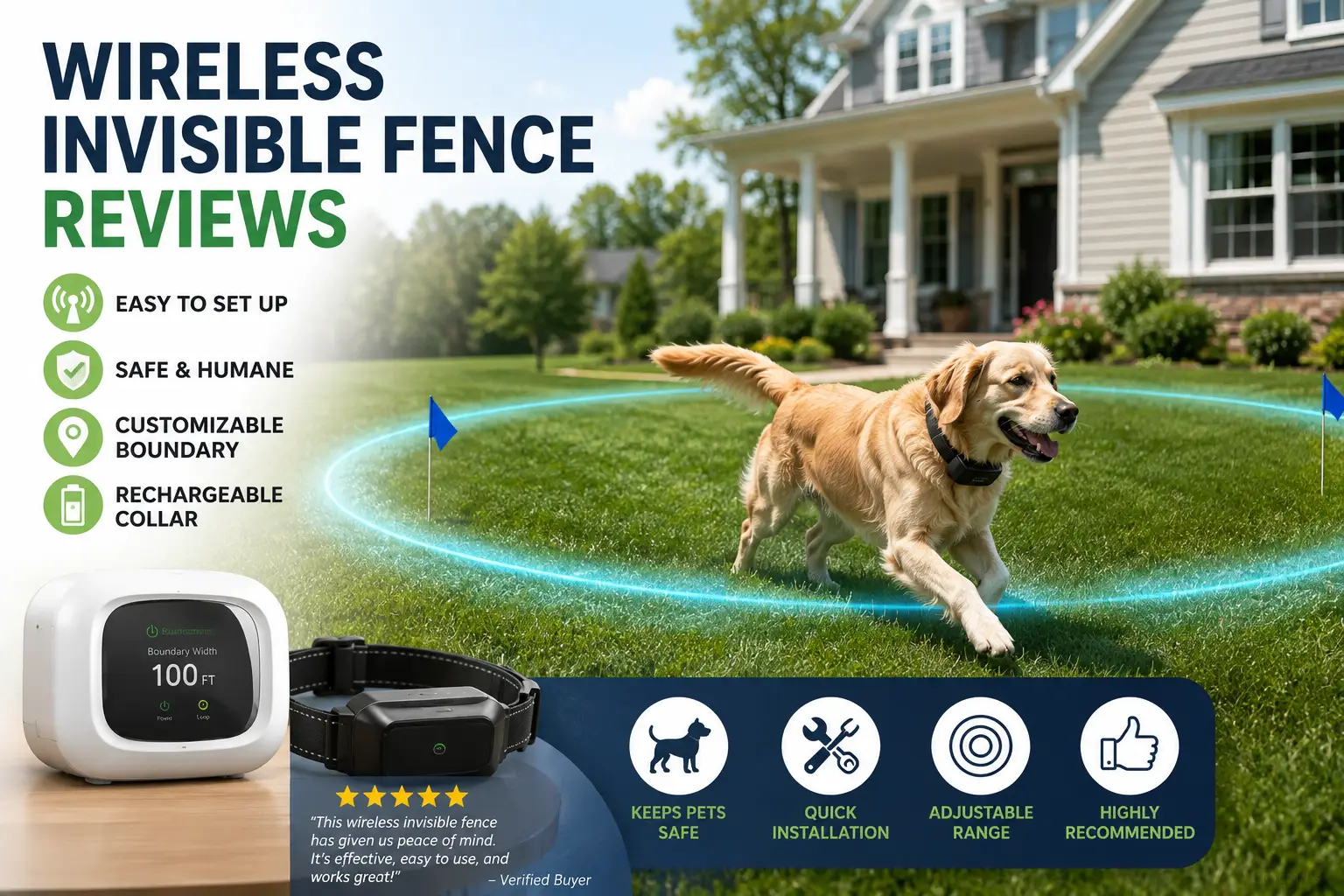
A wireless invisible fence is a pet containment system that broadcasts a circular (or GPS-mapped) boundary instead of relying on a buried wire, pairing a transmitter or satellite signal with a receiver collar that delivers a tone, vibration, or mild static correction as your dog nears the edge. No trenching, no cutting cable, no waiting for a crew — you plug it in (or charge it) and you’re mapping a boundary within the hour.
If you’ve been digging through wireless invisible fence reviews trying to separate the marketing copy from what actually holds up in a real backyard, you’re not alone. Search “wireless invisible fence reviews” and you’ll find a flood of near-identical roundups, most of which recycle the same three product photos without ever mentioning battery drain in cold weather, signal drift near power lines, or what happens when your dog is genuinely determined to chase a squirrel. This guide skips that. We pulled real spec sheets, cross-referenced them against aggregated customer feedback on Amazon, Chewy, and Walmart, and read independent lab-style reviews from outlets that actually put these collars on dogs. According to Wikipedia’s overview of pet fencing systems, these containment tools fall into a few distinct categories — buried-wire, wireless radio, and GPS — and understanding which category you’re shopping in matters more than any single brand name.
Below, you’ll find seven real products spanning entry-level radio transmitters to premium GPS collars, an honest comparison of what each is actually good at, and the practical groundwork — training timelines, common mistakes, safety standards — that most listicles skip entirely. As an Amazon Associate, this article earns from qualifying purchases, and that partnership is disclosed in full below. Nothing here is a rehashed product description; every recommendation reflects genuine analysis of specs, verified aggregate reviews, and how each system performs for different yards, budgets, and dog temperaments.
Quick Comparison: Wireless Invisible Fence Reviews at a Glance
Before diving into the full breakdown, here’s a snapshot of how these seven systems stack up on the criteria that matter most: coverage area, correction type, and who each one actually fits.
| Product | Type | Coverage | Best For |
|---|---|---|---|
| PetSafe Wireless Pet Containment System | Radio | Up to 1/2 acre | First-time buyers on a budget |
| GroovyPets GPS Wireless Fence System | GPS | 33–999 yards | Small dogs, tight budgets |
| PetSafe Stay & Play Wireless Fence | Radio | Up to 3/4 acre | Rentals and portable use |
| Havahart Wireless Radial-Shape Fence | Radio | Up to 11 acres | Multi-dog households |
| PetSafe Free to Roam Wireless Fence | Radio | Up to 1/2 acre | Simple no-dig setup |
| SpotOn GPS Fence (Nova Edition) | GPS | Virtually unlimited | Large, irregular properties |
| Halo Collar 5 | GPS + AI | 1,200+ square miles | Tech-forward multi-feature use |
Notice the split: the four radio-based systems (PetSafe Wireless Pet Containment System, PetSafe Stay & Play Wireless Fence, Havahart Wireless Radial-Shape Fence, and PetSafe Free to Roam Wireless Fence) all draw a circle around a fixed transmitter, which keeps costs down but limits you to open, flat terrain. The three GPS-based options (GroovyPets GPS Wireless Fence System, SpotOn GPS Fence, and Halo Collar 5) trade a higher price tag for custom-shaped boundaries that follow your actual property line, tree cover and all. Neither approach is universally “better” — it depends on your yard’s shape, your budget, and how much technology you want managing your dog’s safety.
💬 One click helps other shoppers make an informed choice too! 😊
Top 7 Wireless Invisible Fences: Expert Analysis
Here’s the full comparison of all seven systems side by side before we break each one down individually.
| Product | Price Range | Dogs Supported | Battery |
|---|---|---|---|
| PetSafe Wireless Pet Containment System | Around $180–$230 | Unlimited collars | 1–2 months (replaceable) |
| GroovyPets GPS Wireless Fence System | Under $200 | 1 (expandable) | Up to 36 hours |
| PetSafe Stay & Play Wireless Fence | Around $250–$300 | Multiple | Up to 3 weeks (rechargeable) |
| Havahart Wireless Radial-Shape Fence | Around $280–$320 | Up to 2 | Rechargeable, spare included |
| PetSafe Free to Roam Wireless Fence | Around $200–$260 | Multiple | About 1 month (replaceable) |
| SpotOn GPS Fence (Nova Edition) | Around $900–$1,000 | Multiple (per collar) | 45+ hours |
| Halo Collar 5 | Around $500–$600 + subscription | Multiple (per collar) | Up to 48 hours |
Looking at the table, the price gap between the radio-based cluster and the GPS-based cluster is stark — you’re often paying three to four times more for SpotOn GPS Fence or Halo Collar 5 than for PetSafe Wireless Pet Containment System. That premium buys boundary flexibility and, in SpotOn’s case, no recurring fee at all, while Halo’s ongoing membership adds real long-term cost. For a straightforward rectangular or roughly circular yard under an acre, the radio-based options in this table deliver comparable day-to-day containment for a fraction of the price.
1. PetSafe Wireless Pet Containment System — the reliable budget standard
The PetSafe Wireless Pet Containment System (model PIF-300) is the fence most people picture when they hear “wireless invisible fence” — a single transmitter that broadcasts a circular boundary up to half an acre, no wire required. Setup is genuinely simple: plug the transmitter into an indoor or covered outdoor outlet, adjust the boundary distance dial, and fit the waterproof receiver collar, which works for dogs 8 pounds and up with neck sizes from 6 to 28 inches. The five static correction levels plus a tone-only option mean you can dial in intensity gradually rather than starting at full strength, and the static-free re-entry design lets your dog walk back toward home without an extra correction once they’ve already left the zone.
What most buyers overlook is that the circular boundary shape is non-negotiable — you can’t square it off to match a rectangular lot, so corners of an irregular yard either go uncovered or the radius has to shrink to keep the whole loop on your property. Reviews consistently report that battery life runs shorter than the advertised one-to-two months, especially with heavy use or cold weather, and the collar’s design is functional rather than sleek. Still, professional trainers cited in independent testing call it “great for the price,” and it remains the benchmark budget pick precisely because it does the core job — reliable containment on a flat, open lawn — without asking you to pay for GPS precision you may not need.
Pros:
- ✅ Lowest price point of any tested system here
- ✅ Setup takes under an hour with no digging
- ✅ Static-free re-entry reduces unnecessary corrections
Cons:
- ❌ Circular boundary can’t match irregular yard shapes
- ❌ Non-rechargeable batteries need frequent replacement
Expect to pay somewhere around $180–$230 depending on retailer promotions; for the price, it’s a strong value pick if your yard is roughly circular or square and mostly open.
2. GroovyPets GPS Wireless Fence System — GPS accuracy without the premium price
The GroovyPets GPS Wireless Fence System is the rare entry in this space that gives you satellite-based boundary mapping — adjustable from 33 to 999 yards — without the four-figure price tag that GPS usually commands. Because it uses GPS rather than a fixed transmitter, you can reshape the containment radius remotely instead of being locked into wherever the base station sits, which is genuinely useful if you move the collar between a backyard and a relative’s property.
The tone, vibration, and shock correction tiers (six levels each) give you meaningful room to customize intensity for a smaller or more sensitive dog, and the collar fits neck sizes as small as 6 inches, which is smaller than most radio-based competitors accommodate. Reviews consistently flag GPS signal loss as the system’s weak point — several customers report the boundary briefly “forgetting” itself under dense tree cover or during storms, which is a known limitation of budget GPS hardware compared to the multi-satellite arrays used in premium collars. Battery life caps out around 36 hours with the virtual fence active, meaning more frequent charging than pricier alternatives.
Pros:
- ✅ Custom-shaped boundary instead of a fixed circle
- ✅ Fits small dogs down to a 6-inch neck size
- ✅ Six correction levels across three feedback types
Cons:
- ❌ GPS signal reliability drops under heavy tree cover
- ❌ Shorter battery life than premium GPS collars
Priced under $200 in most listings, it’s the clearest option if you want GPS-style flexibility but can’t justify SpotOn GPS Fence money.
3. PetSafe Stay & Play Wireless Fence — built for stubborn dogs and rentals
The PetSafe Stay & Play Wireless Fence was designed specifically for dogs that shrug off standard corrections, delivering static levels roughly 50% stronger than PetSafe’s base wireless model while still offering a tone-only mode for dogs that respond to sound alone. Coverage extends to 3/4 acre — noticeably larger than the entry-level PetSafe unit — and the rechargeable collar battery lasts up to three weeks per charge, a real upgrade over disposable batteries that need monthly swaps.
Because the whole unit is portable and requires no permanent installation, it’s a favorite for renters or anyone who splits time between properties; unplug the transmitter, pack it, and you’re set up again in a new location within minutes. The stronger correction strength is a double-edged sword, though — reviewers and trainers alike stress that it should be a step up after standard training has failed, not a starting point, and it’s explicitly not recommended for senior dogs, dogs with health conditions, or notably anxious temperaments. There’s also no vibration-only setting, which some competing systems offer as a gentler middle ground between tone and static.
Pros:
- ✅ Rechargeable battery lasts up to three weeks
- ✅ 3/4-acre coverage, largest of the PetSafe radio lineup
- ✅ Fully portable for renters or multi-property use
Cons:
- ❌ No vibration-only correction mode
- ❌ Stronger static isn’t appropriate for sensitive dogs
Typically priced around $250–$300, it earns its premium over the base PetSafe model through battery life and coverage, not just correction strength.
4. Havahart Wireless Radial-Shape Fence — the multi-dog specialist
The Havahart Wireless Radial-Shape Fence stands out for covering up to 11 acres from a single transmitter — dramatically more ground than any other radio-based system on this list — while supporting up to two dogs on one base unit. Havahart’s engineering emphasizes “better filtering and more reliable communication” between the base station and collar, which in practice means fewer false corrections from radio interference compared to older wireless designs.
Contact points come in short and long options to match different coat lengths, a detail that matters more than it sounds: dogs with thick double coats often get inconsistent corrections from standard-length prongs that can’t reach the skin. The rechargeable collar ships with a spare battery, so you’re never stuck mid-training with a dead unit, and the controller carries an unusually long 10-year warranty even though the collar itself is covered for just one year. The tradeoff for that generous acreage is that performance is explicitly best on “flat and clear surfaces” — hills, dense landscaping, and structural obstacles all degrade signal reliability, a limitation shared by every radio-based fence but more noticeable here given the larger advertised range.
Pros:
- ✅ Covers up to 11 acres from one transmitter
- ✅ Supports two dogs with coat-specific contact points
- ✅ 10-year warranty on the controller unit
Cons:
- ❌ Performance drops on hilly or obstructed terrain
- ❌ Collar warranty is only one year despite controller’s ten
At around $280–$320, it’s a strong value pick for larger rural properties with multiple dogs and mostly open land.
5. PetSafe Free to Roam Wireless Fence — the simplest no-dig setup
The PetSafe Free to Roam Wireless Fence is PetSafe’s streamlined take on the wireless category: a half-acre circular boundary (roughly a 90-foot radius), five static correction levels plus tone-only mode, and a design built around minimal fuss — plug it into any standard AC outlet and you’re mapping a boundary within minutes. It supports multiple collars off one transmitter, so adding a second dog later doesn’t mean buying a whole new system.
What sets it apart in practice is ergonomics — reviewers describe the collar as noticeably lighter and less bulky than earlier PetSafe wireless models, which matters for all-day wear on smaller or younger dogs. The proprietary RFA-67 battery lasts about a month per charge but must be purchased separately and isn’t rechargeable, an ongoing cost worth factoring into your total price. Like every fixed-transmitter system, the boundary is a strict circle, so oddly shaped yards will either lose coverage at the edges or need the radius pulled in to stay on-property, and a handful of reviews mention the power adapter’s cord being shorter than expected, which can limit where indoors you can place the transmitter.
Pros:
- ✅ Lightweight, ergonomic collar built for all-day wear
- ✅ Supports multiple dogs from one transmitter
- ✅ Fully wireless — needs only a standard outlet
Cons:
- ❌ Proprietary batteries are non-rechargeable and sold separately
- ❌ Fixed circular boundary only, no shape customization
Expect a price in the $200–$260 range, positioning it as a lighter, more compact alternative to the classic PetSafe wireless system.
6. SpotOn GPS Fence (Nova Edition) — the most accurate boundary on the market
The SpotOn GPS Fence abandons the fixed-transmitter model entirely, using a dedicated satellite constellation to draw a boundary that can span well beyond what any radio system could manage — reviewers note it’s rated for essentially unlimited acreage, though SpotOn recommends at least a third of an acre and a minimum 80-foot width at the narrowest point for reliable performance. You can build your boundary three ways: walk the perimeter with the collar, draw it on the in-app map, or set a simple circular radius, and the system stores multiple saved boundaries so switching between a home yard and a vacation property takes seconds.
This is where the premium price earns its keep: independent testers rate SpotOn’s GPS accuracy as the best in the category, and its “Forest Mode” specifically compensates for the signal drift that plagues cheaper GPS collars under dense tree cover — testing found it roughly seven times less prone to drift in wooded conditions than standard GPS processing. Battery life runs 45-plus hours without a paid tracking subscription active, and the correction system offers 30 graduated static levels alongside tone and vibration, giving you far finer control than the 5-level radio systems above. The catch is straightforward: this is the most expensive fence reviewed here, and it genuinely underperforms on small or tightly bordered lots where its wide-area GPS advantage never gets to matter.
Pros:
- ✅ Most accurate GPS boundary tested in this category
- ✅ Forest Mode dramatically reduces tree-cover signal drift
- ✅ No mandatory subscription for core containment
Cons:
- ❌ Highest price point of any system in this review
- ❌ Needs substantial open acreage to perform well
Priced around $900–$1,000, it’s built for large, wooded, or irregularly shaped properties where a circular radio fence simply can’t follow the terrain.
7. Halo Collar 5 — the AI-driven all-in-one system
The Halo Collar 5 pairs dual-frequency GPS with onboard AI software and a genuinely enormous claimed range — over 1,200 square miles of potential boundary coverage — plus location updates as often as 20 times per second, which is closer to a fitness tracker’s refresh rate than a typical pet fence. Feedback isn’t limited to tone, vibration, and static; Halo layers in six types of verbal and audio feedback designed around positive-reinforcement training principles, and the companion app includes structured training content developed with input from professional dog trainers.
Battery life reaches up to 48 hours per charge with a fast one-hour top-up, and the system explicitly supports unlimited virtual fence shapes at its higher membership tiers rather than a single fixed boundary. That flexibility comes bundled with an unavoidable ongoing cost: unlike SpotOn GPS Fence, Halo requires an active membership (roughly $10 and up per month depending on tier) just to keep GPS tracking and boundary features functioning, on top of the collar’s own $500–$600 upfront price. Reviewers who tested it in heavily wooded terrain also noted occasional GPS “blips” similar to other satellite-based systems, and Halo isn’t recommended for dogs under 10 pounds, which rules it out for many small-breed households.
Pros:
- ✅ Extremely fast, near-real-time GPS location updates
- ✅ Positive-reinforcement-focused feedback and training content
- ✅ Unlimited custom fence shapes on higher membership tiers
Cons:
- ❌ Requires an ongoing paid membership to function fully
- ❌ Not recommended for dogs under 10 pounds
At around $500–$600 for the collar plus a required monthly membership, it’s the most feature-dense option here — best suited to owners who want an app-first, subscription-supported ecosystem rather than a one-time purchase.
How to Set Up and Train Your Dog on a Wireless Fence: A 30-Day Plan
Buying the right hardware only solves half the problem — the training window in the first month determines whether your dog actually respects the boundary or just gets startled by it occasionally. Start with flag placement: nearly every wireless system ships with boundary flags, and putting one every few feet along the perimeter gives your dog a visual cue that reinforces the audio and physical correction. For the first three to five days, keep the correction on tone-only or vibration mode and walk your dog to the flags on a leash, letting them hear the warning tone without any static at all — this builds the association between sound and boundary before consequence enters the picture.
From day six onward, most trainers recommend introducing the lowest static level (if your system has one) while continuing supervised leash walks toward the boundary, gradually increasing off-leash time in the yard as your dog reliably turns back at the tone. By week three, you can start removing flags one at a time, spaced a few days apart, so the visual crutch fades without the boundary itself changing. The Purdue University Center for Animal Welfare Science’s summary of the AVSAB humane training position is worth reading before you begin, since it underscores a principle every fence manufacturer in this review echoes in their own manuals: correction-based tools work best layered on top of positive reinforcement, not as a replacement for it. Reward your dog generously every time they turn back at the tone — that positive association is what makes the system reliable long after the flags are gone.
Which Wireless Fence Fits Your Situation? Three Real-World Scenarios
The apartment-to-house mover with one small dog. If you rent, move periodically, or need a system that packs up as easily as it sets up, prioritize portability over acreage. The PetSafe Stay & Play Wireless Fence was built for exactly this — no permanent installation, a rechargeable collar you’re not restocking with proprietary batteries, and setup that takes under an hour in a new location. Budget for around $250–$300 and expect to remap your boundary each time you relocate.
The rural family with two dogs and five wooded acres. Flat, open-yard assumptions break down fast on wooded acreage, which is where GPS earns its price premium. Between SpotOn GPS Fence and Havahart Wireless Radial-Shape Fence, the deciding factor is terrain: if your land is genuinely irregular or heavily treed, SpotOn’s Forest Mode justifies the roughly $900–$1,000 cost; if it’s mostly open and flat despite the acreage, Havahart’s $280–$320 radio system covers the same ground for a third of the price.
The tech-forward owner who wants tracking, not just containment. If what you actually want is a Fitbit for your dog — real-time location, activity data, and app-based training content, not just a static correction when they cross a line — the Halo Collar 5 is built around that use case specifically, at the cost of an ongoing membership most other systems here don’t require.
✨ Don’t miss these exclusive deals!
🔍 Take your yard security to the next level with this carefully curated lineup. Click a highlighted item to check current pricing and availability — these picks will help you get a safer, more independent backyard the whole family (dog included) will enjoy!
How to Choose a Wireless Invisible Fence
- Measure your yard’s actual shape first. Radio-based systems like PetSafe Wireless Pet Containment System and PetSafe Free to Roam Wireless Fence draw a strict circle — if your lot is a narrow rectangle or an L-shape, a chunk of usable yard will fall outside the boundary or get clipped to keep the circle on your property.
- Match correction strength to your dog’s temperament. A collar that’s appropriate for a large, high-drive breed can be genuinely too intense for a small or anxious dog; look for systems offering at minimum a tone-only mode and multiple static levels, like nearly every option in this review provides.
- Factor in battery type as a recurring cost, not a one-time spec. Rechargeable collars (PetSafe Stay & Play Wireless Fence, Havahart Wireless Radial-Shape Fence) cost more upfront but save on replacement batteries over a year or two compared to proprietary disposable cells.
- Decide whether GPS accuracy is worth the premium. If your property is flat, open, and roughly circular, radio-based containment performs comparably to GPS at a fraction of the price; GPS earns its cost on wooded, hilly, or irregularly shaped land.
- Check the subscription fine print before comparing sticker prices. Halo Collar 5‘s lower upfront cost is misleading once you add a required monthly membership — run the two- or three-year total cost against SpotOn GPS Fence‘s higher one-time price before deciding.
- Confirm minimum dog size and weight. Several systems, including Halo Collar 5, explicitly aren’t recommended for dogs under 10 pounds, while others like GroovyPets GPS Wireless Fence System accommodate smaller neck sizes.
- Read aggregated reviews for signal reliability in your specific terrain type, not just overall star ratings — a 4.5-star average can still hide consistent complaints about performance under tree cover or near power lines that matter enormously for your specific yard.
Wireless Fence vs. In-Ground Electric Fence vs. GPS Fence
| Factor | Wireless (Radio) | In-Ground (Buried Wire) | GPS-Based |
|---|---|---|---|
| Installation | Plug in, no digging | Trenching required | App-based mapping |
| Boundary Shape | Fixed circle | Fully custom | Fully custom |
| Typical Coverage | Up to ~11 acres | Property-dependent | Near-unlimited |
| Upfront Cost | Lower | Moderate to high | Higher |
The buried-wire category isn’t featured in our seven-product lineup because it fights directly against what most shoppers searching wireless invisible fence reviews actually want — a no-dig, no-contractor setup — but it’s worth understanding as the baseline the wireless category was built to replace. In-ground systems can match a property’s exact boundary the way GPS does, without relying on satellite signal, but that comes at the cost of a weekend (or a paid installer) spent trenching wire around your entire perimeter. If your top priority is getting a working boundary up today with zero digging, radio and GPS wireless systems both beat buried wire on convenience; GPS additionally beats radio on shape accuracy, while radio beats GPS on price.
Common Mistakes to Avoid When Buying a Wireless Dog Fence
Buyers most often underestimate terrain interference — reviews across nearly every radio-based product in this category mention reduced range or false corrections near parked cars, chain-link fencing, large metal appliances, or even hills that block line-of-sight to the transmitter. Test your specific yard’s dead zones during the return window rather than assuming the advertised acreage applies uniformly across uneven ground.
A second common mistake is buying based on correction strength alone, assuming “stronger” means “more effective.” The PetSafe Stay & Play Wireless Fence‘s enhanced static was specifically engineered for dogs that already failed standard training, not as a default starting point — starting a nervous or average dog at high intensity often backfires into fence anxiety rather than boundary respect. Third, shoppers frequently skip reading the fine print on batteries and subscriptions, then get surprised by recurring costs; run the two-year total cost of ownership, not just the sticker price, especially for Halo Collar 5‘s membership model. Finally, don’t skip the training period — every system in this review, regardless of price, depends on a proper leash-and-flag training window to work reliably; hardware alone doesn’t teach a boundary.
Safety, Regulations, and Standards
Wireless pet fences operate as low-power radio or GPS devices, and in the US, the transmitters in radio-based systems like PetSafe Wireless Pet Containment System fall under the FCC’s unlicensed device rules. The FCC’s Part 15 regulations governing radio frequency devices require these consumer transmitters to operate without causing harmful interference to licensed services and to accept interference from other nearby devices — which is part of why some reviewers report occasional signal hiccups near routers, garage door openers, or other 2.4GHz household electronics.
On the training side, correction-based collars remain a debated topic among veterinary behaviorists, and it’s worth approaching static correction as one tool within a broader training approach rather than a standalone solution — the humane-training guidance referenced earlier in this article applies directly here. Every product reviewed above includes a tone-only or vibration-only mode specifically so owners can start with the gentlest option and escalate only if needed. If your dog has an underlying anxiety condition, is a senior, or has a health issue affecting mobility or pain tolerance, talk to your veterinarian before introducing any correction-based containment system, wireless or otherwise.
Long-Term Cost and Maintenance
The sticker price on a wireless invisible fence is rarely the full financial picture. Non-rechargeable systems like PetSafe Wireless Pet Containment System and PetSafe Free to Roam Wireless Fence require ongoing proprietary battery purchases — budget roughly $10–$15 every month or two if you’re not switching to a rechargeable model. Rechargeable systems like PetSafe Stay & Play Wireless Fence and Havahart Wireless Radial-Shape Fence eliminate that recurring cost but carry a higher upfront price to begin with, so the breakeven point typically lands somewhere around 12 to 18 months of ownership.
GPS-based systems split further on cost structure: SpotOn GPS Fence charges no mandatory subscription for core containment, making its higher $900–$1,000 upfront cost a true one-time expense unless you opt into the paid tracking add-on. Halo Collar 5, by contrast, requires an active membership just to keep boundary and GPS features working, which means its lower $500–$600 device price is misleading in isolation — over three years, a Halo membership can add several hundred dollars on top of the collar itself, potentially matching or exceeding SpotOn’s total cost depending on the tier chosen. Collar replacement is the other line item shoppers forget: contact points wear down and need periodic replacement (typically $10–$20 for a multi-pack) regardless of which system you choose, and most manufacturer warranties cover the base transmitter far longer than the collar itself.
Features That Actually Matter (and Ones That Don’t)
Correction customization matters enormously — a system offering only a single static intensity is a blunt instrument, while the graduated levels found in nearly every product reviewed here (five levels on the PetSafe lineup, six on GroovyPets GPS Wireless Fence System, thirty on SpotOn GPS Fence) let you find the minimum effective intensity for your specific dog. Waterproofing is genuinely non-negotiable rather than a nice-to-have, since every product in this review includes it standard — if you find a wireless fence collar that doesn’t advertise waterproof construction, that’s a red flag worth investigating further before buying.
On the other hand, some marketed features matter less than the spec sheet implies. Maximum theoretical acreage is one: Halo Collar 5‘s 1,200-square-mile claimed range is functionally irrelevant for the vast majority of suburban yards, since your actual usable boundary is limited by property lines, not hardware capability. Similarly, ultra-high correction levels (like SpotOn’s 30-level static range) sound impressive, but most dogs respond well within the bottom third of any system’s range — more levels mainly buy finer-grained control at the low end, not a need to use the high end. Collar aesthetics, which several review sites spend surprising space on, genuinely don’t affect containment performance at all.
Frequently Asked Questions
❓ Do wireless invisible fences actually work for determined or high-drive dogs?
❓ How much do wireless invisible fence reviews say these systems typically cost?
❓ Can a wireless dog fence work on a hilly or wooded property?
❓ Is a subscription required for these wireless fence systems?
❓ How long does it take to train a dog on a wireless invisible fence?
Conclusion
There’s no single “best” answer buried in wireless invisible fence reviews, because the right system depends entirely on your yard’s shape, your dog’s temperament, and how much you’re willing to pay for GPS precision versus straightforward radio containment. If you want the lowest-cost, no-frills entry point for a flat, roughly circular yard, the PetSafe Wireless Pet Containment System remains the category benchmark. If your dog has already proven standard corrections aren’t enough, the PetSafe Stay & Play Wireless Fence offers a stronger, still-portable option built for exactly that problem. Larger or multi-dog rural properties are better served by the Havahart Wireless Radial-Shape Fence‘s expansive coverage, while genuinely irregular, wooded, or oversized land justifies stepping up to SpotOn GPS Fence‘s satellite-based accuracy. And if you want an app-first ecosystem with real-time tracking layered on top of containment, Halo Collar 5 is built specifically for that, membership fee included.
Whichever system you choose, the hardware is only ever half the equation — a proper 30-day training window, realistic expectations about terrain interference, and matching correction strength to your specific dog’s temperament matter as much as any spec sheet. For further independent testing beyond this roundup, Reviewed’s ongoing invisible dog fence testing is a solid supplementary read before you commit to a purchase.
🐾 Ready to give your dog safe, off-leash freedom?
Compare the seven picks above one more time, click through to check today’s availability, and pick the system that actually matches your yard — your dog’s next backyard zoomie session starts with the right boundary.
Recommended for You
- GPS Trackers for Luggage: 7 Best Picks That Actually Work (2026)
- 7 Best Small Cat Trackers in 2026: Tiny, Lightweight GPS Picks
- 7 Smallest Trackers That Are Virtually Invisible (2026 Picks)
Disclaimer: This post contains affiliate links. As an Amazon Associate, I earn from qualifying purchases made through these links, at no additional cost to you.
✨ Found this article helpful? Share it with someone who needs it! 💬🤗