
In This Article
If you’ve ever watched your cat squeeze through a two-inch fence gap and vanish into the neighbor’s yard, you already know why a small cat tracker matters more than almost any other piece of pet gear you’ll buy. Cats are small, fast, and famously indifferent to your anxiety about their whereabouts, which makes a bulky, dog-sized tracking collar a non-starter. A small cat tracker has to be light enough that your cat forgets it’s there, tough enough to survive fence-top acrobatics, and accurate enough to actually get you to the right bush.
This guide covers seven real, purchasable small cat trackers, from a $25 Bluetooth clip to premium multi-technology GPS units, so you can match the right device to your cat’s size, personality, and how far they tend to roam. We’ll also walk through how these devices actually work day to day, what the subscription fees really cost over a year, and where a tracker falls short of a microchip (spoiler: you often want both). Losing a pet is far more common than most owners realize — roughly 10 million pets are lost or stolen in the United States every year, and more than 6 million end up in shelters, which is exactly the scenario a good small cat tracker is built to prevent.
Whether you have a nervous indoor cat who occasionally bolts out the door or a full-time outdoor explorer, there’s a small cat tracker on this list built for your situation. Let’s get into it.
What Is a Small Cat Tracker?
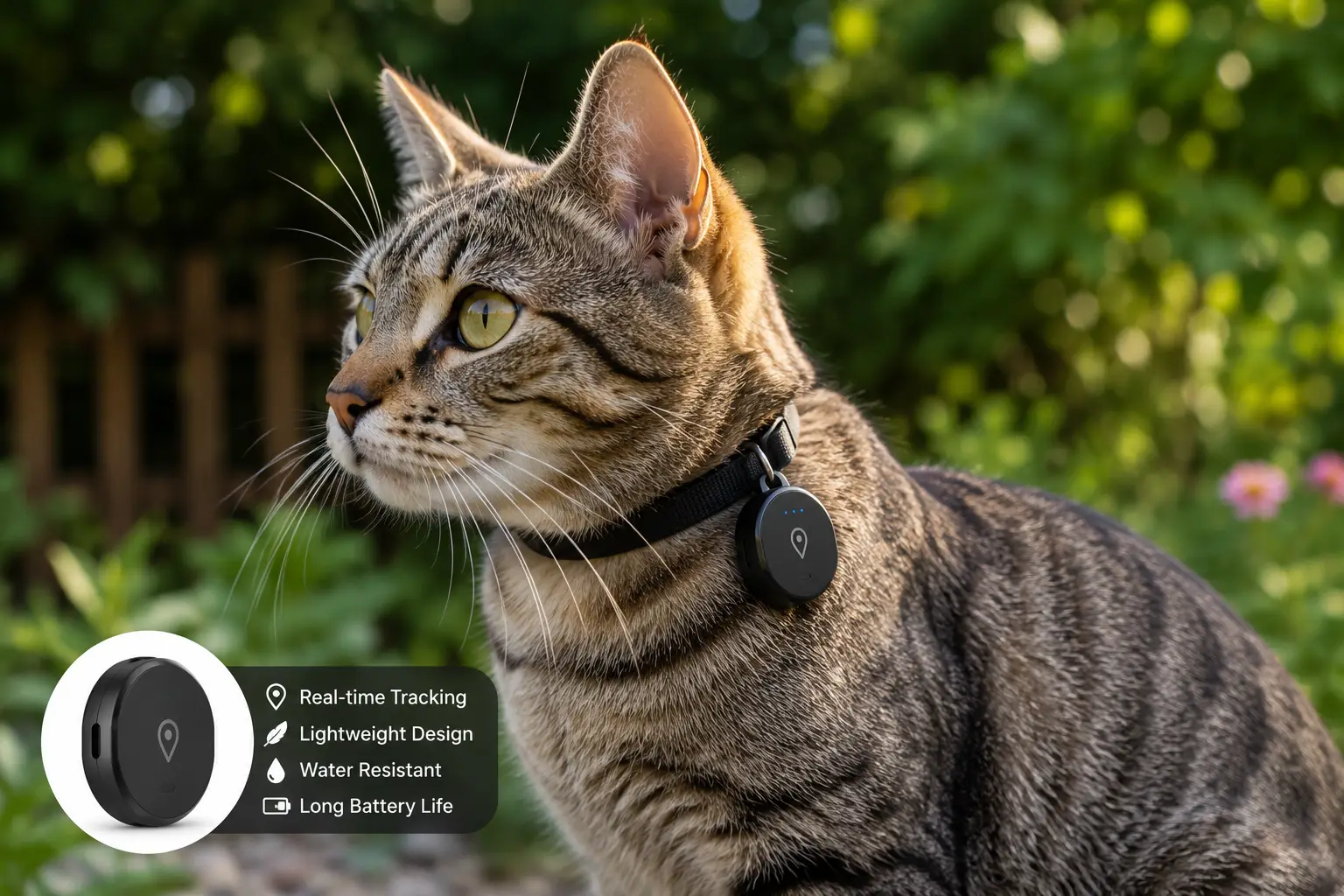
A small cat tracker is a lightweight wearable device — typically under 1.5 ounces — that clips or integrates onto a cat’s collar and reports the cat’s location using GPS, cellular, Bluetooth, or radio-frequency (RF) technology. Unlike dog trackers, small cat trackers are built specifically to avoid adding bulk or weight that could restrict a cat’s movement or irritate their neck.
Small Cat Tracker Quick Comparison
Before diving into full reviews, here’s how the seven trackers stack up on the specs that matter most for small cats: weight, technology, and ongoing cost.
| Tracker | Technology | Weight | Subscription? | Best For |
|---|---|---|---|---|
| Cat Tailer | Bluetooth | ~0.28 oz | No | Budget indoor cats |
| Apple AirTag | Bluetooth (Find My) | ~0.39 oz | No | iPhone households |
| Tabcat V2 | Radio Frequency (RF) | ~0.18 oz per tag | No | Cats that hide nearby |
| Weenect Cat XS | Cellular GPS | ~0.95 oz | Yes | Smallest true GPS |
| Tractive Cat Mini | Cellular GPS | ~0.9-1.5 oz | Yes | Most popular all-rounder |
| Fi Mini | GPS + LTE-M | ~0.56 oz | Yes (membership) | Long battery, clip-on |
| Jiobit | GPS + Cellular + WiFi + BLE | ~0.5-0.65 oz | Yes | Tiniest premium GPS |
Looking at the table, the split comes down to technology first: no-subscription options like the Cat Tailer, Apple AirTag, and Tabcat V2 are cheaper long-term but only work at short range, while the four cellular GPS units track anywhere there’s coverage in exchange for a monthly fee. If your cat never leaves the yard, you likely don’t need cellular GPS at all — but if your cat roams the neighborhood or beyond, the subscription becomes the price of actually finding them.
✨ Ready to stop guessing where your cat wandered off to? Compare the full lineup below and pick the tracker that matches how far your cat actually roams. 💬
The 7 Best Small Cat Trackers of 2026
We researched real spec sheets, manufacturer documentation, and aggregated customer feedback across retailers to put together this lineup — covering entry-level Bluetooth tags, no-subscription RF locators, and premium cellular GPS units, so there’s a genuine option at every budget.
1. Cat Tailer — cheapest way to get started
The Cat Tailer earns its spot as the entry point for small cat tracker shopping: a simple Bluetooth tag with no ongoing fees at all. Weighing about 8 grams (0.28 oz), it’s genuinely one of the smallest and lightest trackers on this list, built to sit on a collar without your cat noticing.
The device uses Bluetooth Low Energy to report distance, not a literal compass direction, so the companion app shows a shrinking number as you get closer rather than a live map. It runs on a replaceable CR1632 coin battery rated for roughly 6 months, and it’s IPX7 waterproof, meaning it survives a rain-soaked cat without issue. Practically speaking, this means you’re not charging anything weekly — you swap a $2 battery a couple of times a year.
This is the right pick for owners of mostly indoor or yard-bound cats who mainly need help locating a cat that’s hiding rather than one that’s genuinely roaming. Multiple owners report using several units across a multi-cat household precisely because there’s no per-device monthly cost to worry about.
Reviews consistently describe the setup as fast and painless — download the app, name the tag, done — and multi-cat households in particular report being satisfied with the value. The most common complaint centers on range: once your cat is out of the roughly 328-foot Bluetooth radius, or behind enough obstacles, the signal drops and the app gives you a radius rather than a direction, so open-field searching still involves some legwork.
Pros:
- ✅ No subscription fee, ever
- ✅ Genuinely tiny at under 0.3 oz
- ✅ Replaceable battery lasts 6+ months
Cons:
- ❌ Loses signal past roughly 328 feet
- ❌ No live map, just a distance reading
In the $25-$35 range, the Cat Tailer is hard to beat as a low-risk first tracker, and the total cost of ownership over several years is lower than almost anything else on this list.
2. Apple AirTag — best if your household is all-iPhone
For cat owners already living inside Apple’s ecosystem, the Apple AirTag offers a clever workaround to full GPS tracking: it doesn’t track your cat directly, but instead pings any nearby iPhone in Apple’s Find My network and relays that location to you anonymously and encrypted.
At around 11 grams (0.39 oz) bare, the AirTag itself is light, though it needs a cat-specific silicone holder (sold separately) to actually attach securely to a breakaway collar — bringing the total weight to roughly 0.4-0.5 oz depending on the holder you choose. There’s no subscription of any kind; the CR2032 coin battery lasts about a year, and Precision Finding uses ultra-wideband on newer iPhones to guide you the last few feet once you’re close.
This tracker is best suited to cats in dense suburban or urban neighborhoods, where the odds of a nearby iPhone picking up the signal are high. Rural cat owners get far spottier coverage simply because there are fewer iPhones nearby to relay the ping. On paper, this means the AirTag’s real-world usefulness depends heavily on your specific street, not just the device itself.
Aggregated feedback across retailers and pet-tech review sites is largely positive on the low cost and zero subscription, though reviewers are consistent in flagging that the AirTag was never designed for pets — there’s no dedicated Lost Cat mode, and Apple’s own guidance discourages using it as your sole safety tool for a living creature.
Pros:
- ✅ Zero subscription cost, ever
- ✅ Massive crowdsourced Find My network
- ✅ About a year of battery life per charge
Cons:
- ❌ Useless in low-iPhone-density areas
- ❌ Not designed or optimized for pets
Budget around $29 for the AirTag itself, plus roughly $10-$15 for a proper cat collar holder — making this one of the most affordable small cat trackers here, provided your neighborhood has the iPhone density to make it work.
3. Tabcat V2 — most accurate for nearby hiding spots
The Tabcat V2 takes a completely different approach from GPS: it uses radio-frequency (RF) technology and a dedicated handheld locator instead of a phone app and satellite signal. The company behind it has built cat-specific RF trackers since 2006, and the V2 is their most refined version yet.
Each homing tag weighs about 5 grams (0.18 oz) — smaller and lighter than the original Tabcat — and the handheld unit uses color-coded lights and a beeping tone that intensifies as you close in, claiming accuracy down to about an inch once you’re close. What most buyers overlook is that RF works well precisely where GPS struggles: dense shrubbery, under decks, inside sheds, or anywhere satellite signal gets blocked. The tradeoff is range, capped at roughly 500 feet outdoors and considerably less through walls.
This is the tracker to buy if your cat is a “hider” rather than a “roamer” — the type who bolts under the porch or into a neighbor’s garage rather than one who disappears for hours at a time. One handset pairs with up to four tags, so multi-cat households get real value from a single purchase.
Customer reviews describe the handset as intuitive and reliably accurate for close-range searches, with the most common critique being that it’s “less useful during outdoor tests” once a cat has genuinely left the immediate area, since there’s no map or history to fall back on — only real-time proximity.
Pros:
- ✅ No subscription, one-time purchase
- ✅ Extremely precise at close range
- ✅ Tracks up to 4 cats on one handset
Cons:
- ❌ Roughly 500-foot maximum range
- ❌ No app, map, or location history
At around $100-$120 for the two-tag bundle, the Tabcat V2 costs more upfront than a Bluetooth tag but pays for itself over time since there’s no recurring fee — a genuinely different value calculation than the cellular GPS trackers later on this list.
4. Weenect Cat XS — smallest real-time GPS tracker made
If your cat needs true live GPS tracking but can’t tolerate anything bulky, the Weenect Cat XS is worth a close look: the manufacturer markets it as the smallest real-time GPS tracker on the market built specifically for cats, and at 27 grams (0.95 oz) with dimensions of just 60.5 x 24.5 x 15mm, that claim holds up against most of the competition here.
The standout feature is Superlive mode, which refreshes your cat’s position once per second when you’re actively searching — dramatically more frequent than the 60-second update intervals common on budget GPS trackers. In practice, this means you can watch your cat’s dot move down the street in near real time rather than getting stale, minute-old pings. It also includes a built-in LED flashlight for locating cats after dark and integrated recall training (ringing the tracker at feeding time to condition your cat to come when called).
This tracker suits budget-conscious owners who still want genuine live GPS rather than settling for Bluetooth or RF, and it’s recommended for cats weighing at least 3 kg (about 6.6 lbs) and up. Owners with lighter kittens should look at the RF or Bluetooth options above instead.
Real-world feedback is largely favorable on accuracy and the surprisingly low subscription starting price, but the battery is the recurring theme in reviews: expect to charge every 2-3 days with heavy use, which is noticeably shorter than several competitors on this list.
Pros:
- ✅ Smallest true GPS tracker for cats
- ✅ 1-second location refresh in Superlive mode
- ✅ Subscription starts around $5.50/month
Cons:
- ❌ Battery needs charging every 2-3 days
- ❌ Not rated for cats under 3 kg
Hardware runs in the $35-$50 range, with subscription plans from roughly $5.50 to $13 monthly depending on whether you commit annually or pay month to month — a solid middle-ground pick for owners who want real GPS without the premium price tag.
5. Tractive Cat Mini — best all-around GPS tracker for cats
The Tractive Cat Mini is the cat-specific version of one of the most established names in pet GPS, and it’s frequently cited across review sites as the most balanced overall pick for cat owners who want reliable live tracking without a steep learning curve.
At roughly 0.9-1.5 oz depending on which generation and collar bundle you choose, it layers GPS, GLONASS, and Galileo satellite positioning with LTE/4G cellular and Bluetooth, which is what most buyers overlook when comparing specs on paper: more positioning technologies stacked together generally means more consistent accuracy in tricky environments like dense tree cover or urban canyons, where any single system alone might struggle. Live tracking refreshes every 2-3 seconds, virtual fences trigger instant alerts when your cat leaves a set zone, and the companion app layers in sleep and activity monitoring on top of pure location.
This is the tracker to choose if you want one dependable, well-supported device and don’t mind the monthly fee — it’s built for cats weighing roughly 6.5 lbs and up, so it fits the large majority of adult cats, though it’s genuinely too much tracker for a small kitten.
Aggregated reviews are strongly positive on tracking accuracy and app usability, with the most consistent complaint being battery life: expect roughly 2-5 days per charge depending on how often live tracking is engaged, which some owners find they need to plan around during long workdays.
Pros:
- ✅ Multi-satellite GPS plus LTE for reliability
- ✅ 2-3 second live location refresh
- ✅ Health and activity tracking built in
Cons:
- ❌ Requires an ongoing subscription
- ❌ Battery drains faster in Live mode
Expect to pay around $50 for the tracker itself, with subscription plans starting around $5 per month on longer prepaid terms and running higher month to month — check the current price and plan optionshttps://www.amazon.com/s?k=Fi+Mini+small+cat+tracker&crid=2QO4Z4JREZFXT&sprefix=fi+mini+small+cat+tracker%2Caps%2C370&linkCode=ll2&tag=5petgpstrackerhub-20&linkId=59741b194ea1dae85b54ac5f6b8242c9&language=en_US&ref_=as_li_ss_tl before buying, since promotional bundles change often.
6. Fi Mini — longest battery life in a clip-on design
The Fi Mini solves a specific problem the trackers above don’t: it clips onto any collar your cat already wears, rather than replacing it, and it’s built around stretching battery life as far as possible for a device this size.
Weighing about 16 grams (0.56 oz), the Fi Mini uses GPS plus LTE-M cellular for outdoor accuracy, layered with WiFi and Bluetooth for indoor precision. Here’s what the spec sheet doesn’t fully convey: according to the U.S. government’s own GPS accuracy documentation, high-quality civilian GPS receivers commonly achieve better than 3-meter horizontal accuracy under open sky, and Fi Mini’s layered-technology approach is specifically designed to compensate for the accuracy loss that happens once your cat wanders indoors or under heavy tree cover, where GPS alone gets less reliable. Fi rates the battery at up to 3 weeks per charge — noticeably longer than the Tractive Cat Mini or Weenect XS above, though real-world use with frequent live tracking will pull that down.
This tracker fits owners who don’t want to think about charging every few days, and who are comfortable with the collar clip-on approach rather than an integrated collar-and-tracker unit. It’s IP68 waterproof and slips onto collars up to 1.25 inches wide.
Customer feedback highlights the clip-on convenience and multi-week battery life as the two biggest wins, with the most common friction points being the subscription cost relative to some competitors and occasional reports of shorter real-world battery life than the marketed 3 weeks under heavy tracking use.
Pros:
- ✅ Up to 3 weeks of battery life
- ✅ Clips onto any existing collar
- ✅ IP68 fully waterproof
Cons:
- ❌ Membership cost adds up over a year
- ❌ Real-world battery trails the 3-week claim under heavy use
Fi Mini is typically sold bundled with 6 or 12 months of membership, landing in the $100-$150 range depending on the term you choose — a fair value if the extended battery life genuinely means fewer charging cycles for you.
7. Jiobit — tiniest premium tracker, built for the smallest cats
Originally engineered for tracking children with sensory sensitivities, the Jiobit now doubles as arguably the most technologically dense small cat tracker on the market, and its origin story explains why it’s so aggressively miniaturized.
At roughly 15-18 grams (0.5-0.65 oz) — the company describes it as lighter than a single AA battery — Jiobit uses patented Progressive Beaconing technology that automatically switches between GPS, cellular, WiFi, and Bluetooth depending on which gives the strongest, most power-efficient connection at any given moment. What most buyers overlook here is that this isn’t just a marketing claim: layering four positioning technologies with adaptive switching is genuinely more sophisticated than the single GPS-plus-cellular setup found on cheaper trackers, and it’s part of why Jiobit routinely gets singled out as the pick for the smallest, most sensitive cats that a bulkier collar would visibly bother. Battery is rated up to 30 days in ideal, learned conditions, though real-world use with an actively roaming cat typically lands closer to 1-2 weeks.
This is the tracker for owners whose cat is simply too small or collar-sensitive for the other GPS options on this list, or who want the most robust connectivity technology available regardless of price. It requires a Jiobit/Life360 subscription to function.
Reviews consistently praise the tiny form factor and connectivity reliability, especially indoors where cheaper single-technology trackers can lose signal; the most frequent criticism is the subscription price, which runs higher than Tractive or Weenect, plus the fact that real-world battery life often falls well short of the 30-day ideal-conditions figure.
Pros:
- ✅ Lightest true multi-technology tracker here
- ✅ Progressive Beaconing improves indoor accuracy
- ✅ Backed by Life360’s large support network
Cons:
- ❌ Highest subscription cost on this list
- ❌ Real-world battery well under the 30-day claim
Hardware typically runs in the $100-$130 range on Amazon, with subscription plans between roughly $8.33 and $14.99 per month depending on plan length — a premium price for what’s genuinely the most advanced small cat tracker in this lineup.
Full Comparison: All 7 Small Cat Trackers Side by Side
| Tracker | Price Range | Monthly Cost | Best For |
|---|---|---|---|
| Cat Tailer | $25-$35 | None | Tightest budget |
| Apple AirTag | ~$29 + holder | None | iPhone-dense areas |
| Tabcat V2 | $100-$120 | None | Close-range hiders |
| Weenect Cat XS | $35-$50 | ~$5.50-$13 | Smallest true GPS |
| Tractive Cat Mini | ~$50 | ~$5-$12 | Best overall balance |
| Fi Mini | $100-$150 | Membership included | Longest battery |
| Jiobit | $100-$130 | ~$8.33-$14.99 | Tiniest premium GPS |
Stacked side by side, the pattern is clear: no-subscription options like the Cat Tailer, Apple AirTag, and Tabcat V2 cost less over time but trade away live GPS tracking, while the cellular GPS group — Weenect Cat XS, Tractive Cat Mini, Fi Mini, and Jiobit — costs more monthly but is the only category that can locate a cat that’s genuinely wandered miles from home. If you’re weighing total cost over three years, a no-subscription tracker plus a $150-200 GPS tracker for a genuinely outdoor-roaming cat often isn’t actually cheaper than it looks on the shelf tag.
💬 One click helps other cat owners make an informed choice too! 😊
Getting Your Small Cat Tracker Set Up Right (First 30 Days)
The first month with a new tracker is where most owners either build good habits or quietly stop using the device. A little structure early on makes a real difference in whether the tracker earns its keep.
Start by attaching the tracker to a genuine breakaway safety collar, not a standard buckle collar — this matters more for cats than dogs, since a cat caught on a fence or branch needs the collar to release before it becomes a strangulation risk. Charge cellular GPS units fully before the first outing, and run a short supervised test in your own yard so you can see how the app behaves with your cat’s actual movement patterns before you’re relying on it during a genuine emergency.
In week one, set up a virtual safe zone around your home if your tracker supports geofencing — this is the single feature most likely to catch a problem early, since you’ll get an alert the moment your cat crosses the boundary rather than discovering hours later that they’re gone. By week two or three, check the app’s location history (on models that offer it) to understand your cat’s normal territory; this baseline makes it much easier to spot when something’s actually wrong versus when your cat is just doing their usual rounds.
The most common first-month mistake is letting the battery run flat because the charging routine hasn’t become habit yet — set a recurring phone reminder that matches your specific tracker’s real-world battery life, not the marketed best-case number.
Real-World Scenarios: Matching the Tracker to Your Cat
Every cat’s risk profile is different, and the right tracker really does depend on the specific situation rather than which device has the flashiest spec sheet.
Consider a strictly indoor cat who occasionally slips out the front door during grocery deliveries. This cat doesn’t need live GPS tracking across town — they need something that locates them fast within a house or yard. The Cat Tailer or Tabcat V2 fits this budget and use case well, since the cat is realistically never more than a few hundred feet away.
Now consider a suburban indoor-outdoor cat who free-roams the neighborhood for a few hours daily. This is the classic case for the Tractive Cat Mini or Weenect Cat XS — live GPS with a safe-zone alert catches the rare occasion the cat wanders further than usual, while daily location history helps you understand their normal territory over time.
Finally, picture a small or nervous kitten, or a cat who’s shown they’ll fight and remove anything bulky on their collar. Here, the Jiobit or Fi Mini‘s minimal weight and clip-on design matter more than raw feature count — a tracker your cat won’t tolerate wearing provides zero protection, no matter how advanced it is on paper.
Common Small Cat Tracker Problems (and How to Fix Them)
Even a well-chosen tracker runs into predictable snags. Here’s how to work through the ones owners hit most often.
Problem: the battery dies faster than advertised. Nearly every GPS tracker’s marketed battery life assumes standby or low-frequency tracking, not continuous Live mode. Reserve Live/Superlive mode for actual searches and let the device fall back to standard tracking the rest of the time to stretch real-world battery life closer to the spec sheet number.
Problem: the collar keeps slipping or the tracker falls off. This is usually a fit issue, not a device failure. Re-measure your cat’s neck with two fingers of slack and switch to a properly sized breakaway collar designed for the tracker’s weight and dimensions rather than forcing it onto a collar that’s too loose.
Problem: GPS accuracy drops indoors or under heavy tree cover. This is a known limitation of satellite positioning generally, not a defect specific to any one brand — even government-grade GPS accuracy commitments assume relatively open-sky conditions. Trackers that layer WiFi and Bluetooth alongside GPS, like the Jiobit and Fi Mini, handle this better than GPS-only devices.
Problem: false safe-zone alerts. An overly tight geofence radius will trigger constant notifications as your cat moves around their own yard. Widen the zone slightly and give the app a few days to learn your cat’s normal patterns before tightening it back down.
How to Choose a Small Cat Tracker
Picking the right device comes down to matching a handful of factors to your specific cat and budget:
- Weigh your cat first. Most small cat trackers list a minimum recommended weight — a device rated for cats 6.5 lbs and up will feel disproportionately heavy on a 4-pound kitten.
- Decide how far your cat actually roams. Strictly indoor or yard-bound cats rarely need cellular GPS; free-roaming outdoor cats generally do.
- Factor in the real subscription cost over a year, not just the sticker price. A $30 tracker with a $12/month plan costs more annually than a $100 tracker with no ongoing fee.
- Check battery life against your actual routine. If you’re not someone who reliably charges devices every few days, prioritize the longer-battery options like Fi Mini or Jiobit.
- Confirm the collar attachment works with your cat’s existing collar, or budget for the manufacturer’s bundled breakaway collar.
- Look at waterproofing rating if your cat spends real time outdoors in variable weather — IP68 is genuinely more protective than a basic water-resistant coating.
- Read aggregated review sentiment, not just the star average, since a 4.3-star product with consistent battery complaints tells you more than the number alone.
Common Mistakes to Avoid When Buying a Small Cat Tracker
The most expensive mistake is buying based on brand recognition alone rather than your cat’s actual weight and lifestyle — a premium tracker built for large outdoor cats is simply the wrong tool for a 4-pound kitten, regardless of how many features it has.
A second common misstep is underestimating subscription costs. Cellular GPS trackers advertise a low hardware price, but the monthly fee compounds over a year or more; run the actual math on total cost before assuming the cheapest-looking box is the cheapest option.
Owners also frequently skip reading the fine print on battery claims, then get frustrated when real-world performance falls short of the “up to” number on the box — manufacturers test those figures under ideal, low-usage conditions that rarely match a cat who’s actually out roaming.
Finally, don’t assume a tracker replaces a microchip, or vice versa — they solve different problems, which the next section breaks down in detail.
Small Cat Tracker vs Microchip: What’s the Difference
This is one of the most common points of confusion for new cat owners, so it’s worth being precise about what each technology actually does.
| Factor | Small Cat Tracker | Microchip |
|---|---|---|
| How it works | Active GPS/RF/Bluetooth signal | Passive ID scanned at a shelter/vet |
| Real-time location | Yes (GPS models) | No |
| Requires power | Yes | No, lasts a lifetime |
| Cost | $25-$150 + possible subscription | One-time, typically $25-$50 |
| Best use | Finding a cat quickly | Proving ownership if found later |
A microchip is a passive identification chip implanted under the skin — it can’t be tracked in real time and only works once your cat is physically brought to a shelter or vet with a scanner, but it lasts your cat’s entire lifetime with no battery and no subscription. A small cat tracker, by contrast, gives you an active, real-time location the moment you need it, but only as long as the device is charged, attached, and (for GPS models) subscribed.
The data backs up why both matter, and it’s also why independent testing groups like Consumer Reports evaluate GPS pet trackers as a distinct product category from ID chips rather than a replacement for one: a microchip is what gets a cat that’s already been found back to you, while a tracker is what helps you find that cat before a stranger or shelter ever gets involved. Most veterinarians and shelter organizations recommend using both together rather than treating them as substitutes for one another.
What to Expect: Everyday Performance
On paper, GPS trackers promise pinpoint accuracy, but daily reality is a little messier and it helps to set expectations accordingly. Even under ideal open-sky conditions, civilian GPS accuracy typically lands within several meters rather than inches, and that accuracy degrades further indoors, under heavy foliage, or between tall buildings — which is exactly why the multi-technology trackers on this list (Jiobit, Fi Mini) tend to perform more consistently in mixed environments than single-technology GPS units.
Battery life is the other area where day-to-day use diverges from the spec sheet. Every “up to X days” claim on this list assumes standby or low-frequency location pings; a cat that’s actively roaming and triggering Live-mode tracking will drain any of these devices meaningfully faster. Build your charging routine around your cat’s actual activity level, not the marketed maximum.
Expect a short adjustment period, too — most cats ignore a properly sized, lightweight tracker within a day or two, though a small minority will scratch at a new collar attachment for the first week regardless of how light it is.
Small Cat Trackers for Kittens and Tiny Breeds
Kittens and naturally petite breeds — Singapuras, Devon Rex, and similarly small cats — need extra care when picking a tracker, since most devices on the market are designed and weight-tested for adult cats in the 6-10 lb range.
For any cat under roughly 5-6 lbs, skip the heavier GPS collars entirely and prioritize the lightest options on this list: the Cat Tailer, Tabcat V2 tags, or Jiobit, all of which come in well under half an ounce. A tracker that exceeds about 10% of a small cat’s body weight can genuinely restrict natural movement and grooming, so err toward the lighter end of this lineup rather than assuming “small cat tracker” marketing alone guarantees a proper fit.
It’s also worth holding off on any tracker until a kitten is fully grown into their adult neck size, since a collar sized for a growing kitten needs frequent adjustment regardless of which tracker is attached to it — and a poorly fitted collar is a safety issue independent of the tracking technology itself.
Long-Term Cost and Maintenance
Sticker price only tells part of the story. Over a three-year ownership window, a no-subscription option like the Cat Tailer or Tabcat V2 costs roughly $25-$120 total, plus the occasional replacement battery. A cellular GPS tracker like the Tractive Cat Mini or Weenect Cat XS, by contrast, runs $35-$50 upfront plus $5-$13 monthly — which adds up to roughly $200-$500 over three years depending on the plan tier you choose.
Maintenance-wise, GPS trackers need periodic firmware updates through their app (typically automatic) and occasional collar or attachment replacement as they wear from weather and outdoor use. No-subscription RF and Bluetooth trackers need far less ongoing attention beyond battery swaps every several months to a year.
The real question to ask isn’t “which is cheapest” but “which cost structure matches how long I’ll actually use this.” A tracker you abandon after three months because the subscription felt like a hassle is a worse value than a slightly pricier device you’ll actually keep charged and active.
Features That Actually Matter (and Ones That Don’t)
Weight and battery life matter more than almost anything else on the spec sheet — a tracker your cat won’t tolerate wearing, or one you forget to charge, provides zero real-world protection no matter how advanced its positioning technology is.
Geofencing/safe-zone alerts matter genuinely, since they’re what catches a problem in the first few minutes rather than hours later. Multi-technology positioning (GPS plus WiFi plus Bluetooth) matters more than raw GPS specs alone, since it’s what keeps accuracy reasonable indoors and under tree cover.
On the other hand, health and activity tracking — step counts, sleep monitoring — is a nice-to-have rather than a purchase-deciding feature for most cat owners; it’s genuinely useful, but it shouldn’t outweigh weight, battery life, and core tracking reliability when you’re comparing options. Similarly, flashy app dashboards and cosmetic collar colors are the least important factor on this entire list, regardless of how prominently they’re marketed.
Safety, Regulations, and Battery Standards
Small cat trackers are low-power consumer electronics, but the lithium-ion batteries inside them are still worth understanding, especially since these devices sit against your cat’s skin for hours at a time. The Consumer Product Safety Commission has documented hazards associated with batteries and chargers, including overheating, thermal burns, and — in rare cases — battery ejection during failure, which is why it’s worth only charging your tracker with the manufacturer’s original cable and avoiding third-party fast chargers not rated for the device.
Reputable manufacturers list their waterproofing (IP68 is the standard to look for) and safety certifications on their product pages; if a listing doesn’t mention any battery safety certification at all, treat that as a yellow flag. It’s also worth periodically inspecting the tracker casing for cracks, swelling, or unusual heat, and discontinuing use immediately if you notice any of those signs — the same commonsense precautions that apply to any small lithium-ion device.
On the collar side, a genuine breakaway buckle is the single most important safety feature for any outdoor cat, tracker or not, since it lets your cat escape if the collar snags on a fence or branch.
Frequently Asked Questions
❓ Do small cat trackers work without WiFi or a phone nearby?
❓ How much does a small cat tracker cost per month?
❓ Is a small cat tracker safe for kittens?
❓ Can I use a small cat tracker instead of a microchip?
❓ What's the most accurate small cat tracker?
Conclusion
There’s no single best small cat tracker — there’s only the best one for your specific cat’s size, personality, and how far they actually roam. If you’re working with a tight budget and a cat who mostly stays close to home, the Cat Tailer or Apple AirTag covers the basics with zero ongoing cost. If your cat genuinely explores the neighborhood, live GPS from the Tractive Cat Mini or Weenect Cat XS is worth the monthly fee for the peace of mind alone. And if you’ve got a small, collar-sensitive cat or simply want the most technically capable device available, the Jiobit or Fi Mini earns the premium price tag through weight, battery life, and multi-technology accuracy.
Whichever you choose, remember that a tracker works best as one layer of protection alongside a proper breakaway collar and, ideally, a microchip — together, they cover both the “find them fast” and “prove they’re mine” sides of the lost-pet problem. Take the time to actually measure your cat, be honest about how far they roam, and pick the device that fits that reality rather than the one with the flashiest feature list.
Recommended for You
- 7 Smallest Trackers That Are Virtually Invisible (2026 Picks)
- 7 Best Dog Portal Fences in 2026: Safe & Durable Options for Pets
- Temporary Wire Fence for Dogs: 7 Best Picks for Your Yard (2026)
Disclaimer: This post contains affiliate links. As an Amazon Associate, I earn from qualifying purchases made through these links, at no additional cost to you.
✨ Found this article helpful? Share it with someone whose cat could use a little extra peace of mind! 💬🤗