
In This Article
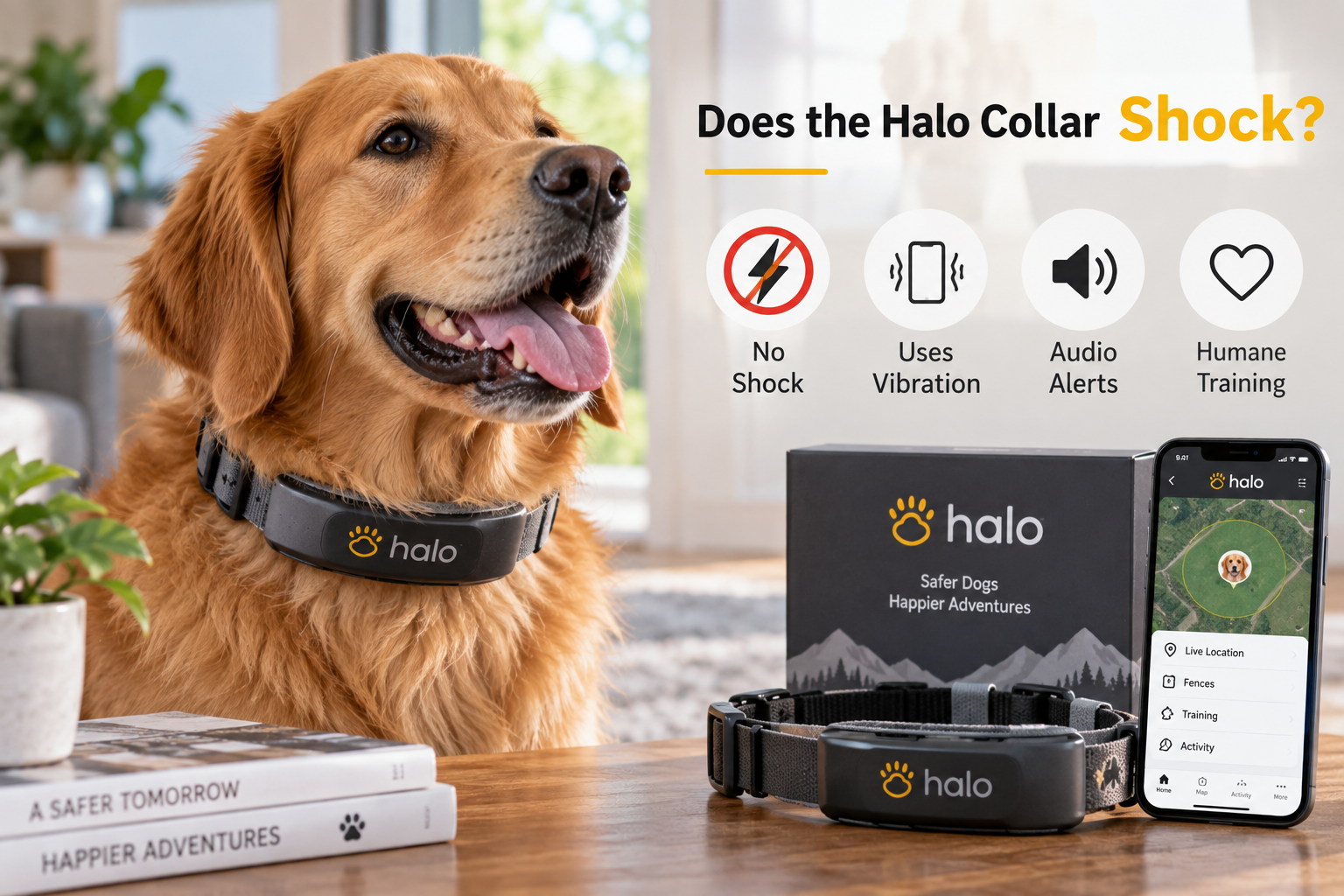
If you’ve spent any time scrolling GPS dog fence reviews, you already know the question won’t leave you alone: does the halo collar shock dogs, or is that just internet noise? It’s a fair thing to worry about before you strap anything electronic around your dog’s neck. Here’s the short version: the Halo Collar is not a traditional shock collar. It’s a GPS-based virtual fence that layers sound, vibration, and an optional adjustable static correction into one feedback system, and static is never required to use it.
That distinction matters more than marketing copy would have you believe, because “GPS collar,” “e-collar,” and “shock collar” get thrown around interchangeably online, and they are not the same product category. A GPS dog fence collar uses satellite positioning to draw an invisible boundary around your property; the feedback it gives your dog when they approach that boundary is the part people are really asking about when they type does the halo collar shock into a search bar.
This guide breaks down exactly how Halo’s feedback works, compares it honestly against six other real GPS collars on the market — including two that skip static correction entirely — and walks through what actually matters when you’re choosing between them. We’ll cover pricing in realistic ranges (never exact numbers, since Amazon pricing shifts constantly), pull in genuine aggregated review sentiment instead of invented quotes, and give you a buyer framework you can actually use. Whether you end up choosing a halo dog collar or one of its alternatives, you’ll leave with a clear picture of what “static correction” really means in practice — and whether it’s right for your dog.
What Is the Halo Collar (and Does It Actually Shock Dogs)?
The Halo Collar is a GPS-based virtual fence and tracking collar for dogs that uses a graduated feedback system of sound, vibration, and adjustable static — not a traditional shock collar. Static feedback is optional, mimics a brief “tap on the shoulder” rather than a painful pulse, and many owners never turn it on at all.
That’s the plain answer. The more useful answer is understanding what “static correction” is doing mechanically and behaviorally, because that’s the piece most product pages gloss over.
Quick Comparison: Halo Collar vs. 6 GPS Dog Collar Alternatives
| Collar | Correction Types | Subscription | Price Range | Best For |
|---|---|---|---|---|
| Halo Collar 5 | Tone, vibration, optional static | Required | Around $700–$900 | Tech-forward owners wanting AI-based fences |
| Halo Collar 3 | Tone, vibration, optional static | Required | Around $400–$550 | Budget entry into the Halo ecosystem |
| SpotOn GPS Fence (Nova Edition) | Tone, vibration, optional static | Optional | Around $900–$1,000 | Large or wooded properties, no monthly fee |
| PetSafe Guardian GPS 2.0 | Tone, vibration, 10 static levels | Required for live tracking | Around $400–$600 | Smaller dogs, budget-conscious multi-fence users |
| Dogtra GPS Fence | Tone, vibration, static | Not required | Under $250 | Containment-only buyers who hate monthly fees |
| Fi Series 3+ Smart Collar | None — sound/app alerts only | Required | Around $150–$200 + plan | Owners who want zero static, ever |
| Tractive Smart Dog GPS Tracker | None — alerts only | Required | Under $100 | Tightest budgets, simple tracking needs |
Looking at the table above, the split isn’t really “good vs. bad” — it’s containment versus tracking. Halo Collar 5, SpotOn GPS Fence, PetSafe Guardian GPS 2.0, and Dogtra GPS Fence are true containment systems, meaning they’re built to physically keep your dog inside a boundary using escalating feedback. Fi Series 3+ and Tractive Smart Dog GPS Tracker, on the other hand, are trackers with fence alerts — they’ll tell you the moment your dog crosses a line, but they won’t do anything to stop them from crossing it. If avoiding static correction entirely is your top priority, that’s the trade-off to understand before you buy.
💬 Bookmark this comparison — you’ll want to reference it again once you see the full breakdown below! 😊
Top 7 GPS Dog Fence Collars: Expert Analysis
1. Halo Collar 5 — smartest boundary AI on the market
The flagship of the Halo lineup, and the reason most people land on this article in the first place. What sets the Halo Collar 5 apart is Direction-Based Feedback: instead of correcting your dog purely based on distance from the boundary, it reads GPS position and motion data to determine which way your dog is actually heading, and only escalates feedback when they’re moving toward the line. A dog standing still or walking parallel to the fence gets no correction at all — a real gap in older GPS fence tech that caused a lot of frustrated, confused dogs.
Under the hood, dual-frequency GPS (using both L1 and L5 satellite signals) is what most owners actually notice day to day: tighter, more consistent boundary lines with less of the “fence drift” that plagued earlier GPS collars, especially under tree cover. Reviews consistently report that the accuracy improvement over the Halo 3 is real, though a subscription is required to keep live tracking, remote commands, and app alerts active — without it, the collar falls back to a limited offline mode.
Based on comparing the feature set against the rest of this list, the Halo Collar 5 is best suited to owners who want the most automated, least hands-on containment experience and don’t mind paying an ongoing fee for it. It bundles in a 21-day boundary training program built with Cesar Millan, which walks you through introducing the fence gradually rather than dropping your dog into full correction mode on day one. Check the current price before buying, since Amazon pricing on this model shifts with promotions.
Pros:
- ✅ Direction-based feedback cuts false corrections
- ✅ Dual-frequency GPS improves boundary accuracy
- ✅ Built-in Cesar Millan training program included
Cons:
- ❌ Subscription required for full functionality
- ❌ Static correction may still feel unnecessary to some owners
Priced around $700–$900 at the time of writing, it’s a premium buy — one that earns its price mainly through the subscription-backed software, not just the hardware.
2. Halo Collar 3 — most affordable way into the Halo ecosystem
If the flagship price tag is the sticking point, the Halo Collar 3 gets you the same core philosophy — sound, vibration, and optional static feedback, paired with the Cesar Millan training program — at a noticeably lower price. It uses a single-frequency GPS chip rather than the Halo 5’s dual-frequency setup, which is the main practical difference buyers should weigh.
In practice, that means slightly less precise boundary lines and more reported fence drift under heavy tree cover or near tall structures, something several independent reviewers have flagged when comparing the two generations side by side. The tradeoff is reasonable for smaller, more open yards where GPS accuracy is less of a constant fight. Reviews consistently describe the Halo Collar 3 as “good enough” containment for suburban lots, with the caveat that owners on wooded or irregularly shaped properties tend to be happier stepping up to the newer model.
This collar is for the buyer who wants Halo’s feedback philosophy — including the ability to rely on tone and vibration alone — without paying for cutting-edge GPS hardware they may not need. Aggregated customer sentiment tends to praise the app’s ease of setup and the flexibility to disable static entirely, while some flag that battery life dips faster with heavy GPS use.
Pros:
- ✅ Meaningfully cheaper than the Halo 5
- ✅ Same optional-static philosophy and training program
- ✅ Simple app setup praised in aggregated reviews
Cons:
- ❌ More fence drift reported under tree cover
- ❌ Single-frequency GPS is less precise than newer models
In the $400–$550 range at the time of writing, it’s the value-conscious entry point into the same feedback system that made Halo’s name.
3. SpotOn GPS Fence (Nova Edition) — most accurate large-property fence
SpotOn GPS Fence takes a different approach to the subscription question: the containment fence itself works with no monthly fee required, and a cellular tracking plan is purely optional on top of that. For owners who mainly want reliable containment and don’t care about live remote tracking from their phone at work, that’s a meaningful cost difference over years of ownership.
Independently lab-tested accuracy is where SpotOn stakes its reputation, with the brand reporting sub-five-foot boundary precision and reliable performance even under heavy tree cover — a common weak point for GPS-based fences. The collar itself is designed and assembled in New Hampshire, and it supports unlimited custom geofences, including overlapping “keep-out” zones around pools or gardens layered inside your main containment area. Feedback options mirror Halo’s: tone, vibration, and optional static, adjustable through the app.
What most buyers overlook with SpotOn is the total cost of ownership math: the higher upfront price is partly offset by the absence of a mandatory monthly fee, so a multi-year owner who skips the optional plan can end up paying less over time than a subscription-locked competitor, even with the steeper sticker price. It’s best suited to rural or wooded properties where GPS accuracy under obstruction is the single biggest pain point.
Pros:
- ✅ No subscription required for core containment
- ✅ Sub-five-foot accuracy even under tree cover
- ✅ Unlimited custom fences and keep-out zones
Cons:
- ❌ Highest upfront price on this list
- ❌ Optional cellular plan still needed for remote tracking
Around $900–$1,000 at the time of writing, it’s the priciest entry here, but the no-subscription core plan is a genuine differentiator worth weighing.
4. PetSafe Guardian GPS 2.0 — best dual-frequency value pick
PetSafe has been in the containment-fence business longer than most competitors, and the Guardian GPS 2.0 reflects that experience: it’s roughly 50% smaller and lighter than the brand’s earlier Guardian model, with an adjustable fit that starts at an 8-inch neck circumference — meaningfully more accommodating for smaller and medium dogs than several competitors on this list, which tend to assume larger breeds.
AccuGuard technology blends GPS data with real-time motion detection and AI to reduce false corrections, and the collar offers 10 distinct static levels alongside tone-and-vibration-only mode, giving owners fine-grained control most competitors don’t match. Up to 50 custom virtual fences can be saved through the My PetSafe app, useful for owners who split time between a primary residence and a second property. A tracking subscription is required to unlock live location alerts and remote commands, following the same model as Halo.
Based on the spec sheet, this is the pick for owners with smaller dogs or multiple properties who want dual-frequency GPS accuracy without paying SpotOn or Halo 5 prices. Aggregated reviews frequently mention that setup takes under an hour and that the smaller collar body is noticeably more comfortable on dogs under 30 pounds than older-generation GPS fences.
Pros:
- ✅ Fits smaller dogs down to an 8-inch neck
- ✅ 10 static levels for fine-grained customization
- ✅ Up to 50 saved virtual fences across properties
Cons:
- ❌ Subscription required for live tracking features
- ❌ Best performance still assumes properties over 3/4 acre
In the $400–$600 range at the time of writing, it lands as a genuine mid-tier value option between Dogtra’s budget fence and Halo’s premium tier.
5. Dogtra GPS Fence — cheapest true no-subscription containment
If a recurring bill is the dealbreaker, Dogtra GPS Fence solves it directly: no monthly fees, ever, with the companion app required only for the initial boundary setup, not for ongoing use. That makes it the most budget-friendly containment-only system on this list, and one of the very few GPS fences that doesn’t quietly turn into a subscription product after the first year.
The tradeoff is scope: this is containment only, with no live tracking feature to check your dog’s location remotely from your phone. Dogtra’s “Come Home Sequence” handles the correction logic — a tiered sequence of warning tones and return cues that escalate before any static feedback triggers, similar in spirit to Halo’s approach but without the direction-based motion analysis. It’s intended for properties larger than 3/4 acre, and Dogtra explicitly recommends removing the collar indoors, since walls and roofing can interfere with GPS signal and cause inaccurate corrections.
What the spec sheet doesn’t say, but the pricing does: this is the collar for someone who has already decided they want containment, has ruled out ongoing fees, and doesn’t need remote tracking bells and whistles. Reviews aggregated across retailers describe it as reliable for straightforward rectangular yards, with less consistency reported on irregularly shaped or heavily wooded lots.
Pros:
- ✅ Zero subscription cost, permanently
- ✅ Tiered Come Home Sequence reduces surprise corrections
- ✅ Lowest price point among true containment systems
Cons:
- ❌ No live remote tracking feature
- ❌ Less reliable reported on irregular or wooded lots
Priced under $250 at the time of writing, it’s the clearest budget pick if containment — not tracking — is genuinely all you need.
6. Fi Series 3+ Smart Collar — best pick with zero static option
For owners whose real question is “how do I avoid static correction entirely,” the Fi Series 3+ Smart Collar answers it by design: it’s built as a GPS tracker and activity monitor, not a containment fence, and it has no static correction feature at all. There’s simply nothing to turn on.
Instead, Fi focuses on real-time GPS location, activity and sleep tracking, and virtual “safe zone” alerts that notify your phone the instant your dog crosses a boundary you’ve drawn — the correction responsibility stays entirely with you, not the collar. That’s a meaningfully different product category than Halo or SpotOn, and it’s worth being honest about: this is a tracking-and-alert tool, not a physical containment system, so a determined escape artist can still get out before you can react.
Who this is for: owners of well-trained or lower-drive dogs who mainly want peace of mind and step-count/activity data, plus instant alerts if something goes wrong — not owners trying to solve an active fence-jumping or bolting problem. Aggregated customer sentiment is generally positive on battery life and app polish, with the more common complaint being that the required subscription adds up over a multi-year ownership period.
Pros:
- ✅ No static correction feature, period
- ✅ Strong activity and sleep tracking data
- ✅ Instant phone alerts on boundary crossing
Cons:
- ❌ Doesn’t physically contain a dog like a true fence collar
- ❌ Ongoing subscription required for full features
In the $150–$200 range at the time of writing, plus a monthly plan, it’s a genuinely different tool than the containment collars above it on this list — pick it with that distinction in mind.
7. Tractive Smart Dog GPS Tracker — lightest budget tracker
At the entry-level end of this whole category sits the Tractive Smart Dog GPS Tracker, a lightweight clip-on unit rather than a full collar system. Like Fi, it has no static or vibration correction feature whatsoever — it’s purely a location tracker with virtual fence alerts, live updates roughly every 2–3 seconds, and reported battery life up to 14 days per charge, among the longest on this list.
Some versions also add vital-signs monitoring, tracking heart and respiratory rate trends over time to flag potential health changes early — a feature none of the containment-focused collars on this list offer. A subscription is required to activate the cellular connection and unlimited-range tracking, with plans reportedly starting in the $5-per-month range, making the ongoing cost relatively modest compared to premium containment subscriptions.
This is the pick for owners on the tightest budget who mainly want a “where is my dog right now” safety net rather than an active containment system — think apartment dwellers, dogs who already respect boundaries reliably, or a lightweight backup tracker layered onto an existing fence setup. Reviews aggregated across retail platforms are mixed on subscription billing practices, with a recurring theme of owners wishing the free trial period were longer before the plan charge hits.
Pros:
- ✅ No static correction — pure GPS tracking
- ✅ Long battery life versus containment collars
- ✅ Optional vital-signs monitoring on some models
Cons:
- ❌ Doesn’t physically stop a dog from leaving
- ❌ Subscription billing has drawn mixed reviews
Under $100 at the time of writing before the subscription, it’s the lowest-commitment way to try GPS tracking without touching static correction at all.
How to Set Up and Train Your Dog on a GPS Fence Collar
Getting a new collar right in the first two weeks makes the difference between a dog who respects the boundary calmly and one who fights it constantly. Start with a full day of the collar on your dog’s neck, powered off, so they get used to the physical weight and fit before any feedback is involved — this alone eliminates a surprising share of early “collar anxiety” complaints in aggregated reviews.
Next, walk the boundary together on a leash with feedback set to tone-or-vibration-only, letting your dog physically feel where the line sits while you narrate it verbally. Most training programs, including the one bundled with Halo, recommend a full week at this stage before introducing static feedback at all — and several models on this list, like Fi and Tractive, skip that step entirely since they have no static option to introduce. If you do move to static, start at the lowest available level and only increase it if your dog shows no response, never as a default setting.
Common first-30-days mistakes include leaving the collar in full correction mode indoors (GPS drift near walls can trigger false corrections), skipping the boundary walk-through, and testing at maximum static intensity “to see what happens” — all of which erode a dog’s trust in the system faster than they build compliance. A consistent, low-and-slow rollout is what separates owners who report a smooth transition from owners who end up returning the collar within a month.
Real-World Scenarios: Matching the Right Collar to Your Dog
Consider a family with a half-acre suburban yard and a food-motivated Labrador who’s never shown much interest in wandering. A lower-cost, containment-only option like the Dogtra GPS Fence or the Halo Collar 3 covers this case well — the yard is small enough that GPS drift is less of a factor, and the dog’s low escape drive means static correction, if used at all, likely stays on the lowest setting indefinitely.
Now picture a rural five-acre property with dense tree cover and a scent-driven hound breed prone to bolting after wildlife. This is the scenario premium, high-accuracy fences are built for — the SpotOn GPS Fence or Halo Collar 5, both rated for sub-five-foot or two-foot accuracy respectively, justify their higher price here because a few feet of GPS drift on a large wooded lot is the difference between a contained yard and a lost dog.
Finally, consider an apartment-dwelling owner with a small, well-mannered senior dog who mainly wants peace of mind on walks and at the dog park, with no real containment need. The Fi Series 3+ or Tractive Smart Dog GPS Tracker fit this profile precisely — no static correction to worry about, lighter hardware, and a lower monthly cost than a full containment subscription, because the underlying problem being solved is “where is my dog” rather than “how do I keep my dog inside a boundary.”
Common Problems With GPS Fence Collars — and How to Fix Them
Problem: Fence drift near trees or tall structures. GPS signal bounces off dense foliage and buildings, occasionally shifting your drawn boundary a few feet in either direction. Solution: dual-frequency models like the Halo Collar 5, PetSafe Guardian GPS 2.0, and SpotOn GPS Fence are specifically engineered to reduce this, so upgrading tier is often the real fix rather than adjusting settings.
Problem: Dog ignores tone and vibration entirely. Some high-drive or scent-driven dogs simply aren’t food- or sound-motivated enough for the earliest warning stages to register. Solution: extend the boundary walk-through training phase before introducing static, and confirm the collar fits snugly enough that vibration is actually felt against the skin, not just the fur.
Problem: False corrections triggered while indoors. Most GPS containment collars, including Dogtra’s, explicitly warn that walls and roofing can distort signal. Solution: remove the collar indoors entirely, or use the collar’s tone-only indoor mode if the model offers one.
Problem: Battery draining faster than expected. Live tracking and frequent GPS pings — the features that make premium models responsive — are also what drains batteries fastest. Solution: dial back live-tracking update frequency in the app when you don’t need minute-by-minute location data, and stick to a consistent nightly charging routine rather than waiting for a dead battery.
Problem: Subscription costs sneaking up over time. Nearly every model on this list except Dogtra’s GPS Fence and SpotOn’s base plan requires an ongoing fee. Solution: calculate total three-year cost, not just the sticker price, before comparing options — the math can flip your “cheapest” pick entirely.
How to Choose a GPS Dog Fence Collar
- Start with your property, not the collar. Wooded, irregularly shaped, or large properties genuinely need dual-frequency GPS accuracy; a small flat suburban yard usually doesn’t.
- Decide how you feel about static correction before comparing prices. If the honest answer is “never,” models like Fi or Tractive remove the decision entirely rather than asking you to keep static turned off manually.
- Calculate three-year total cost, including subscriptions. A cheaper upfront collar with a mandatory monthly plan can cost more over time than a pricier no-subscription model.
- Match the collar to your dog’s actual escape history. A dog with zero history of bolting doesn’t need the same containment intensity as a repeat fence-jumper.
- Check neck-size and weight minimums carefully. Several models, including PetSafe’s standard Guardian line, assume larger dogs — smaller breeds need models like the Guardian GPS 2.0 built for tighter neck circumferences.
- Read the training program included, not just the hardware spec sheet. A collar with a structured, graduated training plan tends to produce calmer results than raw hardware alone.
- Confirm battery life matches your routine. A collar that needs nightly charging is a dealbreaker for owners who forget chargers; a 14-day tracker like Tractive’s solves that at the cost of active containment.
Halo Collar vs. Traditional Wired and Shock Collars
The core difference between a GPS fence collar like Halo and a traditional wired invisible fence comes down to installation and flexibility. A wired fence requires burying cable around your entire property boundary — a physical, often costly installation that can’t move with you and can’t easily accommodate irregular shapes or keep-out zones. A GPS-based system like the Halo Collar 5 or SpotOn GPS Fence draws boundaries in software instead, meaning setup takes an app and a walk around your yard rather than a shovel and a weekend.
The correction philosophy also diverges from older remote-control shock collars, which rely on a human pressing a button at the moment of unwanted behavior — a system highly dependent on the handler’s timing and judgment. GPS fence collars automate that decision based on location data, which reduces human error but also removes some of the nuance a skilled trainer might apply. According to Wikipedia’s overview of shock collars, these devices deliver electrical current to control behavior as a form of aversive training, and can be triggered either automatically, as with fence systems, or manually via remote control — a useful reminder that “GPS fence” and “remote shock collar” are related but functionally distinct tools, even when both include a static option.
For most suburban households without a serious escape risk, that distinction matters less in practice than the underlying feedback philosophy: whether static is optional and rarely used, as with Halo, SpotOn, and PetSafe, or whether it’s the primary training mechanism, as with dedicated remote e-collars built for hunting and working dogs. Buyers chasing “does the halo collar shock” are usually really asking which category they’re buying into — and the honest answer is that Halo sits closer to a layered communication system than a traditional correction tool.
Common Mistakes to Avoid When Buying a GPS Dog Collar
The single most common mistake is buying based on brand recognition alone rather than property size and dog temperament — a Tractive-style tracker won’t contain a fence-jumping husky, no matter how good its reviews are, because it was never built to. The second is ignoring subscription costs during the initial purchase decision, then feeling blindsided a year in when the “cheap” collar has quietly cost more than the premium no-subscription alternative.
A third mistake worth flagging: assuming higher static levels train faster. Peer-reviewed research on remote electronic collars, including a controlled 2020 study out of the University of Lincoln published in Frontiers in Veterinary Science, which compared training outcomes with and without remote electronic collars against positive-reinforcement-focused methods, underscores why manufacturers like Halo build graduated, low-intensity systems rather than jumping straight to high correction levels — starting low and escalating only when necessary is the evidence-backed approach, not a marketing choice.
Finally, don’t skip reading the neck-size and weight minimums before buying — a collar rated for dogs 30 pounds and up, like PetSafe’s standard Guardian line, simply won’t sit correctly (or trigger reliably) on a 15-pound terrier, no matter how good the reviews from larger-dog owners are.
Features That Actually Matter (and Ones That Don’t)
Dual-frequency GPS matters more than almost any other spec on this list, because it’s the single biggest lever for reducing false corrections and fence drift — the complaint that shows up most often across aggregated reviews for every brand. Direction-based feedback, currently unique to Halo’s system, is a genuine functional advantage over distance-only correction logic, not just marketing language, since it directly addresses the “my dog was just standing still and still got corrected” complaint common with older GPS fences.
What matters less than the spec sheets suggest: the sheer number of static intensity levels. Ten levels versus five levels sounds like a meaningful upgrade, but in practice, most owners settle into one or two working levels and never touch the rest of the range — the real value is having enough granularity to find the lowest effective setting, not having the largest possible number.
Battery life claims also deserve a skeptical read. A collar advertised at “up to 72 hours” is almost always tested with tracking features disabled; real-world battery life with live GPS tracking active tends to run considerably shorter, which is worth confirming against current reviews rather than the spec sheet alone before you commit to a charging routine.
Safety, Regulations, and Standards
There’s no federal law in the U.S. banning GPS fence collars or static correction devices, but the regulatory conversation is shifting. A growing number of veterinary and animal behavior organizations have taken formal positions against aversive training tools broadly. The American Veterinary Society of Animal Behavior has stated there is no role for aversive training in behavior modification plans, even for dogs with aggressive behaviors, a position worth knowing before deciding how — or whether — to use any static feature at all.
Several other countries have gone further than professional guidance, moving to outright bans: multiple European nations, along with Wales and parts of Australia and Canada, have prohibited electronic shock collars entirely, reflecting a broader welfare-focused trend that U.S. buyers should be aware of even though it hasn’t translated into federal restriction domestically. Some U.S. cities have introduced similar local proposals in recent years, so it’s worth a quick check of your own state and municipal regulations before purchasing, particularly if you’re considering a high-intensity remote training collar rather than a low-intensity fence system.
On the affiliate side, transparency matters too: this article contains affiliate links, and under FTC guidance, any material connection between a reviewer and the products they recommend needs to be clearly disclosed — a standard covered in detail in the FTC’s Endorsement Guides, which define what counts as an endorsement and when disclosure is required. You’ll find that disclosure below, as required.
Long-Term Cost and Maintenance
Sticker price tells you almost nothing about what a GPS collar actually costs over a typical three-to-five-year ownership window, because subscription fees compound. A $500 collar with a $10-per-month mandatory plan costs roughly $860 over three years — more than SpotOn’s no-subscription base plan at the higher upfront price, once you run the math past year one.
Replacement costs matter too: collar straps wear out, batteries degrade with repeated charge cycles, and most brands sell replacement receiver units separately rather than bundling free replacements after the warranty period ends. Budget for a strap or battery replacement somewhere in year two or three regardless of which brand you choose, since this is a consistent theme across aggregated long-term ownership reviews for every collar on this list.
✨ Ready to stop guessing and start comparing real options? Check today’s pricing on the picks above before your next walk! 🐾
The most cost-predictable buyers tend to be the ones who committed to either a genuinely subscription-free model like Dogtra’s GPS Fence or fully embraced the subscription model with a brand they trust long-term, rather than owners who keep switching brands hoping to dodge fees — brand-switching resets setup time and often forfeits any loyalty pricing on renewal plans.
FAQs
❓ Does the Halo Collar shock dogs like a traditional shock collar?
❓ Is a GPS dog fence collar better than a buried wire fence?
❓ How much does the Halo Collar cost on Amazon?
❓ Can I use a GPS collar without ever turning on static correction?
❓ Do GPS dog fence collars require a monthly subscription?
Conclusion
So, does the halo collar shock dogs? Not in the way the phrase implies. It’s a layered feedback system built around sound and vibration first, with an optional, adjustable static setting that most owners either use sparingly or skip entirely — a meaningfully different product than the remote-controlled shock collars the phrase usually conjures up.
Which of the seven options here actually fits your household comes down to two honest questions: how big and obstructed is your property, and how do you personally feel about static correction as a tool. If the answer to the second question is “never, under any circumstances,” the Fi Series 3+ or Tractive Smart Dog GPS Tracker remove the decision entirely. If you want the most automated, accurate containment available and don’t mind a subscription, the Halo Collar 5 earns its price. And if a monthly bill is the real dealbreaker, Dogtra’s GPS Fence or SpotOn’s no-subscription base plan deserve a serious look before you check out.
Whatever you choose, start slow, lean on the included training programs, and remember that the goal of any of these systems — Halo included — is a dog who understands the boundary calmly, not one who’s afraid of it.
✨ Don’t miss the chance to compare current pricing on all seven picks above before you decide! 🐾🔍
Recommended for You
- Best GPS Tracking Jewelry 2026: 7 Life-Saving Picks
- GPS Locator Jewelry: 7 Best Trackers & Safety Necklaces (2026)
- Garmin Alpha 300 Bundle: 7 Best Picks & Buying Guide (2026)
Disclaimer: This post contains affiliate links. As an Amazon Associate, I earn from qualifying purchases made through these links, at no additional cost to you.
✨ Found this article helpful? Share it with someone who needs it! 💬🤗