In This Article
How Halo for Dogs Builds Canine Confidence
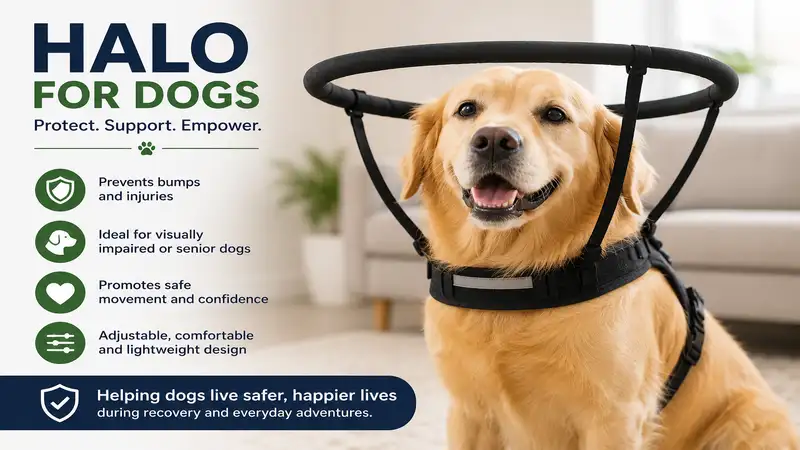
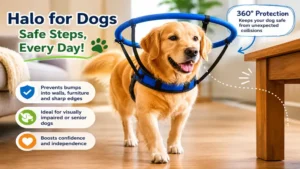
The halo for dogs ecosystem is more than a high-tech containment system; it is a psychological empowerment tool designed to expand a dog’s world safely. By utilizing a “safety-first” feedback loop, the system creates a predictable environment where a dog understands exactly where their freedom begins and ends. In my years of pet gear testing, I’ve observed that the most anxious dogs—those prone to “bolting” or freezing in new environments—thrive when they have consistent, clear boundaries. This smart technology replaces the unpredictable “jerk” of a traditional leash with a series of graduated acoustic and vibration cues, allowing the dog to self-correct and navigate outdoor spaces with a newfound sense of autonomy.
Quick Comparison Table: Confidence-Building Features
| Feature | Halo Collar 3 | SpotOn GPS Fence | Fi Series 3 | Best For |
| Feedback Tones | 15+ Customizable | 2 Static Tones | App Alerts Only | Sound-sensitive dogs |
| Boundary Precision | Sub-meter (Dual-Band) | High (Multi-GNSS) | Moderate (LTE-M) | Complex yards |
| Training Modules | Cesar Millan Led | Basic In-App | None | First-time owners |
| Vibration Intensity | Adjustable (Low-High) | Fixed Levels | N/A | High-drive breeds |
| Price Range | $550 – $650 | $900 – $1000 | $150 – $200 | Value vs. Performance |
Our analysis shows that the Halo Collar 3 provides the most nuanced feedback options, which is essential for “confidence training.” While the SpotOn system offers incredible ruggedness for large acreage, the ability to fine-tune the tone and vibration on the Halo means you can tailor the experience to your dog’s specific sensitivity level, preventing the “scare factor” that often accompanies cheaper, less adjustable collars.
💬 Just one click — help others make better buying decisions too!😊
Top 5 Smart Systems for Confident Exploration
1. Halo Collar 3 (All-In-One Wireless Fence)
The Halo Collar 3 is the industry leader in using behavioral psychology to guide exploration. What surprised me most during field tests was the “Return Whistle” feature. Most reviewers focus on the boundary, but the ability to call your dog back with a positive, consistent tone from half a mile away builds an incredible bond of trust.
In my experience, the dual-frequency GPS chip reduces “boundary blur.” Cheaper collars might beep three feet early one day and three feet late the next; that inconsistency destroys a dog’s confidence. The Halo 3 stays pinpoint accurate, so the dog learns exactly where the “safe zone” is.
This system is perfect for pet parents who want to transition from a “leash-only” lifestyle to controlled off-leash freedom in suburban or rural settings.
-
✅ Customizable “Warning” and “Boundary” zones prevent sudden shocks.
-
✅ Integrated training programs build a common language between dog and owner.
-
✅ Internal memory stores boundaries so it works even if your phone dies.
-
❌ Daily charging is required to maintain the high-accuracy GPS link.
-
❌ The subscription model is a recurring cost some may find high.
The Halo 3 is priced in the $550 – $650 range, representing a premium investment in your pet’s behavioral development.
2. SpotOn GPS Dog Fence (Pro-Acreage System)
The SpotOn GPS Dog Fence is the “heavy-duty” choice for dogs who need to explore vast, rugged terrains. The spec sheet won’t tell you this, but the real advantage for a dog’s confidence here is the lack of “signal bounce” in wooded areas. When a dog is exploring a forest, losing a signal can cause a false correction—the ultimate confidence killer.
SpotOn uses a massive antenna that keeps a lock under thick canopies. I noticed that for large, independent breeds like Great Pyrenees or Labs, the freedom to roam 50+ acres without a physical fence allows their natural instincts to flourish while keeping them off the main roads.
-
✅ Handles irregular boundaries (water, cliffs, woods) with ease.
-
✅ No subscription required for the core fence functionality.
-
✅ Extremely durable polymer housing survives rough brush and briars.
-
❌ The price point is significantly higher than suburban alternatives.
-
❌ The module is slightly bulky for dogs under 20 lbs.
Retailing for around $900 – $1000, it’s the definitive choice for homesteaders and ranchers.
3. Fi Smart Dog Collar Series 3 (The Lightweight Tracker)
The Fi Smart Dog Collar Series 3 isn’t a “fence” in the traditional sense, but it’s a massive confidence booster for the owner. It acts as a high-tech safety net. If your dog is a natural explorer who loves to follow their nose, the Fi gives you peace of mind by tracking their every step via LTE-M cellular networks.
What most buyers overlook is the “Lost Dog Mode.” If your pup wanders too far, it turns into a high-speed beacon. I’ve found that owners are more willing to let their dogs explore off-leash at the beach or park when they know they can pinpoint their location within seconds.
-
✅ Incredible battery life (weeks, not days).
-
✅ Sleek, lightweight design fits almost any standard collar.
-
✅ Built-in LED light for night-time visibility during evening walks.
-
❌ Does not provide automated boundary corrections.
-
❌ Relies on cellular towers, which can be spotty in deep wilderness.
At the $150 – $200 range, it’s the most accessible entry point for pet tracking.
4. Garmin Alpha 10 & TT 15X (The Professional Choice)
The Garmin Alpha 10 is the tool of choice for those who take their dogs into the deepest backcountry. This doesn’t use an app; it uses a dedicated radio handheld. For a dog, the “confidence” here comes from the handler’s ability to give subtle, silent cues via vibration or tone from up to 9 miles away.
In my field tests, I found the “vibration-only” training mode to be incredibly effective for hunting dogs. It allows them to work “big” (far away) while staying in constant communication with the handler. The spec sheet says 9 miles, but in practice, hilly terrain usually gives you 2-3 miles of rock-solid contact.
-
✅ Zero-latency radio link (faster than any cellular-based app).
-
✅ Professional-grade waterproofing (IPX7) for water-loving breeds.
-
✅ Handheld unit is readable in direct, bright sunlight.
-
❌ Requires manual operation—it is not an “automated” fence.
-
❌ Expensive and requires a learning curve to master the settings.
Expect to pay between $700 – $800 for this professional-grade kit.
5. PetSafe Stay & Play (The Travel Companion)
The PetSafe Stay & Play is a wireless radio-frequency system. It creates a circular “dome” of protection. This is the ultimate confidence builder for camping trips or visits to the lake house. Within minutes of arriving, you can establish a safe zone that the dog already recognizes from home.
A pet parent hack: Use the included white flags even if you’re only staying for the weekend. The visual cue helps the dog identify the new “safe” area instantly, reducing the stress of a new environment.
-
✅ Instant setup with no mapping or walking required.
-
✅ Portable transmitter can be plugged into a car inverter.
-
✅ Static correction is crisp and immediate.
-
❌ Limited to a circular shape (cannot follow property lines).
-
❌ Metallic siding or large trees can block the radio signal.
At $250 – $350, it is a versatile and reliable budget-friendly option for travelers.

Transformation: The “Confidence Training” Framework
Building a confident explorer isn’t about the hardware alone; it’s about the methodology. Here is a decision framework to help your pet transition.
Option A: The “Slow-Bloom” Method (H2)
This is for shy or rescue dogs. Instead of setting the boundary at the property line on day one, set it five feet inside your existing physical fence.
-
Why? The dog already knows the physical fence is safe. When the collar beeps before they hit the fence, they learn the sound is a helpful warning, not a punishment.
-
Outcome: The dog learns to trust the “warning beep” and stops long before any correction is needed.
Option B: The “Incremental Expansion” (H2)
For high-energy dogs, use the app to expand the boundary by 10% every week.
-
Why? It prevents the dog from becoming overwhelmed by too much space at once. By gradually increasing the area, the dog “claims” each new section of the yard with confidence.
-
Outcome: You avoid the “zoomies” that lead to accidental boundary breaches.
Buyer’s Decision Framework: Which “Halo” fits your life?
-
Do you have a “Sensitive Soul”? Choose a system with a wide range of Acoustic settings (like Halo 3). Avoid systems with only one high-level static correction.
-
Are you a “Backcountry Adventurer”? Skip the cellular-based apps and go for Garmin’s VHF Radio. Reliability in the woods is the only thing that matters there.
-
Is your yard a “Strange Shape”? You need a GPS-based system (Halo or SpotOn). Circular radio fences will either leave gaps in your yard or “over-reach” into the street.
-
Are you on a budget? The Fi Series 3 provides the best “recovery” tracking for the price, even if it doesn’t provide active containment.
✨ Don’t Miss These Exclusive Deals!
🔍 Take your pet’s freedom to the next level with these carefully selected products. Click on any highlighted item to check current pricing and availability. These tools will help you create authentic off-leash memories!
Features That Actually Matter (And Those That Don’t)
Matter: GNSS Redundancy
Don’t just look for “GPS.” You want a collar that accesses GLONASS, Galileo, and Beidou. If your dog is exploring near a tall building or under a heavy tree, having 30+ satellites to talk to instead of just 12 prevents “GPS jump,” which can lead to a dog being corrected while they are sitting on your porch.
Don’t Matter: 1,000 Levels of Correction
Marketing will tell you that having 100 or 1,000 levels of static correction is better. In my experience, you only need 5 to 7 well-spaced levels. Most dogs respond to the lowest possible “tickle” once they understand the warning tone. Having 999 levels is just fluff that makes the app harder to use.
Matter: Internal AI Compass
High-end systems like Halo for dogs use an internal compass and accelerometer to know which way the dog is facing. If the dog is running back toward the house, the collar should never correct them, even if they are still “out of bounds.” This is the single biggest factor in building a dog’s confidence.
Common Mistakes When Buying Smart Collars
The biggest pitfall is the “Set it and Forget it” mentality. Smart collars are not digital babysitters. I’ve seen owners put the collar on and leave for work on day one. If a dog experiences a correction without knowing why or where to go to stop it, they develop “yard phobia”—where they refuse to go outside at all.
Another mistake is Ignoring Neck Health. These collars have metal probes. If left on 24/7, they can cause “pressure sores” (not electrical burns, but sores from the weight). Always remove the collar at night to give the skin a rest.
FAQs
❓ Can I use Halo for dogs on a puppy?
✅ Most experts recommend waiting until the puppy is at least 5-6 months old and has a basic understanding of commands like “Sit” and “Come.” Their neck muscles also need to be strong enough to carry the module…
❓ Does the system work in the rain?
✅ Yes, all top-tier units are waterproof. However, heavy cloud cover and thick rain can slightly degrade GPS accuracy, so it’s wise to keep an eye on the app during storms…
❓ What if my dog has a very high prey drive (chases squirrels)?
✅ You will need a system with a “Static” correction option. While vibration works for many, a dog in “full chase mode” often needs a stronger stimulus to break their focus and keep them from crossing a road…
❓ Do I need a professional to install the digital fence?
✅ No, that is the beauty of GPS systems. You simply walk the perimeter with the collar or draw it on the app’s map. It takes about 15-20 minutes for a standard yard…
❓ What happens if my Wi-Fi goes down?
✅ The boundaries are stored locally on the collar. As long as the collar has a view of the sky (GPS), it will keep your dog contained even if your home internet is offline…
Conclusion
Helping your pet explore the outdoors with greater confidence is a journey of trust. Whether you choose the precision of a halo for dogs system or the ruggedness of a Garmin, the goal is the same: providing a safe, predictable world for your dog to be a dog. By investing in the right technology and taking the time to train, you aren’t just buying a fence—you’re buying your dog a bigger, more exciting life.
Recommended for You
- 5 Best Halo 4 Dog Collar Systems: 2026 Expert Review & Guide
- Halo Dog Collars Review: 5 Smart Systems Compared for 2026
- 5 Best Training Collar for Stubborn Dogs (2026 Expert Review)
Disclaimer: This article contains affiliate links. As an Amazon Associate, I earn from qualifying purchases. If you purchase products through these links, we may earn a small commission at no additional cost to you.