
In This Article
Introduction: Why Your Pet’s Microchip Is Only as Good as the Network Behind It
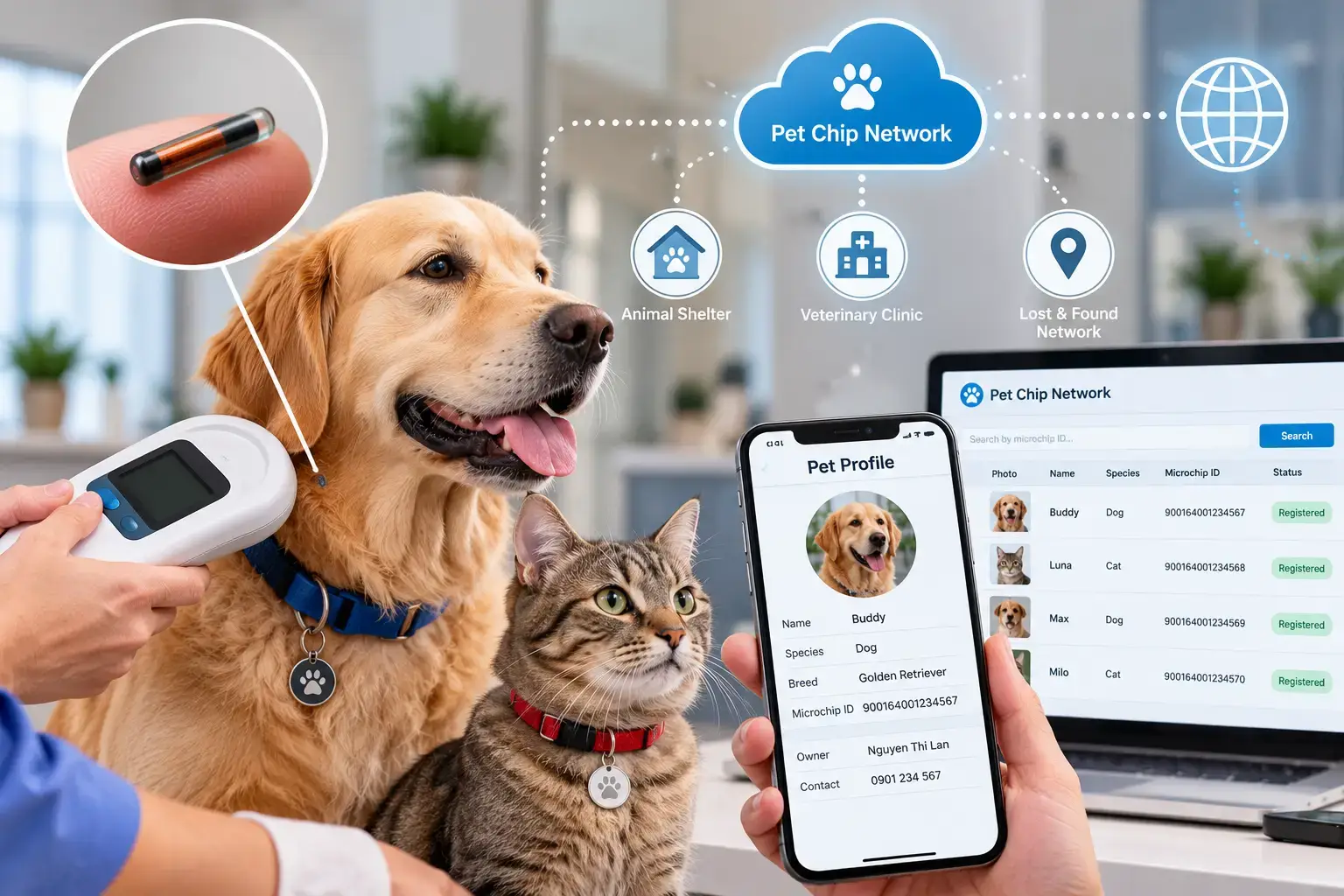
Here’s an uncomfortable truth most pet owners never hear at the vet: the tiny chip under your dog’s skin doesn’t know where your dog is. It doesn’t ping a satellite, it doesn’t call you, and it doesn’t light up on a map. What it does is far quieter and, when everything is set up right, surprisingly powerful. It hands a 9-, 10-, or 15-digit number to whoever scans it, and that number only becomes a phone call to you if it travels through a working pet chip network.
That network is the chain of scanners, registries, and lookup tools that turns an anonymous stray at a shelter into “your Bella, safe and waiting.” When one link breaks, say an outdated phone number or a scanner that can’t read your chip’s format, the whole system goes silent. That’s why understanding the pet chip network matters as much as getting the chip implanted in the first place.
The numbers make the case. According to figures the American Animal Hospital Association cites from a study of more than 7,700 shelter strays, microchipped dogs went home about 52% of the time versus roughly 22% for unchipped dogs. Most failures among chipped pets came down to missing or wrong owner details in the registry, not the chip itself.
In this guide, you’ll get a plain-English tour of how the system works, a comparison of 7 real tools that plug into it (from universal scanners to microchip-keyed doors and a GPS backup), and practical checklists you won’t find on any product page. ⚡
What Is a Pet Chip Network?
A pet chip network is the connected system that links an implanted RFID microchip to its owner: the chip stores a unique ID, a scanner reads it, and a lookup tool such as the AAHA Universal Pet Microchip Lookup points finders to the registry holding the owner’s contact details. No GPS is involved.
Quick Comparison: 7 Tools That Plug Into the Pet Chip Network
Before the deep dives, here’s the at-a-glance view. Some of these products read chips so you can check the network is working; others use your pet’s existing chip as a key around the house; one fills the GPS gap the chip can’t cover.
| Product | Type | What It Reads/Uses | Price Range (at time of writing) | Best For |
|---|---|---|---|---|
| HomeAgain Universal WorldScan Reader Plus | Universal scanner | 125, 128 & 134.2 kHz; ISO, AVID encrypted, Trovan | Around $400–$425 | Rescues and clinics needing every chip format |
| Hero Universal Microchip Scanner | Universal scanner | 9-, 10- & 15-digit chips, Bluetooth | Roughly $180–$300 | Volunteers and breeders who want pro reach for less |
| Halo Microchip Scanner | ISO scanner | 15-digit ISO, 10-digit FDX-A; detects AVID FriendChip | Mid-range (check current price) | Shelters wanting a light, rechargeable reader |
| ISENVO 190A Pet Microchip Scanner | Budget ISO scanner | 15-digit FDX-B/EMID only | Usually under $30 | Owners verifying their own pet’s ISO chip |
| SureFlap Microchip Pet Door | Microchip-keyed door | Pet’s own chip or RFID tag, up to 32 pets | Roughly $150–$250 | Small dogs and large cats who roam outside |
| SureFeed Microchip Pet Feeder | Microchip-keyed feeder | Pet’s own chip or RFID tag, up to 32 pets | Around $150–$180 | Multi-pet homes with diet conflicts |
| Tractive GPS Dog 6 | GPS tracker (complement) | LTE + GPS, subscription | Under $80 + monthly plan | Escape artists who need live location |
Looking at the table, the split is clear: the top four are verification tools, while the SureFlap and SureFeed devices turn your pet’s existing chip into a daily-use key. If you only ever plan to confirm your own pet’s ISO chip reads correctly, the ISENVO 190A Pet Microchip Scanner covers it cheaply, but anyone scanning unknown strays needs the AVID-capable HomeAgain Universal WorldScan Reader Plus or Hero Universal Microchip Scanner. The Tractive GPS Dog 6 sits apart because it answers “where is my dog right now?”, a question no chip can answer.
💬 One click helps other shoppers make an informed choice too! 😊
Top 7 Pet Chip Network Tools: Expert Analysis
Each pick below was chosen from real spec sheets and aggregated buyer feedback, not from hands-on testing. Where review data is thin or comes from outside the US, that’s flagged.
1. HomeAgain Universal WorldScan Reader Plus — the widest chip coverage you can buy
If a stray could carry any chip ever sold in the US, this is the reader built for that worst-case scenario.
The HomeAgain Universal WorldScan Reader Plus reads 125 kHz (encrypted and non-encrypted), 128 kHz, and 134.2 kHz chips, covering FDX-B ISO, HDX ISO, FDX-A, Trovan, and AVID encrypted formats. In practice, that means older pre-ISO American chips, the ones cheaper readers simply miss, still produce a number you can run through the pet chip network. It ships with six rechargeable AAA NiMH batteries, a USB cable, and a test chip keychain, so you can confirm it works before every intake shift.
Based on comparing the specs, this is overkill for a single-pet household and exactly right for rescues, animal control, and transport volunteers. A missed AVID chip is a missed reunion, and this reader is designed to close that gap.
US retail listings show consistently positive sentiment, with buyers often mentioning confidence when traveling with HomeAgain-registered pets; the review pool is small, though, so treat it as supportive rather than conclusive.
Pros:
- ✅ Reads virtually every chip format used in the US
- ✅ Rechargeable batteries cut long-term running costs
- ✅ Bluetooth helps send numbers to a phone or laptop
Cons:
- ❌ The most expensive reader in this lineup by far
- ❌ Small public review base compared with budget scanners
💲 Expect around $400–$425 at the time of writing; worth it only if you scan unknown animals regularly.
2. Hero Universal Microchip Scanner — pro-level reach at a mid-range price
This is the scanner for people who need universal coverage but can’t justify a $400 tool.
The Hero Universal Microchip Scanner from Microchip ID Systems reads ISO chips plus 9-, 10-, and 15-digit chips from any brand, and its Bluetooth can push the chip number to a device up to 25 feet away. That wireless hand-off matters more than it sounds: typing 15 digits on a phone while holding a squirming cat is exactly how lookup typos happen. It runs on a single 9V battery and includes a carrying case and test chip.
What most buyers overlook is the fine print: the manufacturer notes it won’t read the discontinued AKC chips made by Trovan. For nearly every foster home, breeder, or small rescue, that’s an edge case worth knowing rather than a deal-breaker.
Retailer listings describe it as a top-rated scanner among veterinary customers, though that’s manufacturer marketing; independent review volume on major US storefronts is modest.
Pros:
- ✅ Reads ISO and non-ISO chips from all major brands
- ✅ Bluetooth transfer reduces lookup typos dramatically
- ✅ Simple on/off operation with a protective case
Cons:
- ❌ Won’t read discontinued Trovan-made AKC chips
- ❌ 9V battery means buying replacements over time
💲 Typically between $180 and $300 depending on the seller; strong value for semi-professional users.
3. Halo Microchip Scanner — lightweight reader with missing-pet alerts
The Halo’s party trick is software, not hardware: it can warn you when a scanned chip belongs to a pet reported missing.
The Halo Microchip Scanner from Pet Technology Store reads all 15-digit ISO (FDX-B) and 10-digit FDX-A chips, and it will indicate when a 9-digit AVID FriendChip is present. It recharges over USB from a laptop and works with Scanner Angel software, which stores lost-pet chip numbers and flags a match. On paper, that turns a routine scan into an automatic cross-check against a missing-pets list.
Here’s what to weigh: detecting an AVID FriendChip isn’t the same as reading its full number. Shelters in areas with many older AVID-chipped pets should pair the Halo Microchip Scanner with a fully universal reader.
Aggregated listing feedback, much of it from UK and international buyers, is strongly positive about its ergonomics and “reads everything I tested” reliability for ISO chips; US-specific review data is limited.
Pros:
- ✅ Compact, ergonomic design reduces stress for nervous pets
- ✅ USB rechargeable, so no disposable batteries needed
- ✅ Scanner Angel software flags chips of missing pets
Cons:
- ❌ Detects but doesn’t fully read 9-digit AVID chips
- ❌ Software features skew toward UK-based workflows
💲 Usually priced in the mid-range between budget and pro readers; check the current price before buying.
4. ISENVO 190A Pet Microchip Scanner — the cheapest way to verify an ISO chip
Think of this as a smoke detector test button for your own pet’s chip.
The ISENVO 190A Pet Microchip Scanner reads 15-digit FDX-B/EMID chips at 134.2 kHz, has a backlit screen, charges over USB, and auto-powers off after 180 seconds idle. For an owner, the practical value is simple: you can confirm your pet’s chip hasn’t failed or migrated beyond reading range, then type the number into a lookup tool to see whether your registration shows up.
The catch is significant, and it’s printed right in the listing: it cannot read AVID chips or 9-digit IDs. That makes it a poor choice for scanning unknown strays, because a blank result might mean “wrong chip type” rather than “no chip.”
Across budget-scanner listings, buyers praise the price and speed, while the most common complaint is exactly that AVID limitation, usually discovered after purchase.
Pros:
- ✅ Very low price for a functional ISO reader
- ✅ Rechargeable battery with automatic power-off
- ✅ Backlit display is easy to read outdoors
Cons:
- ❌ Cannot read AVID or 9-digit chips at all
- ❌ False negatives possible when scanning unknown animals
💲 Usually under $30 at the time of writing; excellent value strictly for checking your own ISO-chipped pet.
5. SureFlap Microchip Pet Door — your pet’s chip becomes the house key
This door uses the chip already in your pet, so no collar key can fall off in the bushes.
The SureFlap Microchip Pet Door stores up to 32 pets, reads 15-digit FDX-B and 10-digit FDX-A/Trovan chips, and offers a curfew mode that locks and unlocks at set times. It runs on 4 C batteries with up to about 12 months of life and fits small dogs and large cats. In everyday terms, that means no raccoon, neighbor cat, or stray dog strolls into your kitchen at 2 a.m.
Based on the specs, the curfew mode is the underrated feature: locking your pet inside at dusk measurably shrinks the window when they’re most likely to get lost. Owners of medium or large dogs should look elsewhere; the opening is sized for smaller pets.
International reviews, mostly from UK retailers, repeatedly praise its stray-blocking reliability and responsive customer service; a recurring note is that timid pets need a few days to accept the click of the lock.
Pros:
- ✅ Uses existing implanted chips, no collar key required
- ✅ Curfew timer keeps pets home during risky hours
- ✅ Long battery life with low-battery indicator
Cons:
- ❌ Too small for medium and large dogs
- ❌ Locking click can unsettle anxious pets at first
💲 Roughly $150–$250 depending on the version (standard vs Connect); fair value for homes plagued by intruder animals.
6. SureFeed Microchip Pet Feeder — ends food theft in multi-pet homes
If one cat is on a prescription diet and the other eats like a vacuum, this feeder is the referee.
The SureFeed Microchip Pet Feeder opens its sealed lid only for registered pets, stores up to 32 identities, holds a 400 ml bowl for wet or dry food, and runs on 4 C batteries. The sealed lid keeps food fresher and blocks flies, which matters for wet food left out during the workday. A Connect version adds built-in scales and app reporting through a separately sold hub, recording when and how much each pet eats.
What the spec sheet doesn’t say, but reviews reveal: very large or determined pets sometimes reach over the side, and an optional rear cover exists for exactly that problem.
US reviews on Tractor Supply’s listing are strongly positive, with owners highlighting smooth, quiet operation; international feedback adds that nervous cats occasionally reject the lid’s sound.
Pros:
- ✅ Stops food stealing between pets reliably
- ✅ Sealed lid keeps wet food fresh and bug-free
- ✅ Works with implanted chips or included RFID tag
Cons:
- ❌ Hub costs extra for the app-connected version
- ❌ Lid noise can deter very timid pets
💲 Around $150–$180 for the standard model at the time of writing; strong ROI if it prevents diet-related vet visits.
7. Tractive GPS Dog 6 — the live location a chip can never give
A microchip helps someone return your pet; a GPS tracker helps you find them before anyone has to.
The Tractive GPS Dog 6 clips onto a collar and uses a built-in SIM with cellular networks to report location in real time, plus virtual fences and activity and vital-sign monitoring. That subscription model is the trade-off: the device itself is affordable, but you pay monthly for the data that powers unlimited range.
Here’s how it fits the bigger picture. The pet chip network kicks in after a pet reaches a shelter or vet; the Tractive GPS Dog 6 works in the first critical hours, while your dog is still three streets over chasing a squirrel. They’re complements, not substitutes.
US reviews are broadly positive on tracking speed and app usability, while the most common complaint is surprise at the ongoing subscription cost, so budget for it upfront.
Pros:
- ✅ Real-time tracking with no fixed distance limit
- ✅ Virtual fence alerts catch escapes immediately
- ✅ Health and activity data add everyday value
Cons:
- ❌ Requires a paid subscription to function
- ❌ Collar device can be lost, unlike an implant
💲 Device usually under $80, plus a monthly plan; best value when paired with a properly registered chip.
Side-by-Side: How the Top 7 Stack Up
| Product | Reads AVID Chips? | Power | Ongoing Cost | Best For |
|---|---|---|---|---|
| HomeAgain Universal WorldScan Reader Plus | Yes, encrypted | Rechargeable AAA | None | Shelters scanning any stray |
| Hero Universal Microchip Scanner | Yes | 9V battery | Batteries | Fosters and breeders |
| Halo Microchip Scanner | Detects only | USB rechargeable | None | Clinics using alert software |
| ISENVO 190A Pet Microchip Scanner | No | USB rechargeable | None | Checking your own ISO chip |
| SureFlap Microchip Pet Door | n/a (uses your pet’s chip) | 4 C batteries | Batteries | Outdoor cats, small dogs |
| SureFeed Microchip Pet Feeder | n/a (uses your pet’s chip) | 4 C batteries | Batteries, optional hub | Diet-managed multi-pet homes |
| Tractive GPS Dog 6 | n/a (GPS) | Rechargeable | Monthly subscription | Dogs prone to bolting |
The “Reads AVID” column is the one that matters most for scanner buyers: only the HomeAgain Universal WorldScan Reader Plus and Hero Universal Microchip Scanner reliably return a full number from older AVID chips. Meanwhile, ongoing cost separates the Tractive GPS Dog 6 from everything else, since its usefulness depends on a subscription. For most households, the smartest combination is a registered chip plus one convenience device, with a scanner only if you foster or rescue.
✨ Don’t miss these smart picks for your pet’s safety net!
🔍 Take your pet chip network setup to the next level with this carefully curated lineup. Click a highlighted item to check current pricing and availability. These picks will help you keep every furry family member safer, calmer, and easier to bring home! 🐾
How to Get Your Pet Fully Connected to the Pet Chip Network (Step-by-Step)
A chip that isn’t registered is a phone number with no phone attached. The AVMA’s Check the Chip Day reminder exists precisely because so many chipped pets are missing current contact details. Here’s a 30-minute setup that closes every gap. 🐶
- Find your chip number. Check adoption papers or vet records, or ask your vet to scan at the next visit. If you own a reader like the ISENVO 190A Pet Microchip Scanner, scan between the shoulder blades in slow S-shaped passes.
- Run it through a universal pet microchip lookup. Enter the number without spaces. The tool won’t show your personal data; it lists which registries hold a record for that chip, newest first.
- Update every listed registry. If two registries appear, update both. Stale secondary records are a classic source of confusion when a shelter calls.
- Add a backup contact. A friend or relative who answers unknown numbers can save hours if you’re traveling.
- Set a calendar reminder. Re-check after every move, phone change, or rehoming, and at least once a year. August 15, National Check the Chip Day, is an easy anchor.
- Ask for a scan at annual checkups. Chips rarely fail, but migration happens. A 10-second scan confirms the chip still reads where shelters expect it.
Common first-30-days mistakes: assuming the vet or breeder registered the chip for you, registering under an old email, and forgetting that the pet chip network needs your details, not the clinic’s.
Real-World Scenarios: Matching the Right Tools to Your Household
Not every home needs every gadget. Here are three common profiles and the reasoning behind each pairing.
🏡 The Suburban Two-Cat Household
Budget: around $200–$350. Use: daily. One indoor-outdoor cat, one strictly indoor, and a neighborhood tomcat who keeps sneaking in. The fix is a microchip pet door or cat flap set to curfew, so the outdoor cat is home by dusk and intruders stay out. Add the SureFeed Microchip Pet Feeder only if one cat is on a special diet. Registration updates cost nothing and should come first.
🐕 The Escape-Artist Terrier in an Apartment
Budget: under $150 upfront plus a monthly plan. Use: every walk. Small dogs slip harnesses at door thresholds. Here the Tractive GPS Dog 6 earns its subscription by catching the first hour of an escape, while a verified chip registration handles the “found by a stranger” scenario. A microchip pet door adds little in an apartment.
🐾 The Weekend Foster Volunteer
Budget: $180–$425. Use: several scans per month. Fosters regularly handle animals with unknown histories, including older AVID-chipped strays. The Hero Universal Microchip Scanner balances cost and coverage, while active rescues processing many intakes may justify the HomeAgain Universal WorldScan Reader Plus. A budget ISO-only reader is a false economy here, because a missed chip can send a lost pet into adoption instead of home.
Problem → Solution: Fixing the 5 Most Common Pet Chip Network Failures
Most reunions fail for boring, fixable reasons. Here’s how to troubleshoot them.
❌ Problem 1: The lookup shows no registry. ✅ Solution: The chip was likely never registered. Contact the chip’s manufacturer or distributor (the lookup often defaults to them) and register immediately.
❌ Problem 2: The shelter scanned but “found no chip.” ✅ Solution: Ask what scanner they used. ISO-only readers can miss older AVID chips; a universal reader like the HomeAgain Universal WorldScan Reader Plus reads 125, 128, and 134.2 kHz.
❌ Problem 3: The registry has your old phone number. ✅ Solution: Log in and update it today, then repeat for every registry the lookup lists.
❌ Problem 4: Your microchip pet door won’t recognize your pet. ✅ Solution: Re-run learn mode and keep the reading area clean. If the chip sits far from the neck, use the included RFID collar tag as a backup key.
❌ Problem 5: Numbers starting with 900 lead nowhere. ✅ Solution: These chips may not trace to one provider. Register yours with a participating registry so the lookup can find it.
How to Choose the Right Pet Chip Network Tools
The right setup depends on whether you’re protecting your own pet or identifying other people’s. Use these seven criteria in order.
- Start with registration, not hardware. The AAHA’s microchipping overview notes implantation typically runs $25–$50; registering it is what makes that spend pay off.
- Match chip formats. A microchip scanner for pets should read ISO 134.2 kHz at minimum; add 125 kHz AVID support if you’ll scan strays.
- Check digit support. 9-, 10-, and 15-digit coverage prevents the dreaded false “no chip” result.
- Weigh data transfer. Bluetooth, as on the Hero Universal Microchip Scanner, eliminates transcription errors at lookup time.
- Consider power. Rechargeable readers save money; battery-powered doors need a spare set of C cells on hand.
- Size convenience devices correctly. Measure your pet’s shoulder width before buying a microchip pet door.
- Count recurring costs. GPS trackers need subscriptions; chips and scanners don’t.
Pet Chip Network vs GPS Trackers vs Traditional ID Tags
These three tools answer different questions, which is why the smartest owners use at least two.
| Factor | Registered Microchip | GPS Tracker | Collar ID Tag |
|---|---|---|---|
| Can it fall off? | No (implanted) | Yes | Yes |
| Shows live location? | No | Yes | No |
| Ongoing cost | Usually none | Monthly plan | None |
| Who uses it to reunite you? | Vets and shelters | You | Any finder |
| Best for | Permanent proof of ID | First hours after escape | Fastest neighbor callback |
The table shows why the pet chip network is the backbone rather than the whole plan: it’s the only option that can’t be lost, but it only activates once someone scans your pet. A collar tag gets you the quickest phone call from a kind neighbor, and a tracker like the Tractive GPS Dog 6 shortens the search itself. Combine all three if your pet has a history of escaping.
Common Mistakes to Avoid With Your Pet Microchip Registry
Even careful owners trip over these.
- Assuming registration is automatic. Some vets register chips; many don’t. Verify through a lookup yourself.
- Updating one registry and forgetting others. A single chip can sit in several databases. A pet microchip registry with your old number is a dead end.
- Buying an ISO-only reader for rescue work. The ISENVO 190A Pet Microchip Scanner is great for owners, but it can’t read AVID chips.
- Relying on the chip alone. It’s not a tracker; it’s a return ticket.
- Ignoring paid-tier upsells blindly. Basic registration is often free; read what any paid plan actually adds before paying.
Safety, Regulations, and Standards
Most US pet chips follow ISO 11784 and ISO 11785, the international standards defining the 15-digit code structure and 134.2 kHz transmission. Older US chips, notably some AVID and HomeAgain models, use 125 kHz or 128 kHz, which is why universal readers matter. If you travel internationally, many destinations require an ISO-compliant chip, so check before you book.
For powered gadgets, look for FCC compliance on wireless devices like Bluetooth scanners and app-connected doors, and keep batteries away from chewers. Microchip doors and feeders should be installed so children can’t trap fingers or paws; Sure Petcare’s manuals specifically call out childproofing. Implantation itself is a routine veterinary procedure that doesn’t require anesthesia.
Long-Term Cost and Maintenance
A registered chip is the cheapest long-term protection you’ll buy: a one-time fee of roughly $25–$50, often with free basic registration. Scanners range from under $30 to over $400 and need little upkeep beyond charging. The SureFlap Microchip Pet Door and SureFeed Microchip Pet Feeder each run on 4 C batteries, which owners report last from about 6 to 12 months; cleaning fur from the door’s flap noticeably helps battery life, according to buyer feedback. GPS is the only real recurring expense, so total cost of ownership for a tracker over three years can exceed the price of every other item here combined.
Features That Actually Matter (and Ones That Don’t)
Matter: AVID compatibility for strays, Bluetooth transfer, curfew modes, sealed feeder lids, and reliable battery indicators. Don’t matter much: colored housings, LED “ears,” and storage of hundreds of scans for a single-pet owner. If a feature doesn’t reduce lost time, typos, or stress, it’s decoration.
FAQ: Pet Chip Network Questions Buyers Ask Most
❓ Do I have to pay to register my pet's microchip?
❓ Can my phone scan my pet's microchip?
❓ Where can I get my pet's chip scanned for free?
❓ Which microchip pet door works for small dogs?
❓ Is a cheap microchip scanner for pets worth buying?
Conclusion: Make Your Pet Chip Network Actually Work
The pet chip network is a quiet hero. It doesn’t buzz, track, or send notifications, but it’s the one form of ID your pet can’t lose, chew off, or slip out of. Its weakness is entirely human: an unregistered chip, a stale phone number, or a scanner that can’t read an older format.
So here’s the priority order. First, look up your pet’s chip number and update every registry that shows up; that costs nothing and fixes the most common failure. Second, if you foster or rescue, invest in a truly universal reader such as the Hero Universal Microchip Scanner or the HomeAgain Universal WorldScan Reader Plus, while owners who just want peace of mind can verify an ISO chip with the ISENVO 190A Pet Microchip Scanner. Third, put that chip to work at home with the SureFlap Microchip Pet Door or SureFeed Microchip Pet Feeder if intruders or food theft are daily headaches. Finally, if your dog treats open doors as an invitation, add the Tractive GPS Dog 6 for live location during those critical first hours.
Do those steps, and the next time a stranger scans your pet, the call that follows will be to you. 🐾
🚀 Ready to close the gaps in your pet’s safety net?
🛒 Click any highlighted product above to check current pricing and availability. Pair the right tool with a fully updated registration, and you’ll give your best friend the fastest possible route back home!
Recommended for You
- Inside Electric Fence for Dogs: 7 Best Smart Picks for 2026
- Inside Electric Fence for Dogs: 7 Best Picks That Actually Work (2026)
- Indoor Invisible Dog Fence: 7 Best Picks That Actually Work (2026)
Disclaimer: This post contains affiliate links. As an Amazon Associate, I earn from qualifying purchases made through these links, at no additional cost to you.
✨ Found this article helpful? Share it with someone who needs it! 💬🤗