
In This Article
Why a Small Dog Shock Collar With Remote Plays by Different Rules
Picture a 9-pound Yorkie wearing a receiver built for a 70-pound Lab. It’s like strapping a car battery to a housecat. That mismatch is exactly why shopping for a small dog shock collar with remote is its own discipline—not a scaled-down version of buying one for a big dog. The right small dog shock collar with remote is lighter, gentler at the low end, and designed around narrow necks where contact points sit close together.
Here’s the honest framing up front: remote training collars are controversial. Veterinary behavior organizations recommend reward-based training first, and some countries restrict static collars outright. So this guide does two jobs. It compares seven real models available on amazon.com, using manufacturer spec sheets and real aggregated feedback, and it shows you how to use any of them in the least aversive way possible—often with tone or vibration instead of static at all.
What Is a small dog shock collar with remote?
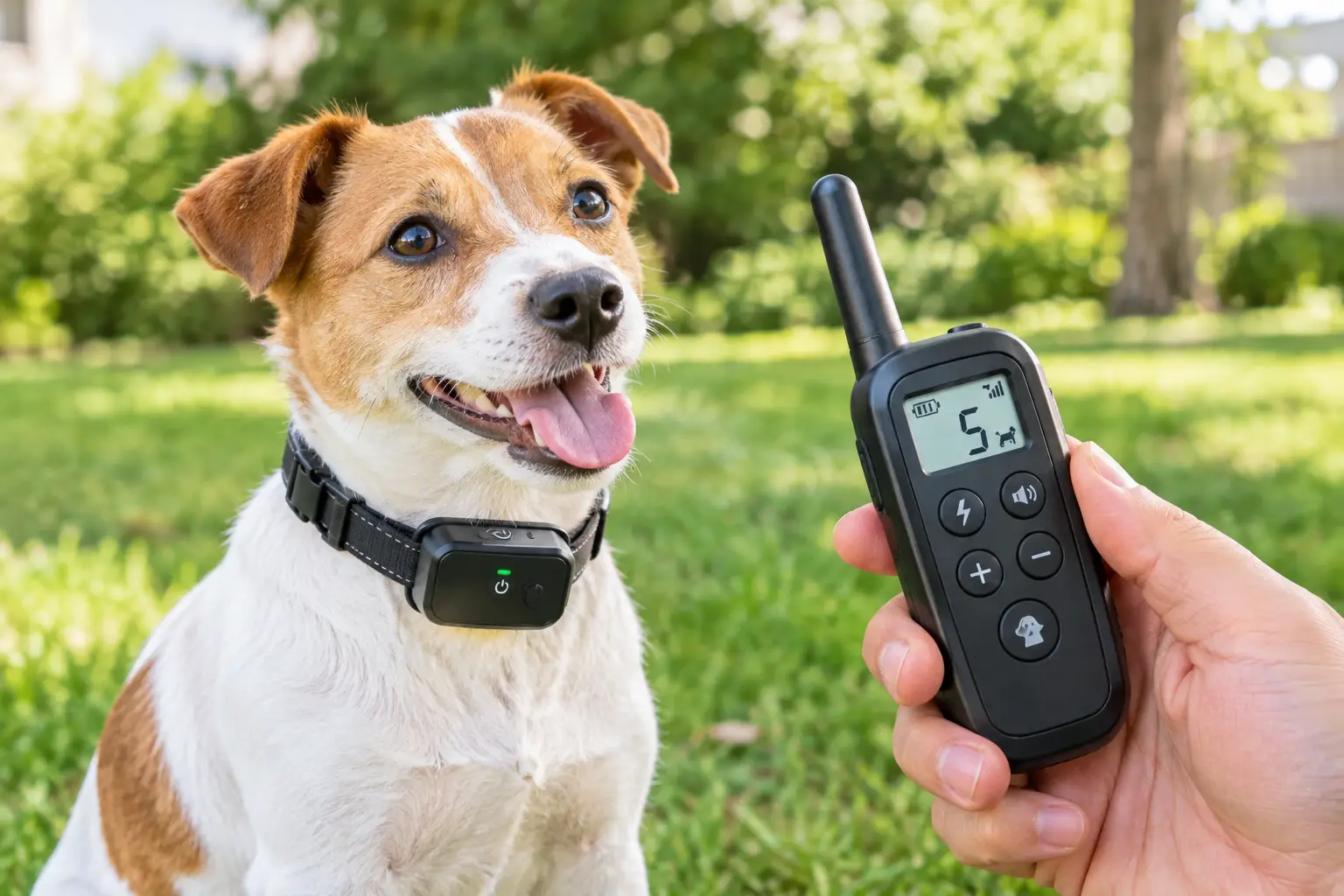
A small dog shock collar with remote is a two-part training system: a handheld transmitter and a lightweight collar receiver sized for dogs roughly 5–20 pounds. At the press of a button, the receiver delivers a tone, a vibration, or low-level static stimulation, letting you mark or interrupt behavior from a distance.
The broader history and debate around these devices is well summarized in Wikipedia’s overview of the shock collar, which covers how the technology evolved and where it’s regulated. Below, you’ll find a quick comparison table, seven detailed product breakdowns, a 30-day starter plan, real-world buyer scenarios, and a frank look at safety and cost. Let’s get into it.
Quick Comparison: The 7 Best Collars for Small Dogs at a Glance
| Product | Min. Dog Weight | Range | Stimulation | Tone / Vibration | Best for |
|---|---|---|---|---|---|
| Educator ME-300 Micro | 5 lbs | ~1/3 mile | 100 levels + boost | Both | Educator ME-300 Micro: toy breeds, soft temperaments |
| Dogtra iQ Mini | 7 lbs | 400 yards | 100 levels (low–medium) | Pager vibration | Dogtra iQ Mini: lightest receiver, backyard obedience |
| Educator ET-300 Mini | 5 lbs | 1/2 mile | 100 levels + boost | Both | Educator ET-300 Mini: households with a small and a larger dog |
| Dogtra 280X | 10 lbs | 1/2 mile | 100 levels + boost | Both | Dogtra 280X: feature-rich training for terriers and doodles |
| PetSafe 300 Yard Lite | 8 lbs | 300 yards | 15 levels | Both | PetSafe 300 Yard Lite: simple, beginner-friendly setup |
| Bousnic 3300Ft Dog Shock Collar | 5 lbs | 3,300 ft | 99 levels | Both | Bousnic 3300Ft Dog Shock Collar: tight budgets |
| Bousnic No-Shock Training Collar | 5 lbs | 1,000 ft | None (no static) | Both | Bousnic No-Shock Training Collar: owners who want zero static |
Reading the table, the two Educator models and the Dogtra iQ Mini stand out because they’re genuinely engineered for small necks rather than marketed as “one size fits all.” The Bousnic 3300Ft Dog Shock Collar wins on range per dollar, but a single receiver rated for 5 to 120 pounds tells you it isn’t purpose-built for a Chihuahua. If you’re undecided about static altogether, the Bousnic No-Shock Training Collar is the lowest-risk entry point.
💬 One click helps other small-dog parents make a smarter choice too! 😊
Top 7 Small Dog Shock Collars With Remote: Expert Analysis
1. Educator ME-300 Micro — purpose-built for the tiniest necks
This is the collar that answers the question, “What if the receiver were actually designed for a 6-pound dog?” The Educator ME-300 Micro pairs E-Collar Technologies’ popular Mini transmitter with the RX-070 Micro receiver, which the company describes as roughly 20% smaller, 20% lighter, and 20% lower in stimulation output than the standard Mini receiver.
What that means in practice: less bulk bouncing on a Pomeranian’s throat and a lower ceiling on intensity, which protects you from over-correcting. The contact points sit about 20% closer together, and the receiver can rotate 90 degrees on the strap for a front-to-back position—genuinely useful on necks too narrow for side-to-side placement. You still get 100 levels, tone, a vibration (“tapping”) mode, and a lock-and-set feature that stops accidental level jumps.
Based on comparing the specs, this is the pick for toy breeds and sensitive dogs whose working level is likely to sit very low anyway. The trade-off is range: Educator lists it at about 1/3 mile, which is plenty for yards and parks but not for open fields.
Retailer and trainer listings consistently describe it as a small-dog-first design, though we couldn’t verify a large pool of independent owner reviews specific to the Micro version, so weigh that accordingly.
Pros:
- ✅ Smallest, lightest Educator receiver for tiny breeds
- ✅ Rotatable receiver fits very narrow necks
- ✅ Lock-and-set prevents accidental level changes
Cons:
- ❌ Shorter range than the ET-300 Mini
- ❌ Fewer remote skin color options than the Mini
Expect it in the $200 range (check the current price); for toy breeds, it’s the best value for fit and safety margin.
2. Dogtra iQ Mini — the lightest receiver on this list
If ounces matter to you—and with a 7-pound dog, they should—the Dogtra iQ Mini is hard to beat. Dogtra lists the receiver at just 1.3 ounces and rates it for dogs as small as 7 pounds.
The standout feature is the conductive plastic contact points paired with a curved rear plate. On paper, that means a smoother surface against the skin and better contact on rounded little necks without long metal prongs digging in. The 0–100 level rheostat dial delivers low-to-medium output, so the top of the range is still modest. You also get Nick (momentary), Constant, and Dogtra’s Pager vibration, and the receiver carries an IPX9K water-resistance rating, meaning it survived high-pressure, high-temperature jet testing.
Who’s it for? Owners focused on basic obedience at home and in the park who want a quality brand without paying for half-mile range they’ll never use. At 400 yards, it covers any suburban backyard with room to spare. One practical note: the transmitter is water-resistant rather than fully waterproof, so don’t drop it in a lake.
We found limited independent review volume for this specific model; what’s verifiable is that Dogtra and multiple dealers position it squarely for small breeds, and it’s expandable to two dogs.
Pros:
- ✅ Ultra-light 1.3 oz receiver for small dogs
- ✅ Smooth plastic contact points reduce skin pressure
- ✅ Heavy-duty IPX9K-rated receiver
Cons:
- ❌ Remote is only water-resistant, not waterproof
- ❌ No dedicated tone button listed in specs
Typically priced between $130 and $170 at the time of writing, it’s a strong mid-range value.
3. Educator ET-300 Mini — the versatile trainer’s favorite
The Educator ET-300 Mini is arguably the most widely recommended remote collar among professional trainers, and it earns a spot here because it scales down well. It’s rated for dogs from 5 pounds up with a receiver commonly listed around 2.4 ounces.
Features that matter: 100 levels of what Educator calls “blunt” stimulation, a separate boost (1–60) for high-distraction moments, vibration and tone-only modes, and a floating, waterproof stopwatch-style remote. The half-mile range and two-hour LiPo charge make it practical for beaches and trails. What most buyers overlook is the value of the stopwatch design: you can operate it by feel without looking down, which improves timing—the single biggest factor in whether any remote training works.
Here’s what to weigh: the ME-300 Micro is better for truly tiny dogs, while the ET-300 Mini makes more sense if your small dog is 12–20 pounds or you plan to add a larger second dog later (it’s expandable to two).
Verified-buyer reviews on Educator’s review pages frequently praise long-term durability and customer service, while a recurring complaint is that the button layout takes time to learn. A minority of reviewers on other retailers report behavioral fallout—a reminder that technique matters more than hardware.
Pros:
- ✅ Half-mile range with a floating remote
- ✅ Vibration and tone modes reduce static use
- ✅ Grows with multi-dog households
Cons:
- ❌ Receiver is bulkier than the Micro version
- ❌ Learning curve on button functions
In the $200 range (check current pricing), it’s the best long-term value for small-to-medium dogs.
4. Dogtra 280X — the most feature-packed small-dog system
The Dogtra 280X replaces the long-running 280C and targets the terrier-sized crowd: Jack Russells, Dachshunds, Shih Tzus, and small doodles from 10 pounds up.
Its feature set reads like a pro-grade unit shrunk down. You get 100 levels via a rheostat dial, BOOST for recall emergencies, tone, Dogtra’s “XPP” pager vibration, and a remote-activated 1000-lux LED on the receiver. That light isn’t a gimmick: it makes a dark-coated dog visible on evening walks. A level lock prevents accidental changes, and the system is waterproof and described as drop-proof. All X-Series receivers are cross-compatible, so you can pair a 280X receiver and a larger 1900X receiver on one remote if you also own a big dog.
Based on comparing specs, the Dogtra 280X is for owners who want room to grow—more modes, more expansion (up to three dogs), and US-based phone support. It’s overkill for a 6-pound Maltese, and its 10-pound minimum rules out true toy breeds.
Owner feedback on Dogtra’s own product pages highlights narrow straps, light receivers, and the convenience of one remote for two dogs. Beyond those listings, we couldn’t verify a large independent review set for the newer X version.
Pros:
- ✅ Built-in LED light for low-light visibility
- ✅ Expandable to three dogs with cross-compatibility
- ✅ Dedicated buttons for tone, vibration, and boost
Cons:
- ❌ Not suitable for dogs under 10 pounds
- ❌ Priciest option in this lineup
Dealers list it around $235 (check the current price); it’s premium, but justified for multi-dog homes.
5. PetSafe 300 Yard Lite — easiest learning curve for beginners
The PetSafe 300 Yard Lite (model PDT00-16024) is the “just make it simple” choice. PetSafe designed the Lite series specifically for smaller or sensitive dogs, with gentler static than its standard trainers.
The spec sheet lists a 1.4-ounce receiver on a slim 0.59-inch strap, fitting dogs 8 pounds and up with necks from 6 to 23 inches. You get tone, vibration, and 15 static levels, with levels 8–15 locked by default. That lock is quietly brilliant for first-timers: the dangerous end of the range simply isn’t reachable by accident. Both the remote and collar are waterproof, charge in about two hours, and last up to 40 hours per charge.
Who should buy it? First-time owners working in a backyard who value clarity over granularity. The trade-off is precision: 15 levels means bigger jumps between steps than a 100-level dial, which makes finding a truly minimal working level harder. PetSafe also states it isn’t for puppies under six months—a rule that applies to every collar on this list, frankly.
We couldn’t verify a robust pool of owner reviews for the Lite version specifically; what’s verifiable is PetSafe’s published safety lock, fit range, and battery specs.
Pros:
- ✅ Safety lock on higher static levels
- ✅ Slim, lightweight receiver and narrow strap
- ✅ Very straightforward remote layout
Cons:
- ❌ Only 15 levels, so coarser adjustments
- ❌ Shorter 300-yard range than premium rivals
Usually found between $80 and $120 (prices may vary), it’s solid value for simple backyard training.
6. Bousnic 3300Ft Dog Shock Collar — maximum range per dollar
The Bousnic 3300Ft Dog Shock Collar is the budget brand you’ll see at the top of many Amazon searches, and it packs impressive numbers for the price.
Specs from the listing: beep (1–8), vibration (1–16), and static (1–99) levels, a claimed 3,300-foot range, an IP67 waterproof receiver, dual-channel control for two dogs, and a strap adjustable up to 24 inches that you can trim. Bousnic claims the receiver lasts up to 15 days per charge, the remote over a month. There’s also an on/off security switch on the remote so it doesn’t fire in your pocket.
Here’s the honest analysis: the same receiver is marketed for dogs from 5 to 120 pounds. That tells you it isn’t sized or output-tuned for small breeds the way the Educator Micro or Dogtra iQ Mini is. With a toy breed, you’d be operating at the very bottom of a range designed for large dogs—workable, but with less margin for error. Bousnic’s own listing advises starting at level 1 and treating shock as a last resort.
We couldn’t independently verify aggregated review themes beyond the listing itself, so treat long-term durability as unproven compared with Educator and Dogtra.
Pros:
- ✅ Very affordable entry into remote training
- ✅ Long claimed battery life between charges
- ✅ Two-dog control on a single remote
Cons:
- ❌ Receiver not purpose-sized for toy breeds
- ❌ Unproven durability versus established brands
Typically under $60 (check the current price), it’s good value if your small dog is on the sturdier side.
7. Bousnic No-Shock Training Collar — zero static, all communication
Sometimes the best shock collar for small dogs is one that doesn’t shock at all. The Bousnic No-Shock Training Collar is sized for dogs 5 to 20 pounds and offers only beep and vibration.
Why include it? Because many small dogs respond perfectly well to a vibration cue once it’s paired with a reward, and it removes the biggest welfare risk from the equation. The listing cites a 1,000-foot range, a waterproof rechargeable receiver lasting roughly 11–15 days, and a remote that runs over a month. For apartment dwellers dealing with door-dashing or leash-reactive barking, that range is more than enough.
Based on the specs, this suits owners who want a remote “tap on the shoulder” rather than a correction—and it’s also a smart first purchase if you’re unsure whether you need static at all. If vibration works (and for many small dogs it does), you’ve saved money and avoided risk. If it doesn’t, the answer is usually better reward timing or a professional trainer, not more intensity.
Independent review data we could verify is limited; the product’s appeal rests mainly on its narrow 5–20 lb sizing and no-static design.
Pros:
- ✅ No static stimulation, lowest welfare risk
- ✅ Sized specifically for 5–20 lb dogs
- ✅ Long battery life between charges
Cons:
- ❌ Some dogs habituate to vibration quickly
- ❌ Shorter range than the static Bousnic model
Roughly $30–$50 at the time of writing, it’s the best-value starting point for cautious owners.
Side-by-Side: How the Top 7 Compare on What Matters
| Product | Receiver design | Waterproofing | Multi-dog | Price range | Best for |
|---|---|---|---|---|---|
| Educator ME-300 Micro | Micro receiver, rotatable | Waterproof | Up to 2 | ~$200 | Educator ME-300 Micro: dogs 5–10 lbs |
| Dogtra iQ Mini | 1.3 oz, plastic contacts | IPX9K receiver | Up to 2 | $130–$170 | Dogtra iQ Mini: lightest wear |
| Educator ET-300 Mini | ~2.4 oz standard mini | Waterproof, floating remote | Up to 2 | ~$200 | Educator ET-300 Mini: 12–20 lb dogs |
| Dogtra 280X | Ultra-compact + LED | Waterproof | Up to 3 | ~$235 | Dogtra 280X: multi-dog homes |
| PetSafe 300 Yard Lite | 1.4 oz, slim strap | Waterproof | Up to 2 | $80–$120 | PetSafe 300 Yard Lite: beginners |
| Bousnic 3300Ft Dog Shock Collar | Universal 5–120 lb | IP67 receiver | 2 | Under $60 | Bousnic 3300Ft Dog Shock Collar: budgets |
| Bousnic No-Shock Training Collar | Sized 5–20 lb | Waterproof | 1 | $30–$50 | Bousnic No-Shock Training Collar: no-static training |
The pattern is clear: you pay more for receivers genuinely engineered for small necks and for finer control at the bottom of the range. The Dogtra iQ Mini delivers the best weight-to-price ratio, while the Educator ME-300 Micro offers the most fitting flexibility for toy breeds. Budget models save money up front but shift more responsibility onto you to stay at very low levels.
✨ Found your match? Take the next step today!
🔍 Give your little one clearer communication with one of these carefully vetted picks. Click a highlighted product to check current pricing and availability—and start with vibration before anything else. 🐾
Your First 30 Days: A Practical Getting-Started Guide
Owning a small dog training collar doesn’t train your dog—your timing and rewards do. Here’s a week-by-week plan that keeps stress low.
Week 1: Collar conditioning without any stimulation
Put the receiver on (powered off) for short sessions during fun activities—meals, play, walks. The goal is a neutral or positive association. Check fit: snug enough that the contact points touch skin, loose enough to slide one finger under the strap.
Week 2: Find the lowest working level
Start with tone or vibration. If you plan to use static, begin at level 0 and raise one step at a time in a quiet room until you see a tiny sign of perception—an ear flick, a head turn. That’s the working level. For many small dogs on 100-level dials, it’s surprisingly low.
Week 3: Pair the cue with rewards
Use the vibration (or low-level tap) as a “check in with me” signal, then immediately reward when your dog looks at you. You’re building a positive meaning, not a punishment.
Week 4: Add distance and distraction gradually
Practice recall on a long line in a fenced area before any off-leash work.
⚡ Common first-month mistakes: leaving the collar on 24/7, using static to “fix” fear-based barking, and skipping the long line. Most manufacturers advise repositioning the receiver every one to two hours and removing it overnight to prevent pressure sores.
Real-World Scenarios: Matching Small Dogs to the Right Collar
Specs only matter when they meet real life. Here are three common profiles.
🐕 Profile 1: The 6-lb Chihuahua who bolts out the front door
Owner context: apartment in a city, budget around $50, daily use at the doorway and on walks. Best match: the Bousnic No-Shock Training Collar. A doorway problem happens at close range, and a vibration cue paired with a “sit-stay-treat” routine usually addresses it without static. If budget grows, the Educator ME-300 Micro offers precise control at a size that suits a tiny neck.
🐕 Profile 2: The 14-lb Jack Russell with selective hearing at the park
Owner context: suburban home, budget around $200, training four to five times a week. Best match: the Educator ET-300 Mini. Half-mile range, a boost for high-distraction moments, and a remote you can use without looking down. Terriers can be driven and distractible, so fine-grained control near the low end is worth paying for.
🐕 Profile 3: A two-dog home—a 10-lb Shih Tzu and a 60-lb Lab
Owner context: rural property, budget up to $350, frequent outdoor time. Best match: the Dogtra 280X. X-Series cross-compatibility means you can pair the small 280X receiver for the Shih Tzu with a larger X-Series receiver for the Lab on one remote. The LED light helps at dusk, too.
The takeaway? Buy for your smallest dog’s neck and your most common training situation—not for the biggest range on the box.
Problem → Solution: Fixing the Most Common Small-Dog Collar Issues
❌ Problem: The collar “doesn’t work.” ✅ Solution: Almost always a fit issue. Small, fluffy dogs (Poms, Shih Tzus) need contact points that reach skin. Educator and Dogtra include or sell longer points; tighten the strap slightly rather than cranking up the level.
❌ Problem: Red spots or sores on the neck. ✅ Solution: This is pressure irritation, not an electrical burn. Remove the collar, reposition it every one to two hours, limit daily wear, and clean the skin and points. Smooth plastic contacts, like those on the Dogtra iQ Mini, can help sensitive dogs.
❌ Problem: Your dog becomes “collar-wise.” ✅ Solution: If your dog behaves only when wearing the receiver, you’ve taught the collar, not the cue. Do the Week 1 conditioning again and let your dog wear it during plenty of pleasant, stimulation-free time.
❌ Problem: Fear, trembling, or hiding after use. ✅ Solution: Stop static immediately. Switch to vibration or no device, and consult a veterinary behaviorist or certified trainer. Fear in small dogs can escalate into defensive biting.
❌ Problem: The remote fires by accident. ✅ Solution: Use lock features (ET-300 lock-and-set, PetSafe’s locked upper levels, Bousnic’s on/off switch) and carry the remote on a lanyard.
How to Choose an E-Collar for Small Dogs
Choosing an e-collar for small dogs comes down to fit and control more than features. Follow these steps:
- Check the minimum dog weight first. A receiver rated for 5–7 lbs is built differently than one sized for 10 lbs—never go below the manufacturer’s rating.
- Compare receiver weight and size. For dogs under 10 lbs, every ounce matters; 1.3–1.4 oz receivers sit far more comfortably.
- Prioritize fine low-end control. A 100-level dial lets you find a barely perceptible level; 15 levels means bigger jumps.
- Insist on tone and vibration modes. These let you train without static most of the time.
- Look for a level lock. Accidental jumps to high levels are a real risk with pocketed remotes.
- Match range to reality. Most small-dog training happens within 100 yards; don’t pay for a mile you won’t use.
- Verify water resistance. Learn what the IP rating system actually means—IP67 and IPX9K describe different kinds of protection.
Choosing this way keeps you focused on your dog’s comfort rather than on marketing numbers.
Remote Training Collar for Small Breeds vs. Reward-Only Training
Is a remote training collar for small breeds actually better than training without one? The research says: not consistently. A 2014 University of Lincoln study published in PLOS ONE compared dogs trained for recall problems with e-collars against dogs trained with reward-based methods. Owners in all groups reported similar improvement, but the researchers found greater welfare concerns in the e-collar group, and e-collar owners were less confident applying the method themselves.
That doesn’t erase the reasons people buy these tools—off-leash distance, immediate interruption of dangerous behavior—but it reframes the purchase. A remote device is a communication tool at best, not a shortcut.
| Approach | Main advantage | Main drawback | Best for |
|---|---|---|---|
| Static remote collar | Instant cue at distance | Welfare risk if misused | Experienced handlers, specific safety cases (e.g., Educator ME-300 Micro) |
| Vibration-only collar | Distance cue, lower risk | Some dogs ignore it | Most small dogs (e.g., Bousnic No-Shock Training Collar) |
| Reward training + long line | Strongest evidence base | Takes more time | Every dog, every owner |
| Leash corrections | No equipment cost | Neck strain, risky for tiny tracheas | Not recommended for toy breeds |
The comparison shows why vibration plus rewards is the sweet spot for most small dogs: you keep the distance benefit while dropping most of the risk. Leash corrections, by contrast, are especially problematic for breeds prone to tracheal collapse. Static belongs at the end of the list, not the start.
Features That Actually Matter (and Ones That Don’t)
Marketing for small dog shock collars loves big numbers. Here’s how to cut through them.
✅ Features that matter
- Low minimum output: The Micro receiver’s reduced output and the iQ Mini’s low-to-medium range protect small dogs from accidental over-stimulation.
- Receiver weight and contact design: Lighter receivers and closer-set or smooth contacts improve comfort on narrow necks.
- Tone and vibration as separate buttons: They make non-static communication easy and quick.
- Lock features: They turn a mistake into a non-event.
❌ Features that mostly don’t
- Huge advertised range: 3,300 feet sounds great, but small dogs rarely work that far away, and real range drops with trees and buildings.
- “99 levels” on budget units: More levels help only if the lowest level is truly low for a small dog.
- Flashy colors and bundles: Nice, but they don’t change training outcomes.
What most buyers overlook is the remote’s ergonomics. A remote you can operate without looking down improves timing, which affects results more than any spec on the box.
Safety, Regulations, and Standards
Safety starts with honest expectations. The American Veterinary Society of Animal Behavior’s position statement on humane dog training recommends reward-based methods for all dog training and advises against aversive tools, including electronic collars. If you choose to use one anyway, these practices reduce harm:
- 🔋 Never use on puppies under 6 months, sick, or elderly dogs, and never on dogs with fear or aggression issues without professional guidance.
- ⏱️ Limit wear time. Reposition the receiver every one to two hours and remove it overnight.
- 🎯 Stay at the lowest perceptible level. If you keep needing higher levels, the training plan—not the dog—is the problem.
- 🔌 Charge safely. Use the supplied cable or a reputable USB adapter and avoid charging damaged lithium batteries.
US and international rules
In the United States, remote training collars are legal to buy and use, and their radio transmitters fall under FCC rules for low-power devices. Outside the US, the picture differs: Wales banned static collars in 2010, and England’s ban took effect in 2024. If you travel with your dog, check local laws before packing one.
The simplest safety rule of all: if your dog shows fear, stop and get professional help.
Long-Term Cost and Maintenance
The sticker price is only part of what you’ll spend on a small dog training collar over its lifetime.
| Product | Upfront cost | Ongoing costs | Longevity signals | Best for |
|---|---|---|---|---|
| Educator ME-300 Micro | ~$200 | Replacement straps, batteries eventually | Established US maker, replacement parts sold | Educator ME-300 Micro: long-term toy-breed use |
| Educator ET-300 Mini | ~$200 | Batteries, contact points | Owners report multi-year use | Educator ET-300 Mini: multi-year value |
| Dogtra iQ Mini | $130–$170 | Replacement batteries (BP37T/BP37Y) | Dogtra support, known battery part numbers | Dogtra iQ Mini: mid-budget buyers |
| Bousnic 3300Ft Dog Shock Collar | Under $60 | Possible full-unit replacement | Unverified long-term durability | Bousnic 3300Ft Dog Shock Collar: short-term needs |
Established brands cost more up front but typically sell replacement receivers, batteries, and contact points, so a single failure doesn’t mean buying a whole new system. Budget units may need full replacement when something breaks, which narrows the real price gap over several years. If you expect to train for more than a year, the premium brands often pencil out as better value.
Simple maintenance routine
- Wipe contact points and the neck area weekly.
- Check contact-point tightness monthly.
- Store fully charged units at partial charge if unused for weeks, per lithium battery best practices.
Common Mistakes to Avoid When Buying a Shock Collar for Small Dogs
Buying a shock collar for small dogs based on price or range alone is the most common trap. Avoid these pitfalls:
- Buying a “universal” receiver for a toy breed. A 5–120 lb rating means you’re operating at the extreme bottom of the scale.
- Skipping vibration-only options. Many small dogs never need static.
- Ignoring coat type. Long, dense coats need longer contact points; otherwise owners compensate with higher levels.
- Expecting the collar to fix anxiety. Barking from fear or separation distress needs behavior work, not stimulation.
- Choosing range over ergonomics. A clumsy remote ruins timing.
- Forgetting future dogs. If a second dog is likely, pick an expandable system like the Educator ET-300 Mini or Dogtra 280X.
Each of these mistakes ends in the same place: more intensity than necessary. Smart buying keeps levels low.
Small Dog Training Collar Advice for Different Owners
A small dog training collar should match its owner, not just its dog.
For first-time dog owners
Start with the Bousnic No-Shock Training Collar or the PetSafe 300 Yard Lite, and budget for a few sessions with a certified trainer. The lessons often matter more than the gear.
For seniors and owners with limited hand strength
The Educator stopwatch remote (on the Educator ET-300 Mini and Educator ME-300 Micro) is compact and operable by feel. Large-display remotes like PetSafe’s help with readability.
For experienced trainers
The Dogtra 280X and Educator ET-300 Mini offer the granularity and boost features pros expect, with multi-dog expansion.
For owners of senior or sensitive dogs
Skip static entirely. Vibration paired with rewards, or no device at all, is the kinder path for older dogs with medical conditions.
The common thread: pick the least aversive tool that solves your specific problem.
FAQ: small dog shock collar with remote
❓ What is the best small dog shock collar with remote for a 5-pound dog?
❓ Is it cruel to use an e-collar for small dogs?
❓ How long can my small dog wear a remote training collar each day?
❓ Can I use a remote training collar for small breeds to stop barking?
❓ Are cheap shock collars for small dogs on Amazon safe?
Conclusion: Choosing the Right Small Dog Shock Collar With Remote
Choosing a small dog shock collar with remote isn’t really about shocks—it’s about clear communication at a distance with the smallest possible footprint on your dog. The best picks here are the ones engineered for small necks: the Educator ME-300 Micro for toy breeds, the Dogtra iQ Mini for the lightest wear, and the Educator ET-300 Mini for versatile, long-term use. The Dogtra 280X earns its premium in multi-dog homes, the PetSafe 300 Yard Lite keeps things simple for beginners, and the Bousnic 3300Ft Dog Shock Collar fits tight budgets with caveats.
If you’re on the fence, start with the Bousnic No-Shock Training Collar. Vibration paired with rewards solves many small-dog problems without static, and the evidence supports putting reward-based training first. Whatever you choose, keep sessions short, levels low, and treats handy. Your dog should finish every session happy to see you—that’s the real measure of success.
🚀 Ready to train smarter, not harder?
🐶 Pick the collar that fits your dog’s size and temperament, click a highlighted product to check current pricing and availability, and start your 30-day plan this week. Calmer walks and reliable recalls are closer than you think! ✨
Recommended for You
- Dog Training Collar for Small Dogs: 7 Best Gentle Picks for 2026
- Radio Collar Guide 2026: 7 Best Picks for Tracking & Training
- Track Small Valuables: 7 Best Tiny Trackers for 2026 (Honest Picks)
Disclaimer: This post contains affiliate links. As an Amazon Associate, I earn from qualifying purchases made through these links, at no additional cost to you.
✨ Found this article helpful? Share it with someone who needs it! 💬🤗