
In This Article
A small gps tracking chip for tools sounds like a simple gadget until the morning you walk out to an empty truck bed. Tool theft isn’t rare or random — it’s a predictable, recurring cost of doing business in construction, HVAC, landscaping, and any trade that leaves equipment in a van overnight. The fix that’s actually working for contractors in 2026 isn’t a bigger padlock; it’s a coin-sized chip that reports where your gear is, in real time or the next time a stranger’s phone walks past it.
This guide breaks down what a small gps tracking chip for tools actually is, why the term gets used loosely for two very different technologies, and which real products on Amazon are worth your money. You’ll see honest, spec-based commentary — not marketing copy — on seven trackers spanning true cellular GPS units, purpose-built tool trackers, and crowd-sourced Bluetooth tags. Heavy equipment and tool theft remains a persistent and costly problem for the construction industry, and a $20–$60 device is one of the few countermeasures a solo contractor or small crew can deploy without hiring a security firm.
We’ll also cover installation, real-world scenarios matched to specific trades, the mistakes that waste people’s money, and the legal side of tracking equipment you own but someone else might be carrying. By the end, you’ll know exactly which type of tracker — and which specific model — fits your tools, your budget, and how fast you need to know when something goes missing.
Affiliate disclosure: This post contains affiliate links. As an Amazon Associate, I earn from qualifying purchases made through these links, at no additional cost to you.
Quick Comparison: Small GPS Tracking Chips for Tools
Before the full breakdown, here’s a snapshot of how the category splits. Not every “GPS tracker” on Amazon actually uses satellite positioning — some rely entirely on nearby phones, which matters a lot once a tool leaves the city.
| Tracker | Type | Price Range | Best For |
|---|---|---|---|
| Apple AirTag | Bluetooth (Find My) | Around $25–$30 each | iPhone-owning solo contractors |
| Samsung Galaxy SmartTag2 | Bluetooth + UWB (Find My Device) | Around $25–$30 each | Android and Samsung households |
| Milwaukee ONE-KEY TICK | Bluetooth (ONE-KEY network) | Around $30–$35 each | Milwaukee tool owners, tool cribs |
| Tracki Mini 4G | True cellular GPS | Around $25–$40 device + subscription | Budget real-time tracking |
| LandAirSea 54 | True cellular GPS | Around $25–$30 device + subscription | Trailers, generators, magnetic mount |
Looking at this table, the split isn’t entry-level versus premium — it’s Bluetooth versus true GPS, and that distinction matters more than price. The Apple AirTag and Samsung Galaxy SmartTag2 are inexpensive and subscription-free, but they only report a location when a stranger’s phone happens to walk within Bluetooth range, which makes them weak once a tool crosses state lines. LandAirSea 54 and Tracki Mini 4G, by contrast, use cellular data to report location on their own schedule, at the cost of a recurring bill.
💬 See today’s prices and current availability on Amazon before you decide — tool tracker pricing shifts weekly. 😊
What Is a Small GPS Tracking Chip for Tools?
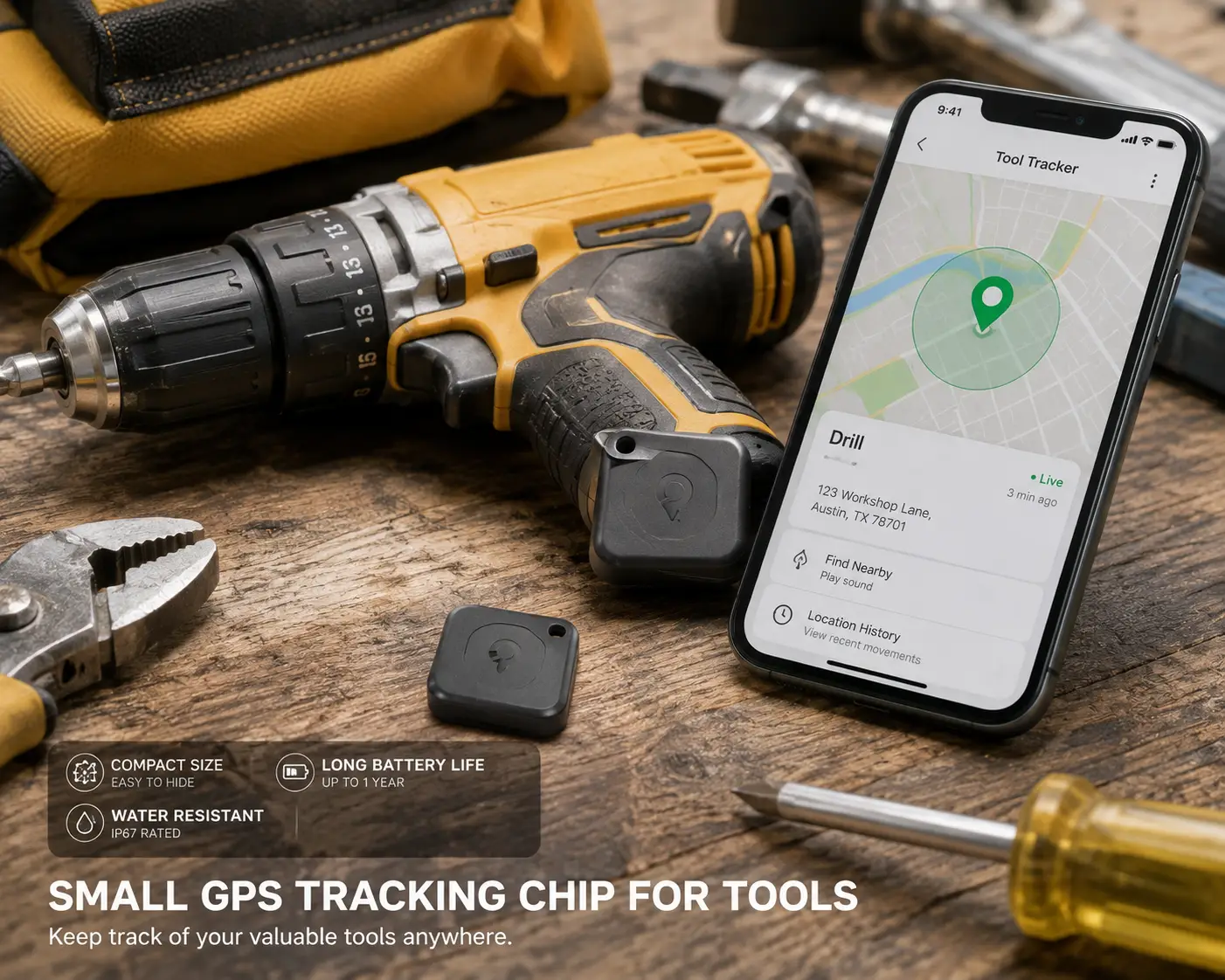
A small gps tracking chip for tools is a compact battery-powered device, usually 1–2 inches across, that you attach to a drill case, tool bag, generator, or trailer to report its location if it’s lost or stolen. Some use true satellite GPS plus a cellular connection for real-time updates; others use Bluetooth and a crowd-sourced phone network (Apple’s Find My or Google’s Find My Device) that only reports location when a nearby phone detects the tag.
That second category is worth pausing on, because a lot of “GPS tracker” listings on Amazon aren’t GPS at all. There is no GPS chip small or cheap enough to genuinely fit inside most hand tools, so the practical mainstream answer for small tools is a Bluetooth-based Find My tag rather than a true GPS module. That’s not a knock on Bluetooth tags — they’re cheap, tiny, and work shockingly well in cities and suburbs where phone density is high — but a contractor tracking a stolen trailer through rural back roads needs cellular GPS, not a hope that someone’s iPhone drives past it.
Top 7 Small GPS Tracking Chips for Tools: Full Breakdown
Here’s the honest, spec-driven rundown of the seven real products worth considering, ordered from lightweight everyday tags to rugged, subscription-based GPS units for higher-value equipment.
1. Apple AirTag — best for iPhone-owning solo contractors
The 2nd-generation Apple AirTag improved on the original with a longer Bluetooth range and a louder built-in speaker, and it remains the easiest tracker to set up if everyone on your crew carries an iPhone. Its Precision Finding feature uses Ultra Wideband to guide you to a tag with an on-screen compass and distance readout once you’re within Bluetooth range, which is genuinely useful when a tool bag is buried under gear in a van. The tradeoff is that it leans entirely on Apple’s Find My network of nearby devices; it never phones home over cellular data on its own.
What that means in practice: in a busy warehouse district or urban jobsite, an AirTag attached to a stolen circular saw will likely report a location within hours, because hundreds of iPhones pass by every day. In a rural area or overnight in a locked shipping container, that same tag could sit silent for weeks. Based on comparing the hardware to purpose-built cellular trackers, the AirTag is best treated as a “recovery insurance” layer for tools that mostly stay in populated areas — not a live-tracking solution for equipment on the move.
Reviews consistently report that battery life lands close to Apple’s stated one-year estimate under normal use, and that the coin-cell replacement is quick and doesn’t require any tools. A recurring complaint in aggregated feedback is that the tag has no keyring hole built in, so it needs a separate holder or adhesive mount to actually stay on a tool.
Pros:
- ✅ Zero monthly fee, ever
- ✅ Massive Find My network in populated US areas
- ✅ Precision Finding pinpoints exact location nearby
Cons:
- ❌ Useless without nearby iPhones reporting in
- ❌ Requires a separate case or mount to attach
Pricing on the Apple AirTag typically runs around $25–$30 for a single unit, with four-packs periodically discounted well below that per-tag price during Amazon sales events. For the total cost of ownership — zero subscription, ever — it’s hard to beat as a first line of defense on tools that stay near people.
2. Samsung Galaxy SmartTag2 — best for Android and Samsung households
The Samsung Galaxy SmartTag2 is the Android-side mirror of the AirTag, built for Samsung’s SmartThings Find network and, unlike the original SmartTag, adding Ultra Wideband precision finding on compatible Galaxy phones. Samsung significantly extended standby time on this generation — the company’s own spec sheet points to roughly 500 days of standard use, with a further jump in a low-power “Power Saving” mode. In practice, that means far fewer battery swaps than a typical Bluetooth tag, which matters when a tag is epoxied inside a tool case and hard to reach.
What most buyers overlook with the SmartTag2 is the IP67 rating: it’s rated to survive dust exposure and temporary submersion, which makes it noticeably more jobsite-friendly than tags designed primarily for keychains. Reviews consistently report solid Bluetooth range near 120 meters in open outdoor conditions, though — like every Find My-style tag — real-world reporting speed still depends entirely on how many nearby Android phones have Find My Device active.
The honest limitation here is ecosystem lock-in: the SmartTag2 doesn’t integrate with Apple’s Find My network at all, so a mixed-fleet crew running both iPhones and Android phones will get inconsistent coverage depending on which tag is on which tool.
Pros:
- ✅ Roughly 1.5-year battery life claim from Samsung
- ✅ IP67 water and dust resistance for job sites
- ✅ UWB precision finding on newer Galaxy phones
Cons:
- ❌ Samsung/Android only — no iPhone support
- ❌ Smaller device network than Apple’s Find My
The Samsung Galaxy SmartTag2 generally sells in the $25–$30 range per tag, occasionally dropping into the high teens during promotions, with multi-packs offering a modest per-unit discount. For an Android-based crew, it’s the most sensible zero-subscription option on this list.
3. Milwaukee ONE-KEY TICK — best purpose-built tool tracker
Unlike the consumer tags above, the Milwaukee ONE-KEY TICK was engineered specifically for tools and equipment rather than keys or luggage. It integrates with Milwaukee’s ONE-KEY app, which layers on low-battery alerts, service reminders, and “missing tool” notifications on top of basic Bluetooth location — features generic trackers simply don’t offer. Multiple mounting options (glue, screw, rivet, or strap) mean it can go inside a drill’s battery compartment or bolted to the frame of a generator, not just clipped to a keyring.
The practical tradeoff is range and network size: the TICK reports location via the ONE-KEY network, which is built from phones running the ONE-KEY app — a far smaller pool than Apple’s or Google’s Find My networks. Aggregated customer feedback is mixed on this point; some reviewers note that the roughly 100-foot Bluetooth range and reliance on other ONE-KEY users nearby means it functions more as a “confirm it’s yours” tool at a jobsite than a true recovery device off-site. What the spec sheet doesn’t say, but reviews reveal, is that the low-profile plastic housing is genuinely easy to hide inside a tool’s battery bay or handle cavity, which matters if you don’t want a thief to spot and remove it immediately.
For contractors already invested in the Milwaukee ecosystem — PACKOUT boxes, M18 batteries, and so on — the ONE-KEY integration for maintenance tracking and tool inventory is a real differentiator that generic AirTags and Tiles can’t match.
Pros:
- ✅ Purpose-built mounting for drills and equipment
- ✅ Service reminders and missing-tool alerts
- ✅ Over one year of runtime on a coin cell
Cons:
- ❌ Smaller reporting network than AirTag or Tile
- ❌ Roughly 100-foot range even with a nearby user
Single Milwaukee ONE-KEY TICK units typically run around $30–$35 each on Amazon, with multi-packs bringing the effective per-unit price down noticeably, especially during Milwaukee tool promotions. For anyone standardized on Milwaukee gear, the value proposition goes beyond raw tracking range into fleet management.
4. Tile Pro — best cross-platform range and volume
The Tile Pro is Life360’s flagship Bluetooth tracker, and its main selling point over Apple and Samsung’s tags is compatibility: it works identically on iPhone and Android, which solves the mixed-crew problem the SmartTag2 and AirTag both run into. It also offers a genuinely longer Bluetooth range — up to roughly 500 feet in open conditions — and a louder onboard speaker rated around 128 decibels, useful for finding a buried tool bag by sound rather than a map pin.
Here’s what most buyers overlook: the Tile Pro uses a user-replaceable battery instead of the sealed, single-use cell in most competitors, so a roughly one-year-rated battery can be swapped indefinitely instead of the whole device becoming e-waste. Reviews consistently report that the Life360 app experience is more polished than Tile’s original standalone app, particularly around notification reliability, though a handful of users note that Tile’s network of active devices, while large, is smaller than Apple’s Find My footprint — which affects out-of-range recovery odds.
Based on comparing this to the AirTag directly, the Tile Pro’s biggest advantage is cross-platform reliability for a crew with mixed phones; its biggest disadvantage is that iPhone users specifically lose access to Precision Finding’s exact-distance guidance, since that’s an Apple-exclusive feature.
Pros:
- ✅ Works identically on iPhone and Android
- ✅ User-replaceable battery, not disposable
- ✅ IP68-rated and genuinely dust/water resistant
Cons:
- ❌ Smaller device network than Apple’s Find My
- ❌ No Ultra-Wideband precision distance readout
Tile Pro typically lists around $35 for a single unit, with two- and four-packs bringing meaningful per-tag savings — often landing in the $55–$80 range for a four-pack depending on current promotions.
5. Tracki Mini 4G — best budget true GPS tracker
This is where the list shifts from Bluetooth tags to actual cellular GPS. The Tracki Mini 4G uses a built-in SIM and 4G LTE connectivity to report location independently of nearby phones, which is the core advantage over every tag above it — it works the same whether it’s sitting in a busy warehouse or on a trailer parked in a field forty miles from the nearest town. Tracki advertises international roaming across roughly 190 countries without swapping SIM cards, aimed squarely at cross-border trucking and logistics use cases as much as tool security.
The honest tradeoff for that always-on reporting is battery life and subscription cost. Standard battery-save mode gets roughly a month of standby, dropping considerably faster with frequent live pings, and the device requires an ongoing data plan to function at all — there’s no free tier. What the spec sheet doesn’t say, but aggregated reviews reveal, is that customer service and account management tend to draw more complaints than the hardware itself, with some users reporting confusion around auto-renewing subscription terms.
For a contractor who needs to know exactly where a stolen generator is right now, rather than whenever a stranger’s phone happens by, the Tracki Mini 4G closes the gap Bluetooth tags can’t.
Pros:
- ✅ True cellular GPS, no phone network needed
- ✅ Works internationally across ~190 countries
- ✅ Real-time geofence and movement alerts
Cons:
- ❌ Mandatory ongoing subscription to function
- ❌ Battery life drops fast with frequent updates
The device itself generally falls in the $20–$40 range depending on the bundle, but budget for a subscription on top — Tracki’s plans are typically priced in the same ballpark as competing cellular trackers, so factor that into the real annual cost before buying.
6. Spytec GL300 (Atlas) — best real-time GPS for high-value gear
Marketed today under the Atlas name but still built on the GL300 hardware, the Spytec GL300 is one of the longest-standing names in portable cellular GPS tracking. It runs on a rechargeable battery that Spytec rates at roughly two weeks per charge under typical use, and its Queclink-manufactured internals have a reputation for reliability that newer budget entrants haven’t matched. A mini-USB charging port and an included magnetic weatherproof case make it straightforward to stash inside a tool chest or clip to the underside of a trailer.
Where the GL300 genuinely outperforms Bluetooth alternatives is response speed on active theft: because it reports over cellular data on a schedule you control, you can watch a stolen tool trailer move in near-real time instead of waiting for a passive network ping. Reviews consistently point out that the mobile experience is more bare-bones than newer competitors — there’s no dedicated Spytec app on some plans, just a mobile-optimized website — which is a real usability gap compared to the polished apps bundled with AirTag or Tile.
What the spec sheet doesn’t say, but owners report, is that the device isn’t waterproof on its own; the included magnetic case is what provides weather resistance, so losing or damaging that case meaningfully changes the durability picture.
Pros:
- ✅ Roughly two weeks of battery per charge
- ✅ Reliable, established cellular GPS hardware
- ✅ Included magnetic weatherproof case
Cons:
- ❌ No standalone dedicated mobile app on some plans
- ❌ Device alone isn’t waterproof without its case
Device pricing for the Spytec GL300 commonly falls in the $30–$50 range, with subscription plans starting around $25/month for real-time updates — a meaningful ongoing cost that only makes sense for equipment worth protecting at that level.
7. LandAirSea 54 — most durable magnetic GPS tracker for equipment
The LandAirSea 54 leans hardest into the “built for vehicles and equipment” use case, with a strong internal magnet designed for tool-free attachment to steel surfaces — a trailer frame, a generator’s housing, or the underside of a skid steer. It uses GPS technology to pinpoint the device’s location in real time and cellular networks to report that data back through the SilverCloud app, with update intervals that can be set as frequently as every three seconds on the top-tier plan. The company also emphasizes US-based design and assembly, which shows up in aggregated reviews as a point of trust for buyers wary of overseas trackers with unclear data handling.
Based on comparing the spec sheet to the Tracki and Spytec entries above, the LandAirSea 54‘s standout feature is its ShareSpot function, letting you send a temporary tracking link to a customer, insurance adjuster, or law enforcement without giving them app access. The rechargeable 1,500 mAh battery is rated for up to two weeks of average use, though update frequency has a major effect on that number — reviewers running the fastest three-second interval report needing to recharge considerably more often.
Aggregated owner feedback describes reliable long-term performance, with some reviewers keeping a single unit running for two years before replacement, alongside a recurring complaint that the “waterproof” claim doesn’t hold up to extended submersion — velcro or adhesive mounting can fail and let water reach the unit over time.
Pros:
- ✅ Strong internal magnet, no tools needed to mount
- ✅ ShareSpot lets you share location temporarily
- ✅ Prepaid annual plans lower the effective monthly cost
Cons:
- ❌ Subscription required for all tracking features
- ❌ “Waterproof” rating doesn’t survive full submersion
The LandAirSea 54 device typically costs around $25–$30, often bundled with a prepaid subscription; standalone monthly plans start near $19.95, while prepaid two-year plans can bring the effective cost down to around $9.95 a month.
Top 7 Small GPS Tracking Chips for Tools: Side-by-Side
| Tracker | Type | Battery Life | Price Range | Best For |
|---|---|---|---|---|
| Apple AirTag | Bluetooth | ~1 year | ~$25–$30 | iPhone users, no subscription |
| Samsung Galaxy SmartTag2 | Bluetooth + UWB | ~1.5 years | ~$25–$30 | Android/Samsung households |
| Milwaukee ONE-KEY TICK | Bluetooth | 1+ year | ~$30–$35 | Milwaukee tool ecosystems |
| Tile Pro | Bluetooth | ~1 year, replaceable | ~$35 | Mixed iPhone/Android crews |
| Tracki Mini 4G | Cellular GPS | Weeks (mode-dependent) | ~$20–$40 + plan | Budget real-time GPS |
| Spytec GL300 (Atlas) | Cellular GPS | ~2 weeks/charge | ~$30–$50 + plan | High-value equipment, trailers |
| LandAirSea 54 | Cellular GPS | ~2 weeks | ~$25–$30 + plan | Vehicles, magnetic mount assets |
Scanning this table, the pattern is clear: every subscription-free option is Bluetooth-based, and every true real-time GPS option carries a recurring bill. If your tools rarely leave a populated area, Apple AirTag or Samsung Galaxy SmartTag2 likely deliver 90% of the protection for a fraction of the long-term cost. For a trailer, generator, or fleet of equipment that travels between job sites across a region, LandAirSea 54 or Spytec GL300 justify their subscriptions with genuinely faster, more reliable location data.
✨ Don’t Wait Until Your Tools Walk Off
🔍 Take your tool security to the next level with this lineup — check current pricing and availability on the tracker that fits your crew, and get peace of mind that survives a long weekend off-site.
How to Install a Small GPS Tracking Chip on Your Tools
Getting a tracker onto a tool is only half the job — placement and setup determine whether it actually works when you need it. Follow these steps in the first week after your tracker arrives.
Register the device before you mount it. Every tracker on this list requires app-based registration, and Bluetooth tags specifically need to be added to Find My, Find My Device, or ONE-KEY before they’ll report anything. Do this on your workbench, not on the jobsite, so you can confirm the app is finding the tag correctly.
Pick a mount that survives vibration. Drills, saws, and compressors shake constantly during use, which loosens adhesive-only mounts within weeks. For Bluetooth tags, a rigid holder screwed or zip-tied into a battery compartment outlasts adhesive pads; for magnetic GPS units like the LandAirSea 54, confirm the magnet is seated against bare metal, not a painted or coated surface where grip weakens over time.
Hide it, don’t advertise it. A visible tracker gets removed by a thief in seconds. Tuck Bluetooth tags inside tool cases, behind battery packs, or under foam inserts rather than on an exterior surface. For trailers and generators, the underside or a recessed panel beats anything at eye level.
Set geofences immediately. For cellular GPS trackers, a geofence around your job site or storage yard turns passive tracking into an active alert system — you’ll get a notification the moment equipment leaves a boundary it shouldn’t, often faster than you’d notice it missing on your own.
Test recovery before you rely on it. Walk your tagged tool out of Bluetooth range, or physically move a cellular tracker off-site, and confirm the app updates correctly. Finding out a mount failed or a subscription lapsed during an actual theft is the worst possible time to learn.
Real-World Scenarios: Matching the Right Tracker to Your Trade
Different trades lose different things in different ways, and the right small gps tracking chip for tools depends heavily on that pattern.
A solo electrician working mostly in-town, carrying a single toolbox between residential jobs, gets the most value from an Apple AirTag or Samsung Galaxy SmartTag2 tucked inside the case — the Find My networks in populated areas are dense enough to recover a stolen box within a day or two in most reported cases, and there’s no monthly bill eating into a tight margin.
A landscaping crew running a trailer with mowers, blowers, and a generator between multiple properties faces a different risk: the whole trailer disappearing overnight from an unattended lot. Here, a LandAirSea 54 magnetically mounted inside the trailer frame, paired with a geofence around the storage yard, catches the theft the moment it happens rather than waiting for a passive network hit.
A general contractor managing a job site with a rotating crew and a shared tool trailer benefits most from Milwaukee ONE-KEY TICK tags across the fleet, since the ONE-KEY app’s inventory and service-reminder features double as tool management — not just theft recovery — which pays for itself in fewer misplaced or forgotten tools even without a theft ever occurring.
A traveling HVAC technician crossing state or even international lines for commercial installs is the clearest case for a Tracki Mini 4G or Spytec GL300: crowd-sourced Bluetooth networks thin out fast on interstate highways and in rural service areas, while cellular GPS keeps reporting regardless of population density.
Common Tool-Loss Problems and Which Tracker Solves Them
Problem: A single hand tool disappears from a shared job box. A Bluetooth tag like the Apple AirTag or Milwaukee ONE-KEY TICK inside the tool’s case is usually enough — the loss is typically local, and passive network detection recovers it quickly if it’s still nearby.
Problem: An entire tool bag vanishes from an unattended vehicle overnight. This calls for a louder, longer-range tag like the Tile Pro, since audible alerts help during an immediate search, combined with app notifications if the bag leaves a set radius.
Problem: A trailer or generator is stolen from a job site or storage yard. This is squarely a cellular GPS situation — LandAirSea 54 or Spytec GL300 — because passive Bluetooth detection is far too slow for equipment that can be loaded onto a truck and moved fifty miles before anyone notices.
Problem: Tools keep going missing without any sign of theft. Before assuming theft, purpose-built inventory tools like the Milwaukee ONE-KEY TICK‘s app-based tool list often reveal the real issue: gear left at a previous job site or borrowed between crew members without logging it.
Problem: A budget doesn’t stretch to cover a fleet of expensive cellular trackers. Mixing strategies works well here — reserve LandAirSea 54 or Tracki Mini 4G units for your two or three highest-value assets, and cover everything else with inexpensive Apple AirTag or Samsung Galaxy SmartTag2 tags.
How to Choose a Small GPS Tracking Chip for Tools
- Decide whether you need true GPS or Bluetooth is enough. If your tools stay within a populated metro area, a Bluetooth tag likely covers you; if they travel to rural sites or cross state lines, cellular GPS is worth the subscription.
- Match the tracker to your phone ecosystem. iPhone-only crews get the most out of Apple AirTag‘s Precision Finding; mixed iPhone/Android crews should lean toward Tile Pro for consistent cross-platform performance.
- Check the mounting options against your actual tools. A magnetic tracker is ideal for a steel trailer frame but useless on a plastic tool case — confirm the attachment method fits what you’re protecting.
- Calculate the real annual cost, not just the sticker price. A $25 cellular tracker with a $20/month plan costs roughly $265 in year one — compare that honestly against a $30 Bluetooth tag with no subscription at all.
- Weigh battery life against update frequency. Faster location updates on cellular GPS units directly shorten battery life; decide how urgently you need live data versus how often you’re willing to recharge.
- Consider durability ratings for your environment. An IP67 or better rating matters far more for a tracker living in a wet or dusty tool case than one clipped to an indoor keyring.
- Test recovery odds before you commit a whole fleet. Buy one unit, tag a real tool, and confirm the app, alerts, and mount all work as expected before tagging every piece of equipment you own.
GPS Tracker vs Bluetooth Tracker for Tools: What’s the Real Difference
The core distinction isn’t marketing — it’s how each device gets its location fix. A true GPS tracker like the LandAirSea 54 or Spytec GL300 uses satellite positioning combined with a built-in cellular SIM, so it reports its location on its own schedule regardless of who’s nearby. A Bluetooth tracker like the Apple AirTag or Tile Pro has no independent way to determine or transmit its position; it broadcasts a low-power Bluetooth signal that a nearby phone running the right app detects and relays.
That difference shows up most in three places: cost, speed, and coverage. Cellular GPS trackers cost more upfront and carry a recurring subscription, but they update on your schedule — useful for watching a theft unfold in real time. Bluetooth trackers are cheaper and subscription-free, but their “coverage” is really just phone density; a tag is only as useful as the number of compatible devices passing nearby, which is why the same AirTag performs beautifully downtown and poorly on a rural back road.
Neither is objectively better — they solve different problems. A contractor tracking equipment that never leaves a busy commercial district is often better served saving the subscription money on Bluetooth tags, while one tracking assets across a wide service territory needs the independence that only cellular GPS provides.
Small GPS Tracking Chip for Tools vs Traditional Tool Security
| Method | Real-Time Location | Recovery Odds | Ongoing Cost | Best For |
|---|---|---|---|---|
| GPS tracking chip | Yes, live updates | Moderate-high | Subscription (varies) | Trailers, high-value equipment |
| Bluetooth tag | Only near other phones | Moderate | None | Individual tools, urban areas |
| Tool engraving/etching | No | Low, ID only after recovery | One-time | Deterrence, insurance claims |
| Locked tool crib/cage | No | High (prevention, not tracking) | Upfront hardware cost | Job-site storage |
| Insurance alone | No | N/A (reimbursement only) | Ongoing premium | Financial backstop |
Looking at the table, tracking chips and traditional methods aren’t competitors — they’re layers. Engraving and photography help prove ownership after recovery but do nothing to locate stolen gear; a locked crib prevents opportunistic theft but doesn’t stop a determined break-in. A LandAirSea 54 or Apple AirTag adds the one thing none of the traditional methods provide: the ability to actually find equipment after it’s gone, rather than just documenting the loss for a claim. Roughly 11,000 to 12,000 pieces of construction equipment are reported stolen in the US every year, and only about one in four is ever recovered, which underscores why locating gear quickly matters more than proving it was yours after the fact.
Common Mistakes to Avoid When Buying a Tool Tracker
Buying a Bluetooth tag and expecting cellular-GPS performance is the single most common misstep — reviewers frequently express frustration that an AirTag “isn’t updating” when in reality it’s working exactly as designed, just waiting for a nearby phone. Set expectations against the technology, not the marketing.
Ignoring the subscription cost until after purchase is another recurring problem, particularly with cellular GPS units where the device price looks deceptively low. Read the plan pricing before buying a Tracki Mini 4G or Spytec GL300, since a bare device with no active plan is functionally useless.
Mounting a tracker somewhere visible defeats the purpose entirely — a thief who spots and removes a tag in the first thirty seconds gets exactly the same head start as if there were no tracker at all.
Buying one tracker for an entire fleet of tools is a false economy. A single Milwaukee ONE-KEY TICK on a job box tells you nothing about which specific tool inside it went missing; tagging individual high-value items separately gives far more useful data.
Finally, skipping the app setup and test-run before an actual emergency means discovering a dead battery, a lapsed subscription, or a mount failure exactly when it matters most.
What to Expect: Everyday Performance on the Jobsite
In day-to-day use, Bluetooth trackers behave less like a live map and more like a very good “last seen” log — you’ll typically see location updates cluster during work hours when your own or nearby phones are active, then go quiet overnight unless a stranger’s device passes by. Cellular GPS units behave more like a true tracking dashboard, with location pins that update on the interval you’ve set, though even the fastest three-second refresh rate on the LandAirSea 54 comes at a real cost to battery life and, on some plans, to your monthly bill.
Dust and moisture are the two biggest everyday threats to any small tracker on a jobsite, which is why IP-rated devices like the Samsung Galaxy SmartTag2 genuinely outperform lower-rated tags over months of daily use. Cold weather also measurably shortens battery life across every device on this list, so contractors in northern climates should expect somewhat shorter runtimes in winter than the manufacturer’s headline battery-life claim suggests.
Best Tool Trackers for Different Users
Solo contractors and side-gig tradespeople get the best return from low-cost, subscription-free Bluetooth tags — the Apple AirTag or Samsung Galaxy SmartTag2 — since a single missing tool doesn’t justify an ongoing monthly bill.
Small crews sharing a job trailer benefit most from a hybrid approach: Milwaukee ONE-KEY TICK tags across individual power tools for inventory and local recovery, paired with one LandAirSea 54 on the trailer itself for the higher-stakes theft scenario.
Fleet managers and larger contracting operations should prioritize cellular GPS across all major equipment — Spytec GL300 or LandAirSea 54 — since the subscription cost becomes proportionally smaller against a larger asset base, and centralized dashboards make monitoring dozens of tagged items realistic in a way that checking individual phone apps isn’t.
Rental equipment businesses have the strongest case for true GPS specifically, since renters are, by definition, people outside your normal network of nearby phones — a Bluetooth tag’s passive detection model breaks down entirely once equipment leaves with a stranger.
Long-Term Cost and Maintenance
The upfront price of a tracker is often the least important number. A $25 Apple AirTag with a dead coin-cell battery costs about $5 and five minutes a year to maintain indefinitely. A $30 LandAirSea 54 with an active subscription can cost anywhere from roughly $120 to $240 a year depending on plan speed, and that recurring cost compounds fast across a fleet of tagged equipment.
| Tracker | Device Cost | Monthly Plan | Estimated Year 1 Cost |
|---|---|---|---|
| Apple AirTag | ~$25–$30 | None | ~$25–$30 |
| Samsung Galaxy SmartTag2 | ~$25–$30 | None | ~$25–$30 |
| Milwaukee ONE-KEY TICK | ~$30–$35 | None | ~$30–$35 |
| LandAirSea 54 | ~$25–$30 | ~$10–$20 | ~$145–$270 |
| Spytec GL300 (Atlas) | ~$30–$50 | ~$25+ | ~$330–$350 |
This table makes the tradeoff explicit: Bluetooth tags are effectively free after purchase, while cellular GPS trackers can cost ten times as much over a year once the subscription is factored in. That said, for a $3,000 generator or a trailer full of equipment, even the higher end of that range is a rounding error against the replacement cost — the math only breaks down when someone tags a $60 drill with a $25/month subscription tracker and pays more in fees than the tool is worth.
Features That Actually Matter (and Ones That Don’t)
Battery life and mounting flexibility matter enormously — a tracker with a dead battery or a mount that shakes loose within a month is worthless regardless of its other specs. Network size matters just as much for Bluetooth tags specifically, which is why Apple’s Find My network gives the AirTag a practical edge over smaller-network competitors in most US regions.
What matters less than the marketing suggests: exact GPS accuracy claims down to a few feet. In practice, “within 6 feet” versus “within 15 feet” rarely changes the outcome of a recovery — you’re locating a general area, then physically searching or calling law enforcement, not walking a precise grid. Similarly, flashy app dashboards and extra smart-home integrations are nice-to-haves, not decision-making factors, when the core question is simply whether the device reliably reports a location when a tool goes missing.
Safety, Regulations, and Standards for Tool GPS Trackers
Every device on this list operates over licensed or unlicensed radio frequencies and must clear FCC equipment authorization before it can legally be sold in the US; you can look up a device’s certification directly through the FCC’s equipment authorization database if you want to verify a specific model’s compliance. IP ratings (IP67, IP68, and similar) are based on standardized international dust- and water-resistance testing, and while they’re not a US-specific regulatory requirement, they’re the most reliable way to compare real-world durability claims across brands.
The legal side is less about the device and more about what you’re tracking. Placing a small gps tracking chip for tools on equipment you personally or your business owns is legal everywhere in the US — the complications arise when tracking equipment used by employees or subcontractors, since at least 26 states and the District of Columbia have enacted laws criminalizing unauthorized location tracking of a person, and courts have increasingly treated tracking someone’s regular movements, even via a company asset, as touching that line. If your crew shares vehicles or job boxes day to day, a brief written notice that tools and trailers carry tracking devices for theft-recovery purposes is a simple, low-cost way to stay clearly on the right side of that distinction.
Amazon Associates content also has its own transparency standard worth knowing about: any post recommending products through affiliate links is required to follow the FTC’s endorsement guidance, which is why every legitimate buying guide, including this one, needs a clear disclosure near the top of the article rather than buried in fine print at the bottom.
FAQs
❓ Do GPS tracking chips for tools need a monthly subscription?
❓ How often do I need to charge or replace the battery?
❓ Is it legal to put a tracker on tools my employees use?
❓ What's the smallest GPS tracking chip that actually works reliably?
❓ Can a tool tracker survive rain, dust, and getting dropped?
Conclusion
Choosing the right small gps tracking chip for tools comes down to one honest question: how far do your tools actually travel, and how fast do you need to know when they’ve gone somewhere they shouldn’t? For tools that mostly stay in populated areas, the Apple AirTag and Samsung Galaxy SmartTag2 deliver real recovery odds without a single recurring charge. For purpose-built tool and inventory management, the Milwaukee ONE-KEY TICK earns its slightly higher price with features generic tags don’t offer. And for trailers, generators, and equipment that moves across job sites or regions, cellular GPS units like the LandAirSea 54, Spytec GL300, and Tracki Mini 4G justify their subscriptions with genuinely faster, independent reporting.
None of these devices prevent theft outright — they change the odds of getting equipment back once it’s gone, and they do it for a fraction of what a single stolen tool trailer costs to replace. Whichever tracker fits your trade and budget, the difference between having one and not having one is usually the difference between a recovered generator and an insurance claim.
Recommended for You
- Indoor Invisible Fence for Cats: 7 Best Picks for 2026
- Boundary Shock Collar for Dogs: 7 Best Picks for 2026 (Ranked)
- Wireless Dog Fence for Two Dogs: 7 Best Picks for 2026
Disclaimer: This post contains affiliate links. As an Amazon Associate, I earn from qualifying purchases made through these links, at no additional cost to you.
✨ Found this article helpful? Share it with someone who needs it! 💬🤗