
In This Article
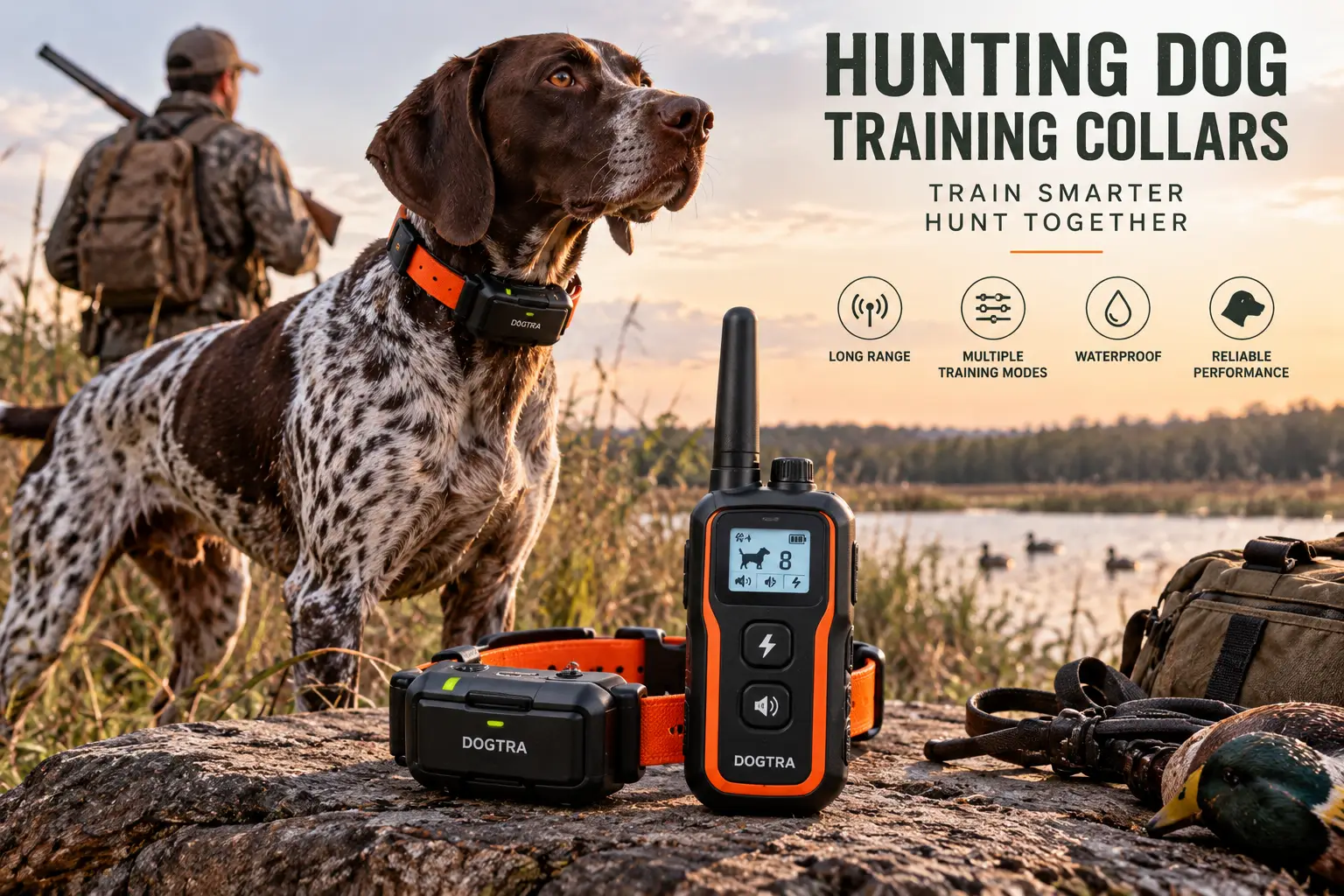
If you’ve ever watched a hard-charging retriever blow past a “here” command in a marsh full of decoys, you already know why hunting dog training collars exist. What is a hunting dog training collar? It’s a remote-controlled e-collar system that lets a handler deliver static stimulation, vibration, or tone to a dog at a distance, reinforcing known commands during field work and hunting…
Choosing the right one isn’t as simple as grabbing whatever’s cheapest on the shelf at the sporting goods store. Range, waterproofing, stimulation range, and multi-dog capability all matter differently depending on whether you’re running a close-working flusher or a wide-ranging pointer three ridgelines away. This guide breaks down seven real, currently available e-collars — from budget-friendly starter units to full GPS-and-training bundles — and explains what actually separates them in the field, not just on the spec sheet.
We’ll also cover how to introduce a collar without souring your dog on it, common buying mistakes, and how e-collars stack up against traditional check-cord training. As always with electronic training tools, this only works well paired with sound, positive foundational training — the collar reinforces commands your dog already knows, it doesn’t teach them from scratch, according to guidance from the American Kennel Club.
Quick Comparison: Top Picks at a Glance
Before diving into all seven, here’s how five standout picks stack up on the numbers that matter most in the field.
| Collar | Range | Stimulation Levels | Waterproof | Best For |
|---|---|---|---|---|
| SportDOG FieldTrainer 425X | 500 yards | 21 levels + tone/vibe | Submersible to 25 ft | Best all-around value |
| PATPET P920 | ~4,250 ft (1,300 m) | 16 levels + tone/vibe | Waterproof | Best budget pick |
| Educator ET-300 Mini Educator | 1/2 mile | 100 levels | Waterproof | Best for sensitive dogs |
| Dogtra 1900S | 3/4 mile | 127 levels | IPX9K waterproof | Best for stubborn breeds |
| Garmin Alpha 300i + TT15X | Up to 9 miles (GPS) | Stim + tone/vibe | Rugged, water-rated | Best GPS + training combo |
Looking at the table above, the SportDOG FieldTrainer 425X covers the widest range of hunters at the lowest cost, while the Dogtra 1900S earns its higher price with dramatically finer stimulation control for dogs that shrug off milder corrections. If your dog routinely disappears into standing corn or heavy cover, the Garmin Alpha 300i + TT15X combo is really in a different category altogether — it’s a tracking system with training built in, not the other way around.
💬 Ready to see which collar fits your dog’s temperament? Keep reading — the breakdown below covers exactly who each one is built for.
Top 7 Hunting Dog Training Collars: Expert Analysis
1. SportDOG FieldTrainer 425X — best all-around value for close-working dogs
The SportDOG FieldTrainer 425X has built its reputation on doing the basics extremely well without overcomplicating the remote. It’s the collar most upland guides and retriever owners reach for first, and it’s easy to see why once you look past the spec sheet. The 500-yard range and 21 levels of static stimulation, plus tone and vibration, mean most close-working flushers, pointers, and retrievers never bump up against its limits — in practice, that range translates to reliable control across a typical grouse cover or duck blind setup without you ever babysitting the dial. DryTek waterproofing rated to 25 feet of submersion means a pond retrieve or a downpour won’t take the system offline, and the 2-hour quick charge means a dead battery the night before opening weekend isn’t a season-ending problem.
What most buyers overlook with the 425X is how much the “no-look” dial design matters in real hunting conditions — you can nudge stimulation up or down by feel while your eyes stay on the dog and the bird, which is exactly the kind of design detail that separates purpose-built hunting gear from repurposed obedience collars. This model is best suited to hunters with one to three dogs of moderate drive; if you’re running a genuinely hard-headed hound or pointer, you may find yourself wanting the Dogtra’s larger stimulation ceiling instead. Reviews consistently report strong reliability and comfortable receiver fit, with the most common complaint being that the 3-dog expansion (via Add-A-Dog collars) adds up in cost fast for larger kennels.
Pros:
- ✅ 500-yard range covers most upland and waterfowl scenarios
- ✅ Submersible to 25 feet for wet-weather hunting
- ✅ Expandable to 3 dogs from one handheld
Cons:
- ❌ 21 levels is plenty for most dogs but not the most granular on this list
- ❌ Add-A-Dog collars raise the multi-dog cost significantly
The SportDOG FieldTrainer 425X typically runs in the $120–$165 range depending on retailer and bundle, and at that price it’s hard to beat for a first serious e-collar — check the current price before you buy, since retailer promotions shift often.
2. PATPET P920 — best budget pick for casual field training
The PATPET P920 proves you don’t need to spend $300 to get a functional hunting-adjacent training collar, though it comes with real trade-offs worth understanding upfront. Its headline feature is a claimed 1,300-meter (roughly 4,250-foot) range, paired with 16 stimulation levels plus tone and vibration and true 2-dog capability from one transmitter. In practice, that range figure is measured in open, obstruction-free conditions — expect real-world performance closer to a few hundred yards once you factor in brush, hills, and foliage, which is standard for budget-tier RF systems at this price point. Still, for backyard-to-field transitional training, dove-field work, or a second collar for a less-driven dog, it punches above its price.
The honest analytical read here is that the PATPET P920 is best for casual or occasional hunters, not the working-dog crowd running collars five days a week for months on end. What the spec sheet doesn’t say, but aggregated customer feedback suggests, is that contact points and strap hardware on budget collars like this tend to be the first failure point under heavy field abuse — a consideration if you’re hard on gear. Reviews of PATPET’s product line consistently mention solid value for the price and easy setup, with occasional complaints about long-term durability of the collar strap and contact prongs after months of daily wear.
Pros:
- ✅ Genuinely affordable entry point into remote training
- ✅ Trains 2 dogs from a single transmitter
- ✅ Simple, beginner-friendly button layout
Cons:
- ❌ Real-world range falls well short of the advertised distance in cover
- ❌ Build quality lags behind purpose-built hunting brands over time
The PATPET P920 generally sits in the $90–$120 range, making it one of the more affordable ways to try remote training before committing to a premium hunting-specific system — prices may vary by color and bundle.
3. Educator ET-300 Mini Educator — gentlest correction for sensitive hunting dogs
The Educator ET-300 Mini Educator takes a fundamentally different approach to stimulation than most hunting-branded collars, and that difference is the whole reason trainers reach for it. Its patented “blunt” stimulation, combined with 100 adjustable levels and an independent 1-to-60 boost setting, gives you dramatically finer low-end control than a typical 10-to-21-level system — meaning you can find a working level that gets a soft-natured pointer’s attention without the flinch-and-shutdown response that heavier corrections can trigger. The half-mile range and 5-pound minimum dog size also make it one of the more versatile picks here if your kennel includes both a big running Lab and a smaller, more sensitive spaniel.
Based on comparing the specs against the rest of this list, the ET-300’s real advantage isn’t raw power — it’s precision at the low end, which matters enormously for young dogs in their first exposure to e-collar pressure or for breeds known for sensitivity, like some setters and spaniels. Trainers and owners who work with soft or first-time dogs consistently point to the Mini Educator’s “lock and set” feature, which locks in a specific stimulation level to prevent an accidental over-correction — a detail that shows up repeatedly in aggregated customer feedback as a reason people switch to this brand. The trade-off is that it lacks the GPS tracking and rugged multi-dog scalability of the Garmin lineup.
Pros:
- ✅ 100 levels give unmatched low-end precision
- ✅ “Lock and set” feature prevents accidental over-stimulation
- ✅ Works for dogs as small as 5 pounds
Cons:
- ❌ Half-mile range is shorter than the Dogtra and Garmin PRO 550
- ❌ No built-in GPS tracking option
The Educator ET-300 Mini Educator typically falls in the $300–$350 range for the single-dog unit — check current pricing, as Educator periodically bundles in extra collar straps or a second receiver.
4. Dogtra 1900S — best for stubborn, high-drive hunting breeds
If your hunting partner is the kind of dog that shakes off a mid-level correction like it’s nothing, the Dogtra 1900S is built specifically for that problem. Its headline feature — 127 levels of stimulation controlled by a patented rheostat dial — means you’re not choosing between 10 or 21 fixed steps but dialing in almost continuous, granular intensity, which matters enormously for dogs at the “stubborn” end of the temperament spectrum, including many hounds, high-drive pointers, and some retriever lines bred for field trial intensity. The 3/4-mile range and IPX9K waterproof certification (tested against high-pressure, high-temperature water jets, not just a rain shower) put it squarely in professional-trainer territory.
What most buyers overlook with the 1900S is that its Rheostat Dial isn’t just about maximum power — it’s about being able to find the exact minimum effective level for an individual dog, which is the actual goal of responsible e-collar use rather than simply having a bigger stimulation ceiling. This model is best suited to experienced handlers working genuinely difficult dogs; a soft-natured started puppy doesn’t need 127 levels of headroom. Reviews consistently report exceptional build quality and reliability from professional trainers and K-9 handlers, with the most common critique being that the learning curve on the dial takes longer to master than simpler push-button systems.
Pros:
- ✅ 127 stimulation levels for precise, granular correction
- ✅ IPX9K waterproof rating built for extreme conditions
- ✅ Trusted by professional trainers and K-9 units
Cons:
- ❌ More expensive than entry-level competitors
- ❌ Rheostat dial has a steeper learning curve for beginners
The Dogtra 1900S generally runs in the $230–$310 range depending on whether you choose the standard or Black Edition with Boost & Lock — at the time of writing, it’s one of the priciest single-dog-only options on this list, though the multi-dog 1902S variant is also available.
5. Garmin Sport PRO Bundle — best beginner-friendly hunting e-collar
The Garmin Sport PRO Bundle is the collar most often recommended to hunters buying their first e-collar system, and the appeal is obvious the moment you hold it. A quick-turn dial delivers positive, audible clicks between its 10 stimulation levels, which lets you change intensity by feel — genuinely useful when you’re focused on a flushing dog and a rising bird at the same time rather than staring down at a remote. The 3/4-mile range, built-in BarkLimiter, and expandability to 3 dogs give it real field credibility, and its IPX7-rated, floating handheld plus 1-ATM-rated collar receiver mean pond work and rain aren’t a concern.
Here’s what to weigh: 10 stimulation levels is meaningfully fewer than the Dogtra’s 127 or the Educator’s 100, which means the Sport PRO trades precision for simplicity. For most moderate-temperament hunting breeds — Labs, mixed-breed flushers, average-drive pointers — that trade-off is a non-issue, and the intuitive one-handed operation is arguably more valuable in the field than extra granularity you’ll rarely use. Reviews consistently praise the Sport PRO’s durability and simple learning curve, particularly from hunters transitioning off cheaper big-box collars for the first time, with occasional notes that serious multi-dog kennels eventually outgrow its 10-level ceiling.
Pros:
- ✅ Intuitive one-handed, no-look dial operation
- ✅ Floating, IPX7-rated handheld survives water landings
- ✅ Built-in BarkLimiter adds function beyond training
Cons:
- ❌ Only 10 stimulation levels versus 100+ on premium rivals
- ❌ Additional dog devices for expansion aren’t included
The Garmin Sport PRO Bundle usually lands in the $250–$350 range, and given that it replaces what would otherwise be a separate tracker and a separate entry-level e-collar, many buyers find it a reasonable middle-ground investment — check the current price, as it’s frequently discounted through hunting retailers.
6. Garmin PRO 550 System — best for serious multi-dog hunting kennels
Built on Garmin’s Tri-Tronics heritage, the Garmin PRO 550 System is aimed squarely at handlers running more than one working dog and needing a full mile of range to do it. Its 21 levels of continuous and momentary stimulation, classic tube-shaped one-handed transmitter, and support for up to 3 dogs from a single handheld make it a favorite among professional trainers who need to toggle between dogs mid-session without fumbling controls. The Autorise BarkLimiter and optional add-on Upland Beeper — which most competitors on this list don’t offer — push it further into dedicated hunting-camp territory rather than general obedience use.
Based on comparing the specs, the meaningful upgrade over the Sport PRO isn’t just the extra range, it’s the doubled stimulation resolution (21 versus 10 levels) and the beeper compatibility, which matters a great deal for pointing-breed owners who rely on audible location cues in thick cover. This collar is best suited to hunters managing a working kennel of two or three dogs rather than a single house pet that occasionally goes afield. Reviews and hunting-forum discussion consistently describe the PRO 550 as bulletproof in rough conditions, echoing broader consensus that Garmin and SportDOG collars hold up especially well to the abuse of daily field use, though a handful of owners note the classic tube design feels bulkier in-hand than more modern remotes.
Pros:
- ✅ Full 1-mile range for wide-ranging dogs
- ✅ 21 stimulation levels with true multi-dog switching
- ✅ Optional Upland Beeper add-on for cover work
Cons:
- ❌ Bulkier, older-style transmitter than newer Garmin models
- ❌ No GPS tracking — pure training-only system
The Garmin PRO 550 System typically sells in the $380–$420 range for the single-dog bundle — at the time of writing, additional collar receivers for multi-dog expansion are sold separately and add meaningfully to total cost.
7. Garmin Alpha 300i + TT15X — best GPS tracking and training combo
For hunters whose dogs routinely disappear over a ridge or into standing timber, the Garmin Alpha 300i + TT15X isn’t really competing with the other six collars on this list — it’s solving a different problem entirely. This is a GPS tracking handheld paired with a combination tracking-and-training collar, capable of monitoring up to 20 dogs simultaneously at up to 9 miles of line-of-sight range, with the added ability to connect to Garmin’s inReach satellite network for messaging in areas with zero cell coverage. A bright touchscreen, roughly 55 hours of battery life, and three quick-access buttons for stim, tone, and vibration round out a system built for hound hunters, houndsmen, and anyone hunting genuinely remote country.
What the spec sheet doesn’t say, but the price tag makes clear, is that this system is overkill for a backyard flusher that never leaves your sightline — the GPS premium only pays for itself when losing visual contact with your dog is a real, recurring safety concern. For hound hunters, wide-ranging pointer owners, and anyone hunting big, broken country, though, few tools solve the “where is my dog right now” problem as completely. Aggregated user feedback and outdoor-gear reviewers consistently rank the Alpha lineup as the gold standard for combined tracking and training, citing accuracy and battery life as its biggest strengths, with cost and subscription requirements for inReach messaging as the recurring drawback.
Pros:
- ✅ Tracks up to 20 dogs at up to 9 miles of range
- ✅ inReach satellite messaging works with zero cell service
- ✅ Touchscreen delivers stim, tone, and vibration at a glance
Cons:
- ❌ Significantly more expensive than pure training collars
- ❌ inReach satellite features require an ongoing subscription
The Garmin Alpha 300i + TT15X bundle generally runs in the $1,100–$1,300 range depending on configuration — this is a serious investment, so it’s worth confirming your specific handheld-and-collar pairing is compatible before you buy.
Top 7 Collars Compared: Full Breakdown
| # | Collar | Range | Stimulation Levels | Waterproof | Multi-Dog | Best For |
|---|---|---|---|---|---|---|
| 1 | SportDOG FieldTrainer 425X | 500 yards | 21 + tone/vibe | 25 ft submersible | Up to 3 | Overall value |
| 2 | PATPET P920 | ~1,300 m (open field) | 16 + tone/vibe | Waterproof | Up to 2 | Tight budgets |
| 3 | Educator ET-300 Mini Educator | 1/2 mile | 100 + boost | Waterproof | 2-dog option | Sensitive dogs |
| 4 | Dogtra 1900S | 3/4 mile | 127 | IPX9K | 2-dog option | Stubborn breeds |
| 5 | Garmin Sport PRO Bundle | 3/4 mile | 10 | IPX7 / 1 ATM | Up to 3 | First-time buyers |
| 6 | Garmin PRO 550 System | 1 mile | 21 | 1 ATM | Up to 3 | Multi-dog kennels |
| 7 | Garmin Alpha 300i + TT15X | Up to 9 miles (GPS) | Stim + tone/vibe | Rugged/water-rated | Up to 20 | GPS + training |
Scanning the full lineup, a clear pattern emerges: stimulation-level count and range both climb steadily with price, but they solve different problems. The Dogtra 1900S and Educator ET-300 compete on precision for difficult or sensitive temperaments, while the Garmin PRO 550 and Alpha 300i compete on raw range and multi-dog scale for serious hunting operations. If budget is your primary constraint, the SportDOG FieldTrainer 425X remains the strongest all-around compromise between price and capability on this entire list.
🎯 Ready to Gear Up Before the Season Opens?
🔍 Match your dog’s temperament and your hunting terrain to the picks above, then click through to check current availability and pricing. Getting the right collar dialed in now means fewer headaches — and a steadier, more responsive dog — once opening day arrives.
How to Condition a Hunting Dog to a New E-Collar
Introducing an e-collar badly is the single biggest reason hunters end up with a “collar-wise” dog — one that behaves differently with the collar on than off. A proper conditioning process, echoed across hunting-dog trainer guidance from outlets like Gun Dog Magazine, takes patience but pays off for the life of the dog. Start by having your dog wear the collar, powered off, during normal activities for several days so it stops registering as anything unusual. Once that’s routine, begin pairing the lowest detectable stimulation level with a command the dog already knows cold — not a new one.
The goal in week one isn’t correction, it’s association: stimulation plus a known cue plus immediate release when the dog complies. Never introduce the collar during an already-stressful situation, like a first hunt or a loud environment, and never use it while your dog is out of sight, since you can’t verify what behavior you’re actually reinforcing. By the second week, most dogs are ready for light field reinforcement of “here” and “sit” at their established working level — the lowest level that reliably gets a response, not the highest level the dog can tolerate.
Real-World Scenarios: Which Collar Fits Your Hunt
Consider three different hunters. A weekend upland hunter with a young, biddable English Setter and a strict budget is best served by the SportDOG FieldTrainer 425X or, if funds are especially tight, the PATPET P920 — both offer enough range and stimulation control for close-working birds without overspending on features that dog will never need. A houndsman running two stubborn Bluetick Coonhounds through thick timber, on the other hand, needs both the correction ceiling of the Dogtra 1900S and, ideally, the tracking security of a GPS system, since hounds are notorious for running out of both sight and hearing range.
A waterfowl guide managing a kennel of three working Labradors that hunt five days a week for months needs durability and multi-dog switching above all else — that’s the Garmin PRO 550 System‘s exact use case, especially with the optional beeper for blind-side cover work. And a competitive field-trial handler working a soft-natured pointer that shuts down under heavy pressure is the textbook case for the Educator ET-300 Mini Educator‘s blunt, low-end-precise stimulation. Matching the tool to the dog and the hunt, not the other way around, is the entire game.
Common First-Season E-Collar Mistakes (and Fixes)
Problem: Starting at too high a stimulation level. Solution: Begin at the lowest level the dog can physically detect (often a twitch of the ear or a head tilt, not a yelp) and work upward only if needed — most dogs need far less than owners assume.
Problem: Using the collar as punishment after the fact. Solution: Stimulation must be timed to the exact moment of the unwanted behavior or paired with a known command; correcting a dog after it’s already returned to you teaches nothing useful and can create confusion.
Problem: Relying on the collar instead of foundational obedience. Solution: An e-collar reinforces commands, it doesn’t install them — go back to leash and check-cord work if your dog doesn’t reliably respond to a command with no collar pressure at all.
Problem: Forgetting the collar is on and leaving it on too long. Solution: Check contact points regularly for skin irritation, especially with collars like the Dogtra 1900S run at higher power for extended sessions, and rotate contact point length as coat and season change.
How to Choose a Hunting Dog Training Collar
- Match range to your terrain. A 500-yard collar like the SportDOG FieldTrainer 425X is plenty for close cover; hound hunters and wide-ranging pointer owners need the mile-plus range of the Garmin PRO 550 or GPS coverage from the Alpha 300i.
- Consider your dog’s temperament first, power second. A soft dog needs precision at the low end (the Educator ET-300‘s 100 levels), not raw maximum output.
- Decide if you actually need GPS. If your dog stays visible during hunts, a pure training collar saves real money over a GPS-integrated system.
- Check multi-dog scalability. If you’ll add a second or third dog within a year or two, buy into a system, like the Garmin PRO 550, that expands without replacing the handheld.
- Prioritize waterproofing for wetland work. Waterfowl hunters should treat submersion rating, not just “water-resistant” marketing language, as a hard requirement.
- Budget for the whole system, not just the base unit. Extra collars, contact points, and beeper add-ons all add up beyond the sticker price.
- Buy from the brand your local trainer supports. Parts availability and community troubleshooting matter more than most buyers expect once something breaks mid-season.
Common Mistakes to Avoid When Buying a Hunting Dog Training Collar
The most frequent buying mistake is chasing stimulation-level count as a proxy for quality — a beginner with a soft-natured dog doesn’t benefit from 127 levels any more than a driver needs a car that goes 200 mph. The second most common mistake is underestimating range needs, buying a 500-yard collar for a dog that regularly works well beyond that distance in open country, which leaves handlers with no way to reinforce commands exactly when they’re needed most. A third mistake is skipping waterproof-rating research entirely; “water-resistant” and “waterproof to 25 feet” are not the same claim, and a splash-rated collar failing during a marsh retrieve is a frustratingly common and preventable problem based on aggregated buyer complaints across several of these product lines.
E-Collars vs. Traditional Check-Cord and Whistle Training
Traditional check-cord and whistle-based training remains the foundation every e-collar should be built on top of, not a replacement for it. A check cord offers zero-cost, tactile, close-range correction that’s ideal for teaching a command for the first time, but it physically limits training distance to the length of the rope — a real constraint once a dog is working fields or water at range. Whistle commands scale distance well for direction and recall cues but offer no way to correct disobedience once the dog is already out of easy physical reach, which is precisely the gap e-collars fill.
The honest comparison isn’t “which is better” but “which tool for which stage.” Check cords and whistles teach; e-collars reinforce what’s already taught at distances no leash could ever reach. Trainers who skip straight to remote stimulation without check-cord foundations consistently report more confused, inconsistent dogs than those who layer the tools in sequence, according to hunting-dog trainer guidance referenced throughout the Gun Dog Magazine training archive.
Hunting Dog Training Collars for Different Breeds and Temperaments
Soft, biddable breeds — many setters, some spaniels, and young dogs of any breed early in training — respond best to systems offering fine low-end control, making the Educator ET-300 Mini Educator and the higher-resolution end of the Dogtra 1900S‘s dial well suited to them. Moderate-drive breeds like Labrador and Golden Retrievers generally do well on mid-tier systems like the SportDOG FieldTrainer 425X or Garmin Sport PRO, where 10 to 21 levels comfortably covers the range most handlers will ever use. High-drive, independent breeds — pointing hounds, some GSPs, and dogs bred heavily for field-trial intensity — often need both the stimulation ceiling of the Dogtra 1900S and, if they range widely, the tracking security that only a GPS-integrated system like the Garmin Alpha 300i provides.
Long-Term Cost and Maintenance of E-Collar Systems
The sticker price is only the starting point of total cost of ownership. Rechargeable lithium-ion batteries across every collar on this list typically last several hundred charge cycles before capacity noticeably degrades, meaning most hunters get 3 to 5 hunting seasons before a receiver battery becomes a real limiting factor. Replacement contact points, which wear down from repeated use, run a modest recurring cost across all seven brands and should be budgeted as routine maintenance rather than a surprise expense. Multi-dog expansion is where long-term cost diverges most sharply — a single Garmin PRO 550 handheld with three dog devices costs meaningfully more over time than the base bundle price suggests, while systems like the Educator line keep add-on receiver costs comparatively modest.
Safety, Regulations, and Standards for E-Collars
E-collar use is a genuinely debated topic among veterinary behavior professionals, and a responsible buyer should know both sides rather than only the sales pitch. The American Veterinary Society of Animal Behavior has published a position statement favoring reward-based training methods and cautioning against aversive tools, including e-collars, when used as punishment or without proper technique. That said, the hunting-dog training community broadly treats e-collars as a reinforcement tool for commands already taught through positive foundational work, not a substitute for it, and manufacturers like Dogtra and Educator specifically engineer low-end stimulation ranges to minimize discomfort when used correctly. There’s no federal e-collar ban in the U.S. as of this writing, though a small number of localities have restricted or banned sale and use, so it’s worth a quick check of your specific city and state regulations before purchasing, particularly if you plan to compete in field trials with specific equipment rules.
Frequently Asked Questions
❓ What's the difference between a training collar and a shock collar for hunting dogs?
❓ How far away can an e-collar work for hunting dogs?
❓ What age should a hunting dog start e-collar training?
❓ Are hunting dog training collars safe to use in water?
❓ Do I need GPS tracking on my hunting dog's collar?
Conclusion
There’s no single best hunting dog training collar — there’s only the best match for your specific dog, terrain, and hunting style. Budget-conscious owners with close-working dogs get excellent value from the SportDOG FieldTrainer 425X, while hunters facing genuinely stubborn temperaments should look hard at the Dogtra 1900S‘s stimulation range. Soft or young dogs benefit most from the Educator ET-300 Mini Educator‘s precision, first-time buyers tend to find the Garmin Sport PRO Bundle the easiest on-ramp, and serious multi-dog kennels or hound hunters facing real out-of-sight risk are the clearest case for the Garmin PRO 550 or the full Garmin Alpha 300i + TT15X tracking system.
Whatever you choose, remember that the collar itself is only as effective as the foundational training behind it — a remote e-collar reinforces commands your dog already knows, it doesn’t replace the work of teaching them in the first place.
🐾 Find the Right Training Partner for Your Season
✨ Take a look back at the picks above and match one to your dog’s temperament and your typical hunting ground. Click through on your top choice to check today’s availability and pricing before the season gets underway.
Recommended for You
- Does the Halo Collar Shock Dogs? 7 Honest Picks Ranked (2026)
- GPS Tracker Wristband: 7 Best Picks for Safety in 2026
- GPS Tracker Jewelry: 7 Best Picks for Safety in 2026
Disclaimer: This post contains affiliate links. As an Amazon Associate, I earn from qualifying purchases made through these links, at no additional cost to you.
✨ Found this article helpful? Share it with a fellow hunter who needs it! 🐕💬