
In This Article
Introduction: The Paper Guide Is Gone — Now What?
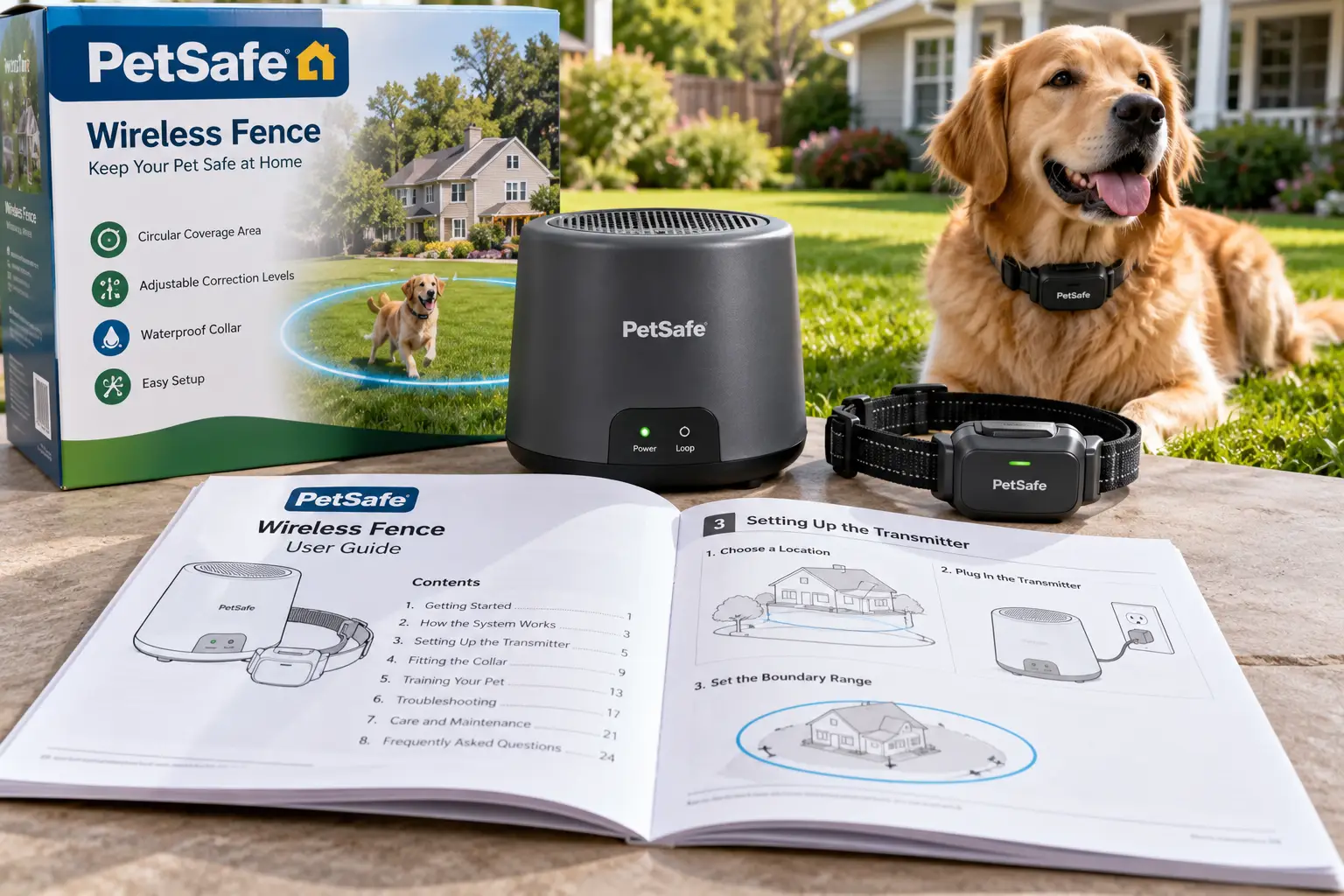
You plugged in the transmitter, snapped the collar together, and then realized the booklet disappeared somewhere between the box and the recycling bin. Happens to the best of us. 🐕 This PetSafe wireless fence user guide pulls together everything that booklet was supposed to teach you: where to put the transmitter, how to set the boundary, how to fit the collar, and how to train your dog without turning the backyard into a place of mystery and dread.
Here’s the thing most owners learn the hard way. A wireless fence is about 20% hardware and 80% routine. The boundary dial takes seconds to turn, but the training plan behind it runs for weeks. Skip the plan, and you get one of two dogs: the escape artist who learns the correction lasts only a moment, or the nervous pup who won’t leave the porch.
These systems belong to a category the encyclopedia entry on electronic pet fences describes as containment without a physical barrier. The collar plays a warning tone near the edge, then delivers a static correction if your dog keeps going. Simple idea — but the details change from model to model, and that’s where people get tripped up.
So in this guide you’ll get the practical stuff: how to find the exact manual for your model, step-by-step setup, the five training phases, and a problem-by-problem troubleshooting section. You’ll also get an honest, spec-based breakdown of 7 PetSafe wireless fence products and accessories, from the original circular-boundary kit to GPS fences you draw on your phone. ⚡
What Is a PetSafe Wireless Fence User Guide?
A PetSafe wireless fence user guide is the operating and training manual for a PetSafe wireless containment system. It explains safety warnings, transmitter placement, boundary adjustment, collar fit, battery or charging care, the multi-phase training plan, and troubleshooting. PetSafe publishes current guides free on its official support site.
One quick clarification before we go further: “user guide” can mean three different documents. There’s the full product manual, a short quick start guide, and a separate guide for an extra receiver collar. Most owners need the full manual for training and the quick start guide for the first hour of setup.
Quick Comparison: 7 PetSafe Wireless Fence Products at a Glance
Before you dig into setup, identify what you actually own (or plan to buy). The boundary type and collar power decide which section of your manual you’ll live in.
| Product | Boundary & coverage | Collar power | Guide you’ll use | Price range | Best for |
|---|---|---|---|---|---|
| PetSafe Wireless Pet Containment System (PIF-300) | Circle, up to 1/2 acre (about 180 ft across) | Replaceable 6V battery | Operating and Training Guide | Roughly $250–$350 | Flat, average-size yards |
| PetSafe Stay & Play Compact Wireless Fence | Circle, 22–105 ft radius (up to 3/4 acre) | Rechargeable | Product manual + quick start guide | $300–$375 | Travel and tight indoor spaces |
| PetSafe Stay & Play Wireless Fence for Stubborn Dogs | Circle, up to 3/4 acre | Rechargeable | Stubborn Dogs product manual | $340–$400 | Determined, high-drive dogs |
| PetSafe Free to Roam Wireless Fence | Circle, 5–90 ft radius (up to 1/2 acre) | Replaceable battery | Setup and training guide | $250–$325 | Budget-minded first-timers |
| PetSafe Guardian GPS Dog Fence | Custom shape, 3/4 acre and larger | Rechargeable | Quick start + My PetSafe app | $370–$470 | Large, irregular properties |
| PetSafe Guardian GPS 2.0 Dog Fence + Tracking | Custom shapes, up to 50 saved fences | Rechargeable | Quick start + training guide | Around $400–$450 + subscription | Home plus travel, with tracking |
| PetSafe RFA-67 6V Replacement Battery 2-Pack | Accessory | 6V lithium | Battery section of your manual | Under $20 | Replaceable-battery collars |
Prices vary — check the current price at the time of reading.
Looking at the table, the real dividing line isn’t price — it’s how the boundary is made. The PetSafe Wireless Pet Containment System (PIF-300), PetSafe Stay & Play Compact Wireless Fence, and PetSafe Free to Roam Wireless Fence all project a circle from an indoor transmitter, so transmitter placement is the make-or-break step. The PetSafe Guardian GPS Dog Fence skips the transmitter entirely: you draw the shape in an app, so the app becomes half your manual.
Collar power is the other quiet decider. Replaceable-battery collars depend on the PetSafe RFA-67 6V Replacement Battery 2-Pack, which means a battery swap every one to three months, while the Stay & Play and Guardian collars charge like a phone.
💬 One click helps other shoppers make an informed choice too! 😊
Top 7 PetSafe Wireless Fence Systems: Expert Analysis
Each pick below is a real, currently sold PetSafe product (or the genuine accessory most owners need). The analysis is based on published specs, PetSafe’s own documentation, and aggregated feedback on major US retail sites — not on invented hands-on testing.
1. PetSafe Wireless Pet Containment System (PIF-300) — the original, still the benchmark
This is the kit most PetSafe wireless fence manuals were written around, and the one many owners still have in the garage.
The transmitter projects a circle up to about 180 feet across (roughly 1/2 acre), adjustable from a few feet out to around 90 feet. In practice, that dial lets you shrink the zone to a patio for a puppy, then widen it as training progresses. The kit ships with 50 training flags and a test light tool — and that tool matters, because it’s how you confirm where the boundary actually sits instead of guessing. The collar runs on the PetSafe RFA-67 6V Replacement Battery 2-Pack and fits necks from about 6 to 28 inches.
On paper, it suits dogs 8 pounds and up, at least 6 months old, in reasonably flat yards. Its own guide warns that it is not a solid barrier, and retailer notes say steep slopes or drop-offs weaken performance. If your yard is a gentle rectangle, it’s a sensible, proven choice.
Across retail reviews, owners consistently praise the no-dig setup, while a recurring wish is a rechargeable collar instead of disposable batteries.
Pros:
- ✅ No wires to bury, setup in an afternoon
- ✅ Works with an unlimited number of compatible collars
- ✅ Test light tool makes boundary checks easy
Cons:
- ❌ Disposable batteries add ongoing cost
- ❌ Struggles on sloped or hilly lots
Expect roughly $250–$350 at the time of writing — fair value if your yard is flat.
2. PetSafe Stay & Play Compact Wireless Fence — smallest transmitter, rechargeable collar
If the bulky original transmitter never fit your shelf, this is PetSafe’s answer: a compact base with a collar you charge instead of feed batteries.
The boundary adjusts from about 22 to 105 feet in every direction, which works out to as much as 210 feet across — noticeably larger than the PetSafe Wireless Pet Containment System (PIF-300). That extra radius matters on wider lots where the original circle would clip your side yard. The collar offers tone-only mode plus adjustable static levels, so you can start with sound alone during the first training phase.
Based on comparing the specs, this one makes the most sense for travelers and renters. You can plug it in at a cabin, RV, or vacation rental, and PetSafe’s support page lists step-by-step articles for each training phase — a nice bonus if the paper guide is long gone.
Retail listings emphasize the rechargeable collar and portability; PetSafe’s own support library, tellingly, includes articles for a collar activating where it shouldn’t and a pet running through the boundary — the two issues worth watching.
Pros:
- ✅ Rechargeable collar ends the battery treadmill
- ✅ Largest circle among the transmitter-based picks
- ✅ Excellent free online training articles
Cons:
- ❌ Still a circle, so odd-shaped lots waste space
- ❌ Needs an outlet wherever you travel
Usually priced in the $300–$375 range — strong value for frequent travelers.
3. PetSafe Stay & Play Wireless Fence for Stubborn Dogs — built for the escape artist
Some dogs treat a warning tone like a polite suggestion. This version targets exactly that dog.
It uses the same 3/4-acre-class transmitter approach but pairs it with a stubborn-dog receiver collar offering tone-only mode and five adjustable static levels. In plain terms, you get a firmer top end without skipping the gentle starting point. Its product manual runs about 20 pages and covers collar fitting, correction levels, and the full training plan.
Vetstreet’s hands-on trial of this system reported it was safe and effective with the required training — but also noted the collar shouldn’t be worn more than 12 hours a day, and steep terrain can cause boundary issues. That’s a useful reality check: a stronger collar doesn’t replace training.
What the spec sheet doesn’t say, but owner feedback suggests, is that the rechargeable collar’s battery life is a common support topic. PetSafe even has a dedicated article for when it isn’t lasting.
Pros:
- ✅ Higher correction ceiling for determined dogs
- ✅ Tone-only mode keeps early training gentle
- ✅ Clear, detailed manual with phase-by-phase training
Cons:
- ❌ Overkill for calm or sensitive dogs
- ❌ Battery-life complaints on the rechargeable collar
Typically $340–$400 — worth it only if a standard collar truly isn’t working.
4. PetSafe Free to Roam Wireless Fence — the budget-friendly entry point
This is PetSafe’s more affordable take on the circular wireless fence, aimed at first-time buyers.
It covers up to 1/2 acre (about 180 feet across), with a boundary adjustable from 5 to 90 feet. That 5-foot minimum is handy for training very small zones, like a deck or a front stoop. The waterproof collar has five correction levels and a tone-only mode, and it’s designed for pets 5 pounds and up — a lower threshold than the PetSafe Wireless Pet Containment System (PIF-300). PetSafe says setup takes about 1 to 2 hours.
Here’s what to weigh: its coverage matches the original kit, so you’re mainly trading a few features for a lower price. Its extra collar is sold as a replaceable-battery model, so budget for the PetSafe RFA-67 6V Replacement Battery 2-Pack too.
At Scheels, the system holds an average around 4.2 stars across roughly 90 reviews, which suggests broadly positive owner sentiment; individual Amazon review themes weren’t verified for this guide, so check recent reviews before buying.
Pros:
- ✅ Lower entry price than most PetSafe wireless kits
- ✅ Works for dogs as small as 5 pounds
- ✅ Very small minimum boundary for training
Cons:
- ❌ Replaceable batteries rather than rechargeable
- ❌ Same flat-yard limits as other circle systems
Often found around $250–$325 — the best value for a simple yard.
5. PetSafe Guardian GPS Dog Fence — custom shapes, no subscription
If your property is big or oddly shaped, a circle wastes yard. The Guardian lets you draw the boundary instead.
Built for properties 3/4 acre and larger, it uses PetSafe’s AccuGuard approach, which blends GPS data with motion detection from the collar to reduce false corrections. You design the fence in the My PetSafe app, and the system supports up to five dogs with add-on collars. Crucially, it has no monthly subscription — a real differentiator in the GPS fence category.
On paper, this is the pick for rural and wooded-edge lots where a transmitter circle would cut through the driveway or miss the back field. It is not designed for small suburban yards, since GPS precision needs room to work.
At Tractor Supply, it averages around 4.2 stars across 170-plus reviews; and one of the most common shopper questions is whether it works on wooded lots — a fair concern, since tree cover and buildings can weaken any GPS signal.
Pros:
- ✅ Custom boundary shapes fit any property
- ✅ No subscription or monthly fees
- ✅ Supports up to five dogs
Cons:
- ❌ Not suited to properties under 3/4 acre
- ❌ GPS can drift near buildings and trees
Generally $370–$470 — excellent value versus installing physical fencing on acreage.
6. PetSafe Guardian GPS 2.0 Dog Fence + Tracking — fence and tracker in one collar
This is PetSafe’s newer, smaller GPS collar that adds real-time location tracking to the fence.
PetSafe says the 2.0 collar is about half the size of the leading competitor and works for dogs 10 pounds and up. You can save up to 50 custom fences — home, the lake house, a campsite — and see your dog on a map. That tracking is the reason a subscription is required, unlike the PetSafe Guardian GPS Dog Fence.
Based on comparing the specs, this makes sense for active owners who travel with their dogs, or for escape-prone dogs where knowing their location matters as much as containment. For a dog that stays home on a big lot, the subscription-free PetSafe Guardian GPS Dog Fence is the leaner choice.
Because the 2.0 is relatively new, review volume is still building, so treat early ratings cautiously. Feedback on PetSafe’s earlier tracking collar praised containment but called some app features limited.
Pros:
- ✅ Smaller collar fits more dog sizes
- ✅ Up to 50 saved fences for travel
- ✅ Live tracking adds escape insurance
Cons:
- ❌ Ongoing subscription required
- ❌ Limited long-term review history so far
Around $400–$450 plus a subscription — strong value only if you’ll use tracking.
7. PetSafe RFA-67 6V Replacement Battery 2-Pack — the part your manual keeps mentioning
Not glamorous, but if your collar suddenly stops correcting, this is the first thing your guide will tell you to check.
The RFA-67 is a waterproof 6-volt lithium battery that PetSafe says lasts about one to three months, depending on how often the collar activates. That means a dog who tests the boundary daily drains it faster than a dog who has learned the rules. It fits the PetSafe Wireless Pet Containment System (PIF-300) collar, the Stay & Play replaceable-battery collar, and PetSafe’s basic in-ground systems. Swapping it takes a coin or the test light tool: twist counterclockwise, insert, twist clockwise until sealed.
Here’s the honest take: generic lookalikes exist, but PetSafe notes off-brand cells may not seat or seal correctly — a bad trade for a collar that lives outdoors.
At Tractor Supply, the 2-pack averages about 4.3 stars from more than 400 reviews; buyers like the reliable fit, while the common gripe is price per battery.
Pros:
- ✅ Genuine fit keeps the collar waterproof
- ✅ Two-pack means a spare is ready
- ✅ Works across several PetSafe collars
Cons:
- ❌ Costs more than generic batteries
- ❌ Short life for dogs that test boundaries often
Usually under $20 — cheap insurance for a working fence.
🐾 Ready to give your dog safe freedom?
🔍 Take your yard setup to the next level with this carefully curated lineup. Click a highlighted product to check current pricing and availability. These picks will help you build a boundary the whole family can trust!
How to Find the Right PetSafe Wireless Fence Manual for Your Model
Downloading the wrong guide is surprisingly easy, because several PetSafe systems look alike. Here’s how to get the correct PetSafe wireless fence manual in about five minutes.
- Find the model number. Check the label on the back or bottom of the transmitter. Typical formats look like PIF-300, PIF00-12917, or PIF00-13663. The collar has its own number, too.
- Go to the official source first. PetSafe hosts free downloads on its support pages — for example, the Stay & Play Compact Wireless Fence support page offers the product manual, a quick start guide, and a long list of setup and training articles.
- Match both pieces. If you bought an extra collar later, grab that collar’s guide as well. Collar guides explain fit, contact points, and battery or charging steps.
- Save it where you’ll find it. Download the PDF to your phone, not just your laptop. You’ll want it in the yard while flagging the boundary.
💡 A word of caution: searches for free manuals surface plenty of low-quality sites stuffed with ads and recycled text. Third-party archives can be helpful for discontinued models, but always prefer PetSafe’s own copy, since it reflects the latest safety notes and light codes.
Setup Step by Step: Following the PetSafe Wireless Fence Instructions
Every circular-boundary system follows the same basic sequence. Your PetSafe wireless fence instructions add model-specific details, but this framework will keep you oriented.
Step 1: Place the transmitter correctly
This is where most setups succeed or fail. PetSafe’s guidance puts the transmitter indoors in a dry, ventilated spot, roughly 2 feet or more above the ground floor. The original guide also warns against closets and metal surfaces. Translation: a wooden shelf in a central room beats the garage workbench or the top of the fridge.
Step 2: Set and test the boundary
Start with the dial at a mid setting. Walk outward holding the collar (with the test light attached) at your dog’s neck height until it beeps. Plant a flag there, then repeat every 10 feet or so around the circle. 🚩
Step 3: Fit the collar
The contact points must touch skin, not float on fur. Use the long contact points for thick coats. A good fit is snug enough that one finger slides under the strap — and remember the guidance not to leave it on more than about 12 hours a day.
Step 4: Choose a starting correction level
Begin with tone-only mode. Raise levels only during the correction phase, and only as far as your dog needs.
The 5 Training Phases Explained in Plain English
PetSafe structures training into phases, and its support library breaks them out as boundary awareness, introduction to static correction, distractions, unleashed supervision, and pet monitoring. Sessions should stay short — about 10 to 15 minutes — repeated several times a day over several days per phase.
- Phase 1 – Boundary awareness: Leashed walks to the flags. When the tone sounds, guide your dog back and celebrate with praise and treats.
- Phase 2 – Static correction: Switch on a low level. Your dog learns that ignoring the tone has a mild consequence.
- Phase 3 – Distractions: Add a tossed toy, a neighbor walking by, or another dog — still on leash.
- Phase 4 – Unleashed supervision: Drop the leash but stay close. Keep sessions brief and positive.
- Phase 5 – Pet monitoring: Gradually extend unsupervised time, checking in often.
The common thread? Your dog should associate the boundary with turning back toward you, not with fear. If tails stay tucked after a session, slow down and repeat the previous phase.
PetSafe Wireless Fence Troubleshooting: Problem → Solution
Most “broken” fences aren’t broken at all. These are the issues PetSafe’s support library returns to again and again, with the practical fix for each.
❌ Problem 1: The collar beeps but doesn’t correct
On replaceable-battery collars, a fading battery is the usual suspect — the tone can survive a little longer than the correction. Swap in a fresh PetSafe RFA-67 6V Replacement Battery 2-Pack cell and retest with the test light. On rechargeable collars like the PetSafe Stay & Play Compact Wireless Fence, confirm it’s fully charged and that the correction level isn’t set to tone-only.
❌ Problem 2: The collar activates inside the safe zone
This usually points to transmitter placement. Large appliances, metal shelving, and foil-backed insulation can distort the signal. Move the transmitter to a central, elevated spot away from metal, then re-walk the boundary.
❌ Problem 3: The boundary feels inconsistent
Circular systems prefer flat ground. Slopes, outbuildings, and parked vehicles can create soft spots. Shrink the circle slightly so the weak edges fall inside open lawn, and re-flag.
❌ Problem 4: The base unit is alarming or shows an error
On Stay & Play units, an alarm or error icon typically means a lost signal or power issue. Check the outlet, the power adapter, and whether the unit was bumped. Your model’s guide lists what each icon means.
❌ Problem 5: Your dog runs through the boundary
This is a training issue first and a hardware issue second. Verify fit (contact points on skin), then step back a phase. If your dog genuinely shrugs off correction during high excitement, the PetSafe Stay & Play Wireless Fence for Stubborn Dogs collar exists for exactly this case.
Real-World Scenarios: Which System Fits Which Owner?
Specs only mean something in context. Here are three typical owner profiles and the reasoning behind each match.
🏡 The suburban family, 1/3-acre flat lot, one beagle, budget around $300. The PetSafe Free to Roam Wireless Fence makes sense here. A 90-foot maximum radius more than covers the lot, the 5-pound minimum leaves room for a future puppy, and the lower price leaves money for batteries. Daily use is moderate, so expect a battery swap roughly every couple of months.
🚐 The weekend camper, rental home, lab mix, budget up to $375. The PetSafe Stay & Play Compact Wireless Fence wins on portability. A small transmitter travels well, the rechargeable collar avoids hunting for batteries at a campsite, and the larger radius handles open campsites. The only requirement is an outlet — RV, cabin, or extension cord from the house.
🌲 The rural owner, 2 wooded acres, two husky mixes, budget flexible. A transmitter circle can’t fit this property sensibly, so the PetSafe Guardian GPS Dog Fence is the logical choice. You draw a shape that follows the actual property line, add a second collar, and pay no subscription. If the huskies have a history of wandering, the PetSafe Guardian GPS 2.0 Dog Fence + Tracking adds location tracking for a recurring fee.
How to Choose a PetSafe Wireless Fence: 6 Steps
If you’re buying new rather than reviving an old kit, these six steps narrow the field fast.
- Measure the usable yard. A circular system covers the circle, not your lot line. Under 1/2 acre and roughly square? Transmitter systems fit well.
- Check the terrain. Flat ground favors circle systems; slopes, drop-offs, and outbuildings push you toward GPS.
- Size up your dog. Most wireless kits start at 5 or 8 pounds, while some GPS collars list higher minimums. Match the collar to your smallest dog.
- Decide on batteries vs. charging. Replaceable batteries mean recurring purchases; rechargeable collars mean a charging routine.
- Be honest about temperament. A calm dog does fine on a standard collar. A determined chaser may need the stubborn-dog version — or a physical fence.
- Factor in travel and subscriptions. Portability favors Stay & Play; tracking requires a subscription with the 2.0 GPS collar.
It’s also worth reading a balanced veterinary view before committing. Vetstreet’s look at the pros and cons of invisible fences is a useful counterweight to marketing copy.
PetSafe Wireless Fence vs. In-Ground, GPS, and Traditional Fences
A wireless circle is one of four common ways to keep a dog home. Here’s how they compare on the factors that matter day to day.
| Option | Installation | Boundary shape | Portability | Keeps others out? | Best for |
|---|---|---|---|---|---|
| Wireless circle (e.g., PetSafe Free to Roam Wireless Fence) | Plug in, flag, train | Circle only | High | No | Flat yards, renters, travel |
| In-ground wire fence | Bury a boundary wire | Any shape | None | No | Owners wanting a permanent custom line |
| GPS fence (e.g., PetSafe Guardian GPS Dog Fence) | App setup | Any shape | High | No | Large, irregular properties |
| Traditional physical fence | Professional build | Any shape | None | Yes | Maximum security, busy streets |
Looking at this comparison, the wireless circle wins on speed and portability but loses on shape flexibility. The GPS option fixes the shape problem without digging, which is why the PetSafe Guardian GPS Dog Fence costs more. Only a physical fence keeps other animals and people out — a point PetSafe’s own guides make when they warn that their systems are not a solid barrier.
Long-Term Cost and Maintenance
The sticker price is only the beginning. Over several years, power, accessories, and subscriptions shape the real cost of ownership.
| Product | Upfront range | Ongoing cost | Main maintenance task | Best for |
|---|---|---|---|---|
| PetSafe Wireless Pet Containment System (PIF-300) | $250–$350 | Batteries every 1–3 months | Battery swaps, boundary retests | Low upfront, predictable upkeep |
| PetSafe Free to Roam Wireless Fence | $250–$325 | Batteries every 1–3 months | Battery swaps | Lowest entry cost |
| PetSafe Stay & Play Compact Wireless Fence | $300–$375 | Electricity only | Regular charging | Low running cost |
| PetSafe Guardian GPS Dog Fence | $370–$470 | None (no subscription) | Charging, app updates | Acreage without fees |
| PetSafe Guardian GPS 2.0 Dog Fence + Tracking | $400–$450 | Subscription | Charging, plan renewal | Owners who value tracking |
Here’s the math that surprises people. With PetSafe RFA-67 6V Replacement Battery 2-Pack prices typically under $20, and each battery lasting one to three months, a battery-powered collar can run roughly $20 to $95 a year — per dog. Two dogs on the PetSafe Wireless Pet Containment System (PIF-300) can therefore close much of the price gap with the rechargeable PetSafe Stay & Play Compact Wireless Fence within a few years. Meanwhile, the subscription-free PetSafe Guardian GPS Dog Fence has the highest upfront cost but the flattest long-term line.
Maintenance itself is light: retest the boundary each season, inspect the strap and contact points monthly, and keep the transmitter dusted and ventilated.
Safety, Regulations, and Standards
A wireless fence is a training tool, and the safety section at the front of every PetSafe guide exists for good reason. Here’s what it boils down to.
Electrical safety. The transmitter is an indoor, dry-location device. Keep it off metal surfaces, out of closets, and away from water. Use the supplied adapter rather than a random replacement.
Animal welfare. PetSafe’s guides set minimum ages and weights — for example, 6 months and 8 pounds for the PetSafe Wireless Pet Containment System (PIF-300). Respect them. The 12-hour daily wear limit protects skin under the contact points, so check your dog’s neck regularly for redness. Research on electronic containment is mixed and species-specific; one University of Lincoln study on cats found no evidence of long-term welfare problems, but that doesn’t replace careful, gradual training for your own dog.
Liability and local rules. An electronic boundary doesn’t stop people or other animals from approaching your dog, and it isn’t a solid barrier. Check your city’s animal-control ordinances and any HOA rules before relying on it near a street. In the US, radio transmitters must meet FCC rules — look for the FCC ID label on the unit if you’re buying used.
Battery safety. The RFA-67 is a lithium cell. Store spares somewhere cool and dry, and recycle spent ones according to local guidance rather than tossing them in household trash.
Common Mistakes to Avoid With Your Wireless Fence
Even a perfect system fails when these slip in. Each one is easy to dodge once you know it.
- Rushing training. Skipping straight to unsupervised time is the number-one reason dogs blow through boundaries.
- Removing the flags too early. Flags are your dog’s visual cue. Pull them gradually, not all at once.
- Poor collar fit. Contact points floating on fur deliver nothing but confusion.
- Ignoring battery warnings. A tired battery can tone without correcting, which teaches your dog that the tone is meaningless.
- Placing the transmitter in the garage. Metal, heat, and humidity all work against you.
- Using the wrong manual. Light codes and battery steps differ between models, so match the guide to the exact model number.
- Leaving the collar on around the clock. It’s a skin issue, not just a comfort one.
Features That Actually Matter (and Ones That Don’t)
Marketing pages love feature lists. Here’s how to separate the useful from the decorative.
Matters a lot:
- ✅ Tone-only mode. It makes the first training phase gentle and teaches association before any correction.
- ✅ Adjustable correction levels. Five levels let you match intensity to temperament instead of guessing.
- ✅ Collar power type. Rechargeable versus replaceable decides your weekly routine and yearly cost.
- ✅ Boundary flexibility. Minimum and maximum radius — or custom GPS shapes — determine how much of your yard you can actually use.
Matters less than you’d think:
- ❌ “Unlimited pets.” True for circle systems, but each dog still needs its own collar, so cost scales anyway.
- ❌ Headline acreage. A 3/4-acre circle won’t cover a 3/4-acre rectangle. Shape beats size.
- ❌ App bells and whistles. For GPS systems, reliable containment matters far more than extra dashboard screens.
FAQ: PetSafe Wireless Fence User Guide Questions
❓ Can I buy an extra collar for my PetSafe wireless fence?
❓ How long does it take to set up a PetSafe wireless fence?
❓ Is a PetSafe wireless fence good for small dogs?
❓ Where can I buy a replacement power adapter or transmitter?
❓ Does a PetSafe wireless fence work for cats?
Conclusion: Your Fence Is Only as Good as Your Routine
A lost booklet shouldn’t mean a lost weekend. With the right PetSafe wireless fence user guide downloaded from PetSafe’s official support pages, you can rebuild your setup, retrain your dog, and troubleshoot most problems without a service call.
The big lessons are simple. Put the transmitter somewhere central, dry, and away from metal. Fit the collar so the contact points touch skin. Train in short, positive sessions, one phase at a time. And keep power fresh, whether that means charging a Stay & Play collar or swapping in a PetSafe RFA-67 6V Replacement Battery 2-Pack cell.
If you’re shopping, match the system to your yard rather than the headline acreage. The PetSafe Free to Roam Wireless Fence is the budget-friendly pick for flat, modest lots, the PetSafe Stay & Play Compact Wireless Fence shines for travelers, and the PetSafe Stay & Play Wireless Fence for Stubborn Dogs handles the determined escape artist. For acreage or odd shapes, the PetSafe Guardian GPS Dog Fence avoids subscriptions, while the PetSafe Guardian GPS 2.0 Dog Fence + Tracking adds peace of mind on the road. The classic PetSafe Wireless Pet Containment System (PIF-300) remains a solid, proven option for flat yards.
Whichever path you choose, remember: the fence sets the line, but you teach your dog what it means. 🐶
✨ Don’t miss these top picks!
🔍 Take your dog’s outdoor freedom to the next level with this carefully curated lineup. Click a highlighted product to check current pricing and availability. These picks will help you create a safe, happy yard the whole family will enjoy!
Recommended for You
- Types of Trackers: 7 Best Picks Compared for Smart Buyers (2026)
- Pet Chip Network 2026: 7 Proven Tools to Bring Lost Pets Home
- Light Up Cat Collar: 7 Brilliant, Breakaway-Smart Picks for 2026
Disclaimer: This post contains affiliate links. As an Amazon Associate, I earn from qualifying purchases made through these links, at no additional cost to you.
✨ Found this article helpful? Share it with someone who needs it! 💬🤗