
In This Article
Why a Long Range Dog Training Collar Changes the Game
A long range dog training collar is a two-part remote training system — a handheld transmitter and a collar-mounted receiver — that lets you send tone, vibration, or adjustable static stimulation to your dog from roughly half a mile to a mile away, so you can reinforce recall and boundaries when your dog is far beyond voice range.
That definition sounds simple, but the “long range” part is where buyers get tripped up. You’ve probably seen budget listings promising 4,000+ feet and premium units quoting “1 mile,” and you’ve wondered whether a $50 collar can really do the job of a $300 one. Short answer: sometimes on an open field, rarely in thick timber or rolling hills. Every manufacturer rates range on flat, unobstructed ground, and real terrain eats signal fast.
So this guide does something different. Instead of reprinting spec sheets, it reads between the lines — what a “21-level” dial means compared with a “100-level” one, why waterproofing depth matters for retrievers, and why the collar’s fit and your training plan matter more than the number on the box. If you’re new to the category, the background on how electronic training collars work and why they’re debated is worth a quick skim before you buy.
We also want to be upfront: we haven’t field-tested these seven units ourselves. Everything below comes from comparing published specs, manufacturer documentation, retailer data, and recurring themes in owner feedback — and we’ll tell you when something can’t be verified. Here’s what you’ll get:
- ✅ A quick comparison table to narrow your shortlist in 60 seconds
- ✅ Seven real models, from budget to professional grade
- ✅ A 30-day getting-started plan and real-world scenarios
- ✅ Honest coverage of welfare, safety, and long-term costs
Quick Comparison: The Best Long Range E Collar Options at a Glance
| Model | Rated Range | Stimulation Levels | Waterproofing | Best For |
|---|---|---|---|---|
| Educator ET-300 Mini | 1/2 mile | 100 | Waterproof (collar + remote) | Small-to-medium dogs, fine-tuned low-level work |
| Educator ET-800 “The Boss” | 1 mile | 100 | Waterproof, floating remote | Stubborn or high-drive dogs 15 lb+ |
| SportDOG SportHunter 1825X | 1 mile | 21 (low/med/high) | Submersible to 25 ft | Multi-dog hunters (up to 6) |
| Dogtra 1900X Black Edition | 1 mile | 100 | IPX9K | Big, tough dogs 35 lb+ |
| Garmin Sport PRO | 3/4 mile | 10 (momentary + continuous) | Dog device 1 ATM; remote floats | Upland/gun dog handlers who want simplicity |
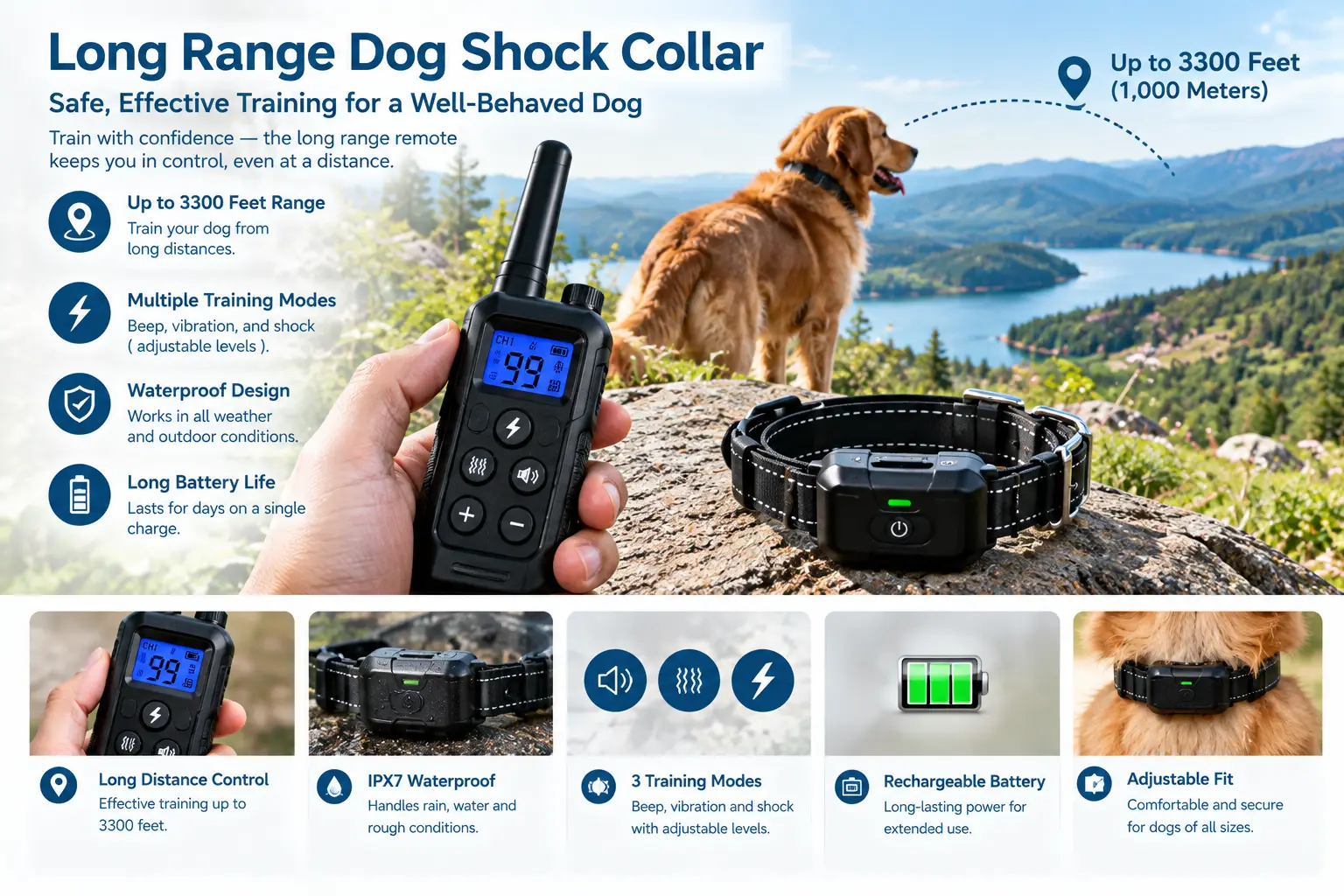
| Bousnic 3300Ft Training Collar | 3,300 ft (rated) | Beep 1-8, vibration 1-16, static 1-99 | Waterproof | Tight budgets, backyard-to-park work |
| HapTop 4500FT Training Collar | 4,500 ft (rated) | Beep 1-8, vibration 1-16, static 0-99 | IPX8 | Budget buyers who want a no-shock mode |
Looking at the table, the real split isn’t range — it’s the precision and durability you get for the money. The Educator ET-800 “The Boss”, SportDOG SportHunter 1825X, and Dogtra 1900X Black Edition all claim a mile, but they differ sharply in how finely you can tune stimulation and how many dogs one remote can run. Meanwhile, the Bousnic 3300Ft Training Collar and HapTop 4500FT Training Collar quote big feet-based numbers that look impressive on paper, but treat those as open-field best cases rather than promises.
💬 One click helps other shoppers make an informed choice too! 😊
Top 7 Long Range Dog Training Collar Picks: Expert Analysis
1. Educator ET-300 Mini — most precise for smaller dogs
The Educator ET-300 Mini proves that “long range” doesn’t have to mean “big and heavy,” packing a half-mile system into a receiver sized for dogs as small as 5 pounds.
Its headline feature is 100 levels of what E-Collar Technologies calls “blunt” stimulation, plus tone and a vibration-style “tapping” mode and a collar night light. In practice, 100 levels let you find the lowest level your dog barely notices — often called the “working level” — instead of jumping between coarse steps. For a sensitive Sheltie or a reactive terrier, that granularity is the difference between a gentle tap on the shoulder and a startle.
Based on comparing the specs, this is the best fit for owners of small-to-medium dogs doing park, trail, and farm-property recall rather than big-country hunting. Half a mile is plenty for most off-leash hiking, because you’ll rarely want a small dog farther away than that anyway. The ergonomic “stopwatch” style remote is a love-it-or-hate-it design, so it suits people who prefer a thumb-dial over a row of buttons.
Owner feedback summarized across retailer listings and third-party roundups consistently highlights Educator’s US-based customer support; we couldn’t verify a reliable star-rating breakdown, so we won’t quote one.
Pros:
- ✅ Fine 100-level dial for sensitive dogs
- ✅ Lightweight receiver suits dogs from about 5 pounds
- ✅ Built-in light helps you spot your dog at dusk
Cons:
- ❌ Half-mile range limits big-country hunting use
- ❌ Unusual remote shape takes practice to master
Typically priced around $200 (check the current price) — strong value if precision matters more than raw distance.
2. Educator ET-800 “The Boss” — mile-long reach for stubborn dogs
The Educator ET-800 “The Boss” takes the Educator stimulation philosophy and doubles the reach to a rated one mile, aimed squarely at strong-willed, high-drive dogs.
You get the same 100-level blunt stimulation, tone, and vibration, but with a floating remote and a 1-inch by 30-inch Biothane strap that’s waterproof and can be trimmed without fraying. That floating remote matters more than it sounds: drop it off a dock or into a duck marsh and you’re not wading in after a sinking transmitter. Biothane also shrugs off mud and odor, which canvas straps soak up.
Here’s what to weigh: Educator markets the Educator ET-800 “The Boss” as having the highest top-end output of its lineup, which is reassuring for a distracted Lab chasing deer scent — but that ceiling is a safety margin, not a target. It’s built for dogs 15 pounds and up, so it’s the logical step up from the Educator ET-300 Mini for owners of larger, harder-headed dogs or those working in wide-open ranch land.
Retail listings and roundups commonly position it as a premium “maximum range and power” pick, and long-term owners repeatedly mention responsive manufacturer support.
Pros:
- ✅ Rated one-mile range for wide-open terrain
- ✅ Floating remote survives water mishaps
- ✅ Trimmable Biothane strap stays clean and fray-free
Cons:
- ❌ Overkill for small dogs or suburban use
- ❌ Higher output ceiling demands disciplined handling
Usually in the $250-$300 range at the time of writing — fair value for professional-grade range and support.
3. SportDOG SportHunter 1825X — best for multi-dog hunting crews
The SportDOG SportHunter 1825X is the one to beat if you run more than two dogs, expanding to six collars on a single remote.
It offers a one-mile rating, tone, vibration, and 21 static levels arranged in low, medium, and high ranges, plus DryTek waterproofing rated submersible to 25 feet. The 21-level setup is coarser than a 100-level dial, but SportDOG designed the remote for “no-look” operation: you feel your way to the right setting without taking your eyes off a bird dog quartering a field. Lithium-ion batteries recharge in about two hours, and the collar fits dogs 8 pounds and up with neck sizes from 5 to 22 inches.
What most buyers overlook with this model is how valuable six-dog capacity becomes over time — you buy one remote now and add Add-A-Dog collars later instead of juggling two transmitters. For waterfowl hunters, 25-foot submersion means retrieves in deep, cold water aren’t a reliability gamble.
Hunting-focused roundups frequently rank it as a fit for serious hunters; the most common caveat in owner discussions is that 21 levels feel less nuanced for very soft dogs.
Pros:
- ✅ Expands to six dogs on one remote
- ✅ Submersible to 25 feet for waterfowl work
- ✅ No-look controls keep eyes on the dog
Cons:
- ❌ 21 levels are coarser than 100-level rivals
- ❌ Bulkier than compact single-dog systems
Expect roughly $300-$360 depending on the retailer — excellent value per dog if you run a pack.
4. Dogtra 1900X Black Edition — toughest build for big dogs
The Dogtra 1900X Black Edition is Dogtra’s longest-range X-Series unit and arguably the most armored collar in this lineup.
It combines a one-mile rating with 0-100 “high output” levels, nick and continuous stimulation, tone, and XPP vibration, plus a quick “Boost” and a safety level lock. The receiver is rated IPX9K — a standard that covers high-pressure, high-temperature water jets, which goes beyond simple submersion ratings — and it ships with a protective case and a 1,000-lux LED light. One detail worth noticing: the standard Dogtra 1900X is rated at 3/4 mile, so make sure the listing actually says “Black Edition” if you want the full mile.
Based on the specs, this is a big-dog collar: Dogtra recommends it for dogs 35 pounds and up, and the receiver weighs about 5.6 ounces. That rules it out for small breeds but makes it a natural fit for shepherds, pit mixes, and large hounds that are hard on gear. USB-C charging is a quiet quality-of-life win in 2026.
Owner reviews on Dogtra’s own product page are largely positive about build quality, though at least one buyer openly hopes the mile range holds up in practice — a fair, realistic expectation.
Pros:
- ✅ IPX9K rating and protective case for harsh use
- ✅ Boost and level lock aid safe, consistent handling
- ✅ Bright LED helps track dogs after dark
Cons:
- ❌ Not suitable for dogs under 35 pounds
- ❌ Easy to confuse with the 3/4-mile standard model
Generally around $300-$330 at the time of writing — premium price, premium durability.
5. Garmin Sport PRO — simplest one-handed field control
The Garmin Sport PRO trades maximum distance for an ergonomic, four-button design that many gun dog trainers find faster to use under pressure.
It runs to 3/4 mile with 10 levels of momentary or continuous stimulation, tone, vibration, remote-controlled beacon lights, and a built-in BarkLimiter with settable levels. Retailers list battery life at up to 60 hours, and — unusually — both the handheld and the dog device use user-replaceable lithium-ion batteries. That last point is a genuine long-term advantage: when a battery fades in year four, you swap it instead of retiring the unit.
Here’s the honest trade-off. Ten levels are the fewest in this lineup, so fine-tuning is limited. But for handlers who want a positive “click” between settings and a fixed antenna that can’t snap off, simplicity is the feature. The dog device weighs about 3.5 ounces and is water-rated to 1 ATM, while the handheld is IPX7 and floats.
Specialist gun dog retailers describe 3/4 mile as ample for most training and close-working field dogs, while noting range varies with weather, terrain, and cover — a caveat that applies to every unit here.
Pros:
- ✅ User-replaceable batteries extend service life
- ✅ Fixed antenna eliminates a common breakage point
- ✅ Built-in bark limiter adds everyday usefulness
Cons:
- ❌ Only 10 stimulation levels limit fine-tuning
- ❌ Shorter rated range than one-mile competitors
Typically around $300 — best value for long-term durability rather than raw specs.
6. Bousnic 3300Ft Training Collar — budget pick with surprising versatility
The Bousnic 3300Ft Training Collar is the collar most first-time buyers find first, and it’s earned a place in several 2026 roundups as a top budget option.
It offers beep (1-8), vibration (1-16), and static (1-99) modes, rechargeable batteries, waterproofing, and listings for dogs roughly 5 to 120 pounds, with two-dog bundles available. On paper, 99 static levels look comparable to premium units — but the number of levels says nothing about how smooth each step feels or how consistent the output is from collar to collar. That’s where established brands justify their price.
Based on comparing the specs, the Bousnic 3300Ft Training Collar makes sense for backyard boundary work, park recall, and owners testing whether remote training suits their dog before investing more. Treat the 3,300-foot figure as open-field marketing; in wooded terrain, expect a fraction of it.
Pet-focused review sites such as Dogster have ranked it highly for value. We couldn’t verify long-term durability data, so if you need a collar for years of hard field use, the premium options are the safer bet.
Pros:
- ✅ Very low entry price for remote training
- ✅ Three modes including vibration-only training
- ✅ Two-dog bundles available for multi-pet homes
Cons:
- ❌ Real-world range falls well short of the rating
- ❌ Long-term durability is harder to verify
Usually under $60 at the time of writing — great value for casual use, not for professional work.
7. HapTop 4500FT Training Collar — budget option with a true no-shock mode
The HapTop 4500FT Training Collar stands out among budget collars for one practical reason: a dedicated no-shock mode for owners who want tone and vibration only.
Listings show beep (1-8), vibration (1-16), and static (0-99), an IPX8 waterproof rating, and suitability for dogs from about 10 to 120 pounds. The “0” static floor and the no-shock mode let you train with tone and vibration while keeping static locked out entirely — a smart setup for families who share the remote or for dogs that respond well to vibration alone.
Here’s what to weigh: the 4,500-foot rating is the highest number in this guide, but it’s the least verifiable. A higher rated range on a budget unit doesn’t mean better signal penetration than a premium mile-rated collar. Think of the HapTop 4500FT Training Collar as a flexible, low-cost option for open spaces and beginners who prioritize vibration-based communication.
Third-party large-dog roundups have singled it out for range and the no-shock option; we didn’t find enough verifiable long-term reviews to comment confidently on durability.
Pros:
- ✅ Dedicated no-shock mode for vibration-first training
- ✅ IPX8 rating handles rain and swimming
- ✅ Wide dog-size range from about 10 pounds
Cons:
- ❌ Highest rated range is also least verifiable
- ❌ Brand support track record is less established
Typically in the budget tier, under about $80 — check the current price before buying.
Side-by-Side Spec Comparison of All 7 Collars
| Model | Dog Size | Max Dogs per Remote | Notable Extra | Price Tier | Best For |
|---|---|---|---|---|---|
| Educator ET-300 Mini | 5 lb+ | 1 (2-dog version sold) | Night light | Mid (~$200) | Educator ET-300 Mini: sensitive, smaller dogs |
| Educator ET-800 “The Boss” | 15 lb+ | 1 (2-dog version sold) | Floating remote | Mid-high | Educator ET-800 “The Boss”: stubborn, high-drive dogs |
| SportDOG SportHunter 1825X | 8 lb+ | 6 | 25 ft submersion | High | SportDOG SportHunter 1825X: multi-dog hunting |
| Dogtra 1900X Black Edition | 35 lb+ | 3 | IPX9K + LED | High | Dogtra 1900X Black Edition: large, rugged dogs |
| Garmin Sport PRO | Most breeds | 3 | Replaceable batteries | High | Garmin Sport PRO: simple one-handed field control |
| Bousnic 3300Ft Training Collar | ~5-120 lb | 2 (bundle) | Low cost | Budget | Bousnic 3300Ft Training Collar: casual use |
| HapTop 4500FT Training Collar | ~10-120 lb | 1+ (varies) | No-shock mode | Budget | HapTop 4500FT Training Collar: vibration-first beginners |
This table shows why dog size should be your first filter, not range. The Dogtra 1900X Black Edition excludes dogs under 35 pounds, while the Educator ET-300 Mini starts at 5 pounds — a gap that instantly decides the purchase for many owners. If you run several dogs, the SportDOG SportHunter 1825X‘s six-dog capacity makes its higher price look much cheaper per dog.
Getting Started: Your First 30 Days With a Long Range E Collar
The collar is only as good as your introduction plan. Here’s a sensible 30-day framework that works with any of the seven models.
Days 1-7: Fit and Familiarity
Let your dog wear the collar — switched off — for short periods during walks and meals, so it predicts good things rather than corrections. Fit is critical: the contact points must touch skin, snug enough that you can slide one or two fingers under the strap. Rotate the receiver position every couple of hours and never leave it on all day, since constant pressure in one spot can cause skin irritation known as pressure sores.
Days 8-14: Find the Working Level
In a quiet yard, start at the lowest level and increase one step at a time until you see a subtle sign of awareness — an ear flick, a head turn. That’s your working level. Many owners start with tone or vibration only, which the HapTop 4500FT Training Collar‘s no-shock mode and every premium unit here support.
Days 15-30: Distance in Small Steps
Pair the cue (“Come!”) with the tone, then reward heavily with food or play when your dog arrives. Extend distance gradually using a 30- to 50-foot long line before going fully off-leash.
⚡ Common first-month mistakes:
- ✅ Testing range before reliable short-distance recall exists
- ✅ Using the collar while angry or frustrated
- ✅ Skipping rewards because “the collar does the work”
A long-range collar extends a skill your dog already has; it doesn’t create one from nothing.
Real-World Scenarios: Matching the Collar to Your Life
Specs only become useful when you map them onto real situations. Here are three common profiles.
Scenario 1: The Weekend Trail Hiker
You hike two or three times a week with a 25-pound Australian Shepherd mix that bolts after squirrels. Your budget is around $200 and your trails are wooded. The Educator ET-300 Mini fits best: half a mile is more than enough for a dog you want within sight, and 100 levels let you stay low and subtle. A budget collar’s inflated range claims won’t help you in trees, but finer control will.
Scenario 2: The Waterfowl Hunter With Three Labs
You hunt every weekend from September to January and run three retrievers. Water submersion and multi-dog capacity matter more than anything else. The SportDOG SportHunter 1825X is the natural pick — 25-foot submersion and room to grow to six dogs. The Garmin Sport PRO is a strong alternative if you prefer its button layout and value replaceable batteries over extra dog capacity.
Scenario 3: The Rural Owner With a Big, Tough Guardian Breed
You own 40 acres and a 90-pound shepherd mix that patrols and occasionally wanders toward the road. You want ruggedness and real reach. The Dogtra 1900X Black Edition or Educator ET-800 “The Boss” both qualify. Choose the Dogtra 1900X Black Edition if the dog is hard on gear; choose the Educator ET-800 “The Boss” if you value the floating remote and finer blunt stimulation for a dog with a softer temperament.
The pattern across all three: start with your terrain, your dog’s size and sensitivity, and how many dogs you run — then let range be the tiebreaker.
Problem → Solution: Fixing Common Long-Range Training Headaches
Even good collars cause frustration when something small goes wrong. Here are the issues owners run into most, with practical fixes.
Problem 1: “My dog doesn’t react at all.” ✅ Solution: Check contact before raising the level. Thick-coated breeds often need the longer contact points included with the Educator ET-800 “The Boss”, Garmin Sport PRO, and SportDOG SportHunter 1825X. Also confirm the collar is charged and paired.
Problem 2: “Range is way shorter than advertised.” ✅ Solution: Hills, dense brush, water, and even how you hold the remote affect signal. Hold the transmitter up and away from your body, and gain elevation when possible. Rated range is an open-field ceiling, so plan for less.
Problem 3: “My dog only listens when wearing the collar.” ✅ Solution: This is called “collar-wise” behavior. Have the dog wear the collar (or a dummy collar) at random times, including when you won’t use it, and keep rewards a big part of every session.
Problem 4: “Red spots on the neck.” ✅ Solution: Those usually come from prolonged wear and friction, not the stimulation itself. Limit wear time, rotate placement, and clean the skin and contact points regularly.
Problem 5: “Battery dies mid-hunt.” ✅ Solution: Charge the night before, carry a power bank for USB units like the Dogtra 1900X Black Edition, and consider the Garmin Sport PRO if long-term battery replacement matters to you.
✨ Ready to upgrade your off-leash freedom?
🔍 Take your training to the next level with this carefully curated lineup. Click a highlighted collar to check current pricing and availability — these picks can help you enjoy safer, more confident off-leash adventures with your dog!
How to Choose a Long Range Dog Training Collar
Choosing the right long range dog training collar comes down to seven questions, answered in order:
- Match the collar to your dog’s size. Receiver weight and minimum dog weight vary from 5 to 35 pounds; a collar that’s too heavy causes discomfort and resentment.
- Be honest about the distance you actually need. Most pet owners rarely exceed a quarter mile of useful visual contact; hunters and ranch owners may genuinely need a mile.
- Check stimulation granularity. More levels (100 vs. 10 or 21) make it easier to find a low working level for sensitive dogs.
- Prioritize tone and vibration options. These let you communicate without static and are essential for a humane training progression.
- Read the waterproof rating carefully. “Water-resistant” isn’t “submersible.” The IP code standard explained here shows why IPX7, IPX8, and IPX9K mean different things.
- Count your dogs — now and later. Expandable systems save money long term.
- Look at battery design and support. Replaceable batteries and responsive US support extend a collar’s life by years.
Answer these honestly and the choice usually narrows to one or two models.
Long Range E Collar vs GPS Tracker vs Long Line: Which Do You Need?
People shopping for a long range e collar often confuse it with GPS tracking collars or simply a long training leash. They solve different problems.
| Tool | What It Does | Range | Training Feedback | Best For |
|---|---|---|---|---|
| Long range e collar (e.g., SportDOG SportHunter 1825X) | Sends tone, vibration, or static | 1/2 to 1 mile rated | Yes, instant | Off-leash recall and boundaries |
| GPS tracking collar | Shows your dog’s location on a map | Often several miles | Usually no (combo units exist) | Finding dogs that roam out of sight |
| Long line (30-50 ft) | Physical connection | Leash length | Indirect | Teaching recall before going off-leash |
The comparison makes the division clear: an e-collar communicates, a GPS tracker locates, and a long line teaches safely in the early stages. Many serious hunters eventually use combo systems, but most pet owners need a long line first and an e-collar second. If your dog regularly disappears over ridgelines, location tracking may matter more than training range.
In practice, these tools stack rather than compete. A long line builds the recall habit, the e-collar maintains it at a distance, and a GPS tracker becomes your safety net when visual contact is lost. Skipping the long-line stage is the most common reason e-collar training stalls — the dog never learned what “come” meant before the remote entered the picture.
Remote Dog Training Collar for Hunting: Field-Specific Advice
A remote dog training collar for hunting faces conditions pet collars rarely see: cold water, mud, brush, gunfire, and long days. That changes your priorities.
Waterfowl and Retrievers
Submersion rating is non-negotiable. The SportDOG SportHunter 1825X‘s 25-foot DryTek rating and the Educator ET-800 “The Boss”‘s floating remote directly address the two most common failure points: a flooded receiver and a lost transmitter.
Upland and Pointing Dogs
Fast, wide-ranging dogs push range hardest. One-mile ratings give you margin in open grassland, but cover and rolling ground will cut that sharply. The Garmin Sport PRO‘s beacon lights and no-look controls are practical in dawn and dusk hunts.
Hounds and Big-Running Breeds
Durability and visibility matter. The Dogtra 1900X Black Edition‘s IPX9K rating, protective case, and bright LED make it a natural fit for dogs that crash through thick brush.
One rule applies across every hunting style: introduce the collar long before the season starts. A dog’s first experience with stimulation should never be in the excitement of a flushing bird or a running deer. Practice in the off-season so the collar is just part of routine by opening day.
Features That Actually Matter (and Ones That Don’t)
Marketing language around long-range collars can be overwhelming. Here’s an honest filter.
Features That Matter ✅
- Fine stimulation control — The ability to stay at a low, barely noticeable level is the foundation of humane, effective use.
- Tone and vibration modes — Critical for owners who want to minimize static entirely.
- Reliable waterproofing — Especially for sporting breeds and rainy climates.
- Level lock and safety features — The Dogtra 1900X Black Edition‘s safety lock prevents accidental jumps in intensity.
- Real customer support — Repairs, replacement parts, and warranty matter after year one.
Features That Matter Less Than You Think ❌
- Massive feet-based range claims — 4,500 feet on a budget unit isn’t automatically better than a one-mile premium rating.
- Hundreds of static levels on cheap units — The number means little if each step isn’t consistent.
- Flashy remote screens — Helpful, but no-look tactile controls often matter more in the field.
A good rule of thumb: pay for precision, durability, and support. Those features keep the collar useful and safe for years, while inflated specs mostly sell the first purchase.
Long-Term Cost and Maintenance
The sticker price is only the beginning of what a long range dog training collar costs you.
| Cost Factor | Budget Units (e.g., Bousnic 3300Ft Training Collar) | Premium Units (e.g., Garmin Sport PRO) |
|---|---|---|
| Upfront price | Under ~$80 | ~$200-$360 |
| Battery life over time | Often sealed; unit may need replacing | Some have replaceable batteries |
| Replacement parts | Limited availability | Straps, contacts, receivers widely sold |
| Support/warranty | Varies by seller | Established US brands with defined warranties |
| Best For | Short-term or casual use | Garmin Sport PRO: long-term field use |
Over five years, a premium collar with replaceable parts often costs less per year than replacing two or three budget units. That’s especially true if you add dogs later — an expandable system like the SportDOG SportHunter 1825X lets you buy just a receiver instead of a whole new kit.
Simple Maintenance Routine
- 🔋 Charge fully before storage, and top up every few weeks during the off-season.
- 🧼 Clean contact points and the strap weekly with mild soap and water.
- 🔩 Check contact points for tightness — loose contacts are a common cause of “it stopped working.”
- 🌡️ Store in moderate temperatures; extreme heat in a truck cab can degrade lithium batteries.
These habits take minutes and prevent most of the failures owners blame on the collar itself.
Safety, Welfare, and Regulations
No honest guide to a long range shock collar for dogs can skip the welfare debate.
What Veterinary Behavior Experts Say
The American Veterinary Society of Animal Behavior’s Humane Dog Training Position Statement recommends reward-based methods for all dog training and advises against aversive tools, which include electronic collars used for correction. That’s a significant professional position, and it’s worth reading before you buy.
Many trainers argue that low-level, well-timed stimulation used as communication — paired with rewards — is different from punishment. Whatever your view, the practical takeaways overlap:
- ✅ Always start with tone or vibration and the lowest effective level.
- ✅ Never use a collar to address fear or aggression without a qualified professional.
- ✅ Pair every session with rewards your dog values.
- ✅ Stop and reassess if your dog shows stress signals (tucked tail, avoidance, cowering).
Legal Landscape
In the US, there is no federal ban on remote training collars, but local rules, park regulations, and organizational policies can vary, so check before using one in public spaces. Some countries have restrictions — Wales banned them in 2010 and England followed with a ban in 2024 — which matters if you travel abroad with your dog. Radio devices sold in the US should carry an FCC ID on the label; its absence on a cheap import is a red flag.
Common Mistakes to Avoid When Buying a Long Range Shock Collar for Dogs
A few predictable mistakes cause most bad experiences:
- ❌ Buying range you’ll never use. A one-mile collar for a Chihuahua in a suburban park adds weight and cost without benefit.
- ❌ Ignoring minimum dog weight. The Dogtra 1900X Black Edition is designed for 35 lb+ dogs; putting it on a 20-pound dog is a fit problem waiting to happen.
- ❌ Confusing model variants. The standard Dogtra 1900X (3/4 mile) and the Dogtra 1900X Black Edition (1 mile) look nearly identical in listings.
- ❌ Skipping multi-dog planning. Buying a single-dog unit when a second dog is coming means buying twice.
- ❌ Trusting range claims blindly. Budget feet-based ratings are open-field figures.
- ❌ Ignoring support and parts. A lost contact point or worn strap shouldn’t end a collar’s life.
Every one of these is avoidable with five minutes of planning and a careful read of the listing.
FAQ: Long Range Dog Training Collar Questions
❓ Is a long range dog training collar worth it for a pet owner?
❓ Which long range e collar works best for small dogs?
❓ Can I use a 1 mile dog training collar on two dogs?
❓ Are cheap long range shock collars for dogs safe?
❓ Do long-range collars work through trees and hills?
Conclusion: Picking the Right Long Range Dog Training Collar
The best long range dog training collar isn’t the one with the biggest number on the box — it’s the one that matches your dog’s size, temperament, terrain, and the number of dogs you run.
Here’s the quick recap:
- 🐾 Educator ET-300 Mini — precise, lightweight choice for smaller or sensitive dogs.
- 🐾 Educator ET-800 “The Boss” — one-mile reach and floating remote for strong-willed dogs.
- 🐾 SportDOG SportHunter 1825X — six-dog capacity and deep submersion for hunters.
- 🐾 Dogtra 1900X Black Edition — rugged, IPX9K-rated option for large dogs.
- 🐾 Garmin Sport PRO — simple controls and replaceable batteries for long-term use.
- 🐾 Bousnic 3300Ft Training Collar — low-cost entry point for casual training.
- 🐾 HapTop 4500FT Training Collar — budget option with a no-shock mode.
Whichever you choose, the collar works best as one part of a reward-centered training plan. Start low, keep sessions positive, build distance gradually, and treat the remote as a way to communicate rather than correct. If you want to dig deeper into the science, Purdue University’s Canine Welfare Science resource on humane training is an excellent next read.
🚀 Give your dog more freedom — safely!
🔍 Click any highlighted collar above to check current pricing and availability, and start building the off-leash recall you and your dog both deserve!
Recommended for You
- Dog Fence Designs: 7 Best Picks That Actually Work (2026)
- Halo Harness: 7 Best Picks for Blind Dogs (Honest 2026 Guide)
- Heavy Duty Dog Fence: 7 Best Escape-Proof Picks (2026 Guide)
Disclaimer: This post contains affiliate links. As an Amazon Associate, I earn from qualifying purchases made through these links, at no additional cost to you.
✨ Found this article helpful? Share it with someone who needs it! 💬🤗