
In This Article
What Is a Vibration Collar for Small Dogs?
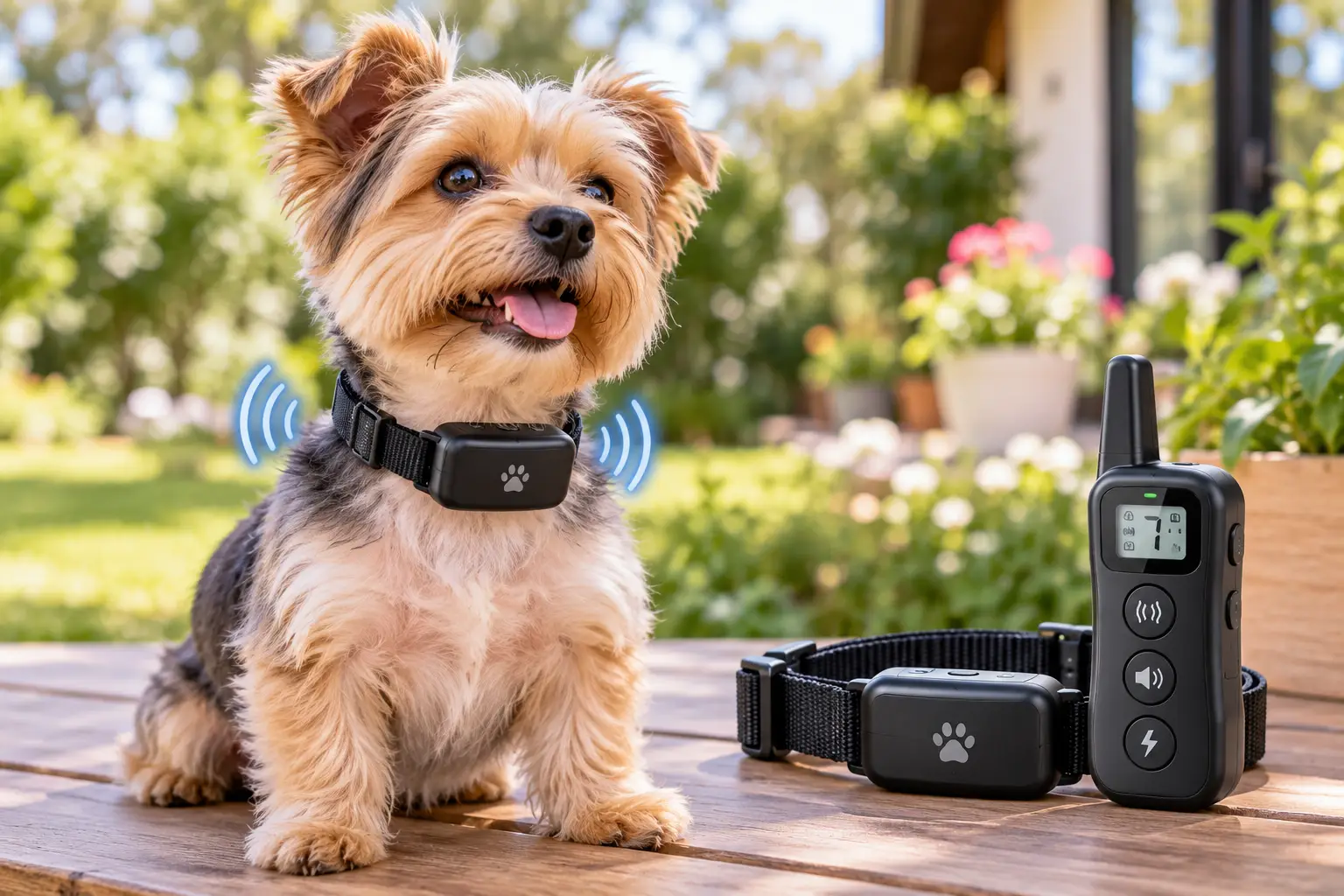
A vibration collar for small dogs is a lightweight collar with a receiver that buzzes against your dog’s neck—either when you press a remote or when a built-in sensor detects barking. In vibration mode, it delivers no electric stimulation, and small-dog models are rated for pups weighing as little as 5 to 10 pounds.
If you share your home with a Chihuahua, Yorkie, Pomeranian, or Shih Tzu, you already know that small dogs have very big opinions. They bark at the mail carrier, ignore you at the dog park, and treat “come” as a polite suggestion rather than a request. A vibration collar for small dogs gives you a quiet, tactile way to say “hey, look at me” without shouting across the yard—and without the static stimulation of a traditional e-collar.
The catch? Most training collars are designed with Labradors in mind. A receiver that feels like a key fob on a 70-pound retriever can feel like a brick on a 6-pound Papillon. That’s why this guide focuses on the details that actually decide whether a collar helps or just annoys your dog: weight ratings, receiver size, and how finely you can adjust the buzz.
It’s also worth being clear-eyed about what vibration can and can’t do. As Whole Dog Journal’s in-depth look at vibration collars explains, these tools work best as a cue rather than a consequence—and not every dog notices the buzz right away. So below, you’ll find seven real models available on amazon.com, from budget no-shock remotes to professional pagers, analyzed spec by spec. You’ll also get a 30-day how-to plan, real-world buyer profiles, troubleshooting fixes, and a decision framework.
One note on method: our analysis relies on manufacturer spec sheets and publicly available product information, and we say so plainly whenever customer-review data couldn’t be verified.
Quick Comparison: The Best Vibration Collar for Small Dogs at a Glance
| Product | Type | Minimum Dog Size | Range / Trigger | Vibration Control | Price Range* | Best For |
|---|---|---|---|---|---|---|
| Educator PG-300 Pager | Remote pager (vibration + tone only) | 10 lbs | Up to 1/2 mile | 100 levels | Premium ($150+) | Educator PG-300 Pager: deaf dogs & off-leash recall |
| eXuby Tiny No Shock Collar | Remote (vibration + sound only) | 5 lbs (5–15 lbs) | Up to 1,000 ft | Adjustable | Budget | eXuby Tiny No Shock Collar: toy breeds on a budget |
| Dogtra iQ VIBE | Automatic bark collar (vibration only) | 10 lbs | Bark-activated | 3 duration levels | Around $60 | Dogtra iQ VIBE: sensitive barkers |
| PetSafe Vibration Bark Control Collar | Automatic bark collar (vibration only) | Any size, 6+ months | Bark-activated | 10 randomized combos | $75–$90 | PetSafe Vibration Bark Control Collar: no-charge convenience |
| PaiPaitek PD526V No Shock Collar | Remote (vibration + beep) | 5 lbs (5–120 lbs) | Up to 3,300 ft | 1–100 levels | Under $55 | PaiPaitek PD526V No Shock Collar: multi-dog homes |
| Dogtra iQ Mini | E-collar with pager vibration | 7 lbs | Up to 400 yards | Non-stim pager | Around $180 | Dogtra iQ Mini: lightest receiver |
| Educator ME-300 Micro | E-collar with tapping vibration | 5 lbs | Up to 1/3 mile | Tapping + tone | Around $200 | Educator ME-300 Micro: trainer-guided programs |
*Price ranges reflect listings at the time of writing. Prices change often—check the current price.
Looking at the table above, the first decision is simple: remote collars (you press the button) versus automatic bark collars (the collar reacts on its own). If barking is your only issue, the Dogtra iQ VIBE and the PetSafe Vibration Bark Control Collar spare you from standing guard all day, whereas the Educator PG-300 Pager is the cleanest premium remote with no static function at all. Meanwhile, the Dogtra iQ Mini and Educator ME-300 Micro also include static stimulation—we include them because their receivers are among the smallest available, not because we recommend using that function.
💬 Found your match in the table? Click a highlighted collar to check today’s price and availability—one click helps other shoppers make an informed choice too! 😊
Top 7 Vibration Collars for Small Dogs: Expert Analysis
Each pick below is a real model you can find on amazon.com. We’ve translated every spec into what it means for a dog who weighs less than a bag of groceries.
1. Educator PG-300 Pager — best vibration-only remote pager
The Educator PG-300 Pager is the rare premium remote collar that ships with no static function at all—just vibration and tone. You get 100 adjustable levels of both, plus a half-mile range, which means you can dial the buzz down to a whisper for a sensitive Havanese instead of choosing between “barely there” and “startling.” Both units are rechargeable, the included Biothane strap is waterproof and odor-resistant, and a night tracking light helps you spot your dog at dusk. Educator rates it for dogs 10 pounds and up with neck sizes from 5 to 22.5 inches.
Based on comparing the specs, this is the pick for owners who want professional-grade build quality without owning a device that can shock—deaf dogs, service-dog prospects, and anxious rescues in particular. It’s arguably overkill for a dog who only needs a nudge in the living room. However, for off-leash recall at the park, that range and fine-grained control earn their keep. What most buyers overlook: the 10-pound minimum rules it out for many Chihuahuas and teacup Yorkies.
We couldn’t verify a large, consistent pool of customer reviews for this model, so we won’t summarize one. Notably, though, the Amazon listing itself says the maker is monitoring connectivity feedback, which hints that pairing consistency has come up.
Pros:
- ✅ Vibration and tone only—no static button to misuse
- ✅ 100 vibration levels allow genuinely fine adjustment
- ✅ Waterproof Biothane strap resists odor and grime
Cons:
- ❌ Not rated for dogs under 10 pounds
- ❌ Costs far more than budget no-shock collars
💲 Premium-priced (generally $150+ at the time of writing—check the current price), but excellent long-term value as a lifelong deaf-dog or recall tool.
2. eXuby Tiny No Shock Collar — built for 5–15 pound pups
The eXuby Tiny No Shock Collar was designed from the ground up for toy breeds, which is exactly what most budget collars are not. It’s rated for dogs between 5 and 15 pounds and offers only sound and vibration—there’s no shock mode and, per the brand’s listing, no metal prongs pressing into your dog’s neck. In practice, that prong-free receiver matters more on a 6-pound Maltese than any headline spec, because a smooth back plate is far less likely to rub. The 1,000-foot range comfortably covers a backyard or neighborhood park, and both the remote and receiver are rechargeable, so you won’t be feeding it coin cells.
Here’s what to weigh: this is a starter tool, not a field system. It’s a strong fit for first-time owners working on attention cues, jumping on guests, or “leave it” around the house. The interchangeable face plates and reflective straps are a nice touch for evening walks. Still, “water-resistant” isn’t the same as waterproof, so skip swims and downpours.
We couldn’t verify a consistent, large body of customer reviews for this exact listing (the same design also appears under the Wiggle Kingdom name), so treat it as promising but less proven than the brand-name picks.
Pros:
- ✅ Sized specifically for 5–15 pound dogs
- ✅ No shock mode and a prong-free design
- ✅ Rechargeable remote and receiver cut battery costs
Cons:
- ❌ Water-resistant only, not fully waterproof
- ❌ Less verified long-term reliability than bigger brands
💲 Budget-tier pricing (check the current price) makes it a sensible, low-risk first buy for a Chihuahua or Yorkie owner.
3. Dogtra iQ VIBE — vibration-only bark control from a pro brand
The Dogtra iQ VIBE brings a professional training brand’s engineering to a bark-collar category crowded with no-name gadgets. It uses an accelerometer-based bark sensor that Dogtra says distinguishes your dog’s bark from surrounding noise—so your Pomeranian shouldn’t get buzzed just because the neighbor’s beagle is having a moment. The vibration, which Dogtra describes as four times stronger than a cellphone buzz, comes in three duration levels. In other words, you adjust how long the interruption lasts rather than how intense it feels. The receiver has no contact points, recharges in about two hours, is fully waterproof, and is rated for dogs 10 pounds and up.
Based on comparing the specs, this is the best choice for owners whose main problem is nuisance barking—alert barking at windows or whining in the crate—and who want a hands-off tool. The duration-based design is smart: a short buzz interrupts, a longer one reinforces, and nothing ever escalates into something harsh.
We couldn’t verify aggregated customer-review data for this model, so we’re sticking to what the spec sheet supports rather than guessing at owner sentiment.
Pros:
- ✅ Vibration only, with no contact points at all
- ✅ Bark sensor designed to ignore background noise
- ✅ Fully waterproof with a fast two-hour recharge
Cons:
- ❌ Not rated for dogs under 10 pounds
- ❌ Only three settings, all based on duration
💲 Around $60 at the time of writing (prices may vary)—strong value for a brand-name, vibration-only bark solution.
4. PetSafe Vibration Bark Control Collar — randomized buzz fights habituation
The PetSafe Vibration Bark Control Collar tackles the biggest weakness of vibration bark collars: dogs getting used to the same buzz. PetSafe’s answer is 10 combinations of vibration with random duration, delivered from one of two vibration points, so the sensation varies each time. That’s genuinely useful, because a predictable stimulus is much easier to tune out. Dual sound-and-vibration sensors aim to trigger only on your dog’s own bark, and an automatic safety shut-off prevents nonstop activation. The collar is waterproof, adjusts for neck sizes from about 6 to 28 inches, and runs on a replaceable 3-volt RFA-188 battery that typically lasts three to six months, with an On/Off switch to stretch it further.
On paper, this suits owners who prefer a set-it-and-forget-it collar and don’t want yet another device to charge. The trade-off is that long 28-inch strap: on a toy breed, you’ll trim a lot of excess. PetSafe also recommends it for dogs over six months old.
We couldn’t verify a reliable aggregate of customer reviews for this model. That said, PetSafe’s own support site includes troubleshooting pages for issues like the collar not vibrating, which is worth knowing before you buy.
Pros:
- ✅ Randomized vibration helps keep your dog from tuning out
- ✅ Replaceable battery lasts months with no charging
- ✅ Automatic safety shut-off is built in
Cons:
- ❌ Long strap needs trimming on tiny necks
- ❌ Replacement batteries add a small ongoing cost
💲 Roughly $75–$90 at the time of writing—fair value for charge-free convenience.
5. PaiPaitek PD526V No Shock Collar — biggest range for the money
The PaiPaitek PD526V No Shock Collar delivers specs you’d normally expect on collars costing several times as much. It offers beep and vibration only, with vibration adjustable from 1 to 100, and a remote range of up to 3,300 feet. It’s IPX7 waterproof—rated for temporary submersion—so rain and puddles aren’t a concern, and PaiPaitek claims up to 20 days of battery life per charge. Better still for busy households, one remote can run up to three collars, with a safety lock to prevent accidental presses from your pocket.
Here’s what most buyers overlook: this collar is marketed for dogs from 5 all the way up to 120 pounds. A receiver built to serve a Great Dane isn’t optimized for a 7-pound Chihuahua, so if your dog sits at the very bottom of that range, check the receiver dimensions on the listing first. For a 12- to 20-pound Beagle mix or a home with several small dogs, though, the value is hard to argue with. Also note that PaiPaitek sells other collars that include shock, so double-check you’re buying the no-shock version.
PaiPaitek’s no-shock collars carry large review counts across major retailers, but we couldn’t tie a verified average rating to this exact model.
Pros:
- ✅ 100 vibration levels for precise tuning
- ✅ Up to 3,300-foot range with three-dog support
- ✅ IPX7 waterproofing and long battery life
Cons:
- ❌ Receiver sized for a wide weight range, not tiny dogs
- ❌ Easy to confuse with the brand’s shock models
💲 Typically under $55 at the time of writing (check the current price)—excellent value for multi-dog homes.
6. Dogtra iQ Mini — lightest receiver in this lineup
The Dogtra iQ Mini stands out for one number: its receiver weighs just 1.3 ounces, the lightest we could verify among these seven. Dogtra rates it for dogs as small as 7 pounds and uses ergonomically shaped plastic contact points. It includes a non-stimulating pager vibration, a 400-yard range, two-hour rapid charging, a receiver rated IPX9K (tested against high-pressure, high-temperature water jets), and expandability to a two-dog system. Here’s the honest caveat: it’s also a static e-collar with 100 levels of nick and constant stimulation.
So who is it for? Owners of very small dogs who want the lightest possible receiver from an established brand and plan to use the pager vibration as their primary cue. Weight on the neck is a real comfort issue for tiny dogs, and 1.3 ounces is meaningfully easier to wear all afternoon than bulkier units. If you’re certain you’ll never want static, however, a vibration-only design removes the temptation entirely—a point we come back to in the buying guide below.
We couldn’t verify aggregated customer-review sentiment for the Dogtra iQ Mini, so this assessment rests on Dogtra’s published specifications, including its one-year warranty.
Pros:
- ✅ Featherweight 1.3-ounce receiver
- ✅ Rated for dogs as small as 7 pounds
- ✅ IPX9K waterproofing and a one-year warranty
Cons:
- ❌ Includes static stimulation you may not want
- ❌ 400-yard range is modest for field use
💲 Around $180 at the time of writing—worth it mainly if receiver weight is your top priority.
7. Educator ME-300 Micro — rated down to just 5 pounds
The Educator ME-300 Micro pairs Educator’s Mini transmitter with its RX-070 “Micro” receiver, which the company says is 20% smaller and lighter than its standard receiver. Officially rated for dogs 5 pounds and up, it offers tapping vibration and tone, a 1/3-mile range, and a night tracking light. The contact points sit closer together, and the receiver can rotate 90 degrees on the strap—a thoughtful detail for narrow, delicate necks. Like the Dogtra iQ Mini, though, it’s a full e-collar with 100 levels of static stimulation plus a boost function.
Based on comparing the specs, this is for owners working with a professional trainer who already uses Educator systems, especially with toy breeds under 7 pounds. The “tapping” vibration deserves a closer look: Educator describes its tapping sensation as similar to vibration but more intense, so don’t expect a gentle phone-style buzz.
Verified customer feedback is limited but instructive. One Chewy reviewer with a 12-pound dog found the included 5/8-inch strap too large and wished the vibration strength were adjustable—which suggests the tapping intensity is fixed.
Pros:
- ✅ Rated for dogs as light as 5 pounds
- ✅ Rotating receiver suits narrow necks
- ✅ Two-year warranty, assembled in Indiana
Cons:
- ❌ Tapping vibration intensity appears to be fixed
- ❌ Includes static stimulation and costs more
💲 Around $200 at the time of writing—good value only if you’ll use it with trainer guidance.
✨ Ready to trade yelling for a gentle buzz? 🐾
🔍 Take your small dog’s training to the next level with this carefully curated lineup. Click a highlighted collar to check current pricing and availability. These picks will help you enjoy calmer walks and quieter evenings the whole family will love!
How to Introduce a Vibrating Dog Collar for Small Dogs: Your First 30 Days
A vibrating dog collar for small dogs only works if your dog learns that the buzz means something good. Rushing this step is the most common reason owners decide “it doesn’t work.” Here’s a realistic month-long plan.
Week 1: Make the Buzz Predict Treats ⚡
Charge everything fully, then fit the collar snugly high on the neck. Start at the lowest vibration level, press the button, and immediately hand over a tiny, high-value treat. Repeat 10–15 times per session, two sessions a day. You’re building a simple association: buzz = chicken.
Week 2: Add a “Check-In” 👀
Now wait a beat after the buzz. The moment your dog glances at you, reward. Rescue groups like NoCo Humane recommend treating the vibration as a “check in with me” signal that comes before any other cue, and that framing is exactly right.
Weeks 3–4: Add Distance and Distractions 🌳
Move to the backyard, then a quiet park on a long line. Raise the level only one step at a time, and only if your dog clearly isn’t noticing the lower setting.
Maintenance Habits That Prevent Problems 🔋
Wipe the receiver and your dog’s neck weekly, reposition the collar every couple of hours, and remove it overnight. Recharge before every outing rather than after, since a dead receiver mid-recall teaches your dog nothing.
First-Month Mistakes to Skip ❌
Don’t buzz while your dog is barking at you in frustration, don’t jump straight to high settings, and never use the collar to “punish” an accident indoors.
Real-World Scenarios: Matching the Right Collar to the Right Dog
Specs only mean something when you map them onto real life. Here are four common small-dog profiles and the reasoning behind each match.
🏢 Profile 1: The Apartment Alarm System
An 8-pound Chihuahua who barks at every hallway noise, an owner who works from home, and a budget under $100. The Dogtra iQ VIBE looks tempting, but its 10-pound minimum rules it out. Instead, the PetSafe Vibration Bark Control Collar—suitable for any size over six months—fits the bill, and its randomized vibration helps prevent the “I’m used to it now” plateau. Pair it with covering the lower window and a white-noise machine for the best results.
🦻 Profile 2: The Deaf Senior Terrier
A 14-pound deaf Jack Russell who loves the backyard but can’t hear “come,” with daily recall practice and a flexible budget. The Educator PG-300 Pager is the natural choice: 100 vibration levels let you find the gentlest setting she notices, and there’s no static button to press by mistake.
🐕🦺 Profile 3: The Three-Dog Household
Dogs at 12, 18, and 25 pounds, weekend hikes, and a tight budget. The PaiPaitek PD526V No Shock Collar runs up to three collars from one remote, covers 3,300 feet, and handles creek crossings thanks to IPX7 waterproofing.
🎀 Profile 4: The Tiny First-Timer
A 6-pound adult Papillon, a first-time owner, and mostly indoor manners training. The eXuby Tiny No Shock Collar matches the weight range precisely, keeps costs low, and skips shock entirely—ideal for learning the ropes together.
Problem → Solution: Fixing Common Vibration Collar Headaches
Even the best collar can hit a snag in the first few weeks. Here are the five issues small-dog owners run into most often, along with practical fixes.
Problem 1: “My dog completely ignores the buzz.”
Solution: First, check the fit—on a small neck, a loose collar lets the receiver slide into fur where vibration dissipates. Next, raise the level gradually. Finally, accept that some dogs genuinely need a stronger or more adjustable unit, which is where the 100-level range of the Educator PG-300 Pager or PaiPaitek PD526V No Shock Collar helps.
Problem 2: “My dog seems scared of the collar.”
Solution: Drop to the lowest setting and go back to Week 1 pairing with treats. If fear persists, stop and consult a veterinary behaviorist—some sensitive dogs simply aren’t good candidates.
Problem 3: “The bark collar misses barks or buzzes randomly.”
Solution: Bark sensors need firm contact with the throat area. Snug the strap and center the receiver. Models with dual detection, like the PetSafe Vibration Bark Control Collar, are designed to reduce false triggers from outside noise.
Problem 4: “There’s redness under the receiver.”
Solution: Remove the collar immediately, let the skin rest, and cut daily wear time. Rotate the receiver position every couple of hours once you resume.
Problem 5: “The remote won’t connect.”
Solution: Charge both units fully, then re-pair following the manual. Test in the same room before blaming range.
How to Choose a Vibration Collar for Small Dogs
Choosing well comes down to seven steps. Follow them in order, and you’ll eliminate most bad fits before you ever click “add to cart.”
- Start with the weight rating. If your dog weighs 7 pounds, a collar rated for 10 pounds and up isn’t a fit—no matter how good the reviews are.
- Check the receiver’s size and weight. Lighter is better on tiny necks; the 1.3-ounce Dogtra iQ Mini sets the bar here.
- Pick remote or automatic. Remotes handle recall and attention training, whereas automatic bark collars only address barking.
- Insist on adjustable vibration. Small dogs vary wildly in sensitivity, so multiple levels let you use the gentlest effective setting.
- Decide: vibration-only or hybrid. The American Veterinary Society of Animal Behavior’s position statement on humane dog training recommends reward-based methods and advises against aversive ones—a strong argument for vibration-only models.
- Match range to real life. Apartment dwellers rarely need a half mile; hikers and farm owners might.
- Confirm power and waterproofing. Rechargeable saves money over time, while a waterproof rating matters if your dog swims or plays in wet grass.
Taken together, these steps usually narrow seven options down to one or two within minutes. After that, it’s a matter of budget and brand preference.
Features That Actually Matter (and Ones That Don’t)
Marketing copy loves big numbers, yet many of them barely affect a small dog’s daily life. Here’s the cut-through.
✅ Features Worth Paying For
- Accurate weight rating and small receiver. Comfort drives compliance; a dog bothered by bulk will paw at the collar instead of learning.
- Adjustable vibration intensity. It’s the difference between a cue and a startle.
- Prong-free or low-profile contact. Less rubbing on thin coats and delicate skin.
- Reliable bark detection (for bark collars). False triggers teach nothing and confuse your dog.
❌ Features That Rarely Matter
- Mile-plus range for city dogs. A 3,300-foot range is irrelevant in a one-bedroom apartment.
- “100 levels” on its own. Many small dogs respond at the very low end; precision at low levels matters more than the maximum.
- Flashy LED light modes. Nice for visibility, but they shouldn’t drive your choice.
| Product | Power Source | Waterproofing | Static Function? | Multi-Dog | Standout Feature | Best For |
|---|---|---|---|---|---|---|
| Educator PG-300 Pager | Rechargeable | Waterproof | No | 2-dog version available | 100 vibration levels | Educator PG-300 Pager: deaf dogs |
| eXuby Tiny No Shock Collar | Rechargeable | Water-resistant | No | Not specified | Interchangeable face plates | eXuby Tiny No Shock Collar: toy breeds |
| Dogtra iQ VIBE | Rechargeable (2-hr) | Fully waterproof | No | N/A (bark collar) | No contact points | Dogtra iQ VIBE: sensitive barkers |
| PetSafe Vibration Bark Control Collar | 3V battery (3–6 months) | Waterproof | No | N/A (bark collar) | Randomized vibration | PetSafe Vibration Bark Control Collar: no charging |
| PaiPaitek PD526V No Shock Collar | Rechargeable (up to 20 days) | IPX7 | No | Up to 3 dogs | 3,300-ft range | PaiPaitek PD526V No Shock Collar: multi-dog homes |
| Dogtra iQ Mini | Rechargeable (2-hr) | IPX9K receiver | Yes | Up to 2 dogs | 1.3-oz receiver | Dogtra iQ Mini: tiniest necks |
| Educator ME-300 Micro | Rechargeable | Waterproof | Yes | 2-dog version available | Rotating receiver | Educator ME-300 Micro: trainer-led programs |
Reading across the “Static Function?” column is the fastest way to filter this list: five of the seven are vibration-only, which aligns with a reward-based training philosophy. Within those five, the power column becomes the tiebreaker—the PetSafe Vibration Bark Control Collar never needs charging, while the PaiPaitek PD526V No Shock Collar stretches the longest between charges.
No Shock Collar for Small Dogs vs. Static E-Collars and Other Alternatives
A no shock collar for small dogs sits in the middle of a spectrum of options. On one side are static e-collars; on the other, spray collars and pure reward-based training with no device at all. Understanding where vibration fits helps you use it correctly.
Static e-collars deliver an electrical sensation through contact points. Some trainers use them at very low levels, but veterinary behavior organizations advise against aversive methods, and a small dog’s lower body mass leaves less margin for error. Spray collars, such as PetSafe’s Little Dog spray model (which fits necks up to 16 inches and gets roughly 30–40 sprays per refill), interrupt barking with a burst of spray—effective for some dogs, but refills add up. Reward-based training alone is the gold standard for teaching new behaviors; the challenge is getting your dog’s attention at a distance, which is precisely where vibration helps.
| Method | How It Works | Main Advantage | Main Watch-Out | Best For |
|---|---|---|---|---|
| Vibration collar | Tactile buzz as a cue | Gentle, no electric stimulation | Some dogs don’t notice it | Attention cues, deaf dogs (e.g., Educator PG-300 Pager) |
| Static e-collar | Electric stimulation | Very noticeable at distance | Aversive; risk of misuse | Experienced handlers only |
| Spray bark collar | Burst of spray on bark | No electricity involved | Ongoing refill costs | Barking-only issues |
| Reward-only training | Treats, praise, play | Builds trust and skills | Hard to reach dogs at distance | Every dog, as the foundation |
The takeaway from this comparison is that vibration isn’t a replacement for reward-based training—it’s a way to extend it across distance and noise. Used as a cue followed by a reward, a vibration collar keeps you firmly on the humane end of the spectrum while solving the practical problem of being heard.
Vibration Collar for Deaf Dogs: What Small-Dog Owners Should Know
A vibration collar for deaf dogs is one of the most compelling uses of this technology, and small breeds like Dalmatian-mix toys, white Chihuahuas, and double-merle Shelties are among the dogs who may need one. When your dog can’t hear “come,” a buzz becomes the equivalent of calling their name.
The key is conditioning. Deaf Dogs Rock suggests acclimating your dog by first holding the vibrating receiver against a leg or hip rather than starting at the neck—especially if your dog has an unknown history. The same resource stresses that vibration should be used to get attention, never as a correction.
Setting Up for Success 🦻
- Choose a vibration-only model. The Educator PG-300 Pager is purpose-built for this, with 100 levels to find the gentlest noticeable setting.
- Teach one meaning: “look at me.” Buzz, wait for eye contact, then reward with a treat and a thumbs-up hand signal.
- Layer hand signals afterward. Once your dog reliably checks in, add sit, down, and come signals.
- Use a long line outdoors. Off-leash freedom comes only after recall is rock-solid.
- Mind the startle. Deaf dogs can startle easily, so never buzz a sleeping dog.
For dogs under 10 pounds, the eXuby Tiny No Shock Collar is a budget-friendly vibration-only alternative, although its water resistance is limited.
Small Dog Vibration Bark Collar: What to Expect Day to Day
A small dog vibration bark collar is the most hands-off option in this guide, so it’s worth setting realistic expectations before you buckle one on.
How It Actually Works 🔊
Automatic collars like the Dogtra iQ VIBE and the PetSafe Vibration Bark Control Collar detect barking through sound and/or throat vibration, then deliver a buzz that interrupts the bark. The interruption creates a brief pause—and the pause is your window to redirect or reward quiet.
What Realistic Progress Looks Like 📅
Most owners see the biggest change in alert barking—at doorbells, windows, and passersby. Results vary widely by dog, though, and no collar can promise a timeline. If barking stems from boredom, the collar treats the symptom rather than the cause; more exercise, puzzle toys, and blocking visual triggers will do the heavy lifting.
When a Bark Collar Is the Wrong Tool ⚠️
Barking caused by separation anxiety, pain, or fear shouldn’t be interrupted with a collar. In those cases, talk to your veterinarian first, because suppressing the bark doesn’t resolve the distress behind it.
Daily Routine Tips 🔋
Put the collar on during your dog’s typical barking windows rather than all day. Check battery indicators weekly, and take the collar off during unsupervised sleep.
Common Mistakes to Avoid When Buying a Vibration Collar for Small Dogs
Most disappointing purchases trace back to a handful of avoidable errors. Here’s what to watch for.
- Trusting a “5 to 120 pounds” rating blindly. A collar that fits everything often fits tiny dogs worst. Check receiver dimensions, as we noted with the PaiPaitek PD526V No Shock Collar.
- Assuming the title tells the whole story. Many brands sell look-alike shock and no-shock versions. Read the listing’s mode list before buying.
- Ignoring strap width. As one owner of the Educator ME-300 Micro discovered, a strap that suits a 30-pound dog can overwhelm a 12-pound one.
- Buying for punishment. A vibration collar used as a scolding device erodes trust quickly. Plan on pairing every buzz with a reward.
- Forgetting the weight minimum. The Dogtra iQ VIBE and Educator PG-300 Pager both start at 10 pounds, which excludes many toy breeds.
- Using a bark collar for anxiety. If your dog barks only when you leave, a collar won’t fix the underlying problem.
- Skipping the fit check. Too loose and the buzz disappears into fur; too tight and you risk skin irritation.
Avoiding just the first three mistakes eliminates most returns. Beyond that, the remaining four are about using the collar well once it arrives.
Long-Term Cost and Maintenance
The sticker price is only part of the story. Over two or three years, power, parts, and replacements shape the real cost of owning a vibration collar for small dogs.
Where the Ongoing Costs Hide 💰
Rechargeable collars cost almost nothing to run day to day, but lithium batteries gradually lose capacity over years of charging. Battery-powered bark collars like the PetSafe Vibration Bark Control Collar need a replacement RFA-188 cell every few months. Losing a remote is the hidden budget-breaker: for example, Educator sells a replacement PG-300/302 transmitter for around $90, which is a substantial share of the system’s cost.
| Product | Ongoing Cost | Warranty (Verified) | Value Verdict |
|---|---|---|---|
| Educator PG-300 Pager | Low (rechargeable); ~$90 replacement remote | Check listing | Educator PG-300 Pager: premium long-term tool |
| eXuby Tiny No Shock Collar | Very low (rechargeable) | Check listing | eXuby Tiny No Shock Collar: cheapest to start |
| Dogtra iQ VIBE | Very low (rechargeable) | Check listing | Dogtra iQ VIBE: best bark-collar value |
| PetSafe Vibration Bark Control Collar | Batteries every 3–6 months | 1-year limited | PetSafe Vibration Bark Control Collar: convenience |
| PaiPaitek PD526V No Shock Collar | Very low (rechargeable) | Check listing | PaiPaitek PD526V No Shock Collar: best cost per dog |
| Dogtra iQ Mini | Low (rechargeable) | 1 year | Dogtra iQ Mini: pay for lightness |
| Educator ME-300 Micro | Low (rechargeable) | 2 years | Educator ME-300 Micro: longest verified warranty |
Looking at total cost of ownership, the PaiPaitek PD526V No Shock Collar wins on cost per dog because one remote covers three collars. On the other hand, the Educator ME-300 Micro offers the longest warranty we could verify, which offsets some of its higher upfront price.
Safety, Fit, and Standards for Small-Dog Vibration Collars
Small dogs need extra care with any neck-worn device, so safety deserves its own section.
Fit and Wear Time 🐾
Fit the receiver snugly so it stays in contact, yet loose enough to slide a finger underneath. Many manufacturers’ manuals advise repositioning the collar every couple of hours and limiting daily wear, so check your specific manual and follow it closely.
Protect the Trachea 🫁
Small breeds are prone to tracheal problems, so never clip a leash to the receiver collar. Instead, use a separate harness for walks—the training collar should carry a signal, not tension.
Understand Waterproof Ratings 💧
IPX7 means a device can survive temporary submersion. IPX9K, which Dogtra cites for the Dogtra iQ Mini, refers to resistance against high-pressure, high-temperature water jets. “Water-resistant,” by contrast, usually means splashes only.
Look for FCC Compliance 📡
Remote collars are radio devices, and radio transmitters sold in the US generally require FCC authorization. An FCC ID on the device or packaging is a quick sign you’re buying a legitimate product rather than a gray-market import.
Know the Legal Landscape ⚖️
There’s no federal US ban on training collars, but several countries restrict static e-collars. Choosing vibration-only models keeps you on the least controversial, most future-proof side of that debate.
Frequently Asked Questions About Vibration Collars for Small Dogs
❓ What's the best vibration collar for a 5-pound dog?
❓ Are vibration collars cruel for small dogs?
❓ Can puppies wear a vibration collar?
❓ How long do vibration collar batteries last?
❓ Is a vibration bark collar worth it for a Chihuahua that barks at everything?
Conclusion: Finding the Right Vibration Collar for Small Dogs
Choosing a vibration collar for small dogs isn’t about finding the most powerful device—it’s about finding the gentlest one your dog genuinely notices, in a size that actually fits. That’s why weight ratings and receiver size should drive your decision before range, levels, or looks.
For most owners who want a professional-grade, vibration-only remote, the Educator PG-300 Pager is the standout, especially for deaf dogs and recall work. If your dog weighs under 10 pounds and you’re on a budget, the eXuby Tiny No Shock Collar is sized precisely for toy breeds. Barking is your main headache? The Dogtra iQ VIBE offers brand-name, vibration-only bark control, whereas the PetSafe Vibration Bark Control Collar suits dogs under 10 pounds and owners who’d rather not recharge anything. Multi-dog households will get the most for their money from the PaiPaitek PD526V No Shock Collar. Finally, if receiver weight is everything, the Dogtra iQ Mini and Educator ME-300 Micro lead on size—just remember they also carry static functions you may choose never to use.
Whichever you pick, the collar is only half the equation. Pair every buzz with a reward, build up gradually, and you’ll turn a simple vibration into your small dog’s favorite way of hearing, “Hey, look at me.”
🐾 Give your little one a gentler way to listen!
🔍 Click a highlighted collar above to check current pricing and availability, and start building calmer walks, quieter evenings, and a stronger bond with your small dog today!
Recommended for You
- Dog Training Collar for Small Dogs: 7 Best Gentle Picks for 2026
- Radio Collar Guide 2026: 7 Best Picks for Tracking & Training
- Track Small Valuables: 7 Best Tiny Trackers for 2026 (Honest Picks)
Disclaimer: This post contains affiliate links. As an Amazon Associate, I earn from qualifying purchases made through these links, at no additional cost to you.
✨ Found this article helpful? Share it with someone who needs it! 💬🤗