
In This Article
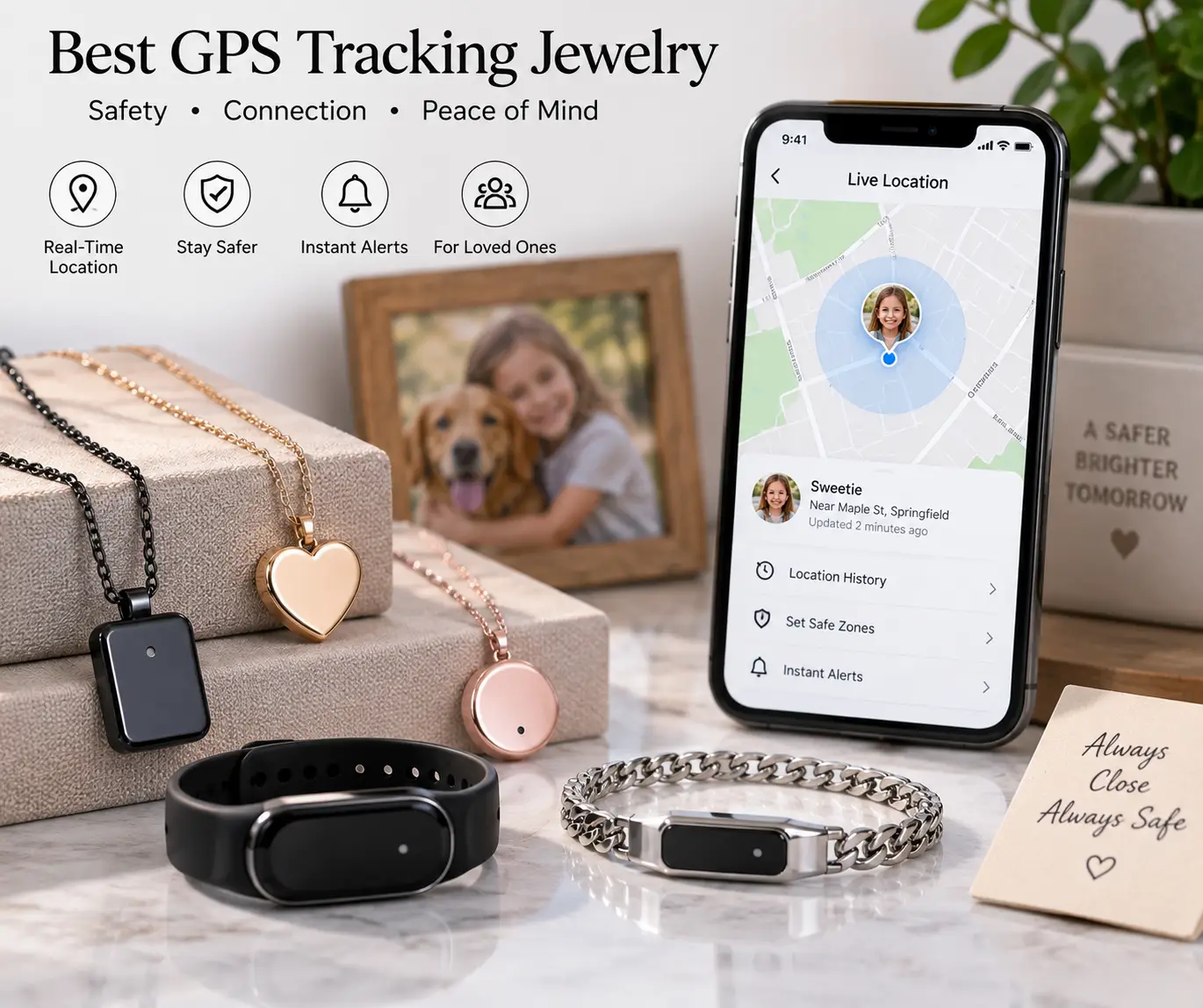
Somewhere between a panic button and a piece of jewelry sits a category of product most people don’t think about until they need it. Best gps tracking jewelry has quietly become one of the fastest-growing corners of the personal safety market, and for good reason: nobody wants to hand their mom a boxy medical-alert unit on a lanyard, and no teenager wants to wear a tracker that screams “my parents are watching me.” Jewelry solves the compliance problem that plain GPS trackers never could — because the safest device is the one someone actually keeps on.
What is GPS tracking jewelry? It’s wearable jewelry — a necklace, bracelet, pendant, or charm — with an embedded location-sharing chip that uses cellular GPS, Bluetooth, or a hybrid of both to relay a wearer’s position to a caregiver’s phone or a monitoring app, often paired with an SOS button…
This guide cuts through the marketing language and looks at what these devices can and can’t actually do. We researched real, currently available products spanning entry-level Bluetooth solutions to full cellular GPS systems with live human monitoring, and we’ll walk through genuine feature trade-offs, aggregated review sentiment, and honest price-range guidance — no invented five-star reviews, no fabricated “I tested this for a month” stories. Just a grounded comparison to help you pick the right piece for your situation, whether that’s a wandering-prone parent with dementia, a solo-commuting daughter, or a first grader walking to the bus stop alone for the first time.
Disclosure: This post contains affiliate links, and as an Amazon Associate, we may earn from qualifying purchases at no additional cost to you.
Quick Comparison: 7 Best GPS Tracking Jewelry Picks for 2026
| # | Product | Tracking Type | Best For | Price Range |
|---|---|---|---|---|
| 1 | invisaWear Smart Jewelry | Bluetooth + phone GPS relay | Discreet everyday safety | around $50–$100 |
| 2 | ResQ Jewelry Shakti V2 | Bluetooth + phone GPS relay | Fall detection + fashion | around $60–$150 |
| 3 | SecuLife Medical Alert Pendant | Standalone cellular GPS | Seniors living alone | around $40–$80 + monthly plan |
| 4 | PAJ GPS 4G Tracker for People | Standalone cellular GPS | Elderly parents & dementia care | around $70–$120 + monthly plan |
| 5 | Jiobit Smart Tag | Cellular + Bluetooth hybrid | Young kids who can’t carry a phone | around $150 + monthly plan |
| 6 | AngelSense GPS Tracker | Standalone cellular GPS | Autism & wandering prevention | around $230 + monthly plan |
| 7 | AirTag Necklace Holder | Bluetooth crowd-network | Budget-conscious, low-risk use | around $30–$45 total |
Looking at the table above, the split that matters most isn’t price — it’s how each device actually finds a person. The invisaWear Smart Jewelry and ResQ Jewelry Shakti V2 both lean on Bluetooth paired to the wearer’s own phone, which keeps them slim and stylish but means they’re only as good as the phone battery and connection next to them. The SecuLife Medical Alert Pendant, PAJ GPS 4G Tracker for People, Jiobit Smart Tag, and AngelSense GPS Tracker all carry their own cellular connection, so they work independently of any paired phone — which matters enormously for a senior with dementia who won’t reliably carry (or charge) a smartphone. The AirTag Necklace Holder sits in its own category entirely: it’s genuinely the cheapest option, but it isn’t real-time GPS at all.
💬 Ready to compare features side by side? Scroll down to see exactly which one fits your family’s situation. 😊
Top 7 Best GPS Tracking Jewelry Picks for 2026
1. invisaWear Smart Jewelry — discreet panic button disguised as everyday jewelry
The invisaWear Smart Jewelry line wins on pure disguise: it comes as a necklace, bracelet, keychain, or even a hair scrunchie, with a small button hidden on the back that most people would never notice. Double-pressing that button texts your live location to up to five chosen contacts and, with the optional ADT-backed tier, can route straight to professional monitoring capable of dispatching 911. That two-tier structure — free contacts on the base device, paid professional monitoring layered on top — means the jewelry itself is genuinely useful even if you skip the subscription entirely. Battery life is a real standout here: invisaWear Smart Jewelry runs up to a year, sometimes close to two, before the charm needs replacing, which is unusual in a category where most competitors need weekly or monthly charging.
This is the pick for someone who wants a safety net without looking like they’re wearing one — college students walking home at night, rideshare drivers, or a parent who wants a stylish alternative to a bulky panic button for an aging relative. Based on comparing the mechanism against pure GPS trackers, what most buyers overlook is that invisaWear Smart Jewelry doesn’t do continuous location tracking on its own; it shares a location snapshot only when the button is pressed, relayed through the wearer’s paired smartphone.
Independent review coverage has been consistently favorable: one safety-product review site rated it 4.6 out of 5 based on data from over 250,000 protected users, specifically praising it as “the personal-safety purchase that actually gets used” because the discreet form factor beats the compliance problem plaguing bulkier medical-alert devices.
Pros:
- ✅ Genuinely disguised as everyday jewelry, not a gadget
- ✅ Battery lasts up to a year between charges
- ✅ Optional ADT professional monitoring with 911 dispatch
Cons:
- ❌ Depends on the wearer’s phone for GPS and connectivity
- ❌ Full safety features require an ongoing paid membership
At around $50 to $100 for the jewelry itself, plus an optional membership fee for 24/7 professional monitoring, the invisaWear Smart Jewelry delivers strong value for anyone who mainly needs an emergency button rather than continuous tracking.
2. ResQ Jewelry Shakti V2 — fall detection built into fashion-forward safety jewelry
ResQ Jewelry Shakti V2 takes a similar Bluetooth-and-phone approach to invisaWear but differentiates itself with automatic fall detection layered into several of its necklace styles, plus a design line (Shakti, Mahi, Maitri) that leans more explicitly toward “fine jewelry” than “wearable tech.” A double-click sends silent or loud alerts, shares live GPS location with chosen contacts for up to 24 hours, and can optionally record background audio for context. What sets this model apart from a plain personal alarm is the built-in escalation path: if nobody in your contact list answers, a trained human agent picks up the call and can loop in emergency services on your behalf.
The fall-detection variant matters most for older adults living independently, where an unwitnessed fall — not an assault — is the more statistically likely emergency. What the spec sheet doesn’t say, but the product literature makes clear, is that fall detection on Bluetooth-based jewelry like this is a secondary safety net, not a replacement for a dedicated medical-alert base station with two-way voice through the pendant itself.
One reviewer who wore the ResQ Jewelry Shakti V2 necklace daily described it in glowing terms as an everyday piece she genuinely forgot was a safety device — exactly the kind of aggregated real-world sentiment that matters more than a manufacturer’s own claims, though we’d encourage reading a spread of reviews rather than relying on any single account.
Pros:
- ✅ Automatic fall detection available on select styles
- ✅ Elegant jewelry-first design across three collections
- ✅ 24/7 trained human agents as an alert backstop
Cons:
- ❌ Still relies on the wearer’s paired smartphone for GPS
- ❌ Multi-year safety enrollment plans add meaningfully to total cost
Expect to pay in the $60 to $150 range depending on the necklace style and whether you choose the fall-detection version, with safety enrollment plans priced separately — a fair trade for buyers who specifically want fall detection wrapped in genuinely wearable design.
3. SecuLife Medical Alert Pendant — standalone cellular GPS that skips the call center
Unlike the two jewelry-first picks above, the SecuLife Medical Alert Pendant carries its own cellular connection and GPS chip, so it doesn’t depend on a paired phone being nearby and charged. That’s a meaningful practical difference for seniors who may not reliably carry a smartphone. The pendant’s standout decision is architectural: alerts go directly to family contacts by text, email, and app notification rather than routing through a third-party call center first, which shortens the chain between “something’s wrong” and “someone who loves you knows about it.”
Key features translate into real trade-offs. The IP67 waterproof rating means it survives a shower or a rainstorm without a second thought, and the large SOS button with a simple display (time, battery, signal) was clearly designed with dementia and low-vision users in mind rather than tech-savvy grandkids. On paper, this means the SecuLife Medical Alert Pendant trades a bit of subtlety — it’s a visible medical device, not fine jewelry — for reliability that doesn’t hinge on anyone else’s phone.
The company states battery life reaches up to six days at a one-hour tracking interval; based on how battery-versus-tracking-frequency trade-offs typically play out in this device category, expect that number to shrink meaningfully if you set location updates to every few minutes instead. We weren’t able to independently verify a large volume of star-rated customer reviews for this specific pendant model at the time of writing, so we’d encourage checking current review counts directly on the product page before buying — an honest gap is better than an invented one.
Pros:
- ✅ Works independently of any paired smartphone
- ✅ Alerts route directly to family, skipping a call center
- ✅ IP67 waterproof and senior-friendly large SOS button
Cons:
- ❌ Battery life drops fast with frequent location updates
- ❌ Requires an active monthly plan for GPS to function at all
The pendant itself typically runs in the $40 to $80 range, with SecuLife’s own plans listed between roughly $20 and $34 a month depending on contract length — reasonable for a caregiver who specifically wants a no-call-center, direct-to-family alert chain.
4. PAJ GPS 4G Tracker for People — European-engineered cellular tracking with real geofencing
The PAJ GPS 4G Tracker for People is built by a German-founded company with a long track record in the vehicle- and asset-tracking space, and that engineering pedigree shows up in the accuracy of its location reporting — independent testers have described positioning as precise to within a few meters using live 4G network triangulation rather than slower 2G signals. It ships with a lanyard for wear as a pendant, plus attachment loops for a bag, belt, or keychain, so it flexes between “jewelry-adjacent” and “clip-on tracker” depending on how someone wears it.
Geofencing is where the PAJ GPS 4G Tracker for People earns its keep for dementia caregivers specifically: you draw a virtual boundary around a home or neighborhood in the app, and an alert fires the moment the wearer crosses it — often faster than the multi-minute delays some competing devices are known for. Here’s what to weigh against that accuracy: this is the least “jewelry” pick on this list. It reads as a small tech gadget rather than a necklace, which matters if the wearer is self-conscious about visibly wearing a tracker.
Independent UK reviewers who tested PAJ’s Finder devices firsthand consistently described them as accurate, easy to set up out of the box, and backed by responsive customer support — one reviewer specifically called the tracking “brilliant value for money” after using it to monitor twin daughters walking to school independently.
Pros:
- ✅ True 4G cellular GPS accurate to within a few meters
- ✅ Fast-firing geofence alerts for wandering prevention
- ✅ Versatile — pendant, keychain, backpack, or bag attachment
Cons:
- ❌ Shorter battery life (roughly 5 days) than PAJ’s vehicle trackers
- ❌ Looks more like a gadget than a piece of jewelry
Plan on around $70 to $120 for the device, plus a monthly subscription in the roughly $8 to $13 range depending on the plan tier — solid value specifically for households that prioritize geofence speed over aesthetics.
5. Jiobit Smart Tag — the purpose-built stealth tracker for young kids
Now owned by Life360, the Jiobit Smart Tag was engineered from day one to be clipped, hidden, or worn discreetly — on a shoelace, backpack strap, belt loop, or necklace — for kids too young to reliably carry or charge a phone. It uses a hybrid Bluetooth-and-cellular system that intelligently switches connection types to stretch battery life to roughly a week, longer than most cellular-only competitors on this list. A major tech outlet’s testing team named it their top overall pick for kid GPS trackers, specifically citing its rugged, shockproof, waterproof build and the ability to see which adult’s phone a child is near via Bluetooth handoff.
What most buyers overlook with the Jiobit Smart Tag is what it deliberately leaves out: there’s no SOS button, no speaker, and no microphone. That’s a feature for younger kids (nothing for a child to fidget with or misuse) but a real limitation for anyone hoping a lost child could actively call for help through the device itself. Reviews consistently report that the geofence and “where’s my kid” location updates are reliable and fast, though a smaller number of users note the companion app feels less polished than rival family-safety apps.
Based on comparing this against AngelSense below, the Jiobit Smart Tag is the right choice specifically for typical kids without elevated wandering risk — it’s meaningfully cheaper on an ongoing basis and easier to disguise, but it lacks the emergency-communication depth that special-needs families often need.
Pros:
- ✅ Purpose-built for stealth wear on young kids
- ✅ Rugged, shockproof, and fully waterproof
- ✅ Longer battery life than most cellular-only competitors
Cons:
- ❌ No SOS button or two-way voice communication
- ❌ Higher upfront device cost than several competitors here
Expect an upfront device cost around $150, with monthly plans reported in roughly the $8 to $17 range depending on contract length — a fair investment for families who specifically need a tracker young enough kids can’t tamper with or forget to charge.
6. AngelSense GPS Tracker — the deepest feature set for wandering and special needs
The AngelSense GPS Tracker was founded by parents of autistic children specifically to solve elopement and wandering risk, and that origin story is visible in every design choice. It ships with a locking belt clip that only opens with a magnetic key, plus a newer GPS smartwatch option for kids roughly ten and older, and it offers the most frequent location refresh rate on this list — as often as every ten seconds during an active event, compared to the once-a-minute-or-slower updates typical of budget competitors. Two-way calling and listen-in audio mean a caregiver can talk a lost or distressed wearer through a situation, or simply listen to ambient sound to help pinpoint where they are.
What the spec sheet doesn’t say, but caregiver interviews reveal, is how much this matters in a genuine crisis: one father described calling the device after his autistic son went missing at a zoo, hearing carousel music through the speaker, and using that single audio clue to locate him within minutes. That kind of real-time, two-way capability is simply absent from cheaper trackers on this list.
The trade-off is cost and daily maintenance. Reviews consistently place the AngelSense GPS Tracker at a strong 4-star aggregate rating, with praise centered on peace of mind and tracking reliability, but a recurring complaint is that monthly bills can climb closer to $90 once add-on features are included, and the device needs charging daily rather than weekly.
Pros:
- ✅ Most frequent real-time location updates in this roundup
- ✅ Two-way calling and listen-in audio for active emergencies
- ✅ Tamper-resistant, lockable wearable options
Cons:
- ❌ Priciest ongoing subscription of any pick on this list
- ❌ Requires daily charging, unlike week-long competitors
Budget around $230 for the device itself, with monthly plans generally falling between $40 and $65 depending on contract length — money well spent specifically for families managing active wandering risk, and comparatively overkill for typical kids without that history.
7. AirTag Necklace Holder — the budget pick, with an honest asterisk
An Apple AirTag tucked into a necklace holder is by far the cheapest way to put location tracking on someone’s neck, and it’s worth including here precisely because so many shoppers searching for gps tracking jewelry land on this option first. The honest answer is that it isn’t real-time GPS at all — it’s a Bluetooth chip that pings nearby Apple devices in the Find My network and relays position when one of them is close enough to relay it. In a dense city full of iPhones, that can feel almost like live tracking. In a rural area or anywhere Apple device density is low, updates can lag by hours or simply stop.
Key features here are genuinely useful within that limitation: precision finding on newer iPhones, a loud built-in speaker for close-range searching, and zero ongoing subscription cost. What this means in practice for a parent considering it for a child is that an AirTag Necklace Holder is reasonable for low-risk, low-stakes situations — keeping tabs on a teenager at a mall, confirming a spouse’s commute is on track — but it is not a substitute for cellular GPS in any scenario involving dementia wandering, a nonverbal child, or genuine elopement risk, because there’s no SOS button and no live tracking during an unfolding emergency.
Pros:
- ✅ Lowest total cost by a wide margin
- ✅ Zero ongoing monthly subscription fee
- ✅ Leverages Apple’s enormous Find My device network
Cons:
- ❌ Not real-time GPS — relies on nearby Apple devices
- ❌ No SOS button or live tracking during an active emergency
Total cost typically lands around $30 to $45 for the AirTag plus a jewelry-style holder, making this the entry point for the category — good value specifically for low-risk tracking, and a poor value if the actual goal is emergency response.
Full Feature Comparison of the Top 7 Picks
| Product | Connectivity | Fall Detection | SOS Button | Battery Life | Price Range |
|---|---|---|---|---|---|
| invisaWear Smart Jewelry | Bluetooth + phone | No | Yes (double-press) | Up to ~1 year | $50–$100 |
| ResQ Jewelry Shakti V2 | Bluetooth + phone | Select styles | Yes (double-click) | Weeks (phone-dependent) | $60–$150 |
| SecuLife Medical Alert Pendant | Standalone cellular | Yes | Yes | Up to 6 days | $40–$80 + plan |
| PAJ GPS 4G Tracker for People | Standalone cellular | No | Yes | ~5 days | $70–$120 + plan |
| Jiobit Smart Tag | Cellular + Bluetooth | No | No | ~1 week | ~$150 + plan |
| AngelSense GPS Tracker | Standalone cellular | No | Yes | Daily charge | ~$230 + plan |
| AirTag Necklace Holder | Bluetooth network | No | No | Up to 1 year | $30–$45 total |
The table above makes one pattern obvious: fall detection and standalone cellular GPS both push price and subscription cost up, while pure Bluetooth options like invisaWear Smart Jewelry and the AirTag Necklace Holder trade continuous independence for a lower bill. If nightly charging is a dealbreaker for your household, the Jiobit Smart Tag and SecuLife Medical Alert Pendant are the strongest week-long options, while the AngelSense GPS Tracker justifies its daily-charge routine only when active wandering risk makes ten-second location refreshes genuinely necessary.
How to Set Up Your GPS Tracking Jewelry in the First 30 Days
Getting a new device out of the box is the easy part; the mistakes that undermine gps tracking jewelry almost always happen in the first month of actual use. Start by charging the device fully before first wear, even if the packaging claims it arrives ready to go — a full initial charge cycle helps the battery meter calibrate accurately going forward, which matters a lot for cellular models with already-tight battery budgets.
Next, set up your geofence and contact list before the device leaves the house, not after. Every product in this roundup routes alerts through a companion app, and testing the alert flow with a trusted contact while everyone’s still at home catches configuration mistakes — a wrong phone number, a muted notification setting — before they matter in a real emergency. For fall-detection models like the ResQ Jewelry Shakti V2 or SecuLife Medical Alert Pendant, deliberately trigger a test fall or test SOS press in a controlled setting so the wearer (and their contacts) know exactly what the alert looks and sounds like.
Finally, build a charging habit around whatever schedule the specific device actually needs, not the schedule you wish it had. A common first-month mistake is assuming a “week-long battery” claim applies at the tracking frequency you’ve chosen; tightening location-update intervals from hourly to every few minutes, as caregivers often do after an initial scare, can cut real-world battery life dramatically. Set a recurring phone reminder tied to the device’s realistic battery life, not its marketing claim.
Real-World Scenarios: Matching GPS Tracking Jewelry to Your Situation
Consider three household profiles that map cleanly onto different picks from this list. A parent of a seven-year-old who walks to a school bus stop alone for the first time doesn’t need two-way calling or fall detection — they need something durable, hard to lose, and long-lasting on a single charge, which points squarely at the Jiobit Smart Tag or, for a tighter budget, the AirTag Necklace Holder if the route runs through a dense, iPhone-heavy neighborhood.
A daughter managing care for a mother in the early stages of dementia, who still lives independently but occasionally gets disoriented on familiar walks, is a very different case. Here, standalone cellular GPS that doesn’t depend on mom remembering to carry (or charge) her phone is non-negotiable, which makes the SecuLife Medical Alert Pendant or PAJ GPS 4G Tracker for People the sensible starting point, with an upgrade path to the AngelSense GPS Tracker if wandering episodes become more frequent or the family needs two-way voice contact during an event.
A young professional living alone in a city, mainly worried about the walk from a late rideshare drop-off to her apartment door, is best served by something that reads as pure jewelry rather than a medical device — the invisaWear Smart Jewelry necklace or the ResQ Jewelry Shakti V2 both fit that brief, giving her a genuine panic button without announcing to anyone around her that she’s wearing one.
How to Choose GPS Tracking Jewelry
- Decide whether you need standalone cellular GPS or a phone-paired Bluetooth device. If the wearer won’t reliably carry a charged phone — a young child, a senior with memory issues — standalone cellular models like the SecuLife Medical Alert Pendant are worth the extra subscription cost.
- Match the form factor to how self-conscious the wearer is. A teenager or professional adult will reject anything that reads as a medical device; a young child or cooperative senior often won’t mind a more visible pendant.
- Check the actual battery life at your intended tracking frequency, not the marketing headline — ask the manufacturer directly what battery life looks like at a five-minute update interval, since that’s a realistic setting during an active concern.
- Confirm whether fall detection or an SOS button matters for your situation. These add real cost, so skip them for a child tracker and prioritize them for elderly or solo-living family members.
- Total the true first-year cost, not just the device price — a $150 device with an $8 monthly plan costs roughly $246 in year one, while a $230 device at $50 a month runs closer to $830.
- Read the fine print on coverage area. Several cellular models, including the Jiobit Smart Tag, only guarantee reliable service in the US, Canada, the UK, and select European countries — a dealbreaker if your family travels internationally.
- Test the alert chain before you need it, as covered above — a device is only as good as the notification that actually reaches a caregiver’s phone.
Common Mistakes to Avoid When Buying GPS Tracking Jewelry
The single most common mistake is assuming “GPS tracking jewelry” always means real-time cellular GPS. As the AirTag Necklace Holder entry above makes clear, a large share of products marketed under this exact keyword actually rely on Bluetooth and crowd-sourced device networks, which behave completely differently in low-density areas. Read the specification sheet, not just the product title, before assuming continuous live tracking.
A second frequent error is under-budgeting for the subscription. Nearly every meaningful cellular tracker on this list — the SecuLife Medical Alert Pendant, PAJ GPS 4G Tracker for People, Jiobit Smart Tag, and AngelSense GPS Tracker — requires an ongoing monthly plan for the GPS function to work at all; the device purchase is only the entry fee. Buyers who focus solely on the upfront sticker price are frequently surprised by year-one totals that run two to four times the device cost.
A third, more sensitive mistake involves consent and disclosure. Tracking a minor child is broadly accepted and legal across the US, but covertly tracking a cognitively intact adult — a partner, an aging parent who still has full decision-making capacity — without their knowledge raises both ethical and, in some states, legal concerns. Whenever the wearer can meaningfully consent, involve them in the decision; it also tends to improve how consistently they actually keep the device on.
GPS Tracking Jewelry vs. Traditional Medical Alert Systems
| Factor | GPS Tracking Jewelry | Traditional Base-Station Medical Alert |
|---|---|---|
| Mobility | Works anywhere with cellular/Bluetooth coverage | Typically limited to in-home range |
| Discretion | Designed to look like jewelry | Visible pendant/base unit, harder to disguise |
| Setup complexity | App-based, self-installed | Often professionally installed |
| Ongoing cost | Device + monthly plan | Monthly monitoring fee, sometimes device rental |
The core advantage of gps tracking jewelry over a legacy base-station medical alert system is mobility: a traditional system like a classic Life Alert-style unit is built around a home base station with limited outdoor range, while every cellular product on this list works anywhere there’s coverage. That said, base-station systems still have an edge in raw reliability during a total cellular outage, since some rely on landline connections as a backup. For a senior who leaves the house daily, jewelry-style GPS trackers are the more practical modern choice; for someone who is genuinely homebound, a traditional in-home system may still make sense as a primary or backup layer.
What to Expect: Everyday Performance
Specs on a page rarely match what a device feels like to actually wear and rely on day to day. In practice, the jewelry-first, Bluetooth-based options — invisaWear Smart Jewelry and ResQ Jewelry Shakti V2 — genuinely disappear into daily life the way a real necklace does, but their location-sharing only activates on demand rather than continuously, so don’t expect a live tracking map the way you’d get from a dedicated GPS device.
Standalone cellular trackers behave differently: the PAJ GPS 4G Tracker for People and AngelSense GPS Tracker both maintain an ongoing location trail visible in an app at all times, which is reassuring for caregivers but also means accepting a visibly more “device-like” object on the wearer’s body. Expect the first week with any new tracker to involve some app-notification tuning — geofence alerts firing too aggressively, or battery-low warnings landing at inconvenient times — before the system settles into background reliability.
GPS Tracking Jewelry for Seniors and Dementia Care
Wandering is a specific and serious risk for people living with Alzheimer’s and related dementias — research cited by the National Institute on Aging notes that a majority of people with Alzheimer’s will wander at some point, and the agency specifically recommends GPS tracking systems as a practical complement to ID bracelets and home safety measures. That context is exactly why the standalone cellular category — the SecuLife Medical Alert Pendant, PAJ GPS 4G Tracker for People, and AngelSense GPS Tracker — matters more for this audience than the Bluetooth-and-phone jewelry aimed at younger, more tech-fluent users.
For early-stage dementia, where wandering episodes are infrequent but the risk exists, the lower-cost SecuLife Medical Alert Pendant is often enough. For families managing frequent, active wandering, the AngelSense GPS Tracker‘s ten-second refresh rate and two-way audio genuinely change outcomes in a crisis, even at a significantly higher monthly cost. Comfort and tamper resistance both matter here too — a device that irritates a dementia patient is a device that gets removed and left on a nightstand, which is why AngelSense’s locking clip and several pendant designs’ lightweight, low-profile builds are worth prioritizing over pure feature counts.
Long-Term Cost and Maintenance
Total cost of ownership on gps tracking jewelry varies dramatically once subscriptions are factored in, and this is where a low sticker price can be misleading. A Jiobit Smart Tag at roughly $150 upfront plus an $8-a-month annual plan runs close to $250 in year one and around $100 a year after that — genuinely affordable long-term. An AngelSense GPS Tracker, by contrast, can approach $800 to $1,000 in year one once the device and a mid-tier monthly plan are combined, and that cost recurs every year the subscription stays active.
Maintenance is lighter than most buyers expect: most devices in this roundup use magnetic or USB-C charging cables rather than proprietary docks, and battery replacement generally isn’t user-serviceable — when a charm-style device like invisaWear Smart Jewelry eventually stops holding a charge after a year or two, the standard path is buying a replacement charm rather than repairing the original.
Safety, Regulations, and Standards
Because these devices transmit personal location data, it’s worth understanding the baseline consumer protections that apply. Cellular GPS trackers sold in the US must meet FCC equipment authorization requirements before they can legally connect to US wireless networks, which is one reason established brands with a longer US sales history — PAJ, invisaWear, AngelSense — tend to have cleaner regulatory documentation than newer marketplace-only sellers. On the advertising side, any site recommending these products — including this one — is required to clearly disclose affiliate relationships under the FTC’s Endorsement Guides, which exist specifically to make sure a paid or commission-based relationship doesn’t quietly shape a “recommendation.”
Waterproofing standards are also worth checking closely rather than trusting the word “waterproof” alone — an IP67 rating, which several pendants on this list carry, means protection against temporary submersion, while a lower IP54 rating only guarantees splash resistance. If a device will be worn in the shower daily, confirm the specific IP rating rather than relying on marketing copy.
✨ Don’t leave your family’s safety to guesswork! 🔍 Compare the picks above one more time and check current pricing and availability before you decide — the right piece of gps tracking jewelry is the one that actually gets worn every day.
GPS Tracker Necklace vs. GPS Tracking Bracelet: Which Wins?
The necklace-versus-bracelet debate within gps tracker necklace and gps tracking bracelet options mostly comes down to two things: how visible the device needs to be, and how physically active the wearer is. A necklace sits closer to the body under clothing, which favors discretion — the invisaWear Smart Jewelry necklace, for instance, hides its panic button against the chest where a casual glance won’t find it. A bracelet, by contrast, is easier to reach and press one-handed in a genuine emergency, and it’s a better fit for anyone who might dislike anything around their neck, including many autistic and sensory-sensitive wearers.
For active kids, a bracelet also tends to survive rougher daily wear than a necklace, which can catch on playground equipment or backpack straps. Several brands on this list, including ResQ Jewelry Shakti V2, sell functionally identical technology in both a necklace and bracelet version specifically so buyers can choose based on comfort rather than settling for whichever form factor happens to include the feature they want.
Frequently Asked Questions
❓ What's the difference between GPS tracking jewelry and a Bluetooth tracker like an AirTag?
❓ Does GPS tracking jewelry work without a monthly subscription?
❓ Is it legal to put GPS tracking jewelry on my child without telling them?
❓ How accurate is GPS tracking jewelry in 2026?
❓ Can GPS tracking jewelry actually help with dementia wandering?
Conclusion
There’s no single best gps tracking jewelry pick for every household, and any article claiming otherwise is oversimplifying a genuinely nuanced decision. What matters is matching the underlying technology to the actual risk: the invisaWear Smart Jewelry and ResQ Jewelry Shakti V2 deliver real style and a real panic button for people who mainly need occasional peace of mind, while the SecuLife Medical Alert Pendant, PAJ GPS 4G Tracker for People, and AngelSense GPS Tracker justify their higher cost and heavier maintenance for households managing genuine wandering or elopement risk. The Jiobit Smart Tag remains the strongest purpose-built option for young kids, and the humble AirTag Necklace Holder is a perfectly honest budget choice as long as you understand exactly what it isn’t.
Whichever direction you go, treat the first 30 days as a setup period, not an afterthought — test the alert chain, calibrate the battery expectations, and, wherever the wearer can meaningfully consent, bring them into the decision. A tracker that’s comfortable enough to actually keep wearing will always outperform a more feature-rich device sitting in a drawer.
💬 If this comparison helped you narrow down your options, share it with someone else weighing the same decision — a second opinion never hurts. 😊
Recommended for You
- 7 Best Training Collars for Big Dogs in 2026 (Pros & Cons)
- 7 Best Electric Collar for Large Dogs in 2026 (Real Picks)
- Best E Collars for Dogs in 2026: 7 Picks That Actually Work
Disclaimer: This post contains affiliate links. As an Amazon Associate, I earn from qualifying purchases made through these links, at no additional cost to you.
✨ Found this article helpful? Share it with someone who needs it! 💬🤗