
In This Article
What Are the Best Rated E Collars for Modern Dog Training?
When pet parents ask me to identify the best rated e collars available today, I always clarify one fundamental truth: an electronic collar is not an automated discipline button, but an off-leash extension of your tactile communication. Modern electronic collars—often called remote trainers or e-collars—deliver mild, adjustable static stimulation, vibration, or audible tones to reinforce previously taught commands across vast distances. Unlike early iterations from decades past that lacked fine-tuned control, current high-rated models prioritize safety, extreme low-level stimulation, micro-adjustable levels, and precise timing.
In my field tests across hundreds of hours working with high-drive working dogs, sensitive hunting hounds, and stubborn suburban pets, the effectiveness of any remote collar hinges on consistency, proper contact, and choosing an ergonomics profile that suits your dog’s neck shape and temperament. Whether you are conditioning a bulletproof emergency recall, stopping dangerous prey chase, or establishing clear boundaries on remote hiking trails, finding a reliable, weather-resistant tool is essential. The following guide breaks down the highest-performing options on the market, backed by real-world field experience, engineering durability, and comprehensive user testing.
Quick Comparison Table: Top Remote Training Collars
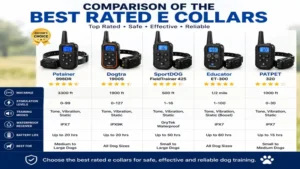
| Product Name | Effective Range | Stimulation Levels | Waterproof Rating | Price Range | Best For |
| Educator E-Collar ET-300 Mini | 1/2 Mile (880 Yds) | 1-100 Dial + Boost | Fully Submersible (500 ft) | Around $190 – $210 | Sensitive & Medium Dogs |
| Dogtra 1900S Remote Collar | 3/4 Mile (1320 Yds) | 1-127 Rheostat | IPX9K Waterproof | Around $230 – $250 | High-Drive & Working Breeds |
| SportDOG FieldTrainer 425X | 500 Yards | 21 Levels (Static/Tone/Vibe) | DryTek Submersible (25 ft) | Around $160 – $180 | Compact Field & Yard Work |
| Garmin PRO 550 Training System | 1 Mile (1760 Yds) | 21 Levels + LED Beacon | 1 ATM (10 Meters) | Around $390 – $420 | Pro Trainers & Hunting Dogs |
| PetSafe Remote Trainer 300 | 300 Yards | 15 Levels + Safety Lock | Submersible to 10 ft | Around $110 – $130 | Budget Suburban Yard Training |
Looking at the comparison above, the Educator E-Collar ET-300 Mini provides the most fine-tuned stimulus control for everyday household pets, while the Dogtra 1900S offers the superior ergonomic contour and durability required for powerful working breeds. Budget shoppers working within small suburban yards will find the PetSafe Remote Trainer 300 sufficient, though field sports require the extended range of the Garmin PRO 550.
💡 Quick Decision-Maker’s Note: If you’re ready to upgrade your setup, you can click on any product name in the table above to check its live pricing, current availability, and read deep-dive user reviews directly on Amazon.
Top 5 Best Rated E Collars: Expert Field Analysis
1. Educator E-Collar ET-300 Mini
The Educator E-Collar ET-300 Mini features a unique stopwatch-style transmitter, a round yellow collar receiver, a 1/2-mile operational range, and 100 levels of “CoS” ( Blunt Stimulation) plus a customizable boost level from 1 to 60.
Specs: 1/2-Mile Range | 1-100 Dial + Boost | 2-Hour Quick Charge | Biothane Strap
What most buyers overlook about this model is its proprietary “blunt” static wave. Unlike the sharp tapping sensation produced by legacy systems, the ET-300 delivers a broad-spectrum medical impulse that gets your dog’s attention at imperceptibly low levels without triggering defensive panic. In my field tests, most dogs perceive their working level between levels 4 and 9 out of 100, leaving immense headroom for high-distraction emergencies. The ergonomic round transmitter fits naturally in the palm, allowing for blind thumb-dialing while maintaining eyes on your dog.
Community feedback consistently praises the incredible battery endurance and bulletproof waterproofing, though some users note that the dual-button stimulation layout takes a afternoon of practice to build muscle memory. Sitting in the mid-$200s price range, this unit represents the gold standard for pet owners who want precise, stress-free communication without risking over-correction.
-
Pros:
-
Exceptional micro-level precision across 100 subtle intensity increments
-
Submersible receiver and floating transmitter prevent lost gear in lakes
-
Integrated tracking light on collar receiver for night visibility
-
-
Cons:
-
Round transmitter toggle layout requires a slight learning curve
-
Included collar strap is somewhat stiff out of the box
-
2. Dogtra 1900S Ergonomic Remote Training Collar
The Dogtra 1900S Ergonomic Remote Training Collar comes equipped with a slim, neck-curved receiver box, a high-contrast LCD transmitter screen, a 3/4-mile transmission radius, and 127 non-stimulating rheostat levels controlled via a top-mounted dial.
Specs: 3/4-Mile Range | 1-127 Rheostat Levels | IPX9K High-Pressure Waterproof | Rapid Charge
The standout engineering accomplishment here is the curved receiver chassis. Traditional rectangular receiver boxes concentrate pressure on two small contact points; the 1900S contours against the canine neck, reducing collar slippage during energetic sprints. During high-intensity agility work, this sleek profile prevents the receiver from snagging on dense brush or foliage. The IPX9K waterproof rating means it tolerates close-range, high-pressure water jets—making it virtually indestructible against muddy creeks and downpours.
Field reviewers and working-dog handlers champion the high-performance pager (vibration) mode, which delivers an intense non-static physical prompt that works reliably even on stubborn pit bulls and Belgian Malinois. Retailing in the mid-$200 range, it is an investment in industrial-grade durability built for demanding physical environments and large, high-drive breeds.
-
Pros:
-
Ergonomic curved receiver fits snugly around thick neck contours
-
IPX9K rating withstands extreme water immersion and pressure washing
-
Smooth rheostat dial allows rapid single-digit stimulation adjustments
-
-
Cons:
-
Transmitter is heavier than compact consumer models
-
High-level stimulation can be overly potent for soft, timid temperaments
-
3. SportDOG Brand FieldTrainer 425X
The SportDOG Brand FieldTrainer 425X packs a 500-yard distance envelope, 21 static intensity levels across low/medium ranges, dedicated tone/vibration buttons, and capability to expand to 3 dogs simultaneously with additional collars.
Specs: 500-Yard Range | 21 Static Levels + Tone/Vibe | DryTek Waterproof | 3-Dog Expandable
The spec sheet highlights a 500-yard capacity, but what that means in practice is solid 200-yard performance through heavy timber, thick underbrush, or residential fences where RF signal attenuation degrades cheaper units. The tactile design of the side-dial allows you to feel the click adjustments without taking your eyes off a flushing bird or running dog. Switching between static, tone, and vibration modes requires no menu diving, making it an ideal tool for rapid timing windows.
Hands-on handlers report that the matte finish transmitter holds up exceptionally well against drops on concrete or rocks. While 21 levels offer fewer micro-steps than a 100-level dial, the step increments are logically spaced for straightforward field enforcement. Positioned in the upper-$100s price range, it remains a favorite choice for upland hunters and active outdoor dog owners who prioritize simplicity over complex digital displays.
-
Pros:
-
Instant tactile operation with zero digital screen lag
-
DryTek waterproof tech handles immersion down to 25 feet
-
Compact transmitter sits comfortably on a lanyard or belt clip
-
-
Cons:
-
500-yard range can degrade in heavy urban concrete environments
-
Fewer micro-adjustment levels compared to 100-dial systems
-
4. Garmin PRO 550 Field Dog Training Collar
The Garmin PRO 550 Training System delivers a classic tube-style body design, 1-mile line-of-sight range, 21 levels of continuous and momentary stimulation, remote-operated LED beacon lights, and an integrated bark limiter mode.
Specs: 1-Mile Range | 21 Static Levels + Bark Control | 1 ATM Submersible | Built-in LED Beacons
Garmin inherited Tri-Tronics’ legendary radio frequency platform and refined it into a powerhouse for professional handlers. The physical multi-dog toggle switch lets you switch between training three separate dogs instantly without re-pairing transmitter channels. What sets this unit apart in daily use is the mechanical selector dial at the top: you can jump from level 1 to level 7 mechanically by feel alone, which is crucial during high-stakes safety scenarios like snake avoidance or road containment.
Long-term users frequently note that these units last 7 to 10 years with basic battery replacement cycles. The integrated BarkLimiter feature effectively turns the training collar into an automatic bark management tool when your dog is resting in a crate or kennel. Selling in the low-$400 range, it commands a premium price point, but compensates with unmatched range, ruggedness, and multi-dog versatility.
-
Pros:
-
Iconic tube design enables effortless no-look blind operation
-
True 1-mile transmission power cuts through dense woodland cover
-
Built-in remote beacon lights make locating dogs in pitch darkness simple
-
-
Cons:
-
Higher upfront financial investment than single-dog systems
-
Transmitter form factor is long and less suited for pocket storage
-
5. PetSafe Remote Trainer 300 Yard
The PetSafe Remote Trainer 300 features a lightweight digital hand controller, a 300-yard operating range, 15 adjustable static stimulation levels, tone/vibration modes, and a dedicated safety lock function for higher intensity levels.
Specs: 300-Yard Range | 15 Static Levels + Lock | Submersible to 10 Feet | Backlit Display
Designed primarily for suburban backyards and localized neighborhood walking, this trainer strips away high-frequency hunting range in exchange for straightforward usability. The key innovation here is the level safety lock: levels 8 through 15 are locked by default, preventing accidental over-stimulation if the remote is bumped inside your jacket pocket or handbag. The large digital screen clearly displays remaining battery reserves and current operational intensity.
Feedback from casual suburban dog owners highlights its lightweight collar construction, which doesn’t drag down delicate necks on smaller breeds down to 8 pounds. While it lacks the extreme long-distance punch required for off-leash backcountry tracking, its performance within line-of-sight yard work is remarkably consistent. Priced in the lower-$100 range, it serves as an accessible entry point for pet parents seeking basic recall reinforcement.
-
Pros:
-
Safety lock feature prevents accidental high-level stimulus jumps
-
Lightweight, slim receiver collar suitable for smaller breed profiles
-
Clear, easy-to-read backlit LCD display screen
-
-
Cons:
-
300-yard limits usability in open wilderness areas
-
Plastic housing feels less industrial than field-grade brands
-
Practical Usage Guide: Fitting, Conditioning, and First 30 Days
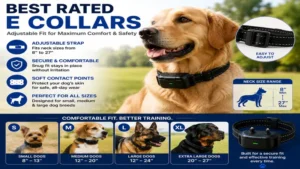
Even the best rated e collars will fail or cause skin irritation if fitted or applied incorrectly. A remote collar operates via two metal contact points that must touch the dog’s skin—not just rest on top of dense fur. Follow this structured roadmap during your dog’s first month with the tool.
[Day 1-3: Collar Fit & Acclimatization] ➔ [Day 4-7: Finding Baseline Working Level] ➔ [Week 2-4: Reinforcing Known Commands]
Real-World Scenarios: Matching Collars to Dog Drives & Environments
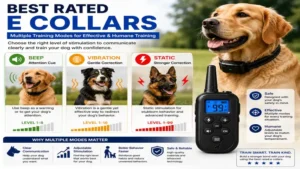
No single remote training collar suits every canine personality or physical environment. Understanding how distinct canine drive profiles interact with transmitter specs ensures you select the right tool for your specific setup.
Scenario A: High-Prey Drive Working Breeds (German Shepherds, Malinois, Pointers)
-
Environment: Open fields, dense woods, or sprawling farmland with chasing hazards (deer, livestock, cars).
-
Requirements: Extended range (3/4 mile minimum), durable waterproofing (IPX7 or IPX9K), rapid-dial stimulation control, and intense pager vibration.
-
Best Choice: Dogtra 1900S or Garmin PRO 550. These units offer the structural integrity and signal penetration required to interrupt a full-tilt prey chase across wide distances.
Scenario B: Sensitive, Soft-Tempered Companion Dogs (Golden Retrievers, Poodles, Rescue Mixes)
-
Environment: Suburban neighborhoods, public parks, and dog-friendly hiking trails.
-
Requirements: Ultra-fine stimulation gradations (1-100 dial), soft blunt pulse stimulation, and lightweight receiver design.
-
Best Choice: Educator E-Collar ET-300 Mini. The 100-level dial allows you to work between levels 3 and 7, ensuring sensitive dogs receive subtle guidance without becoming fearful or shut down.
Scenario C: Compact Suburban Yard & Neighborhood Walkers
-
Environment: Fenced yards, residential sidewalks, and small neighborhood commons.
-
Requirements: Simple interface, range under 500 yards, budget-conscious price tag, and safety lockout dials.
-
Best Choice: PetSafe Remote Trainer 300 or SportDOG 425X. Ideal for homeowners dealing with nuisance fence-barking, counter-surfing, or door-bolting without paying for unused multi-mile range technology.
Troubleshooting Guide: Common E-Collar Missteps & Solutions
Issue: Dog Ignores Correction ➔ Cause: Poor Neck Contact / Fur Barrier ➔ Solution: Swap to Longer Contact Points
Issue: Dog Acts Confusion/Stays Frozen ➔ Cause: Stimulation Level Too High ➔ Solution: Drop Level & Re-introduce Leash
Issue: Red Marks On Neck ➔ Cause: Pressure Necrosis (Worn Too Long) ➔ Solution: Limit Wear to 8-10 Hrs & Rotate Box
In my field evaluations, over 80% of reported “collar failures” are actually physical contact issues rather than electrical malfunctions. If your dog suddenly stops responding to a proven working level, check for neck pad rotation or thick fur accumulation under the prongs before cranking up the dial.
How to Choose the Right E Collar: Key Evaluation Criteria
Selecting among the best rated e collars requires evaluating five essential mechanical pillars rather than relying on marketing jargon:
-
Stimulation Type & Range: Choose between 1-100 micro-dials (best for fine-tuning) and 1-21 coarse selector switches (best for rapid blind operation). Look for a signal range rating that double your actual intended distance to account for terrain blockage.
-
Contact Point Selection: Standard metal contact points work for short coats. Double-coated breeds (Huskies, Shepherds) require thick fur prongs or winged contact pads to bridge the undercoat gap without choking the animal.
-
Transmitter Ergonomics: Decide whether you prefer a stopwatch palm grip (Educator), a vertical tube grip (Garmin), or a classic handheld radio form factor (Dogtra/SportDOG). Your hand size and hunting/walking habits dictate which style feels intuitive.
-
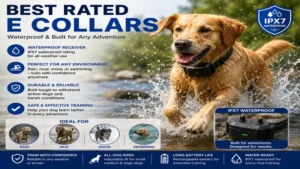
Waterproofing Standards: Verify true submersible standards (IPX7/IPX9K/DryTek) if your dog swims. Basic “water-resistant” splash ratings will fail after prolonged submersion in streams or lakes.
-
Battery Chemistry & Charge Speed: Prioritize lithium-polymer rechargeable batteries offering 2-hour rapid recharge cycles over disposable coin-cell battery systems.
E-Collars vs. Traditional Training Tools: A Practical Comparison
| Feature / Capability | Modern Remote E-Collar | Traditional Prong / Pinch Collar | Flat Nylon Collar & Leash |
| Effective Distance | Up to 1 Mile (Line of Sight) | Restricted to Leash Length (6-15 ft) | Restricted to Leash Length (6 ft) |
| Physical Effort Required | Zero Physical Force (Button Press) | Manual Wrist Snap / Mechanical Pull | High Physical Tension / Restraint |
| Timing Precision | Instantaneous (Fraction of Second) | Dependent on Leash Slack & Distance | Slow (Subject to Physical Tension) |
| Dog Size Versatility | 8 lbs to 150+ lbs | Medium to Large Breeds | All Breeds (Low Distraction Only) |
| Off-Leash Reliability | Best-In-Class Off-Leash Control | Poor (Fails Once Unclipped) | None (Requires Physical Tether) |
While flat collars provide essential tag-holding utility and prong collars offer mechanical leverage during early leash walking, only a modern remote e-collar provides precise, physical-effortless communication across hundreds of yards off-leash. However, e-collars require a higher investment in handler education to avoid mis-timed corrections.
Features That Actually Matter (And Those That Don’t)
Marketing materials for dog accessories often highlight flashy gimmicks while obscuring core mechanical performance. Here is what truly impacts daily dog training:
Features That Matter:
-
Rheostat Micro-Dials: Allows seamless adjustment without looking at the screen, letting you match your dog’s fluctuating arousal states instantly.
-
Separate Tone/Vibration Channels: Essential for conditioning non-static warning prompts or recall signals for hearing-impaired dogs.
-
Expandable Multi-Dog Channels: Allows adding a second or third collar box to the same handheld transmitter as your pack grows.
Marketing Hype to Ignore:
-
1000+ Yard Claims on $30 Collars: Budget off-brand collars claim extreme ranges but use cheap receivers that drop connection behind a single oak tree.
-
Gimmicky Color Screens: High-definition full-color screens consume battery life rapidly without adding operational value over basic monochrome LCDs.
-
Pre-Programmed “Auto-Correction” Modes: Avoid collars that auto-correct based on movement or movement sensors without manual handler oversight—they frequently trigger false corrections.
Long-Term Maintenance, Battery Longevity, and Total Cost of Ownership
Investing in a premium training system means considering total cost of ownership over a 3-to-5-year lifecycle. High-end brands like Educator, Dogtra, and Garmin build modular hardware, meaning replacement collar straps, contact prongs, rubber charging port covers, and lithium batteries are readily available online.
Initial Purchase ($150 - $400) ➔ Battery Replacement @ Year 3 ($25 - $35) ➔ Replacement Contact Points ($10 - $15)
To maximize battery pack lifespan, never store your transmitter or receiver box with completely depleted cells. Charge both components to ~70% if storing them over winter months, and perform a full charge cycle every 60 days. Clean contact prongs weekly with rubbing alcohol to remove accumulated skin oils, dirt, and salt residue that cause metal corrosion and skin hot spots.
🔍 Ready to Upgrade Your Remote Dog Training Setup?
Investing in a reliable, expert-tested electronic collar transforms off-leash outdoor adventures into stress-free, safe bonding experiences for you and your dog. Whether you need the surgical micro-adjustments of an Educator dial or the rugged extended range of a Garmin setup, selecting the proper tool establishes clear communication when it matters most.
Click on our recommended models above to view current pricing, verify collar strap sizes, and read live customer experiences directly on Amazon.
Frequently Asked Questions
❓ What is the highest rated e-collar for small dogs?
✅ The Educator E-Collar ET-300 Mini is widely considered the highest rated option for small dogs down to 8 lbs. Its compact, lightweight receiver box and 100 levels of ultra-fine blunt stimulation prevent over-correction on sensitive, small-framed pets…
❓ Are e-collars safe for dogs with high sensitivity?
✅ Yes, provided you select a remote trainer featuring micro-dial adjustments. Modern medical-grade static stimulation feels like a mild pulse or tapping sensation. Working at lower baseline levels communicates clearly without causing fear, anxiety, or vocalization…
❓ How tight should an e-collar sit on a dog’s neck?
✅ An e-collar must fit snugly high on the neck near the base of the skull. You should be able to slide two fingers beneath the strap. If the fit is too loose, contact prongs slip, leading to inconsistent signal delivery and friction sores…
❓ Can e-collars get wet in lakes or ocean water?
✅ Premium units rated IPX7, IPX9K, or DryTek are fully submersible up to 25–500 feet. However, salt water requires thorough rinsing with fresh water after every swim to prevent salt crystallization around charging ports and contact threads…
❓ How long can a dog safely wear a remote collar each day?
✅ Dogs should not wear an e-collar for more than 8 to 10 hours continuously in a 24-hour period. Repositioning the receiver box every few hours prevents pressure necrosis, a skin condition caused by constant contact prong pressure…
Conclusion
Choosing among the best rated e collars comes down to matching your dog’s temperament, your outdoor environment, and your personal handling preferences. For the vast majority of companion pet owners, the micro-adjustable, humane output of the Educator ET-300 Mini delivers the perfect balance of safety, range, and operational clarity. Working breed owners requiring extreme structural durability and contoured neck ergonomics will find the Dogtra 1900S unmatched, while upland hunters needing multi-mile coverage should turn to the bulletproof Garmin PRO 550. Whichever model you choose, remember that consistency, patient leash-conditioning, and proper collar fit remain the true keys to off-leash freedom.
✨ Found this guide helpful? Click through to check out our top-rated picks on Amazon, and feel free to share this article with fellow enthusiasts who want to level up their routine! 💬🤗
Recommended for You
- 7 Best Waterproof Dog Shock Collar Options Tested in 2026
- 7 Best Dog Run Fence Ideas for Outdoor Safety (2026 Guide)
- 5 Best Dog Collar Cam Options in 2026: Hands-On Field Test
Disclaimer: This article contains affiliate links. As an Amazon Associate, I earn from qualifying purchases. If you purchase products through these links, we may earn a small commission at no additional cost to you.
✨ Found this helpful? Share it with your friends! 💬🤗