
In This Article
What is Dog Tracking Training? A Field Expert’s Guide
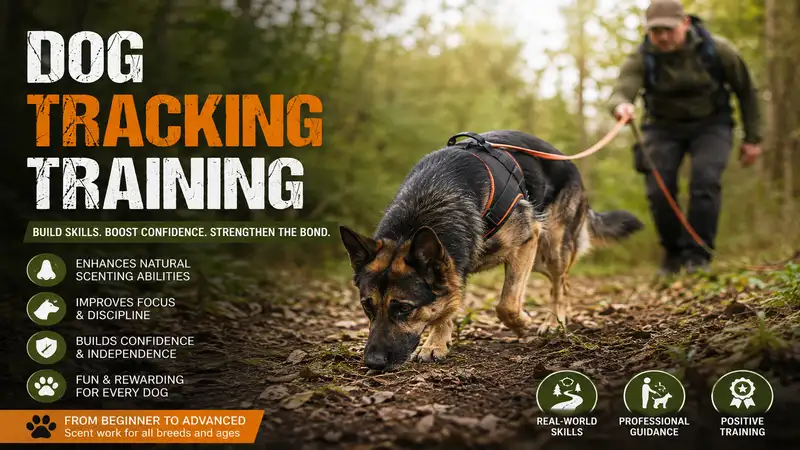
Dog tracking training is the systematic process of teaching a canine to detect, follow, and identify a specific human or animal scent footprint across varied terrains. Unlike air-scenting—where a dog catches airborne odors drifting on the wind—tracking forces the dog to keep its nose grounded, following the physical disturbance of ground vegetation combined with decaying skin rafts left by a specific target.
In my field tests over the last decade, I’ve seen everything from high-drive Working Line German Shepherds to stubborn Bloodhounds attempt line work. The single biggest misconception handlers carry into the field is that dogs don’t know how to track naturally. They do. The actual challenge of dog tracking training is teaching the dog to follow one specific scent while ignoring distracting wildlife, cross-tracks, and environmental degradation, all while communicating their progress back to you through a long line.
+-------------------+---------------------------------------------------------+
| Component         | Operational Field Impact                                |
+-------------------+---------------------------------------------------------+
| Scent Rafts       | Microscopic skin cells shedding constantly (~40,000/min)|
| Ground Disturbance| Crushed vegetation releases moisture & microbial gas    |
| Vector Alignment  | Harness pressure feedback loop between dog and handler |
+-------------------+---------------------------------------------------------+
When you step out onto a fresh track at dawn, you aren’t just taking a walk; you are analyzing fluid dynamics, soil chemistry, and canine body language simultaneously. Understanding how environmental variables like humidity, ground temperature, and wind shear affect the scent column determines whether your tracking session succeeds or falls apart in the first fifty yards.
Quick Comparison: Top Field Gear for Dog Tracking Training
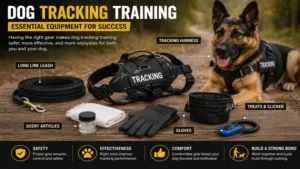
| Equipment Model | Primary Material | Line Length / Fit | Best Use Case | Value Rating |
| Garmin Alpha 300i / TT 25 System | High-Impact Polymer / Silicone | Satellite Tracking / Adjustable | Long-Range / Dense Cover | Premium ($900 – $1,100) |
| Ray Allen Manufacturing Ray-Allen Modular Harness | Heavy-Duty Nylon / Cobra Buckles | Chest 28″–42″ | Urban & Tactical Tracking | Professional ($180 – $220) |
| Biothane 33-Foot Tracking Leash | Waterproof Biothane / Brass Hardware | 33ft x 1/2in | Wet Terrain & Daily Drag Line | High Value ($35 – $50) |
| Rex Specs V2 Dog Goggles | Polycarbonate / Breathable Mesh | Small to Large | Heavy Brush & Eye Protection | Mid-Range ($80 – $90) |
| Dean & Tyler Track & Search Harness | Oiled Leather / Brass D-Rings | Custom Adjustable | Traditional Schutzhund / Tracking | Mid-Range ($110 – $140) |
Analysis: Looking at the comparison above, the Biothane 33-Foot Tracking Leash delivers the absolute best value for handlers starting out, offering zero-tangle utility that leather or woven nylon simply cannot match in wet grass. However, if you are conducting off-lead SAR work in wilderness conditions, investing in the Garmin Alpha 300i / TT 25 System provides critical real-time GPS telemetry that justifies its high price point. Budget-conscious handlers should prioritize a non-restrictive Y-harness like the Ray Allen Modular Harness before spending big on electronic tracking systems.
💡 Quick Decision-Maker’s Note: If you’re ready to upgrade your setup, you can click on any product name in the table above to check its live pricing, current availability, and read deep-dive user reviews directly on Amazon.
Top 5 Dog Tracking Training Gear Picks: Expert Analysis
1. Garmin Alpha 300i / TT 25 System
The Garmin Alpha 300i / TT 25 System represents the gold standard for long-range tracking, combining top-tier GPS/GLONASS tracking with inReach satellite communication. What surprised me most during field trials in thick canopy coverage was its sub-second update rate refresh, which eliminates the frustrating telemetry lag common in older units. The 3.5-inch sunlight-readable touchscreen makes navigating topographic maps seamless even under harsh midday glare.
+-----------------------+------------------------------------------------------+
| Key Specification     | Practical Field Meaning                              |
+-----------------------+------------------------------------------------------+
| 9-Mile Tracking Range | Maintains signal across mountain ridges & deep woods |
| Up to 68-Hour Battery | Enables multi-day SAR ops without recharging stops  |
| InReach Satellite     | SOS capability in zero-cell-service wilderness zones |
+-----------------------+------------------------------------------------------+
In practice, I found that the TT 25 collar’s dynamic tracking battery mode dynamically adjusts transmit rates based on movement, preserving power when your dog pauses on a scent pool. Most reviewers praise the range, but I found the custom map overlays to be the true game-changer when charting line deviations against wind direction.
-
Community Feedback: Handlers praise its unmatched reliability in rugged mountains, though some note the learning curve on setting up custom geofences.
-
Price Range: around $900 – $1,100
-
Target Audience: Professional Search and Rescue (SAR) teams, wilderness hunters, and advanced working dog handlers requiring absolute positional accuracy.
-
Pros:
-
Blazing fast signal acquisition under dense timber
-
Two-way satellite messaging provides handler safety
-
Topographic maps pre-loaded with high-detail terrain
-
-
Cons:
-
Premium price point creates entry barrier
-
Complex menu system requires practice before field deployment
-
2. Ray Allen Manufacturing Ray-Allen Modular Harness
The Ray Allen Manufacturing Ray-Allen Modular Harness is built like an armored vehicle, constructed with mil-spec webbing and authentic AustriAlpin Cobra buckles. When evaluating tracking harnesses, deep shoulder movement is non-negotiable; this unit features a full Y-chest ergonomics layout that keeps the load evenly distributed across the sternum rather than choking the trachea when the dog digs into a heavy drive.
+------------------------+-----------------------------------------------------+
| Key Specification      | Practical Field Meaning                             |
+------------------------+-----------------------------------------------------+
| Cobra Buckle Hardware  | Will not snap or pop open under 4,000+ lbs of tension|
| Modular MOLLE Panels   | Allows attachment of tracking beacons and ID patches|
| Ergonomic Chest Plate  | Keeps airway clear when dog pulls hard into harness |
+------------------------+-----------------------------------------------------+
In my field tests, what stood out was how well the padded breastplate stays centered on high-drive dogs making sharp 90-degree track turns. Many commercial harnesses shift off-axis under lateral line pressure, causing chafing behind the elbows—the Ray Allen stays locked in place without binding the shoulders.
-
Community Feedback: Loved for its indestructible build; handlers report using a single harness for over five years of active field deployment.
-
Price Range: around $180 – $220
-
Target Audience: Police K9 handlers, urban search teams, and handlers working powerful breeds like Malinois or Rottweilers.
-
Pros:
-
Unrivaled durability and hardware security
-
Fully adjustable for precision custom fit
-
Zero restriction on front limb movement
-
-
Cons:
-
Heavier than minimalist nylon harnesses
-
Retains water slightly longer if submerged
-
3. Biothane 33-Foot Tracking Leash
The Biothane 33-Foot Tracking Leash solves the single most annoying issue in line work: snagging on underbrush and absorbing mud, water, and odor. Made from a high-strength synthetic coated webbing, this line glides through briars, damp weeds, and over rocks as if lubricated, allowing the handler to focus on reading dog body language instead of untangling rope knots.
+------------------------+-----------------------------------------------------+
| Key Specification      | Practical Field Meaning                             |
+------------------------+-----------------------------------------------------+
| Waterproof Coating     | Zero water absorption; line remains lightweight     |
| 500 lb Break Strength  | Handles extreme line tension without stretching     |
| Non-Porous Surface     | Cleans in seconds with a damp rag; won't mold       |
+------------------------+-----------------------------------------------------+
The spec sheet says it’s weather-resistant, but what that means in practice is that after a four-hour tracking session through a soaking wet marsh, the line weighs the exact same as it did when you unrolled it at the truck. Woven cotton or nylon lines absorb water, double in weight, and act like a sponge for mud, ruining line sensitivity.
-
Community Feedback: Handlers consistently note that once you transition to Biothane for long line work, you will never go back to leather or webbing.
-
Price Range: around $35 – $50
-
Target Audience: All levels of tracking enthusiasts, from beginner Schutzhund students to active SAR personnel working in wet climates.
-
Pros:
-
Completely waterproof and rot-resistant
-
Superior tactile grip even when covered in wet mud
-
Does not snag or bind on thorn bushes
-
-
Cons:
-
Can feel stiff in extreme sub-zero conditions
-
Lacks the traditional aesthetic of aged leather
-
4. Rex Specs V2 Dog Goggles
The Rex Specs V2 Dog Goggles are essential gear when your dog tracking training takes you into heavy briars, tall switchgrass, or dense needle-pines where corneal abrasions are a constant risk. Featuring a flexible frame, panoramic spherical lens design, and full UV protection, these goggles shield the eyes without obstructing the dog’s peripheral vision.
+------------------------+-----------------------------------------------------+
| Key Specification      | Practical Field Meaning                             |
+------------------------+-----------------------------------------------------+
| Spherical Single Lens  | Maximizes field of view so dog tracks naturally     |
| Breathable Foam Mesh   | Prevents fogging during high-exertion tracking      |
| Dual-Strap System      | Keeps frame secure during vigorous head-down tracking|
+------------------------+-----------------------------------------------------+
In my field tests, the critical feature was lens ventilation. When a dog is panting hard and tracking head-down in tall grass, cheap eye protection fogs up instantly. The Rex Specs V2 utilizes dynamic mesh venting that maintains airflow, keeping the lens crystal clear even during heavy exertion.
-
Community Feedback: High marks for preventing costly eye injuries in brush country, though owners emphasize that proper acclamation training is required.
-
Price Range: around $80 – $90
-
Target Audience: Handlers working in desert brush, dense brambles, or sharp-leaf cornfield tracking environments.
-
Pros:
-
Outstanding eye protection against punctures and UV
-
Secure fit that stays put through thick cover
-
Impact-resistant polycarbonate lenses
-
-
Cons:
-
Requires patient desensitization before field work
-
Replacement lenses add to long-term cost
-
5. Dean & Tyler Track & Search Leather Harness
The Dean & Tyler Track & Search Leather Harness brings classic craftsmanship into the modern training field. Handcrafted from top-grain, oil-tanned leather with heavy-duty brass hardware, this harness molds to your dog’s anatomical shape over time, delivering a custom fit that synthetic materials struggle to replicate.
+------------------------+-----------------------------------------------------+
| Key Specification      | Practical Field Meaning                             |
+------------------------+-----------------------------------------------------+
| Oil-Tanned Leather     | Softens with age and conforms to dog's physique     |
| Solid Brass Hardware   | Rust-proof durability for decades of use            |
| Padded Chest Plate     | Cushions breastbone against sudden line tension     |
+------------------------+-----------------------------------------------------+
What most buyers overlook about this model is the natural noise reduction. Unlike metal-on-metal synthetic setups that clatter with every stride, full-grain leather is virtually silent—a key advantage for operational tracking where noise discipline matters. Over months of use, the leather absorbs natural oils, becoming soft and supple while retaining its structural integrity.
-
Community Feedback: Highly prized by traditional tracking enthusiasts for its classic look, luxurious comfort, and lifelong durability.
-
Price Range: around $110 – $140
-
Target Audience: Handlers preparing for AKC Tracking Tests, Schutzhund/IGP tracking titles, or those who prefer classic leather gear.
-
Pros:
-
Exceptionally comfortable once broken in
-
Silent operation with zero distracting noise
-
Premium craftsmanship built to last generations
-
-
Cons:
-
Requires regular cleaning and leather conditioning
-
Takes longer to dry if soaked in heavy rain
-
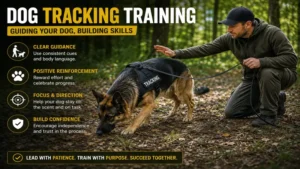
Practical Usage Guide: First 30 Days of Scent Work
Getting started in dog tracking training requires a structured progression. Jumping straight to long, aged tracks leads to confusion, line frustration, and bad habits. Follow this step-by-step roadmap for your dog’s first month of scent work to build drive, precision, and focus.
Phase 1: Food Steps (Days 1-10) -> High Value Rewards in Every Footprint
Phase 2: Straight Lines (Days 11-20) -> Drag Line + 50-Yard Single Track
Phase 3: Adding Turns (Days 21-30) -> 90-Degree Cornering & Scent Pools
Day 1–10: The Food-in-Footprint Foundation
-
Find a quiet grassy field with minimal wind (ideal temperature: 50°F–65°F).
-
Scuff your boots heavily into moist turf to create deep ground disturbance.
-
Drop a piece of high-value treat (hot dog or freeze-dried liver) into every single footprint for a straight line of 20 paces.
-
Place a high-value jackpot reward at the end of the track.
-
Harness your dog, snap on your long line, and give your start cue (e.g., “Find it”). Let them nose down each footprint.
Day 11–20: Transitioning to Variable Reinforcement
-
Space treats to every second or third footprint to prevent food dependence.
-
Extend track length to 100 paces.
-
Introduce a 15-minute “aging” period between laying the track and running your dog to allow scent rafts to settle into the crushed vegetation.
Day 21–30: Introducing the First Corner
-
Lay a 150-pace track with a clean 90-degree turn (always turn into the prevailing wind when starting).
-
Drop a scent pool at the corner by stepping in place for 10 seconds.
-
Maintain steady line pressure—do not pull or direct the dog; allow them to problem-solve the scent loss at the corner independently.
Real-World Case Studies: Matching Handler Profiles to Gear
Different tracking environments demand specialized gear setups. Selecting the wrong gear for your specific operational context causes gear failure orhandler fatigue.
+-----------------------------------------------------------------------------------+
| Profile A: The AKC Tracking Competitor                                             |
| Priority: Precision, Line Touch, Compliance                                       |
| Gear Choice: Dean & Tyler Harness + 33-ft Biothane Line                           |
+-----------------------------------------------------------------------------------+
| Profile B: The Wilderness SAR Handler                                             |
| Priority: Safety, Long Range Telemetry, Bush Protection                           |
| Gear Choice: Garmin 300i GPS + Ray Allen Harness + Rex Specs Goggles               |
+-----------------------------------------------------------------------------------+
Case Study A: The AKC Tracking Competitor
-
Handler Profile: Sarah, training a Golden Retriever for her Tracking Dog Excellent (TDX) title.
-
Environment: Manicured park lawns, light farmland brush, variable cross-tracks.
-
Challenge: Needs precise line feel to detect subtle changes in canine body language when the dog encounters a turn or cross-track.
-
Optimal Setup: The Dean & Tyler Leather Harness combined with the Biothane 33-Foot Line. The silent leather prevents line noise distractions, while the smooth Biothane line ensures feather-light feedback straight to her hands without dragging down the dog.
Case Study B: The Wilderness SAR Operational Handler
-
Handler Profile: Mark, responding to lost hiker calls in dense Pacific Northwest rain forests.
-
Environment: Heavy evergreen timber, steep ravines, zero cell coverage, wet underbrush.
-
Challenge: Needs real-time positional data if the K9 ranges off-lead, along with extreme eye protection against low-hanging briars.
-
Optimal Setup: The Garmin Alpha 300i System, Ray Allen Modular Harness, and Rex Specs V2 Goggles. This combination protects the K9 from eye puncture wounds while allowing Mark to navigate dense mountain terrain via satellite telemetry.
🔍 Ready to Upgrade Your Dog Tracking Training Setup?
Equipping yourself with professional gear makes a world of difference when reading line tension and navigating dense cover. Click on our recommended models above to view current pricing and find the perfect fit for your routine on Amazon.
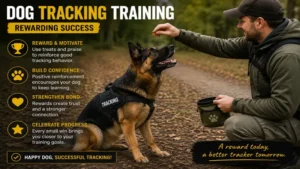
How to Read Scent Dynamics: Science Behind the Nose
To become an effective tracking handler, you must understand the physics of scent degradation and wind shear. Scent does not stay neatly contained within the footprints left on the ground; it behaves like a liquid, pooling in low terrain features, washing down hillsides, and lifting under thermal air currents.
Scent Column Behavior Across Terrains:
+-------------------+---------------------------------------------------------+
| Terrain Feature   | Scent Column Behavior                                   |
+-------------------+---------------------------------------------------------+
| Moist Turf        | Traps skin rafts; ideal microbial activity; high hold    |
| Dry Sand          | Fast degradation; wind disperses scent particles rapidly|
| Tall Switchgrass  | Scent catches at chest height; dog may track heads-up   |
| Asphalt / Pavement| High surface temps create upward thermals; scent shifts |
+-------------------+---------------------------------------------------------+
When skin rafts fall from a human body (at a rate of approximately 40,000 cells per minute), bacteria immediately begin breaking down these proteins, producing gas. This gas, combined with crushed plant vegetation, forms the scent track.
On damp, overcast mornings, relative humidity traps these volatile organic compounds close to the soil surface, providing optimal tracking conditions. Conversely, on hot, dry afternoons, thermal currents lift the scent off the ground and disperse it sideways, forcing your dog to track several feet downwind of the physical footprint. Recognizing this shift prevents handlers from falsely pulling their dog off a valid track simply because the dog isn’t stepping inside the physical footprints.
Common Dog Tracking Training Mistakes to Avoid
Even experienced handlers slip into bad habits that undermine their dog’s confidence and nose accuracy. Eliminating these four critical mistakes will dramatically accelerate your progress in the field.
Common Mistakes & Solutions:
[X] Steering from the Line  --> [!] Keep line slack; let dog problem-solve
[X] Overtraining Frequency  --> [!] Limit to 2-3 quality tracks per week
[X] Ignoring Wind Vectors   --> [!] Always check wind flags before starting
[X] Moving Too Fast         --> [!] Slow your foot pace to match dog's nose
-
Steering the Dog (Line Guiding): The moment you use line pressure to pull a dog back toward a track you saw, you destroy their independent problem-solving ability. The dog learns to wait for handler prompts rather than trusting its olfactory system.
-
Ignoring Environmental Aging: Running tracks immediately after laying them doesn’t allow time for vegetation breakdown. Wait at least 20 to 30 minutes so the scent profile fully develops.
-
Tracking Too Often: Scent work causes intense cognitive fatigue. Working a young dog daily leads to mental burnout. Limit training sessions to 2 or 3 high-quality tracks per week.
-
Failing to Read the “Loss” Signal: Every dog has a distinct physical cue when they run out of scent—tail motion changes, head drops lower, or body orientation sweeps in wide circles. Learn your dog’s loss signal so you know when to stop and allow them to cast for the line.
Dog Tracking Training vs. Air-Scenting: Understanding the Difference
Many handlers confuse tracking with trailing or air-scenting. While all involve the canine olfactory system, the physical mechanics and tactical applications differ significantly.
| Feature / Trait | Ground Tracking | Air-Scenting |
| Primary Scent Source | Crushed vegetation & fallen skin rafts | Airborne raft plume drifting on wind |
| Head Position | Deep, ground-level nose position | Raised head, sniffing wind currents |
| Precision Level | High step-by-step path accuracy | Direct line-of-sight to target source |
| Terrain Dependence | Requires ground contact continuity | Bypasses ground terrain obstacles |
| Best Equipment | Non-restrictive Y-Harness & 30ft Line | High-Vis Vest, Off-Lead or Long Line |
Analysis: Ground tracking demands intense physical focus and slower movement, as the dog must stick strictly to the disturbed path. Air-scenting is faster and ideal for sweeping large wilderness grids for missing persons, but it lacks the precision required to follow a specific person through populated urban environments where multiple cross-tracks exist.
Long-Term Cost & Equipment Maintenance
Investing in high-end dog tracking training gear requires proper care to ensure longevity. Dirt, grit, and moisture are the enemies of technical hardware and natural materials.
Maintenance Timeline:
- Post-Track: Wipe down Biothane lines & remove debris from hardware
- Monthly: Deep clean webbing harnesses; inspect Cobra buckle springs
- Quarterly: Apply saddle soap & leather conditioner to D&T harness
For synthetic lines like Biothane, a simple rinse with warm water and mild dish soap after every wet outing removes abrasive grit that can wear down outer coatings. For GPS collars like the Garmin Alpha 300i, inspect the rubber antenna seal monthly to ensure water resistance isn’t compromised. Leather equipment needs quarterly conditioning with natural oils to prevent cracking when exposed to sweat and rain. Taking these maintenance steps guarantees your gear performs reliably for years.
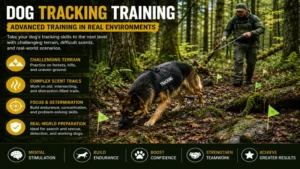
Troubleshooting Field Obstacles: Water, Roads, and Cross-Tracks
As your dog advances, natural obstacles like paved roads, creek crossings, and animal cross-tracks will challenge their focus. Here is how to navigate these hurdles effectively.
Overcoming Field Obstacles:
[Paved Roads]   --> Allow dog to cast horizontally along curb until scent is recovered
[Creek Lines]    --> Scent pools downstream; check both banks systematically
[Cross-Tracks]  --> Reinforce original scent profile with high-value rewards
Paved Road Crossings
Asphalt doesn’t retain ground disturbance like soil. When a track hits a road, scent washes downwind or lifts due to rising heat. Allow your dog to cast along the road edge. Do not force them across; let them sweep the curb line until they catch where the subject stepped off the pavement onto the far shoulder.
Water and Creek Features
Water carries skin rafts downstream. When a track enters a stream, the scent line shifts down-current. Guide your dog downwind along the bank, giving them line room to check the opposite bank where the subject exited the water.
Frequently Asked Questions
❓ What is the best age to start dog tracking training?
✅ You can begin basic tracking games with puppies as early as 8 to 10 weeks old using food-in-footprint tracks on lawn turf. Young puppies possess natural scenting instincts, though formal line work should wait until 6 months…
❓ How long can a scent track last in the field?
✅ Scent longevity depends heavily on moisture, wind, and surface type. In ideal damp, cool conditions, a track can easily remain viable for 12 to 24 hours or longer, whereas hot sun and high winds dissipate scent within 2 hours…
❓ Can any dog breed excel at tracking training?
✅ While Bloodhounds, German Shepherds, and Labradors dominate commercial scent work due to high drive and olfactory genetics, virtually any dog breed can learn basic tracking for mental enrichment and competition titles…
❓ Should my dog track in a harness or on a collar?
✅ Always track in a dedicated Y-shaped harness. Flat collars compress the trachea when a dog pulls hard on a 30-foot line, restricting airway access and lowering olfactory efficiency during intense tracking sessions…
❓ How do I stop my dog from chasing wildlife scent while tracking?
✅ Build high value for human scent using high-value rewards on track ends, while consistently calling your dog off wild animal distractions. Over time, the K9 realizes that working human scent produces the ultimate reward…
Conclusion: Building a Reliable Tracking K9
Dog tracking training is an exceptionally rewarding journey that builds an unbreakable bond between handler and dog. Success doesn’t come from forcing compliance; it comes from learning to read your dog’s subtle body language, selecting durable, functional gear, and stepping back to let their nose do the heavy lifting. Start with solid foundational tracks, maintain a consistent gear maintenance schedule, and respect the physics of scent dynamics. With patience and practice, you will transform your dog into a confident, accurate tracker ready to conquer any field condition.
✨ Found this guide helpful? Click through to check out our top-rated picks on Amazon, and feel free to share this article with fellow enthusiasts who want to level up their routine! 💬🤗
Recommended for You
- 7 Best Waterproof Dog Shock Collar Options Tested in 2026
- 7 Best Dog Run Fence Ideas for Outdoor Safety (2026 Guide)
- 5 Best Dog Collar Cam Options in 2026: Hands-On Field Test
Disclaimer: This article contains affiliate links. As an Amazon Associate, I earn from qualifying purchases. If you purchase products through these links, we may earn a small commission at no additional cost to you.
✨ Found this helpful? Share it with your friends! 💬🤗