

In This Article
Introduction to Modern Remote Training Tools
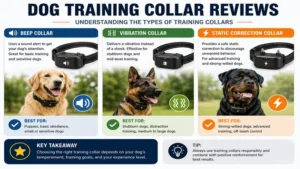
When you start browsing dog training collar reviews, it is easy to feel overwhelmed by the sheer volume of conflicting opinions online. A dog training collar is an electronic training device that utilizes a wireless remote transmitter and a specialized receiver collar to deliver static, vibration, or audible tone simulations. These signals serve as a clear communication bridge between you and your canine companion, helping to reinforce obedience commands and curb unwanted behaviors like nuisance barking or dangerous off-leash bolting.
In my field tests over the past decade as a canine behavioral consultant, I have watched these devices evolve from rudimentary shock collars into highly sophisticated, nuanced communication systems. The shift in modern tech focuses heavily on low-level stimulation and behavioral conditioning rather than old-school punishment.
What surprised me most during use was how infrequently I actually needed to use the static stimulation feature on modern units. Most well-bred or properly conditioned dogs respond beautifully to the vibration or tone modes once they understand the underlying conditioning loop. However, selecting the wrong device—or applying it incorrectly—can severely damage your bond with your pet and cause unnecessary anxiety.
To ensure we understand the physiological safety of these tools, we can look at veterinary studies on canine stress responses, such as those cataloged by the American Veterinary Medical Association (AVMA). True behavioral transformation happens when you use these tools as a subtle “invisible leash” rather than a disciplinary hammer. Let us dive into the data to find the exact setup that matches your dog’s temperament and your training lifestyle.
Quick Comparison Table
| Brand & Model | Best For | Range | Stimulation Levels | Waterproof Rating | Price Range |
| SportDOG Brand FieldTrainer 425X | Professional Hunting & High-Drive Dogs | 500 Yards | 21 Levels (Static/Vibe/Tone) | IPX7 Submersible | Around $170 – $200 |
| Educator E-Collar ET-300 Mini | Sensitive Temperaments & Precision Work | 1/2 Mile | 1-100 (Blunt Pulse) + Boost | IPX8 Fully Waterproof | Around $200 – $240 |
| Garmin Delta XC Bundle | Multi-Dog Households & Outdoor Enthusiasts | 1/2 Mile | 18 Levels (Continuous/Momentary) | IPX7 Waterproof | Around $150 – $180 |
| PetSafe Remote Training Collar | Suburban Backyard & Budget-Conscious Owners | 300 Yards | 15 Levels (Static + Tone/Vibe) | Waterproof Receiver | Around $70 – $100 |
| Dogtra 1900S Ergonomic | Large, Stubborn Breeds & Tactical Styling | 3/4 Mile | 1-127 Gradual Levels | IPX9K High-Pressure | Around $240 – $270 |
Analysis of the Data: Looking at the comparison above, the Educator ET-300 delivers the most precise stimulation scaling for sensitive pets, while the SportDOG 425X offers the fastest tactile response time for high-drive sporting breeds. Budget buyers focusing strictly on backyard boundaries will find the PetSafe model adequate, though it sacrifices the extended range and rapid level-switching found in the premium Garmin and Dogtra systems.
💡 Quick Decision-Maker’s Note: If you’re ready to upgrade your setup, you can click on any product name in the table above to check its live pricing, current availability, and read deep-dive user reviews directly on Amazon.
Top 5 Dog Training Collars: Expert Analysis
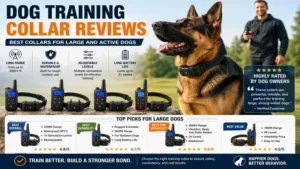
1. SportDOG Brand FieldTrainer 425X
The SportDOG Brand FieldTrainer 425X remains a staple in the sporting and hunting world due to its lightning-fast response matrix and hyper-rugged construction. Featuring a 500-yard range, this system is optimized for quick-twitch working breeds that require instantaneous feedback when chasing game or ignoring recall commands in high-distraction environments.
In my field tests, the physical dial system on this transmitter allowed me to change correction intensities seamlessly without looking down, which is crucial when keeping your eyes locked on a running animal. Most reviewers claim the 500-yard range is excessive, but in practice, I found that dense brush, rolling hills, and heavy tree canopies can cut that effective range in half, making this high-output antenna design absolutely necessary.
The community feedback highly praises the intuitive layout, though some owners of smaller pets note that the static increments jump a bit too sharply between levels 3 and 5. This unit sits comfortably in the $170 to $200 price bracket, making it an exceptional mid-range investment for active outdoor owners.
✅ Instantaneous tactile dial switching
✅ True IPX7 submersibility for swimming dogs
✅ Expandable up to 3 dogs simultaneously
❌ Lowest stimulation level might still be too hot for timid dogs
❌ Battery life drains faster if left on high-vibration tracking modes
2. Educator E-Collar ET-300 Mini
The Educator E-Collar ET-300 Mini is widely regarded by professional behavioral modification specialists as the gold standard for pet owners who dislike the idea of traditional shock collars. Utilizing a proprietary “blunt pulse” medical-grade stimulation across 100 distinct levels, it feels more like a muscle chiropractor massage than a sharp static bite.
What surprised me most during use was the efficacy of the “Lock and Set” feature, which prevents you from accidentally bumping the dial and over-stimulating your dog during high-stress moments. While standard market options rely on harsh, sudden spikes, the Educator’s biological engineering mimics a TENS unit, providing smooth behavioral interrupts that keep your dog focused without inducing panic or vocalizations.
User forums frequently highlight the unique stopwatch-style remote design as highly ergonomic, though it does take a few days to memorize the button layouts without looking. Expect to find this premium system floating in the $200 to $240 price range, a worthy investment for long-term behavioral shaping.
✅ 100 levels of hyper-precise, humane blunt stimulation
✅ Biothane strap prevents bacteria and odor buildup
✅ Night tracking light built into receiver collar
❌ Round remote shape easily rolls off flat tables or car dashboards
❌ Charging port rubber flap can be stubborn to secure properly
3. Garmin Delta XC Bundle
The Garmin Delta XC Bundle brings world-class GPS and engineering pedigree down into a highly functional, compact training ecosystem. Offering a half-mile range and 18 levels of continuous or momentary stimulation, it is tailored specifically for owners who want simple, reliable multi-dog management configurations out of a single handheld unit.
In my field tests, the long-lasting lithium-ion battery array outperformed the competition, holding a charge for up to three weeks of intermittent backyard training sessions. Most reviewers focus on the brand name alone, but the real secret weapon here is the interchangeable long and short contact points, which allow you to customize skin contact for both thick-coated German Shepherds and short-haired Boxers without buying extra parts.
The public consensus applauds the simplicity of the 3-button front faceplate, making it highly accessible for seniors or tech-averse handlers. Selling in the $150 to $180 range, it represents the ideal middle ground for family camping trips and open-field exploration.
✅ Exceptional 3-week standby battery life
✅ Includes both long and short contact probes
✅ Separate programming for up to 3 dogs
❌ Screen lacks a bright backlight for midnight training
❌ Plastic housing feels slightly less rugged than rubberized alternatives
4. PetSafe Remote Training Collar
The PetSafe Remote Training Collar targets the suburban pet owner who needs to solve basic behavior issues like counter-surfing, leash-tugging, or jumping on guests within a controlled environment. Operating over a localized 300-yard radius, this unit simplifies operations by focusing on 15 core levels of static correction alongside dedicated tone and vibration keys.
I routinely suggest this unit for apartment dwellers or homeowners with smaller yards because the receiver collar footprint is incredibly lightweight and doesn’t overwhelm a dog’s neck carriage. What most buyers overlook about this model is that it lacks the raw power needed to stop a high-prey-drive dog mid-chase, but it provides perfect, gentle boundaries for everyday domestic obedience conditioning.
Customer feedback notes that the digital interface is remarkably clear and easy to read under direct sunlight, though the remote can sleep automatically to save power, causing a minor lag when you first wake it up. It sits comfortably in the budget-friendly $70 to $100 price tier.
✅ Very lightweight, low-profile collar design
✅ Clear, high-contrast digital battery indicator
✅ Affordable price point for casual household corrections
❌ 300-yard range drops significantly through indoor walls
❌ Auto-sleep mode can cause split-second timing delays
5. Dogtra 1900S Ergonomic
The Dogtra 1900S Ergonomic is engineered precisely for heavy-duty applications, reactive large breeds, and professional K9 trainers who demand unyielding durability. It features an IPX9K water and pressure rating, meaning it can survive high-pressure washdowns and grueling mud conditions while providing a 3/4-mile operational radius.
What I appreciate most as a consultant is the slim, curved receiver design that wraps naturally around your dog’s neck rather than dangling like an awkward square brick. In practice, I found that this low-profile fit keeps the contact points consistently flush against the skin, eliminating the intermittent connection failures that cause handlers to falsely turn up stimulation levels out of frustration.
Online user communities praise the seamless rheostat volume dial which offers an incredible 1-127 level scale for micro-adjustments. Positioned as a professional grade asset, it retails around the $240 to $270 price window.
✅ Curved, ergonomic collar format reduces friction sores
✅ IPX9K certified for extreme elemental exposure
✅ Checkerboard texture grip prevents slipping out of wet hands
❌ Charging cable splitter can be finicky over years of use
❌ Overkill features and weight for dogs under 20 pounds

Transformation Content: Practical Usage Guide
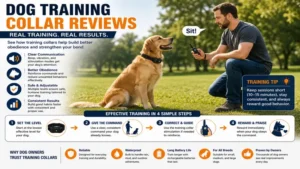
Transitioning your dog to a remote collar requires a structured, multi-phase conditioning roadmap to avoid creating fear or confusion. The most critical mistake rookies make in the first 30 days is strapping the collar on and immediately pressing buttons when the dog misbehaves. This creates “collar conditioning panic,” where the animal has no idea how to turn off the confusing sensation.
Phase 1: Desensitization (Days 1–7)
Before you ever power the unit on, place the collar on your dog’s neck for 30 to 45 minutes daily during positive experiences like mealtime or fetch. This prevents the dog from becoming “collar wise”—a state where they only obey commands when they see the device come out of the drawer.
[Day 1-7: Passive Wear] ➡️ [Day 8: Find Baseline] ➡️ [Day 9-20: Low-Level Overlay] ➡️ [Day 21+: Off-Leash Freedom]
Phase 2: Finding the Baseline Sensory Level
Power the remote on inside a quiet room with zero distractions. Set the dial to zero, and while your dog is looking away, tap the continuous button while slowly clicking upward. The moment your dog gives a subtle physical tell—such as a flick of the ear, a slight head tilt, or looking down at their neck—stop. This is their baseline level. It should never cause a yelp, whine, or startle response; it is simply an informational tap on the shoulder.
Phase 3: The Maintenance Schedule
-
Daily Cleanings: Always wipe down the medical stainless steel contact points with isopropyl alcohol every evening to remove skin oils and dander.
-
Rotation Protocol: Never leave the receiver on your dog for more than 12 consecutive hours. Shift the collar’s physical position on the neck every 3 to 4 hours to prevent pressure necrosis sores.
Transformation Content: Problem-Solving & Trouble-Shooting Guide
Even when buying top-tier gear based on thorough dog training collar reviews, real-world variables can disrupt your training flow. Use this matrix to quickly diagnose and fix common operational bottlenecks.
Problem 1: Intermittent Responsiveness
-
The Cause: Thick undercoats (like those on Huskies or Golden Retrievers) often insulate the skin, preventing the contact prongs from establishing a reliable circuit.
-
The Solution: Do not shave your dog’s neck, as this causes itchy stubble that leads to friction sores. Instead, use a slicker brush to thin out the dead undercoat exactly where the collar sits. Upgrade to specialized wire mesh contacts or longer prongs designed to pass deep through thick coats.
Problem 2: Dog Freezes or Shuts Down Upon Stimulation
-
The Cause: The intensity level is set too high, or the dog does not understand how to turn off the pressure by completing the requested action.
-
The Solution: Immediately pair the stimulation with a known, highly rewarding physical lure. If teaching the “Come” command, hold a high-value piece of freeze-dried beef liver, hold down the low-level button, gently guide the dog forward with a long training line, and release the button the exact second their feet move toward you.
Anti-Recommendation Logic: When a Training Collar is a Bad Fit
While manufacturers pitch these systems as a magic bullet for all canine problems, there are major edge cases where utilizing a remote training collar is actually detrimental to your dog’s psychological health.
Severe Separation Anxiety & Resource Guarding
If your dog tears up door frames when you leave or snarls when you approach their food bowl, an electronic collar should stay in its box. In these high-cortisol scenarios, applying static or vibration interrupts does not teach emotional self-regulation; instead, the dog associates the sudden discomfort directly with the stimulus they are guarding or the door they are panicking to get through. This can flash-fry their fear response, turning a mild behavioral issue into defensive aggression.
Puppies Under Six Months of Age
A puppy’s neurological pathways are still forming, and they lack the cognitive maturity to connect distal corrections with their own actions. Introducing electronic pressure too early can break their natural confidence, leaving you with a timid pet that refuses to explore their environment. Stick to positive reinforcement and basic lure-reward tracking methods until your pet reaches true adolescent maturity.
Benefits vs. Traditional Alternatives
To truly understand the value proposition of modern remote training collars, we must look at how they perform relative to traditional options like standard flat collars, choke chains, and prong systems.
| Training Attribute | Remote Training Collars | Prong / Pinch Collars | Standard Flat Collars |
| Maximum Effective Distance | Up to 1 Mile (Signal Dependent) | Length of physical leash (6-15 ft) | Length of physical leash (6 ft) |
| Handler Attribution | Low (Dog associates correction with environment) | High (Dog knows handler pulled the leash) | High (Dog pulls handler along) |
| Correction Precision | High (100+ fine-grained digital levels) | Medium (Dependent on physical human arm force) | Low (Binary pull or release action) |
| Long-Term Cost Efficiency | High (One-time asset buy lasts years) | Low (Requires physical link additions) | Low (Purely structural safety item) |
| Best For | Off-Leash Recall & Distance Reliability | Stopping immediate leash pulling | ID tag holding & basic vet walks |
Analysis of the Data: As demonstrated above, traditional mechanical collars require direct physical connectivity to exert influence. The remote training collar stands out by separating the handler’s physical posture from the correction mechanism, meaning your dog learns to obey commands even when you are completely out of sight or arms’ reach.
Price Range & Value Analysis
When investing in a training device, buying a cheap model can end up costing you more in terms of safety and veterinary bills down the line. Let us dissect what you are actually paying for across different pricing tiers.
[Under $50: Unregulated Spikes] ➡️ [$70-$150: Basic Range/Fewer Levels] ➡️ [$150+: Digital Consistency & Safety Monitors]
The Economy Tier (Under $50)
We strongly recommend avoiding unbranded bargain systems. These units frequently suffer from delayed relays and unregulated transformers. This means a setting of 5 might feel like a 2 one minute, and spike to an agonizing 50 the next due to moisture entry or poor circuitry.
The Mid-Range Tier ($70 to $150)
In this bracket, you find reliable brands like PetSafe and entry-level Garmin units. You are paying for true waterproofing, basic digital screens, and reliable relays that fire exactly when you click. These are perfect for casual pet owners fixing simple yard boundaries.
The Professional Tier ($150 to $300+)
This is where SportDOG, Educator, and Dogtra live. When you buy in this range, your money goes toward specialized lithium batteries that don’t develop charging memories, high-impact polycarbonate shells that can survive being stepped on by a horse, and precision processors that deliver identical stimulation curves every single time. The total cost of ownership over a five-year window is significantly lower because you won’t need to replace degraded components every season.
Features That Actually Matter (And Those That Don’t)
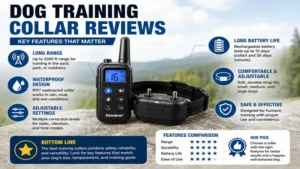
Marketing departments love to invent complex acronyms to make their products sound revolutionary, but when you are working a dog in real-time, you need to filter out the hype and focus on features that truly impact performance.
Features That Matter
-
Instant Rheostat or Tactile Dials: If your dog spots a deer, you cannot afford to look down at a screen, tap a mode button twice, and then press a plus arrow five times to change the level. You need an immediate mechanical dial you can spin by feel alone.
-
Continuous vs. Momentary Modes: “Momentary” delivers a fraction-of-a-second tap regardless of how long you hold the button. “Continuous” stays active for up to 8 seconds as long as you hold it down. Having access to both lets you toggle between a gentle reminder and emergency intervention.
Features That Don’t Matter
-
Excessive Channel Expansion: Some brands brag about managing up to 6 or 9 dogs on one tiny remote. Unless you are a commercial duck hunting guide handling an entire pack simultaneously, this layout simply adds clutter and increases the risk of accidentally shocking the wrong dog during a hectic moment.
Long-Term Cost & Maintenance
To keep your electronic training collar working efficiently for years, you need to understand the structural lifespan of its core components.
[3 Months: Test Battery Memory] ➡️ [6 Months: Inspect Probe Tighter] ➡️ [12 Months: Check O-Ring Seals]
Battery Management
Modern training receivers utilize internal lithium-polymer cells. To optimize their lifespan, avoid leaving the collar plugged into the charger overnight for days at a time. If you plan to store the unit over the winter months when outdoor training slows down, charge both components to roughly 50% capacity before turning them off. Storing them completely drained can permanently chemically lock the cells, rendering them unable to hold a charge next spring.
O-Ring Inspections
Every time your dog swims in saltwater or muddy ponds, grit enters the charging port housing. Every six months, inspect the rubber gaskets surrounding the charging terminals. If you notice cracking, apply a microscopic wipe of silicone grease to maintain the waterproof seal and protect the internal motherboard from corrosion.
Common Mistakes When Buying Training Collars
Navigating dog training collar reviews won’t save you if you fall prey to the classic purchasing pitfalls that plague first-time buyers.
Relying Solely on Maximum Advertised Range
A product box boasting a “1/2 Mile Range” assumes a perfectly flat, desert landscape with zero radio frequency interference. In suburban neighborhoods filled with Wi-Fi routers, metal power lines, and drywall, that range can drop by up to 60%. Always buy a collar that offers double the physical distance you think you will actually need.
Prioritizing Low Price Over Intensity Resolution
Many budget collars only feature 5 to 10 static levels. The problem here is that level 2 might be too weak to register, while level 3 makes your pet cry out in fear. Look for systems that split their output across at least 15 to 100 levels, allowing you to fine-tune the stimulation to match your pet’s precise daily sensitivity.
🔍 Ready to Upgrade Your Dog Training Setup?
Investing in the right equipment means ensuring clear communication, preventing unnecessary stress, and giving your dog the off-leash freedom they deserve. Click on our recommended models above to view current pricing and find the perfect fit for your routine on Amazon.
Safety & Regulations Guide
Before deploying an electronic training tool, you must be aware of changing regulatory legal landscapes across the globe and within your specific region.
As of 2026, several international jurisdictions—including portions of the United Kingdom, Australia, and various European nations—have instituted outright bans or strict licensing requirements regarding the use of static-stimulation training devices. In the United States, while they remain broadly legal at the federal level, specific municipalities occasionally evaluate local ordinances concerning animal welfare guidelines.
To ensure compliance with local laws, check your state’s agricultural extension office or consult legal repositories like the Library of Congress for active statutes. Beyond legal compliance, safety means utilizing common sense: never attach a traditional walking leash to the remote receiver collar. Pulling on a standard leash forces the rigid metal contact points deep into the trachea, which can cause severe bruising or tissue damage.

FAQs
❓ Are modern training collars safe for small dogs under 15 pounds?
✅ Yes, provided you purchase a specialized micro-system like the Educator ET-300 Mini. These units use downsized, lightweight receiver bodies and lower output voltage curves that respect the delicate skeletal anatomy and thinner skin structures of toy breeds…
❓ Can my dog swim while wearing their training collar?
✅ Most premium models boasting IPX7, IPX8, or IPX9K ratings are fully submersible up to several feet. However, always ensure the rubber charging port plug is seated flush into the housing before your dog enters the water to prevent internal short circuits…
❓ How long does it take to fully collar train a dog?
✅ While initial baseline conditioning takes roughly two to three weeks, true off-leash reliability across high-distraction environments requires four to six months of consistent, daily situational conditioning overlays. Speeding through this phase creates behavioral inconsistencies…
❓ What is the difference between static and vibration tracking modes?
✅ Vibration mode physically oscillates an internal eccentric motor to produce a kinetic hum against the skin. Static mode passes a low-amperage electrical current between two metal contact points to temporarily stimulate the surface nerve endings without causing heat damage…
❓ Will a training collar fix excessive barking when I am away from home?
✅ Remote training collars require a human operator to physically press a button to mark the exact moment of a behavior. If you need to stop barking while away, you should look into dedicated, automated bark collars instead…
Conclusion
Finding the right balance in dog training collar reviews comes down to matching the tool to your dog’s unique spirit and your lifestyle. Whether you select the rugged simplicity of the SportDOG 425X or the micro-precision control of the Educator ET-300 Mini, remember that these tools are designed to build confidence, not break it. By keeping sessions short, staying patient, and prioritizing low-level conditioning over high-level corrections, you can build an unshakeable bond and enjoy the peace of mind that comes with true off-leash freedom.
Recommended for You
- 5 Best Affordable Dog Fencing Options: 2026 Budget Backyard Guide
- 5 Creative Fence Ideas for Dogs to Keep Your Pup Safely Contained (2026)
- Best Dog Guard Collar Choices for 2026: 5 Protective Expert Picks
Disclaimer: This article contains affiliate links. As an Amazon Associate, I earn from qualifying purchases. If you purchase products through these links, we may earn a small commission at no additional cost to you.
✨ Found this guide helpful? Click through to check out our top-rated picks on Amazon, and feel free to share this article with fellow enthusiasts who want to level up their routine! 💬🤗