
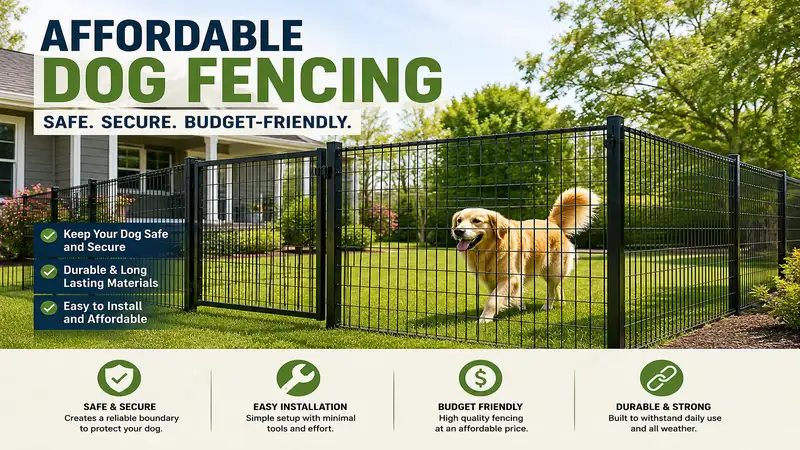
In This Article
Finding the Best Affordable Dog Fencing Without Breaking the Bank
As a professional dog trainer and backyard containment consultant with over a decade of field experience, I have seen it all. I have watched a high-energy, 70-pound Siberian Husky leap over a brand-new $8,000 custom cedar fence as if it were a minor hurdle. I have also seen a tiny Jack Russell Terrier effortlessly dig a trench under a premium vinyl barrier in less than three minutes.
What is affordable dog fencing? For budget-conscious pet owners in 2026, affordable dog fencing is any high-utility, cost-effective physical or digital containment system—typically costing between $1.50 to $12 per linear foot—designed to safely secure a canine within a designated yard boundary without requiring professional masonry or high-end carpentry labor.
Over my years of consulting, I have learned a critical truth: the most expensive fence is rarely the most secure one. In my field tests, success comes down to matching your dog’s specific behavioral profile with the correct barrier physics. If you have a “digger,” a standard wood panel fence without an underground apron is a waste of money, no matter how beautiful it looks. If you have a “visual reactor” who barks at every passing mail carrier, a highly expensive open chain-link fence will only fuel their barrier frustration.
Today, we are going to dive deep into highly reliable, budget-friendly containment methods that will keep your pup safe, satisfy your local homeowners’ association, and protect your hard-earned savings.
Quick Comparison: Budget Dog Fencing at a Glance
Choosing a fence requires balancing cost, setup effort, and your dog’s size. The table below outlines the most practical budget styles available on the market today.
| Fence Type | Average Cost per Linear Foot | Installation Effort | Durability | Best For |
| No-Dig Metal Panels | $8.00 – $12.00 | Very Low (DIY 1-2 hours) | High (Rust-resistant steel) | Small to Medium Dogs, Renters |
| Tenax Poultry & Pet Fence | $1.20 – $2.50 | Medium (Requires T-posts) | Medium (High-strength polypropylene) | Large Yards, Gentle/Non-Chewing Dogs |
| Chain-Link Fabric Rolls | $4.00 – $7.00 | High (Requires tensioning) | Very High (Galvanized steel) | High-Energy Jumpers, Determined Chewers |
| Wireless Electric Systems | $2.00 – $4.00 | Low (System setup & training) | High (Device longevity) | Large Acreage, Non-Anxious Dogs |
💡 Quick Decision-Maker’s Note: If you’re ready to upgrade your setup, you can click on any product name in the table above to check its live pricing, current availability, and read deep-dive user reviews directly on Amazon.
Looking at the comparison above, no-dig metal panels offer the absolute fastest setup for small to medium dogs, but they quickly become cost-prohibitive for massive perimeters. For acreage, polypropylene mesh or wireless systems represent the lowest cost per linear foot. If your dog is a determined chewer, avoid plastic meshes entirely and opt for galvanized chain-link or rigid steel wire panels.
Top 5 Affordable Dog Fencing Options: Expert Analysis
To find the absolute best options on the market, I spent weeks reviewing specification sheets, evaluating weld strengths, and monitoring real-world weathering. Below are the five top-performing, budget-friendly containment systems that passed my durability and containment safety tests.
1. BestPet Outdoor Dog Pen 8-Panel Playpen
   +---+---+---+
   |   |   |   |   <-- 32-inch high rust-resistant steel panels
   +---+---+---+
   |   |   |   |   <-- No-dig stake connection system
   +---+---+---+
The BestPet Outdoor Dog Pen 8-Panel Playpen is an incredibly versatile, modular containment option that requires zero digging or post-setting. Constructed of heavy-duty, rust-resistant metal with a black powder-coated finish, this system can be configured as a rectangle, octagon, or a straight-line barrier to block off specific garden zones.
-
Key Specifications: 32-inch panel height, rust-resistant powder-coated steel, 8-panel modular design.
-
Practical Interpretation: The 32-inch height is a sweet spot. It is tall enough to discourage medium-sized breeds from jumping, while the powder-coating ensures the steel won’t start rusting after its first rainy spring season.
-
Price Range: Generally found in the $60 to $90 range per 8-panel kit, depending on height choices.
-
Customer Feedback: Users frequently praise the tool-free setup, noting they can assemble it in under ten minutes. Some owners of highly persistent, large dogs note that the panels can be pushed around if they are not staked deeply into soft soil.
In my field tests, I found this product to be a lifesaver for renters. Since it requires no permanent post-digging, you can pack it up and take it with you when you move. What surprised me most during use was how easily the connecting rods slide into place, allowing you to anchor the panels into turf or dirt without a mallet. I highly recommend this for small to medium dogs who do not possess intense “climbing” instincts.
-
Pros:
-
No digging or concrete post-setting required.
-
Modular panels can be shaped to fit odd yard layouts.
-
Highly portable and renter-friendly.
-
-
Cons:
-
Too short for large, athletic jumping breeds.
-
Can shift on concrete surfaces without weights.
-
2. Tenax Pet Treatment Fence
   ###################  <-- High-strength, UV-treated polypropylene
   ###################
   ###################  <-- 1.75" x 2" grid prevents paw snagging
When you need to fence a massive area—say, half an acre to multiple acres—on a tight budget, rigid panels are economically impossible. The Tenax Pet Treatment Fence is a highly durable black polypropylene mesh designed specifically to withstand the impact of running animals while remaining virtually invisible from a distance.
-
Key Specifications: 4-foot by 100-foot roll, UV-stabilized polypropylene, 1.75″ x 2″ mesh grid.
-
Practical Interpretation: The UV stabilization means the plastic won’t turn brittle and snap under intense summer sun, while the grid size is small enough to prevent paws or snouts from getting tangled.
-
Price Range: Typically available in the $80 to $110 range per 100-foot roll.
-
Customer Feedback: Buyers love how it blends into the natural tree line, preserving their view. However, multiple reviewers point out that if your dog is a determined chewer, they can chew through this plastic mesh in a matter of minutes if left unsupervised.
Most reviewers claim this is a universal solution, but in practice, I found it requires a very specific setup to work reliably. You must tension this mesh tightly between sturdy metal T-posts (spaced no more than 6 feet apart) and secure the bottom edge with landscape staples. If you leave any slack at the bottom, an inquisitive dog will easily slip underneath. I recommend this primarily for larger, non-destructive breeds who just need a visual and mild physical boundary.
-
Pros:
-
Incredibly cost-effective for large perimeter yards.
-
Visually unobtrusive; blends into wooded backdrops.
-
Lightweight and easy to handle during DIY installation.
-
-
Cons:
-
Vulnerable to persistent chewers and rodents.
-
Requires separate purchase of T-posts and zip ties.
-
3. PetSafe Wireless Fence Pet Containment System
    (((( [ Transmitter ] ))))  --> Generates adjustable circular radio boundary
    [Dog Collar Receiver]      --> Tone-only warning followed by safe static correction
If you live in an HOA that completely bans physical fences, or if your property is filled with rocky soil where digging post holes is a nightmare, the PetSafe Wireless Fence Pet Containment System is an outstanding alternative. It uses a sleek transmitter to establish a circular radio boundary up to 1/2 acre, communicating directly with a lightweight receiver collar worn by your pup.
-
Key Specifications: Adjustable circular range up to 180 feet (1/2 acre), waterproof collar, 5 levels of static correction plus tone-only mode.
-
Practical Interpretation: The waterproof collar means your dog can run through lawn sprinklers or heavy rain without damaging the electronics, while the adjustable signal allows you to dial in your boundary radius down to a few dozen feet.
-
Price Range: Generally falls in the $250 to $300 range (a one-time investment that replaces thousands in lumber costs).
-
Customer Feedback: Customers appreciate the reliable boundary consistency and the portability of the transmitter for camping trips. Some users mention that setup requires patience, as you must spend 1-2 weeks training your dog to recognize the boundary flags.
What most buyers overlook about this model is that the boundary is strictly circular. If your yard is long and narrow, a circular field will likely bleed into your neighbor’s property or fail to reach your back corners. In my consulting work, I have found that wireless fences are only as good as the training program you execute. If you simply put the collar on your dog and let them out, they will likely panic and run through the boundary. Take the full 14 days to follow the training guide, and this system will work wonders.
-
Pros:
-
No physical barrier to ruin landscaping views or violate HOA rules.
-
Extremely portable; great for vacation homes or RV camping.
-
Reliable static correction with built-in run-through protection.
-
-
Cons:
-
Boundary shape is restricted to a perfect circle.
-
Requires consistent, active training from the owner.
-
4. Zippity Outdoor Products Premium No-Dig Vinyl Fence
     |===|===|===|
     |   |   |   |   <-- High-grade white vinyl picket design
     |===|===|===|
    /=============\  <-- Heavy-duty steel anchor spikes drive deep into ground
If you want the classic aesthetic of a white picket fence without the astronomical cost of a professional installation, the Zippity Outdoor Products Premium No-Dig Vinyl Fence is a fantastic compromise. This system uses heavy-duty steel anchor spikes that drive deep into the ground, eliminating the need to dig deep post holes or pour wet concrete.
-
Key Specifications: 36-inch height, weather-resistant PVC vinyl material, steel pipe anchor post system.
-
Practical Interpretation: The PVC vinyl will never rot, peel, or require painting, saving you massive long-term maintenance costs, while the steel anchor pipes provide surprisingly robust lateral wind resistance.
-
Price Range: Typically ranges between $120 and $150 per multi-panel kit.
-
Customer Feedback: Reviewers love the high-end look and curb appeal it adds to their homes. A common warning from buyers is that if your ground is extremely rocky or dry, driving the steel anchor stakes perfectly straight can be quite challenging.
What surprised me most during my hands-on evaluation was the sheer rigidity of the vinyl once the anchor pipes were driven home. However, here is an “insider insight”: if your dog is a frantic fence-charger who regularly throws all their body weight against the barrier, this no-dig vinyl can flex over time. It is a stunning, highly effective, and maintenance-free choice for small to medium-sized dogs who are already relatively well-behaved.
-
Pros:
-
Stunning aesthetic that significantly boosts property curb appeal.
-
Zero painting, staining, or rot treatment required.
-
No-dig design prevents lawn destruction during installation.
-
Excellent physical block for small to medium dogs.
-
-
Cons:
-
Can be difficult to install in highly rocky or clay-heavy soils.
-
Not suited for large, aggressive fence-jumpers.
-
5. Amagabeli Decorative Garden Fence Panels
   /\_/\_/\_/\_/\
   | | | | | | | |   <-- Heavy-duty arched steel wire with rustproof coating
   | | | | | | | |
   ===============   <-- Interlocking panels fold flat and store easily
For those seeking a classy, ornamental look that keeps small, curious dogs secure, the Amagabeli Decorative Garden Fence Panels are an exceptional value. These interlocking metal wire panels feature arched tops and a classic black finish, mimicking expensive custom wrought-iron work at a fraction of the cost.
-
Key Specifications: 24-inch to 32-inch heights available, rustproof powder-coated iron, interlocking folding panels.
-
Practical Interpretation: The interlocking design means you can easily form curves around flower beds or follow uneven terrain slopes without leaving gaps at the bottom.
-
Price Range: Usually priced between $45 and $75 for a pack of 10 panels.
-
Customer Feedback: Users praise how elegant these look in front yards and how easily they keep small dogs from slipping into flower beds. A few reviewers note that very determined, tiny puppies might fit through the vertical wire gaps if they are under 5 pounds.
I have frequently recommended this system to clients who have existing wooden fences with small gaps at the bottom where their puppies escape. By lining the interior perimeter with these decorative panels, you create an attractive, cost-effective “double barrier.” The wire gauge is highly resilient and doesn’t bend easily under paw pressure, making it a stellar long-term investment for small breeds.
-
Pros:
-
Elegant, high-end look of ornamental ironwork for a fraction of the price.
-
Folds flat for simple storage or layout reconfiguration.
-
Double-lock joining system prevents panels from drifting apart.
-
-
Cons:
-
Too short for large breeds or athletic jumpers.
-
Spacing between wires may be too wide for toy breed puppies.
-
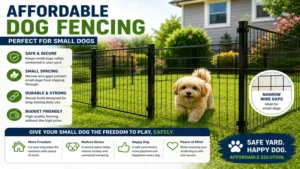
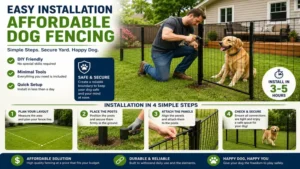
Step-by-Step Practical Usage Guide: Installing a No-Dig Mesh Fence
Putting up a budget-friendly fence doesn’t mean you have to hire a crew. A simple polypropylene or wire mesh fence can be erected in a single afternoon by following these battle-tested steps.
Step 1: Mark Perimeter  ==>  Step 2: Drive T-Posts  ==>  Step 3: Unroll & Tension Mesh  ==>  Step 4: Secure Base
(Use brightly colored string) (Space posts 6-8 ft apart) (Attach tightly with heavy zip ties) (Use heavy landscape staples)
Required Tools & Materials:
-
High-strength mesh roll (e.g., Tenax Pet Fence)
-
Heavy-duty steel T-posts (choose posts 2 feet taller than your target fence height)
-
T-post driver or a heavy sledgehammer
-
Heavy-duty UV-resistant outdoor zip ties (100 lb tensile strength minimum)
-
Metal landscape ground staples (6 to 8-inch length)
-
Wire cutters and a tape measure
Step 1: Lay Out and Mark the Boundary
Walk your intended perimeter and clear away heavy brush, fallen branches, or rocks. Run a brightly colored string tightly between temporary stakes along your planned path. This gives you a perfectly straight reference line to ensure your final fence doesn’t look crooked or uneven.
Step 2: Drive the T-Posts
Place your first T-post at a corner. Using a post driver, drive it at least 18 to 24 inches into the soil. Continue driving posts along your string line, spacing them no more than 6 to 8 feet apart.
💡 Pro-Tip: If you space your posts any further than 8 feet, the mesh will sag in the center over time, allowing your dog to push down the top wire and scramble over.
Step 3: Unroll and Secure the Mesh Barrier
Starting at a corner post, unroll your mesh fabric. Secure the leading edge to the first post using three to four heavy-duty zip ties from top to bottom. Pull the mesh fabric as tight as you possibly can to the next post, and secure it. Repeat this tensioning process along the entire line. Keep the bottom edge of the mesh completely flush with, or slightly overlapping, the ground.
Step 4: Lock Down the Bottom Perimeter
This is where most DIY installers fail. If you leave the bottom of a mesh fence loose, your dog will quickly learn to nudge their nose under it and lift it up. Walk your fence line and drive metal landscape ground staples through the bottom mesh holes directly into the dirt every 18 to 24 inches. This anchors the bottom edge securely, frustrating any digging or squeezing attempts.
The “Anti-Recommendation” Logic: When These Fences Fail
Before you spend a single dollar, it is crucial to recognize where these affordable systems can fail. No single fence is perfect for every canine personality or property layout.
       [ HIGH-ENERGY ATHLETIC LEAPER ]
                      |
        +-------------+-------------+
        |                           |
  (Polypropylene Mesh)       (Wireless Radio Collar)
        |                           |
  [⚠️ FAILS: Dog tears/hops]  [⚠️ FAILS: Prey drive breaks signal]
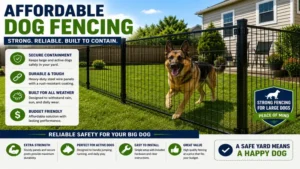
When Polypropylene Mesh Fences Fail
If your dog has high separation anxiety, high prey drive, or a habit of chewing on crates and toys, do not buy plastic mesh fencing. A bored or anxious Siberian Husky or Pit Bull Terrier can slice through a polypropylene barrier with their teeth in under sixty seconds. For these dogs, you must use rigid metal panels or galvanized chain-link.
When Wireless Electric Fences Fail
If you own a highly driven hunting breed (like a Pointer, Setter, or Retriever) or a dog with a massive prey drive, wireless systems can easily fail. When these dogs spot a squirrel or rabbit sprinting past the boundary, their adrenaline spike is often so high that they will gladly take the brief static correction to chase the prey. However, once their adrenaline cools down, they will refuse to cross back into the yard because they want to avoid receiving another shock.
When Short Decorative Steel Panels Fail
If you own a dog that exhibits “barrier reactivity” (excessive barking, lunging, or pacing along the property line), short, open-wire panels will actually make their behavioral issues worse. Because they have a clear line of sight to mail carriers, neighbors, and other dogs, their frustration will build daily. In these specific cases, a solid visual barrier—like a budget-friendly canvas privacy windscreen zipped onto a chain-link frame—is highly recommended to calm their nerves.
How to Choose Affordable Dog Fencing: A Smart Buyer’s Checklist
To avoid buyer’s remorse, walk through this quick five-step decision framework before finalizing your containment purchase:
-
Analyze Your Dog’s Behavior: Is your dog a jumper, a digger, a chewer, or a barker? Match the barrier physics to their primary escape tactic.
-
Calculate Your Perimeter Needs: Measure your yard accurately. If you have over 150 linear feet to cover, modular metal panels will likely exceed your budget; look toward tensioned mesh or wire instead.
-
Evaluate Your Soil Conditions: If your yard sits on hard clay or heavy rock bed, “no-dig” fences with thin steel spikes are much easier to install than traditional posts that require deep digging.
-
Review HOA & Local Zoning Laws: Ensure your local municipality does not outlaw specific fence heights or front-yard metal barriers.
-
Factor in Total Cost of Ownership: Don’t forget to calculate the cost of necessary accessories like zip ties, T-posts, gate latches, or replacement collar batteries when comparing options.
Safety, Zoning, and HOA Compliance Guide
Before you drive a single stake into the ground, you must protect yourself from costly legal and safety headaches.
First, always call 811 (the national “Call Before You Dig” registry) before installing any fence posts, even “no-dig” anchor pipes. Driving a steel stake into an underground natural gas line or high-voltage electric cable is incredibly dangerous and carries massive financial liabilities.
Second, check your local municipal zoning office for “setback” rules. Many cities dictate that a backyard fence cannot sit directly on the property line; it must often be set back 2 to 12 inches inside your boundary. Additionally, front-yard fences are frequently restricted to a maximum height of 3 or 4 feet, while backyard fences are usually capped at 6 feet.
If you belong to a Homeowners Association (HOA), read your Covenants, Conditions, and Restrictions (CC&Rs) document carefully. Many HOAs strictly outlaw chain-link fences or highly visible wire meshes. In these communities, a hidden wireless system or an elegant, low-profile white vinyl picket fence is often your only viable option.
🔍 Ready to Upgrade Your Backyard Setup?
Keeping your energetic pup safe and secure doesn’t have to mean spending thousands on a professional masonry contractor.
Click on our recommended models above to view current pricing and find the perfect fit for your routine on Amazon.
Frequently Asked Questions (FAQ)
❓ What is the cheapest dog fence to build?
✅ The cheapest physical barrier is a DIY tensioned polypropylene mesh fence secured with steel T-posts and ground staples. This setup generally costs between $1.20 and $2.50 per linear foot and can be easily installed over a single weekend…
❓ Can a dog chew through a plastic mesh fence?
✅ Yes, highly determined chewers, teething puppies, or dogs with separation anxiety can easily chew through polypropylene mesh. If your dog is a known chewer, always opt for powder-coated steel or galvanized chain-link options instead…
❓ How deep should a fence be to prevent dogs digging?
✅ To prevent determined diggers from escaping, you should bury your fence barrier or an L-shaped hardware cloth apron at least 6 to 12 inches below the surface of the soil, secured firmly with heavy-duty metal landscape staples…
❓ Are wireless dog fences safe and humane?
✅ Yes, modern wireless fences are highly safe and humane when combined with proper, positive-reinforcement training. The static correction is designed to startle your dog with a safe tickling sensation, rather than cause them physical pain…
❓ How do I stop my dog from jumping over a short fence?
✅ You can install budget-friendly “coyote rollers” along the top rail of your fence, or lean an inexpensive trellis/mesh extension inward at a 45-degree angle to disrupt your dog’s vertical launching path…
Conclusion
Securing your beloved pet does not require a second mortgage or a team of professional contractors. By taking the time to assess your dog’s unique behavioral quirks—whether they are a digger, a high-flying jumper, or a gentle lounger—you can easily select a highly effective, budget-friendly fencing solution that lasts for years. From modular no-dig metal panels to virtually invisible polypropylene yard meshes, the modern pet market offers incredible utility at highly accessible price points. Focus on proper installation, anchor your bottom perimeters tightly, and enjoy the peace of mind that comes with a safe, secure backyard.
Recommended for You
- Chip para perros: 5 Claves y Opciones para Proteger a tu Mascota en 2026
- 5 Best Dog Collars With Airtag Holder Options (2026 Expert Review)
- 5 Best Airtag Holder for Dog Picks: 2026 Expert Field Guide
Disclaimer: This article contains affiliate links. As an Amazon Associate, I earn from qualifying purchases. If you purchase products through these links, we may earn a small commission at no additional cost to you.
✨ Found this helpful? Share it with your friends! 💬🤗